


You're probably doing what most players do. You open your phone, check a casino promo, skim a message that looks official, and think, “I'll sort this in a minute.” That's exactly when phishing lands. Not when you're paranoid, but when you're busy, relaxed, or half-distracted by a “limited-time bonus” that looks close enough to real.
Casino phishing in the Philippines isn't abstract. It shows up as fake bonus offers, spoofed support chats, copied login pages, and messages that lean on names players already trust, including PAGCOR, game providers, and familiar casino brands. One careless tap can hand over your password, OTP, e-wallet details, or full account access.
Table of Contents
- Why Casino Phishing Is a Real Threat
- Recognizing Phishing Tactics in Casino Environments
- Verifying Offers and Platform Communications
- Securing Your Casino Account Against Phishing
- Recovering from a Phishing Attack
- Casino Security Checklist and Final Thoughts
Why Casino Phishing Is a Real Threat
A common setup goes like this. A player sees a message offering a “claim now” slot bonus tied to a trending game provider, maybe dressed up as a JILI promotion. The page looks polished, the colours match a real casino site, and the button sends the player to a login screen that's just fake enough to miss at a glance. Minutes later, their actual account password no longer works.
Another version is nastier because it uses fear instead of greed. You get an email or SMS saying your account is under review, your withdrawal is frozen, or a PAGCOR compliance check requires immediate identity confirmation. The wording is stiff, urgent, and pushy. That's the point. Phishers want panic, because panic kills careful reading.
What these scams look like in practice
Casino phishing usually borrows familiar details, then twists them:
- Fake bonus blasts: “Free bonus” messages that push you to log in through a special link instead of the platform's normal website.
- Spoofed support emails: Messages that copy the tone of customer service and ask for your password, OTP, or payment details.
- Provider impersonation: Promotions that misuse names like JILI, Fa Chai, or Pragmatic Play to look credible.
- Regulatory scare tactics: Notices that mention PAGCOR, account audits, or licence verification to pressure quick action.
A player searching for game offers might even land on pages adjacent to legitimate content like the Mega Panalo casino page, then assume every similar-looking link is safe. That assumption is where attackers win.
Practical rule: If a casino message makes you rush, stop. Real platforms want you verified. Scammers want you hurried.
Why the damage hits hard
This isn't just about losing a password. Once scammers get in, they'll try to change login details, trigger withdrawals, abuse saved payment methods, or use your account to target other people. The emotional hit matters too. Players feel embarrassed, then delay reporting it. That delay gives attackers room to do more damage.
Phishing works because it mimics normal casino behaviour. Promotions are common. Login alerts are common. Verification requests happen. Scammers hide inside what already feels routine. That's why learning phishing scams how to avoid isn't optional for casino players. It's basic account survival.
Recognizing Phishing Tactics in Casino Environments
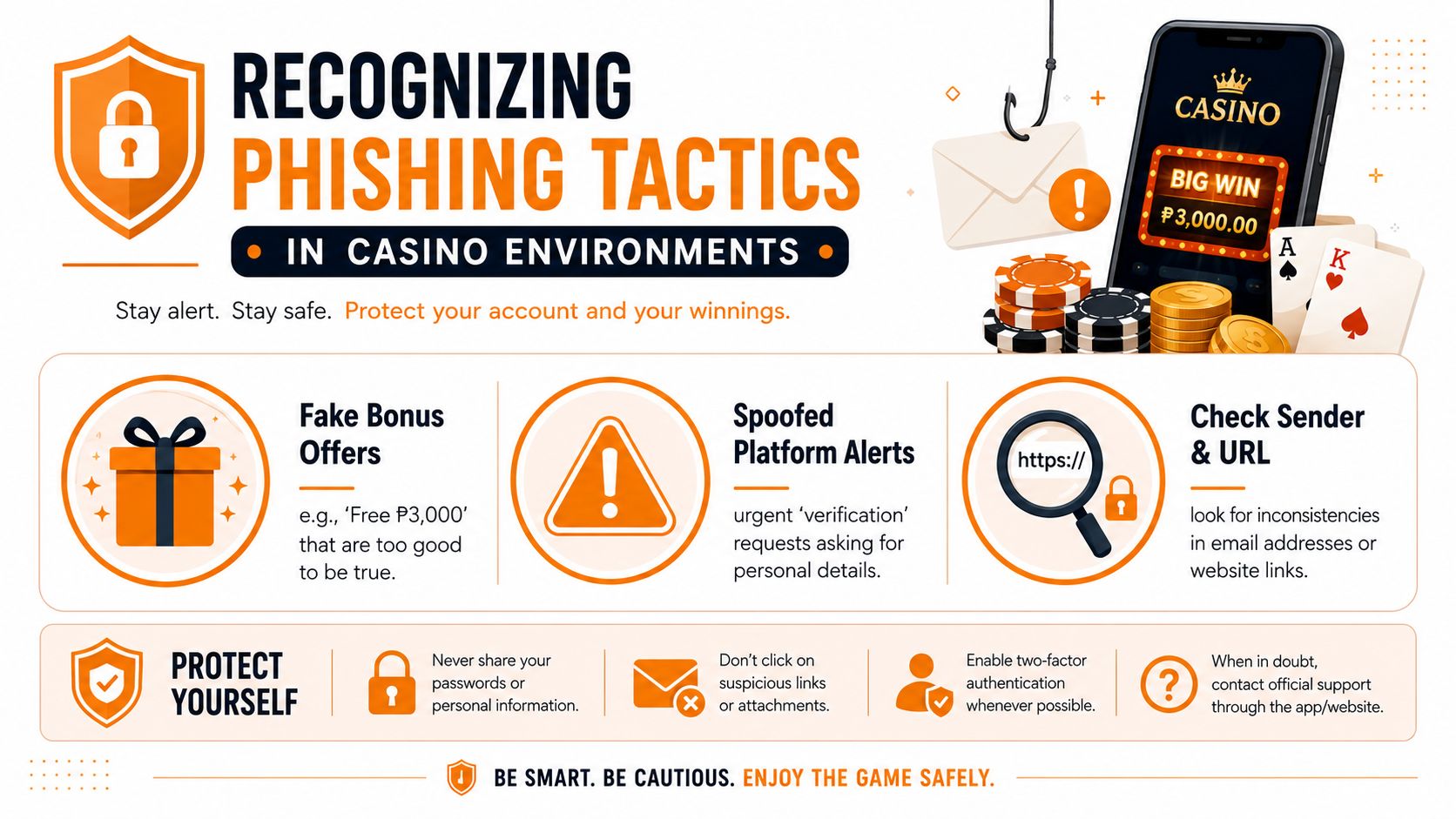
Most casino phishing starts with one of three lures: free money, fake urgency, or brand familiarity. If you train yourself to spot those patterns first, you'll block most scams before they get near your account.
The most common bait
The sloppiest scams promise an eye-catching reward. A message says you've received a welcome deal, cashback, or a special reward such as “Free ₱3,000”, but it arrives through a suspicious route like SMS, Telegram, or a random Facebook message rather than the platform itself. If you want to compare how real bonus messaging is normally presented, look at a page like this free sign-up bonus offer, then notice how phishing copies the style but inserts pressure and shady links.
Other scams impersonate platform security. You'll see wording like:
- “Verify now or your balance will be frozen”
- “Your withdrawal failed. Reconfirm your GCash details”
- “PAGCOR flagged your account for urgent review”
These messages are built to make you obey before you think.
Red flags you should catch immediately
Use this quick comparison when a message lands in your inbox:
| Sign | Likely legitimate | Likely phishing |
|---|---|---|
| Greeting | Uses your account name or clear context | Uses generic greetings like “Dear player” |
| Link behaviour | Points to the expected site | Sends you to a lookalike URL or short link |
| Request | Asks you to log in normally | Asks for OTP, password, or payment details directly |
| Tone | Clear and calm | Threatening, rushed, or oddly dramatic |
| Sender details | Matches the brand's normal communication channel | Slightly altered email or unknown mobile number |
Don't stop at the message body. Check the sender carefully. A fake email often uses a display name that looks right while the actual address is off by a character, a strange suffix, or an unrelated domain.
If the message says “don't share this code with anyone” and the same message asks for that code, you're being conned.
How to inspect a suspicious message
When you suspect a phishing attempt, do this in order:
- Hover before clicking. On desktop, place your cursor over the link and inspect the destination.
- Press and hold on mobile. Don't tap. Preview the link first.
- Read the full sender address. The display name means nothing on its own.
- Look for generic phrasing. Scammers often blast the same script to everyone.
- Ignore countdown pressure. “Expires soon” is one of the oldest tricks in the book.
A lot of phishing scams how to avoid advice sounds repetitive because the basics still work. Slow down, inspect, verify. Players lose accounts when they skip those three steps.
Verifying Offers and Platform Communications
Suspicious messages don't deserve guesswork. They deserve a verification routine. Not a vibe check. A routine.
Start with the official route
If you receive a promo, support message, or compliance notice, don't use the link inside it. Open your browser and manually type the platform's official web address yourself. If the message concerns account setup or wallet steps, compare it against the process shown on the GCash verification guide. That gives you a baseline for what a real workflow looks like.
Then check whether the message matches what appears inside your actual logged-in account. Real promotions and important notices are usually reflected on-platform. A message that exists only in a text thread or random DM should already make you suspicious.
What to verify before you respond
Run through these checks:
- Brand consistency: Does the wording sound like a real operator, or like someone trying too hard to sound official?
- Licence references: If a message mentions PAGCOR, verify that through official channels rather than trusting the message itself.
- Provider names: If a promo claims to come from JILI, Fa Chai, or Pragmatic Play, treat that as branding, not proof.
- Website certificate: On mobile or desktop, inspect whether the site presents a proper secure connection before you enter anything.
- Domain history: A quick WHOIS lookup can reveal whether a site feels established or suspiciously throwaway.
A simple decision filter
Use this three-part test before acting on any casino communication:
| Question | If yes | If no |
|---|---|---|
| Did you reach the site yourself? | Continue checking | Stop and avoid the message link |
| Does the notice appear inside your account too? | More credible | Treat as suspect |
| Are you being asked for an OTP or password directly? | It's almost certainly a scam | Continue with caution |
Field advice: Never verify a casino message inside the same chat, email thread, or SMS where it arrived. Step out of that channel and check independently.
What players often get wrong
They verify only the logo. That's useless. Attackers can copy logos in seconds.
They trust screenshots. Also useless. Screenshots prove nothing.
They assume a polished page must be real. Wrong again. A fake site can look cleaner than a legitimate one. Verification means checking the path, the domain, the secure connection, and the account notice itself. If any one of those is off, back out.
Securing Your Casino Account Against Phishing
Recognition helps. Verification helps. But your account still needs hard protection so one mistake doesn't turn into a full compromise.
Lock down the login
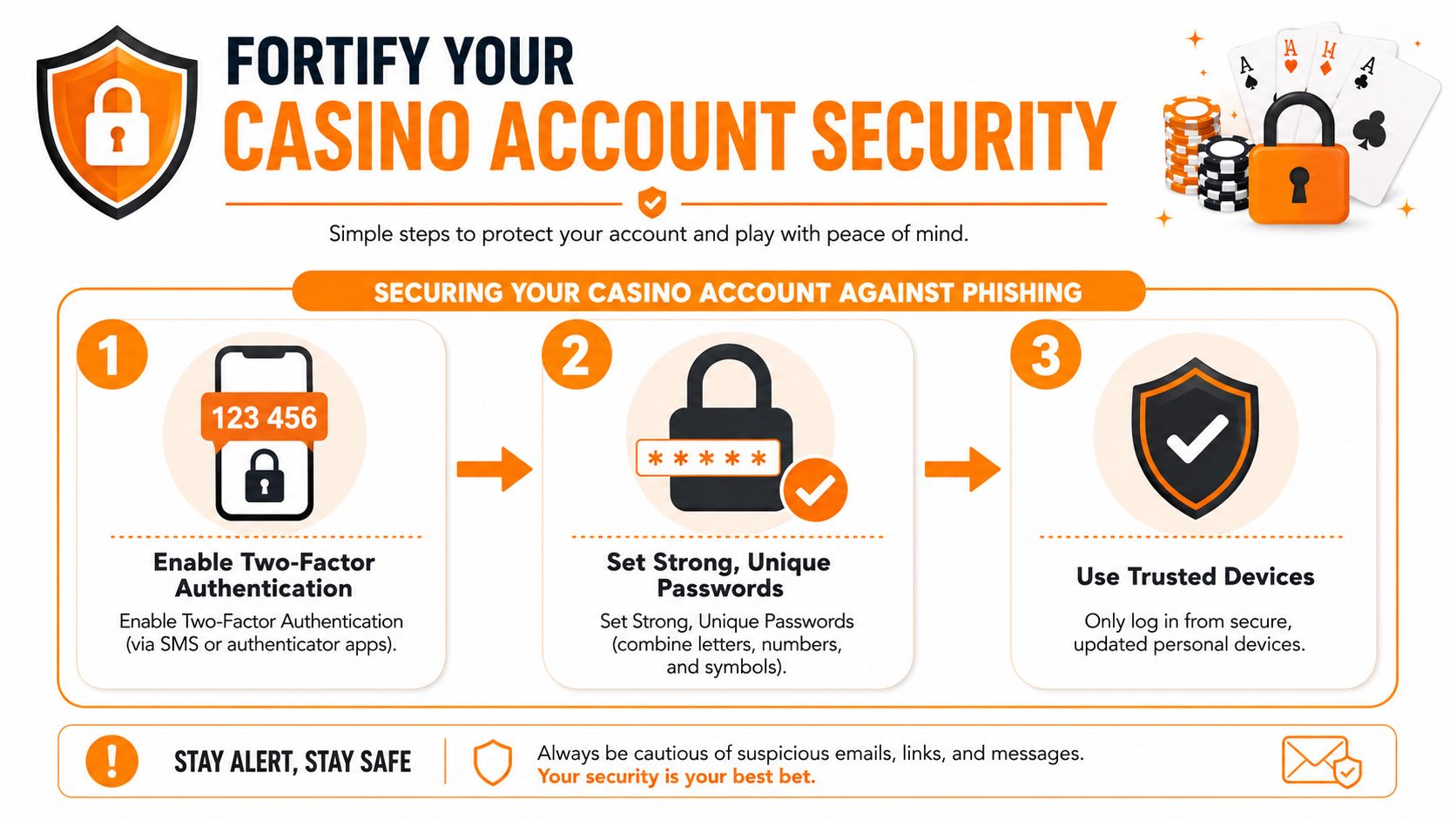
Start with two-factor authentication. If your platform offers SMS codes, use them. If it offers an authenticator app, that's often the stronger choice because it doesn't rely on basic text delivery. Either way, use one. A password alone is thin protection.
Next, fix your password habits. Don't reuse the same password across casino, email, banking, and e-wallet accounts. If one account gets exposed, reused passwords let attackers walk through the rest. Use a password manager and create a unique login for every gambling platform, email inbox, and payment service attached to it.
If you use any gaming app, including one tied to titles like the JILI app, download only from trusted sources and verify the app name, publisher details, and permissions. Fake apps are a favourite phishing route because players lower their guard once something is installed.
Clean up your device habits
Your device can either protect you or betray you. Set it up properly.
- Update your phone and browser: Security patches close holes that phishing kits and malicious scripts exploit.
- Turn on app review habits: If an app asks for access it doesn't need, don't wave it through.
- Block pop-ups where possible: Fake login overlays often ride on aggressive pop-up behaviour.
- Avoid public Wi-Fi for logins and withdrawals: Casino sessions don't belong on unsecured networks.
Tighten the surrounding accounts
Many players secure the casino login and ignore the email account attached to it. That's a mistake. Your email is the reset key to everything. Protect it with a strong password and two-factor authentication too.
Your mobile number matters as well because OTPs, alerts, and recovery steps often depend on it. Treat your SIM account like part of your casino security, not a separate issue.
A secure casino account starts with a secure email account. If your email falls, the casino account often follows.
The minimum setup I recommend
If you want a practical baseline, use this order:
- Change weak or reused passwords first
- Enable two-factor authentication
- Review logged-in devices and active sessions
- Secure your email account
- Check payment methods linked to the account
- Delete old screenshots of OTPs, IDs, or wallet details from your phone
That's the version of phishing scams how to avoid that proves practical in daily life. Not just spotting fakes, but making sure one bad tap doesn't destroy the whole account.
Recovering from a Phishing Attack
If you clicked a fake link, entered credentials on a spoofed page, or shared an OTP, act fast. Don't waste time feeling stupid. Scammers count on that pause.

First moves that matter
Do these immediately:
- Change your password: If you can still access the account, replace it at once.
- Secure your email account next: If the attacker gets your inbox, recovery gets harder.
- Log out other sessions: Use any device-management or session-management option available.
- Check withdrawal and payment settings: Look for changed wallet details, new devices, or altered contact information.
If the phishing message mentioned a withdrawal issue, compare your recent activity against normal withdrawal workflows such as the steps shown on this withdrawal guide. The point isn't to follow that page mechanically. It's to spot anything in your account that no longer matches a legitimate process.
What to save before the trail goes cold
Preserve evidence before deleting anything:
- Screenshots of the message
- The sender address or mobile number
- The phishing page URL
- Login alerts or suspicious activity notices
- Records of changed account details or unauthorised transactions
The value of a clean timeline is clear: support teams and authorities can do more with it than with a vague complaint.
Reporting in the Philippines
Once you've stabilised the account, report the incident through the proper channels. Start with the platform's official customer support using only contact details from the legitimate website. Then escalate if needed.
A sensible Philippine reporting path includes:
- The casino platform's official support team
- PAGCOR channels for gambling-related concerns
- The Philippine National Police Anti-Cybercrime Group or relevant cybercrime reporting desk
- Your e-wallet or bank if payment credentials were exposed
Report the attack even if you think “nothing happened”. Attackers often test access quietly before making a bigger move.
What not to do after an attack
Don't keep chatting with the scammer. Don't click a “recovery” link from the same message thread. Don't post your issue publicly with screenshots that expose your personal details, account ID, email, or partial wallet information.
Also, don't assume changing one password solves everything. If you reused that password anywhere else, those accounts are exposed too. Check your email, payment apps, and any other service tied to the same login pattern.
Recovering well is about speed and order. Secure access, preserve evidence, report properly, then review every connected account.
Casino Security Checklist and Final Thoughts
The best defence is a repeatable habit. Not luck, not instinct, and definitely not confidence in your ability to “spot scams easily”. Phishing catches overconfident people all the time.
Your quick checklist
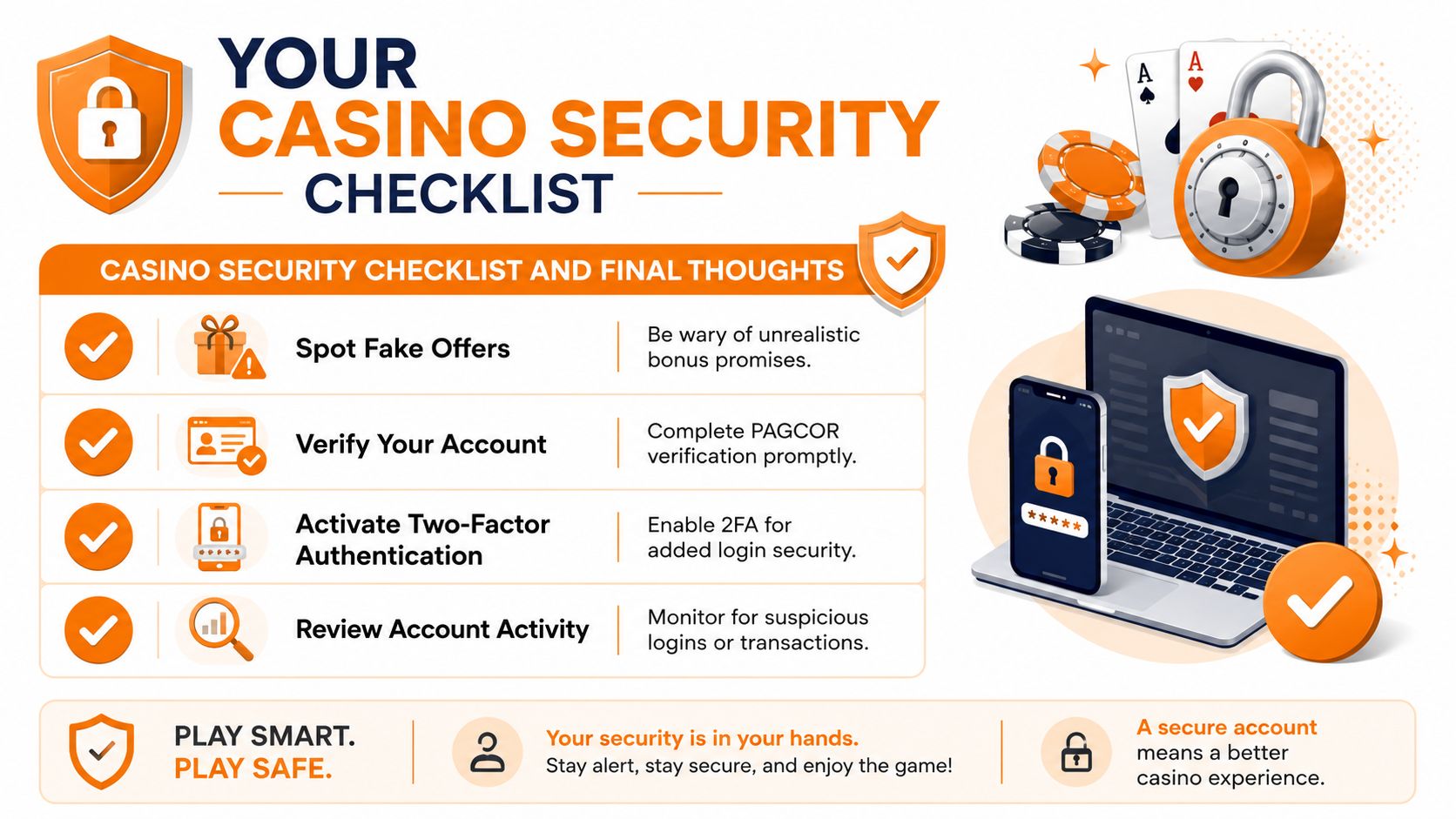
- Question every bonus link: If a promo arrives through a strange channel, assume it's unsafe until proven otherwise.
- Use the official site manually: Don't log in through links sent by SMS, email, or DMs.
- Treat OTPs as private: No real support agent needs you to hand them over.
- Enable two-factor authentication: Make account takeover harder.
- Secure your email first: It controls resets and recovery.
- Review account activity regularly: Look for unfamiliar logins, changed details, and unexpected payment edits.
- Report fast in the Philippines: Contact the platform, then escalate to PAGCOR or cybercrime authorities when needed.
- Share the warning: If your friends play online, tell them what fake bonus and spoofed support messages look like.
Casino players in the Philippines don't need panic. They need discipline. Slow clicks, direct verification, strong login protection, and fast reporting beat most phishing attempts before they turn into losses.
If you remember one thing, remember this: a real casino wants secure access. A scammer wants rushed action.
If you want a safer place to play, stick to a regulated platform with clear account processes and official channels. Visit Insta Play Online Casino to explore a PAGCOR-licensed option built for Filipino players who care about security, convenience, and trusted gaming access.