
You've probably seen the pattern already. A new casino brand appears in your feed, a friend drops a link in chat, or you spot a search result for 747 Games PH and wonder whether it's worth trying. The lobby may look polished, the games may seem familiar, and the promos may sound attractive. But for a Filipino player, the first question isn't which slot is trending. It's whether the site is legal, traceable, and safe to trust with your money and documents.
That's where most reviews get the priority wrong. They start with bonuses, game count, and flashy graphics. I look at the opposite end first: licence claims, payment handling, withdrawal risk, complaint paths, and whether the operator's identity is even clear enough to verify. In the case of 747 Games PH, that matters even more because the query itself isn't identifiable from the available evidence as a specific Philippine entity, event, or dataset, which means unsupported certainty would be irresponsible (reference on the lack of identifiable evidence).
Table of Contents
- What Is 747 Games PH and Should You Trust It
- Investigating the License and Safety of 747 Games PH
- Exploring the Games and Providers on 747 Games
- How to Sign Up and Start Playing
- Managing Your Money Bonuses and Payouts
- How 747 Games PH Compares to Insta Play
- Final Verdict and Player FAQs
What Is 747 Games PH and Should You Trust It
When players search for 747 Games PH, they usually assume they're dealing with a clearly defined local brand. That assumption is risky. The available evidence does not clearly identify the query as a specific Philippine entity or dataset, so any confident claim about its scale, market position, or operating history would be unsupported.
Why the identity problem matters
A vague brand identity creates practical problems fast. If a site delays your withdrawal, asks for extra documents, or changes terms after you've deposited, your next move depends on whether you can verify who runs it and under which rules. If the operator sits behind unclear branding, recovery becomes harder.
That's why trust in online gaming starts with traceability, not appearance. A polished site tells you very little by itself.
Practical rule: If you can't clearly identify the operator, you shouldn't treat the platform as low risk.
What a Filipino player should verify first
Before looking at games, check these basics:
- Operator identity: Is there a named company, a licence statement, and a terms page that identifies who runs the site?
- Jurisdiction: Does the site say it serves Philippine players under local rules, or does it rely on offshore language that leaves room for dispute?
- Support trail: Is there a credible complaint path beyond live chat?
- Document handling: Does the platform explain why it collects ID, and when?
A lot of new players make the same mistake. They treat “working login, playable slots, and visible promos” as proof of legitimacy. It isn't. Those are front-end features. The actual test comes later, when you ask to cash out or when the operator flags your account for review.
747 Games PH may attract attention because the name sounds established, but a familiar-sounding name isn't the same as a verifiable operating footprint. If a brand can't pass the identity check cleanly, every other selling point becomes secondary.
Investigating the License and Safety of 747 Games PH
Licensing is where the review either becomes useful or turns into marketing fluff. For Philippine players, the important question is simple: what legal and complaint framework protects you if something goes wrong?
Why the identity problem matters
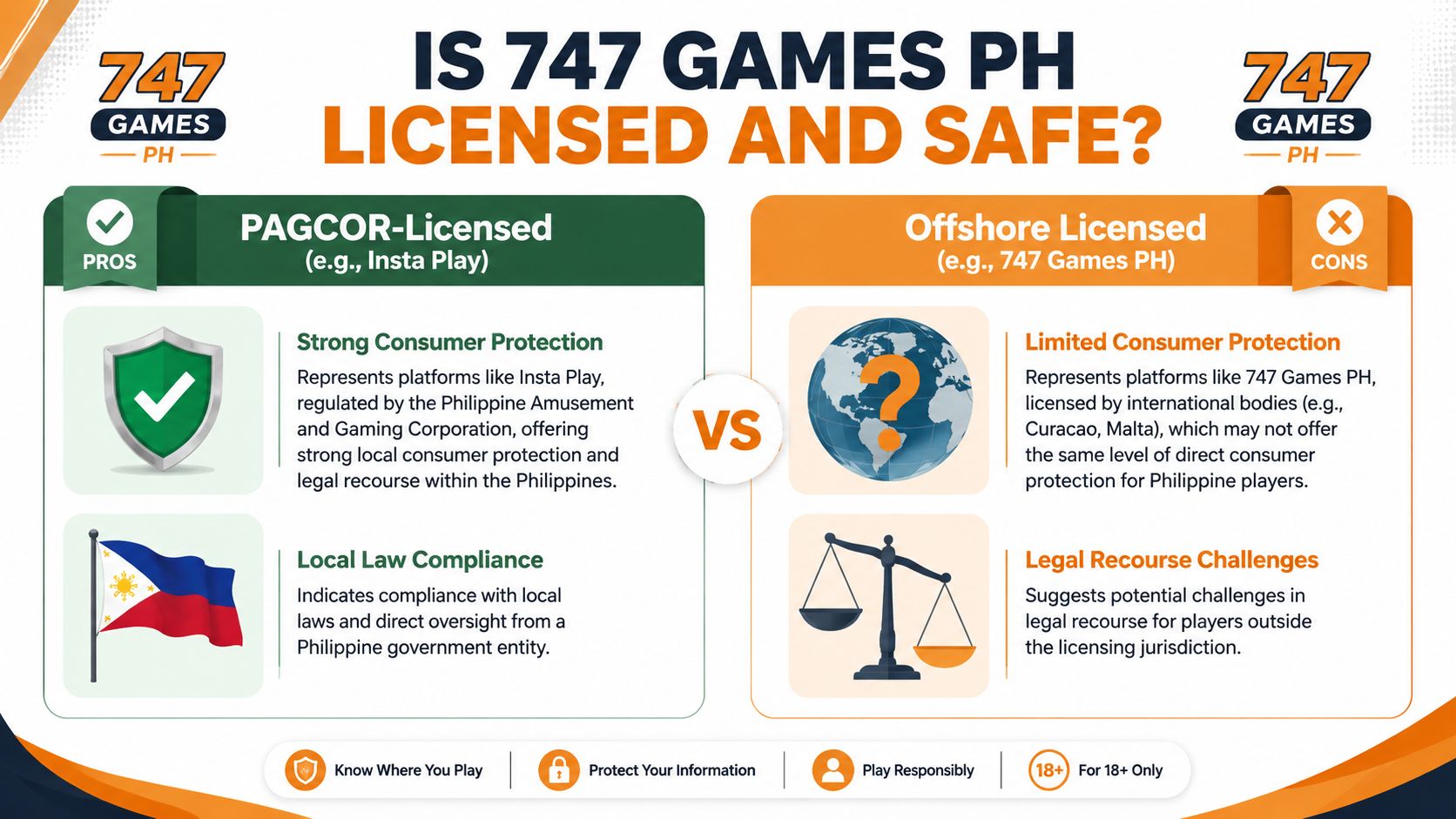
A local player often sees two broad patterns. One is a platform operating within Philippine regulatory expectations. The other is a site that appears accessible from the Philippines but is harder to place under a local consumer-protection structure. That difference affects dispute handling, document checks, and your recourse if the site stalls a payout.
One of the most useful framing points for PH users is this: the unanswered question is usually “How do I confirm this site is legal, and what can I do if withdrawals are delayed?” rather than “What games does it have?”, especially because Philippine regulators have been tightening enforcement around illegal gambling operators (discussion of legality and delayed-withdrawal concerns).
What a Filipino player should verify first
Use a basic verification checklist before depositing:
- Read the footer and terms page. Look for a licence claim, corporate name, and governing jurisdiction.
- Check whether the claim is verifiable. A badge image alone doesn't mean much. The claim should be specific enough to confirm.
- Assess PH-facing compliance. If a site targets Filipino users, ask how it handles eligibility, KYC, and restricted access.
- Test support before funding. Ask one direct question about withdrawals or verification. Weak support before deposit usually gets worse after deposit.
A practical benchmark is a locally regulated option such as Mega Panalo Casino on Insta Play, where the regulatory frame is part of the user decision, not an afterthought buried in the footer.
If a casino review spends more time on bonus banners than on licence verification, it's probably serving the operator more than the player.
There's another reason this matters in the Philippines. A PAGCOR-regulated operating model affects product design itself. In the PH market, offshore operators are prohibited from serving Philippine residents, while domestic e-gaming and e-bingo models must operate under Philippine regulation. That means a locally compliant funnel has to enforce geo-eligibility, KYC, and responsible-gaming controls before bankroll access. Players often see that as friction. In reality, it's also a compliance barrier against restricted play, fraud, and AML exposure.
That's the key trade-off. The site that asks harder questions up front may be the one reducing the chance of bigger problems later.
Exploring the Games and Providers on 747 Games
Once the safety check is done, the next question is product quality. Many players, however, often relax prematurely regarding this. A strong-looking lobby can make a platform feel safer than it is. It shouldn't.

What you're likely to see in the lobby
Platforms using the 747 Games PH style usually try to cover the categories Filipino players already know:
- Online slots: Fast sessions, simple interfaces, and heavy promo visibility.
- Live casino tables: Baccarat, roulette, and dealer-led formats for players who want a more social rhythm.
- Fishing and arcade-style games: Common on Asian-facing platforms because they appeal to mobile users and casual play patterns.
- Card and table variants: Often mixed into the same wallet flow for convenience.
You may also see provider names that players recognise from the PH market, including JILI, Fa Chai, and Pragmatic Play. The presence of known studios can be useful, but only in a limited way. It may suggest a familiar content mix and a more standardised game presentation. It does not automatically tell you how the operator handles withdrawals, disputes, or account reviews.
For players who want to compare how a known slot title is presented on another platform, Duo Fu Duo Cai is one example of the kind of game page structure worth comparing.
How to judge a game catalogue properly
Don't ask only whether the games look good. Ask whether the operator presents them responsibly.
A sensible review of the catalogue should include:
- Provider consistency: Are studio names shown clearly, or are games listed in a vague way that makes sourcing hard to confirm?
- Wallet clarity: Does one balance cover everything, or do transfers between sections create confusion?
- Rule access: Can you find paytable details, game rules, and bonus conditions easily on mobile?
- Session stability: Does the game launch cleanly and return to the lobby without odd redirects?
A good game library on a weak operator is still a weak player proposition.
That's the practical lens. If the site has attractive slots and live tables but can't answer the licence question properly, treat the entertainment value as separate from the trust question. New players often merge those two ideas. Experienced players keep them apart.
How to Sign Up and Start Playing
Registration is where a site starts collecting two things at once: your money and your identity. That's why the sign-up process deserves more attention than most players give it.
Registration checks before you submit anything
A typical casino registration flow is straightforward. You enter mobile or email details, create login credentials, confirm a password, and accept the site's terms. The risky part isn't the form itself. It's what happens if you submit information before reading the terms on account verification, duplicate accounts, restricted territories, and withdrawal review.
Use a quick pre-sign-up check:
- Read the withdrawal section first: If the cash-out rules are hard to find, that's already a warning sign.
- Check the privacy language: A legitimate operator should explain document use, not just request uploads.
- Avoid rushed bonus opt-ins: Some welcome offers lock you into conditions from the start.
- Use unique login details: Never recycle a password you use for banking or e-wallets.
If you're comparing registration patterns on a beginner-facing gaming offer, free sign-up bonus details on Insta Play show the kind of promo page that should still sit alongside clear onboarding terms.
Why KYC isn't optional
KYC, or Know Your Customer, is where many players get annoyed because it slows the fun part. But on any compliant platform, KYC exists for a reason. It helps the operator confirm identity, prevent fraud, reduce account abuse, and stop withdrawals from going to the wrong person.
A proper KYC flow usually asks for identity information that matches the payment profile. Problems tend to appear when players enter a nickname instead of a legal name, use someone else's e-wallet, or ignore the terms until the first withdrawal request.
Submit clean details from the start. Most account trouble begins with mismatched names, reused accounts, or payment methods that don't belong to the player.
That's one of the simplest habits that reduces withdrawal friction later.
Managing Your Money Bonuses and Payouts
The payment side is where a casino either earns trust or loses it. Filipino players often discover and use sites on mobile, so deposit speed gets a lot of attention. Withdrawal mechanics deserve more.
How payment reality works for PH players
The Philippines has one of Southeast Asia's most active mobile internet environments, and that matters because discovery, registration, and funding often happen on smartphones. It also creates a major information gap around verification delays, cash-out thresholds, and transaction limits that affect Filipino players in practice (discussion of mobile-first onboarding and PH payment friction).
That mobile-first pattern changes how money risk shows up:
- E-wallet convenience: Fast to fund, but players sometimes assume fast deposit means fast withdrawal. It doesn't.
- Small-screen terms: Bonus rules and payout conditions are easier to miss on mobile.
- Document uploads: Poor camera quality or cropped IDs can trigger re-submission loops.
- Account matching: A wallet name mismatch can become a withdrawal issue later, even if deposit worked instantly.
If you're trying to understand the user side of local withdrawal expectations, Arena Plus withdrawal guidance is a useful comparison point for the kind of payout-focused content players need.
Bonus terms that change the real value
Bonuses are rarely free in the plain-language sense players imagine. What matters is the condition attached to the bonus, not the headline offer.
Look for these terms before accepting anything:
| Term | What it usually means for you |
|---|---|
| Wagering requirement | You may need to keep playing before bonus-linked winnings can be withdrawn |
| Turnover | The site may count only certain bets or games towards release conditions |
| Game contribution | Some games may contribute differently, or not at all, to bonus completion |
| Max withdrawal rule | A promotion can limit how much of the resulting balance is cashable |
| Expiry period | A bonus may vanish if not used within the stated time |
A disciplined approach works better than chasing every promo. Deposit only after you know whether the bonus helps your play style or traps your balance in conditions you didn't intend to accept.
Money rule: Judge a casino by how clearly it explains withdrawals, not how loudly it advertises deposits.
How 747 Games PH Compares to Insta Play
A side-by-side comparison makes the trade-offs clearer than any promo page can. The key issue isn't whether both platforms can display similar game categories. It's whether a Filipino player gets the same level of local accountability.
The practical difference between offshore and local compliance
For PH users, 747PH-style platforms are typically constrained by a PAGCOR-regulated operating model, because offshore operators are prohibited from serving Philippine residents, while a locally compliant casino must enforce geo-eligibility and KYC before access. That has a direct effect on product risk and payment design.
In plain terms, a PH-compliant platform builds friction into the journey for a reason. It has to filter who can play and how funds move. An offshore-style experience may feel lighter at the start, but that lightness can also mean weaker recourse if disputes appear.
One local benchmark in the same category is Insta Play Online Casino, which presents itself as a PAGCOR-licensed option for Philippine players. That doesn't remove the need for players to read terms carefully, but it does place the platform inside a local compliance frame that matters when the issue shifts from gameplay to recourse.
Platform Comparison 747 Games PH vs. Insta Play
| Feature | 747 Games PH (Typical Offshore) | Insta Play (PAGCOR-Licensed) |
|---|---|---|
| Regulatory clarity | May be harder to verify cleanly from a PH player's perspective | States a local regulatory positioning |
| PH player eligibility | Can raise questions if the operator sits outside the local model | Built around Philippine compliance expectations |
| KYC approach | May feel lighter at first, but standards can be less transparent | KYC is part of the expected compliance path |
| Withdrawal recourse | Complaint handling may be less direct for PH users | Local-regulation framing can offer clearer accountability paths |
| Promo transparency | Varies heavily by operator | Easier to benchmark against local standards and disclosures |
| Player fit | Better only if you accept higher verification and recourse uncertainty | Better for players who prioritise documented compliance |
The main lesson is simple. If your priority is short-term convenience, an offshore-style platform can look tempting. If your priority is proof, accountability, and a cleaner legal footing inside the Philippines, local regulation carries more weight than lobby design.
Final Verdict and Player FAQs
My view on 747 Games PH is cautious. Not because every unfamiliar platform is automatically unsafe, but because the most important trust signals around this query aren't clear enough to justify easy confidence. When a site's identity, licensing path, or PH-facing compliance isn't straightforward, a player should assume added risk until proven otherwise.
That's the right order of judgment. Check legality first. Check payment handling second. Only then look at games and promos. If a platform can't satisfy the first two, the rest doesn't matter much.
Quick answers for cautious players
Is 747 Games PH definitely legal for Filipino players?
I wouldn't state that confidently based on the available evidence. The safer move is to verify the operator, licence claim, and PH-facing terms before depositing.
What should I do if a withdrawal is delayed?
Start by reviewing the withdrawal terms, KYC status, and payment-name match. Then contact support in writing and keep records of the timeline, documents submitted, and responses received.
What red flags matter most in casino terms?
Watch for vague licence wording, unclear company identity, broad rights to suspend winnings, and bonus conditions that are hard to locate before deposit.
Are strong game providers enough to trust a site?
No. Provider logos can suggest a familiar content mix, but they don't answer who holds your funds or how disputes are handled.
Should a legit site ask for ID?
Yes. On a compliant platform, KYC is part of fraud control and account security. The concern isn't whether ID is requested. The concern is whether the operator explains and handles that request properly.
Players in the Philippines don't need another review that treats safety as a footnote. They need a habit: verify first, deposit second, and never confuse an attractive lobby with a trustworthy operator.
If you'd rather play on a platform that presents itself within a Philippine compliance framework, Insta Play Online Casino is one option to review alongside any offshore-style brand. Compare the licence disclosure, KYC process, withdrawal terms, and support visibility before making your choice.