

Does a gambling licence make an online betting business legal wherever its website can be opened? Not necessarily. The answer turns on the customer's location, the product offered, the entity providing it and the permissions attached to that activity.
Gambling laws are a set of checkable obligations, not a single legal or illegal label. For operators, suppliers, affiliates and investors, a useful assessment starts with the governing jurisdiction and ends with evidence that the business can meet its licensing, consumer protection, technical and financial duties. Formal authorisation and effective enforcement must also be assessed separately.
Table of Contents
- Gambling Laws by Jurisdiction at a Glance
- Core Legal Definitions Explained
- Who Licenses Gambling in Britain and Which Licence Applies
- Player Protection Duties Under UK Rules
- Technical Standards and Audit Evidence Regulators Expect
- Levies, Premises Rules and Supplier Costs
- Prohibition, Enforcement and Offshore Gambling
- Confirm Your Obligations Before You Launch
Gambling Laws by Jurisdiction at a Glance
Primary gambling law, regulator and online model by jurisdiction
| Jurisdiction | Primary law | Regulator | Online market model |
|---|---|---|---|
| United Kingdom | Gambling Act 2005 framework for Great Britain | Gambling Commission, with local authorities for premises | Licensed remote gambling for British consumers; Northern Ireland requires separate assessment |
| United States | Federal Wire Act 1961 and UIGEA 2006, plus state laws | State gaming regulators | Set state by state; sports betting legal in most states, online casino in a smaller group |
| Australia | Interactive Gambling Act 2001 | ACMA at federal level, with state and territory regulators | Offering online casino games to Australian customers is prohibited; licensed wagering is permitted subject to product restrictions |
| Germany | State Treaty on Gambling 2021 | Gemeinsame Gluecksspielbehoerde der Laender (GGL), with state authorities for certain casino permissions | Licensed online sports betting, virtual slots and poker; online table-game authorisation follows separate state arrangements |
| Sweden | Gambling Act 2018 | Spelinspektionen | Licensed market since 2019 |
| Netherlands | Betting and Gaming Act, as amended by the Remote Gambling Act, Wet kansspelen op afstand | Kansspelautoriteit | Licensed remote gambling market since October 2021 |
| France | Law No. 2010-476 and the broader gambling framework | Autorité nationale des jeux (ANJ) | Licensed online sports betting, horse-race betting and poker; online casino games aren't part of the licensed model |
The table identifies the starting authority and product model, not an approval to operate. In particular, France shouldn't be classified as a licensed online casino jurisdiction, and Germany's permissions shouldn't be treated as a single unrestricted online casino licence.
Product permission matters more than a market label
The same activity can be authorised in one jurisdiction and prohibited in another because lawmakers distinguish between betting, poker, casino games and other products. A country may permit regulated wagering without opening an online casino market, so a sportsbook licence doesn't establish permission to launch slots or live-dealer tables.
For a cross-border business, the decisive comparison is therefore product plus territory plus licence scope. A licence held by a related company, or permission covering a different product, shouldn't be entered into a market-access assessment as interchangeable authorisation.
The British framework also needs geographical precision. The Gambling Commission's market is Great Britain, rather than an undifferentiated United Kingdom licensing territory. Businesses should avoid using a UK-wide label where their legal assessment concerns England, Wales and Scotland.
Lookup rule: A market comparison should identify the exact product being sold before describing a jurisdiction as open or closed.
Market-specific reading can help organise the next inquiry. A guide to online casino legality in the Philippines is useful for a separate Philippine assessment, but it doesn't establish permission in any jurisdiction listed above.
This comparison is a navigation aid, not legal advice. The definitions of gambling, remote participation, facilities and licensed activities often determine whether the apparent answer survives a review of the actual business model.
Core Legal Definitions Explained
A business description isn't a legal classification. A company calling itself a technology provider may still need a regulatory assessment of the facilities it supplies, while a business describing itself as a broker may perform a different role from the operator accepting liability for a bet.
Key gambling law terms, legal meaning and practical example
| Term | Legal meaning | Practical example |
|---|---|---|
| Gambling | Broad working description of staking money or something of value on an uncertain outcome; statutory categories control | A hypothetical football wager whose return depends on the match result |
| Remote gambling | Gambling through electronic channels without physical presence at the venue | An online slot played from home |
| Facility | Means or arrangements enabling a person to gamble, subject to the governing statutory wording | Hosting a casino game platform used by British players |
| Operating licence | Authorisation for specified gambling facilities or services | A remote casino operating licence from the Gambling Commission |
| Premises licence | Local permission for gambling activity at a physical venue | A betting shop premises licence issued by an English licensing authority |
| Identity verification | Establishing and checking the customer's identity before permitted gambling | An onboarding process completed before play |
| Stake limit | A ceiling on the amount committed during the specified unit of play | An age-sensitive cap enforced for an online-slots game cycle |
| Cease-and-desist request | A regulator's formal demand that an unlicensed operator stop the relevant activity | A demand addressed to an unlicensed site serving British customers |
| Leviable amount | The statutory calculation base used to determine a levy liability | A software licence holder calculating the amount to which its applicable levy rate applies |
Definitions change the compliance decision
Gambling is a useful everyday umbrella, but it shouldn't replace the statute's treatment of betting, gaming or other regulated categories. A product team should record its classification and the features supporting that conclusion, rather than rely on the product's marketing name.
Remote describes participation through communications technology, not merely the location of a company's headquarters. Telephone and other electronic participation can therefore matter alongside websites and mobile applications.
The term facility requires particular care. A technical service can enable gambling without its supplier owning the consumer-facing brand, but that doesn't make every hosting or support service equivalent to operating a casino. The service's actual functions need examination.
Permissions and calculations aren't interchangeable
An operating licence concerns the authorised business activity; a premises licence concerns the venue. Holding one doesn't answer every question raised by the other.
A gambling software operating licence addresses software activity. A remote betting intermediary licence addresses bringing betting parties together rather than merely supplying a game or accepting a bet as principal. A platform supplier's contract should describe which of those functions it in fact performs.
Likewise, a stake ceiling isn't an account deposit limit, and a levy calculation base isn't automatically the amount shown under a similarly named accounting heading. Finance and product teams should use the definition specified for the relevant obligation.
These are working explanations, not substitutes for statutory text. Before relying on a classification, counsel should check the exact wording on legislation.gov.uk, including applicable amendments, exclusions and commencement provisions.
Who Licenses Gambling in Britain and Which Licence Applies
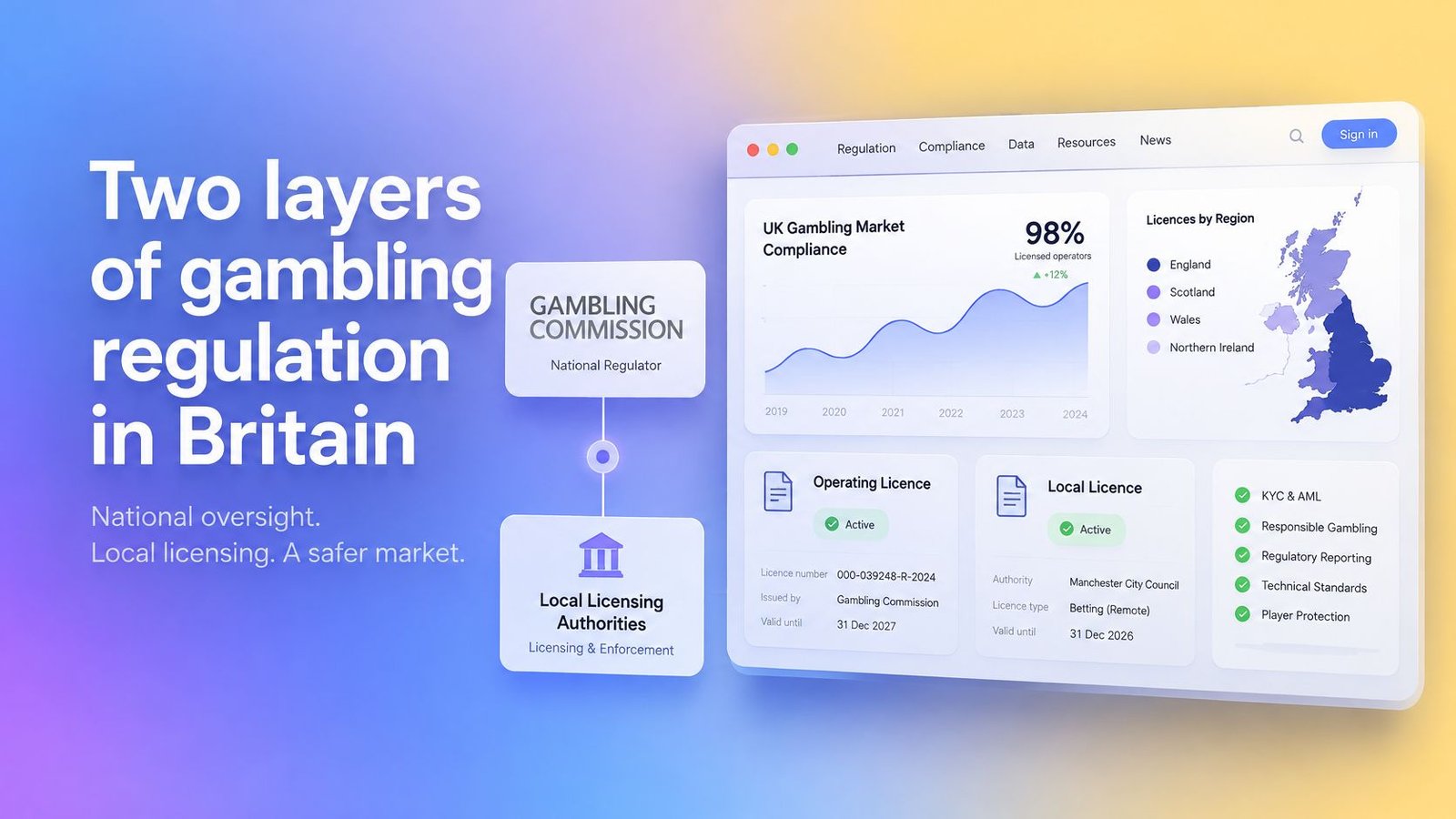
Britain has national operating regulation and local premises oversight. The Gambling Commission handles operating authorisation, remote market access and enforcement, while local licensing authorities deal with premises and specified permits and notifications.
The regulatory objectives are substantive: preventing crime and disorder, ensuring gambling is fair and open, and protecting children and vulnerable people. The framework also recognises remote participation through internet, telephone, television and other electronic channels.
National and local permissions serve different purposes
The scale of local administration is material: the Gambling Commission's licensing-authority statistics recorded returns from 329 of Great Britain's 350 local authorities, approximately 94.0%, for 2024–2025; separately dated figures show 51,541 active permits or notifications as of March 2019 and 5,098 inspections or visits during that reporting period.
Those older totals shouldn't be presented as a current premises count. They demonstrate the breadth of local oversight across alcohol-licensed premises, clubs and unlicensed family-entertainment centres, rather than the size of the online operator market.
For an acquisition, that distinction changes the due-diligence file. An investor should examine the operating entity's permissions separately from each venue's licensing position, and shouldn't assume either permission transfers automatically with a commercial transaction.
Licence types by activity and issuing authority
| Licence | Issued by | Authorises | Typical holder |
|---|---|---|---|
| Remote operating licence, Great Britain | Gambling Commission | The specified remote casino, betting or other gambling activity offered to British consumers | Online casino or sportsbook |
| Premises licence, England and Wales | Local licensing authority | Gambling activity at the specified betting shop, casino or arcade premises | Land-based operator |
| Gambling software operating licence, Great Britain | Gambling Commission | Licensed gambling software activity | Game studio or platform supplier |
| Remote betting intermediary licence, Great Britain | Gambling Commission | Bringing betting parties together without acting as the betting principal; trading-room-only activity requires separate classification | Betting exchange or broker |
| Online sports betting licence, Germany | GGL | Authorised online sports betting for the German market | Licensed sportsbook |
| Online casino licence, Sweden | Spelinspektionen | Authorised online casino gaming for the Swedish market | Licensed online casino |
| State online gambling licence, United States | Relevant state gaming regulator | The wagering product and territorial scope authorised by that state | State-licensed operator |
The table maps commercial roles to likely permission categories. It doesn't establish that every service sold by a platform company falls within the same category, or that every product offered under a casino brand is covered by one authorisation.
Offshore infrastructure doesn't replace British authorisation
The Gambling Commission's guidance to licensing authorities explains the licensed betting framework and the requirement for appropriate Commission authorisation when remote gambling is offered or advertised to consumers in Great Britain, including where key equipment is overseas.
Foreign incorporation therefore isn't a market-access solution. An operator may need to evaluate its British customer acquisition, website offering and contractual arrangements even when its servers and management sit abroad.
For suppliers, a separate jurisdictional process can look quite different. The PAGCOR B2B provider application process offers a comparison for Philippine-facing supplier planning, not a substitute for a British software-licensing assessment.
A licence should be matched to the legal entity, the regulated function and the destination market, not merely to the brand displayed on a website.
A practical assessment closes with a role test:
- Who accepts the bet? Identify the entity contracting with the customer and carrying the relevant betting liability.
- Who provides the facility? Identify the company operating the platform or supplying the regulated functionality.
- Who advertises to the market? Examine the operator's own marketing and the arrangements used by affiliates and partners.
The answers should be documented before commercial responsibility is allocated across the group.
Player Protection Duties Under UK Rules
Customer protection begins in onboarding, before the gambling session. Product, compliance and customer-support teams should agree what constitutes a completed verification state and how the platform prevents an unresolved account from reaching restricted functionality.
Build verification before payment and play
The Gambling Commission's customer identity verification condition requires operators to obtain and verify the customer's name, address and date of birth before gambling is permitted, take reasonable steps to maintain accurate records, and avoid using withdrawals to request information they could reasonably have sought earlier, while preserving legally required enhanced checks.
A practical implementation uses a shared verification status across registration, the cashier, bonus services and the wagering engine. If those components maintain inconsistent statuses, a blocked customer may still reach a function through a different route.
The implementation file should include:
- State rules: Define pending, verified, failed and review-required outcomes, with an owner for each unresolved case.
- Access controls: Prevent deposits, wagering and bonus use until the applicable verification workflow is complete.
- Exception handling: Record why manual intervention occurred, who approved it and what evidence supported the decision.
- Record quality: Monitor incomplete or conflicting identity information and route it for correction.
These are operational controls, not reasons to collect documents indiscriminately. The design should distinguish routine verification from enhanced checks and explain when an escalation is justified.
Before deposit, customers should be told which identity information or documents may be needed and how they can submit them. Customer-support scripts should use the same requirements as the product interface, so an escalation doesn't introduce an unexplained new process.
Enforce slot limits inside the wagering engine
The Gambling Act operating licence amendment regulations cap an individual's total stake during a single online-slots game cycle at £2 for players under 25 and £5 for players aged 25 or older, attach the condition to every remote casino operating licence including existing licences, and provide a six-week transitional period after commencement.
The transition is an implementation window, not a permanent exemption. A compliance register should capture the applicable commencement provision and the resulting deadline rather than assume the instrument's publication date starts every obligation.
The engineering consequence is precise: verified age information must reach the service authorising the qualifying stake. A general deposit ceiling can't enforce a game-cycle rule because the customer may divide an account balance across many separate rounds.
Release testing should cover a rejected over-limit stake, an allowed stake, missing age information and changes to the customer's applicable age category. The operator should retain the test results alongside configuration approvals and confirm that a supplier update can't overwrite the control.
Technical Standards and Audit Evidence Regulators Expect
A compliance statement says what a platform is intended to do. An audit file should show what the deployed platform did, which release was tested and whether the evidence can be reproduced.
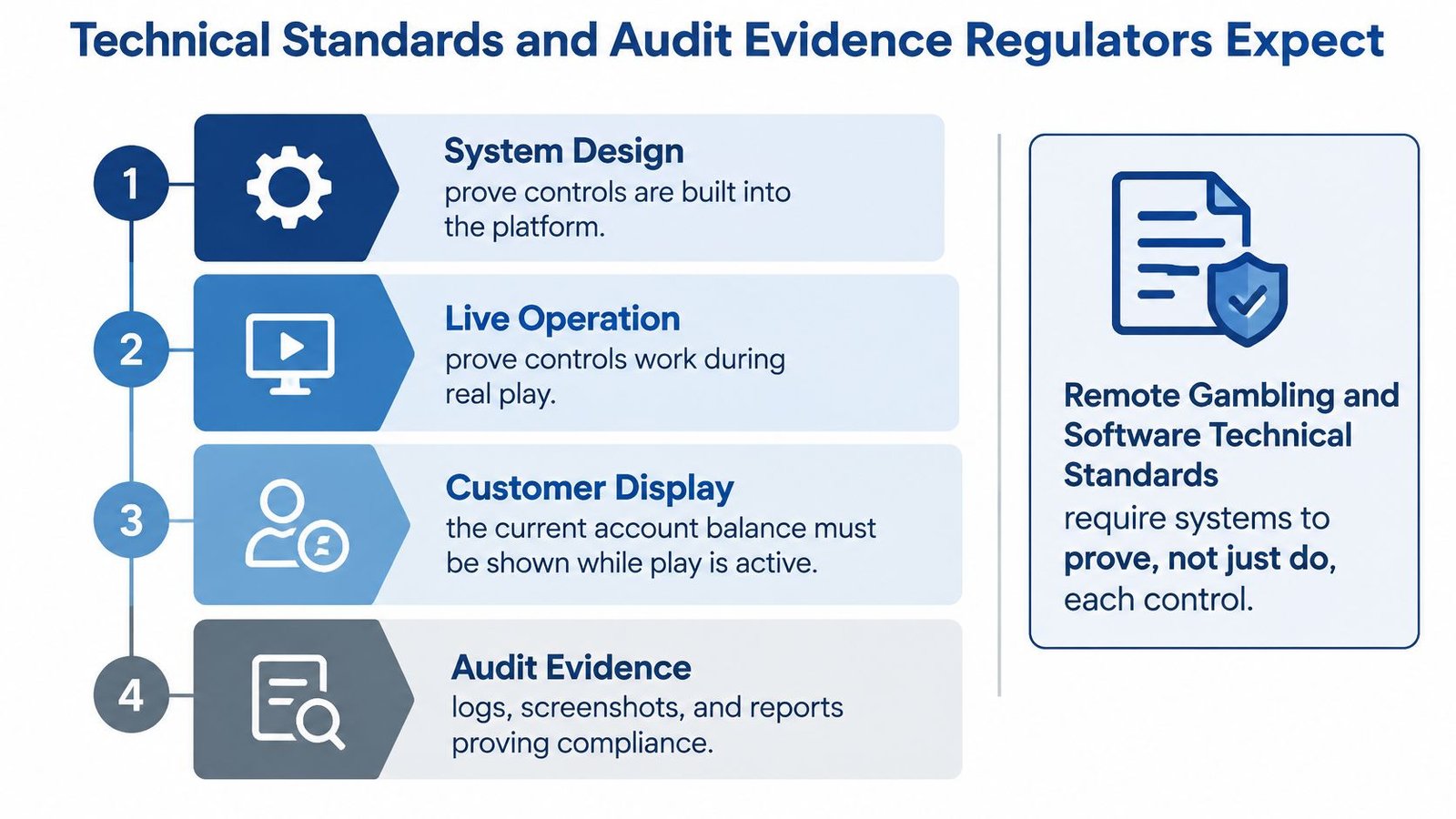
The Gambling Commission's remote gambling standards and testing framework requires a visible current balance while logged in, at least three months of account and gambling history through the interface and at least 12 months on request, demonstrably random outcomes supported by accepted testing, and, for applicable licence categories, independent security assurance including annual third-party audits against relevant ISO/IEC 27001:2022 sections.
Customer display and game testing
Customer display evidence should demonstrate the customer journey, not just the existence of a balance field in a design document. A useful audit document is a requirements-to-test matrix linking balance presentation, history access and pre-game information to test results from the deployed interface.
Games must provide information reasonably needed for an informed decision before the customer commits to gambling. Testers should therefore capture the point at which rules and relevant game information become available, including mobile layouts and any route that bypasses a conventional lobby.
Randomness evidence requires more than a supplier's general assurance. The auditor should receive the applicable laboratory or statistical test report, the tested game and random-number-generator versions, and a release record connecting that evidence to production.
A game update should trigger a documented assessment of whether existing testing still covers the changed build. Otherwise, a valid report may describe software customers no longer use.
Records, integrity and governance
Investigation evidence should support reconstruction of relevant activity and demonstrate anti-collusion, anti-cheating and account or session suspension controls. An auditor would reasonably request event-log samples, integrity-alert handling records and evidence that authorised staff can carry out a suspension.
Governance evidence should connect security responsibilities to actual access and change decisions. The audit file should contain the applicable independent report, remediation tracking, access-control records and incident-response procedures.
| Evidence layer | Document to prepare |
|---|---|
| Customer display | Interface test matrix and dated captures |
| Game testing | Statistical test report and release mapping |
| Records and integrity | Event-log samples and investigation records |
| Security governance | Audit report, remediation register and access reviews |
The standards specify control outcomes without prescribing one universal architecture. Operators should select an implementation they can explain, test and maintain, rather than collect documents disconnected from production.
For a Philippine supplier workstream, PAGCOR game content provider accreditation requirements can help organise a separate approval file. British technical evidence shouldn't be assumed to satisfy another regulator's accreditation process.
Levies, Premises Rules and Supplier Costs
Which legal obligation applies to each entity, and when must it be met? A dated register should identify the liable licence holder, calculation basis, payment owner and evidence of payment.
The UK Gambling Levy Regulations brought the statutory levy into force on 6 April 2025 across England, Wales and Scotland. Gambling software licence holders and qualifying remote betting intermediaries pay 1.1% of the leviable amount, with payment due before 1 October following the end of each levy period.
Record the rate and deadline against the correct entity
Levy rates, payment deadlines and premises amendment dates
| Obligation | Rate or date | Applies to |
|---|---|---|
| Annual statutory levy | Starts 6 April 2025 | Relevant operating licence holders in England, Wales and Scotland |
| Gambling software levy | 1.1% of the leviable amount | Gambling software operating licence holders |
| Remote betting intermediary levy | 1.1% of the leviable amount | Remote betting intermediary licence holders, excluding trading-room-only intermediaries |
| Levy payment deadline | Before 1 October after each levy period | All levy-liable licence holders |
| Premises licensing amendments | 22 July 2025 | Part 8 applications to licensing authorities in England and Wales |
A licensed supplier or qualifying intermediary may have its own levy liability. A customer-facing operator should not be assumed to bear every gambling-related charge.
Finance teams should assign three controls:
- Calculate the base: Reconcile the statutory leviable amount to the relevant financial records.
- Control the calendar: Assign preparation, review and payment responsibilities before the deadline.
- Review the contract: Determine whether commercial pricing absorbs the cost or allows a documented pass-through.
A pass-through clause allocates costs between counterparties; it does not change which licence holder owes the regulator. Keep the commercial agreement separate from the statutory payment process.
Premises applications need a territorial check
The premises-licensing amendment regulations came into force on 22 July 2025. They apply to applications under Part 8 of the Gambling Act 2005 made to licensing authorities in England and Wales, and to premises licences those authorities issue, although the instrument's extent includes Scotland.
The distinction between extent and application affects expansion timetables. Before setting a project deadline or procedure, identify the authority responsible for the specific application.
Acquisition models should distinguish recurring supplier costs from premises permissions. A software business and a betting-shop estate may both face gambling regulation, but their triggers, responsible authorities and supporting records differ.
For a Philippine cost comparison, PAGCOR B2B accreditation fees belong in a separate jurisdictional worksheet. Combining unrelated licence fees, levies and accreditation charges into one assumed global rate obscures the liabilities that apply to each entity.
Prohibition, Enforcement and Offshore Gambling
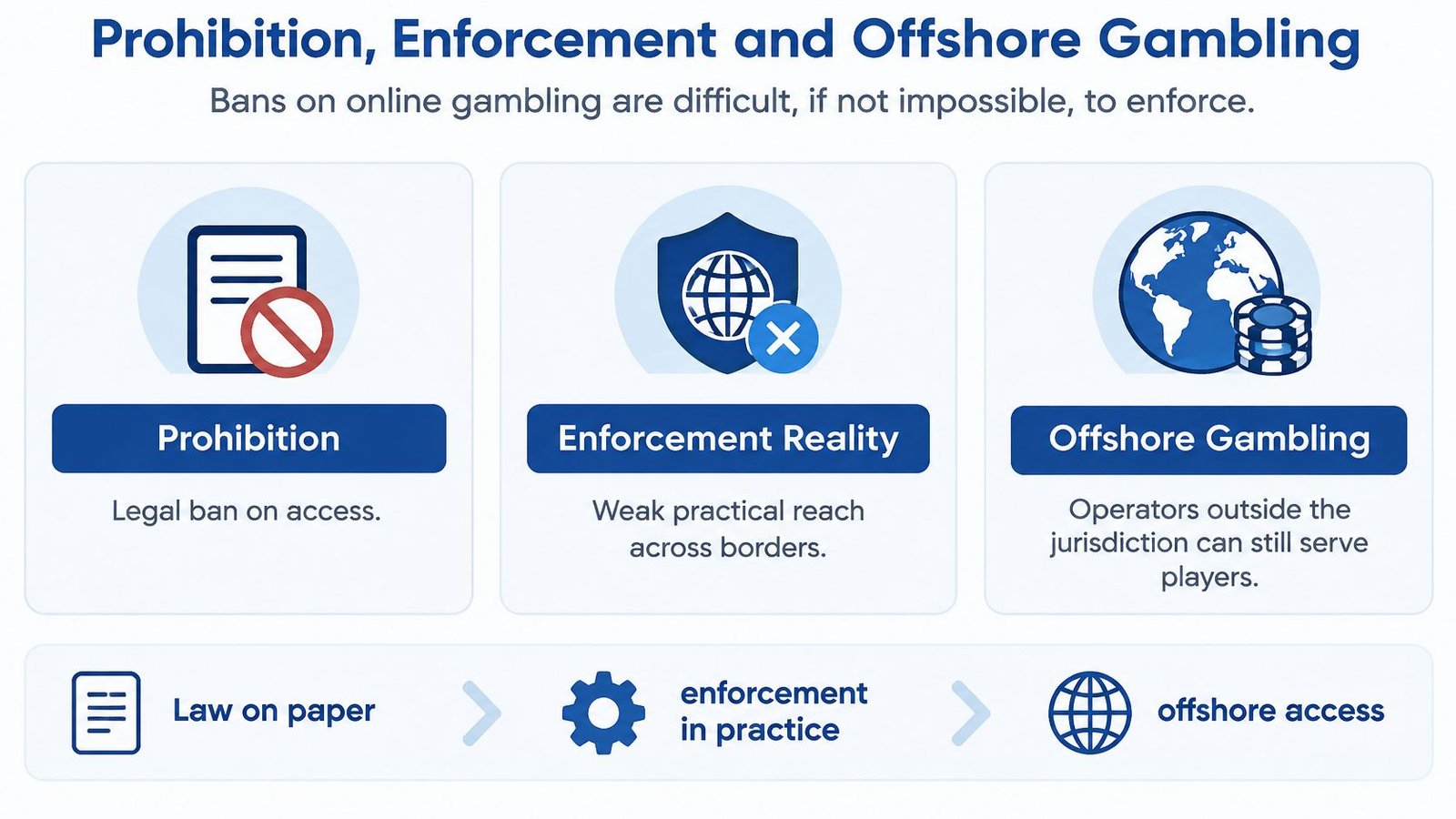
Does a legal ban stop people from accessing unlawful gambling services? A prohibition defines what is unlawful; enforcement activity shows how authorities respond. Neither alone establishes whether access has fallen or consumers have better protection.
Enforcement activity isn't an outcome measure
The Gambling Commission's annual report and accounts records more than 9,700 compliance activities in 2024–2025, compared with more than 4,200 in 2023–2024.
Those figures describe regulatory work, not its effect. They do not establish whether illegal gambling expenditure fell, fewer customers experienced harm or more people recovered disputed funds.
Blocking may disrupt access. To assess its effect, distinguish disruption from displacement: customers might stop using a targeted service, or seek access through mirror sites, social channels, cryptocurrency payments or foreign payment infrastructure. Those are possible routes, not outcomes established by a blocking total.
Assess access and protection separately
A useful enforcement scorecard asks four separate questions:
- Traffic disruption: Did the targeted service lose meaningful access to the intended market?
- Payment interdiction: Were unlawful payment routes interrupted, and did substitute routes appear?
- Legal consequences: Did investigations lead to enforceable decisions or prosecutions?
- Consumer outcomes: Did customers experience less harm or obtain better practical redress?
Financial-crime controls are a separate compliance question. UAE anti-money laundering requirements may inform a business's AML assessment, but an AML process does not itself authorise gambling activity in a market.
Product classification also requires a jurisdiction-specific check. A business assessing online sabong betting should establish how that activity is classified and which permission applies, rather than assume that every remotely delivered wager falls under the same rules.
Formal legal status, actual consumer access and player protection are distinct measures. An offshore website being reachable proves access, not legality. A domestic licence proves authorisation within its scope, not that harm is absent. An assessment of enforcement should therefore consider both the applicable prohibition or licence and the practical consequences for consumers.
Confirm Your Obligations Before You Launch
A launch approval should rest on a documented decision, with named owners for unresolved issues. A licence certificate alone doesn't establish that the product, marketing model, supplier arrangements and operational controls are ready.
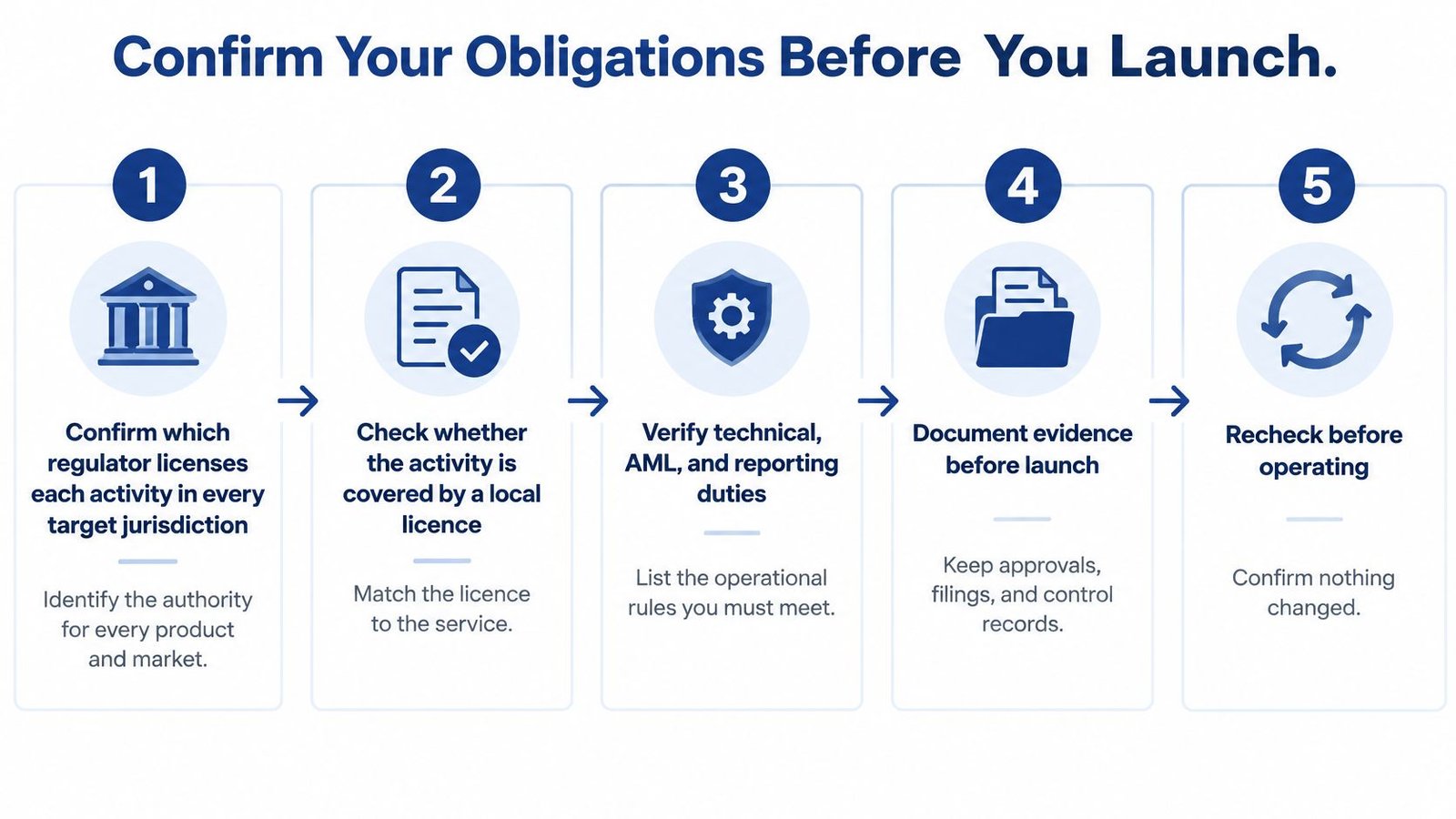
Complete the launch checks in sequence
Identify the responsible authorities. The legal team should map each target territory and product to its regulator, including any separate premises authority. The jurisdiction comparison is a starting point, not the final classification.
Verify licence status directly. Compliance should check the regulator's own records against the contracting entity, authorised activity and relevant trading identity. A third-party badge or a counterparty's statement shouldn't replace that verification.
Allocate each regulated function. The business model should identify the parties accepting bets, providing facilities, advertising, supplying software and brokering transactions. Counsel should resolve overlapping roles before the parties finalise their agreements.
Test customer protection in production-like conditions. Product and quality-assurance teams should retain evidence that verification gates and applicable stake controls work across the customer's available journeys. A policy document isn't a substitute for an executed test.
Assemble the technical audit file. The release owner should connect deployed software to test reports, configuration approvals, security records, and incident procedures. Evidence should identify the system version it supports.
Assign finance and premises milestones. Finance should own levy calculations and payment scheduling, while the property or legal team owns applicable premises procedures. Each deadline needs an accountable person and a completion record.
Align commercial contracts. Marketing, affiliate and supplier agreements should reflect territorial restrictions, regulated responsibilities and agreed treatment of levy costs. Contractual allocation shouldn't imply that a statutory duty has moved to another entity.
Use primary texts for the final decision
The primary destinations are the Gambling Commission website for licensing, guidance and statistics, and legislation.gov.uk for statutory instruments, amendments and commencement provisions. The launch file should record the exact documents reviewed and the date of the legal assessment.
For businesses with a separate UAE establishment or financial-crime compliance workstream, Smart Classic Business Hub's AML guidance for UAE business owners can help frame questions for local advisers. It doesn't determine whether a gambling product may be offered.
Official publications should control the legal analysis. Trade publications such as Top 1 Rank can support monitoring and market context, alongside regulator announcements and professional advice, without replacing the primary text.
Before approving a launch, the responsible executive should commission a jurisdiction-specific legal review, require closure of material control gaps and obtain written sign-off from legal, compliance, product and finance owners. This guide is reference material, not legal advice; a qualified lawyer should review the specific business model before the final operating decision.





Join thousands of gaming professionals receiving the latest iGaming news, regulatory updates, and market insights.
