


You place a small bet on a colour, the dice tumble, and for a few seconds everything narrows to one thought. Red ba, or blue? That moment feels like pure luck. For many players, that's where the story ends.
But the more useful question isn't “What colour feels hot tonight?” It's whether the game's rules make your bet mathematically sensible in the first place. That's where color game probability becomes valuable. It doesn't remove suspense, and it doesn't promise profit. It helps you see what's really happening behind the game instead of relying on hunches, streaks, or social media “systems”.
A lot of Filipino-facing advice stops at very simple odds talk. The bigger gap is mechanics transparency. Educational probability guidance shows that fair game design depends on listing outcomes, matching payouts to probabilities, and checking theory against repeated play, while PH-specific colour-game pages often don't walk players through the full outcome space or expected value clearly, as noted in this probability teaching reference from Appalachian State University.
Table of Contents
- Beyond Luck What Is Color Game Probability
- The Building Blocks of Probability in Casino Games
- Calculating Color Game Odds Step by Step
- Common Color Game Variations and Their Odds
- Why Betting Strategies Like Martingale Fail
- How RNG and PAGCOR Ensure a Fair Game
- Practical Tips for Playing Color Games on Insta Play
Beyond Luck What Is Color Game Probability
Color game probability is the chance that a specific result happens when the game resolves. In plain language, it answers a practical player question. How likely is this bet to win, and is the payout worth that risk?
That second part matters more than many players realise. A bet can win often and still be a poor bet overall if the payout doesn't match the true chances of success. That's why experienced players don't stop at “Which colour comes out more?” They ask whether the return is fair for the risk taken.
Consider a sari-sari store raffle. If you get many chances to win a tiny prize, you might feel successful often. But if you spend more joining the raffle than the prizes are worth on average, the frequent wins don't help you. Casino maths works the same way.
Practical rule: A bet isn't judged by how exciting a single round feels. It's judged by what usually happens over many rounds.
Many people often get confused. They mix up hit rate with value. Hit rate means how often a bet lands. Value means what that result is worth after you factor in payout. Those are not the same thing.
Many guides about colour games talk as if picking the “best” colour is the key decision. In reality, the deeper question is whether the game's design gives the player a fair return at all. Once you start looking at outcomes, payouts, and average return together, the game becomes much easier to understand.
The Building Blocks of Probability in Casino Games
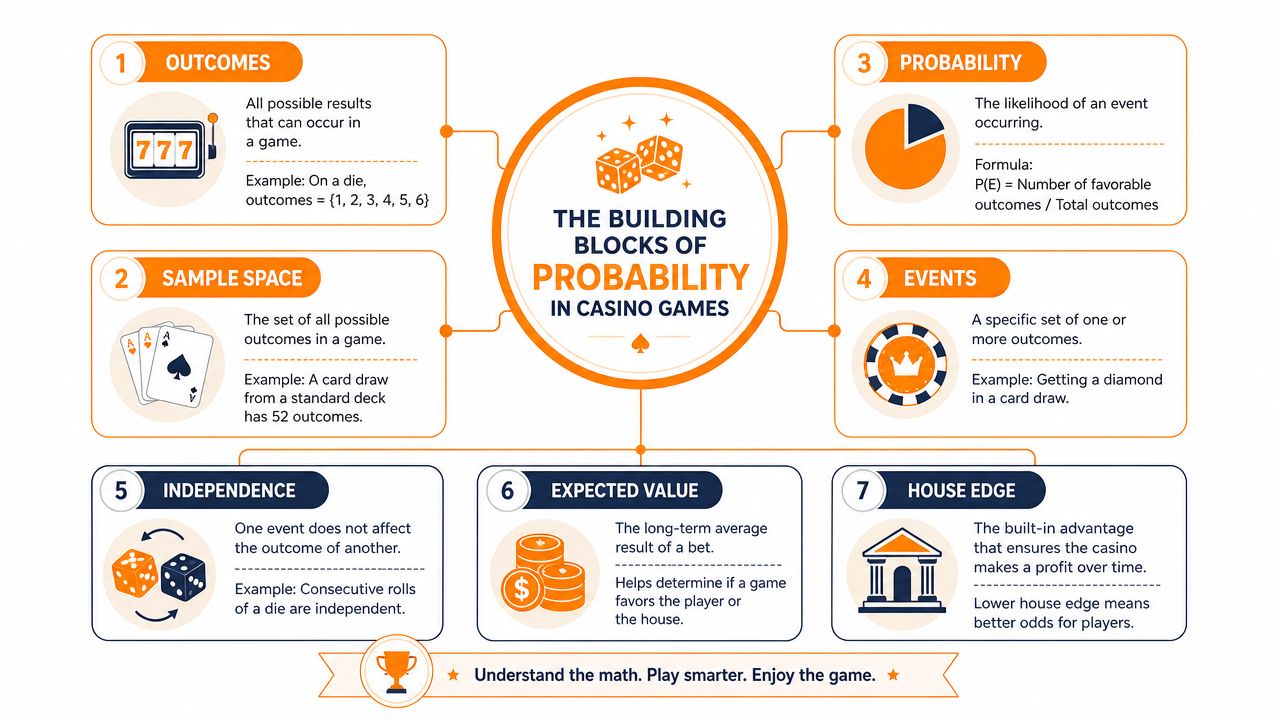
Probability sounds technical, but the core idea is simple. You count what can happen, then you count the outcomes you care about.
Outcomes sample space and events
Start with a coin. Flip it once and you have two possible outcomes. Heads or tails. The list of all possible outcomes is called the sample space.
Now use one regular die. It can land on one of six faces. If you care specifically about rolling a 4, that target is an event. The sample space is all six faces. The event is only one of them.
That's the whole backbone of probability:
- Outcome means one possible result, like heads on a coin or a blue face on a die.
- Sample space means the full set of possible results.
- Event means the result, or group of results, you're betting on.
Once you understand those three ideas, casino games stop looking mysterious. They become counting exercises.
Why counting matters more than guessing
A color game may look more complicated than a coin toss because several dice are involved and each die can show one of several colours. But the principle is identical. You still ask two things. What are all the possible results? Which of those results pay my bet?
This approach is less intimidating than it sounds because you don't need advanced maths. You need organised counting. If you've ever compared jeepney routes or sorted change in your wallet, you've already used the same kind of thinking. You group possibilities, then decide which ones fit your need.
In gambling, confusion usually starts when players skip the counting and jump straight to prediction.
That's why probability matters in casino games. It gives you a way to test your instinct against the structure of the game. Maybe your chosen colour seems to appear “a lot”, but unless you count the full result space, that feeling can be misleading.
One more thing helps beginners. Probability doesn't predict the next single round with certainty. It describes the pattern you'd expect over repeated play. That's a big difference. In one round, anything allowed by the rules can happen. Over many rounds, the game tends to reflect its built-in probabilities.
Calculating Color Game Odds Step by Step
A player at Insta Play places a bet on red because red has shown up several rounds in a row. It feels like a smart read of the table. Probability asks a calmer question. How often does that bet return enough over many rounds to be worth the risk?
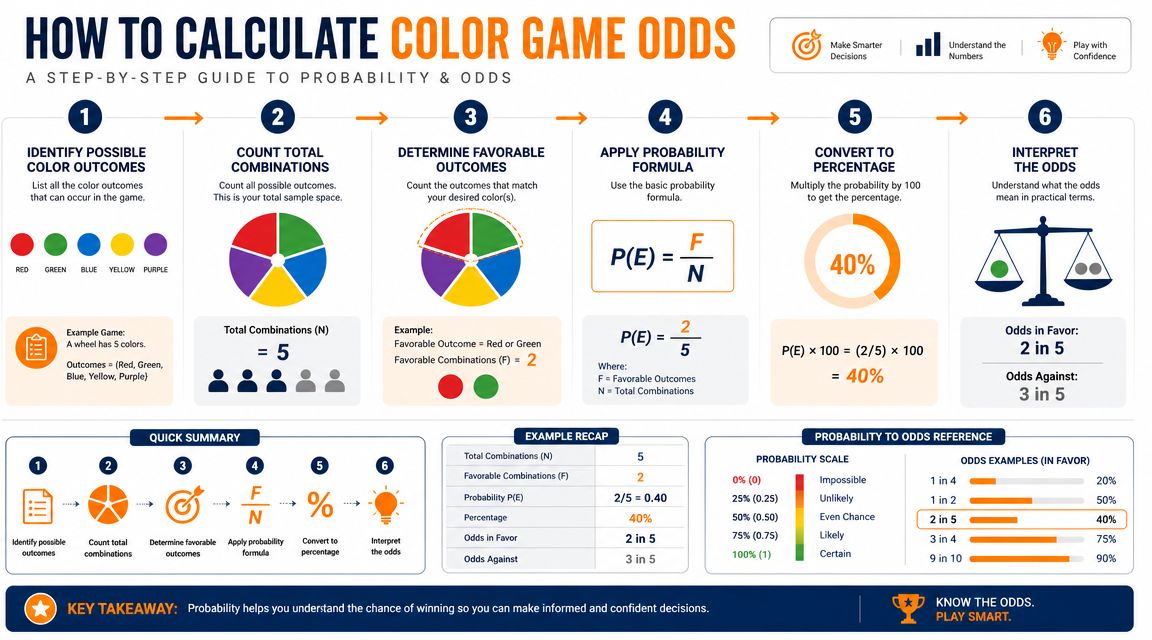
A common color game format uses three dice, and each die can land on one of six colours. To measure the bet properly, start by counting every possible result. One die has 6 possible outcomes. Three dice produce 6 × 6 × 6 = 216 total outcomes.
That number matters because every later calculation comes from it. Many guides stop at “your colour can appear” and treat that like the whole story. A better method is to count the full set of results first, then compare those results with the pay table. That is how you get expected value, which tells you more than simple win rate.
If you like learning games by checking the rules carefully before betting, that same habit helps in card-based titles too, especially with Lucky 9 rules and gameplay basics.
Count the winning outcomes for one colour
Suppose your chosen colour is red. Your bet can win in three different ways:
- Exactly one die shows red
- Exactly two dice show red
- All three dice show red
This is easier than it looks. It works like checking how many matching socks you pulled from a drawer. One match, two matches, and three matches are different results, so they need separate counts.
| Result for your chosen colour | How the count works |
|---|---|
| One match | Pick 1 die to be red. The other 2 dice must be any non-red colour |
| Two matches | Pick 2 dice to be red. The remaining die must be any non-red colour |
| Three matches | All 3 dice are red |
Now count them one by one.
- Exactly one red: there are 3 choices for which die is red. Each of the other 2 dice has 5 non-red options. So the count is 3 × 5 × 5 = 75.
- Exactly two reds: there are 3 ways to choose which 2 dice are red. The last die has 5 non-red options. So the count is 3 × 5 = 15.
- Exactly three reds: only 1 outcome fits. All dice are red.
Add them together and you get 75 + 15 + 1 = 91 winning outcomes for a single-colour bet.
So the probability that your colour appears at least once is 91 out of 216. That sounds decent at first glance, and many players stop their inquiry there. The more useful question is what those 91 outcomes pay compared with the 125 outcomes that pay nothing.
Turn probability into expected value
Winning often does not automatically make a bet good. A sari-sari store promo that gives tiny prizes most of the time can still leave you spending more than you get back. Casino math works the same way.
True odds come from the 216 possible outcomes you counted. Payout odds come from the game's pay table. If the payout for one match, two matches, or three matches is lower than the risk those outcomes carry, the game keeps a house edge even if your colour appears regularly.
That is why expected value matters more than raw hit rate. Expected value asks: if this same bet were repeated many times, what is the average return per bet after combining all wins and all losses?
A player who only asks, “How often will I see my colour?” is looking at one piece of the puzzle. A player who asks, “What do all those outcomes pay on average?” is looking at the core mechanics of the game.
That second question leads to better decisions on regulated platforms like Insta Play, because it separates a fun-looking result from a mathematically fair return.
Common Color Game Variations and Their Odds
Not every colour game follows the same structure. Some versions use a different number of dice. Others tweak the pay table. Some may keep the same visual theme while changing the way matching colours are rewarded. Small rule changes can turn a familiar-looking game into a very different mathematical experience.
What changes from one version to another
The biggest trap is assuming that one colour game “plays like” another because the board looks similar. That's like assuming every card game with chips on the table has the same risk. It doesn't.
Three features shape the odds:
- Number of dice used changes how many total outcomes exist.
- How many colours appear on each die changes the sample space.
- How matches are paid determines whether a frequent result is worth backing.
If a platform offers more than one table-style game, it helps to compare rules before betting. Players who like switching between different formats often do the same thing with games such as Super Six Baccarat, where small rule details also matter.
Color Game Odds Comparison
Because rule sets vary and many platforms don't present a fully standardised pay table, the safest way to compare games is qualitatively unless the exact game mechanics are published. That still gives you a useful checklist.
| Game Variant | Probability (Single Color Bet) | Typical Payout | Calculated House Edge |
|---|---|---|---|
| Standard 3-dice colour game | Depends on how many matching-colour outcomes are counted and paid | Varies by operator | Only calculable from the full outcome map and exact pay table |
| More dice added | Your colour can appear in more combinations, but so can misses | Usually adjusted to match added complexity | Changes with the pay table, not with hit frequency alone |
| Same dice, different pay ladder | Base colour appearance may stay structurally similar | Can be flatter or more top-heavy | Can improve or worsen depending on payout fairness |
| Promotional or themed variation | Often presented as familiar | Sometimes simplified for casual play | Must be checked game by game |
That table may look less dramatic than flashy “best strategy” posts, but it's more honest. If you don't know the exact rules, you can't know the exact edge.
A practical habit helps here. Before you play any variation, ask three questions: What counts as a win? Are different match levels paid differently? What happens on rare outcomes? Those answers tell you more than any “lucky colour” theory.
Why Betting Strategies Like Martingale Fail
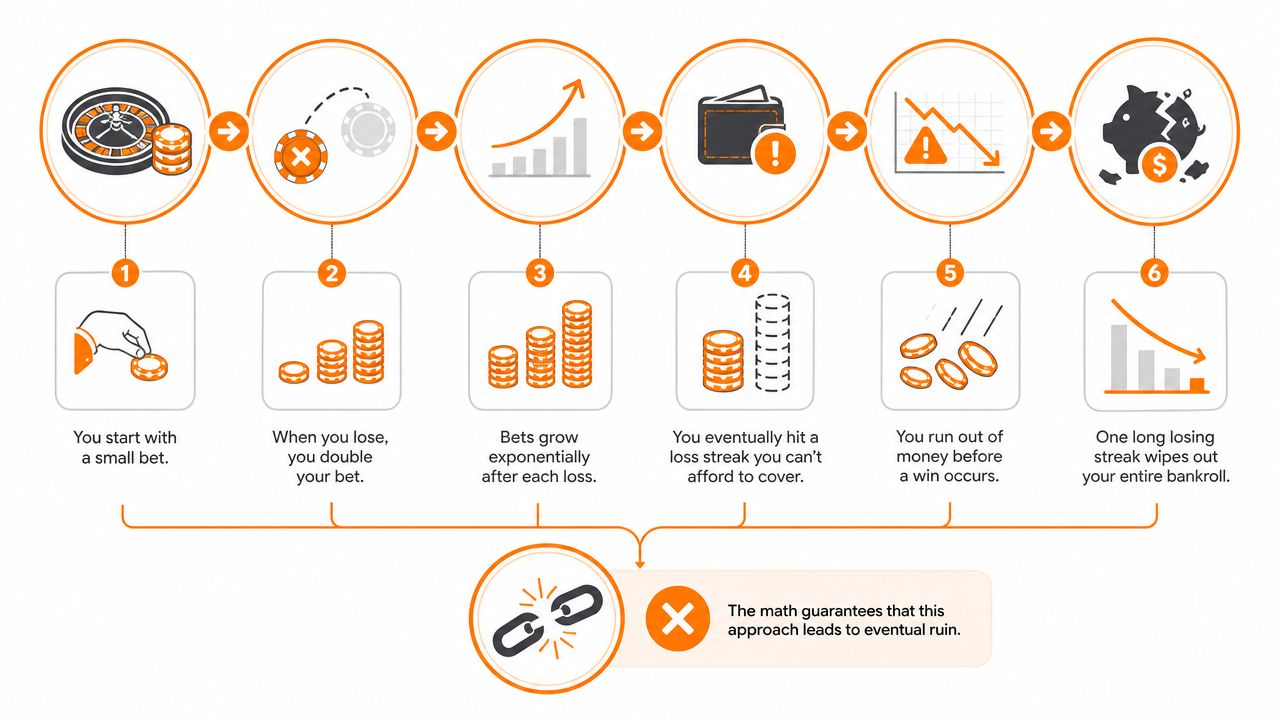
The Martingale idea spreads fast because it sounds neat. Lose one round, double the next bet, and when you finally win, you recover the earlier losses plus a small gain. On paper, that feels disciplined. In practice, it breaks down for a simple reason. The game doesn't owe you a win before your money or the table limit runs out.
Independent rounds break the illusion of control
Each round of a properly run game is independent. That means the next result doesn't become “due” because of what happened earlier. A streak may feel meaningful, but the dice don't remember previous rounds.
The gambler's fallacy enters. A player sees several losses on one colour and believes a hit must be near. But independence means past misses don't push the next round toward your side. The next round is still just the next round.
That matters because Martingale depends emotionally on a false sense of inevitability. The system feels safe only if you assume a win will arrive before the doubling becomes painful.
Why doubling feels safe until it doesnt
The core flaw in Martingale isn't just that it's risky. It's that bankroll demands grow rapidly during losing streaks, while the game's underlying expected value stays the same. Recent PH-facing strategy content still recommends doubling after losses, but the deeper issue is the tail risk created when finite capital or table limits stop the sequence, as noted in this discussion of Martingale-style advice.
Take a simple pattern. You start with a small bet. Lose, then double. Lose again, then double again. Very quickly, you're no longer making a casual table bet. You're making a large recovery bet under pressure.
Here's what that experience usually looks like:
- Early rounds feel harmless because the amounts still look manageable.
- Mid-streak stress kicks in because each loss forces a visibly bigger commitment.
- One longer streak changes everything because the next required bet may exceed your comfort level, your bankroll, or the table cap.
That's why Martingale can produce many modest sessions that feel successful, followed by one punishing session that wipes out those gains.
“Recovering losses” sounds strategic, but it doesn't change the maths of the game.
If you're interested in recurring patterns in casino play, it's better to treat them as observation tools rather than magic formulas. That's a healthier mindset than relying on progression systems promoted in pages about Super Ace pattern ideas.
The useful takeaway is simple. Betting systems can change the distribution of outcomes. They can't flip a negative expectation into a positive one just by rearranging stake size.
How RNG and PAGCOR Ensure a Fair Game
Once you understand the maths, the next concern is natural. If the probabilities are real, how do you know the game conforms to them?
What RNG actually does
In online casino games, the result is generated by an RNG, or random number generator. You can think of it as the digital mechanism that produces each outcome freshly, without memory of what happened before.
For a player, the important part is practical. A proper RNG means the system shouldn't “chase” your last bet, punish a recent win, or reward a superstition. Each result should be produced independently within the game's rules.
That doesn't mean every session will feel balanced. Randomness often feels streaky in short bursts. You may see one colour repeat, then disappear for a while. That's normal. Fair randomness doesn't look neatly alternating. It looks messy.
Why regulation matters
Fair maths only matters if the platform runs games under real oversight. In the Philippines, that's where PAGCOR licensing matters to players. Regulation gives structure to how gaming operations present and govern their offerings.
For players, the practical benefit is trust in process. You're not relying only on a brand promise or a nice-looking interface. You're choosing a platform that operates within a locally recognised compliance environment.
A player comparing licensed options may also look at broader game selection and platform standards, such as what's presented through Mega Panalo Casino access and game offerings. The key principle is the same across titles. Rule clarity and regulated operation matter more than hype.
Fair doesn't mean beatable. It means the game follows its stated rules instead of hidden manipulation.
That distinction is important. A fair game can still carry a house edge. Regulation doesn't remove the casino advantage. It helps ensure the advantage comes from disclosed rules, not from rigged outcomes.
Practical Tips for Playing Color Games on Insta Play
You open a color game after work, win a couple of early rounds, then feel the urge to press harder while the luck feels hot. That moment is where good habits matter most. Probability is most useful at the table when it helps you make calm choices, not when it gives you false confidence.
A practical approach starts with one idea. Chase value, not just wins. A round can feel successful because you guessed the right color, but the better question is whether the payout matched the risk over many rounds. That shift in thinking separates casual guesswork from informed play.
Here are the habits that help:
- Check the exact payout rule first: In some color games, one matching die, two matching dice, and three matching dice pay differently. Your true odds only make sense when you know what the game counts as a winning result.
- Judge results over a long stretch: A short streak is like flipping a coin and seeing heads several times in a row. It feels meaningful in the moment, but it does not change the underlying probability of the next round.
- Set a fixed budget before you play: This gives your session a clear boundary and helps stop the common pattern of chasing losses after a rough run.
- Be careful with bet progression systems: If your plan requires larger and larger bets after every loss, test it against a bad streak on paper first. Many systems sound clever until the bankroll pressure shows up.
- Treat the game like paid entertainment: You are paying for suspense, fun, and a chance to win, not building a dependable income stream.
- Choose regulated platforms with clear rules: Good play starts with knowing the game terms, payout structure, and platform standards before you place money on the table.
One more habit ties all of this together. Keep your expectations realistic. Probability can help you read the game more clearly, spot weak betting ideas, and avoid common mistakes. It cannot remove uncertainty, and it cannot turn a negative expected value game into a reliable profit engine.
If you want to review the platform setup, promos, and local gaming context before playing, visit the welcome page for Insta Play Online Casino and read the details first.
With that foundation in place, the brand call-to-action makes more sense. A trusted platform matters because good probability decisions only mean something when the rules and payouts are clearly presented. For Filipino players who want a locally regulated place to apply these lessons, Insta Play Online Casino offers a PAGCOR-licensed platform, a beginner-friendly welcome offer, and a wide selection of e-games.