

You're at the branch or thinking about heading there, and the amount in your pocket feels too small for the day's need. Maybe your ATM cash just ran out, maybe you're sending money to family, or maybe you don't want to make three separate withdrawals just to cover one payment. That's where the BDO over the counter withdrawal limit question gets practical, because the issue isn't only how much the bank allows, it's whether OTC still makes sense compared with raising your ATM limit or moving money digitally.
Table of Contents
- Why the BDO Over the Counter Withdrawal Limit Matters for Filipinos
- How BDO Structures Cash Access Across Channels
- Typical OTC Limits and What Changes Them
- Documents and Process for Withdrawing Cash at a Branch
- OTC Versus ATM and Digital Transfer Alternatives
- Fees, Holds, and Fraud Risks at the Branch Counter
- Quick Checklist and Next Steps Before You Visit a Branch
Why the BDO Over the Counter Withdrawal Limit Matters for Filipinos
A lot of Filipino account holders only think about limits after they've already lined up. A salary earner may need to settle a big bill, a parent may be sending cash to a child in the province, or a player may want to fund an account without getting stuck at the ATM cap. In those moments, the question isn't academic, it's about whether you can get the cash you need in one trip.
BDO's published ATM rule gives you the first clue to the bigger picture. The bank sets a ₱50,000 default daily withdrawal limit, adjustable up to ₱200,000 through BDO's digital banking controls, with a ₱25,000 maximum per transaction at BDO ATMs. That means the branch counter is usually considered only after the ATM route starts to feel restrictive, because even cash access is managed through layers, not one single rule. BDO's debit limits page shows that this is an official policy, not a loose branch preference.
Practical rule: if your need fits inside your app-adjusted ATM ceiling, OTC may be unnecessary. If it doesn't, the branch counter becomes a fallback, not the starting point.
One reason this matters is that people often ask the wrong first question. They ask, “What is the limit?” The better question is, “Do I really need cash from the branch, or can I raise my ATM ceiling or use a transfer instead?” That shift saves time and reduces the chance of walking in unprepared.
For readers comparing cash options with gaming-related cash movement, the same decision logic still applies. The branch is useful when the amount, timing, or documentation makes cash access the safer fit, but it's not automatically the best route. If you're weighing whether to head out at all, a useful starting point is this broader Philippine cash access guide for players.
How BDO Structures Cash Access Across Channels
BDO doesn't treat every withdrawal the same way. A building has different doors. The ATM is the quick side entrance, the app is the control panel, and the branch counter is the staffed front desk for situations that need more handling. That's why the BDO over the counter withdrawal limit is best understood as part of a larger cash-access framework, not as an isolated figure.
Different channels, different ceilings
At the ATM level, BDO's published rules show a ₱50,000 daily maximum, a ₱25,000 per-transaction ceiling, plus smaller withdrawal modes such as ₱10,000 via QR Code and ₱10,000 via biometrics, with a ₱200 minimum per transaction. The same ATM page says the daily maximum is adjustable via the BDO Online app. BDO's ATM information makes clear that BDO expects customers to move between channels based on need, not force every transaction through one lane.
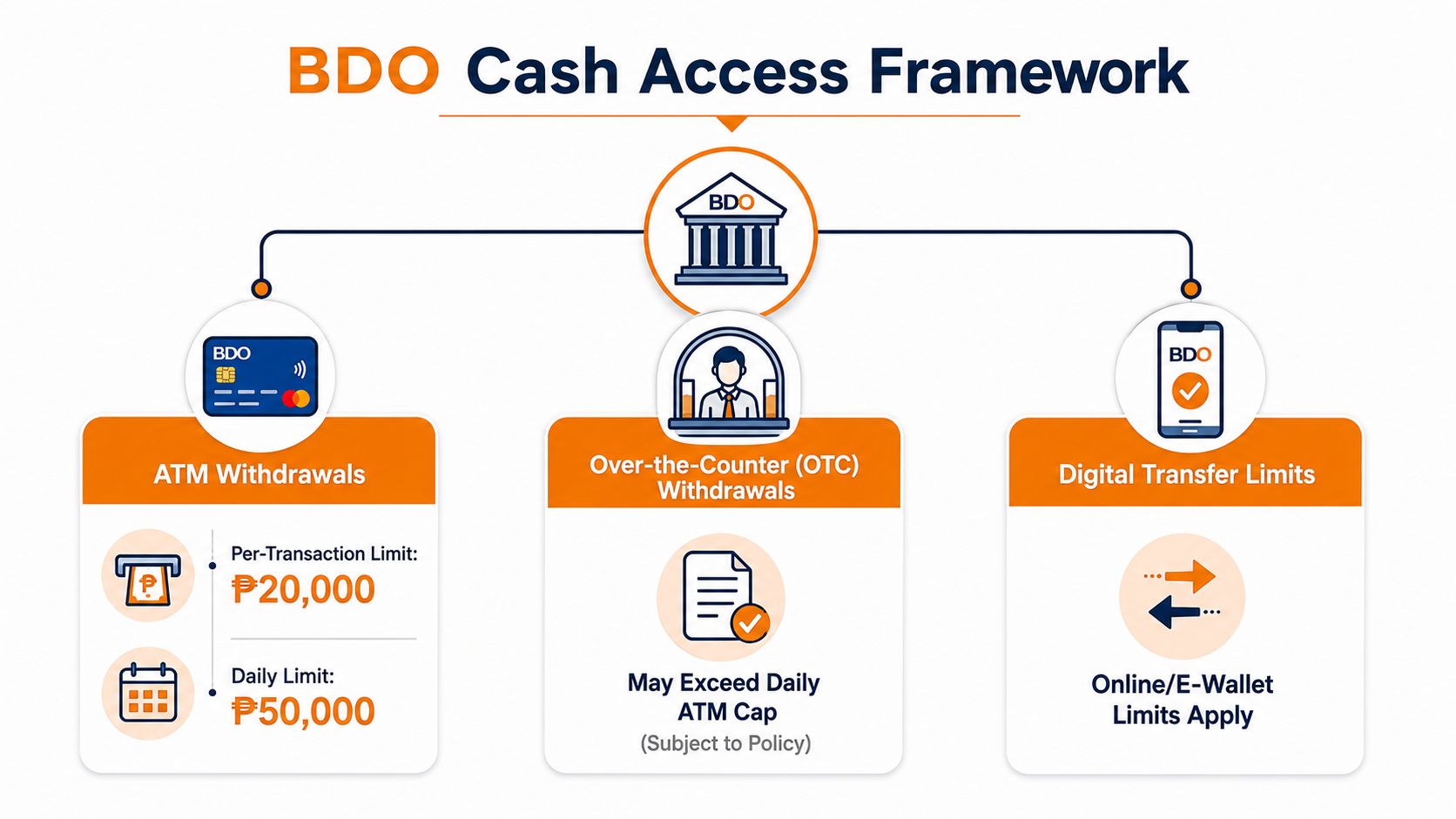
The branch counter usually comes into play when the amount, purpose, or verification needs don't fit neatly inside the ATM or app rules.
That layered setup is important because it explains why OTC feels different from a normal withdrawal. A teller can review the request, check the account, and apply branch procedures. The customer gets more flexibility, but the bank also gets more control. That's the trade-off.
Why the cash desk exists at all
Cash access at the counter is not just a bigger ATM. It's a different process with different checks. BDO's digital materials also show segmented limits for other transaction types, which reinforces the idea that the bank separates cash withdrawals from card purchases and online spending by purpose and risk profile. BDO's cash card limits page shows that this separation is deliberate.
For a quick comparison, the logic is simple, even if the exact branch handling can vary:
- ATM or app route for routine cash needs, because it's faster and predictable.
- OTC route when the amount or situation doesn't fit the ATM structure.
- Digital transfer route when you don't need physical cash.
That last point matters more than people think. If your goal is just to move funds, standing in line for cash might be the slowest option available. For a more wallet-focused comparison of branch and non-branch routes, some readers also look at this withdrawal discussion for Arena Plus users.
Typical OTC Limits and What Changes Them
BDO doesn't publish one single OTC number on the same pages that list its ATM caps, and that absence matters. It tells you something practical, which is that branch withdrawals are handled as a controlled service rather than a fixed self-service action. In real life, the teller's decision depends on the account, the purpose, and the supporting details you bring.
What usually affects the branch outcome
The most concrete published rule here is BDO's Basic Account disclosure. The account is available to Filipino citizens aged 18 and above with a Philippine address, requires zero initial deposit and no maintaining balance, and has a maximum monthly cash-in and maximum account balance of ₱100,000. It also becomes dormant after 1 year of no activity. BDO's Basic Account terms matter because account structure can shape how much movement is practical, even before a teller starts checking a withdrawal request.
A branch visit can also feel different depending on whether your account is active and how you usually move money. If your cash-in history, balance pattern, or account type doesn't match a large withdrawal request, the teller may ask for more context. That doesn't automatically mean “no”, it usually means the bank wants the transaction to make sense within the account's profile.
| Common Variables That Affect Your OTC Limit | Effect on OTC Limit | Reader Action |
|---|---|---|
| Account type | Some accounts are designed for lighter movement, which can affect how a large cash request is handled. | Check your account disclosure before going to the branch. |
| Purpose of withdrawal | A clearly explained reason is easier to process than an unexplained large cash request. | Prepare a simple, truthful explanation. |
| Supporting documents | Documents help the teller match the transaction to your account history. | Bring IDs and any proof linked to the cash need. |
| Recent account activity | Dormant or lightly used accounts may get more questions. | Review your latest transactions before you line up. |
The takeaway is straightforward. OTC is not just about cashing out. It's about whether your request fits the bank's working rules for that account. If you're trying to understand this from a gaming or cash-out angle, the same logic applies when you compare branch handling with site-level cash alternatives, including this withdrawal reference for free-credit users.
What you control and what BDO controls
You control your account type, how clearly you explain the purpose, and what papers you bring. BDO controls the final approval, the process, and any extra review. That separation is why a branch visit feels more like a verification step than a simple money pick-up.
Documents and Process for Withdrawing Cash at a Branch
The branch counter is much easier when you treat it like an errand with a checklist, not a surprise test. Bring the right ID, know the amount, and be ready to explain what you need. That keeps the process short and reduces the back-and-forth that usually slows people down.
What to bring and what to say
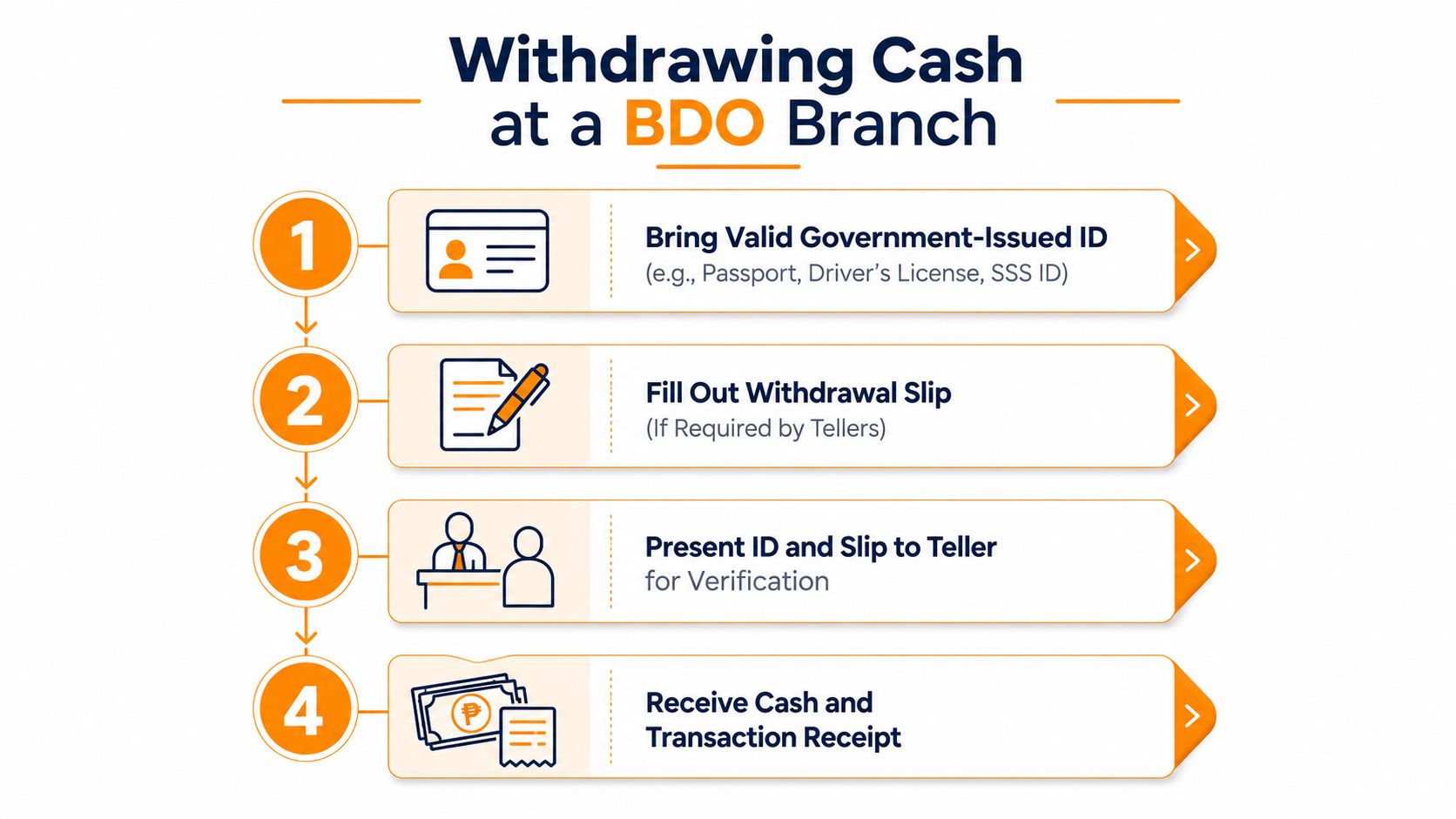
Start with a valid government-issued ID. BDO's account materials and wider retail banking setup assume identity verification as part of routine transaction handling, so it helps to arrive with more than one valid ID if you have them. If a withdrawal slip is needed, fill it out clearly before you reach the teller window.
A simple approach works best at the counter:
- State the amount clearly. Don't round off if your actual need is exact.
- Present your ID calmly. Keep it ready before the teller asks.
- Fill in the slip carefully. Match the account name and number exactly.
- Check the receipt before leaving. Compare the printed amount with your request.
If you're withdrawing for someone else, expect more verification. That usually means the account holder's ID copies and a written authorisation are needed, because the teller has to confirm the request is legitimate. The more a withdrawal moves away from the account owner personally standing there, the more the branch will want paperwork.
Branch habit that helps: keep your withdrawal slip and ID visible, but don't let strangers read your details over your shoulder.
How to keep the visit smooth
The teller's job is to verify, process, and release cash only when the details line up. Your job is to make the request easy to read. That means clear handwriting, matching signatures, and no rushed corrections on the form.
If you're unsure whether a slip is required, ask the teller early in the queue. That's better than learning after you've already filled in the wrong form. If the withdrawal involves a large amount or an unusual purpose, be ready for a few extra questions.
OTC Versus ATM and Digital Transfer Alternatives
The smartest branch decision is often the one you don't make. If your cash need fits inside your adjustable ATM ceiling, the app route is usually faster. If you only need to move money to another bank or wallet, a digital transfer may be more convenient than standing at the teller window.
Choosing the right channel
BDO's app can raise the practical ATM ceiling to ₱200,000, which can remove the need for OTC in many routine cases. BDO's limits and fees page is the clearest sign that BDO expects some customers to manage larger withdrawals digitally instead of at the counter. That matters because it changes the default decision from “branch or not” to “which channel fits best?”
For online movements, the key issue isn't just speed. It's whether the receiving platform has its own cash-out rules. That's why a transfer to an e-wallet or another bank can be simpler, but only if the destination side accepts the amount and timing you need.
At a practical level:
- OTC works when you need staffed handling, paper verification, or a branch-level exception.
- ATM works when cash is needed fast and the amount stays within your limit setup.
- Digital transfer works when your goal is movement, not physical cash.
- Remittance or cash-pickup options work when the recipient or destination channel is outside your own account flow.
A simple decision question
Before you leave home, ask yourself, can this transaction be done faster, cheaper, and just as safely without lining up at the branch? If the answer is yes, OTC may be unnecessary. If the answer is no, then the counter is probably the right place to start.
For readers who regularly move funds in and out of gaming platforms, planning matters most. A higher ATM ceiling or a transfer can often do the job without the branch visit, and that's why comparing channels beats memorising one limit. If you're checking a withdrawal path connected to a gaming account, this cash access guide for players can help you compare the options.
Fees, Holds, and Fraud Risks at the Branch Counter
A branch visit feels safer than random online messages, but it isn't risk-free. The common mistake is assuming OTC is always cheaper or always simpler. In reality, large withdrawals can still carry service costs or extra checks, and the counter is also where scams try to catch distracted customers.
What people miss about cost and verification
BDO's public pages explain withdrawal limits, but they don't promise that every branch interaction is friction-free. For large cash requests, the bank may ask for extra documentation if the transaction needs stronger verification. That's part of normal account control, especially when the request doesn't match your usual pattern.
The biggest practical risk is not the fee itself, but the assumption that cash at the branch is automatically the no-hassle route. If your amount can move through a transfer or an app-adjusted ATM limit, that may save time and reduce exposure at the counter. If it can't, then bring the right papers and expect a more careful process.
Watch for common scam tactics
Branch environments attract opportunistic fraud. Someone may text pretending to be a teller, show a fake receipt, or hover too close while you're filling out a slip. The fix is basic, but people forget it when they're rushed.
- Protect your slip: cover account details and the amount while you write.
- Check every printed amount: don't pocket the cash until the receipt matches your request.
- Ignore unofficial verification claims: if anyone says they're from the bank, confirm through BDO's official channels instead of the number in a random message.
- Keep your phone and wallet in front of you: that lowers the chance of distraction theft at the counter.
A good habit is to verify any branch instruction through official bank contact routes before you travel, not after you're already at the teller window. That's also where some people pair branch cash decisions with their broader account security habits and promo research, including this bonus and verification page.
Quick Checklist and Next Steps Before You Visit a Branch
Before you line up, decide three things, the amount, the account type, and the reason. Then check whether the same need can be handled by the app or a transfer first. If not, bring your ID, your papers, and enough time for the teller to verify the request properly.
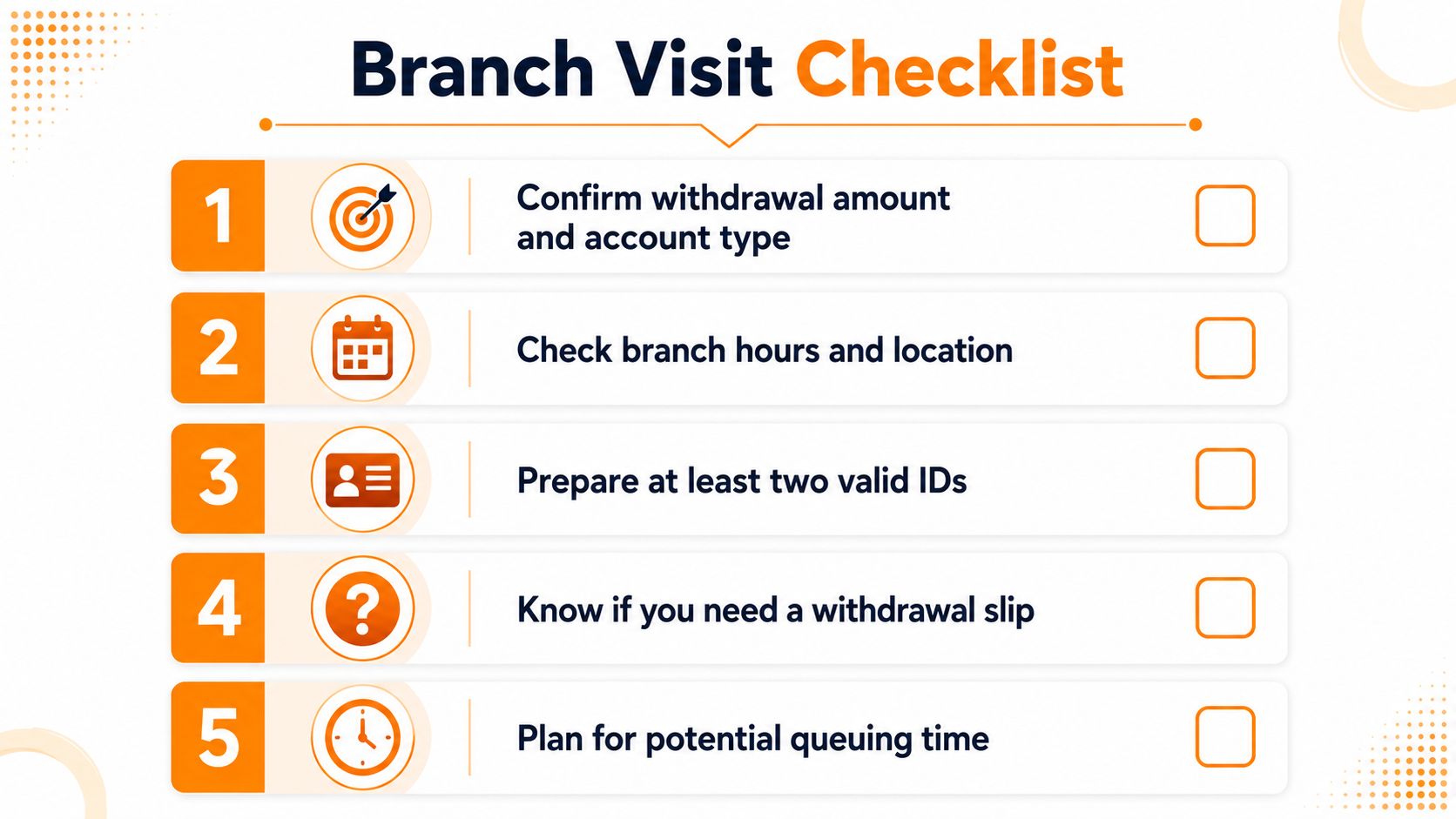
A short pre-visit list helps more than guesswork:
- Confirm the amount and account type.
- Check branch hours and location.
- Prepare valid IDs and any supporting documents.
- Know whether a withdrawal slip is needed.
- Plan for queuing time.
If the branch visit feels avoidable, use the BDO Online app to review whether your ATM ceiling can be raised first. If the issue is still unclear, confirm directly through BDO's official website, app, or customer service before you go.
If you want a smoother way to handle cash decisions, visit Insta Play Online Casino for a simple starting point and check the platform's current welcome offer before you decide where to take your next step.





Join thousands of gaming professionals receiving the latest iGaming news, regulatory updates, and market insights.
