

Yes, online casinos are legal in the Philippines if they're licensed by PAGCOR, but that answer comes with an important warning. PAGCOR also reported that the regulated market generated PHP94.61 billion in total gross gambling revenue in Q3 2023, including PHP35.71 billion from electronic gaming, so the space is large, fast-moving, and full of both legitimate operators and risky illegal sites.
That's why so many players get confused. You might open a casino site, see polished graphics, GCash-friendly payment claims, and a big bonus banner, then assume it must be legal. In practice, the actual question isn't just whether online gambling is allowed. It's whether the specific platform you're about to use is properly authorised for the Philippine market.
For most players, the confusion starts at the exact moment money enters the picture. You want to know whether you can register, deposit, withdraw, and play without falling into a grey area or sending your money to an operator that won't pay out. The safest approach is simple: treat legality as something you verify, not something you assume.
This guide explains the rules in plain language. It also gives you a practical checklist you can use before you deposit on any site.
Table of Contents
- The Current State of Online Gaming in the Philippines
- Understanding PAGCOR and Its Role as Gaming Regulator
- Licensed vs Unlicensed Casinos What Players Must Know
- How to Verify a Legal Online Casino in the Philippines
- Your Legal Responsibilities Age Verification and Taxes
- Conclusion Playing Smart and Safe in the Regulated Market
The Current State of Online Gaming in the Philippines
Online gaming in the Philippines is no longer a niche topic. It's a mainstream part of the local gambling market, and the numbers show why players need to pay attention to the legal side before they sign up anywhere.
In PAGCOR's Q3 2023 market figures reported by iGaming Business, the Philippines posted PHP94.61 billion in total gross gambling revenue, up 37.5% year on year. Of that amount, PHP35.71 billion came from electronic gaming, which surged 465.0% from the prior year. The same report noted that land-based licensed casino revenue fell 2.3% to PHP50.72 billion, which is a strong sign that online play was outpacing traditional casino channels.
That matters for one reason above all. When a market expands quickly, more players enter, more brands appear, and it becomes harder to tell which sites are operating under proper Philippine oversight and which ones are merely targeting Filipino users from elsewhere.
Why the legal question matters more now
A few years ago, some players mainly associated casino gambling with physical venues. Today, someone can search for slots, baccarat, e-games, or even games that can earn money thru GCash and find dozens of offers within minutes. The convenience is real, but so is the risk of landing on a site that looks legitimate without being compliant.
The phrase online casino Philippines legal sounds like a yes-or-no issue, but it isn't that simple. The law doesn't make every gambling site legal just because it can be accessed from the Philippines. The key distinction is licensing and regulatory supervision.
Practical rule: In the Philippines, legality depends less on the game itself and more on whether the operator is authorised to offer it under the current regulatory framework.
What players should focus on
For an ordinary player, three questions matter more than anything else:
- Who regulates the platform: If there's no clear PAGCOR connection, that's a warning sign.
- How the site handles money: Deposits are easy on almost every casino site. Withdrawals, identity checks, and complaint handling separate compliant operators from risky ones.
- Whether the terms are visible before you deposit: A legal operator should not hide important rules in vague language.
Many articles stop at “yes, online casinos are legal.” That answer is incomplete. A useful answer has to help you identify the difference between a legal local-facing operator and a site that happens to accept Filipino traffic.
Understanding PAGCOR and Its Role as Gaming Regulator
If you want to understand whether an online casino is legal in the Philippines, you need to understand PAGCOR first. PAGCOR stands for the Philippine Amusement and Gaming Corporation, and it sits at the centre of the country's gambling system.
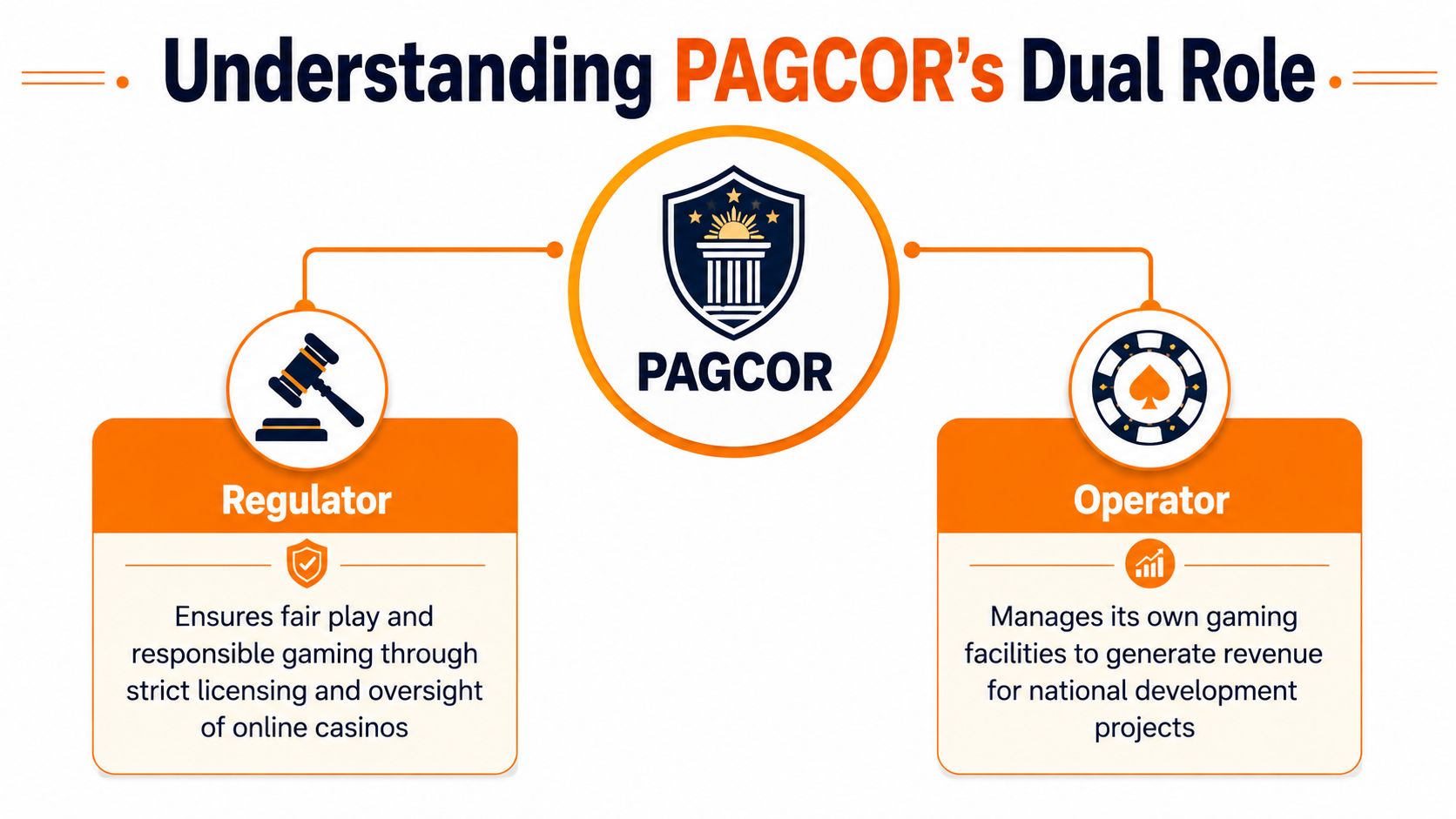
Here's the visual summary.
PAGCOR isn't just a name that appears in website footers. It matters because it is the authority players rely on when they want local oversight, accountable operators, and rules that can be enforced inside the Philippines.
PAGCOR has two roles
PAGCOR has a structure that can confuse new players because it has both a regulatory role and an operating role. In simple terms:
| Role | What it means for players |
|---|---|
| Regulator | It oversees licensing, compliance, and operational rules for gambling activities under its authority. |
| Operator | It also manages gaming activities and facilities within the broader state gaming system. |
The point for players is straightforward. When you see a site referring to PAGCOR, you shouldn't treat that as decorative branding. You should treat it as a claim that can be checked.
Why the rules changed
The older legal picture included offshore licensing. A major milestone came in 2016, when the government launched the Philippine Offshore Gaming Operations (POGO) regime and PAGCOR began issuing online-gaming licences for offshore service providers. By 2024, the industry had grown to around 300 POGO outfits, despite the government having allocated only 50 licences, before President Ferdinand Marcos Jr. ordered all POGOs and IGLs to cease operations by December 31, 2024 under Executive Order No. 74, as outlined in this background on gambling regulation in the Philippines.
That shift changed the practical legal question for players. The issue is no longer whether a site can point to an offshore structure. The issue is whether it fits the current domestic compliance model.
A site that still leans on old offshore language is giving you useful information, even if it doesn't mean to. It may be describing a legal setup that no longer matches the current Philippine direction.
What domestic licensing means in practice
Under the current framework, the centre of gravity is Philippine-facing compliance. That means local oversight, local review, and controls that make sense for users physically located in the country.
A player checking a platform today should expect to see clearer signs of domestic accountability than in the old offshore era. That includes visible licensing claims, terms that are written for Philippine users, and support processes that don't disappear once you ask a difficult question.
If you want to see how casinos present themselves to Filipino players, looking at a market-facing brand page such as Mega Panalo Casino can help you understand the kind of language and positioning commonly used in this space. The legal part, though, still comes back to whether the operator's PAGCOR status is real and current.
Licensed vs Unlicensed Casinos What Players Must Know
A polished casino homepage doesn't tell you whether the site is legal. Fast loading pages, local payment logos, and flashy promo banners can appear on both licensed and unlicensed platforms.
That's a serious issue in the Philippines because PAGCOR has publicly warned that a large share of sites accessed in the country are illegal. An ANC report discussing PAGCOR's warning stated that over 60% of online gambling sites accessed from the Philippines were operating without a proper licence.
That single fact changes how players should behave. It means you should assume that legality is uncertain until you verify it.
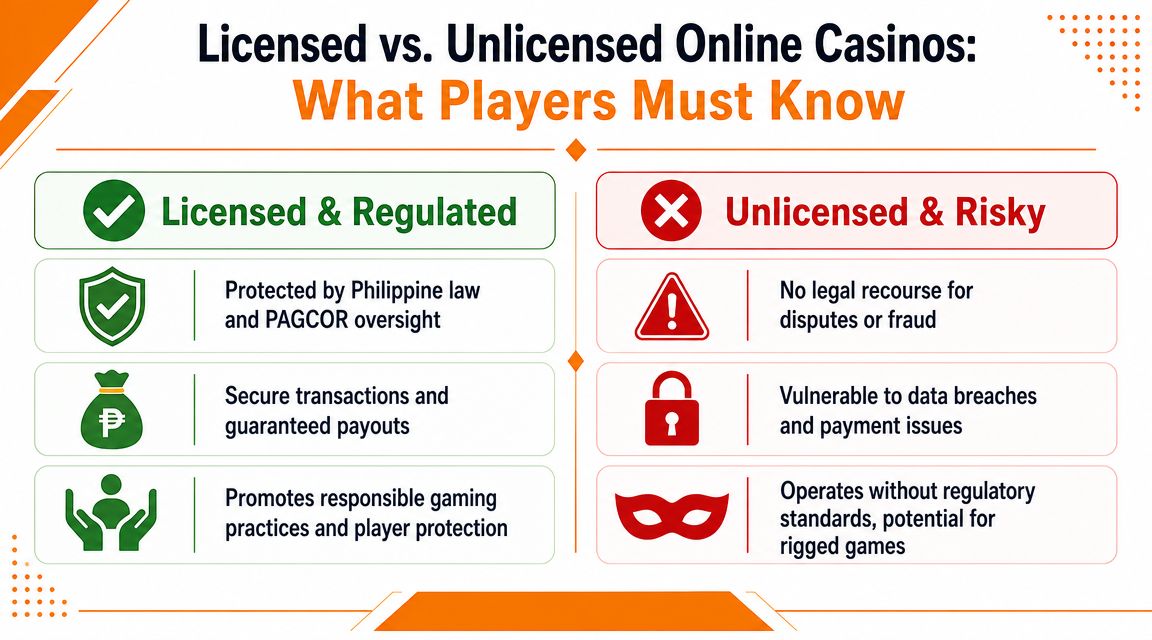
What a licensed site usually looks like
A licensed, regulated platform generally behaves like a business that expects scrutiny. It doesn't hide its legal identity, and it usually makes it easier to find the terms that govern deposits, bonuses, withdrawals, and account checks.
Here's the side-by-side difference that matters to players most:
| Issue | Licensed and regulated | Unlicensed and risky |
|---|---|---|
| Licence visibility | Licence details are usually presented clearly and consistently | Claims may be vague, missing, or hard to verify |
| KYC checks | Identity and age checks are part of the account process | Verification may be weak until withdrawal time, or absent |
| Payment handling | Terms are usually defined before deposit | Rules may change after you win |
| Dispute options | There is at least a local regulatory reference point | You may have no realistic recourse |
| Promotions | Terms should be disclosed with conditions | Bonus promises may be broad and misleading |
What players often get wrong
Many players treat strict verification as a bad sign. They think, “Why is this site asking for ID if I only want to play?” In reality, the opposite is often true. A platform that never checks identity, never asks where funds come from, and never explains its withdrawal rules may be convenient in the short term but dangerous later.
That's where the phrase online casino Philippines legal becomes practical. A legal casino doesn't just let you in. It also applies controls that can feel annoying at first but protect both the operator and the player.
If a casino is effortless when taking your deposit and evasive when discussing withdrawals, that's not convenience. That's a risk signal.
Common red flags on unlicensed sites
Use this list before you register anywhere:
- No clear operator identity: If you can't tell who runs the site, where it is accountable, or what entity holds the licence, slow down.
- Hidden withdrawal conditions: If payout timelines, verification rules, or bonus deductions are buried or missing, expect problems later.
- Support that avoids direct answers: Ask whether the site is PAGCOR-licensed. If support replies with generic marketing language instead of specifics, treat that as a warning.
- Overly broad claims: Some sites suggest they are “internationally licensed” without explaining what that means for Filipino players.
- Weak age controls: A platform that appears happy to register anyone without proper checks is not showing signs of a serious compliance culture.
For players browsing categories like JILI Bet 888, the game library itself isn't the legal issue. The legal issue is who operates the platform offering that content, under what authority, and with what safeguards attached.
How to Verify a Legal Online Casino in the Philippines
Most articles tell you to “use licensed sites” and stop there. That isn't enough. Players need a checklist they can use before depositing, especially because legality in this market depends on verification, not appearance.
A strong legal perspective on Philippine online gambling also highlights a consumer-protection gap. Many guides don't answer the practical question of how a player can confirm a site's PAGCOR status, withdrawal rules, and age-compliance safeguards before depositing money, as discussed in this Philippine legal commentary on smart regulation and consumer protection.
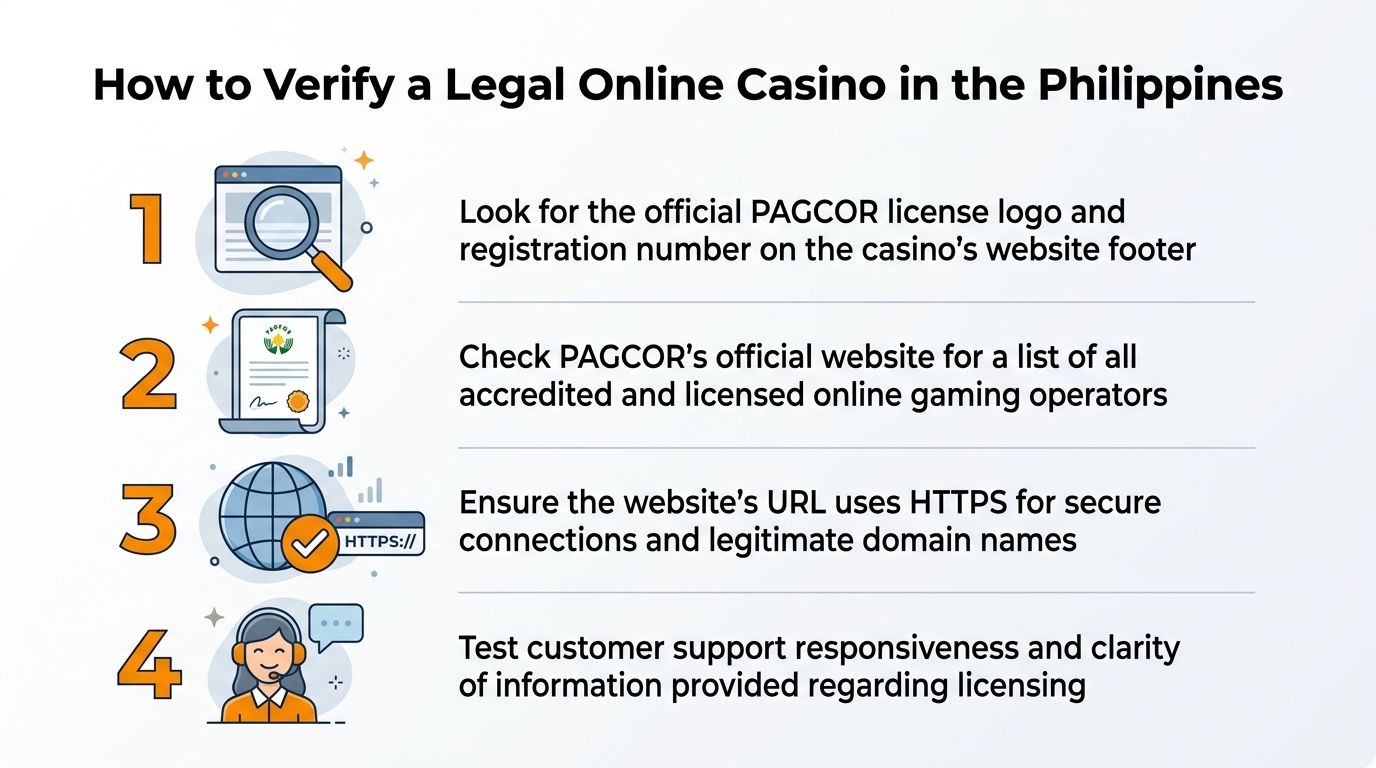
This is the checklist I'd use myself.
Start with what the site shows you
Before you register, check the footer, the about page, and the terms page.
Look for a specific PAGCOR claim
You want more than “safe and secure” language. A legal-facing site should make a concrete claim about licensing or regulatory status.Check whether the claim is consistent
If the homepage says one thing and the terms page says another, that's a concern. Legitimate operators usually keep their legal identity consistent across the site.Inspect the terms before deposit
Focus on withdrawals, account verification, bonus restrictions, and account suspension triggers. Don't wait until after winning to discover what the site really requires.
Test the site like a cautious customer
A useful verification step is to act like someone who's about to send money and ask direct questions first.
Try these:
- Ask support who the operator is: If the answer is vague, that matters.
- Ask what documents are needed for withdrawal: A compliant site should be able to explain the process clearly.
- Ask how bonus terms affect cashout: If support dodges the question, assume the terms may be unfavourable or poorly administered.
Ask your hardest question before your first deposit, not after your first win.
Check whether the compliance signals make sense
A legal Philippine-facing casino should show signs that it expects domestic oversight. That includes clear terms, identity checks, and rules that apply before payment disputes start.
Here's a simple decision framework:
| Checkpoint | Good sign | Bad sign |
|---|---|---|
| Licence disclosure | Easy to find and specific | Missing or generic |
| Withdrawal policy | Written in plain language | Vague or incomplete |
| Age and ID controls | Visible and enforced | Barely mentioned |
| Support answers | Direct and consistent | Evasive or promotional |
| Promotional terms | Conditions disclosed | Big promises, little detail |
One practical example
One example often discussed by Filipino players is Insta Play Online Casino app access through its PH 777 Casino download page. What matters in a case like this isn't marketing style. It's whether the platform openly presents its legal status, explains player-facing terms, and supports a verification flow that makes compliance visible before a user deposits.
That's the standard you should apply to any operator. Don't ask whether the site looks popular. Ask whether it gives you enough information to verify that it is lawful, accountable, and transparent.
Your Legal Responsibilities Age Verification and Taxes
Legality doesn't only apply to operators. Players also have responsibilities when they use an online casino in the Philippines.
The most important idea is this: a compliant casino shouldn't let you play anonymously forever. If a platform is operating under the domestic Philippine model, it has to care about who you are, where you are, and whether your payment activity fits its compliance obligations.
According to Altenar's explanation of the current Philippine online-gambling compliance model, domestic PAGCOR licensing shifts operators toward a locally enforceable setup that includes geo-restricted access, KYC/AML controls, and payment routing designed for domestic oversight rather than offshore service delivery. For players, that means identity verification is not an optional extra. It's part of how legal platforms operate.
Why age and identity checks matter
Many players only think about verification when a withdrawal gets delayed. That's backwards. On a compliant site, age and identity checks are part of the legal process from the start.
You should expect a legal operator to ask for documents that confirm:
- Your identity: The account should match a real person.
- Your location: Access may depend on you being physically within the Philippines.
- Your payment connection: The deposit method and account holder details should make sense together.
If you're preparing your payment tools before registering, practical guides such as this GCash verification walkthrough can help with the payment-readiness side, but that doesn't replace casino-side compliance checks.
What about taxes
Tax questions confuse many players because they want a single easy rule. The safer legal approach is to avoid assuming anything that the platform does not clearly explain and to treat gambling records seriously.
Keep your own basic records of deposits, withdrawals, and account statements. If a site offers no transaction history, or makes it hard to download or review your own payment activity, that's another sign of weak transparency.
Good record-keeping protects you even when the legal rule feels unclear. If money moves in and out of your account, keep a clean trail.
Responsible play is part of legal play
A regulated environment is not only about collecting ID. It also means the operator should have controls around account access, player verification, and risky account behaviour.
As a player, your side of the bargain is simple. Use your own identity, your own payment channels, and accurate account information. Don't borrow someone else's details to get around a check. If a platform seems happy to let you do that, it's showing you exactly how weak its controls are.
Conclusion Playing Smart and Safe in the Regulated Market
The legal answer is straightforward once you strip away the noise. Online casino play is allowed in the Philippines when the operator is properly licensed and compliant under the current PAGCOR-centred framework. The hard part isn't the headline answer. The hard part is separating legal operators from the many sites that only look trustworthy on the surface.
That's why verification matters more than promotion. Bonus size, game count, and app design should never come before basic checks like licence claims, withdrawal rules, age verification, and support clarity. If a site can't explain who regulates it, how it handles withdrawals, or what documents it requires, you shouldn't be sending it money.
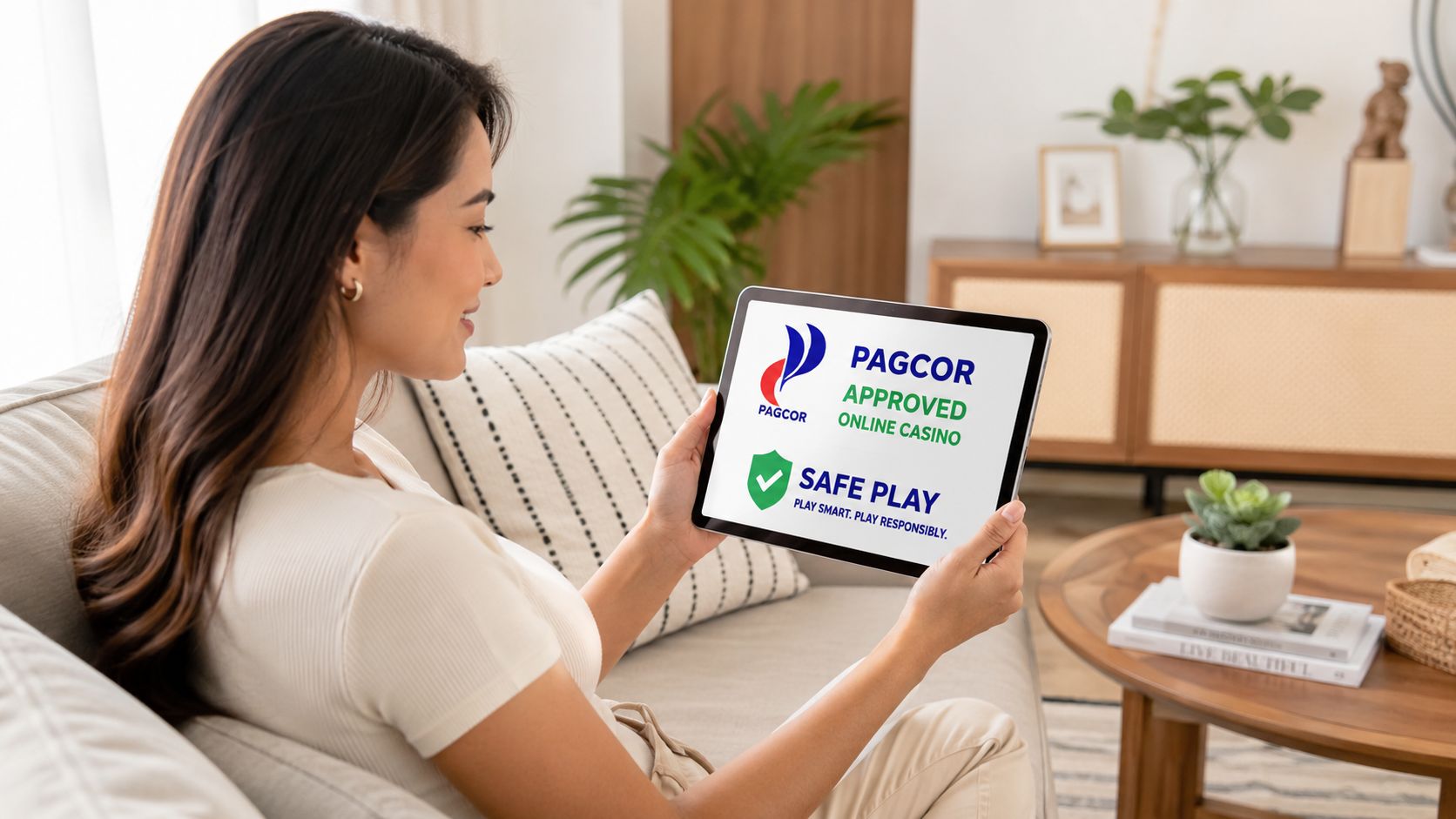
A simple safe-play shortlist
Keep these habits in mind whenever you evaluate a casino:
- Verify before deposit: Check licence claims, terms, and support responsiveness first.
- Read withdrawal rules early: Don't rely on promo banners. Read the cashout conditions yourself.
- Use your real details: Mismatched names and payment methods often create problems later.
- Keep records: Save screenshots of terms, bonuses, and transaction history.
- Leave if answers are vague: If support can't give direct compliance information, move on.
A smart player treats legality as a filter. If a platform passes that filter, then you can start comparing games, payment convenience, and user experience. If it fails that filter, nothing else on the site matters.
If you want a Philippine-facing option to evaluate, Insta Play Online Casino presents itself as a PAGCOR-licensed platform with locally relevant games, payment-friendly access, and clearly visible player-facing content. The right next step is the same one recommended throughout this guide: review its licence claims, check the terms, and confirm the withdrawal and verification rules before you deposit.




Join thousands of gaming professionals receiving the latest iGaming news, regulatory updates, and market insights.
