

PAGCOR's 2025 advertising reset changed the compliance baseline for every gambling operator, affiliate, and media buyer in the Philippine market. Once PAGCOR and the Ad Standards Council signed the memorandum of understanding that made branded and corporate gambling ads subject to prior ASC review and approval across television, radio, online, and outdoor media, campaign launch planning stopped being a simple creative sign-off exercise and became a regulated workflow with a gatekeeper attached to it (PAGCOR and ASC sign MOU on gambling ads).
That shift matters because gambling was then placed inside the ASC's broader must-screen category framework, alongside alcohol, milk, food supplements, over-the-counter drugs, and transport fare promos (same PAGCOR and ASC MOU notice). For operators, the practical result is simple, even if the process is not. Creative teams can no longer treat ads as publish-ready once a brand manager approves them. They have to clear the regulator-facing review path first.
Table of Contents
- The 2025 Regulatory Shift That Changed Everything
- Core Legal Framework and Responsible Gaming Requirements
- Permitted Versus Prohibited Advertising Content
- Navigating the ASC Pre-Screening Approval Process
- Platform-Specific Rules and the Outdoor Advertising Ban
- Enforcement Actions and Penalty Consequences
- Building Your Compliance Checklist and Sample Ad Copy
The 2025 Regulatory Shift That Changed Everything
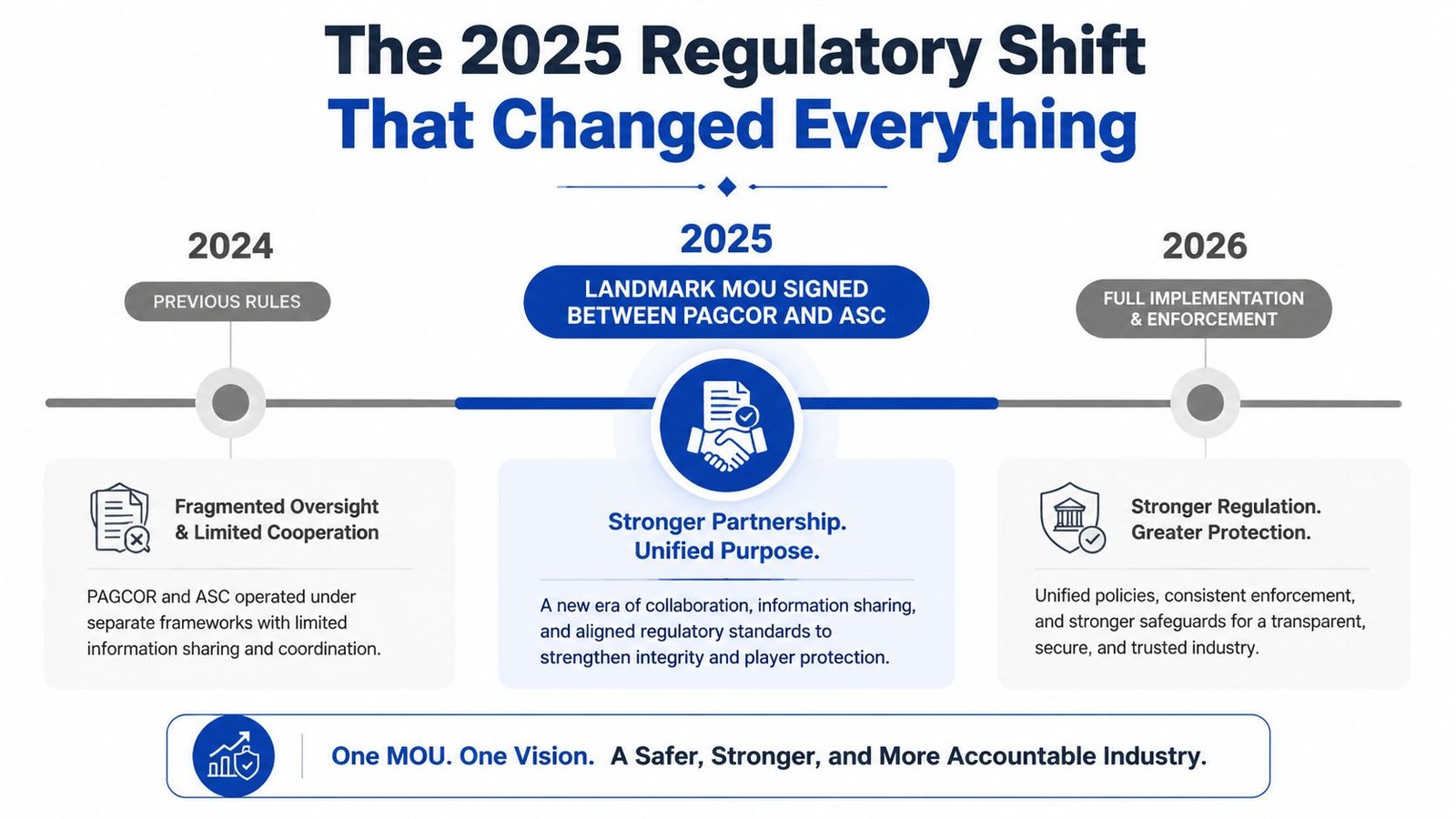
The 2025 MOU between PAGCOR and the ASC did more than add another approval layer. It moved gambling advertising into a formal pre-screen regime that applies before public release, which changes how campaigns are built, scheduled, and budgeted (PAGCOR and ASC sign MOU on gambling ads). For operators that run simultaneous campaigns across TV, radio, digital, and outdoor placements, the primary issue is no longer whether a creative idea is persuasive. It is whether that idea survives multi-stage compliance review without forcing a last-minute production rebuild.
Why the MOU changed operating discipline
The regulator's move effectively extended pre-screening to a broad set of gambling advertisements, and later guidance framed gambling as the sixth must-screen category (PAGCOR and ASC sign MOU on gambling ads). That matters operationally because must-screen categories usually require tighter internal version control, earlier legal review, and cleaner substantiation before submission. A campaign with multiple cutdowns, language variants, and platform-specific edits now has more ways to fail review if the underlying claims are not aligned.
The same 2025 guidance also described a much firmer enforcement posture on outdoor media. PAGCOR later ordered the removal of gambling-related outdoor advertising, which showed the regulator was not only reviewing ads before release, but also pulling back existing inventory already in market (PAGCOR July 2025 outdoor ad order). That combination tells compliance teams something important. The regulator is supervising both creative approval and media placement, so campaign compliance has to cover the full lifecycle, not just the ad copy.
Practical rule: if a campaign cannot be defended in a compliance memo before it goes to ASC, it is already too late to fix cheaply.
What operators should change in their workflow
Campaign calendars now need a compliance lead time that starts before production, not after. Creative briefs should be written with legal constraints in mind, and media buys should remain conditional until approval is secured. For operators and affiliates, that also means house rules for paid media need to reflect the new status of gambling as a must-screen category, because the review burden lands on the publisher, the advertiser, and often the agency chain at the same time.
The operational takeaway is straightforward. PAGCOR gambling advertising rules are no longer just content restrictions. They are a workflow mandate that touches briefing, drafting, review, resubmission, and media scheduling. Teams that still treat approval as a final checkbox will keep absorbing delays that were avoidable from the start. For a broader licensing context, see the 2026 B2B accreditation checklist for Philippine gaming businesses.
Core Legal Framework and Responsible Gaming Requirements
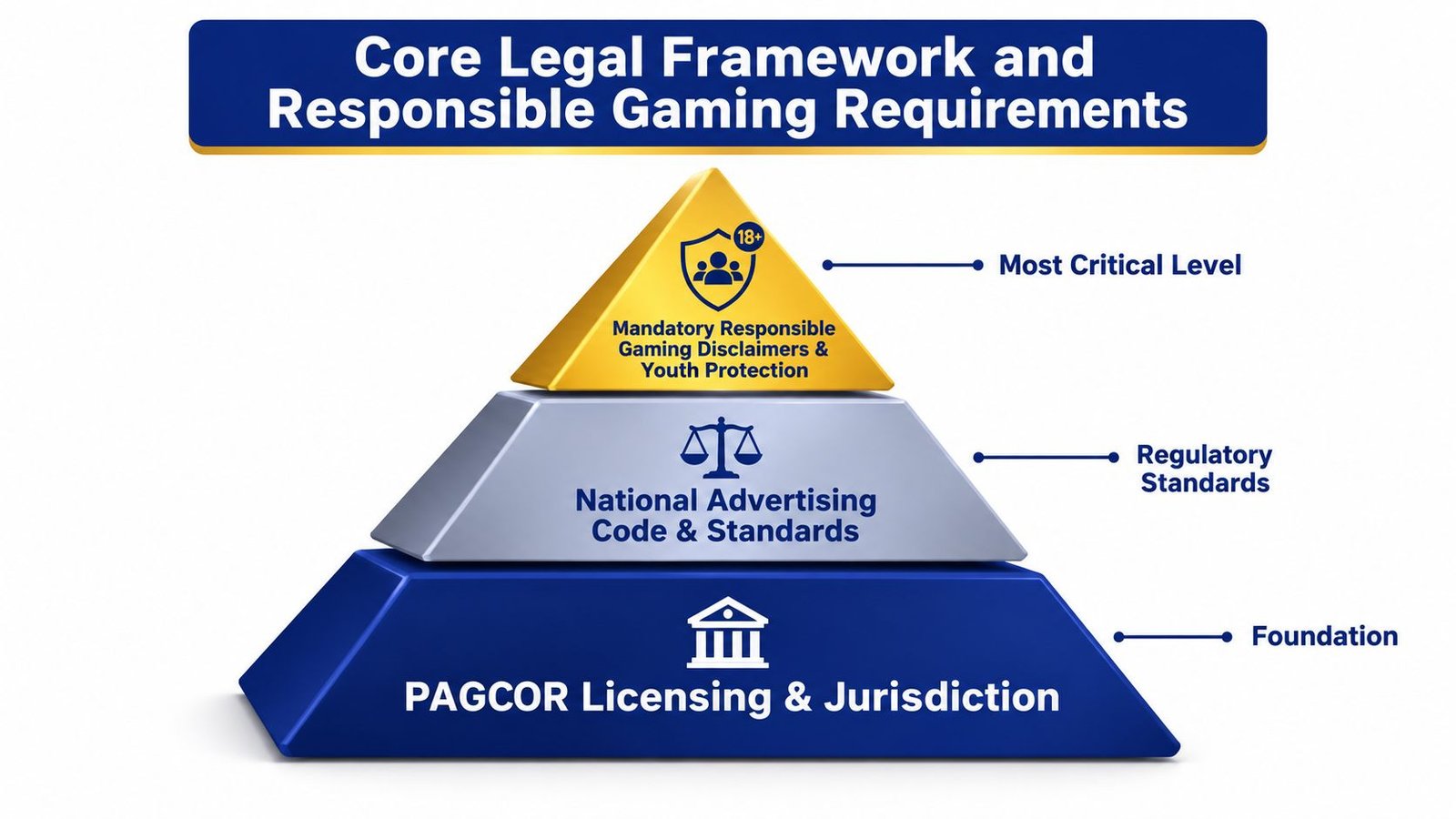
PAGCOR's responsible gaming code sets the baseline for every gambling ad in the Philippines. Advertising in any media must be socially responsible, must not target or feature people who are under 21, and must not portray gambling as a cure for financial problems or encourage socially irresponsible gambling (PAGCOR Responsible Gaming Code of Practice). That is not a styling preference. It is the core legal filter that decides whether a campaign can be shown to the public at all.
The mandatory message operators cannot omit
The code also requires mandatory age-and-responsible-gaming messaging across TV, print, billboards, web promos, and other media, including the closing tagline, “Gaming for 21 years old and above only. Keep it Fun. Game Responsibly.” The radio end-tag is “Keep it Fun. Game Responsibly.” (PAGCOR Responsible Gaming Code of Practice). That means the compliance review is not finished when the copy reads well. It is finished only when the correct disclaimer is present in the correct format for the medium.
The reason this matters is straightforward. Responsible gaming statements are often treated like a footer, but PAGCOR's framework makes them part of the ad's legal substance. A polished creative concept that omits the required line is still non-compliant. The same applies if the ad tone suggests gambling can solve bills, debt, or other financial pressure.
Compliance reality: a creative that implies relief from money problems is not “bold marketing,” it is likely to be read as a prohibited message.
How teams should operationalize the rule set
Marketing and legal teams should split the review into three checkpoints. First, screen the audience, and remove any creative device that could reasonably appeal to under-21 viewers. Second, test the main claim, and ensure the ad does not frame gambling as an income substitute or financial rescue. Third, verify the end-tag for the exact channel, because television, print, web, billboard, and radio do not all use the same closing language.
That review structure is especially important for multilingual campaigns, influencer scripts, and cutdown edits. If the core message changes between assets, the required disclaimer can disappear in the transition. The safest approach is to keep a master compliance template for all public-facing gambling promotions, then adapt it only after the disclaimer and age-protection elements are locked in.
For operators working through broader Philippine market mechanics, the Philippines online casino PAGCOR overview helps frame how advertising rules sit inside the wider licensing environment.
Permitted Versus Prohibited Advertising Content
The cleanest way to audit a campaign is to separate what PAGCOR gambling advertising rules allow from what they clearly prohibit. The ad should lead with licensed product information, responsible gaming language, and audience-appropriate messaging. It should not lean on emotional pressure, youth appeal, or financial rescue narratives. That distinction is especially important for affiliates, where creative language can drift from brand-safe to regulator-risky very quickly.
Quick comparison for campaign review
| Permitted Content | Prohibited Content |
|---|---|
| Clear branding tied to a licensed operator | Any appeal to minors or youthful subcultures |
| Required responsible gaming and age messaging | Claims that gambling fixes financial problems |
| Neutral product descriptions for licensed offers | Content that encourages socially irresponsible gambling |
| Channel-appropriate disclaimer placement | Creative cues that make under-21 audiences the target |
| Straightforward promotional language | Misleading impressions of certainty, recovery, or easy profit |
The table above is the practical starting point. A campaign can still be rejected if the tone suggests pressure, urgency, or guaranteed outcomes, even when the exact words look harmless on paper. That is why affiliate reviews need to look beyond copy and assess imagery, casting, music, and call-to-action phrasing together.
What to remove before submission
A responsible compliance review should strip out anything that looks like youth targeting, especially slang, meme-style visual references, or influencer formats that skew younger. It should also avoid any creative hook that implies gambling can replace income, pay debts, or solve temporary cash problems. Even if the claim is indirect, regulators tend to focus on the message a reasonable viewer would take away.
The same discipline applies to licensing references and age verification cues. If an ad names a product, it should do so in a way that matches the licensed offer exactly. If it invites a viewer to act, it should do so with the correct age and responsible gaming message attached. That is the quickest way to keep a campaign out of the revision queue.
For affiliate teams reviewing cross-sell creative, the sabong online bet resource is a useful reminder that format-specific messaging still has to sit inside the broader Philippine compliance framework.
Navigating the ASC Pre-Screening Approval Process
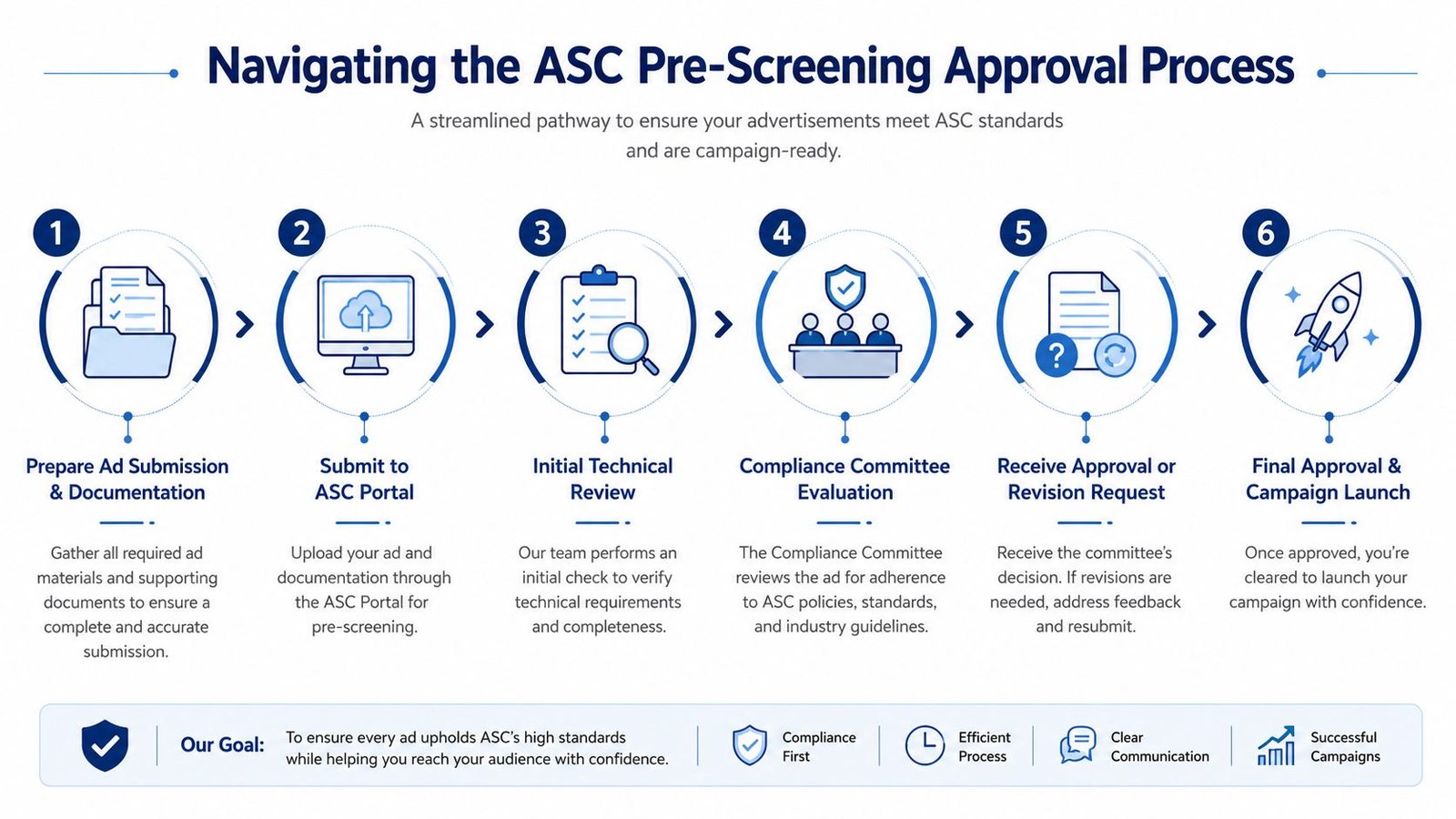
ASC pre-screening now sits at the center of gambling ad compliance in the Philippines, so campaign teams need a repeatable submission process rather than an ad hoc approval habit. The 2025 MOU made prior review mandatory for branded and corporate gambling ads across television, radio, online, and outdoor media, which means the approval file has to be ready before the media plan is locked (PAGCOR and ASC sign MOU on gambling ads).
Build the file before the creative is frozen
The best submissions usually start with a clean package, not a polished late-stage edit. The file should include the final ad version, the exact responsible gaming message for the target channel, and any support material needed to show that the content is licensed and age-appropriate. If an agency sends in a partially completed asset, the review process can stall before it even gets to substantive assessment.
The workflow should move in a clear sequence.
- Prepare the submission package with final creative, channel version, and required disclaimer.
- Check internal compliance against age targeting, financial rescue messaging, and responsible gaming rules.
- Submit for ASC review before the campaign is booked for public release.
- Respond quickly to revision requests if the review team asks for clarification or edits.
- Lock approval records so the final live asset matches the approved version.
- Launch only after sign-off, not while edits are still floating through email.
Why digital teams need the same discipline as broadcast teams
Digital and social assets often fail because teams assume a banner or short-form video is easier to clear than television. That assumption is risky. If a campaign appears across multiple platforms, every version still needs to carry the right message and survive the same pre-release logic. Even small format changes, such as a new headline, different end card, or shortened disclaimer, can create a fresh compliance problem.
Approval is not a production task. It is a controlled release process, and the asset that gets approved is the only asset that should go live.
Internal planning should also connect approval timing to media buying deadlines. If a booking cannot be delayed, the creative deadline needs to move earlier. For teams mapping campaign economics, the user acquisition cost discussion helps frame why compliance delays can distort acquisition planning even when the ad itself is strong.
Platform-Specific Rules and the Outdoor Advertising Ban
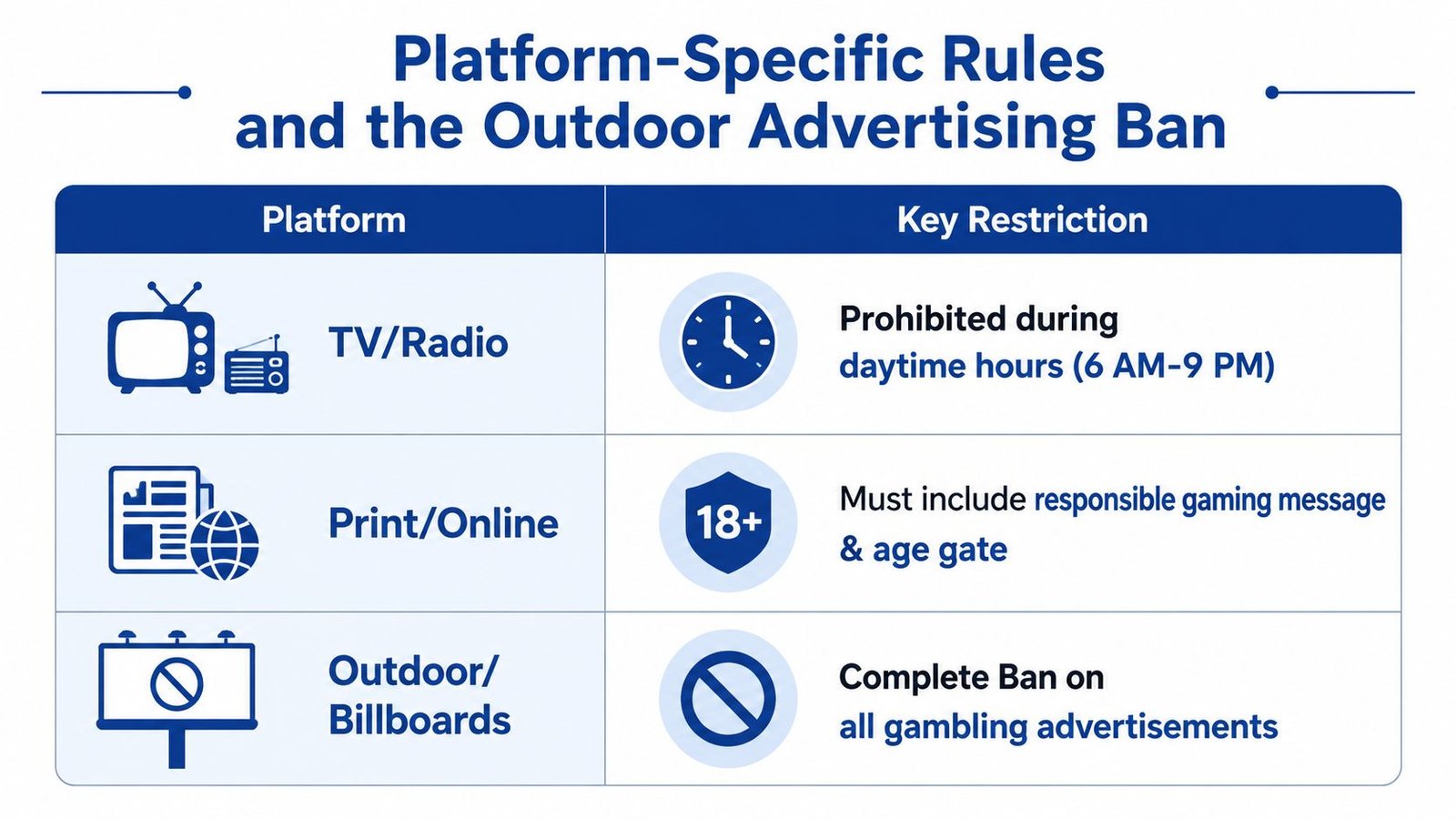
PAGCOR's framework does not treat every channel the same way. Broadcast, digital, social, and out-of-home media each sit under the same overall rules, but the enforcement intensity differs by format. That became clear when PAGCOR indicated that gambling advertising was already prohibited during primetime television and radio hours, while it was evaluating whether that restriction should extend to all broadcast hours (Digital Policy Alert summary of PAGCOR advertising rules).
Outdoor media took the hardest hit
The sharpest change came in July 2025, when PAGCOR ordered the removal of all gambling-related outdoor advertising by 15 August 2025 and required operators to submit billboard and wallscape inventories by 16 July 2025 (PAGCOR outdoor ad order notice). A separate industry report described the order as covering billboards and other out-of-home placements, including ads on buses, jeepneys, taxis, and trains, with immediate removal required and full compliance due by the same August deadline (ASGam report on PAGCOR outdoor ad removal).
That structure matters because it was not a blunt one-day shutdown. It created a phased enforcement mechanic. Operators had to inventory existing assets first, then remove them by the deadline, which gave compliance teams a narrow but real transition window. For advertisers, that meant location audits, landlord coordination, transit media shutdowns, and creative replacement planning all had to happen at once.
Digital coordination is moving toward the same model
PAGCOR also said it was coordinating social-media and digital-platform rules with the ASC (Digital Policy Alert summary of PAGCOR advertising rules). That point is important because it signals a framework that is no longer focused only on billboard removal or TV spot approval. It is expanding toward platform-wide supervision, which is the direction most compliance teams had already anticipated.
For operators, the immediate takeaway is to treat each platform as its own compliance file. Broadcast needs timing discipline. Outdoor needs inventory control and removal logs. Digital needs approval-ready creative variants and fast asset replacement. Affiliates should assume that anything purchased for broad reach will get the hardest scrutiny, especially when the creative crosses into public spaces or high-visibility placements.
Enforcement Actions and Penalty Consequences
Enforcement in this area is best read as a pattern, not a single event. PAGCOR has already shown that it is willing to move from rule-making into operational action, first by tightening ad standards and later by ordering outdoor removals and inventory submissions (PAGCOR outdoor ad order notice). That means a violation is no longer just a theoretical risk in a policy document. It can become a placement issue, a production issue, and a licensing issue at the same time.
What usually draws the fastest regulatory response
The strongest response is likely to come when an ad breaches the clearest boundaries, especially content that targets minors, omits required responsible gaming messaging, or presents gambling as a financial fix. Those are the areas PAGCOR already identified in its responsible gaming code (PAGCOR Responsible Gaming Code of Practice). Once a campaign crosses one of those lines, the compliance defence becomes much weaker because the rule is explicit.
The outdoor advertising order adds another enforcement lesson. PAGCOR did not just announce a preference change. It required existing advertisers to inventory assets and remove them within a deadline, which is a sign that compliance is being measured against physical media presence, not just policy statements. That is a meaningful shift for operators who still rely on legacy placements or third-party transit inventory.
Why repeat issues are harder to defend
Repeat non-compliance is especially dangerous because each violation makes future approvals harder to justify internally. A brand that keeps sending incomplete or borderline assets into review burns goodwill with both regulators and media partners. Even without a publicly detailed penalty ladder in the verified record, the risk is obvious, repeated failures can delay approvals, trigger removal actions, and complicate the operator's broader relationship with PAGCOR.
For compliance teams, the lesson is to build a warning-and-escalation protocol before a regulator does it for them. That protocol should flag prohibited copy, stop unsupported campaigns, and require sign-off before any media booking. The cost of that discipline is low compared with the operational damage of having to pull an active campaign after public release.
Building Your Compliance Checklist and Sample Ad Copy
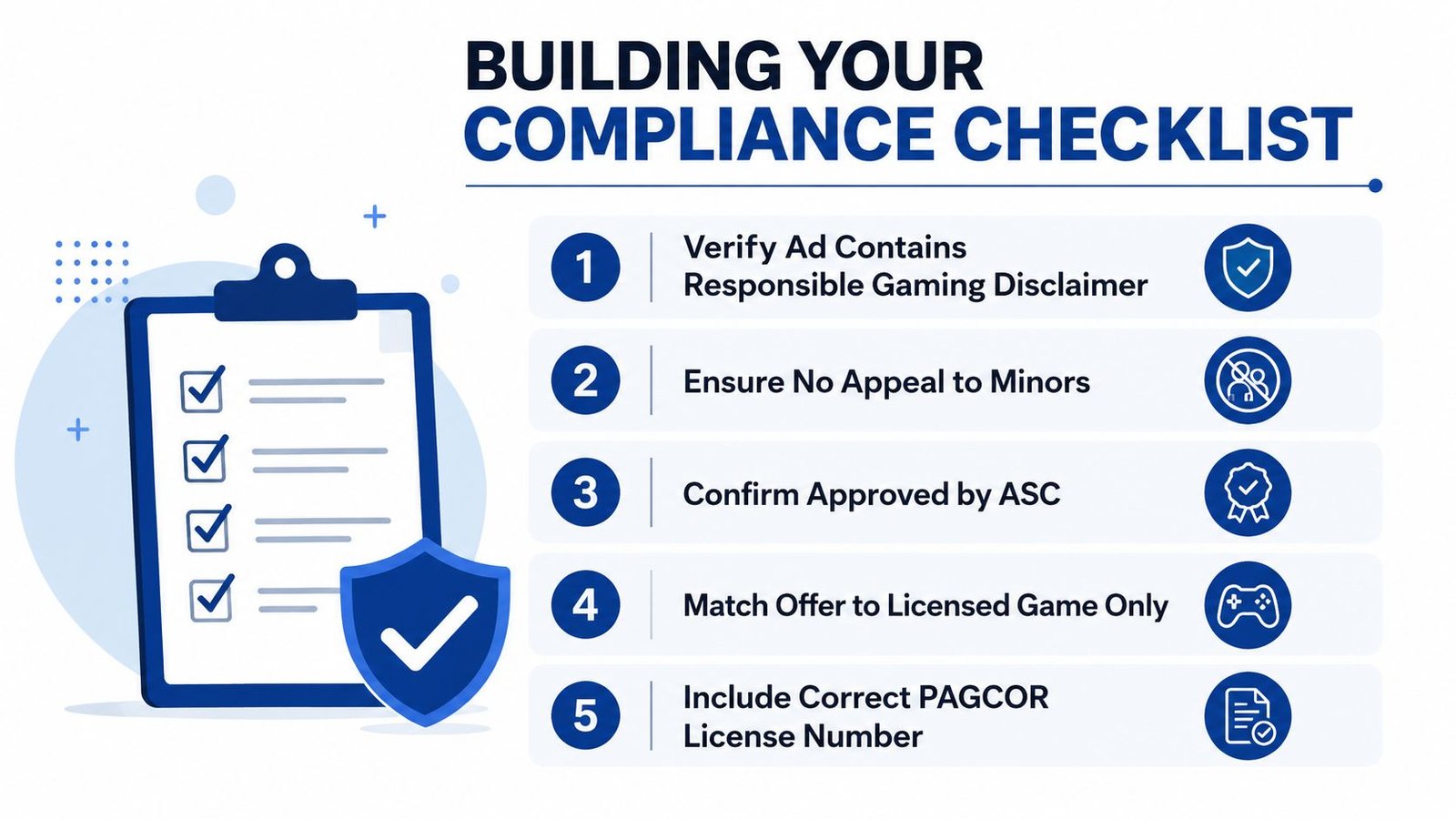
The simplest way to operationalize PAGCOR gambling advertising rules is to turn them into a launch checklist that sits inside the campaign approval workflow. The checklist should not be a legal memo that nobody opens. It should be a live production tool that the marketing lead, compliance officer, and agency all use before a single asset is submitted.
Practical launch checklist
- Verify the disclaimer first. Match the required responsible gaming and age message to the channel, including the exact TV, print, billboard, web, or radio closing line from PAGCOR's code (PAGCOR Responsible Gaming Code of Practice).
- Check the audience profile. Remove anything that appears to target under-21 viewers, including visual styling, casting, or tone.
- Review the core claim. Make sure the ad does not imply gambling solves debt, income gaps, or financial pressure.
- Confirm ASC status. Do not schedule public release until approval is secured for the exact asset version.
- Match the platform rule. Keep outdoor, broadcast, and digital requirements separate so one channel's formatting does not leak into another.
Sample compliant and non-compliant copy
A safer ad line would read, “Play with a licensed operator, and remember the required responsible gaming message for the channel.” That works because it focuses on licensed play and compliance language rather than promised outcomes.
A risky line would be, “Use your next win to solve your bills.” That is problematic because it frames gambling as a financial rescue tool, which sits directly against PAGCOR's prohibition on portraying gambling as a cure for financial problems (PAGCOR Responsible Gaming Code of Practice).
For affiliates, the practical fix is usually to simplify. Clean product naming, age-appropriate language, and channel-specific disclaimers travel better through review than hype-driven copy. Operators that build those controls into their briefing template usually spend less time rewriting assets after submission and more time launching campaigns that survive regulatory scrutiny.
Top 1 Rank recommends that operators and affiliates treat every PAGCOR gambling advertising rules review as a pre-launch risk test, not a creative formality. Use the checklist above on every campaign brief, lock the correct channel disclaimer before production starts, and keep all ASC approvals attached to the live asset record so the team can prove exactly what was approved.





Join thousands of gaming professionals receiving the latest iGaming news, regulatory updates, and market insights.
