

You're probably looking at a dashboard that says your campaign is working. Registrations are coming in. Bonus claims are climbing. Your paid traffic looks active. On the surface, it feels like growth.
But if you run an online casino in the Philippines, that surface view can fool you fast. A welcome offer can drive a wave of sign-ups and still leave you with weak first deposits, poor retention, and marketing spend that never comes back. That's why user acquisition cost matters so much. It tells you what you paid to get each new user, and whether your growth is sustainable or just expensive noise.
The Philippine market gives you reach, but it also gives you competition. Early 2024 data cited by Amra & Elma's customer acquisition cost statistics notes that the Philippines had 86.98 million internet users, equal to 73.6% of the population, while social media users reached 87.35 million, or 73.9%. For iGaming operators, that means large digital audiences are available, but every serious operator, affiliate, and media buyer is competing for the same attention.
Table of Contents
- Why User Acquisition Cost Is Your Most Important Metric
- The Real Way to Calculate iGaming CAC
- Looking Beyond CAC With LTV and Payback Period
- CAC Benchmarks and Channels in the Philippines
- How to Accurately Track Your Acquisition Costs
- Strategies to Lower CAC and Boost Player Quality
Why User Acquisition Cost Is Your Most Important Metric
A new operator often starts by watching the wrong numbers. Clicks look healthy. Installs look promising. Registrations create momentum. Even a bonus page like a free sign-up bonus offer can make the top of the funnel look strong.
None of that tells you whether you're building a real business.
User acquisition cost is the number that forces honesty. It answers a simple question: how much did you spend to acquire each new user? In iGaming, that question matters more than vanity metrics because deposits, repeat play, and long-term value don't automatically follow from traffic.
What CAC tells you that sign-ups don't
A casino operator can buy cheap traffic and still lose money. That happens when users register only to claim an offer, fail KYC, never deposit, or churn after the first session. In the Philippines, where digital reach is broad and competition for attention is intense, small changes in conversion quality can push acquisition economics in very different directions.
That's why CAC works as a control metric. It connects marketing activity to business reality.
Consider the difference between these two situations:
- High-volume registrations: A campaign brings in many new accounts, but most users stop before first deposit.
- Lower-volume, stronger intent: Another campaign brings in fewer sign-ups, but more of them complete onboarding and become active players.
The first campaign looks exciting in a dashboard built around volume. The second usually looks better in a finance review.
Practical rule: If your reporting celebrates registrations before it explains acquisition cost, deposit conversion, and player value, you're reading the wrong scoreboard.
Why this matters more in PH iGaming
Philippine iGaming operators deal with a local mix of realities that general marketing articles often ignore. PAGCOR compliance shapes what you can say and how you can advertise. Player trust affects whether users move from click to registration to deposit. Payment friction can break conversion even when ads are performing well.
That makes user acquisition cost more than a marketing KPI. It becomes a management tool for deciding:
| Business decision | What CAC helps you judge |
|---|---|
| Bonus strategy | Whether an offer attracts valuable players or low-intent claimers |
| Channel budget | Which sources deserve more spend and which only look efficient |
| Onboarding flow | Whether friction is inflating cost after the click |
| Compliance-led messaging | Whether safer, clearer messaging still produces acceptable economics |
A disciplined operator treats CAC as the first test of sustainable growth. If you don't know what each user costs, you can't know whether your budget is buying a player base or just buying activity.
The Real Way to Calculate iGaming CAC
The standard formula is still the right starting point. CAC equals total acquisition spend divided by new users acquired. Count's guide to user acquisition cost is useful here because it states the core model plainly and clarifies what should sit inside that spending number for online gaming.
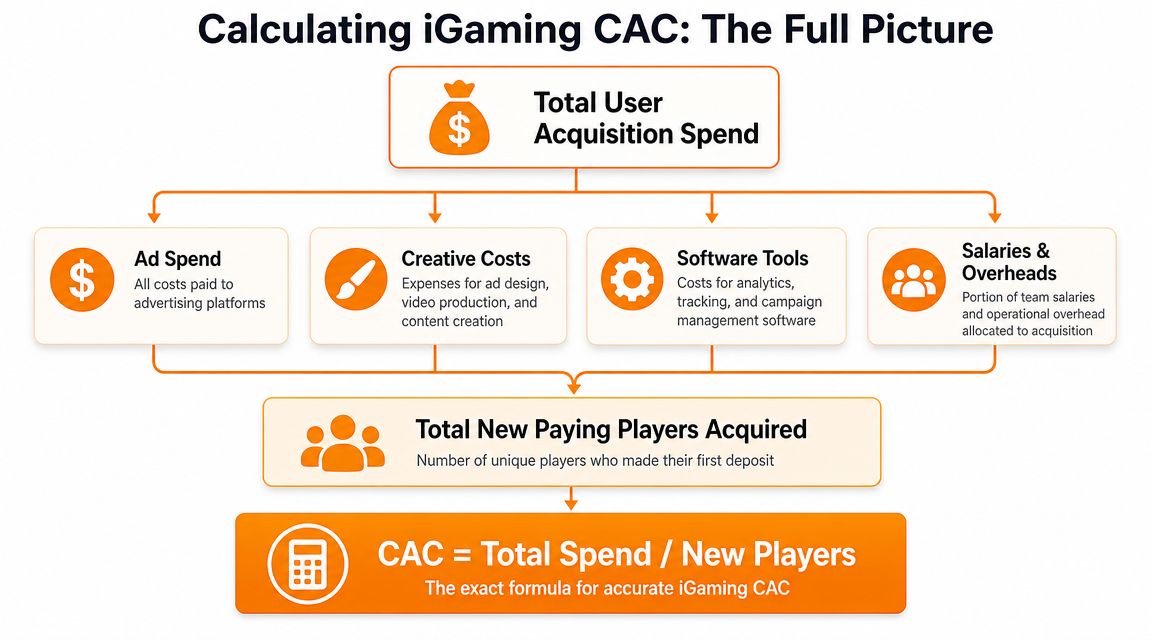
Most mistakes don't come from the formula. They come from pretending the numerator is smaller than it really is.
What belongs in your acquisition spend
For iGaming, an honest CAC calculation should include more than media spend. The same Count reference explains that the numerator should include paid media, affiliate commissions, CRM or onboarding tooling, and a pro-rated share of acquisition-team labour. If you leave those out, your reported CAC will look cleaner than your actual operation.
Consider building a house. The roof is visible, so everyone remembers to budget for it. The wiring behind the walls is less visible, but the house doesn't work without it. In the same way, acquisition doesn't happen because of ads alone. It depends on the full system around those ads.
Your practical cost stack usually includes:
- Paid media spend: Facebook, TikTok, display, search, app campaigns, and boosted placements.
- Affiliate payouts: Revenue-share, CPA-style deals, hybrid arrangements, and placement fees.
- Onboarding tools: CRM flows, messaging systems, funnel tools, analytics, and verification support.
- Team cost allocation: The part of your marketing staff's time that directly supports acquisition.
- Creative production: Ad videos, landing page design, copywriting, and offer assets.
- Promotional support costs: The operating cost of running acquisition-led offers, such as a registration free spins promo, when it is clearly part of the new-user acquisition engine.
What should count as a new user
The actions of casino operators frequently muddy the picture. A registration is not always the right denominator.
For most PH iGaming teams, the cleaner operating definition is new paying players acquired. If you divide your spend by all sign-ups, you'll flatter your CAC whenever low-intent users flood the funnel. If you divide by first depositors, the number gets stricter, but it becomes far more useful.
The closer your denominator is to revenue behaviour, the more useful your CAC becomes.
A clean calculation process
Use one time period. Monthly works well for most operators because spend, affiliate billing, and campaign changes move quickly.
Then do this:
- Pull all acquisition-related costs for the month. Don't isolate only ad platform invoices.
- Allocate shared costs fairly. If a CRM or team member supports both acquisition and retention, use a consistent pro-rated method.
- Define one acquisition outcome. New registrants, verified users, or first depositors. Pick one and stick to it.
- Divide total spend by that count.
- Repeat by channel. Your blended CAC matters, but channel CAC is what lets you act.
A deceptively low CAC usually means one of two things. You're excluding real costs, or you're using a weak denominator. Both create false confidence, and false confidence is expensive in iGaming.
Looking Beyond CAC With LTV and Payback Period
A low acquisition cost can still be a bad deal. If a player signs up, deposits once, uses a bonus heavily, and disappears, the campaign may look efficient at entry and weak in reality. That's why smart operators never read CAC on its own.
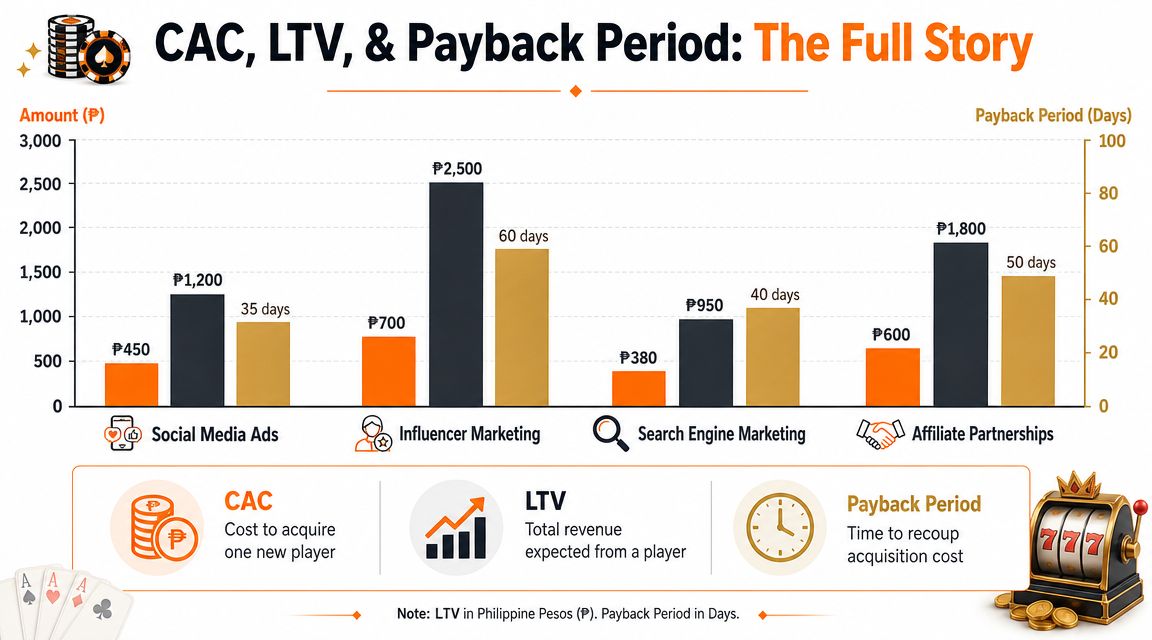
User acquisition cost becomes meaningful only when you compare it with LTV, or lifetime value, and with payback period, which is the time it takes to recover your acquisition spend. If you're promoting a content or game hub such as Mega Panalo Casino, the key question isn't whether traffic arrived. It's whether those users stay, play, and produce enough value to justify what you spent to get them.
Why cheap users can be expensive
A cheap user can be expensive if that player has weak retention, low deposit intent, or repeated bonus-seeking behaviour. This is common in bonus-led environments where an offer gets attention but doesn't filter for quality.
A more expensive user can be healthier if that player:
- completes onboarding cleanly
- makes a first deposit without excessive support
- returns after the first session
- prefers games with steadier engagement
- responds to CRM without requiring constant incentives
That's why channel comparison matters. One source may send low-cost traffic that rarely matures. Another may send fewer users at higher cost, but those players behave better after acquisition.
A simple LTV lens
You don't need a complicated model to start. In practical terms, LTV is the revenue value you expect a player to generate across the relationship. The exact model varies by operator, game mix, retention curve, and bonus structure, but the management question stays the same:
Does player value comfortably exceed acquisition cost?
If the answer is unclear, you shouldn't scale that channel.
A useful working habit is to review these side by side:
| Metric | What it tells you |
|---|---|
| CAC | What you paid to acquire the player |
| LTV | What the player is worth over time |
| LTV to CAC | Whether acquisition creates healthy unit economics |
| Payback period | How fast the business recovers the upfront spend |
A channel with a higher CAC can still be the better bet if the players it brings in stay active longer and recover spend faster.
A simple way to think about payback
Payback period matters because acquisition spend leaves your account today, while player value comes back over time. If cash recovery is too slow, you can create strain even while growth charts look positive.
This is especially relevant in local iGaming operations because spend often lands upfront across media, affiliates, creative, and bonuses, while player behaviour unfolds in stages. A user may register today, deposit later, and either become valuable or disappear before recovering the initial cost.
Here's a practical way to use payback in decision-making:
- Fast payback: Gives you more room to reinvest quickly.
- Slow payback: Demands tighter cash discipline and stronger retention confidence.
- Unclear payback: Usually signals weak tracking, poor cohort analysis, or both.
A beginner's mistake is treating all acquired users as equal. They aren't. Some channels produce volume. Some produce players. Those are not the same thing, and LTV plus payback is what exposes the difference.
CAC Benchmarks and Channels in the Philippines
Operators always ask the same question. What's a good CAC in the Philippines?
The honest answer is that there isn't one universal number for PH iGaming. Still, there is a useful market reference point. Business of Apps reports an average app user acquisition cost of $29 per new user in 2025 in its user acquisition cost research. For a Philippine operator, that's best treated as a floor-style reference point for multi-channel mobile acquisition, not as a target you can apply blindly.

Local results move with targeting quality, onboarding friction, payment experience, creative fit, and channel mix. A campaign pushing app installs for a PH casino app download may look efficient at install level and still underperform if users stall before deposit.
How channels behave differently
In the Philippine market, channels don't fail or succeed for the same reasons.
Facebook and Meta placements usually give broad reach and fast testing. They're good for creative rotation, audience comparisons, and bonus-led hooks. They can also attract users who click quickly and convert poorly if the message leans too heavily on the offer.
TikTok and creator-led traffic can work well when the content feels native, local, and game-specific. But if the audience responds mainly to entertainment value, user quality can soften after the click.
Search traffic often shows stronger intent because users are already looking for casino brands, games, or app access. The downside is that competition can be intense, and branded search can distort your view if you mix it with non-brand campaigns.
Affiliate traffic can look expensive on paper and still be excellent if the affiliate pre-sells trust, explains the offer clearly, and sends users who are ready to register and deposit.
Here's a simple comparison:
| Channel | Common strength | Common risk |
|---|---|---|
| Paid social | Fast scale and creative testing | Weak intent if offer-led messaging dominates |
| Influencers | Local relevance and trust transfer | High variance in user quality |
| Search | Stronger intent | Competitive placement costs |
| Affiliates | Better pre-qualified traffic | Uneven partner quality |
Bonus-led acquisition and player quality
Bonus strategy affects CAC in two directions.
It can lower effective acquisition friction by giving users a clear reason to register. It can also worsen player quality if the offer attracts users who chase promotions without long-term value. In PH iGaming, that trade-off shows up clearly when operators optimise for headline volume rather than post-registration behaviour.
A better question than “Did the bonus convert?” is “What kind of player did the bonus bring in?”
Review bonus-led channels against:
- Deposit intent after sign-up
- Completion of verification and onboarding
- Early play behaviour
- Retention after the initial promotional window
- Need for repeated incentives to stay active
A good CAC benchmark is never just a number. It's a number tied to a channel, an offer, and a type of player. That's what makes benchmarking useful instead of misleading.
How to Accurately Track Your Acquisition Costs
Even a strong acquisition strategy falls apart if your tracking is messy. Many operators don't have a CAC problem first. They have an attribution problem. They don't know which touchpoint influenced the user who registered, deposited, or became active.
When that happens, teams overfund noisy channels and underfund the ones doing the actual work. If your reporting is spread across ad accounts, spreadsheets, affiliate panels, CRM logs, and payment events, you need one tracking discipline that joins the full path together. Even operational pages like an Arena Plus withdrawal guide can become part of the user journey if returning users engage with informational content before acting again.
Attribution models without the jargon
Attribution means deciding which touchpoint gets credit.
The three most common models are easy to understand if you strip away the language.
First-touch attribution gives credit to the channel that introduced the user. This is useful when you want to know which campaigns create awareness.
Last-touch attribution gives credit to the final click before conversion. This is useful when you need a clean operational model for day-to-day reporting.
Multi-touch attribution spreads credit across multiple interactions. This is more realistic, especially in iGaming, where a player may see a social ad, return through search, then convert after an affiliate review or CRM reminder.
None of these models is perfect. The mistake is assuming one view tells the whole story.
If you only use last-touch, brand search often looks like a hero while upper-funnel campaigns quietly do the heavy lifting.
A practical tracking setup
You don't need an enterprise stack to improve attribution. You do need consistency.
Use this checklist:
- Tag every campaign with UTMs: Paid social, influencer links, affiliate placements, CRM messages, and content distribution should all use clear source, medium, campaign, and content naming.
- Separate registration from deposit events: A user who signs up is not yet the same as a user who funds an account.
- Create one source-of-truth dashboard: Pull channel spend, registration counts, verification outcomes, first deposits, and early retention into one view.
- Map channel names consistently: “FB”, “Facebook”, and “Meta paid” should not appear as separate sources.
- Review blended and channel CAC together: Blended CAC tells you overall efficiency. Channel CAC tells you where to act.
Where operators get confused
Two issues cause most reporting mistakes.
First, they count too early. They report success at click or registration level, then treat that as acquisition efficiency. In iGaming, too much happens after registration for that shortcut to be reliable.
Second, they mix timeframes. Spend may be logged this month while the deposit shows up later. If you don't align cohorts properly, your CAC can swing for reasons that have nothing to do with campaign quality.
A practical fix is to review performance twice. Use one operational view for immediate optimisation, then use a cohort review later to judge actual player quality. That gives you speed without losing accuracy.
Strategies to Lower CAC and Boost Player Quality
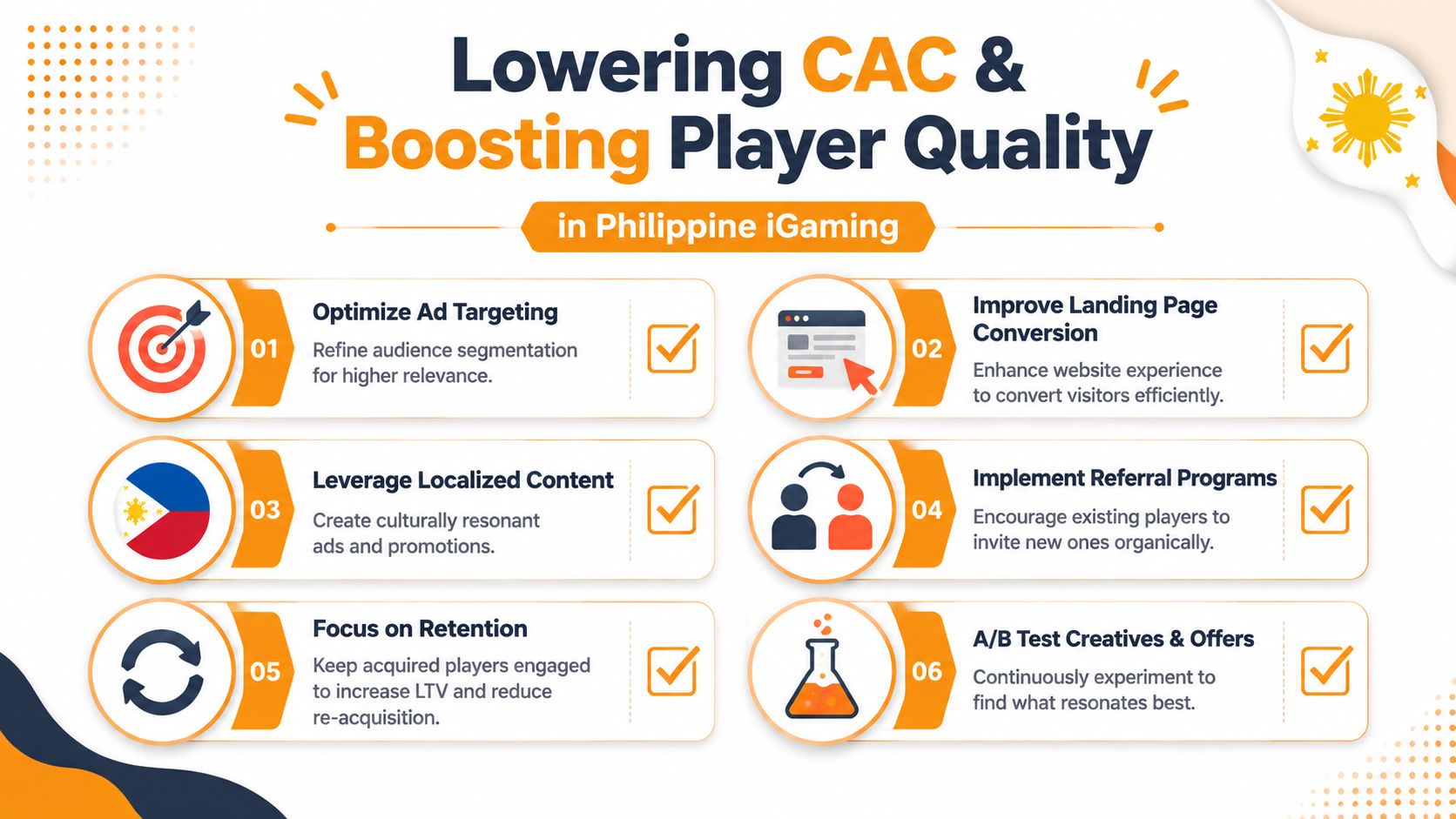
Lowering user acquisition cost doesn't mean chasing the cheapest traffic. It means removing waste while attracting players who are more likely to deposit, stay active, and remain compliant within a PAGCOR-regulated environment.
That distinction matters. Cheap traffic often creates expensive follow-up problems. Better growth comes from tightening the path from first click to first meaningful action.
Fix conversion before you buy more traffic
Many operators try to lower CAC by negotiating media prices or changing channels. Sometimes the biggest savings sit inside the funnel you already have.
If your ads generate interest but users drop during registration, KYC, app install, or first deposit, your real problem is conversion efficiency. Every leak in that path raises acquisition cost because you're paying for users who never become valuable.
Start with the basics:
- Tighten the landing page match: If the ad promises a slot offer, don't drop the user into a generic homepage.
- Reduce onboarding friction: Keep forms clear, mobile-friendly, and easy to complete on local devices.
- Explain the next step plainly: Users should know what happens after registration, what documents may be needed, and how deposits work.
- Improve payment confidence: If users hesitate at the cashier step, reassure them with clear process messaging and trusted cues.
- Use retargeting for high-intent drop-offs: Someone who began registration but didn't complete it is different from a cold audience member.
Better conversion lowers CAC without requiring cheaper media. That's usually the cleaner win.
Lower CAC without lowering standards
You also need to protect player quality. A campaign that cuts acquisition cost but attracts weak-fit users can damage economics later.
The strongest operators usually focus on these levers:
Sharper audience targeting
Broad targeting can fill the funnel, but it often pulls in casual curiosity rather than playing intent. Segment by game interest, device behaviour, geography, and message fit.Localised creative
Filipino audiences respond better when ads feel familiar, direct, and locally grounded. Generic casino creative often gets attention without building trust.Smarter bonus use
Bonuses should support acquisition, not replace real intent. Structure offers so they attract users who are willing to continue past the first claim.Referral and advocacy loops
Existing satisfied players can become a lower-cost source of higher-trust acquisition if the programme is compliant and clearly managed.Retention support
Better retention doesn't lower CAC mathematically at the point of acquisition, but it improves what that CAC buys. That strengthens unit economics quickly.Disciplined testing
Test one variable at a time when possible. Offer, headline, creative angle, landing page, and onboarding step should not all change at once.
Here's a practical operator view:
| Tactic | Likely effect on CAC | Likely effect on player quality |
|---|---|---|
| Better landing page match | Lowers waste | Improves intent continuity |
| Overly aggressive bonus hook | May reduce front-end friction | Can weaken quality |
| Cleaner retargeting | Improves efficiency | Usually stronger than cold traffic |
| Localised messaging | Improves relevance | Can lift trust and fit |
| Better onboarding support | Raises conversion | Improves early player experience |
PAGCOR compliance belongs inside this playbook, not beside it. If your creatives overpromise, your terms confuse users, or your acquisition flow encourages the wrong expectations, you may lower surface CAC while creating trust and operational problems later. Sustainable growth in PH iGaming comes from alignment. Message, offer, funnel, and compliance all need to point in the same direction.
If you want a PAGCOR-licensed platform that gives Filipino players a straightforward and secure way to explore online gaming, Insta Play Online Casino is built around trust, accessibility, and recognised game providers. New users can check current offers, browse available games, and see how a locally compliant platform presents a clearer onboarding experience from the start.





Join thousands of gaming professionals receiving the latest iGaming news, regulatory updates, and market insights.
