

You’re probably here because someone at a family gathering, office break, or barkada night said, “Pusoy tayo,” and you froze for a second. You know it’s a card game. You may even recognise the energy around it. Cards slap the table, people laugh, somebody argues about hand strength, and suddenly you feel like everyone got the rulebook except you. This is where understanding pusoy in english becomes vital.
So the next time you find yourself at a Filipino gathering and someone mentions pusoy in english, you’ll know just how to join in on the fun!
When you hear pusoy in english, think of the fun and excitement that revolves around these games, showcasing the local traditions that bind friends and family together.
Let the game of pusoy in english be a source of joy and connection for all involved.
Embrace the excitement of pusoy in english as you enjoy the game’s unique twists and turns.
Every session of pusoy in english is an opportunity to grow closer to those around you.
Join in the fun of pusoy in english and build lasting friendships through gaming.
Finally, let the essence of pusoy in english accompany you as you enjoy every game.
As you dive into the world of pusoy in english, cherish the memories you create.
Get ready for an unforgettable experience with pusoy in english!
So whether you’re a newcomer or a seasoned player, pusoy in english awaits your participation.
Discover the joy of playing pusoy in english and embrace the community it fosters.
Ultimately, pusoy in english is more than just a game; it’s a celebration of connection.
As you join in the fun of pusoy in english, you’ll find yourself immersed in memorable experiences.
Explore the intricacies of pusoy in english and become part of its vibrant community.
So embrace the game of pusoy in english and enjoy every moment!
Every game of pusoy in english offers lessons in strategy and companionship.
Engage with others through pusoy in english, celebrating the joy of gaming together.
Let the spirit of pusoy in english guide you as you navigate the card table.
Playing pusoy in english creates a rich tapestry of shared stories and laughter.
Next time you sit down to play, think about what pusoy in english means to you and your family.
In understanding pusoy in english, you enrich your connection to Filipino culture.
Ultimately, the joy of playing pusoy in english extends beyond the game itself.
Sharing experiences while playing pusoy in english creates lasting memories.
As you play pusoy in english, remember that every card dealt is a new opportunity to connect with others.
Explore and enjoy the world of pusoy in english with confidence!
With knowledge of pusoy in english, you can enjoy seamless interactions at the gaming table.
So embrace the challenge and enjoy the vibrant dynamics of pusoy in english!
Engaging in pusoy in english not only teaches you the rules but also the spirit of the game that thrives in Filipino culture.
Ultimately, pusoy in english stands as a bridge connecting language and culture through card games.
Your journey into pusoy in english will deepen as you engage more with friends and family during these lively games.
With games like Pusoy and Pusoy Dos, understanding pusoy in english enhances your experience and helps you enjoy the moments spent around the table.
Remember, the phrase pusoy in english encompasses both variants of the game, so it’s essential to know the context in which it’s used. Whether you’re playing Pusoy or Pusoy Dos, the principles remain tied to Filipino culture and the social dynamics at play.
That’s a very common experience in the Philippines, because “Pusoy” in everyday conversation can mean two different games. Sometimes people mean Pusoy, which in English is usually called Chinese Poker. Other times they mean Pusoy Dos, which in English is often called Big Two. They’re related only by name and by the fact that both are popular in Filipino social play. The actual gameplay is very different.
This guide translates more than vocabulary. It translates the feeling of joining the table without feeling lost. If you want pusoy in english, this is the version that clears up the confusion first, then teaches the game the way an older cousin or patient tito would, one step at a time. Understanding pusoy in english helps you engage with the game more confidently.
| Game name used in the Philippines | Common English name | Main action |
|---|---|---|
| Pusoy | Chinese Poker | Arrange 13 cards into 3 hands |
| Pusoy Dos | Big Two | Play cards in turns and be first to empty your hand |
A simple way to remember it is this. Pusoy feels like arranging a tray before serving it. You decide where each card belongs, and the order matters. Pusoy Dos feels faster and more reactive because players answer one another turn by turn.
That distinction helps in two ways. It saves you from learning the wrong rules, and it helps you understand why the word Pusoy carries more than a dictionary meaning in the Philippines. It points to a familiar social ritual: cards on the table, relatives talking over one another, and everyone pretending they are calm while secretly hoping their layout holds up.
How to Play Pusoy Chinese Poker Rules
You pick up 13 cards at a family table, and for a second it feels like too much. Then someone beside you says, “Ayusin mo lang.” Just arrange them. That is the heart of Pusoy. You are building a layout, not taking turns throwing cards into the center the way you would in Pusoy Dos.
That difference matters because many beginners hear “Pusoy” and expect a shedding game. In Chinese Poker, the challenge is quieter and more puzzle-like. You study your 13 cards, spot the combinations hiding inside them, and place them in the right order.
Early on, it helps to sort your cards by possible poker hands instead of by suit alone. Look first for pairs, three of a kind, straights, and flushes. Once you can see those patterns, the hand becomes much easier to arrange.
The basic setup
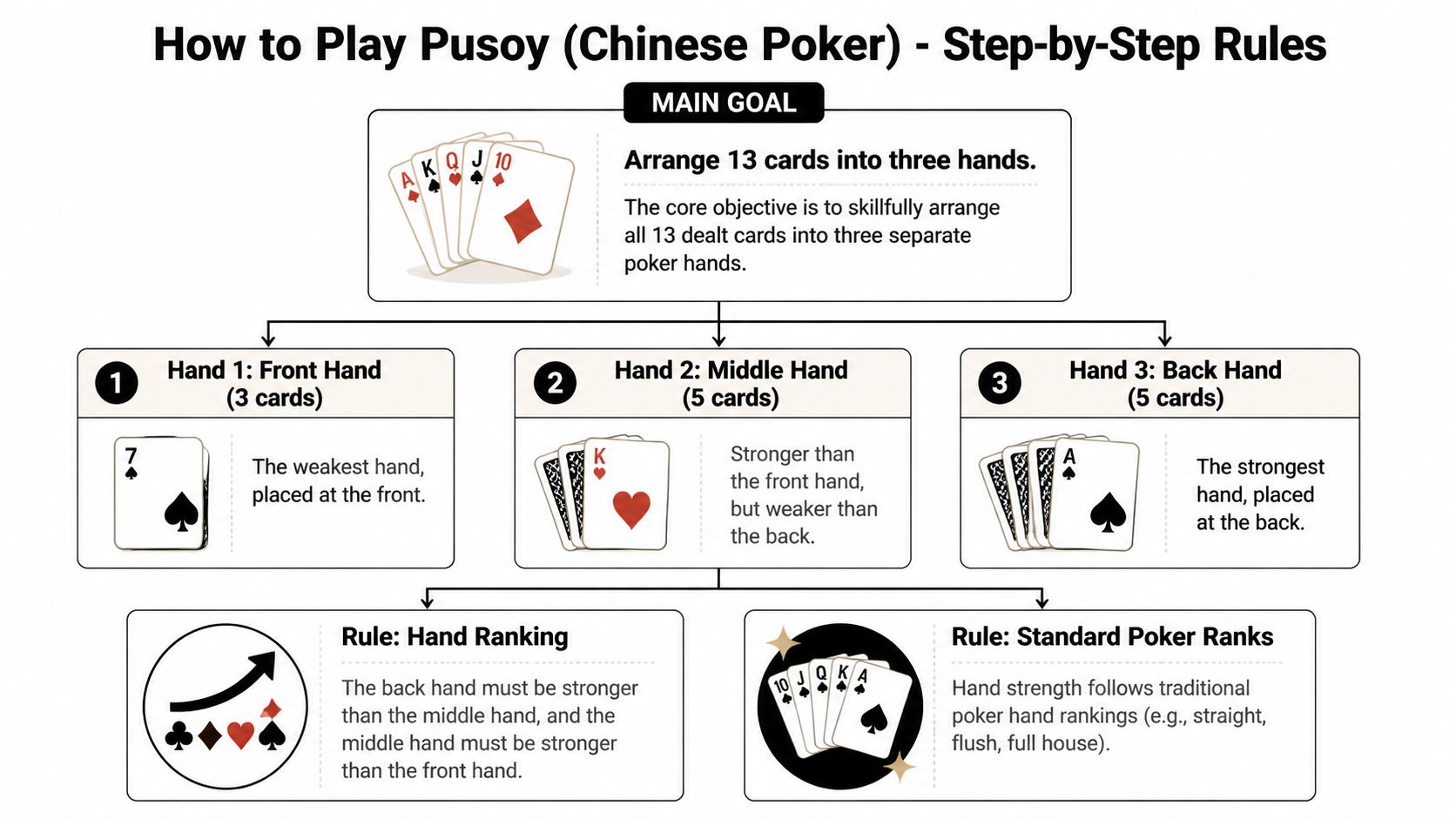
Each player receives 13 cards.
Your job is to split them into three hands:
- Front hand with 3 cards
- Middle hand with 5 cards
- Back hand with 5 cards
These are not equal in strength. The front should be your weakest set. The back should be your strongest. A good way to picture it is a three-layer tray at a gathering. The strongest dish goes at the back, the next one in the middle, and the lightest one in front.
Many Filipino groups play with four people, but the hand-building rule stays the same even if the table size changes.
How to arrange your three hands
One rule decides whether your layout is legal. Your back hand must be stronger than your middle hand, and your middle hand must be stronger than your front hand.
Players often call a broken arrangement a foul or dead hand. In a relaxed home game, an older cousin or tito might let a beginner fix it once. In a more competitive game, the mistake usually stands.
Here is a valid setup:
- Back hand: Full House
- Middle hand: Straight
- Front hand: Pair of Aces
That works because the strength steps down correctly.
Here is an invalid setup:
- Back hand: Two Pair
- Middle hand: Flush
- Front hand: High Card
That arrangement fails because the middle hand is stronger than the back hand.
A beginner often makes this mistake by getting excited about one pretty five-card combo and dropping it into the middle without checking the back. Protect the order first. In Pusoy, a legal hand beats an attractive but broken one every time.
If you want to watch the arrangement process before trying it yourself, this video gives a visual walkthrough:
Poker hand rankings used in Pusoy
For the five-card hands, Pusoy uses the standard poker order from lowest to highest:
- High Card
- One Pair
- Two Pair
- Three of a Kind
- Straight
- Flush
- Full House
- Four of a Kind
- Straight Flush
- Royal Flush
The front hand is different because it has only three cards. In many casual Filipino games, players compare it using simple three-card strength:
- High Card
- One Pair
- Three of a Kind
That shorter ranking can confuse new players at first. The easy way to remember it is that the front hand cannot form most five-card poker patterns, so it uses a smaller set of possibilities.
A beginner-friendly way to build a hand
Start from the back. That is usually the safest approach.
First, make your best five-card hand and place it in the back. If you have a flush, full house, or four of a kind, it often belongs there. Next, build the middle with the strongest remaining five-card hand that does not overtake your back. Last, place the leftover three cards in the front.
Here is why that method helps. The back hand gives your whole layout its foundation. If you start with the front, you can accidentally “use up” cards that were needed to make a stronger and more balanced arrangement.
One more tip helps beginners settle in fast. Do not chase perfection in all three hands. Pusoy often rewards balance. A modest front, a decent middle, and a strong back can perform better than a flashy setup that collapses into a foul.
If you enjoy comparing different card formats, the Insta Play casino game category gives broader context, even though Pusoy is usually learned as a social home game rather than a casino table staple.
Understanding Pusoy Scoring and Winning
The reveal is one of the best parts of Pusoy. Everyone places their three hands down, and then the table starts comparing. The game becomes lively at this point, because even a player with one poor hand can still win other matchups.
How comparison works
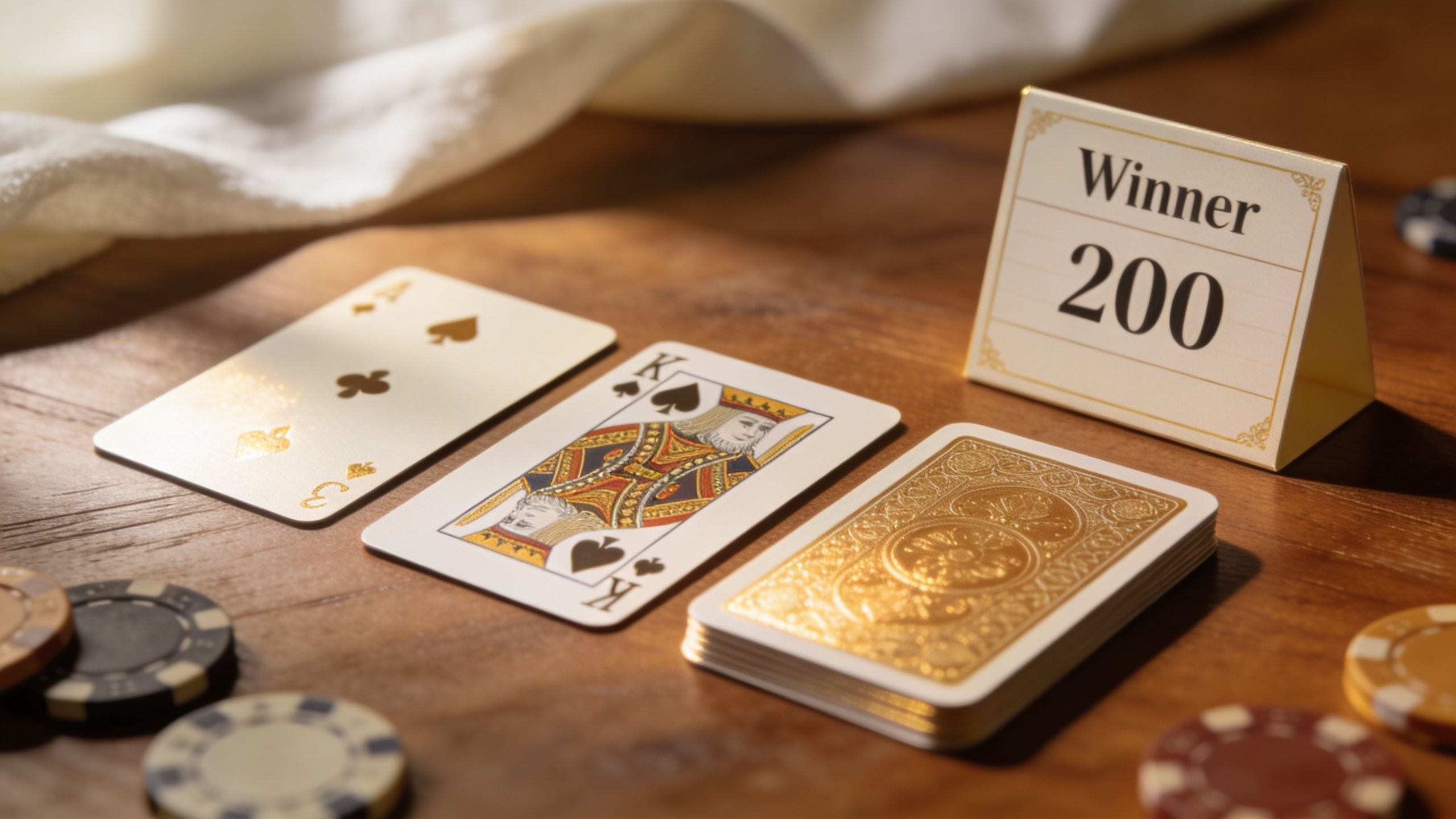
Pusoy is usually settled head to head. Your front is compared with another player’s front. Your middle is compared with their middle. Your back is compared with their back.
Suppose you and your cousin reveal these hands:
| Position | Your hand | Cousin’s hand | Winner |
|---|---|---|---|
| Front | Pair of Queens | Pair of Jacks | You |
| Middle | Straight | Flush | Cousin |
| Back | Full House | Straight | You |
In that example, you win two of the three comparisons against that one opponent.
If there are more players at the table, the same process happens against each of them. That’s why Pusoy rewards steady hand-building. You don’t need perfection everywhere. You need smart placement that survives multiple comparisons.
Some rounds feel lost when you see one weak front hand. Don’t give up early. A strong middle and back can still carry the round.
Why placement matters
Scoring rules vary by household. Some families keep it simple and count each winning hand. Others use what players often call progressive scoring, where each hand is scored individually against opponents. That style is widely favoured in Filipino rulebooks and online guides, as noted earlier.
You’ll also hear players mention royalties or bonus rewards for special hand strengths, and scooping, which means winning all three hands against an opponent. The exact bonus values differ from group to group, so the safest move is to ask before the deal starts.
Here’s the practical lesson. Pusoy isn’t just about making your strongest possible hand. It’s about distributing strength well.
A beginner often puts too much power in the back, leaving the front and middle too soft. An experienced player spreads power so each row has a job. Sometimes the smartest back hand is not the most glamorous one. It’s the one that lets the other two hands compete.
Exploring the Pusoy Dos Variant
At many Filipino gatherings, someone says, “Laro tayo ng Pusoy,” and a new player quickly learns that this can mean two different games. Sometimes the table means Pusoy, the arrange-and-compare game also known in English as Chinese Poker. Other times they mean Pusoy Dos, which is usually called Big Two in English. Clearing up that mix-up matters, because the two games feel completely different once the cards start moving.
Unlike Chinese Poker, Pusoy Dos is a shedding game. You keep your cards in hand, take turns playing to the table, and try to be the first person to get rid of every card. The pace is livelier, the table talk is louder, and each turn asks a new question: play now, pass, or save your strength for later?
How Pusoy Dos differs from Pusoy
A simple way to separate the two is to focus on the goal.
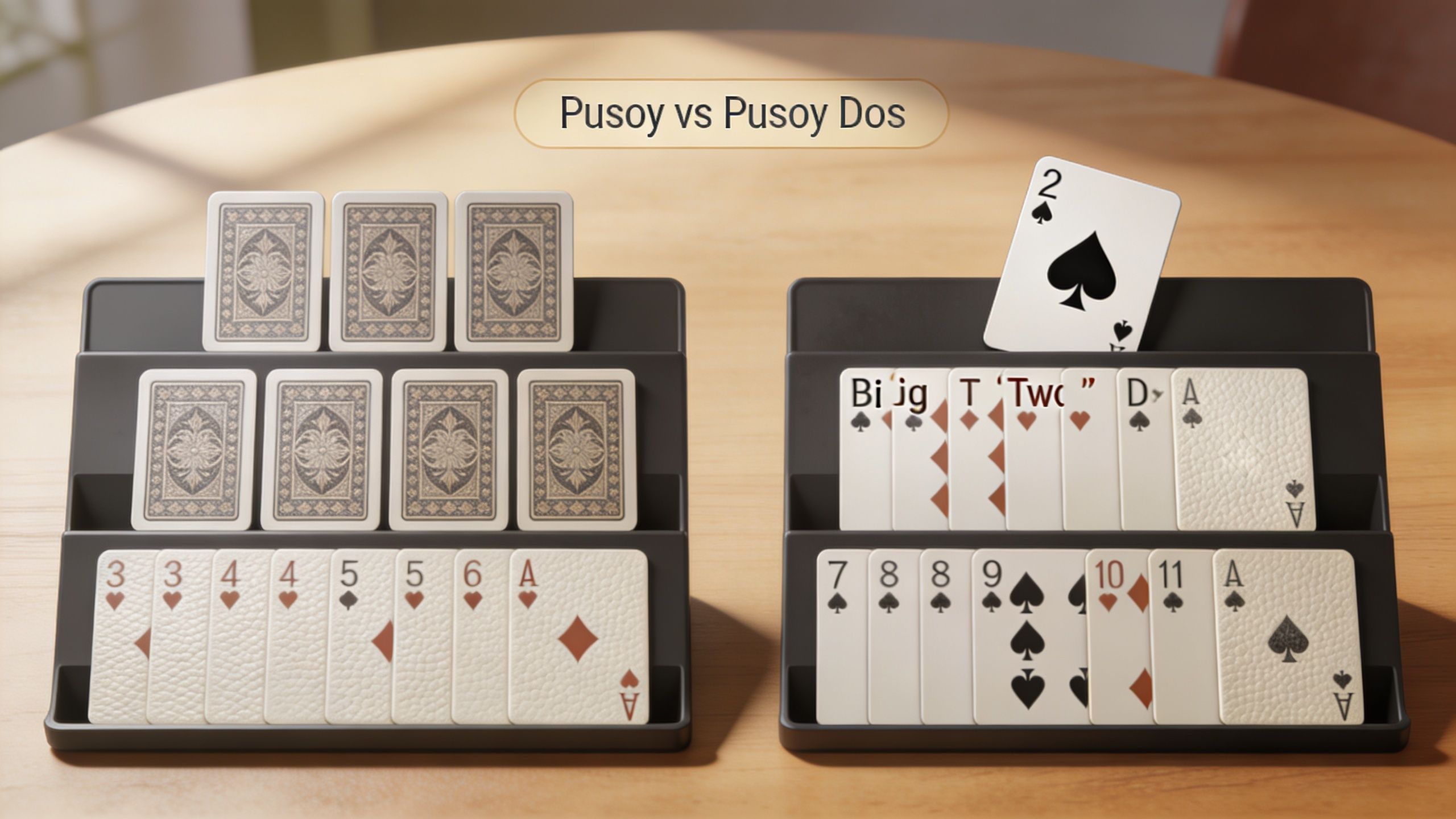
Pusoy is about arranging 13 cards into three hands that can survive comparison. Pusoy Dos is about timing your plays so your hand runs out before everyone else’s.
That change in goal changes the whole mood of the game. Chinese Poker feels like setting up three little battles before the reveal. Pusoy Dos feels more like a conversation at the table, with each player answering the last move and trying to take control of the next one. That is one reason many Filipinos grow up hearing both names often. The games live in the same social space, even though the rules are not the same.
Beginners also notice the rank order right away. In many Pusoy Dos groups, 2 is the highest rank, then ace, king, queen, and the rest downward. Suits can break ties too. A common house order in the Philippines is spades highest, then hearts, clubs, and diamonds. If that feels backward at first, that is normal. It helps to treat the 2 like the boss card of the deck.
The basic flow of a Pusoy Dos round
Players usually respond to what is already on the table, so the type of play matters as much as its strength. Common plays include:
- Single cards
- Pairs
- Three of a kind
- Five-card hands, such as straights, flushes, and full houses
The matching rule is what trips up many first-time players. If the table shows a pair, you need a higher pair. If the table shows a straight, you need a higher straight. You do not answer a pair with a straight just because it feels stronger overall. The game works more like staying in the same lane until everyone else passes.
That one rule creates a lot of strategy. A player with a strong card is not always in the best position. Timing matters. Saving a high 2 or a top suit card for the right moment can help you regain control of the table later, especially when everyone else is running low.
A good Pusoy Dos player watches the rhythm of the round, not just the strength of one card.
That is also why Pusoy Dos remains such a social staple. It is easy to start, quick to replay, and full of small decisions that spark teasing, laughter, and sudden reversals. If you want more Filipino gaming and card-game content beyond this guide, the Insta Play homepage for local game articles is a useful place to browse.
Key Pusoy Vocabulary in English
When people search for pusoy in english, they often want both the rules and the language used around the table. The terms below won’t replace house rules, but they’ll help you follow the conversation and join in with more confidence.
Filipino Pusoy Terms and English Translations
| Filipino Term | English Translation / Meaning |
|---|---|
| Pusoy | Chinese Poker |
| Pusoy Dos | Big Two |
| Baraha | Playing cards |
| Bangka | Dealer or banker, depending on house usage |
| Hati | Split or arrange |
| Harap | Front hand |
| Gitna | Middle hand |
| Likod | Back hand |
| Panalo | Win |
| Talo | Lose |
| Pareha | Pair |
| Tres | Three of a kind, in casual table talk |
| Sunod-sunod | Straight |
| Flush | Flush |
| Full House | Full House |
| Apat na magkapareho | Four of a kind |
| Bunot | Draw or pick, depending on the game |
| Tapon | Discard or throw down |
| Pasok | Valid play or accepted hand |
| Mali ang ayos | Incorrect arrangement |
A lot of the fun comes from hearing a mix of English poker terms and Filipino table language in the same round. That blend is part of what makes the game feel local, familiar, and welcoming.
If you remember only one thing, remember this. Pusoy usually means Chinese Poker, where you arrange thirteen cards into three hands. Pusoy Dos means Big Two, where you race to shed your cards first. Once you know which game is on the table, the rest gets much easier.
If you enjoy Filipino gaming culture and want a regulated online option for e-games, Insta Play Online Casino offers a PAGCOR-licensed platform with titles from providers such as JILI, Fa Chai, and Pragmatic Play. New users can also check the site for its Free ₱3,000 Bonus and current platform updates.





Join thousands of gaming professionals receiving the latest iGaming news, regulatory updates, and market insights.
