

You're probably here because Tong-its keeps showing up around you. Maybe it's a family get-together, a late-night barkada session, or a mobile game lobby full of players who already seem to know what they're doing. You hear someone say “bahay,” “sapaw,” or “draw,” and suddenly the table feels closed to beginners.
That's a normal place to start.
Tong-its is one of those card games that looks easy once you've watched it for a while, but the flow can feel confusing when you're trying to join your first round. The good news is that the core tong its rules are learnable. Once you understand the setup, the rhythm of a turn, and how points work, the game starts to feel less intimidating and a lot more fun.
If you already know Filipino card games like Pusoy in English, you'll notice that Tong-its has its own pace and personality. It rewards observation, timing, and calm decisions more than flashy moves.
Table of Contents
- Welcome to the World of Tong-its
- Game Objective and Initial Setup
- The Anatomy of a Player's Turn
- Mastering Melds and Dumping Cards
- How to Score Points and Win the Game
- Beginner Strategy Tips and Common Mistakes
- Playing Tong-its Safely Online in the Philippines
Welcome to the World of Tong-its
A lot of players first learn Tong-its the same way. They sit beside the table, watch a few hands, try to follow the chatter, and realise the game moves faster than expected. One player lays down cards. Another adds to that meld. Someone discards with confidence. Then the hand ends, and the beginner still isn't fully sure why.
That doesn't mean the game is hard. It means Tong-its is easier to learn when someone explains it in plain language.

Tong-its has long been part of Filipino social life. It fits naturally into relaxed afternoons, reunion tables, and friendly challenges that stretch for hours. People enjoy it because the rules are simple enough to learn, but the decisions keep every round interesting.
Why people keep coming back to Tong-its
The charm of Tong-its isn't only in winning. It's in reading the table, deciding what to keep, and trying not to hand an opponent the exact card they need. Even when you lose a round, you usually learn something useful right away.
Tong-its feels lively because every discard tells a story. Good players don't just watch their own hand. They watch everyone else's choices too.
New players often think they need to memorise everything at once. You don't. Start with three ideas:
- Build combinations: You want to group cards into valid melds.
- Lower your leftover points: Unmatched cards can hurt you at the end.
- Pay attention to discards: The table gives away clues all the time.
Once those ideas click, the rest of the tong its rules become much easier to follow.
Game Objective and Initial Setup
You sit down for your first round, pick up your cards, and wonder what you are supposed to be building. That is the right place to start. Tong-its gets much easier once you know what a good hand is supposed to look like before the first discard even hits the table.
At its core, the round is a race to organise cards into valid groups while keeping stray cards from piling up in your hand. If you have played other card games, this helps set expectations. You are not chasing tricks or betting on fixed outcomes. You are arranging cards into combinations, reading what other players leave behind, and trying to end the round with the strongest position.
What you need to start a round
The setup is simple, but each part has a job.
Tong-its is commonly played by three players using a standard deck with no jokers. Each player receives 12 cards, the dealer receives 13, and the rest of the deck becomes the stock pile in the center. A discard pile starts once the first card is thrown.
Here's the basic setup flow:
- Choose the dealer.
- Use a standard deck with no jokers.
- Deal 12 cards to each player.
- Give the dealer 13 cards.
- Place the remaining cards face down as the stock pile.
- Create a discard pile when play begins.
New players often pause at the extra card and ask why the dealer gets it. The reason is mechanical, not mysterious. The dealer needs one more card so the round can begin in the proper order, with a discard that opens play for everyone else.
This early structure matters more than it may seem. In a home game, everyone can agree on the deal and move on. In an online game, a trusted platform handles that setup automatically, which removes arguments about dealing mistakes and helps you focus on learning key decisions. That is one reason many Filipino players prefer PAGCOR-licensed platforms when they want to practice safely.
The main objective
Your job is to build melds and cut down your deadwood.
Deadwood means cards left in your hand that do not belong to a valid combination. Those loose cards are the ones that can hurt you if the round ends before you fix them. A pretty hand is not always a strong hand. A strong hand is one where the cards work together.
A useful way to judge your starting cards is to ask two questions:
- Do I already have a set?
- Am I close to a run?
- Which cards are isolated and likely to stay deadwood?
Sets and runs are the backbone of the game, but the larger lesson is simple. Connected cards help you. Lonely cards usually become a problem.
Practical rule: Judge your hand by how many cards can realistically join a meld, not by how attractive the cards look on their own.
Card values matter from the start
Even this early, it helps to respect high-value loose cards. If a round ends quickly, those unmatched cards can weigh down your result. Beginners sometimes hold onto face cards too long because they feel strong. In Tong-its, a card only becomes strong when it fits into a real plan.
That is part of what makes Tong-its so enjoyable online as well as at the table. Traditional rules still shape every choice, but a reliable digital platform gives you a cleaner place to learn them. If you like comparing how different casino games reward decision-making, games such as Super Six Baccarat for players exploring other table formats show a very different kind of pressure from a combination-based game like Tong-its.
The Anatomy of a Player's Turn
The easiest way to learn Tong-its is to stop thinking about the whole round and focus on a single turn. Most confusion disappears once you understand the order of actions.
A turn has a rhythm. You take a card, see what play becomes possible, then end by discarding.
For a quick visual guide, this flow helps:
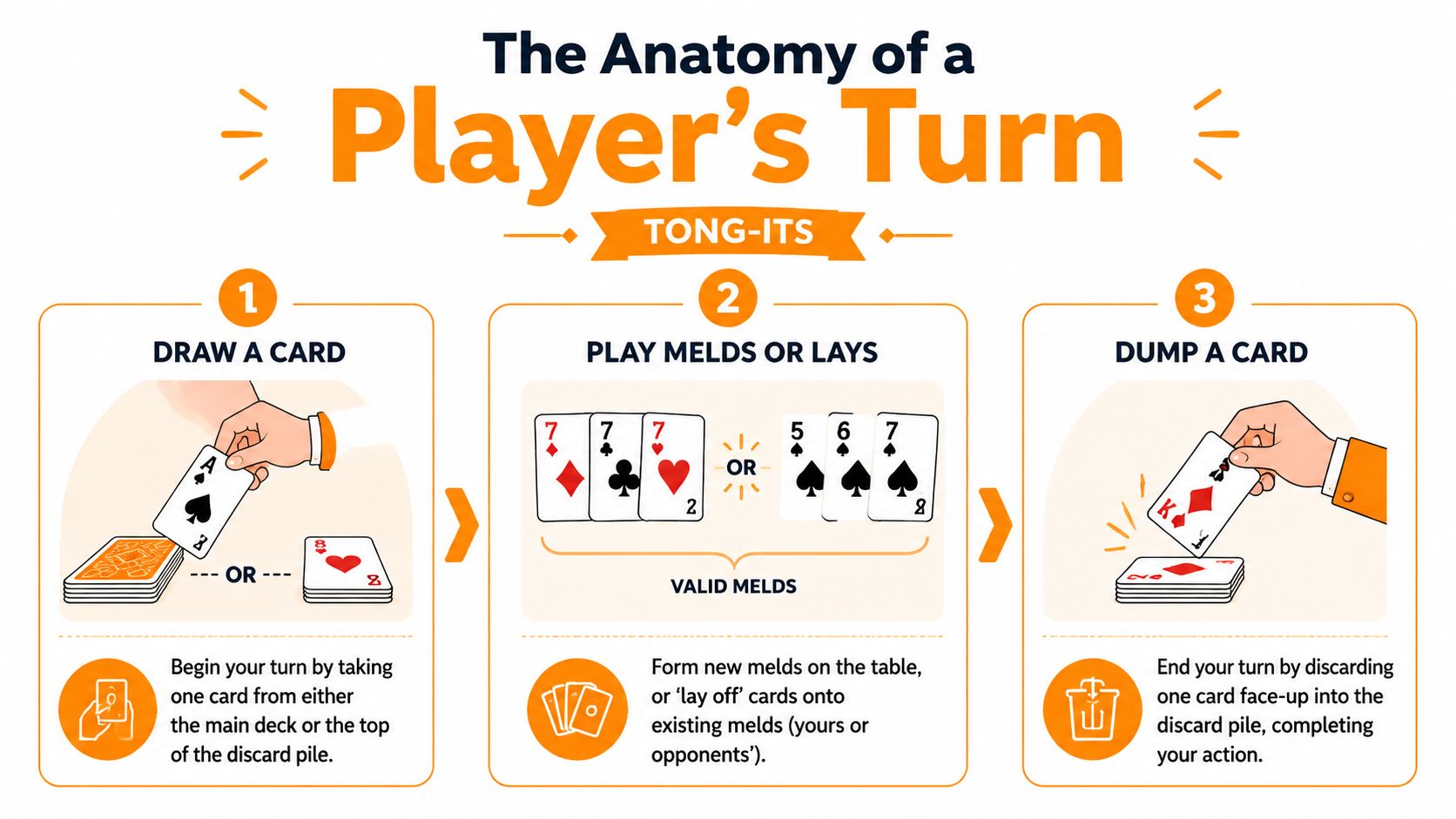
The basic rhythm of play
Think of your turn in three parts:
- Draw a card: You begin by taking one card.
- Play if possible: You may form melds or add to melds already on the table.
- Discard one card: This ends your turn.
That sequence matters. New players sometimes try to discard immediately or forget that their turn has to close with a discard. If you remember “draw, play, discard,” you'll stay organised.
Another thing beginners miss is that a turn isn't just about improving your own hand. Your discard can shape the next player's options. That's why Tong-its feels interactive even when everyone is deep in thought.
Here's a quick video if you prefer to see the flow in action.
A simple turn example
Say you start your turn with cards that are close to forming a run. You draw a card and suddenly that run becomes complete. You place the meld on the table, then choose one leftover card to discard.
That's a clean, efficient turn.
Now consider a messier turn. You draw a card that doesn't help. You can't build a meld yet. Your job becomes damage control. Which card can you safely throw away without helping someone else too much? That question sits at the centre of many Tong-its decisions.
A calm player usually makes fewer mistakes than an aggressive one. In Tong-its, patience often saves more points than excitement does.
Mastering Melds and Dumping Cards
Tong-its begins to feel fun instead of mechanical. Once you know what counts as a valid meld, you stop staring at random cards and start seeing patterns.
A meld is often called a bahay at the table. It's a legal group of cards that you can lay down face up.
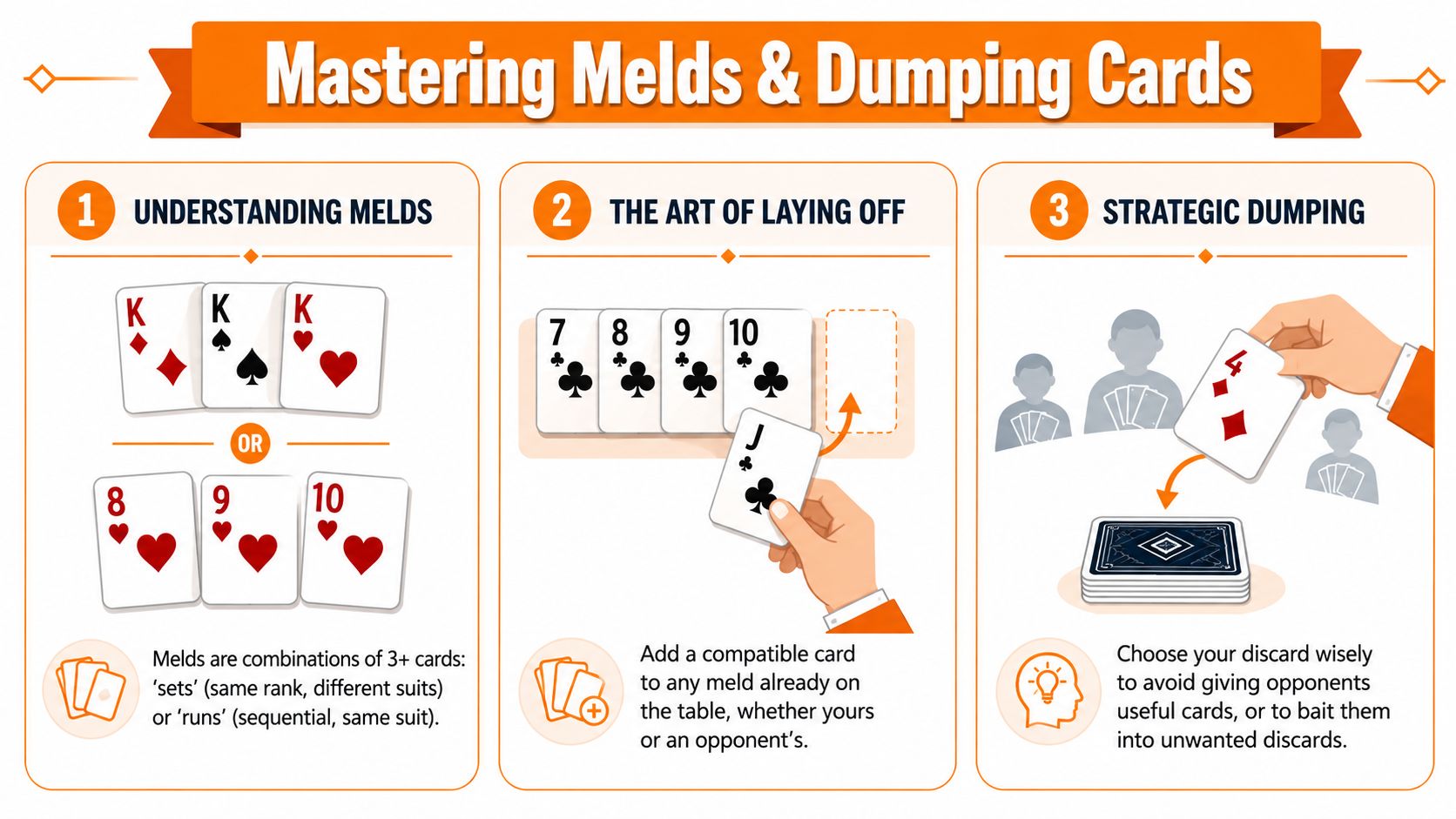
What counts as a valid meld
In plain terms, you're looking for either matching ranks or a suited sequence.
These are the common categories:
- Set: Cards of the same rank, such as three Kings or four sevens.
- Run: Consecutive cards of the same suit, such as a sequence in hearts or spades.
A beginner mistake is to confuse “consecutive” with “same colour.” In Tong-its, a run isn't just red cards or black cards. The cards must be in order and in the same suit.
Here's a simple reference table.
| Meld type | What it looks like |
|---|---|
| Set | Same rank across different suits |
| Run | Consecutive cards in one suit |
When you lay a meld down, you reduce the amount of deadwood sitting in your hand. That's why players are usually eager to expose useful combinations when the timing feels right.
How sapaw changes the table
One of the liveliest parts of tong its rules is sapaw, also called laying off. This means adding a compatible card to a meld that's already on the table. It could be your own meld or another player's meld, depending on the situation and house interpretation.
For example, if a run is already exposed, and you hold the next fitting card in sequence, that card may no longer be deadwood for you. It can become a tool to shrink your hand.
That changes how you evaluate every card. A card that looks weak in isolation might become strong because someone else has already built the structure you need.
Choosing what to dump
Discarding isn't random. A useful way to think about it is to divide your hand into three groups:
- Cards that already belong together
- Cards that are one good draw away from a meld
- Cards with no clear future
The third group is where your discard often comes from.
Key idea: A bad discard doesn't only weaken your hand. It can improve an opponent's hand immediately.
That's why experienced players hesitate before throwing away cards that sit near visible patterns on the table. If an opponent has shown interest in a suit or rank, your discard may be more dangerous than it looks.
How to Score Points and Win the Game
You reach the end of a round with three cards left in hand. One is an Ace, and two are face cards. Another player also failed to go out, but their leftovers are all small number cards. That situation shows why scoring matters so much in Tong-its. Winning is not only about making the flashiest finish. It is also about keeping your hand light if the round closes before you can empty it.
The basic idea is simple. Any card not safely part of your exposed or completed combinations can hurt your final total. The lower that leftover total is, the better your chance to win when the hand is compared.
As noted earlier from the Wikipedia rules summary, numbered cards count at face value, Aces count as 1, and Jacks, Queens, and Kings count as 10 each.
The card values you need to remember
Here is the scoring guide most beginners memorize first:
| Card | Point Value |
|---|---|
| Ace | 1 |
| Number cards | Face value |
| Jack | 10 |
| Queen | 10 |
| King | 10 |
A practical way to remember this is to treat loose high cards like heavy baggage. They are harder to carry safely to the end of the round. A loose 9 is annoying. A loose King is expensive.
That is why experienced players often release face cards early unless those cards are clearly helping form a meld.
How a round ends
A hand usually finishes in one of several common ways:
- Tongits: A player gets rid of all cards through valid plays and exposed combinations.
- Draw: A player calls for a draw under the rule set being used.
- Stock exhaustion: The draw pile runs out, so the remaining deadwood is compared.
If nobody finishes cleanly, the player with the lowest deadwood total wins. That is the part many newcomers miss at first. Tong-its works a bit like boxing on points. A dramatic knockout is great, but smart round management can still earn the win.
This is also why calm players often do well online. On a trusted platform, the app handles point counting consistently, so you can focus on reading the table instead of arguing over totals.
Chips and side pots in some rule summaries
Some rule summaries also include chip-based payouts beyond the basic win. One version notes rewards for winning the hand, extra chips tied to Aces held by the winner, and bonuses for concealed four-of-a-kind. It also mentions a side pot format that can carry over until a player meets the condition to claim it.
Those payment details depend on the table or platform you are using, so check the house rules before you play. The scoring values above stay the foundation either way. Learn those first, then learn how that table converts a win into chips, credits, or prizes.
If you want to see how card games and digital cash-out interest often overlap for Filipino players, this guide to games that can earn money thru GCash gives useful context. The safest habit is the same in every case. Learn the rules, know how scoring is settled, and play only on PAGCOR-licensed platforms that apply those rules clearly.
Beginner Strategy Tips and Common Mistakes
Knowing the tong its rules is the first step. Turning that knowledge into better decisions is where the game opens up.
Beginners often lose for ordinary reasons, not because they're unlucky. They hold the wrong cards too long, ignore obvious table clues, or discard in ways that help the next player.
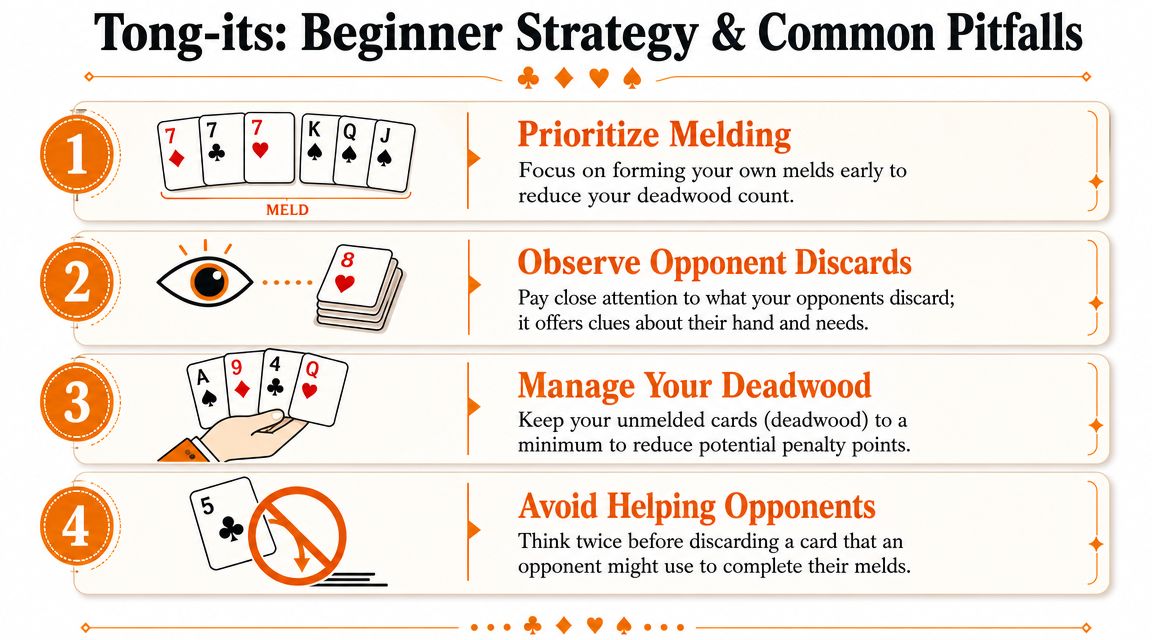
Habits that help new players
A useful beginner mindset is to value flexibility. Don't fall in love with one plan too early. If a potential meld isn't developing, move on before it traps too many cards in your hand.
These habits usually help:
- Watch every discard: Opponents tell you what they don't want, and sometimes what they're building.
- Trim risky cards: Loose face cards can become expensive if the round ends suddenly.
- Expose with purpose: Laying down a meld can lower pressure, but it also reveals information.
- Stay aware of table texture: Open melds change the value of cards in your hand.
One of the best learning tools today is repetition on digital platforms. Many players sharpen their instincts by trying round after round in apps such as the 90 JILI app, where they can practise hand reading and timing in a more structured environment.
Mistakes that cost rounds
Some errors show up again and again at beginner tables.
The first is chasing a perfect hand. A nice-looking sequence in your head means nothing if the needed cards never come. The second is discarding carelessly after focusing only on your own combinations. Tong-its punishes tunnel vision.
Here are common traps:
- Holding deadwood too long: Hope can be expensive.
- Ignoring exposed melds: The table is part of your hand-reading job.
- Discarding obvious connectors: A single careless card can solve another player's problem.
- Forgetting the endgame: If the hand is close to ending, point control matters more than fancy setups.
Good Tong-its players don't always make brilliant moves. Often, they just avoid the costly obvious mistake.
A practical beginner rule is this: if you can't improve your hand cleanly, at least make it less dangerous.
Playing Tong-its Safely Online in the Philippines
Learning the rules is only half the modern picture. A lot of players now move from the physical table to online play, and that shift adds a new skill. You need to know where to play.
In the Philippines, platform trust matters because Tong-its online should feel organised, fair, and secure. A regulated environment gives players more confidence that account handling, gameplay systems, and platform operations follow local oversight.
Why safe platforms matter
A trusted online platform does more than host games. It gives players a clearer environment for deposits, withdrawals, account support, and rule consistency. That matters most when real money, bonuses, or competitive play enter the picture.
For Filipino players, a PAGCOR-licensed platform offers an important layer of confidence. That licence signals that the operator functions within a local regulatory framework rather than floating around as an anonymous app or sketchy website.
Safety also protects your learning experience. If you're still building confidence with tong its rules, you don't want extra stress from unreliable software or unclear account systems.
Simple checks before you play
Before creating an account anywhere, keep your checklist simple and practical:
- Check licensing: Look for clear regulatory information, not vague claims.
- Use the official site or app path: Avoid random downloads shared in chats or comment sections.
- Create a strong password: Don't reuse one from social media or email.
- Review payment and support pages: Legitimate platforms explain how help works.
- Play responsibly: Set limits before emotions take over.
A player who wants a broader look at regulated online gaming options can explore Mega Panalo Casino as part of comparing legitimate Philippine-facing platforms and game environments.
If you're moving from home games to online Tong-its, treat safety as part of the rules. It isn't separate from the experience. It protects it.
If you're ready to put these tong its rules into practice on a regulated platform, Insta Play Online Casino offers Filipino players a PAGCOR-licensed place to explore online gaming with a beginner-friendly welcome offer, recognised game providers, and a smoother path from learning the game to playing with confidence.





Join thousands of gaming professionals receiving the latest iGaming news, regulatory updates, and market insights.
