


You're probably here because you've seen Pusoy Way played at a family gathering, a barkada session, or an online table, and it looked harder than it really is. Cards are laid out in three rows, someone calls a foul, someone else celebrates a scoop, and if you're new, it can feel like everyone else got the rules except you.
The good news is that Pusoy Way is very learnable once the structure clicks. You're not trying to bluff your way through a betting war. You're trying to arrange your cards well, avoid a bad setup, and beat the matching hands in front of you. If you're also curious about digital card games in the Philippines, this guide sits nicely alongside games that can earn money thru GCash because the same habit matters in both cases: know the rules first, then play with confidence.
Table of Contents
- Your First Look at Pusoy Way
- The Foundation Rules and Hand Rankings
- How to Arrange Your 13 Cards Like a Pro
- The Showdown Scoring and Claiming Victory
- Essential Strategies for New Players
- Pusoy Variants and Playing Safely Online
Your First Look at Pusoy Way
Pusoy Way has that classic Filipino table-game energy. People go quiet while arranging cards, then the table suddenly gets loud when the hands turn over. What looks intimidating at first is a game of organisation and judgement.
The heart of how to play Pusoy Way is simple. You receive a full set of cards for your turn, then you split them into three separate hands. After that, your three hands are compared against the matching hands of the other player or players. If your arrangement is legal and stronger in the right places, you score well.
What the game feels like
If you already know basic poker hand names, you've got a head start. If you don't, that's fine too. Pusoy Way is less about reading faces and more about building a smart layout from the cards you're given.
Most beginners get stuck on one question: “Should I make my strongest possible hand first?” Usually, no. A player who spreads strength properly often does better than a player who creates one beautiful hand and leaves the rest weak.
Pusoy Way rewards discipline. A legal, balanced arrangement usually beats a flashy one that collapses in the middle.
The first thing to remember
Before you think about advanced tactics, keep one target in mind. You want a setup that can compete across the board, not just in one lane. That's why experienced players spend time checking the order of their hands before they lock anything in.
Once you understand the core structure, the rest becomes much easier:
- You sort your cards
- You build three hands
- You compare each lane
- You avoid fouls above all else
That's the whole rhythm of the game. The next part is where the rules become concrete.
The Foundation Rules and Hand Rankings
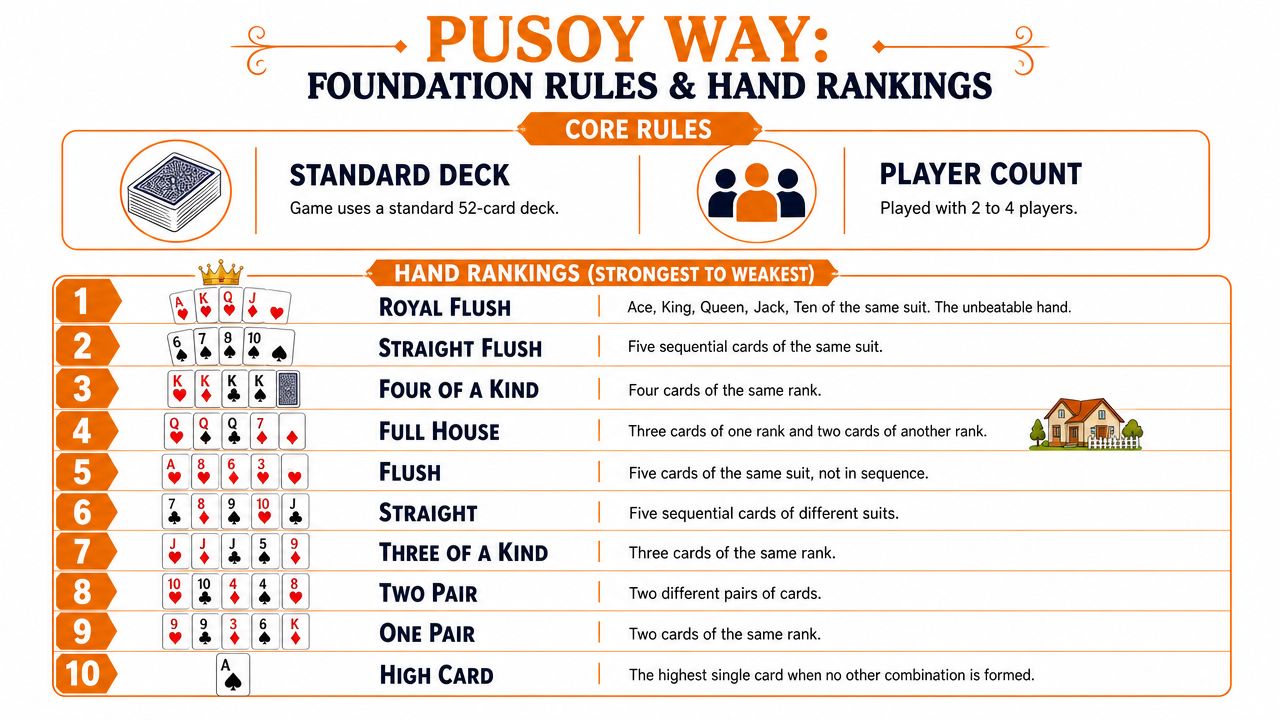
In Philippine-facing guides, Pusoy is commonly taught as a 13-card Chinese Poker format where each player gets 13 cards and must split them into Front (3 cards), Middle (5 cards), and Back (5 cards). A key rule is that the Back hand must be stronger than the Middle hand, and the Middle must be stronger than the Front hand, otherwise the layout is invalid and becomes a foul, as explained in this Filipino guide to Pusoy rules.
If you want another beginner-friendly reference after this guide, this Pusoy in English page is a useful companion read.
What makes Pusoy Way different
A lot of card games ask you to react turn by turn. Pusoy Way asks you to make one complete arrangement decision. That's why the setup phase matters so much.
Think of the three hands like a staircase:
- Back hand must be the strongest
- Middle hand must sit below the back
- Front hand must be the weakest
If that order breaks, the whole arrangement falls apart.
Practical rule: Before you compare anything else, check your order. Back first, middle second, front last.
The hand rankings you need to know
For the Middle and Back hands, Pusoy Way uses familiar poker-style rankings.
| Rank | Hand Name | Description |
|---|---|---|
| 1 | Royal Flush | Ace, King, Queen, Jack, Ten of the same suit |
| 2 | Straight Flush | Five sequential cards of the same suit |
| 3 | Four of a Kind | Four cards of the same rank |
| 4 | Full House | Three cards of one rank and two of another |
| 5 | Flush | Five cards of the same suit, not in sequence |
| 6 | Straight | Five sequential cards of different suits |
| 7 | Three of a Kind | Three cards of the same rank |
| 8 | Two Pair | Two different pairs |
| 9 | One Pair | Two cards of the same rank |
| 10 | High Card | No made hand, judged by highest card |
The Front hand is different because it only has 3 cards. So in practical play, beginners should remember that the front is restricted to low-strength patterns such as high card, pair, or three-of-a-kind, rather than the full list used in a 5-card hand.
A fast mental check
When you finish arranging, ask yourself:
- Is my back clearly strongest?
- Is my middle still competitive?
- Did I accidentally make the front too strong for the middle?
If the answer to any of those feels shaky, rearrange before the reveal.
How to Arrange Your 13 Cards Like a Pro
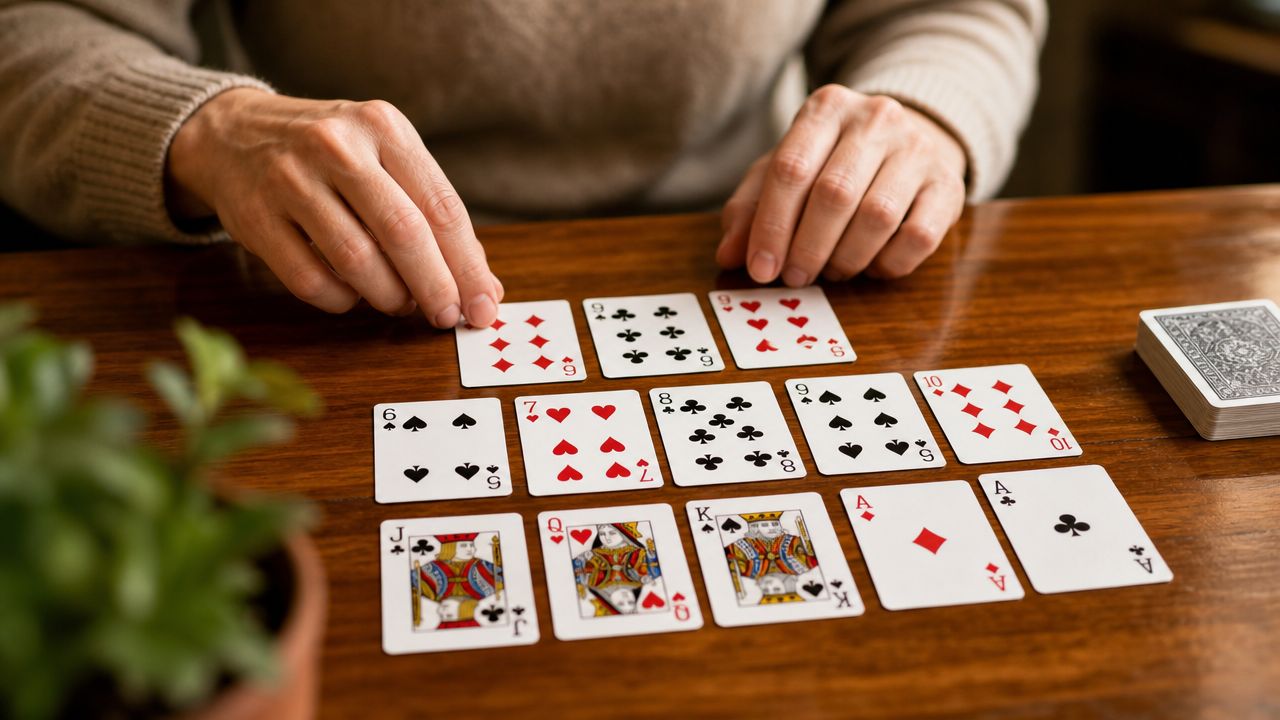
The hardest part for a new player isn't understanding the idea of three hands. It's looking at a pile of cards and knowing where to begin. The trick is to sort first, then decide.
If you enjoy card games that also reward clean reading of combinations and timing, this Lucky 9 rules guide is another useful contrast in style.
A simple way to sort your cards
When your 13 cards arrive, don't place them immediately. Scan for structure.
Start with this order:
- Look for made hands first. Pairs, three-of-a-kind, and obvious 5-card hands stand out fastest.
- Check suit clusters next. If you're close to a flush, that affects where your strongest 5-card hand might go.
- Check running cards. Connected ranks can turn into a straight if the pieces fit cleanly.
- Leave the front for last. Many beginners force the front too early and damage the middle.
Here's the practical mindset. Your first job isn't to build the most beautiful back hand possible. Your first job is to build a legal arrangement that gives you a chance to win multiple lanes.
A sample arrangement from start to finish
Let's say your cards include a strong 5-card combination, a pair, another pair, and a few scattered high cards. A beginner often drops the best 5-card hand into the back, then dumps leftovers into the middle and front. Sometimes that works. Often it leaves the middle too soft.
A better approach is to test more than one layout.
For example:
- Layout A gives you a very strong back, a weak middle, and a dead front.
- Layout B makes the back slightly less impressive, but creates a playable middle and a front with a fighting chance.
Most of the time, Layout B is the stronger table decision.
If your middle hand looks like an afterthought, your arrangement probably needs another pass.
A common table habit is to hold the back hand in place, then move just two or three cards around until the middle improves without breaking the order. That small adjustment is where many rounds are won.
Here's a quick visual explainer before the next example.
What a foul looks like
A foul happens when your hand order is wrong. The usual mistake is making the middle stronger than the back.
Say you place:
- Back: a straight
- Middle: a full house
That arrangement is dead on arrival because the middle outranks the back.
Another mistake is overbuilding the front in a way that makes the middle too weak by comparison. Even if the front looks clever, it can ruin the whole set if the order no longer makes sense.
To avoid that, use this final check:
- Back beats middle
- Middle beats front
- Front stays within its simpler hand types
A calmer decision process
When you're under time pressure, use this short routine:
- Lock your best 5-card direction
- Build the middle with intent
- Use the front as a scoring tool, not a dumping ground
- Recheck the full order before showing
That's how to play Pusoy Way without panicking. Skilled players don't just see cards. They see trade-offs.
The Showdown Scoring and Claiming Victory
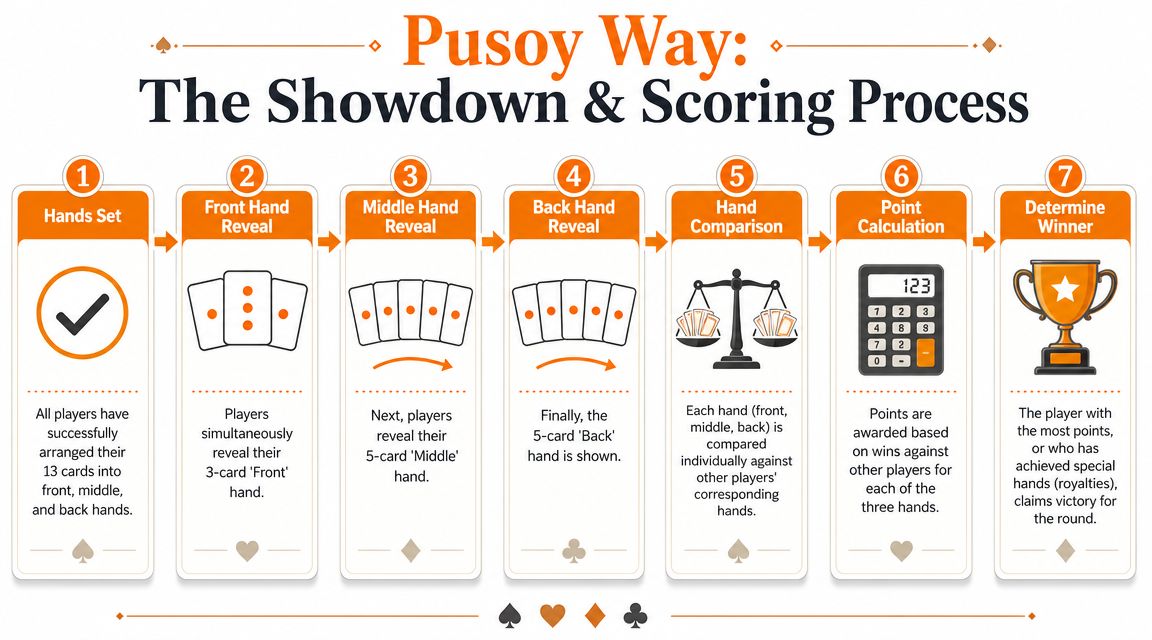
Once every player has arranged their cards, the round shifts from planning to comparison. This is the satisfying part. No more rearranging. The hands go face up and each lane gets judged against the matching lane.
Many rule sets compare the three lanes independently, often scoring 1 point per lane won, with a scoop bonus for winning all three against one opponent, as described in this Pusoy scoring guide.
If you also play online and care about handling platform cash-out steps cleanly, this Arena Plus withdrawal guide covers that side of the experience.
How the reveal usually happens
Most tables reveal by corresponding rows:
- Front versus front
- Middle versus middle
- Back versus back
Each lane is its own contest. That matters because you don't need to dominate every row to come out ahead. Winning two lanes can already put you in a strong position.
A clean scoring example
Take a simple head-to-head round.
Your result:
- Front: you win
- Middle: you lose
- Back: you win
That means you've taken two lanes out of three. In a standard lane-by-lane setup, that's a good round because your arrangement beat your opponent in more places than it lost.
Now look at the dream result:
- Front: you win
- Middle: you win
- Back: you win
That's a scoop. Some groups also call it a walis. It feels great because you didn't just edge the round. You controlled the whole layout.
Winning one giant back hand isn't the point. Winning the right comparisons is.
What happens with a foul
A foul changes everything. If your arrangement is invalid, you usually don't get the benefit of comparing lane by lane in the normal way. That's why experienced players treat legality as the first layer of scoring strategy.
A legal but modest hand can still earn points. A fouled hand wastes the whole effort.
Here's the best habit to carry into every showdown:
- Reveal with confidence only after checking order
- Count lane wins, not just your prettiest hand
- Value the scoop, but don't chase it recklessly
That mindset keeps your scoring consistent over time.
Essential Strategies for New Players
Your cards are finally dealt, and one problem shows up right away. You can build a beautiful back hand, but if the middle turns soft and the front becomes dead weight, that pretty setup often loses more lanes than it wins.
That is why good Pusoy Way players in Filipino home games usually aim for a balanced arrangement first. On a modern online table, the habit matters even more because the pace is faster and you need a repeatable way to sort your 13 cards without second-guessing every round.
A simple way to remember it is this. Your back hand works like your strongest kuya in a basketball lineup. Your middle hand is the steady scorer. Your front hand is the role player who still needs to contribute. If one spot carries everything and the others disappear, the whole team becomes easy to beat.
Why balance beats a flashy setup
Beginners often pour too much strength into the back because that hand feels the most satisfying to build. The trouble comes later. You win one lane, then watch the middle and front get picked apart.
A better target is a layout that can fight in at least two places. Sometimes that means trimming a strong back hand so the middle becomes more respectable. That trade can win more comparisons over time, especially against players who also know how to arrange cleanly.
This skill carries over well if you move from kitchen-table Pusoy to licensed online play in the Philippines. Fast platforms reward players who can recognize structure quickly, stay legal, and avoid emotional decisions. As you sharpen that kind of card sense, you can also explore how other games reward different habits on Mega Panalo Casino.
Beginner mistakes that cost rounds
These mistakes show up again and again:
- Overloading the back hand: You create a monster at the bottom, but the middle no longer has enough strength to survive.
- Ignoring the front hand: The top row may look small, yet a useful pair or high-card edge can still swing a lane.
- Skipping the final legality check: A fouled hand is an automatic loss.
- Protecting one combo too much: Sometimes a nice-looking set should be broken apart if it improves the full 13-card arrangement.
One habit helps with all four mistakes. Before you lock your hand, pause and read it from back to middle to front. Ask yourself, "Is the order legal? Can the middle compete? Did I leave any value in front?"
A practical habit you can use every round
When two arrangements both look decent, choose the one that gives you a legal setup, a middle hand with real fighting chance, and a front hand that still has purpose.
Here is the beginner-to-improver shift in plain language. Stop asking which single hand looks the most impressive. Start asking which full arrangement gives you more realistic paths to win the round.
That mindset saves a lot of points.
Pusoy Variants and Playing Safely Online
You sit down for a casual game night, hear someone say "Pusoy," and assume you will be arranging front, middle, and back hands. A few minutes later, the table starts shedding cards race-style. That mix-up happens often in the Philippines, especially when players learned from different households.
It's common to confuse Pusoy Way with Pusoy Dos, but they are distinct games.
Pusoy Dos is a shed-type card game usually played by 2 to 4 people, using a standard 52-card deck, with 13 cards dealt to each player in a 4-player game. The goal is to empty your hand first, so the rhythm feels quicker and more like a race than a hand-arrangement contest, according to this Pusoy Dos rules reference.
A quick way to tell them apart
A simple check helps:
- Pusoy Way: You build three hands from your 13 cards, with the back strongest, the middle next, and the front weakest.
- Pusoy Dos: You play combinations to get rid of all your cards before the other players.
That one question, "Way or Dos?", saves a lot of confusion before the first card is even dealt.

What safe online play should look like
The jump from home play to online play changes one big thing. At home, house rules can shift depending on who is hosting. On a regulated platform, the rules and game flow are presented clearly, so you spend less energy sorting out disputes and more energy reading your hand well.
That is why the platform matters.
If you want to play Pusoy-style games online in the Philippines, choose a site that shows its licensing clearly, explains account steps plainly, and presents games in an organized lobby. A PAGCOR-licensed platform like Insta Play Online Casino gives players a regulated environment, which helps remove the guesswork that often comes with informal setups.
For beginners, that structure is helpful in a very practical way. You already have enough to think about with hand strength, legal arrangement, and scoring. A clear platform reduces extra distractions, so learning feels closer to sitting beside an experienced player who keeps the rules consistent every round.
If you are exploring online gaming options, Insta Play also highlights recognised game providers and current offers, including the Free ₱3,000 Bonus. That does not replace strategy, of course, but it does give Filipino players a more confident starting point when moving from kanto or family-table Pusoy habits to a regulated online setting.





Join thousands of gaming professionals receiving the latest iGaming news, regulatory updates, and market insights.
