

In 2024, electronic gaming generated Php154.51 billion in gross gaming revenue, rising from Php58.16 billion in 2023, according to PAGCOR's official 2024 GGR release. That result changed the market-entry question. Legal online gaming platforms in the Philippines are no longer a peripheral opportunity attached to land-based gambling. They're now part of the country's central regulated gaming economy, but access depends on a domestic authorization model that sharply separates Philippine-facing activity from offshore operations.
For operators, suppliers, affiliates, and investors, the important distinction is not whether a business holds a gambling license somewhere. The decisive question is whether the operator, platform, game content, payment flow, and customer-access controls fit within the Philippine Amusement and Gaming Corporation, or PAGCOR, framework. The post-POGO market is therefore best understood as a technical compliance stack, not just as a list of approved brands.
Table of Contents
- The Scale of Legal Online Gaming in the Philippines
- PAGCOR and the Regulatory Architecture
- Why Offshore Licenses No Longer Guarantee Legality
- License Categories Fees and Entry Requirements
- The Tightening Compliance Environment for 2026
- How to Verify a Legally Authorized Platform
- Business Implications for Operators Affiliates and Investors
The Scale of Legal Online Gaming in the Philippines
Php372.33 billion was the Philippines' total gaming GGR in 2024, compared with Php285.27 billion in 2023, an increase of 30.52%. Electronic gaming contributed Php154.51 billion, up 165.66% from the previous year. PAGCOR also reported broader gaming-sector revenues of Php410.5 billion in 2024, compared with Php328.88 billion in 2023, in the regulator's 2024 industry announcement.
The figures establish electronic gaming as a major regulated revenue channel. They also change the compliance risk profile. Licensing, identity verification, payments, advertising, game systems, and supplier relationships now affect continued access to a commercially significant market. Compliance is therefore an operating condition, not a document package assembled before launch.
The verified revenue picture
The available official figures support a clear conclusion, but they do not provide a complete year-by-year series from 2021 through 2025. The table preserves those gaps rather than filling them with estimates or unsupported disclosures.
| Year | Land-Based Casino GGR | Electronic Gaming GGR | Total GGR | E-Gaming Share |
|---|---|---|---|---|
| 2021 | Not specified in verified data | Not specified in verified data | Not specified in verified data | Not specified in verified data |
| 2022 | Not specified in verified data | Not specified in verified data | Not specified in verified data | Not specified in verified data |
| 2023 | Not specified in verified data | Php58.16 billion | Php285.27 billion | Not specified in verified data |
| 2024 | Not specified in verified data | Php154.51 billion | Php372.33 billion | Not specified in verified data |
| 2025 | Not specified in verified data | Not specified in verified data | Not specified in verified data | Not specified in verified data |
The analytical point is stronger than a missing table cell. Verified electronic-gaming revenue rose sharply between 2023 and 2024 while total GGR reached a record level. Digital formats had become a major growth engine within the regulated sector. That scale helps explain why controls increasingly extend beyond the licensed operator to the platform, content, payment chain, and accredited vendors.
From offshore expansion to domestic segmentation
The earlier POGO period showed how offshore licensing, labor, technology, and cross-border operations could expand together. PAGCOR issued POGO rules on August 26, 2016, and by 2019 had issued licenses to 58 POGOs employing more than 130,000 individuals. Offshore operations generated Php11.9 billion in gaming revenues between 2016 and 2018, compared with Php56 million previously, according to historical reporting on the POGO timeline.
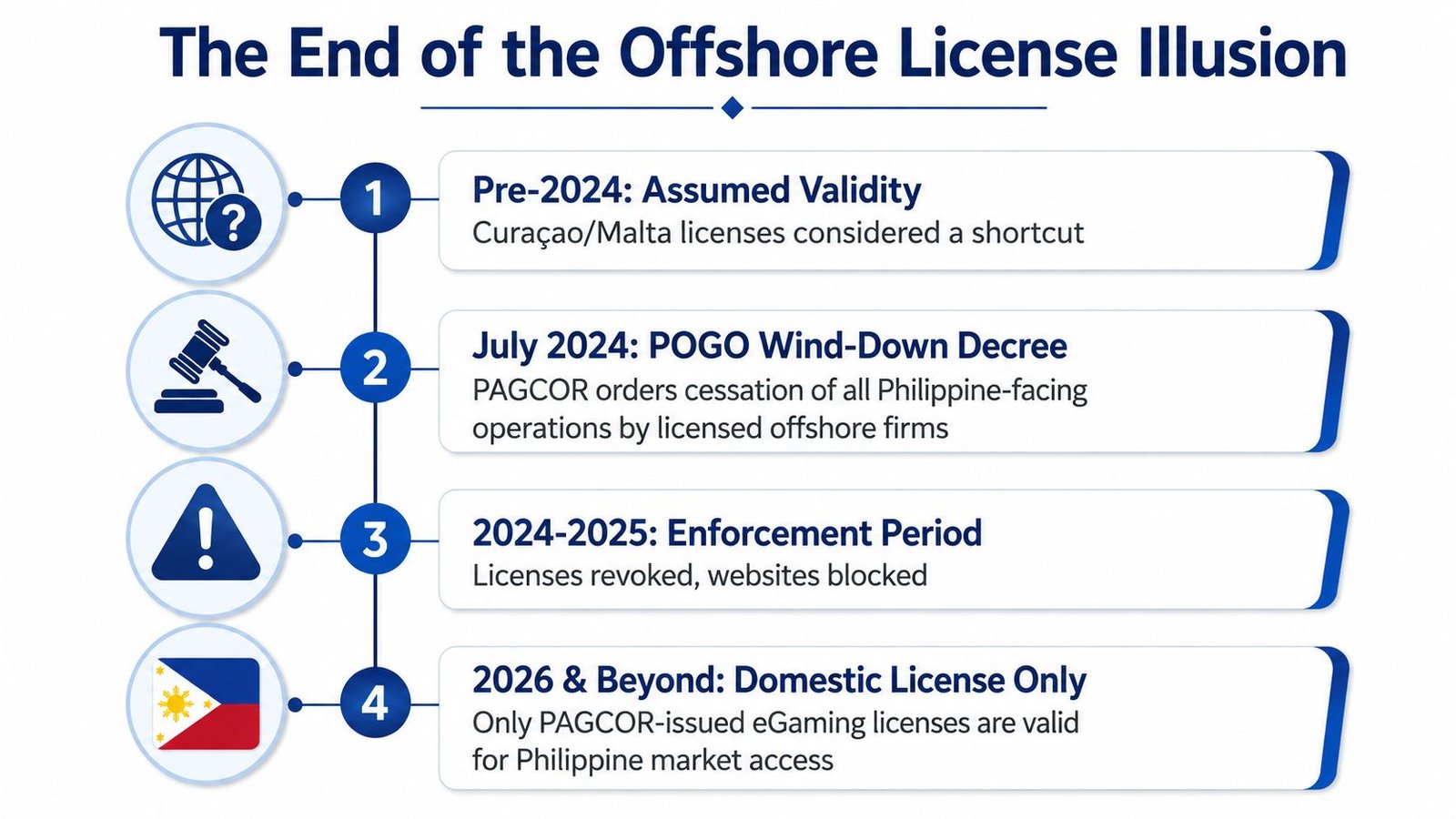
That structure no longer defines Philippine-facing access. Executive Order No. 74 required Philippine offshore gaming operations and related services to wind up by December 31, 2024. PAGCOR also stated that as many as 70 legal online gambling platforms paid Php50 billion in license fees in 2024. The post-POGO market is consequently segmented: domestic channels require Philippine authorization, while offshore activity is subject to a forced wind-down.
For operators assessing online casino real-money options in the Philippines, revenue growth is a compliance signal. The practical boundary is defined by the authorization covering the operator, the platform running the service, the content offered, and the vendors supporting payments or technology. A foreign license alone does not establish access to the domestic market.
PAGCOR and the Regulatory Architecture
PAGCOR occupies a distinctive position because it both operates gaming establishments and regulates gaming activity. Its regulatory mandate states that the corporation operates, grants authority to operate, and regulates gaming establishments in the Philippines, including games of chance and gaming operations within Philippine territory.
That dual role creates a practical consequence for executives. A market-entry plan must identify not only the commercial license required, but also the specific regulatory function connected to the operator's platform, game content, service providers, and transaction systems.
The control layers that matter
PAGCOR's Electronic Gaming Licensing Department, or EGLD, licenses and regulates local online operations including e-bingo, e-casino, sports betting, online poker, and numeric games. It also evaluates gaming platforms and systems and accredits gaming system service providers, as set out in PAGCOR's Electronic Gaming Licensing Department framework.
The architecture can be read as a sequence:
- PAGCOR establishes the regulatory perimeter. Its mandate determines which gaming operations require authority within Philippine territory.
- EGLD assesses online gaming activity and systems. The review extends beyond the corporate applicant to the platform and deployed gaming content.
- Service providers enter a separate control relationship. A supplier supporting the operator may need accreditation or system evaluation rather than relying on the operator's authorization alone.
- Financial-crime controls operate alongside gaming regulation. Operators must build their compliance processes around applicable AML and KYC obligations, not treat them as a post-launch administrative function.
The verified framework doesn't establish every institutional role described in older market explainers, so executives should avoid assuming that a single PAGCOR approval resolves every issue involving payments, technology, or criminal enforcement. The legally useful distinction is that licensing is not monolithic. The operator, platform, service provider, and game content can all sit within the regulator's approval scope.
Why the architecture changes launch planning
A commercial team may regard a platform as ready when its wallet, games, customer support, and marketing are operational. PAGCOR's framework applies a different test. Launch readiness depends on whether the relevant platform has been evaluated, the service providers are appropriately accredited, and the game offering fits the authorized activity.
Practical rule: A Philippine market-entry file should map every regulated function to its responsible entity, approval, system evaluation, and ongoing monitoring obligation.
Businesses reviewing PAGCOR online casino requirements should therefore separate the corporate license from the technical permissions supporting the customer journey. That separation is the foundation of the post-POGO model.
Why Offshore Licenses No Longer Guarantee Legality
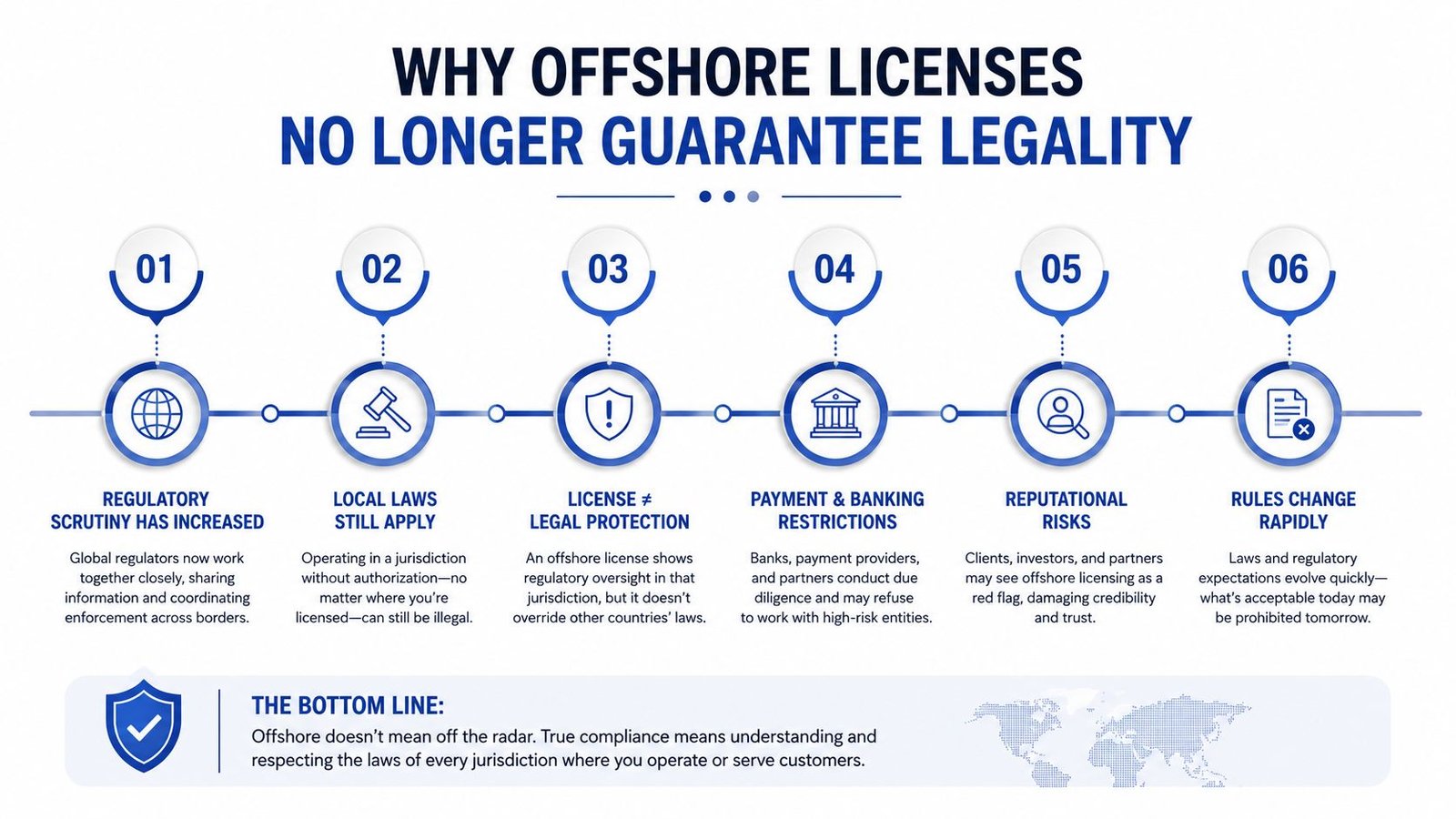
A Curaçao, Malta, or Isle of Man license can show that an operator is regulated abroad. It does not, by itself, authorize service to players located in the Philippines. The relevant boundary is the Philippine authorization covering the activity, platform, and audience, not the reputation or accessibility of a foreign certificate.
Executive Order No. 74 required Philippine offshore gaming operations and related services to cease by December 31, 2024, or earlier. The official text of the executive order sets out that policy direction. PAGCOR separately distinguishes locally licensed online gaming from offshore operations directed at foreign players.
The market boundary after the POGO era
The former offshore model allowed a business to appear internationally licensed while leaving its position concerning Philippine users unclear. The regulatory response was to remove that ambiguity, require offshore operations and related services to wind up, and direct compliant domestic demand toward locally authorized channels.
PAGCOR's historical record illustrates the transition. The regulator issued POGO rules on August 26, 2016, licensed 58 POGOs by 2019, and recorded Php11.9 billion in offshore gaming revenues from 2016 to 2018, compared with Php56 million before that period, according to the documented POGO history. PAGCOR later stated that up to 70 legal online gambling platforms paid Php50 billion in license fees in 2024. Together, these figures show a shift toward a market subject to more direct domestic oversight.
For 2026, the practical conclusion is narrow. A foreign license cannot replace relevant Philippine authorization when a platform targets Philippine-based players. Affiliates, payment providers, software vendors, and investors must assess their own role, because the operator's offshore certificate does not automatically protect the wider commercial chain.
The due-diligence implication
Marketing may emphasize a foreign license while obscuring the location of the customer being served. That makes customer geography a central compliance test, alongside the operator's corporate approval and the platform's technical permissions.
For partners assessing legitimate gaming platforms available to Philippine users, separate three questions:
- Who is licensed? Identify the operator's legal entity.
- What is licensed? Confirm that the authorization covers the product, platform, and service scope.
- Who may be served? Check that the customer jurisdiction fits the authorization.
Market-entry test: A foreign certificate establishes an operator's status abroad. Evidence of relevant Philippine authorization is still required for Philippine-facing activity.
License Categories Fees and Entry Requirements
PAGCOR's published fee schedules show that entry costs vary according to the gaming activity and the regulatory category. The verified data doesn't provide a complete 2026 IGL and B2B cost model in United States dollars, annual license charges, minimum paid-up capital, or domestic-versus-offshore capital requirements. Any investment model using those figures would therefore need separate confirmation from current PAGCOR materials or professional counsel.
The available official schedule does establish meaningful Philippine-peso fees. Traditional bingo, electronic bingo, and electronic casino games carry a PHP300,000 application fee for a three-year term, while sports betting, specialty games, numeric games, and online poker carry a PHP200,000 application fee with a two-year validity term, according to PAGCOR's regulatory framework for gaming-venue fees and rates.
Verified fee categories
| License or activity reference | Application or processing fee | Validity or status | What the data supports |
|---|---|---|---|
| Traditional bingo | PHP300,000 | Three years | Published PAGCOR application fee |
| Electronic bingo | PHP300,000 | Three years | Published PAGCOR application fee |
| Electronic casino games | PHP300,000 | Three years | Published PAGCOR application fee |
| Sports betting | PHP200,000 | Two years | Published PAGCOR application fee |
| Specialty games | PHP200,000 | Two years | Published PAGCOR application fee |
| Numeric games | PHP200,000 | Two years | Published PAGCOR application fee |
| Online poker | PHP200,000 | Two years | Published PAGCOR application fee |
| Selected gaming-venue processes | PHP2,500,000 processing fee | Not specified in verified data | Published PAGCOR schedule |
| Selected gaming-venue processes | PHP5,000,000 accreditation fee | Not specified in verified data | Published PAGCOR schedule |
PAGCOR's separate schedule of regulatory fees lists a PHP2,500,000 processing fee and a PHP5,000,000 accreditation fee for some gaming-venue processes. Those amounts shouldn't be repurposed as universal IGL or B2B prices, because the verified source doesn't assign them to every online license category.
What investors should verify before budgeting
A disciplined budget should distinguish:
- Application charges, which are paid to submit or process an application.
- Accreditation charges, which may apply to a particular venue, system, or supplier process.
- Ongoing regulatory costs, which aren't specified in the verified data and require current confirmation.
- Corporate and technical costs, including systems evaluation, responsible-gaming controls, KYC, AML processes, and vendor oversight.
The practical conclusion is conservative. PAGCOR B2B accreditation fees should be validated against the exact service category, because a platform provider, game supplier, payment business, and operator may not face the same approval pathway.
The Tightening Compliance Environment for 2026
2026 regulation separates market access from technical authorization. Domestic-facing online gaming remains commercially significant, while offshore operations serving foreign players sit outside the domestic authorization framework. PAGCOR's published materials place controls across the operator, platform, gaming system, service provider, and game content. Legal entry therefore depends on how these layers connect, not on the entity holding an approval alone.
The current direction also points to tighter operational controls, including geofencing, real-time identity verification, and mandatory accreditation for B2B service providers. AML obligations are expanding across online gambling and digital-finance-linked activity. A regulatory analysis covering the 2026 framework reports that Philippine gaming GGR reached Php87.60 billion in Q1 2026, compared with Php104.12 billion previously. The commercial data reinforces a regulatory point: operators must prove control over customer access, transactions, and suppliers.
From licensing event to continuous control
A license establishes an approved operating basis. It does not end the compliance task. The platform must continue to show that customers enter through permitted channels, identity checks remain effective, transactions receive appropriate review, and suppliers operate within the approved structure.
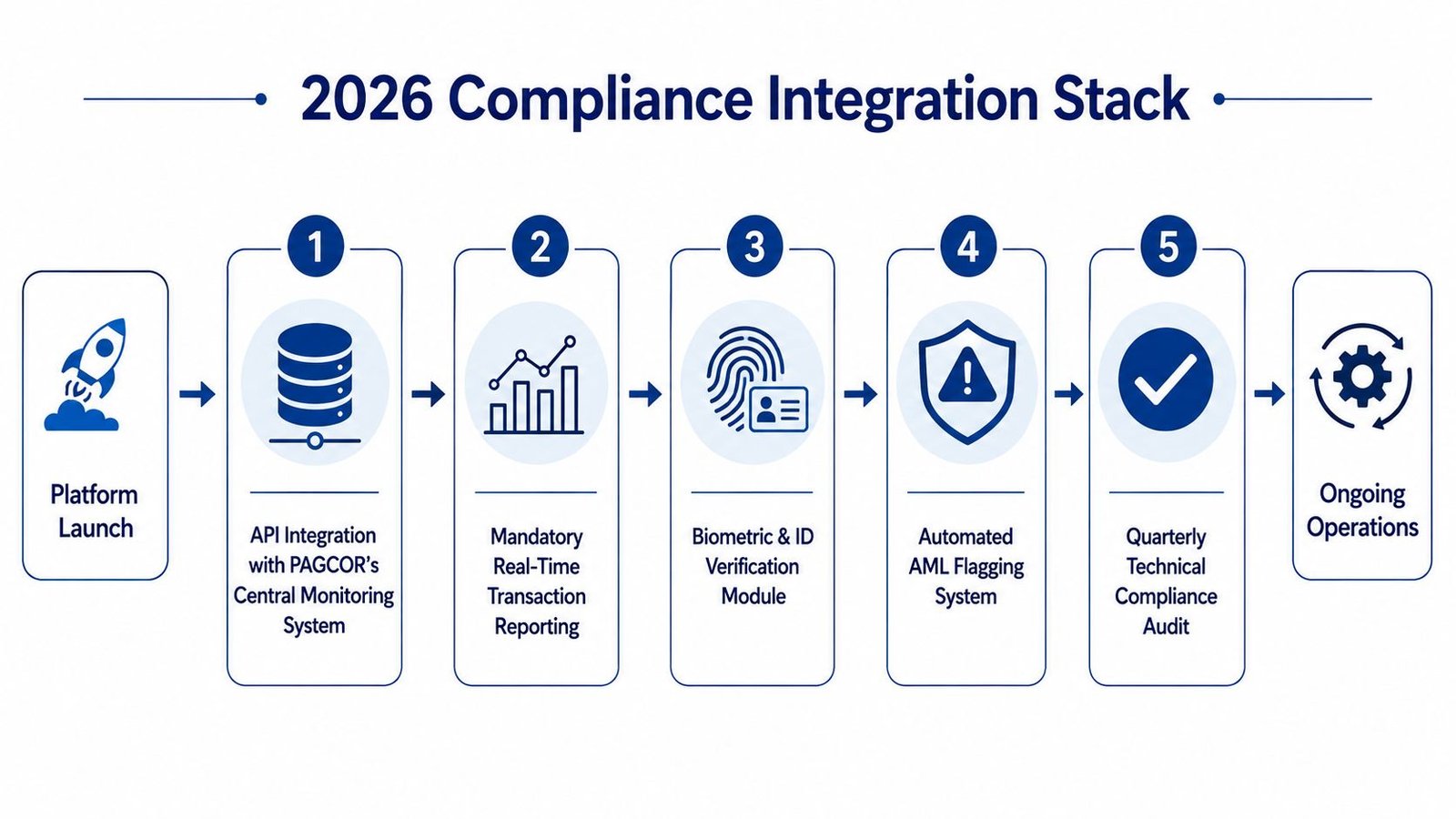
The technical stack links several control areas:
- Geofencing restricts access according to the authorized market.
- Identity verification connects account creation and ongoing access with verified customer information.
- AML monitoring flags transactions and behavior for review or reporting.
- Vendor accreditation brings platform companies, game aggregators, payment gateways, and other B2B participants into the control framework.
- Technical evaluation checks whether the platform and gaming systems function as represented.
The supplied official material does not establish every implementation detail. Executives should use this stack as a planning model based on the documented regulatory direction, then confirm current PAGCOR specifications before deployment.
Why prepared entrants face a different cost profile
Software can be acquired quickly. Sustaining an authorized Philippine operation requires continuing investment in monitoring, identity workflows, supplier due diligence, governance, and audit evidence. Those requirements affect the platform, content, and vendor layers simultaneously.
Compliance insight: Competitive strength may depend less on promotional reach than on keeping every regulated layer aligned after launch.
Teams following PAGCOR regulatory updates for 2026 should assess each rule by identifying the affected system, vendor relationship, or customer-control process. This turns regulatory monitoring into an operating discipline rather than a legal-news exercise.
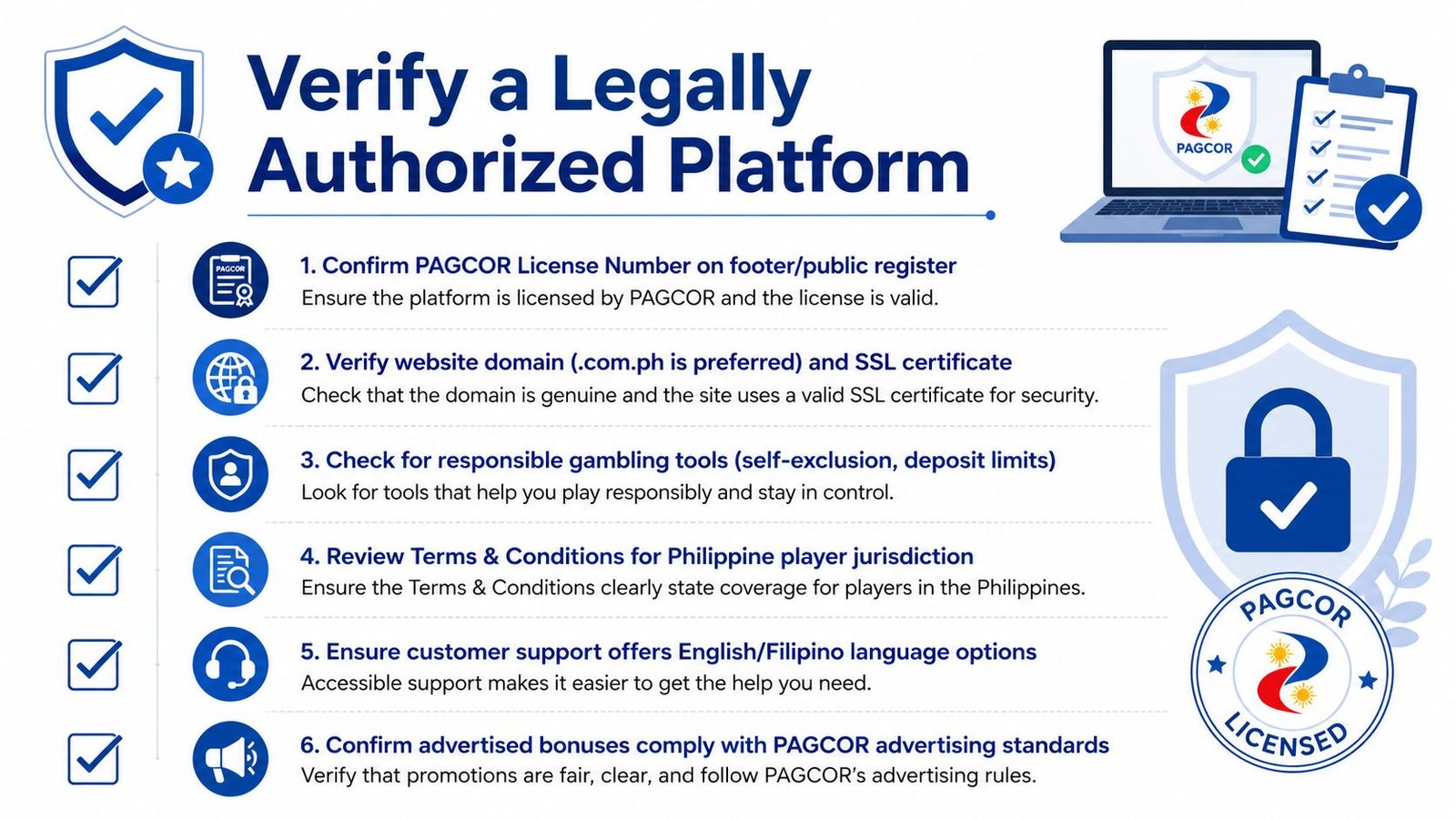
How to Verify a Legally Authorized Platform
Verification should start with the regulator, not the brand's advertising. PAGCOR states that it regulates gaming operations within Philippine territory and that its electronic gaming framework covers local online activities, platforms, systems, and service providers. A platform's claims should therefore be checked against the official regulatory information available from PAGCOR's regulatory pages.
A practical verification sequence
- Identify the legal operator. The website should disclose the entity responsible for the gaming service, not only a commercial brand name.
- Check the authorization scope. The relevant approval should correspond to the product offered, such as e-casino, sports betting, online poker, numeric games, or e-bingo.
- Confirm the platform relationship. PAGCOR's framework includes platform and system evaluation, so an operator should be able to explain the technology and service-provider structure supporting the site.
- Review the customer jurisdiction. A foreign license doesn't establish Philippine authorization. The platform's terms and market positioning should be consistent with its approved audience.
- Inspect payment and identity processes. A credible platform should explain its account verification, payment, responsible-gaming, and complaint procedures clearly.
- Escalate uncertainty before transacting. Affiliates and B2B partners should pause promotion or integration when the operator cannot provide verifiable authorization evidence.
Red flags that deserve a higher review threshold
An expired POGO reference, a foreign license presented as the only approval, unclear ownership, unexplained payment intermediaries, or missing information about platform providers should all trigger enhanced diligence. The absence of a visible license number isn't conclusive by itself, but it prevents a partner from completing a basic verification exercise.
Affiliates should preserve the evidence used to approve a partner, including the operator identity, authorization scope, relevant PAGCOR registry entry, and the date of review. That record matters because a platform's status can change, and an affiliate's campaign may continue after the underlying authorization has been withdrawn.
Business Implications for Operators Affiliates and Investors
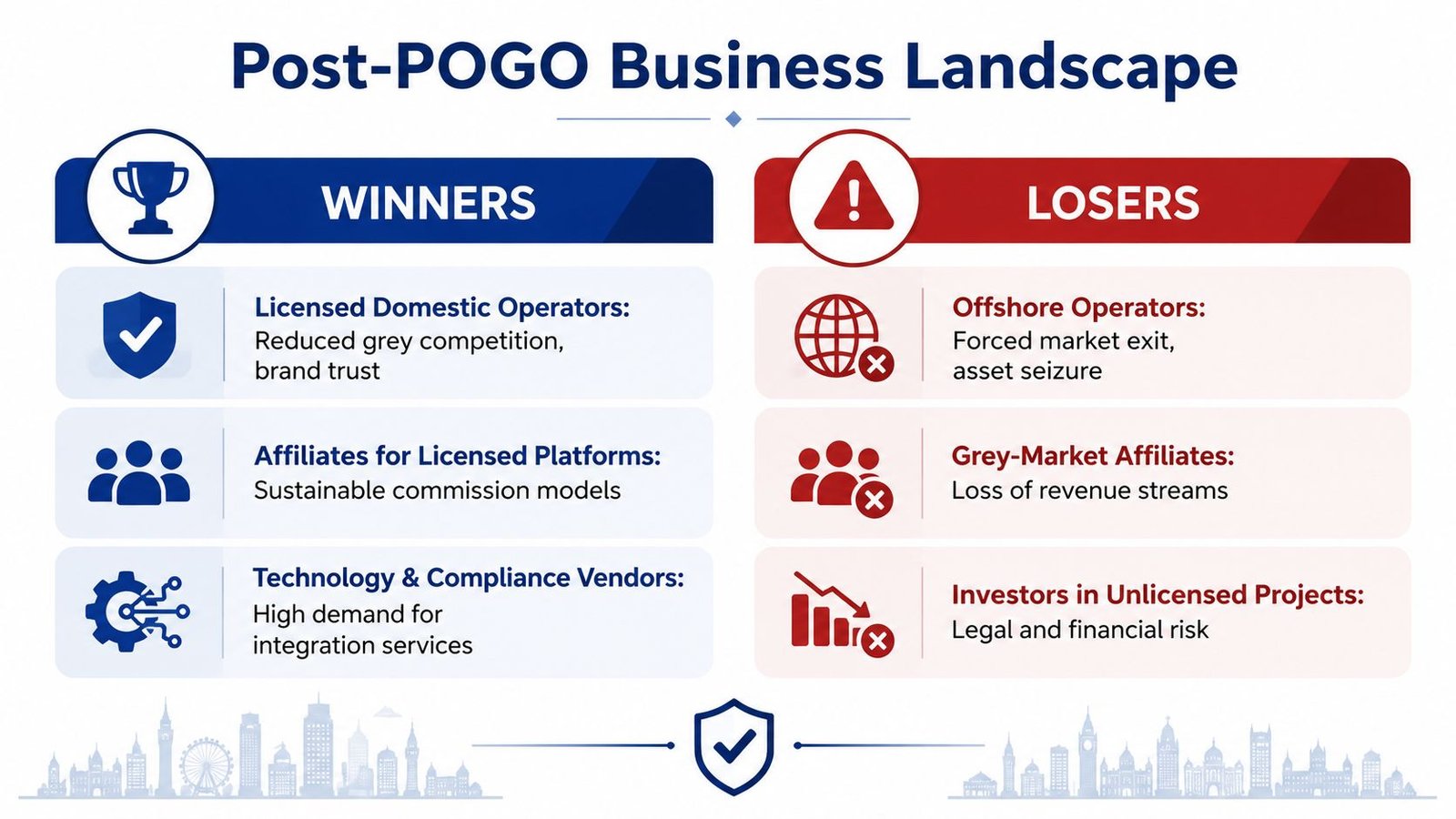
The post-POGO framework separates businesses designed for Philippine authorization from those dependent on offshore reach. Licensed Philippine-facing operators gain a clearer competitive boundary because offshore models cannot be treated as equivalent substitutes. They also assume greater responsibility for platform controls, game systems, identity checks, payments, and supplier oversight.
The commercial case remains significant. Electronic gaming GGR rose from Php58.16 billion in 2023 to Php154.51 billion in 2024, while total gaming GGR reached Php372.33 billion in 2024, as reported earlier. That scale attracts capital, but it also makes weak controls more visible and more costly.
Operators and technology suppliers
Operators should map authorization before customer acquisition. The relevant question is not only whether a brand holds a license, but whether its platform, content, technical systems, payment arrangements, and vendors fit within the authorized scope. A gap in that chain can create launch, enforcement, and business-continuity risk.
The compliance stack creates openings for technology suppliers that can document their role and controls:
- Platform integration, connecting gaming operations with required monitoring and reporting workflows.
- Identity and risk tools, supporting customer verification, account controls, and responsible-gaming processes.
- Game-system services, where testing, evaluation, and accreditation form part of readiness for the Philippine market.
- Payment and compliance infrastructure, provided the supplier's own status, function, and contractual relationship are assessed.
Vendor accreditation should therefore be treated as part of market access, not as a procurement detail. A technically capable supplier still creates exposure if its approval status, service scope, or data flows cannot be documented.
Top 1 Rank covers regulatory updates, licensing, compliance, market intelligence, and technology developments for iGaming participants. It can serve as one information source for teams tracking this operating environment, alongside official regulatory materials.
Affiliates and capital providers
Affiliates need partner screening that goes beyond conversion rates and commission terms. A campaign for a platform holding only a foreign license can expose the affiliate relationship to regulatory and commercial risk when the brand's Philippine-facing activity is unclear. Approval files should show the operator's identity, domestic authorization, product scope, and the vendors supporting the advertised service.
Investors should assess that compliance architecture within the investment case. More durable models are those that can document Philippine authorization, maintain qualified suppliers, and fund continuing technical oversight. Unlicensed projects, offshore-only strategies marketed domestically, and businesses treating accreditation as optional face structural barriers to lawful growth.
The reported decline from Php104.12 billion to Php87.60 billion in Q1 2026 indicates a more selective market environment, according to the 2026 regulatory commentary. The figure does not establish the reason for the change. It does support stress-testing investment plans against enforcement, compliance costs, and market-access conditions.
Investor filter: The strongest Philippine opportunity is a regulated operating model with evidence that every critical supplier and system can withstand scrutiny.
Before committing capital, businesses should obtain current PAGCOR confirmation for the relevant license class, product scope, fees, technical requirements, and vendor obligations. Affiliates and suppliers should independently verify Philippine authorization, retain the review record, and decline campaigns or integrations when the evidence does not establish lawful domestic market access.
For current analysis of legal online gaming platforms in the Philippines, follow Top 1 Rank's regulatory coverage and use official PAGCOR materials as the final reference for licensing, authorization scope, and compliance decisions.





Join thousands of gaming professionals receiving the latest iGaming news, regulatory updates, and market insights.
