

PAGCOR regulatory updates 2026 did not arrive as a single policy tweak. They arrived as a coordinated reset, with fees, KYC, payments oversight, supplier accreditation, and advertising controls all moving at once, and with some deadlines shifting before full enforcement took hold. For operators, suppliers, and payment partners, the key issue is no longer whether a rule exists, but whether the whole compliance chain can survive the regulator's cutover windows.
That matters because PAGCOR is now regulating the gaming stack as a system, not as isolated parts. A platform can be commercially sound and still become non-viable if its supplier is unaccredited, its onboarding flow is too weak, or its payments rails are out of step with the new monitoring perimeter. The practical question for leadership teams is simple, even if the answer isn't: which controls need to be fixed now, and which ones can be phased in without disrupting revenue?
Table of Contents
- Understanding the 2026 Regulatory Reset
- New Minimum Guaranteed Fee Structure for Gaming Operators
- Enhanced KYC and Payment Monitoring Requirements
- Supplier Accreditation and Technical Compliance Deadlines
- Advertising Restrictions and Responsible Gaming Controls
- Sports Betting Fee Adjustments and Product Differentiation
Understanding the 2026 Regulatory Reset
The 2026 cycle shows PAGCOR moving from targeted rulemaking to a broader supervisory model. The clearest sign is that the regulator did not only adjust operator fees. It also tightened identity checks, expanded payment oversight, and put supplier accreditation on a hard deadline that can affect live production environments, not just licensing paperwork.
The timeline tells the real story
The fee changes alone show how quickly the rulebook moved. PAGCOR introduced a new minimum guaranteed fee structure for gaming system administrators and gaming venue operators in 2026, with the first phase initially set for 1 April 2026, then deferred to 1 June 2026, and later extended again to 31 July 2026. The published thresholds included PHP 30 million in monthly gross gaming revenue with a PHP 9 million minimum guaranteed fee, and PHP 15 million in monthly gross gaming revenue with a PHP 3 million minimum guaranteed fee, which materially changes the cost base for Philippine online gaming operations. PAGCOR fee update summary
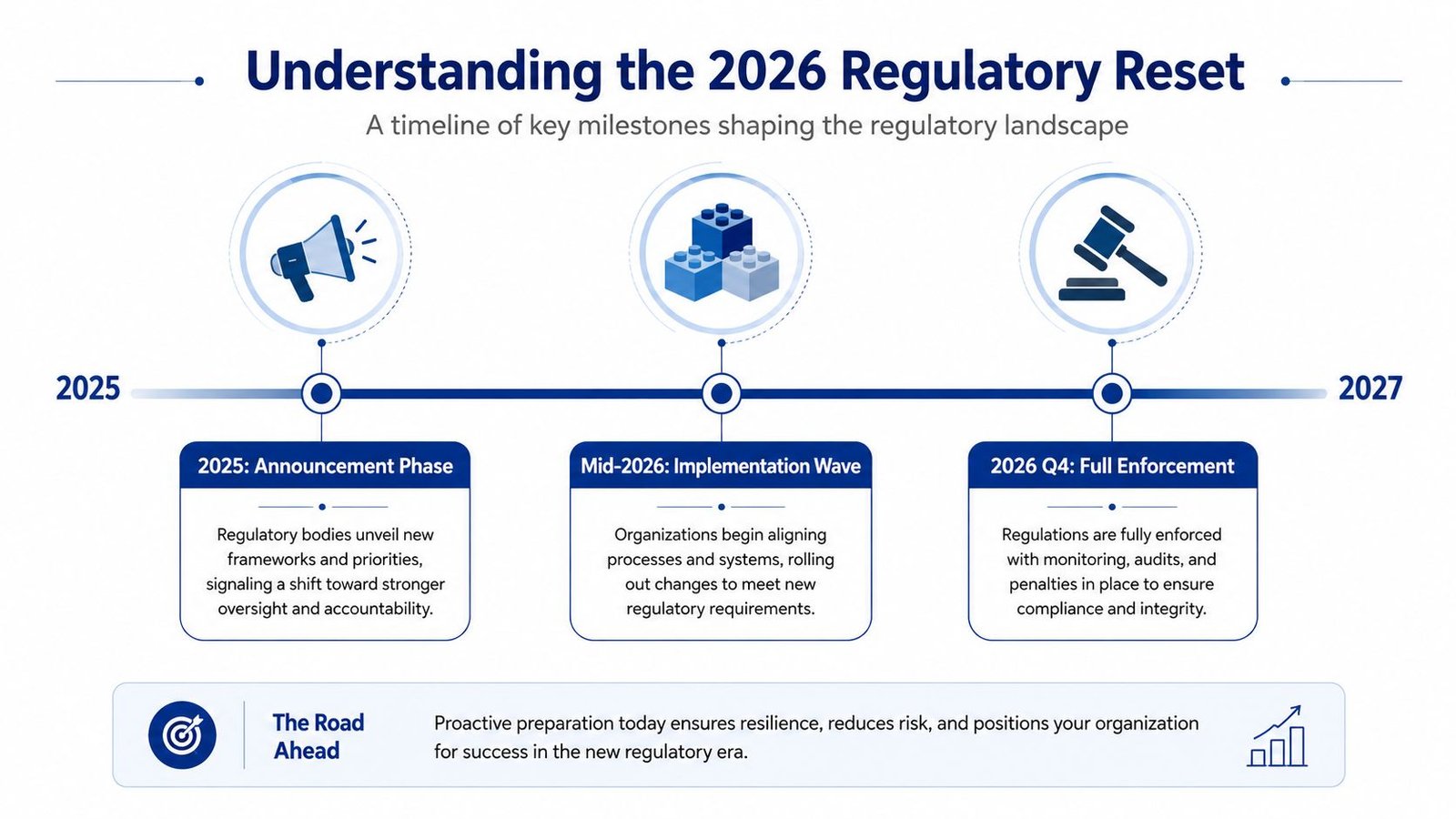
The deeper shift is structural. PAGCOR's 2026 posture links revenue compliance, customer identity assurance, payment monitoring, and vendor accreditation into one enforcement environment. That means a company can't treat finance, product, legal, and operations as separate workstreams anymore. Each one now touches a different point in the same regulatory chain.
Practical rule: if a control failure can interrupt deposits, onboarding, or supplier continuity, it's no longer a back-office issue. It's an operating-risk issue.
The market should also read the timing carefully. Some measures are already in force or clearly signaled, while others allow only a narrow planning window. The safest approach is to classify every change by enforcement urgency, then assign accountability across compliance, payments, product, and vendor management instead of waiting for a single formal deadline.
For domestic-facing operators, the central risk is not one regulation, but the interaction among several. A tighter fee model compresses margin, stricter KYC reduces onboarding tolerance, and supplier accreditation can remove key infrastructure partners from the chain. That combination is why the 2026 reset deserves to be treated as a full operating-model review. For a market-specific overview, this Philippines online casino page is a useful internal reference point.
New Minimum Guaranteed Fee Structure for Gaming Operators
PAGCOR's minimum guaranteed fee framework changes the commercial math for operators before a single player is onboarded. The critical point goes beyond the amount due, it is how the structure divides operators into two compliance bands based on monthly gross gaming revenue and product mix. Finance teams therefore need to model fees at the portfolio level, not just at the brand level.
The timeline tells the story
Under the 2026 framework, the first tranche is projected to run from 1 April 2026 to 30 September 2026, and the second tranche is expected to begin on 1 October 2026. For tranche one, GSAs operating eCasino games must pay PHP 9 million monthly if their gross gaming revenue reaches at least PHP 30 million, while GSAs without eCasino games must pay PHP 3 million monthly at a PHP 15 million gross gaming revenue threshold. PAGCOR MGF structure
| Operator Type | Monthly GGR Threshold | Monthly MGF | Effective Period |
|---|---|---|---|
| GSA operating eCasino games | PHP 30 million | PHP 9 million | 1 April 2026 to 30 September 2026 |
| GSA without eCasino games | PHP 15 million | PHP 3 million | 1 April 2026 to 30 September 2026 |
That table is the starting point, not the conclusion. Finance teams still have to test whether their revenue mix can absorb the fee load without pushing marginal products out of the regulated channel. Volatility is the planning issue, because revenue near a threshold can trigger a sudden shift in effective cost.
What operators should do first
Operators should calculate the fee impact at three levels. First, at the individual brand level. Second, at the consolidated operator level. Third, across product categories, especially where eCasino activity and non-eCasino activity sit inside the same commercial group.
Commercial insight: the fee model rewards precise portfolio segmentation. Operators that blur product lines may misjudge which revenue streams actually support the regulated structure.
A second point matters for planning teams. The rule affects pricing, product prioritisation, channel economics, and whether some market segments remain viable after compliance cost is layered in. A profitability review should therefore happen before any expansion decision, not after the fee is booked.
For B2B contexts, supplier-facing accreditation costs can also shape these economics. The internal reference on PAGCOR B2B accreditation fees helps teams gauge how upstream cost pressure can compound operator-side obligations.
Enhanced KYC and Payment Monitoring Requirements
PAGCOR's KYC tightening changes the control point from after registration to before funding. That shift sounds small, but it changes the whole user journey. Once identity assurance happens before a deposit, onboarding friction, verification latency, and payment approval quality all become part of the regulated experience.
Identity verification now sits in the critical path
PAGCOR's revised registration process requires a government-issued ID and real-time selfie verification. That means operators can't rely on lightweight account creation flows and clean them up later. The control now needs to block weak or suspicious registrations before money enters the wallet, which is a different fraud model. PAGCOR KYC and ad rules update
Operators that still use manual review queues will feel the pressure first. Real-time selfie checks, document OCR, liveness detection, and sanctions or PEP screening all need to sit inside the registration funnel if the company wants to avoid bottlenecks. That is especially true in mobile-first markets, where a slow verification step can weaken conversion even when customer demand is strong.
Payment oversight now extends beyond the operator
PAGCOR also brought the Bangko Sentral ng Pilipinas into the oversight picture to help monitor banks, digital banks, non-bank financial institutions, and e-money issuers involved in gaming transactions. That widens the compliance perimeter beyond the gaming operator and into the payment ecosystem itself. PAGCOR payment monitoring update
The implication is direct. Deposit rails now need stronger transaction monitoring, wallet-linkage controls, and suspicious-activity escalation. Payment providers and verification vendors are no longer peripheral service partners. They're part of the control environment that determines whether a gaming operator can function cleanly under scrutiny.
| Control Area | Earlier Operating Logic | 2026 Operating Logic |
|---|---|---|
| Identity checks | Verify after registration, then monitor | Verify before deposit, then monitor |
| Payment review | Focus on operator-side flows | Extend oversight to banks and e-money issuers |
| Fraud risk | React to suspicious accounts | Block weak accounts at onboarding |
| Compliance burden | Mostly internal to the operator | Shared across operator, PSP, and verification vendor |
A useful way to frame the change is this. PAGCOR is trying to build a more traceable transaction environment, not just a stricter onboarding form. That improves consumer-protection visibility, but it also raises the bar for technical integration across KYC, AML, and payments. The connected payments angle is also covered in this payment gateway accreditation resource.
Operational takeaway: if the onboarding funnel can't prove identity and screen payment risk before the first deposit, it's already behind the new compliance standard.
Supplier Accreditation and Technical Compliance Deadlines
The supplier regime is where PAGCOR's 2026 update becomes most unforgiving. Unlike fee changes, which can be planned into a budget cycle, supplier accreditation creates a cutover window that can shut down products if vendors are late. That makes technical compliance a business-continuity issue, not just a legal one.
The deadline is about infrastructure, not paperwork
Contracted providers that filed accreditation applications on or before 31 May 2026 were allowed to keep servicing GSAs only through an interim period ending 31 July 2026. After that, any noncompliant Electronic Gaming System, online gaming platform, games, or gaming equipment can be decommissioned effective 1 August 2026. PAGCOR supplier shutdown warning
That wording matters. It means the regulator is targeting the upstream supply stack, not only the operator's license. Studios, aggregators, affiliates, and support-service firms all need to prove readiness before deployment dependencies are locked into production environments. If a critical vendor misses the window, the operator may inherit the interruption even if its own internal controls are sound.
What executives should audit immediately
- Vendor status checks. Confirm which suppliers already filed accreditation applications and which ones are still outside the process.
- Dependency mapping. Identify which live products, game feeds, and support tools rely on vendors exposed to the August cutover.
- Cutover planning. Prepare fallback paths for onboarding, content delivery, and live operations if a supplier is decommissioned.
- Contract review. Align commercial terms with regulator-imposed deadlines, not only renewal dates.
- Technical ownership. Assign product, legal, and compliance leads to the same risk register, so no team assumes another one has handled the issue.
The biggest risk is timing mismatch. Commercial contracts often renew on a flexible schedule, but PAGCOR's compliance window does not. That means a supplier can be commercially important and still be too risky to keep in production after the deadline. Operators that wait for renewal season may discover that the regulator has already moved the market.
The B2B angle is especially important for infrastructure providers. These content provider requirements are relevant to teams that need to understand how upstream accreditation pressure flows into product and content delivery.
Advertising Restrictions and Responsible Gaming Controls
PAGCOR's advertising posture in 2026 should be read as part of the same control system as KYC and payments. The regulator is not just limiting how operators market. It is also narrowing the channels through which users are acquired, which affects conversion, attribution, and responsible gaming design all at once.
Marketing controls are becoming compliance controls
By February 2026, PAGCOR had announced stricter online-gambling rules covering KYC, advertising, and responsible gaming, including ad restrictions during peak TV and radio hours. It also signaled possible broader ad bans and stronger responsible gaming safeguards. PAGCOR advertising and responsible gaming rules
That creates a clear strategic shift for affiliates and operators. Paid media can no longer be treated as a growth channel that sits separately from regulatory risk. Messaging, placement timing, and audience targeting all need to be reviewed together because the same regime that constrains promotion also monitors how players are identified and funded.
Why the package matters more than each rule alone
The combined effect is what changes the business case. A stricter ad environment reduces some acquisition pressure, but it also pushes operators toward cleaner onboarding and better player-risk controls. If the customer can't move smoothly from ad exposure to verified account to monitored deposit, then the funnel breaks at multiple points.
For compliance teams, the priority is to connect marketing review with product governance. Ad restrictions should feed into promotion approval, while responsible gaming tools should feed into retention and risk monitoring. That alignment matters because PAGCOR is building a more traceable environment across the full customer lifecycle, not only at registration.
Broad advertising control, stronger identity checks, and payment monitoring are now part of the same consumer-protection architecture.
Affiliates will need the most discipline here. Traffic quality, channel selection, and creative approvals all become more sensitive when the regulator is also tightening identity and deposit controls. The old model of separate marketing and compliance sign-off is too slow for that environment.
Sports Betting Fee Adjustments and Product Differentiation
PAGCOR's sports betting move is smaller than the KYC and supplier changes, but it's strategically important. The regulator has now formally split live and virtual sports products at the fee level, and that tells operators how it views each product's regulatory profile.
Live and virtual betting are no longer treated the same
PAGCOR reduced the regulatory fee on live sports betting to 15% of gross gaming revenue, while keeping the fee for virtual sports betting at 30% of gross gaming revenue. PAGCOR sports betting fee update
That split does more than alter margin. It creates a clear signal that live betting and virtual sports are not interchangeable products in the regulator's eyes. Operators should treat live sports as the more favorable commercial lane, but only after checking product compliance, trading capability, and internal risk appetite.
What sportsbook teams should prioritize
- Rebalance product mix. Review whether live betting deserves a larger share of marketing, trading, and CRM focus.
- Check operating margin. Recalculate take rates and promotional budgets under the new fee split.
- Align risk oversight. Make sure fraud, responsible gaming, and payment monitoring controls are consistent across both products.
- Update stakeholder ownership. Give trading, finance, and compliance shared responsibility for the product decision, not separate assumptions.
The broader lesson is that PAGCOR is using fee policy to steer product behavior. When live and virtual products carry different regulatory costs, operators will naturally rethink where to invest inventory, staffing, and customer acquisition. That makes product differentiation part of compliance strategy, not just pricing strategy.
For market context on sportsbook positioning, this MPBL betting odds reference is a useful internal point of comparison for teams evaluating live-betting relevance.
Top 1 Rank tracks regulatory change, licensing pressure, and iGaming compliance trends across markets where payments, identity, and supplier governance are converging. For operators and suppliers building their 2026 action plan, the next step is a full internal review of KYC flow design, vendor accreditation status, payment monitoring, and fee exposure against PAGCOR's deadline map.—
Contact the compliance, payments, and product leads this week, then run a side-by-side gap review against the 2026 PAGCOR schedule. Teams that update onboarding, supplier contracts, and sportsbook product economics before the cutover window will keep far more operational flexibility than those waiting for a final warning.





Join thousands of gaming professionals receiving the latest iGaming news, regulatory updates, and market insights.
