

PAGCOR's current B2B accreditation fee is PHP 5,000,000, and the separate Performance Cash Deposit is PHP 1,000,000 per offering. For suppliers, that makes the Philippine entry cost a layered compliance stack, not a single filing fee.
Table of Contents
- What PAGCOR B2B Accreditation Covers and Why It Exists
- Breakdown of Every Fee Category in the B2B Stack
- How the New Fee Schedule Compares to Older PAGCOR Charges
- Application Workflow, Payment Methods, and the 2026 Deadline
- Sample Cost Scenarios for Common Supplier Profiles
- PAGCOR B2B Costs Compared to Other Asian Markets
- Practical Tips, Common Misconceptions, and FAQs for Applicants
What PAGCOR B2B Accreditation Covers and Why It Exists
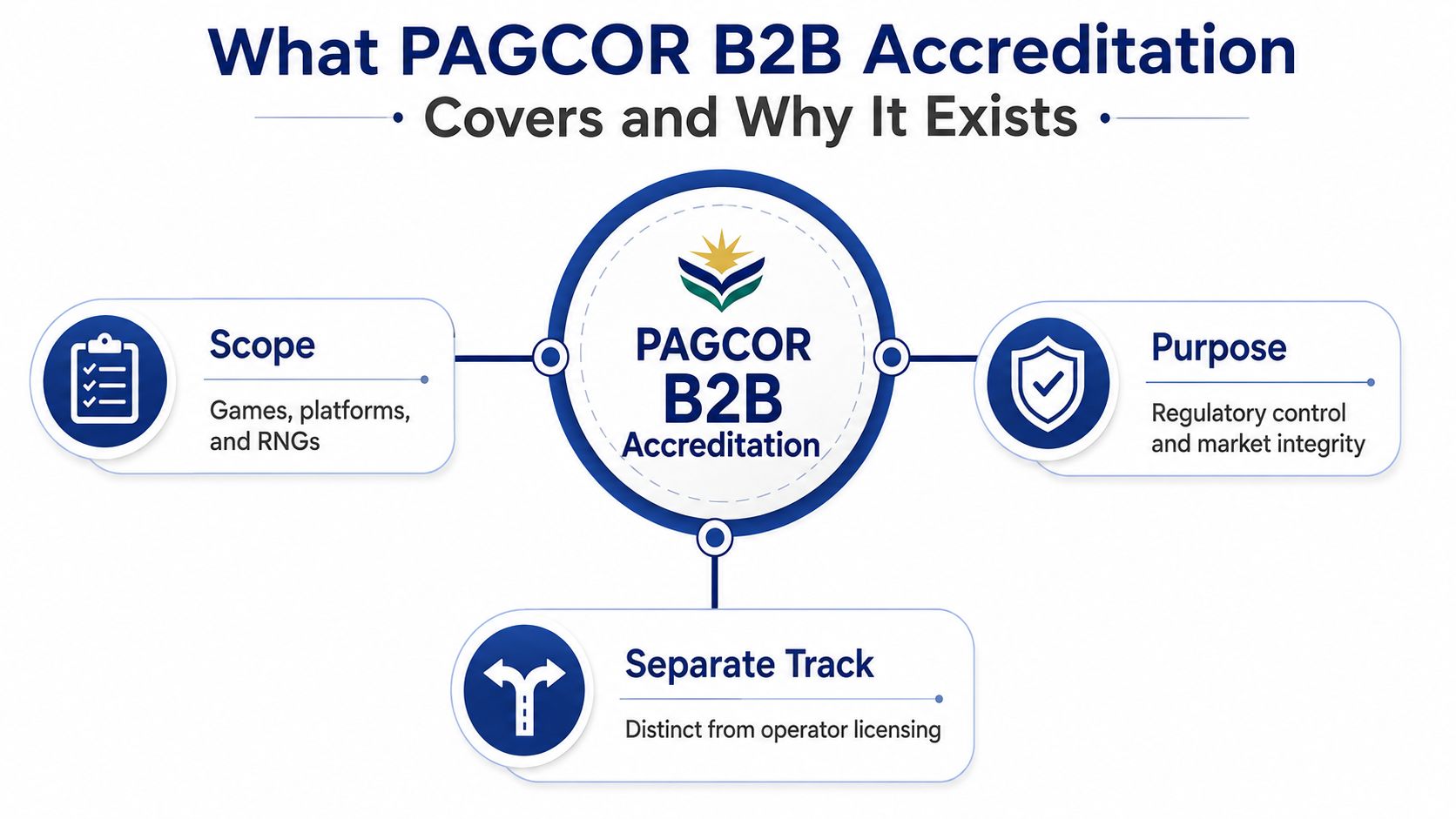
The PHP 5,000,000 accreditation fee and the PHP 1,000,000 Performance Cash Deposit sit at the centre of PAGCOR's B2B regime, but the core point of the framework is control. It separates Game Content Providers and Support Service Providers from the operator side of the market, which means a supplier can't treat accreditation as a light-touch vendor registration. For context on the broader Philippine gaming structure, see the market overview at Top 1 Rank's PAGCOR guide.
A separate compliance track, not a licence shortcut
PAGCOR's B2B accreditation works as its own compliance lane because suppliers touch regulated gaming operations without necessarily taking player risk directly. That distinction matters. A studio, platform vendor, or support provider can shape game delivery, uptime, and technical integrity, so the regulator has built a gate that checks the supplier before the operator integrates the product.
The official framework also makes the cost meaningful over time. The accreditation regime has been described as valid for a two-year accreditation cycle from board approval, which means the fee is tied to medium-term market access rather than a quick administrative filing. In practical terms, that pushes finance teams to look at Philippine revenue potential against locked compliance capital, not just a one-off approval charge.
Practical rule: if a supplier cannot justify the cost across a two-year operating window, the Philippine market is probably not the right immediate expansion target.
Who the regime affects
The categories matter because PAGCOR's current framework is not built for one generic vendor profile. A Game Content Provider may be assessed per game offering, while a Support Service Provider is handled per service category. That structure tells commercial teams something important, each additional product line can widen exposure even before any live deployment begins.
The line between accreditation and operator licensing also shapes negotiations. Operators will want assurance that their vendors are already cleared, while suppliers will want to avoid paying for a market entry path that later turns out to be too narrow for their catalogue. The safest reading is simple, PAGCOR B2B accreditation fees are designed to filter access, not just collect paperwork.
Breakdown of Every Fee Category in the B2B Stack
The current schedule contains more than one cost line, and mixing them up leads to bad budgeting. The PHP 5,000,000 B2B accreditation fee is listed in PAGCOR's current fee schedule, while the PHP 1,000,000 Performance Cash Deposit is a separate security requirement applied per offering or service category. That distinction matters because one is a regulatory charge and the other is locked capital. The current fee schedule is published in PAGCOR's own materials, and finance teams should treat it as the baseline for entry planning.
For commercial planning, the useful question is not just “what is the fee,” but “what is payable, what is held, and what repeats.” An application that needs multiple offerings can trigger more than one deposit exposure, while the main accreditation charge sits as the headline gate. A supplier comparing customer acquisition budgets should read this the same way it would read a platform launch budget, by separating upfront charge, security deposit, and ongoing compliance overhead. A separate perspective on marketing and acquisition economics is available in this cost-focused guide.
Fee components that matter most
| Fee Component | Amount (PHP) | Type | Recurrence |
|---|---|---|---|
| B2B accreditation fee | 5,000,000 | Regulatory charge | Per accreditation cycle |
| Performance Cash Deposit | 1,000,000 | Locked compliance deposit | Per game offering or service category |
| Application and processing fee, older DCS framework reference | 250,000 | Administrative charge | One-time, historical example |
| eGames application fee | 2,500 | Administrative charge | One-time, historical example |
| eGames inspection fee | 20,000 | Administrative charge | One-time, historical example |
| eGames processing fee | 30,000 | Administrative charge | One-time, historical example |
The table above shows the structural shift clearly. Older PAGCOR materials often used smaller paperwork and inspection fees, while the current B2B model centres on a much larger fixed accreditation charge and a separate deposit. That makes the new framework harder to absorb as operating overhead, because the money is tied up before scale is proven.
What finance teams should budget separately
Three lines deserve separate treatment in internal models. First, the non-refundable accreditation fee, which is the entry charge. Second, the Performance Cash Deposit, which is not the same thing and should not be treated as consumed expense. Third, the indirect compliance burden, which can include documentation, legal review, and internal process work, even if those items are not set out as single published numbers.
The old way of budgeting for PAGCOR was closer to a filing and inspection exercise. The new way is closer to an institutional commitment. That is why groups planning Philippine entry should not compare only the fee headline, they should compare the amount of capital locked against the revenue they can realistically generate under local demand and partner demand.
How the New Fee Schedule Compares to Older PAGCOR Charges
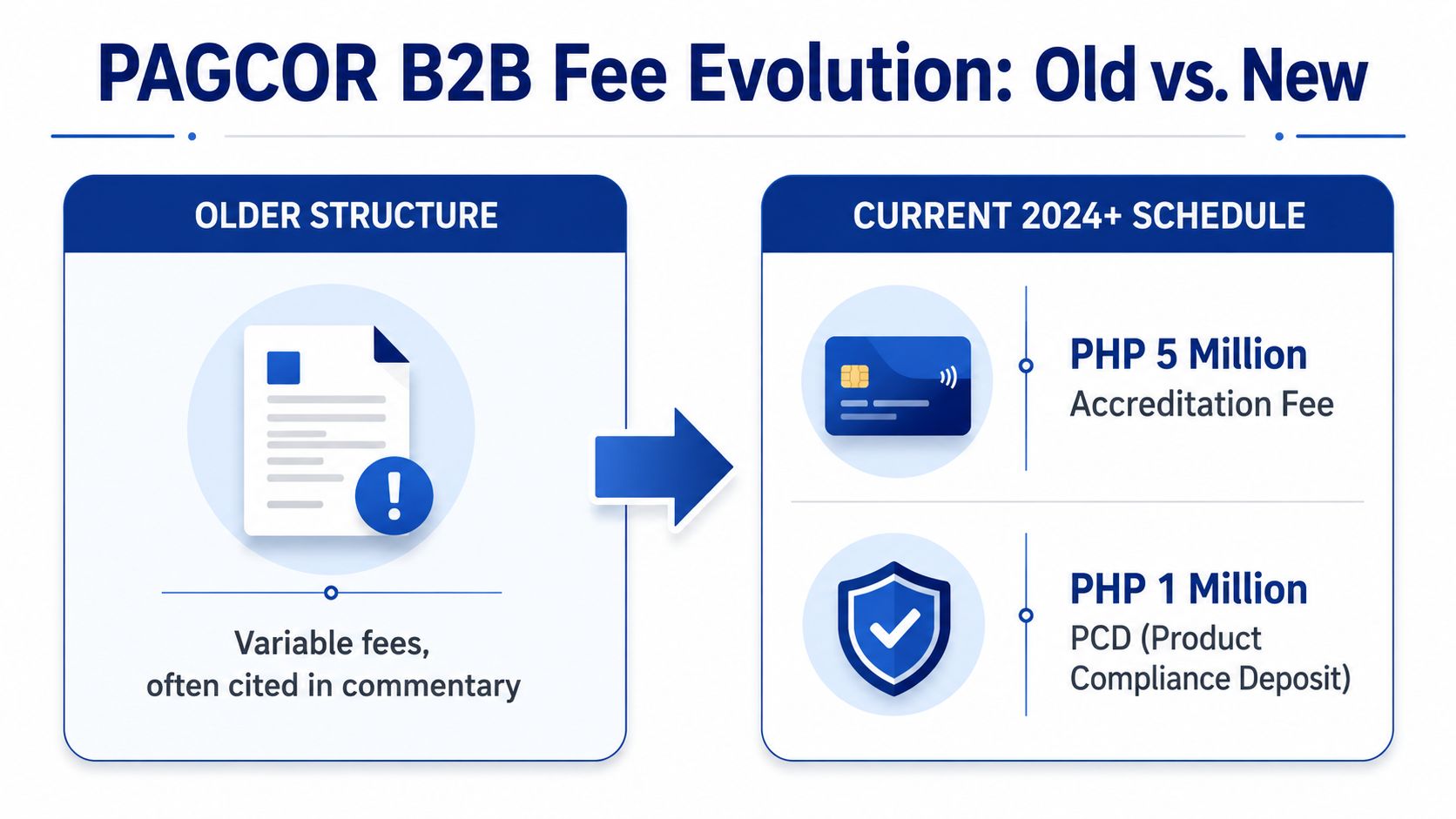
PAGCOR's earlier B2B-style charging model was materially lighter. In the regulatory manual for Data/Content Streaming Providers, the applicant faced a one-time application and processing fee of PHP 250,000, plus site-related charges of PHP 100,000 for an additional or transferred operating site in a different building and PHP 75,000 per floor when the site moved to a building with an existing operating site. By contrast, the current regime is built around a PHP 5,000,000 accreditation fee and a separate PHP 1,000,000 deposit, which is a different order of magnitude in financial commitment.
The comparison matters because it shows a change in regulatory posture, not just pricing. Earlier charges looked like administrative screening costs. The present structure looks like a capitalised control mechanism. That tells suppliers PAGCOR is now using price as part of market filtering, not merely as a way to recover review costs.
Why the older fee model feels familiar, but no longer fits
The older fee pattern was operationally modest. PAGCOR also published an eGames station schedule showing a PHP 2,500 application fee, PHP 20,000 inspection fee, PHP 30,000 processing fee, and a PHP 22,500 combined total for application and inspection on certain eGames and Instawin applications. Those numbers belong to a different regulatory logic, one built on transaction processing rather than supplier capital commitment.
That historical contrast is commercially important. A studio or service vendor that mentally anchors its budget to those older figures can understate Philippine entry cost by a wide margin. A supplier seeing the modern fee stack for the first time should read it as evidence that PAGCOR is prioritising financial seriousness and regulatory accountability over low-friction onboarding.
The fee jump is not just inflation, it is a signal that the regulator wants fewer, better-capitalised B2B entrants.
What the shift signals to market entrants
For vendors, the practical implication is threshold risk. A price band that once looked manageable for smaller technology suppliers now sits much closer to a strategic market decision. That can benefit larger multi-market groups that already amortise compliance over several jurisdictions, but it can exclude niche vendors whose Philippine pipeline is still uncertain.
The conclusion is straightforward. Older PAGCOR charges resembled paperwork costs. The current B2B regime behaves like an access control system. That is a meaningful difference for anyone building a regional rollout plan, especially those comparing PAGCOR B2B accreditation fees with lighter-touch markets elsewhere.
Application Workflow, Payment Methods, and the 2026 Deadline
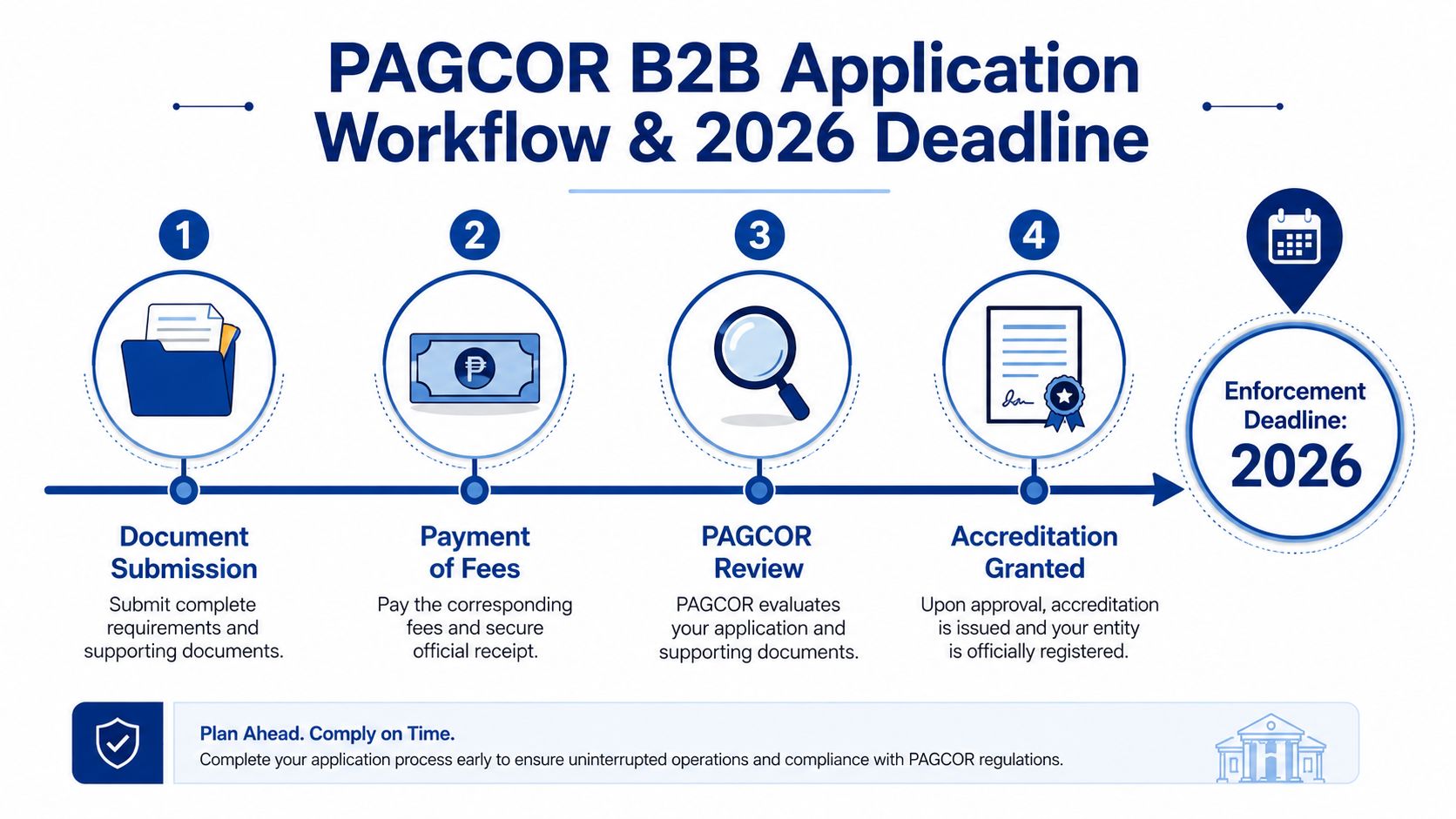
PAGCOR's accreditation process is not only about paying the right amount, it is about paying on time and in the right sequence. Industry reporting said PAGCOR set a 31 July 2026 compliance deadline for B2B providers to complete accreditation, and late applicants were barred from supplying services after the cutoff. Separate industry coverage said PAGCOR reiterated a 31 March deadline tied to the PHP 1,000,000 deposit requirement, which shows the deposit had become a formal compliance gate rather than a loose filing step.
The practical message is blunt. Missing the deadline is not an administrative inconvenience, it is a market access failure. That matters especially for vendors whose commercial pipeline depends on integrating into live operator systems before launch windows close. The framework was also updated again in October 2025, and the later commentary around it noted that total costs can include accreditation fees, registration fees, cash bonds, employee training, and other establishment expenses.
The operating sequence suppliers need to plan for
The workflow is best understood as a compliance chain rather than a single filing. First comes document submission, then payment of the required fees, then PAGCOR review, and finally accreditation grant. Each stage can introduce delay if the submission package is incomplete, which means finance and legal teams need to coordinate before operations teams promise launch dates to partners.
A supplier should also assume that payment timing matters. Regulatory fees and deposits are not interchangeable, and the deposit requirement can lock capital before business has begun generating returns. That makes cash management a real concern for smaller vendors, especially if they are already funding localisation, legal review, or technical integration work.
Payment support content for online businesses can be useful for internal finance teams, but the core issue here is regulatory sequencing, not payment convenience.
Compliance reality: a late filing can cost more than the fee itself, because it can shut off commercial supply entirely.
Where timing risk shows up in practice
The 31 July 2026 deadline creates a cliff edge for suppliers that delay internal approvals. A vendor that waits to finalise corporate approvals, local entity documentation, or technical packs may still be forced into the same deadline bucket as a well-prepared competitor. That creates transition risk, especially for firms launching multiple products at once.
The risk compounds when more than one charge applies to a portfolio. An accreditation fee, a deposit, and any related establishment expenses all arrive before market revenue does. For commercial teams, the right question is not whether accreditation is possible, it is whether the business can absorb the timing gap between payment and monetisation.
Sample Cost Scenarios for Common Supplier Profiles
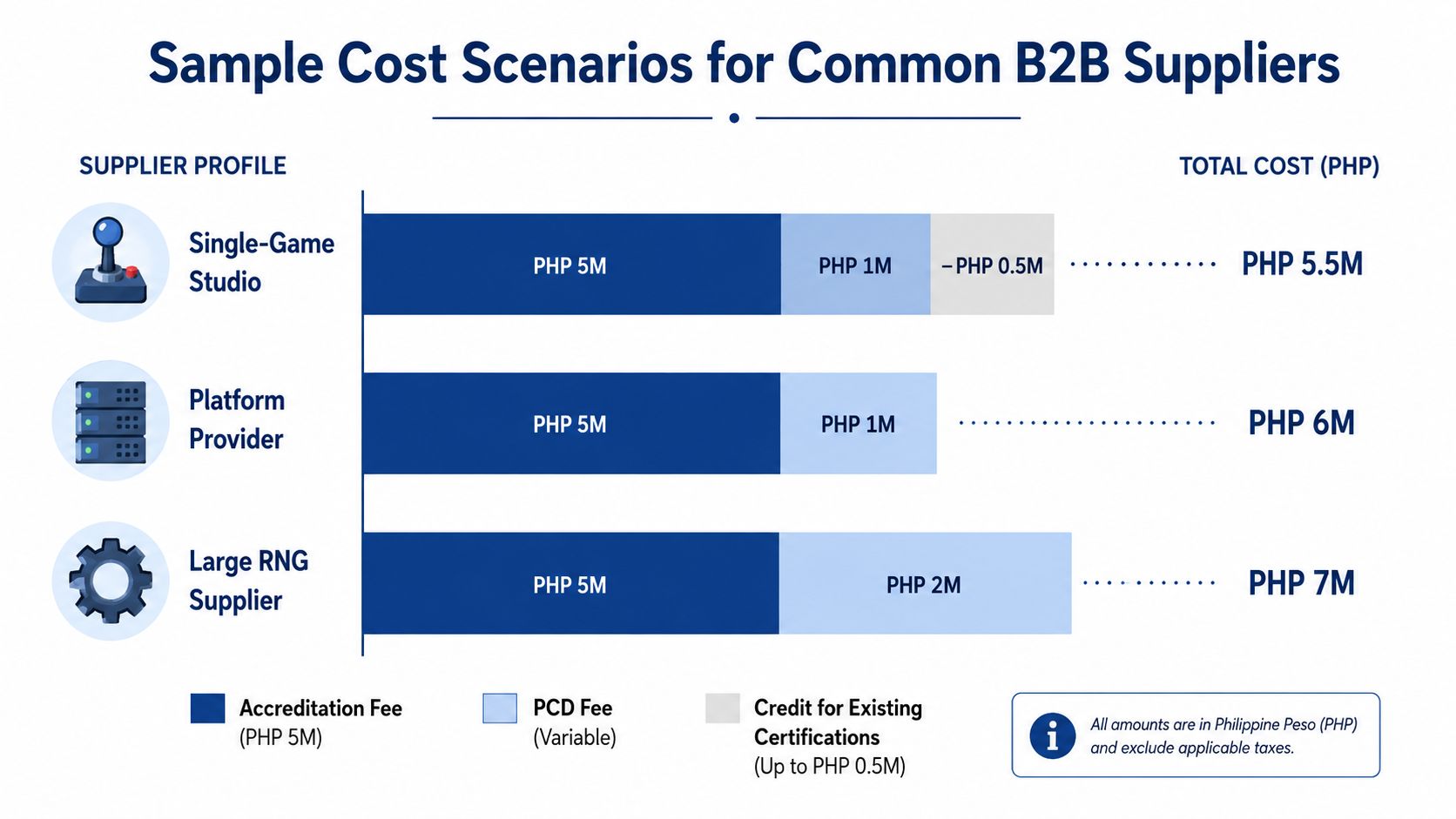
The cleanest way to think about the cost stack is to model it by supplier type. A single-title studio, a broader platform provider, and a smaller support vendor may all fall under the same framework, but their exposure won't feel the same once multiple offerings are in play. The published numbers only confirm the major regulatory charges, so the scenarios below keep the analysis tight and avoid pretending there is a single universal all-in cost.
Single-title studio
A studio seeking accreditation for one game offering faces the core pair of costs, PHP 5,000,000 for accreditation and PHP 1,000,000 for the Performance Cash Deposit. That is the cleanest interpretation because the deposit is applied per offering. For a focused supplier with one product and one market thesis, the commercial question becomes whether Philippine distribution is worth six million pesos of regulatory exposure before local demand is proven.
Multi-jurisdiction platform provider
A platform vendor with several offerings can face a materially larger stack because the deposit applies per game offering or service category. The regulatory fee still starts at PHP 5,000,000, but each additional qualifying offering increases locked capital exposure. That makes portfolio breadth a cost driver, not just a sales advantage, and it rewards vendors that have already built regional compliance scale.
Small support service provider
A support service firm entering with a single service category also starts with the same headline fee structure. The difference is not in the published charge, it is in the economics of recovery. A smaller vendor may have less ability to spread the fixed accreditation cost across many operator contracts, which can make the Philippine market attractive only if the pipeline is already warm and conversion is likely.
A planning checklist helps internal review teams pressure-test the decision:
- Map every offering separately: Count each game or service category before budgeting the deposit.
- Treat the deposit as locked capital: Don't confuse it with a sunk charge.
- Stress-test the payback window: Make sure local contract timing can support the compliance outlay.
- Plan for a two-year horizon: The framework's medium-term structure matters for investment recovery.
For finance teams benchmarking these models against internal efficiency work, cost-reduction strategies matter more once the compliance bill becomes fixed and non-trivial.
PAGCOR B2B Costs Compared to Other Asian Markets
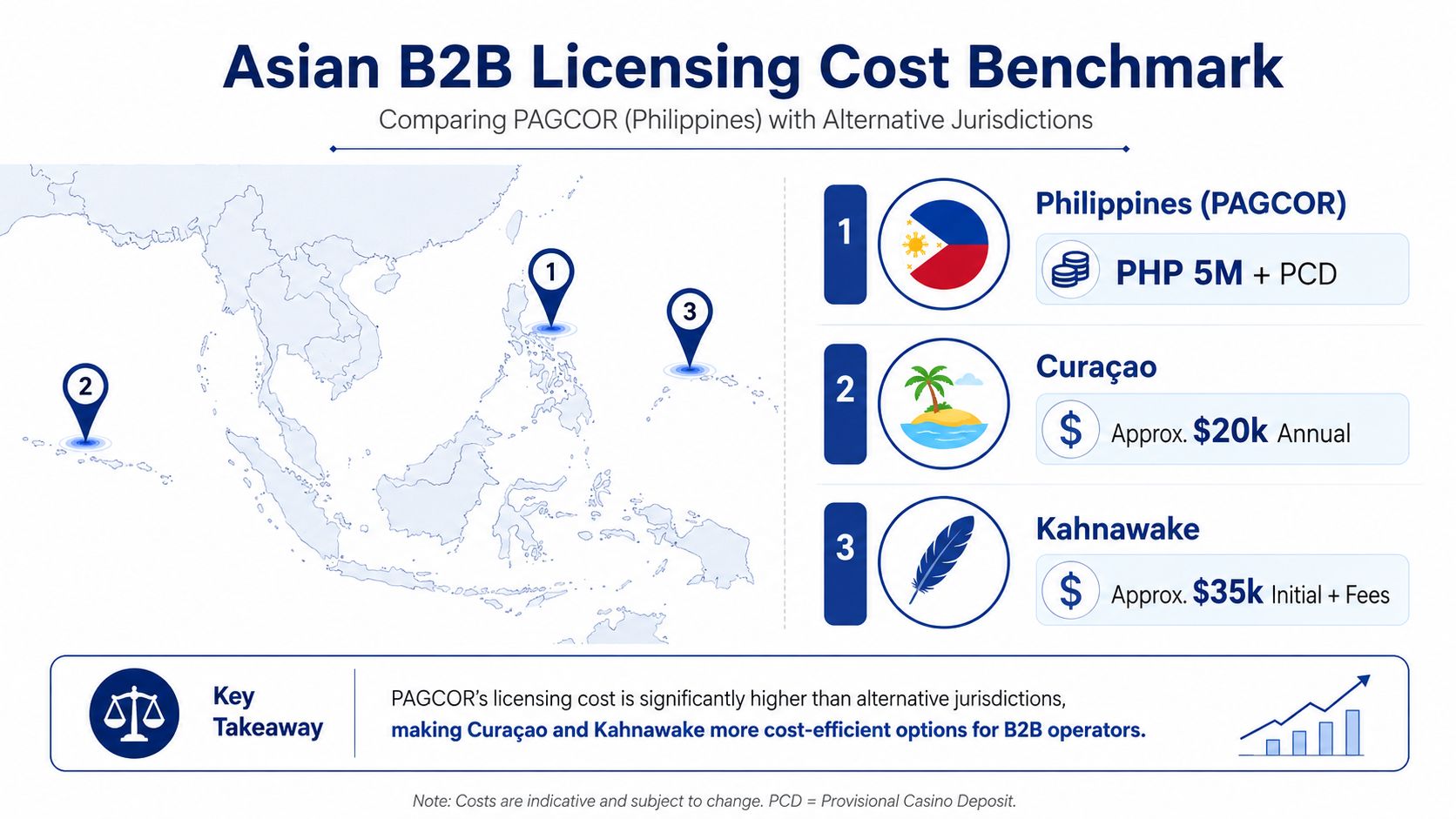
The PHP 1,000,000 deposit is easier to place in context when translated into dollars. At prevailing exchange rates, it works out to roughly US$16,975 to US$17,000, according to An infographic comparing B2B licensing costs between PAGCOR Philippines, Curaçao, and the Kahnawake Gaming Commission. That conversion gives international suppliers a rough cross-border reference point, but it does not capture the full entry cost. The PHP 5,000,000 accreditation fee remains the larger fixed charge in the Philippine stack, and it sits on top of the deposit rather than replacing it.
Seen against other regional entry models, PAGCOR's B2B structure is heavier at the front end because it combines a fixed regulatory fee with locked capital. That combination changes the commercial calculation. Suppliers are asked to commit meaningful funds before revenue starts, so capital efficiency becomes part of the licensing decision, not just market size or brand fit.
What the benchmark means for vendor strategy
The comparison with other jurisdictions is useful because it shows trade-offs, not just headline prices. A supplier that needs fast partner onboarding may prefer a market with lower initial friction, while a larger vendor may accept higher Philippine entry costs if the local opportunity justifies the capital tie-up. The numbers do not make the decision, but they do narrow the set of realistic options.
PAGCOR's position is best described as high-commitment, compliance-heavy access. That profile can deter opportunistic entrants and favour vendors with existing operator relationships, stronger balance sheets, or a more mature regional rollout plan. It also makes the Philippines unlikely to be treated as a casual test market by serious B2B firms.
Why the deposit matters as much as the fee
The deposit should not be treated as a technical footnote. It reduces available working capital, which can affect hiring, certification, and localisation budgets elsewhere in the business. For companies comparing jurisdictions, that capital lock can hurt more than a modest licence fee in a higher-tax market.
Commercially, the right approach is to model Philippine entry as a bundled decision. The fee, the deposit, compliance overhead, and launch timing all sit on the same sheet. That is the clearest way to judge whether PAGCOR's B2B market is a strategic expansion target or a capital-intensive distraction.
Practical Tips, Common Misconceptions, and FAQs for Applicants
The most common mistake is treating the PHP 5,000,000 accreditation fee and the PHP 1,000,000 Performance Cash Deposit as interchangeable. They are not. One is the regulatory entry charge, the other is a separate security mechanism, and both can shape the capital plan differently.
A short checklist helps reduce avoidable errors:
- Confirm the category first: Separate game content offerings from support service categories before budgeting.
- Keep the timeline live: Build the 31 July 2026 deadline into internal approval calendars early.
- Reserve capital, don't recycle it: Treat the deposit as locked compliance capital.
- Check renewal assumptions: Review whether the business model still works over the full accreditation cycle.
- Align contracts with approval timing: Don't promise go-live dates before the application is safely in motion.
Common misconception: a supplier can usually treat accreditation as a one-off admin task. Under PAGCOR's current structure, the financial and timing burden says otherwise.
Is the accreditation fee refundable? The official framing described in the available material treats it as a regulatory charge, not as returned operating capital.
How do renewal costs scale? The available framework points to a two-year accreditation cycle from board approval, so planning should assume the accreditation term matters as much as the opening fee.
What happens if the deadline is missed? Industry reporting said late applicants were barred from supplying services after the 31 July 2026 cutoff.
Do GGR-share obligations apply on top of accreditation fees? For gaming system service providers, the framework also includes ongoing monetisation rules, including 55% of GGR for electronic bingo games and 47.50% of GGR for electronic games.
For suppliers, the cleanest next step is a line-by-line internal budget review against the current PAGCOR schedule, with legal and commercial teams checking every offering before filing. For deeper market intelligence and Philippines regulatory coverage, readers can follow Top 1 Rank and use its compliance analysis to pressure-test their entry plan before committing capital.


Join thousands of gaming professionals receiving the latest iGaming news, regulatory updates, and market insights.
