

No single PAGCOR directory covers every gaming supplier type. PAGCOR maintains 10 distinct official resources spanning equipment suppliers, system administrators, affiliates, support providers, registered domains, approved games, testing laboratories, BPOs, and licensed venue operators.
The popular advice to “check the PAGCOR registered gaming suppliers list” is therefore incomplete. A hardware vendor, game aggregator, payment provider, testing laboratory, gaming brand, and licensed casino may appear in different regulatory records, with different approval categories and different evidence of scope. PAGCOR's official materials distinguish between GLDD enrollment, EGLD accreditation, approved content, registered URLs, support services, and operator licensing.
That distinction matters to operators, suppliers, affiliates, investors, regulators, and gaming professionals assessing a Philippine-facing business relationship. Inclusion in one record doesn't prove approval for every product, domain, brand, market, or activity. The correct process is to match the vendor's function to the relevant PAGCOR source, confirm the exact legal name and reference details, review the publication or update date, compare the approved scope with the proposed service, and retain supporting documents for procurement and compliance files.
PAGCOR's suppliers hub identifies the GLDD Suppliers List as the public registry for enrolled suppliers, while the regulator also maintains category-specific resources for gaming content, system service providers, affiliates, support services, registered brands, and related records. The main suppliers page was last updated on 2026-02-06, and the detailed enrolled-suppliers page was last updated on 2026-07-13, according to the current official page. Those dates show why status checks should be performed against the live regulator source before engagement, rather than relying on an old PDF, vendor presentation, or third-party directory.
Table of Contents
- 1. GLDD Suppliers List for gaming equipment and paraphernalia
- 2. Suppliers GLDD landing page and regulatory gateway
- 3. Gaming System Administrators and registered brands, domains, and URLs
- 4. Accredited Gaming Affiliates for content providers and aggregators
- 5. Accredited Support Service Providers
- 6. Registered brands and domains of licensed casinos
- 7. EGLD-approved electronic games by provider
- 8. Accredited independent testing laboratories
- 9. ROASD list of Special Class of BPOs
- 10. Licensees for gaming venue operations
- 10-Item Comparison of PAGCOR Registered Supplier Lists
- Turn registry checks into vendor controls
1. GLDD Suppliers List for gaming equipment and paraphernalia
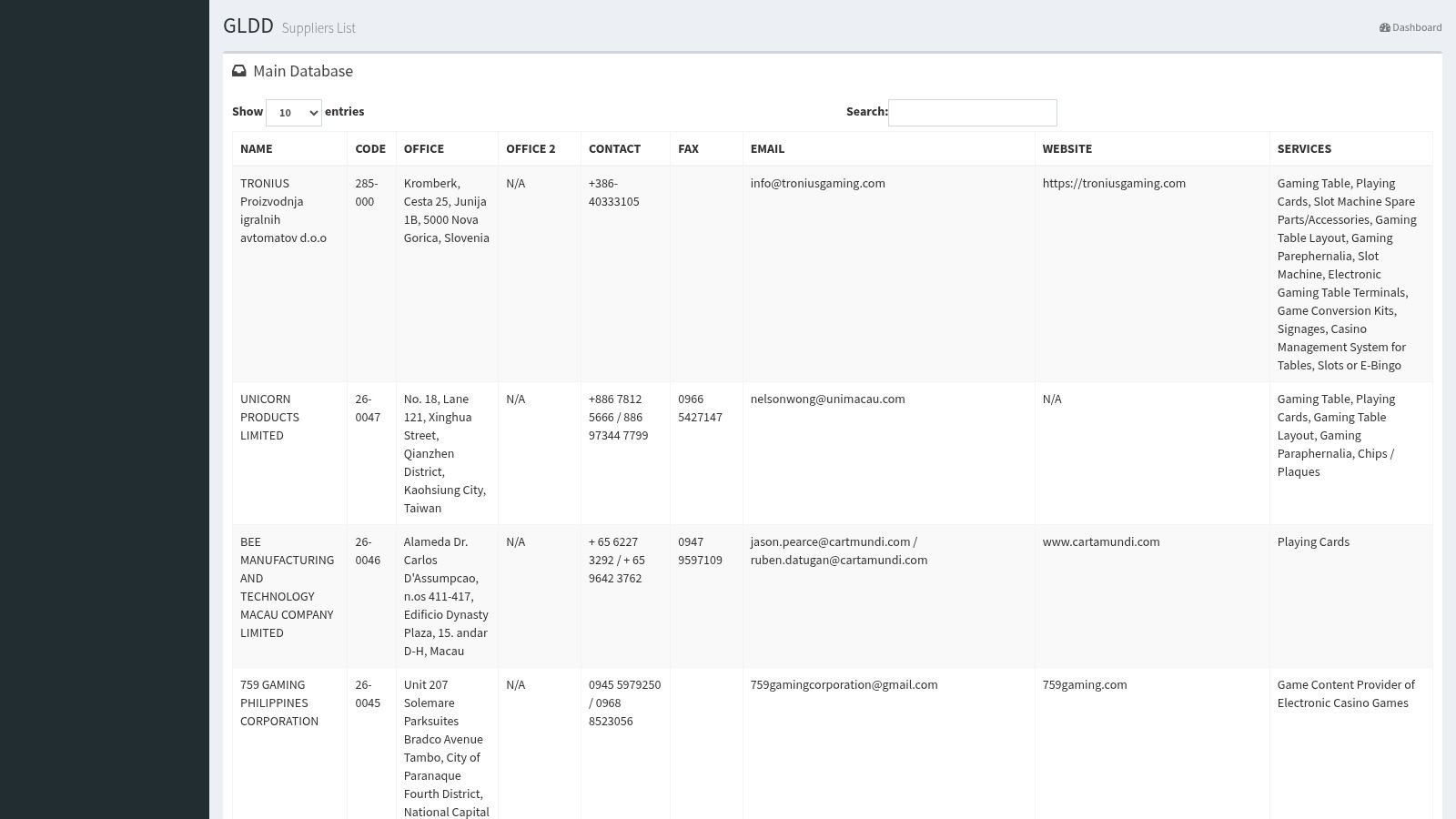
The GLDD Suppliers List is the most direct PAGCOR resource for suppliers enrolled to provide gaming equipment and paraphernalia in the Philippines. It belongs to the Gaming Licensing and Development Department, and its records identify supplier names, company codes, addresses, contact details, websites, and authorized goods or services.
For procurement teams, the important field isn't whether a company appears. The listed product scope helps determine whether the supplier's authorization aligns with the proposed transaction. A record may relate to slot machines, e-bingo terminals, chips and plaques, surveillance equipment, payment solutions, or another defined category. That makes the directory more useful than a general corporate roster when an operator is assessing a hardware or systems vendor.
The PAGCOR supplier regulatory manual says suppliers must enroll through GLDD before doing business with an operator and must obtain a Permit to Hold when supplying gaming equipment or paraphernalia. Documentary requirements include an enrollment form, company profile, product list, procurement registration, and proof of ownership or lease for Philippine storage facilities.
What the record verifies
The list can support a finding that a supplier is publicly recorded by PAGCOR in the relevant GLDD framework. It can also help an operator compare the supplier's recorded scope with a purchase order, integration plan, or request for proposal.
It can't, by itself, verify every commercial detail. It doesn't replace contract review, technical testing, product-specific approvals, beneficial ownership checks, or confirmation that a particular shipment and deployment remain covered.
Practical rule: A supplier's company name is only the starting point. The authorized goods and services, current status, permits, and operator accreditation need to match the proposed transaction.
The public page is maintained as an official registry, not a static brochure. Procurement teams should capture the relevant record and page date during due diligence, then monitor for changes. Teams assessing commercial entry can also review the PAGCOR B2B accreditation fees as part of their regulatory planning, while keeping fee questions separate from the public list's status evidence.
2. Suppliers GLDD landing page and regulatory gateway
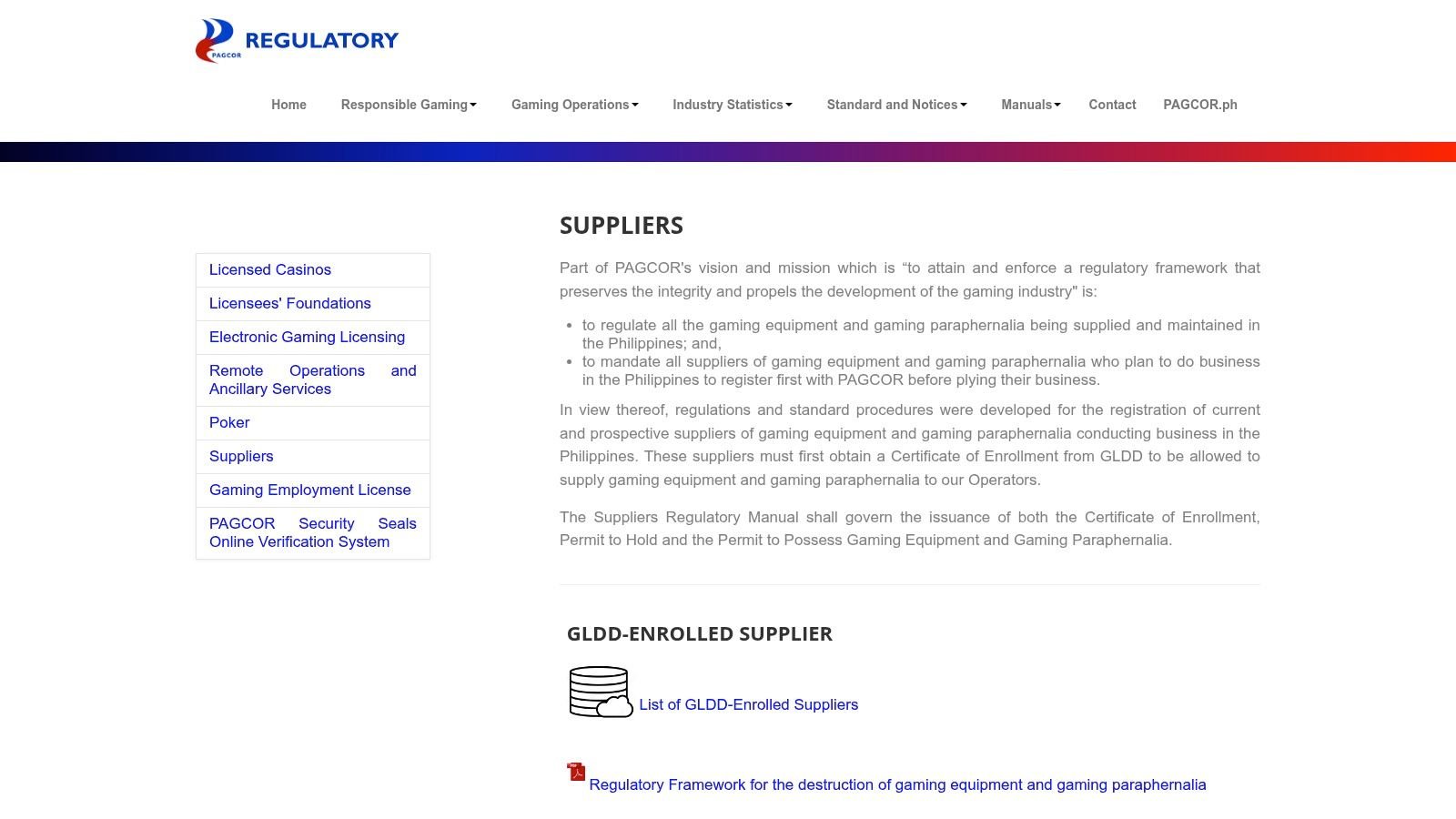
The PAGCOR Suppliers landing page is a gateway rather than a supplier record itself. It connects users to the live list of GLDD-enrolled suppliers, the Suppliers Regulatory Manual, and forms associated with enrollment, shipment clearance, inventory reporting, and related compliance processes.
That distinction is operationally important. A procurement analyst who stops at the landing page hasn't verified a vendor. The page provides the regulatory context needed to interpret the directory and understand the obligations attached to enrollment. PAGCOR states that gaming suppliers must first obtain a Certificate of Enrollment from GLDD before supplying gaming equipment or paraphernalia to operators in the Philippines, and that enrolled suppliers will be posted on PAGCOR's regulatory website.
Why the gateway matters
The landing page ties the public directory to a broader licensing and supplier-control framework. It helps answer questions that a company name alone can't answer, such as:
- Enrollment requirements: What documents does an applicant need to submit?
- Operational permissions: Which permits or clearances may be relevant to equipment supply?
- Ongoing reporting: Which inventory or shipment processes may affect the relationship?
- Regulatory interpretation: Which manual governs the supplier category?
The page's visible maintenance dates also provide an important control point. The main supplier page was last updated on 2026-02-06, while the detailed enrolled-suppliers page was last updated on 2026-07-13. Those dates are evidence of ongoing maintenance, not proof that every listed entity remains commercially active or authorized for every activity.
Best use in procurement
Operators should open the landing page before relying on an entry in the detailed list. The page gives the analyst the correct forms and rules for follow-up questions, while the PAGCOR B2B provider application process can help frame a supplier's preparation work without substituting for formal PAGCOR confirmation.
3. Gaming System Administrators and registered brands, domains, and URLs
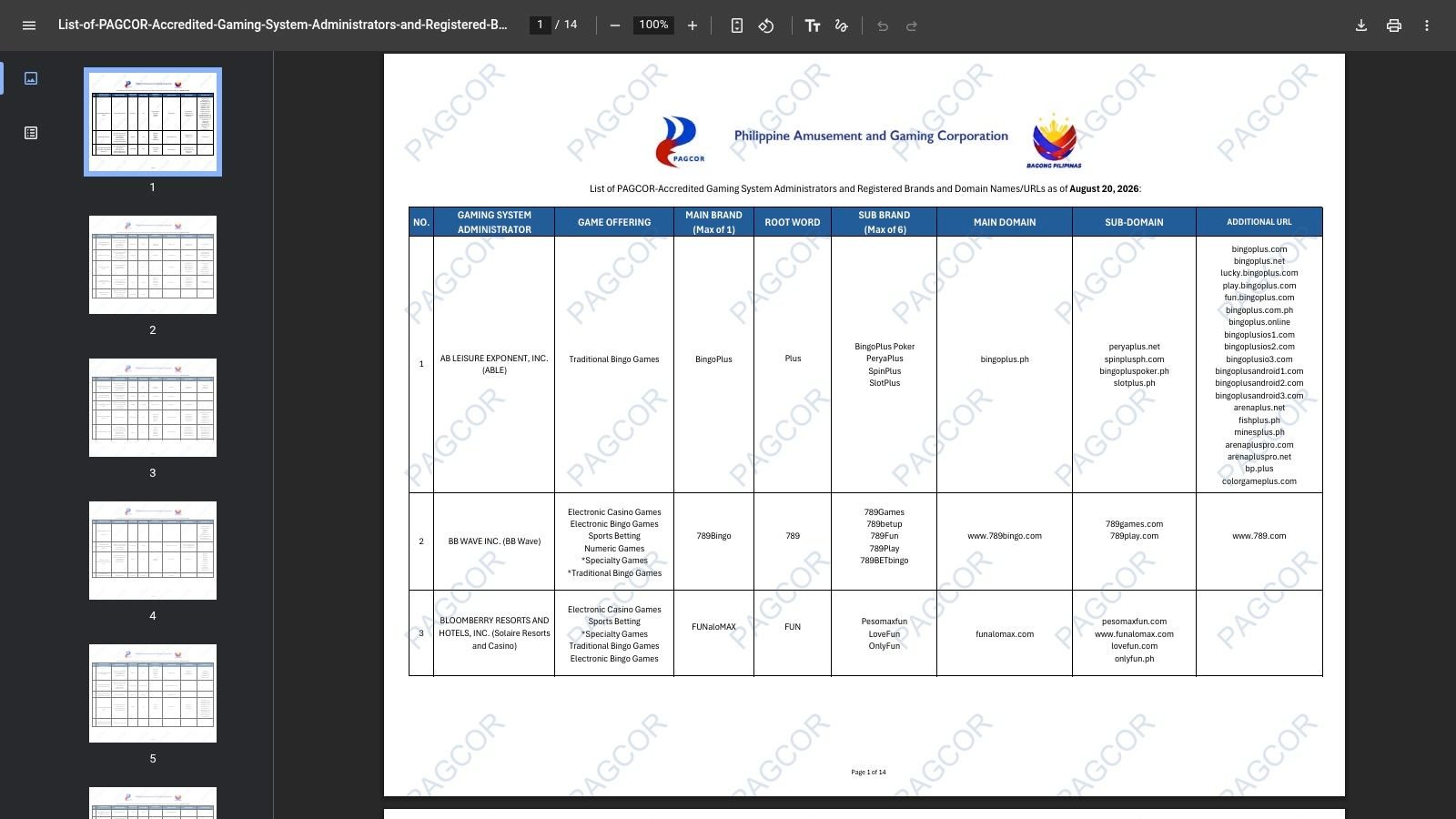
The PAGCOR-accredited Gaming System Administrators and registered brands and URLs document serves a different purpose from the GLDD equipment directory. It maps EGLD-accredited Gaming System Administrators to their approved game offerings, brands, and registered domains or subdomains.
This resource is particularly relevant to online platform due diligence. A system administrator's accreditation doesn't automatically mean that every website using its brand, every domain resembling its brand, or every product associated with its corporate group has the same status. The document's value lies in the relationship it records between the administrator, the approved vertical, the brand, and the URL.
Domain mapping is the distinctive control
The document can help a compliance team investigate whether a proposed online presence appears in the regulator's registered-domain framework. It can also help identify inconsistencies between:
- The contracting company: The legal entity signing the supplier or platform agreement.
- The administrator: The accredited platform or system provider.
- The brand: The consumer-facing name shown to players.
- The domain: The web address proposed for marketing, access, or affiliate traffic.
- The vertical: The relevant eCasino, eBingo, sports betting, numeric, specialty, or online poker category.
The document may also distinguish brands approved but not yet live. That status note is important. Approval to use a brand or domain shouldn't be treated as proof that the site is operating, accepting players, or commercially available.
A registered domain is evidence of regulatory listing within the relevant document. It isn't, without more, proof that every page, promotion, payment route, or affiliate relationship connected to the domain is approved.
The PDF format requires manual review, and periodic publication means the copy in a diligence file should be paired with its stated date. Teams assessing administrator requirements can consult the PAGCOR gaming system administrator requirements as a separate preparation resource.
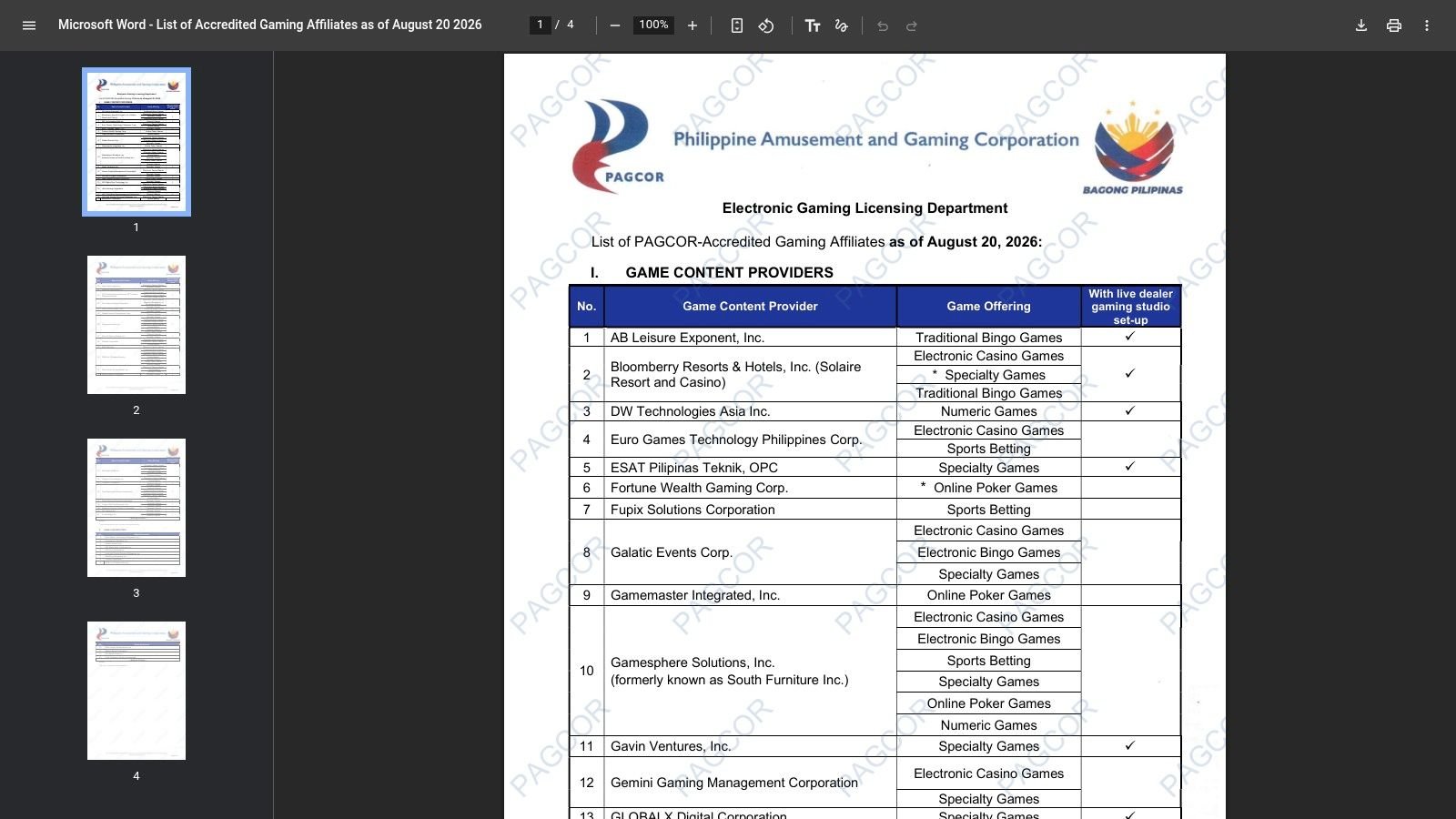
4. Accredited Gaming Affiliates for content providers and aggregators
The PAGCOR-accredited Gaming Affiliates list is the principal resource for separating game content providers from game aggregators under the EGLD framework. Its structure matters because an aggregator and a direct content supplier may perform different roles in an operator's technology stack, commercial agreement, and compliance chain.
The document includes separate tables for Game Content Providers and Game Aggregators. It also identifies approved verticals such as eCasino, eBingo, sports, numeric, poker, and specialty. Some entries are marked as pending commercial operations, which prevents a reader from treating every accredited name as an active supplier with live commercial deployment.
What operators can verify
The list can support vendor selection, RFP preparation, and outreach by showing whether a proposed content or aggregation partner appears in the relevant PAGCOR category. It can also help an operator determine whether the supplier's approved vertical corresponds with the content being proposed.
It doesn't establish technical performance or product-level certification. The PDF doesn't, by itself, provide RTP certification, studio location, integration architecture, game mathematics, security controls, or contractual responsibility for compliance. Those matters require separate documentation.
The most important analytical distinction is between company-level accreditation and title-level approval. A content provider may appear on the affiliate list, while individual games may need to be checked through the separate approved-games resource. An aggregator's presence also doesn't automatically prove that every title available through its catalogue is cleared for deployment in the Philippines.
Procurement implication
A vendor file should retain the exact category, approved vertical, publication date, and any note regarding commercial launch. The PAGCOR game content provider accreditation requirements can support application preparation, but formal accreditation and product approval remain distinct questions.
5. Accredited Support Service Providers
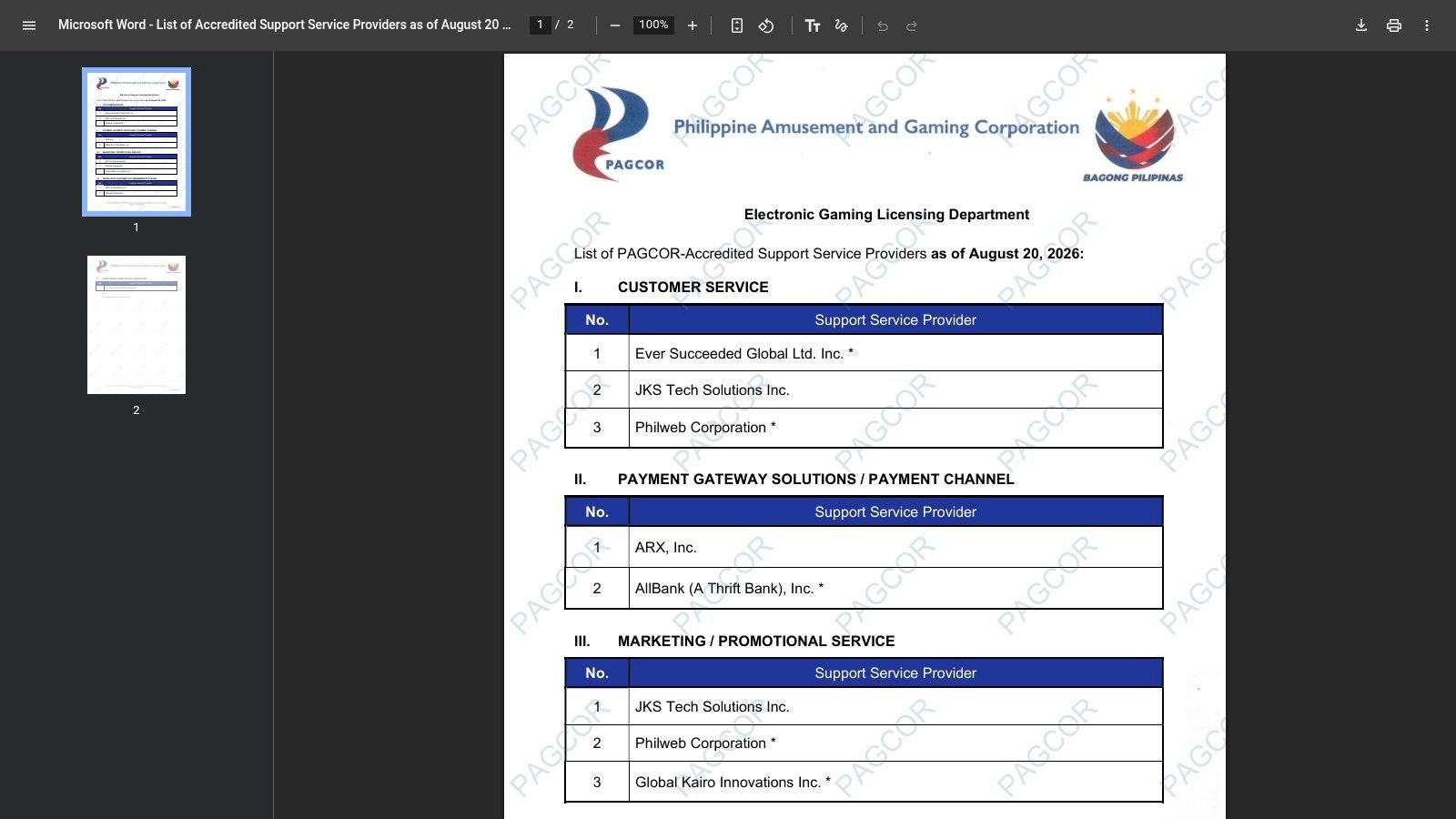
The PAGCOR-accredited Support Service Providers list covers operational functions that often sit outside the game supplier relationship. Its categories include customer service, payment gateways and channels, marketing and promotions, KYC or membership systems, and game testing laboratories.
That categorization gives operators a practical way to examine third-party dependencies. A payment provider, KYC vendor, customer-support company, and testing laboratory may all affect regulatory risk, but they don't perform the same function and shouldn't be assessed under one generic “supplier” label.
Function-specific evidence
The list can help answer whether a proposed support provider appears in the relevant accredited category. It can also identify entries that haven't yet commenced commercial operations, a distinction that matters when a vendor presents accreditation as proof of active delivery capability.
The resource can't answer every procurement question. It provides fewer operational fields than the GLDD supplier database, and its PDF format doesn't create a live searchable record. It also doesn't, by itself, establish:
- Payment authorization: Whether a payment route is suitable for the exact transaction model.
- KYC performance: Whether the provider's controls satisfy the operator's risk appetite.
- Testing scope: Which games, systems, or jurisdictions a laboratory can assess.
- Marketing permission: Whether a specific campaign, affiliate arrangement, or communication has been approved.
- Contractual accountability: Which party owns incidents, reporting, and remediation.
The PAGCOR support service provider accreditation requirements can help suppliers organize their application work. The published list remains a status and category reference, not a complete third-party risk assessment.
6. Registered brands and domains of licensed casinos
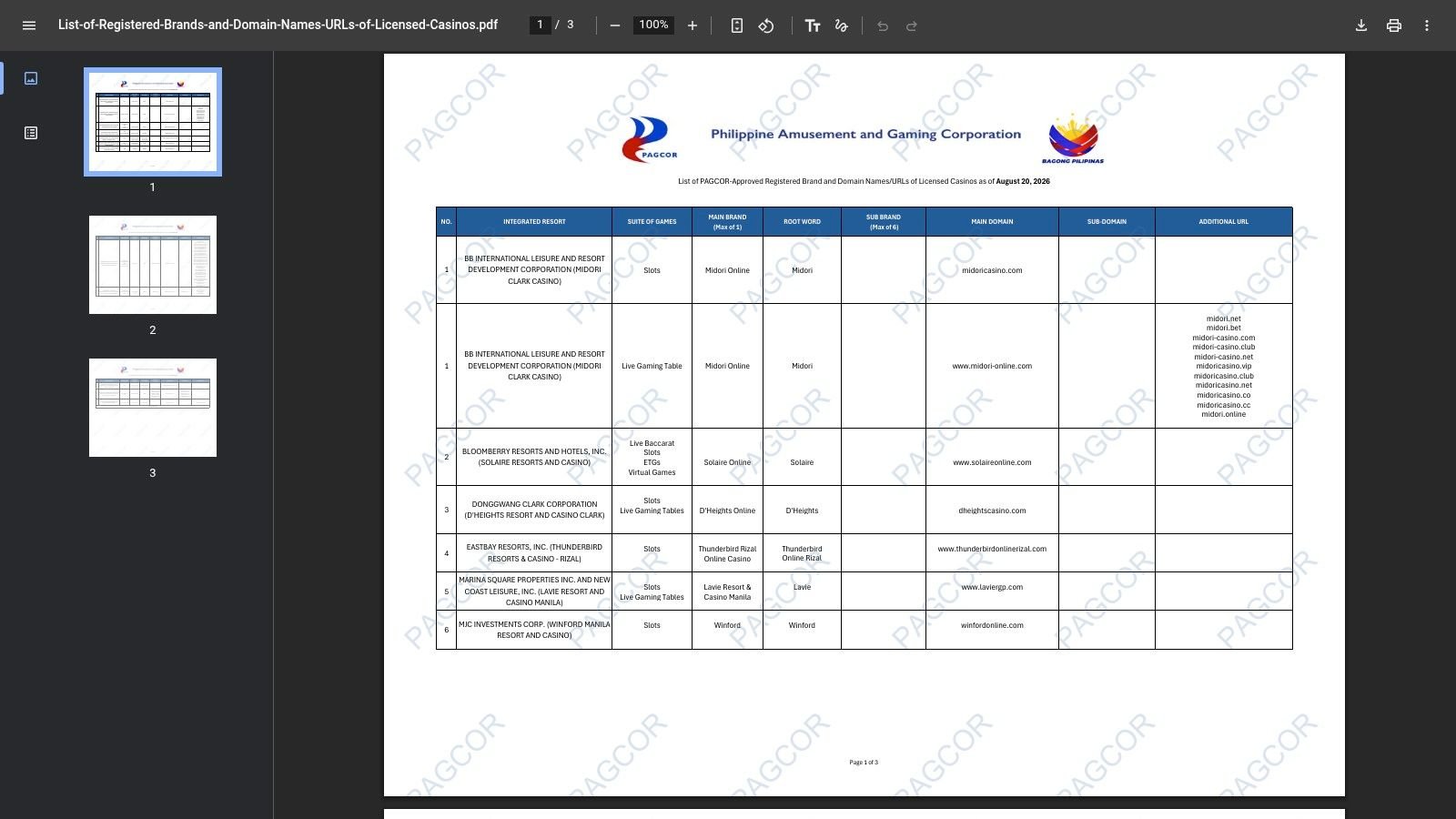
The registered brands and domain names of licensed casinos list isn't a supplier directory. It maps online brands and URLs to licensed land-based casino operators, making it useful for checking casino-linked online presences rather than validating a hardware, platform, or content vendor.
This distinction prevents a common category error. A domain can be connected to a licensed casino without the entity behind a separate service arrangement being a PAGCOR-enrolled equipment supplier or an EGLD-accredited content provider. The document supports a relationship check between a registered online identity and a licensed casino operator, not a universal approval finding.
Where the list adds value
Affiliates and marketing teams can use the document to compare a proposed casino brand or URL with the operator relationship recorded by PAGCOR. Operators can use it when reviewing a digital extension of a land-based business. Investors can use it as one part of a corporate and domain-mapping exercise.
The list is also relevant to look-alike domain risk. A proposed URL that differs from the registered address should trigger a request for clarification, especially where the difference affects the domain, subdomain, brand spelling, or ownership. The absence of a domain from this specific resource isn't conclusive evidence of illegality, because different regulatory categories use different lists, but it does mean the analyst needs to find the correct record or obtain direct confirmation.
What it can't prove
This PDF doesn't establish supplier accreditation, game approval, testing certification, payment authorization, or the current operational condition of a site. Its periodic format also means that the copy should be dated and preserved during the review.
7. EGLD-approved electronic games by provider
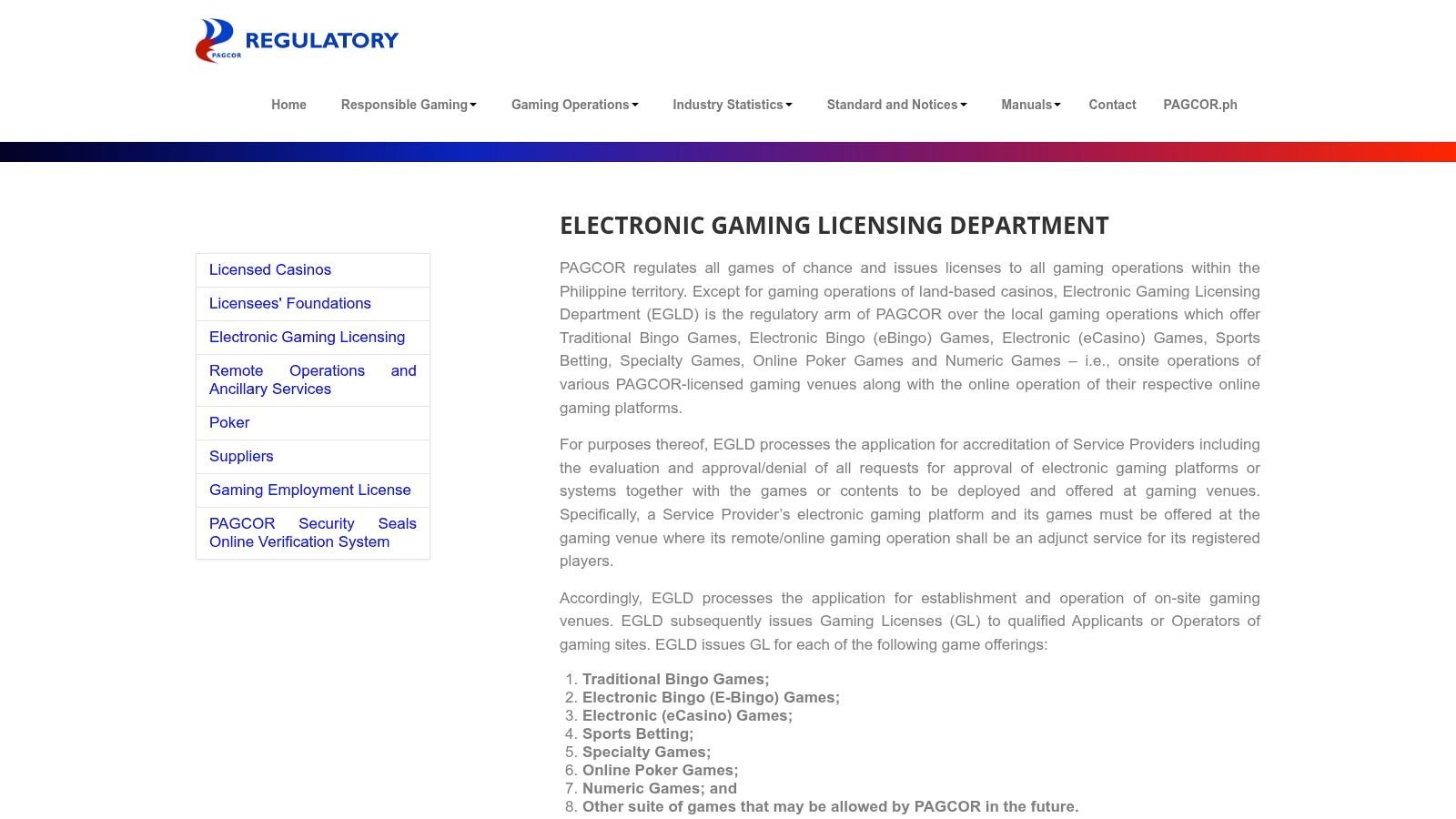
The EGLD-approved electronic games index moves the verification question from the provider to the individual title. PAGCOR's official page lists gaming content providers and links to provider-specific pages showing the electronic games approved for use under the local online framework.
This is the most granular resource in the group for content deployment. A supplier may be accredited at company level, while the operator still needs to confirm that the specific game title appears in the appropriate provider record. That distinction is especially important for an aggregator with a broad catalogue, where the supplier's general approval doesn't necessarily establish approval for every game accessible through its integration.
Why title-level review changes procurement
An operator curating a launch or reviewing an existing catalogue can compare each proposed title with the provider's PAGCOR page. The index covers multiple verticals, including eCasino and eBingo, alongside other categories represented in the EGLD framework.
The index is maintained through the EGLD portal and requires users to browse provider pages. It isn't presented as one consolidated downloadable file, so diligence teams need a disciplined capture process. Each review should record the provider name, game title, page location, access date, and any relevant status wording.
The page does not replace testing evidence. Approval in the index doesn't tell a procurement team which independent laboratory assessed the game, what test scope applied, how the operator will manage version changes, or which party is responsible for incident reporting. Those questions belong in the technical and contractual file.
A useful control for aggregators
Aggregators should provide a title-level mapping that an operator can reconcile with the EGLD provider pages. Operators should treat missing mappings as an unresolved diligence item, not as proof that the full catalogue is cleared.
8. Accredited independent testing laboratories
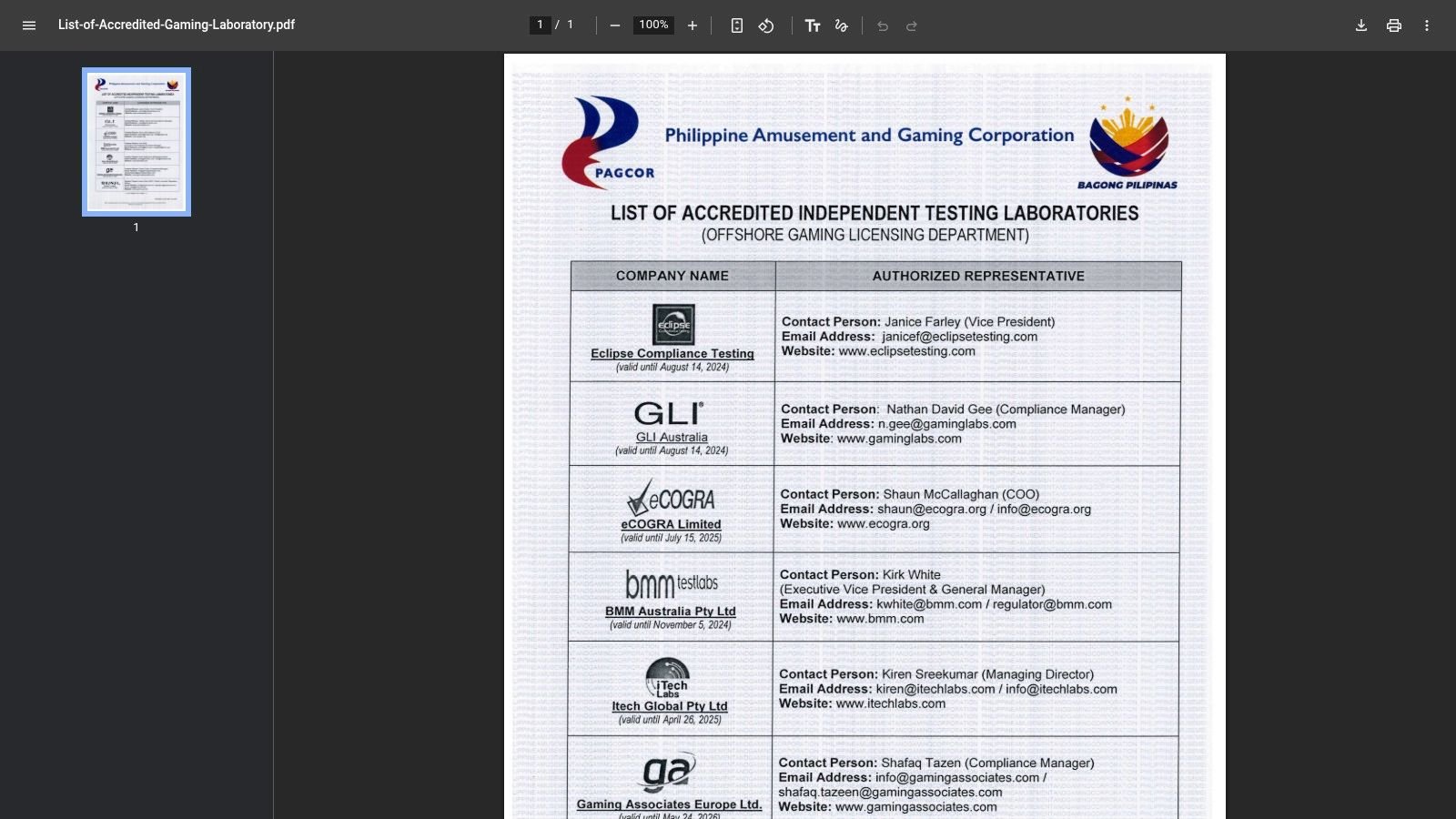
The PAGCOR-accredited gaming laboratory list identifies independent laboratories accredited to evaluate electronic gaming systems, games, and terminals. It therefore addresses the testing pathway rather than the commercial status of a supplier or operator.
For studios, platform providers, and equipment manufacturers, the list provides a regulator-recognized starting point for selecting an assessment laboratory. It can also help an operator ask whether a proposed certification came from a laboratory appearing in PAGCOR's accredited record.
A narrow but important source
The laboratory list is brief. It identifies accredited laboratories, but it doesn't provide detailed scopes by product type or jurisdictional limitations. A laboratory's appearance shouldn't be interpreted as proof that every certificate it issues covers every PAGCOR-relevant system, game version, terminal, or deployment model.
A strong technical file should connect four separate pieces of evidence:
- The laboratory identity: Does the laboratory appear in the official accreditation record?
- The test report: Does the report identify the relevant game, system, or terminal?
- The test scope: Does the assessment address the product and version being deployed?
- The deployment approval: Does the operator have the appropriate approval or listing for the game or system?
The laboratory resource complements the approved-games index. One shows an acceptable testing pathway, while the other helps address whether specific electronic games appear in the regulator's content record.
9. ROASD list of Special Class of BPOs
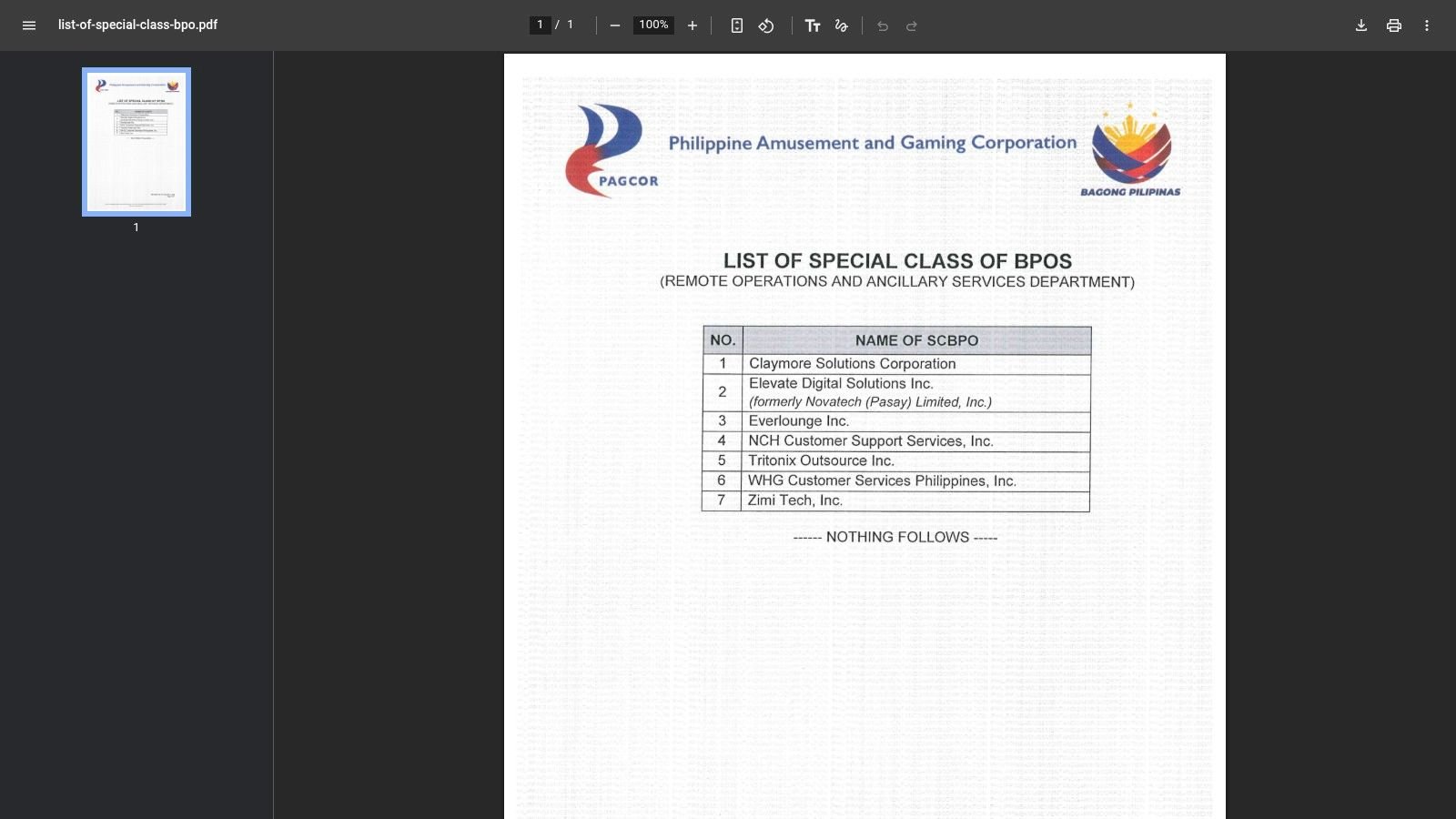
The ROASD Special Class of BPOs list covers a function-specific category of businesses supporting gaming operations through back-office and ancillary services. It sits alongside ROASD regulations, amendments, and fee materials, so the list should be read within that regulatory context.
A BPO's inclusion doesn't make it a game provider, equipment supplier, platform operator, or licensed venue. The resource answers a narrower question: whether a business appears in the accreditation list for the Special Class of BPO category associated with remote operations and ancillary services.
Why BPO classification matters
Outsourced customer support, administrative work, technical assistance, and other back-office functions can create operational dependencies even when the BPO doesn't control gaming content or player funds. An operator assessing such a vendor should confirm the precise services, site, personnel, data flows, subcontractors, and incident responsibilities in addition to checking the ROASD record.
The list is useful for sourcing and preliminary status verification. It isn't sufficient for complete supplier diligence because it doesn't focus on game content, hardware, platform approval, or the operator's own license. A BPO may also need to be cross-checked against other support-provider records when it performs functions that overlap with customer service, KYC, payment support, or technical operations.
The practical conclusion is narrow but significant: category-specific accreditation doesn't expand automatically into unrelated regulatory permissions. The BPO's approved function, the actual contract scope, and the operational model should remain aligned.
10. Licensees for gaming venue operations
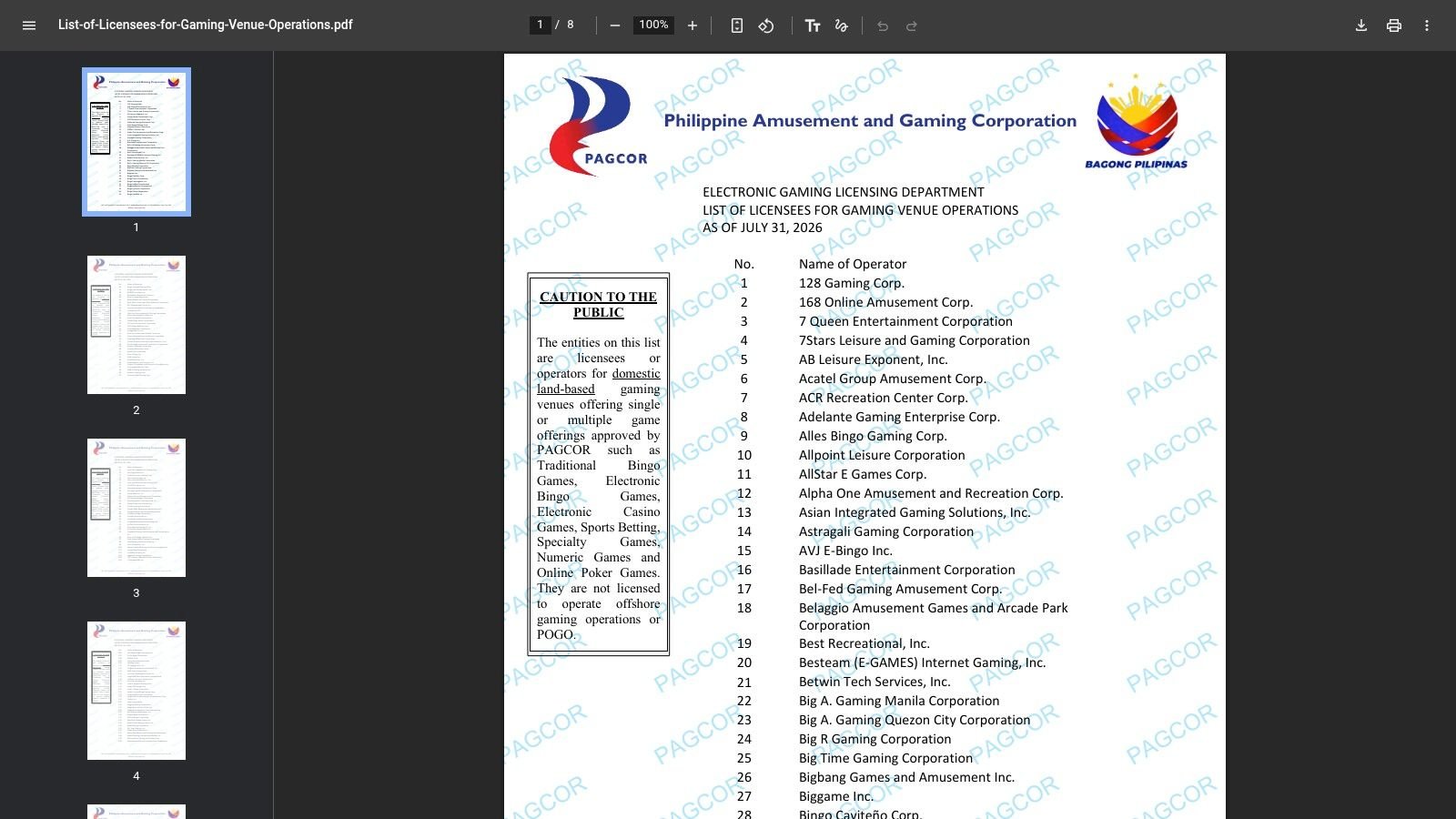
The PAGCOR licensees for gaming venue operations list is focused on operators, not suppliers. It identifies licensed domestic gaming venue operators and the game verticals authorized under the EGLD framework, including venue models associated with eBingo, eCasino, and sports betting halls.
That makes the resource valuable to suppliers vetting potential customers. A vendor may confirm that a prospective client appears in the operator roster, then compare the client's authorized vertical with the product or service being sold. A content provider, payment vendor, equipment company, or support provider shouldn't treat every listed operator as an appropriate customer for every offering.
Domestic scope is a critical boundary
The document distinguishes domestic licensing from offshore operations. That boundary matters when a supplier has an international group structure, serves multiple markets, or receives a request from a customer using a Philippine corporate presence to support activity outside the local framework.
A supplier's customer file should capture the operator's exact legal name, listed vertical, document date, and relationship to the proposed service. The operator roster doesn't prove that the customer's domains, brands, games, payment routes, or subcontractors are all compliant. It also doesn't prove that the supplier itself holds the approvals required for its side of the transaction.
The operator's license and the supplier's accreditation answer different questions. A compliant procurement file needs both sides mapped where the transaction requires them.
10-Item Comparison of PAGCOR Registered Supplier Lists
| Resource | Scope & Content | Update & Access | Primary value | Target audience | Limitations |
|---|---|---|---|---|---|
| GLDD Suppliers List (Equipment) | Master public DB of enrolled hardware/software suppliers with authorized goods/services, contacts | Live public webpage; continuously updated; no CSV/API | Official source to validate vendor authorization for Philippine market | Operators, integrators, procurement, compliance teams | No bulk export/API; occasional formatting inconsistencies |
| GLDD Suppliers Hub (Landing Page) | Gateway to supplier list plus Suppliers Regulatory Manual, enrollment & shipment forms | Web hub linking to lists and downloadable forms; may note fees | Provides regulatory context and required compliance paperwork | Prospective suppliers, operators, legal/compliance staff | Not a direct supplier list; requires navigation; some fee-based forms |
| Accredited GSAs & Registered Brands | PDF of EGLD‑accredited Gaming System Administrators with mapped brands/domains | Timestamped downloadable PDF; periodic updates | Verifies platform providers and detects unauthorized look‑alike sites | Operators, affiliates, security/compliance teams | Periodic PDF (not real‑time); manual review needed |
| Accredited Content Providers & Aggregators | PDF roster of game content providers and aggregators with approved verticals | Downloadable PDF; updated periodically | Regulatory mapping of who may supply games/aggregation locally | Operators, RFP teams, affiliates, content managers | Lacks technical details (RTP/studio locations); PDF format |
| Accredited Support Service Providers | PDF list categorized by function (payments, KYC, testing labs, CS, marketing) | Downloadable PDF; regulator‑maintained | Speeds third‑party compliance checks for integrations | Operators, integration teams, compliance officers | Narrower scope than GLDD; fewer data fields; PDF |
| Registered Casino Brands & Domains | PDF mapping of online brands/domains tied to licensed land‑based casinos | Downloadable PDF; periodic | Verifies casino‑linked online presences; reduces brand/domain ambiguity | Affiliates, brand managers, compliance teams | Focused on domains (not vendors); periodic updates |
| EGLD‑Approved Games Index | Portal index with per‑provider pages listing approved electronic game titles | Rolling updates on EGLD portal; per‑provider pages; no consolidated export | Granular list of specific titles cleared for deployment | Content teams, product managers, compliance | Requires browsing many pages; no bulk export |
| Accredited Testing Laboratories | One‑page list of PAGCOR‑accredited game/testing labs | Downloadable PDF; concise listing | Identifies acceptable independent labs for certification pathways | Studios, platform vendors, compliance teams | Limited detail; no lab scope or jurisdiction notes |
| ROASD Special Class BPOs | PDF of accredited Special Class BPOs supporting gaming plus regs/fee tables | ROASD portal PDF; includes regulations and amendments | Source for regulated back‑office and ancillary service providers | Operators outsourcing back‑office, HR, compliance | Function‑specific; may need cross‑checking with other lists |
| Licensees for Gaming Venue Operations | PDF roster of licensed domestic gaming venue operators and authorized verticals | Timestamped downloadable PDF; periodic | Confirms operators' licensing status for sales/market mapping | Suppliers, sales teams, market researchers, compliance | Not a supplier list; complementary resource only |
Turn registry checks into vendor controls
The PAGCOR registered gaming suppliers list is most useful when treated as a control input, not as a final procurement decision. The first step is to classify the counterparty by function. Equipment and paraphernalia suppliers belong in the GLDD workflow. Gaming system administrators, content providers, aggregators, support providers, BPOs, laboratories, brands, domains, and operators require different sources and different interpretations.
The second step is to open the matching PAGCOR resource and record the evidence precisely. A diligence file should identify the exact legal company name, company code or accreditation reference where available, listed category, approved vertical, registered domain, and relevant status note. The analyst should preserve the source copy or capture the page details together with its publication or update date.
A practical verification sequence
- Classify the vendor: Decide whether the party supplies equipment, operates a platform, supplies content, aggregates games, provides support, performs testing, offers BPO services, or operates a venue.
- Select the official record: Use the category-specific PAGCOR page or document instead of assuming the GLDD directory is universal.
- Match the legal identity: Compare the registry name with the contract party, invoice entity, corporate records, brand owner, and relevant affiliates.
- Check the scope: Compare the listed goods, services, verticals, domains, brands, games, or operator permissions with the proposed activity.
- Review status wording: Note whether the source identifies pending commercial operations, approved but not live brands, or another limiting status.
- Record the date: Preserve the source date and the date of the review, especially for PDFs and pages that are updated periodically.
- Escalate ambiguity: Seek direct regulator confirmation or formal legal advice when the record, contract, domain, or operating model doesn't align.
PAGCOR's supplier manual shows that enrollment involves more than a name appearing online. It identifies company information, product information, procurement registration, and Philippine storage evidence among the documentary requirements for the relevant supplier category. The manual also distinguishes enrollment from permits connected with holding and supplying equipment.
What registry evidence can't answer
A public list generally doesn't establish the full commercial or operational risk of a relationship. The registry alone can't confirm contract scope, jurisdictional responsibility, testing documentation, AML and KYC controls, data handling, incident reporting, subcontracting, business continuity, insurance, financial resilience, or renewal monitoring.
Those controls should be documented separately. An operator onboarding a payment provider should review payment flows, KYC ownership, transaction monitoring, data protection, and incident obligations. A content supplier should provide title-level mappings, testing reports, version controls, and change-management procedures. A BPO should disclose its sites, personnel model, subcontractors, access controls, and continuity arrangements.
Inclusion is not universal approval
A company's presence on one PAGCOR list doesn't automatically prove approval for every product, market, brand, domain, game, service, or activity. A laboratory listing doesn't approve a game. A content-provider entry doesn't approve every title. A registered domain doesn't establish that every associated campaign or payment route is compliant. An operator listing doesn't make its suppliers compliant.
The strongest procurement process therefore combines regulator-led verification with contractual controls. Agreements should identify the relevant approval, require continuing compliance, mandate notice of suspension or material change, permit updated evidence requests, and provide termination rights when the regulatory basis becomes false, incomplete, or outside scope.
Top 1 Rank provides continuing coverage of iGaming regulation, supplier governance, market intelligence, and technology developments for operators, suppliers, affiliates, investors, regulators, and gaming professionals. Teams making a Philippine vendor decision should use the current PAGCOR records as the primary status evidence, retain the review trail, and obtain qualified legal or compliance advice before relying on a disputed or ambiguous approval.
For the next supplier, operator, or platform review, classify the counterparty first, open the matching official PAGCOR resource, save the dated evidence, reconcile the approved scope with the proposed service, and complete the wider contractual and compliance assessment before onboarding.





Join thousands of gaming professionals receiving the latest iGaming news, regulatory updates, and market insights.
