


Online poker is legal in the Philippines, but only if you play on a PAGCOR-licensed platform. That's the rule that matters most, and if you ignore it, you're taking unnecessary legal and payment risk from the first deposit.
A lot of Filipino players are in the same spot right now. You want to try online poker, maybe you've seen tables running, maybe a friend mentioned a site, but you're not sure what's legal, which platforms are safe, or how to avoid getting stuck with a bad cashier experience. That confusion is normal.
The good news is that the answer isn't complicated once you strip away the noise. In the Philippines, the smart path is simple: verify the licence, use platforms built for local players, and avoid rooms that make deposits and withdrawals harder than they need to be. If you want a starting point for regulated local gaming, you can check Insta Play Online Casino, but the bigger lesson is this: licensing comes first, everything else comes second.
Table of Contents
- Your Introduction to Online Poker in the Philippines
- Understanding the Legality of Philippine Online Poker
- How to Choose a Safe and Licensed Poker Platform
- A Beginners Guide to Popular Poker Variants
- Essential Tips for Bankroll Management and Security
- Playing Responsibly and Finding Support
Your Introduction to Online Poker in the Philippines
If you're searching for online poker Philippines, you probably want a straight answer, not recycled forum talk. You want to know where you can play without guessing whether the site is legal, whether the games are fair, or whether your withdrawal will turn into a headache.
That hesitation is justified. Online poker looks simple from the outside, but the main issue isn't learning hand rankings. It's knowing which rooms are genuinely safe for Filipino players.

Why Filipino players get stuck early
Most beginners don't fail because poker is too hard. They fail because they start on the wrong platform. They pick a room with vague compliance language, weak local payment support, or no clear standing with Philippine regulators.
That creates three immediate problems:
- Legal uncertainty means you're relying on a platform that may not be properly cleared to serve Filipino residents.
- Payment friction means deposits might work one day and fail the next, or withdrawals become slow and unclear.
- Support problems mean when something goes wrong, you're stuck talking to a help desk that doesn't understand the Philippine user experience.
Practical rule: If a poker platform isn't clear about its licensing status, walk away before you register.
What matters more than bonuses
A flashy promo can distract new players fast. Don't let it. The best poker room for a Filipino player isn't the one shouting the loudest. It's the one that can show legal standing, process local-friendly payments smoothly, and keep your account secure.
That's the mindset to bring into every decision. Treat poker like any other regulated online service. You wouldn't hand over your money to a random app with no clear compliance. Don't do it with poker either.
A safe start matters more than a fast start. Once you choose the right platform, the rest gets easier: funding, game selection, account protection, and enjoying the tables.
Understanding the Legality of Philippine Online Poker
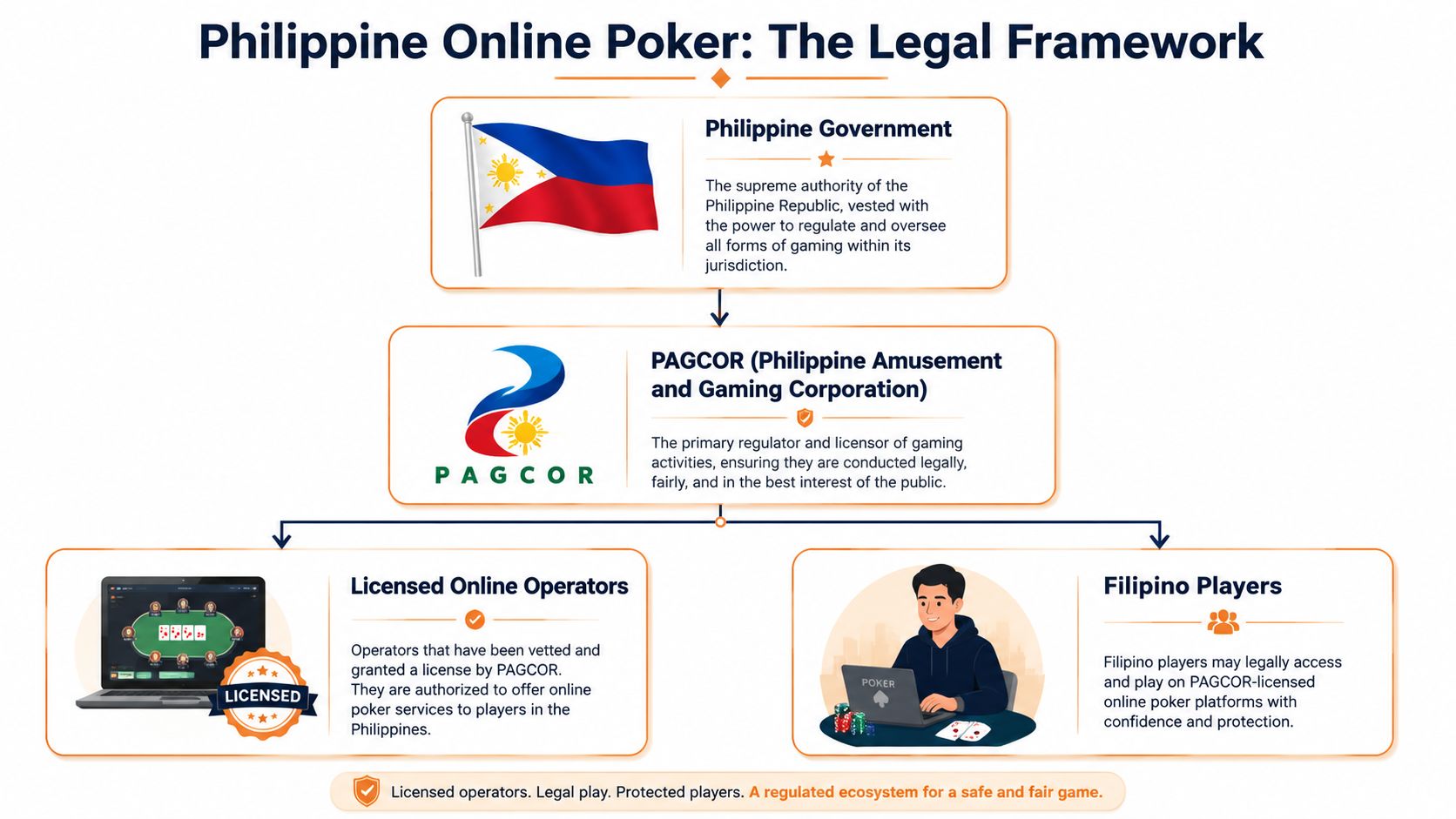
The legal question has a clean answer. Online poker in the Philippines is legal only on PAGCOR-licensed platforms, and operators need to appear on PAGCOR's public list of accredited providers. Somuchpoker also notes that GGPoker is the only major online poker room with a full PAGCOR licence, which tells you something important: this isn't branding fluff, it's a hard compliance filter that decides whether a room can legally serve Filipino residents, as explained in Somuchpoker's guide to poker in the Philippines.
What PAGCOR licensing actually means
PAGCOR sits at the centre of the legal framework. For players, that means the licence isn't some decorative logo tucked into a footer. It's the difference between playing inside the regulated local environment and drifting into a grey area that can create payment, access, and trust issues.
A proper licence matters because poker isn't just a game product. It's also a money-handling service. You're depositing, withdrawing, sharing identity details, and trusting the platform to resolve disputes fairly. If the operator isn't properly accredited, you're relying on promises instead of oversight.
Here's the blunt version. If a site can't clearly show that it's licensed for the Philippine market, don't convince yourself that “it's probably fine”. That's how people end up chasing support tickets instead of enjoying the game.
The fastest way to judge a poker site
You don't need a legal background to filter good rooms from risky ones. Use this quick standard:
| Check | What to look for | Why it matters |
|---|---|---|
| Licence status | Clear PAGCOR licensing or accreditation information | Confirms legal standing in the Philippines |
| Public visibility | Operator appears on the official accredited list | Reduces the chance you're relying on marketing claims |
| Payment fit | Local-friendly options and clear withdrawal process | Cuts friction for Filipino users |
| Terms clarity | Rules, limits, and account checks written plainly | Shows the operator isn't hiding behind vague language |
A lot of players waste time comparing software, table design, or promotions before they've settled the legal question. That's backwards. Compliance is your first filter.
If you also play other regulated games, you can see how local gaming platforms present their offerings by looking at options such as Mega Panalo Casino access. The main lesson stays the same. In the Philippine market, legal access starts with operator status, not with game variety.
A poker room that makes its legal status hard to verify is telling you enough already.
How to Choose a Safe and Licensed Poker Platform
The safest way to choose a poker site in the Philippines is to start with the parts most players ignore. Not the graphics. Not the headline promo. Start with payments, support, and proof that the platform is set up for local users.
That approach saves you from the most common beginner mistake. A site can look polished and still be awkward to use from the Philippines.

Start with the cashier, not the lobby
For Filipino players, the question isn't only whether a poker room is accessible. It's whether funding and cashing out are smooth and legal in practice. As noted in Rakeback's Philippines poker guide, some international sites have payment constraints, including Skrill being unavailable for deposits from the Philippines and Neteller not appearing in the cashier, while some rooms are blocked.
That's why I tell people to inspect the cashier before they get excited about the games. If the payment page feels like an afterthought, the platform probably wasn't built with Filipino users in mind.
Look for local convenience first. A room that supports payment behaviour familiar to Philippine players is usually easier to use day to day than an offshore room that technically accepts you but makes every transaction feel uncertain.
A practical checklist before you register
Use this list before you create an account:
- Check the licence first: Don't register until you've verified the operator's standing.
- Read the cashier pages: See what deposit and withdrawal methods are shown, not what the homepage implies.
- Test support quality: Ask a simple question before depositing. A good team answers clearly and quickly.
- Review verification rules: Know what documents may be required before withdrawal.
- Avoid platform hopping: One reliable room is better than juggling several questionable ones.
If you also use gaming apps outside poker, it's worth seeing how local mobile access is presented through options like the PH777 casino app download page. The principle is the same across products. Convenience only matters when it sits on top of compliance.
This quick video gives a useful feel for the kind of digital casino environment many Filipino players are already exploring before they branch into poker.
Good poker platforms don't force you to decode the cashier. They make deposits, withdrawals, and verification easy to understand before you risk a peso.
A Beginners Guide to Popular Poker Variants
A lot of new players think poker is one game. It isn't. When people talk about online poker in the Philippines, they're usually talking about a few core formats that play very differently.
That variety helps explain why poker sits comfortably inside a much bigger digital gaming shift. In 2025, e-games, e-bingo, and online poker together generated PHP201.12 billion, equal to 50.77% of total Philippine gaming revenue and overtook land-based gaming in revenue contribution, according to iGaming Business reporting on PAGCOR industry data. Poker isn't some side curiosity. It belongs to a mainstream digital gaming environment.
Texas Holdem for most new players
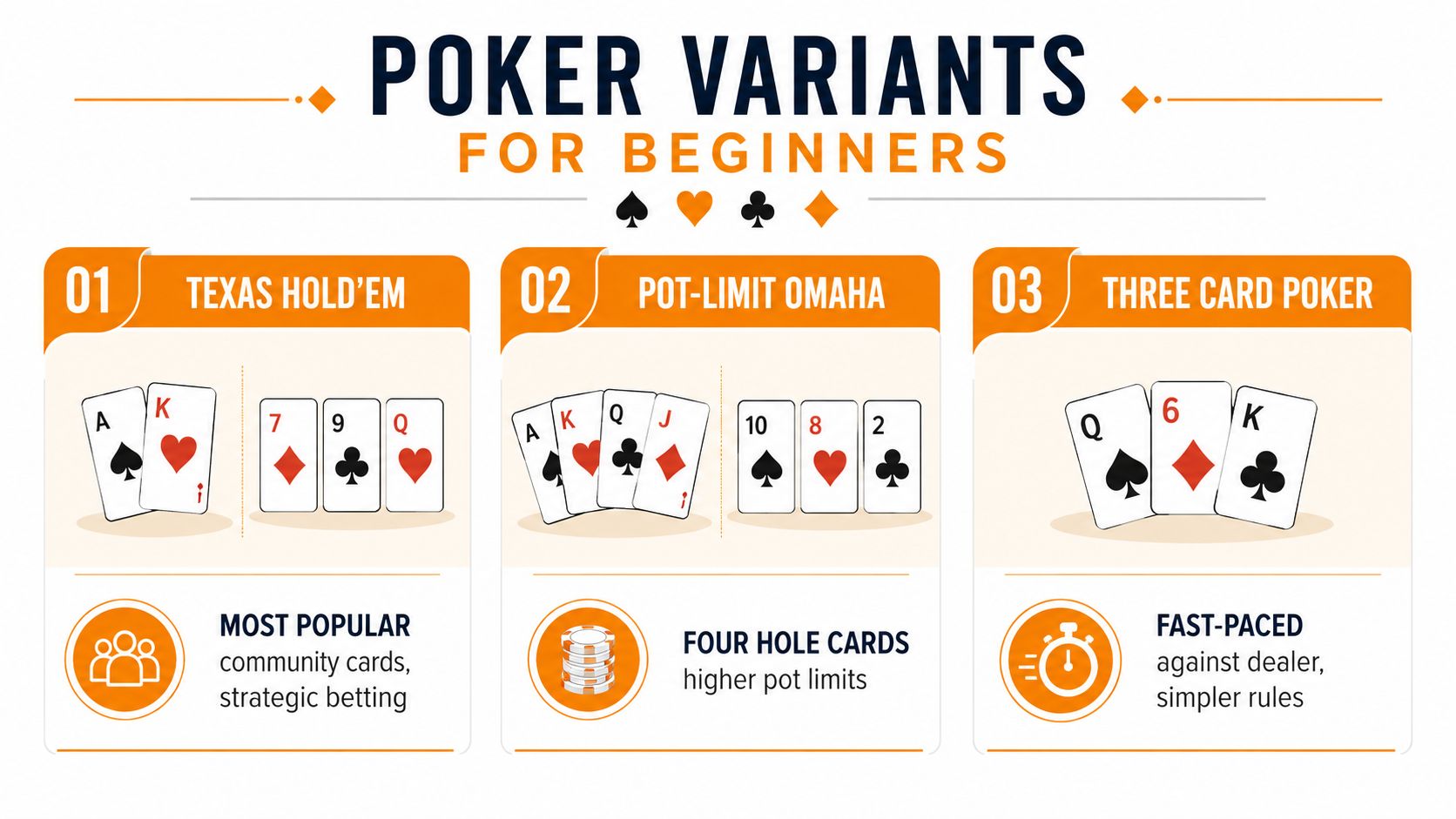
If you're brand new, start with Texas Hold'em. It's the easiest format to follow because each player gets two private cards, then shares community cards on the board. Your job is simple in theory: make the best five-card hand and decide when to bet, call, raise, or fold.
Hold'em teaches the core skills that transfer to nearly every poker format:
- Patience: You don't need to play every hand.
- Position awareness: Acting later in the round gives you more information.
- Bet sizing: Small mistakes with chip management add up fast.
Most beginners should stay here until the betting rhythm feels natural.
Pot-Limit Omaha if you want more action
Pot-Limit Omaha, often called PLO, is livelier and less forgiving. You get four hole cards instead of two, but you must use exactly two of them with three community cards. That creates more possible combinations and bigger drawing hands.
The result is obvious at the table. More players connect with the board, more hands look strong, and weak discipline gets punished quickly.
Here's a simple comparison:
| Variant | Hole cards | Feel of the game | Best for |
|---|---|---|---|
| Texas Hold'em | Two | More controlled and easier to read | Beginners |
| Pot-Limit Omaha | Four | Faster, swingier, more hand combinations | Players who already know the basics |
| Three Card Poker | Three | Quick and straightforward | Casual players |
Three Card Poker for a simpler entry point
Three Card Poker isn't traditional table poker in the same strategic sense as Hold'em or Omaha, but many beginners like it because it's easy to grasp. You're usually playing against the dealer rather than navigating a table full of opponents.
That makes it a decent confidence builder if regular poker feels intimidating at first. If you also enjoy Filipino card games, there's a useful crossover in thinking about hand value and decision-making, and a quick read on Pusoy in English can help if you like comparing familiar local card-play ideas with broader gaming formats.
Essential Tips for Bankroll Management and Security
Most poker mistakes don't come from bad cards. They come from poor money decisions and lazy account security. If you want to last, you need control in both areas.
Handle your bankroll like it matters
Your bankroll is your poker budget, not your spare cash for emotional decisions. Once you mix the two, the game gets expensive fast.
Use basic discipline:
- Set a fixed play budget: Choose an amount you can afford to lose and treat it as entertainment spend.
- Start low: New players learn more at smaller stakes because the pressure is lower.
- Stop chasing losses: A bad session doesn't become a good one because you doubled your next deposit.
- Cash out with intention: Don't leave every win sitting in your account just because it's convenient.
A lot of players sabotage themselves by treating each session like a recovery mission. Poker punishes that mindset.
Bankroll rule: If losing tonight's budget would annoy you tomorrow, your stakes are too high.
Know the tax and age rules
There are two legal details every Filipino player should know before sitting down. According to PokerListings on poker in the Philippines, winnings of Php10,000 and below are taxed at 10%, while winnings above Php10,000 are taxed at 20%. The same source states that players must be at least 21 years old.
That matters for two reasons. First, you need realistic expectations about what you keep from a winning session. Second, age eligibility isn't negotiable. If you're under the threshold, you shouldn't be trying to force access through someone else's account.
If you're also dealing with cash-out procedures across gaming platforms, guides like this one on Arena Plus withdrawal steps can help you think more clearly about withdrawal mechanics and verification habits in local gaming environments.
Protect your account properly
Poker accounts hold money, identity details, and transaction history. Treat yours like a banking app.
Use this security baseline:
- Create a unique password for your gaming account only.
- Turn on two-factor authentication if the platform offers it.
- Ignore suspicious messages asking you to “confirm” login details through links.
- Check the site address carefully before logging in.
- Log out on shared devices and don't save credentials in public places.
People love talking strategy, but a stolen account destroys your experience much faster than a bad river card.
Playing Responsibly and Finding Support
Poker should stay enjoyable. The moment it starts controlling your mood, your spending, or your time, you need to take that seriously. Not dramatically. Just realistically.
Signs that the game is slipping out of control
Watch for behaviour changes, not just money problems. Trouble usually shows up in habits first.
Common warning signs include:
- You're playing to escape stress, not because you actually want to play.
- You keep extending sessions after saying you'd stop.
- You increase deposits after losses because you want to “win it back”.
- You hide your play from family or friends.
- You feel irritated or restless when you can't log in.
One sign doesn't automatically mean disaster. Several signs together mean it's time to pause.
Simple rules that keep poker enjoyable
Responsible play works best when your rules are simple enough to follow every session.
Try this approach:
- Pick a time limit before you start.
- Set a deposit limit and don't change it mid-session.
- Never play when angry, tired, or drinking.
- Take breaks away from the screen.
- Keep poker separate from money meant for bills and daily living.
If those limits are hard to keep, step back and ask for help. Official support options in the Philippines can change, so the safest move is to check current assistance and responsible gaming contacts directly through recognised local regulatory and platform channels. If you feel your gaming is becoming harmful, stop playing immediately and contact an official support service or a qualified mental health professional in your area.
Poker is best when it stays in its proper place. A game. Not a rescue plan, not a side-income fantasy, and not a way to fix a rough week.
If you want a regulated place to explore online gaming with a local-first approach, Insta Play Online Casino is worth a look. It's positioned around PAGCOR licensing, familiar payment convenience, and a beginner-friendly experience, which is exactly what most Filipino players should prioritise before anything else.




Join thousands of gaming professionals receiving the latest iGaming news, regulatory updates, and market insights.
