

A supplier can look fully operational on paper and still discover, too late, that PAGCOR now expects direct accreditation before the business can keep serving licensed operators. That reality has changed how contracts, technical testing, local representation, and even interim continuity have to be managed in the Philippine market. For many vendors, the hard part isn't understanding the headline requirement. It's keeping revenue stable while the approval file moves through a regulator that now controls the supply chain itself.
Table of Contents
- Understanding the 2026 Regulatory Shift
- Eligibility Criteria and Supplier Categories
- Application Process and Documentation Requirements
- Navigating the Transition Period and Operational Continuity
- Compliance Best Practices and Common Pitfalls
- Post-Approval Obligations and Long-Term Compliance Strategy
Understanding the 2026 Regulatory Shift
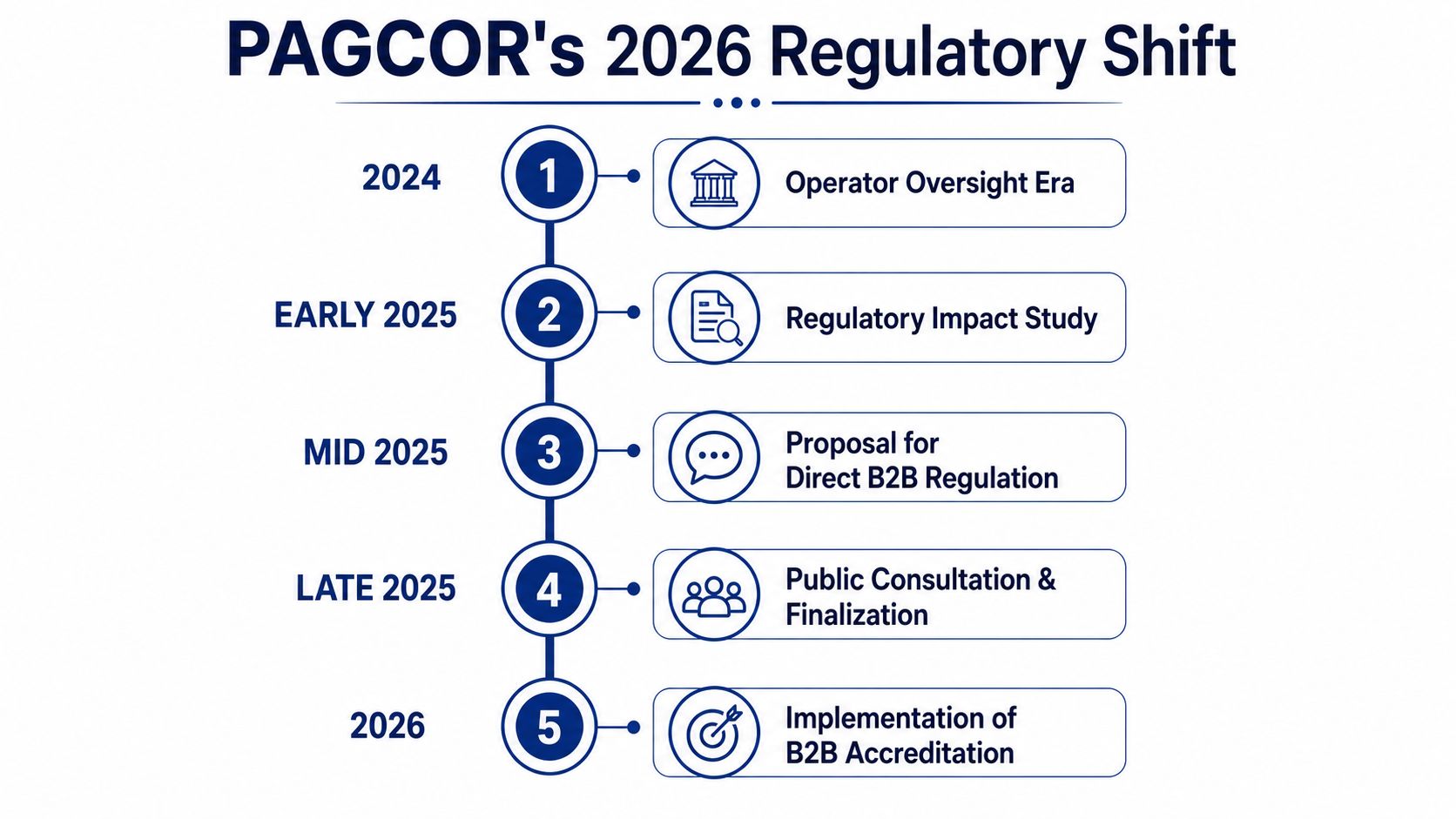
A foreign game provider signs a distribution agreement with a PAGCOR-licensed operator, starts integration work, and assumes the operator's licence is enough. Then the compliance team asks for PAGCOR B2B accreditation. That is the moment the operating model changes. The old operator-only oversight approach no longer covers third-party suppliers in the same loose way, because PAGCOR moved to direct regulation of gaming affiliates, game content providers, and support service providers that supply licensed operators when the new framework took effect on 2 October 2025. The accreditation framework also moved the term from 1 year to 2 years and required a PHP 1,000,000 Performance Cash Deposit before a supplier can operate.
Why the change matters in practice
The practical effect is straightforward. A supplier can no longer treat operator onboarding as the final gate. PAGCOR now has its own approval path, and that approval sits in front of continued market access. Industry coverage also notes that foreign content and live-dealer suppliers were pushed toward a Philippine presence or local representation, so market access now depends on a corporate footprint as much as a product suite. The Gaming Boardroom on PAGCOR's accreditation timeline
The timing created a compressed compliance window. Providers that applied by 31 May 2026 were allowed to continue operating only until 31 July 2026 while PAGCOR reviewed their files, and later updates tied full compliance to a final shutdown risk on 1 August 2026. That matters because accreditation becomes a continuity problem, not just a filing exercise. MB on PAGCOR's shutdown warning
Practical rule: a supplier should plan as if the operator relationship is conditional the moment the framework applies, because the regulator can interrupt supply even before the final decision arrives.
The operational gap is the period between submission and approval. Revenue can keep flowing only if the supplier has already aligned contracts, local representation, technical files, and internal controls with the new approval path. If those pieces are not ready, a live integration can stall even while commercial terms stay active. For broader market context on how Philippine operators structure their gaming stacks, see Top 1 Rank's Philippines online casino coverage.
Eligibility Criteria and Supplier Categories
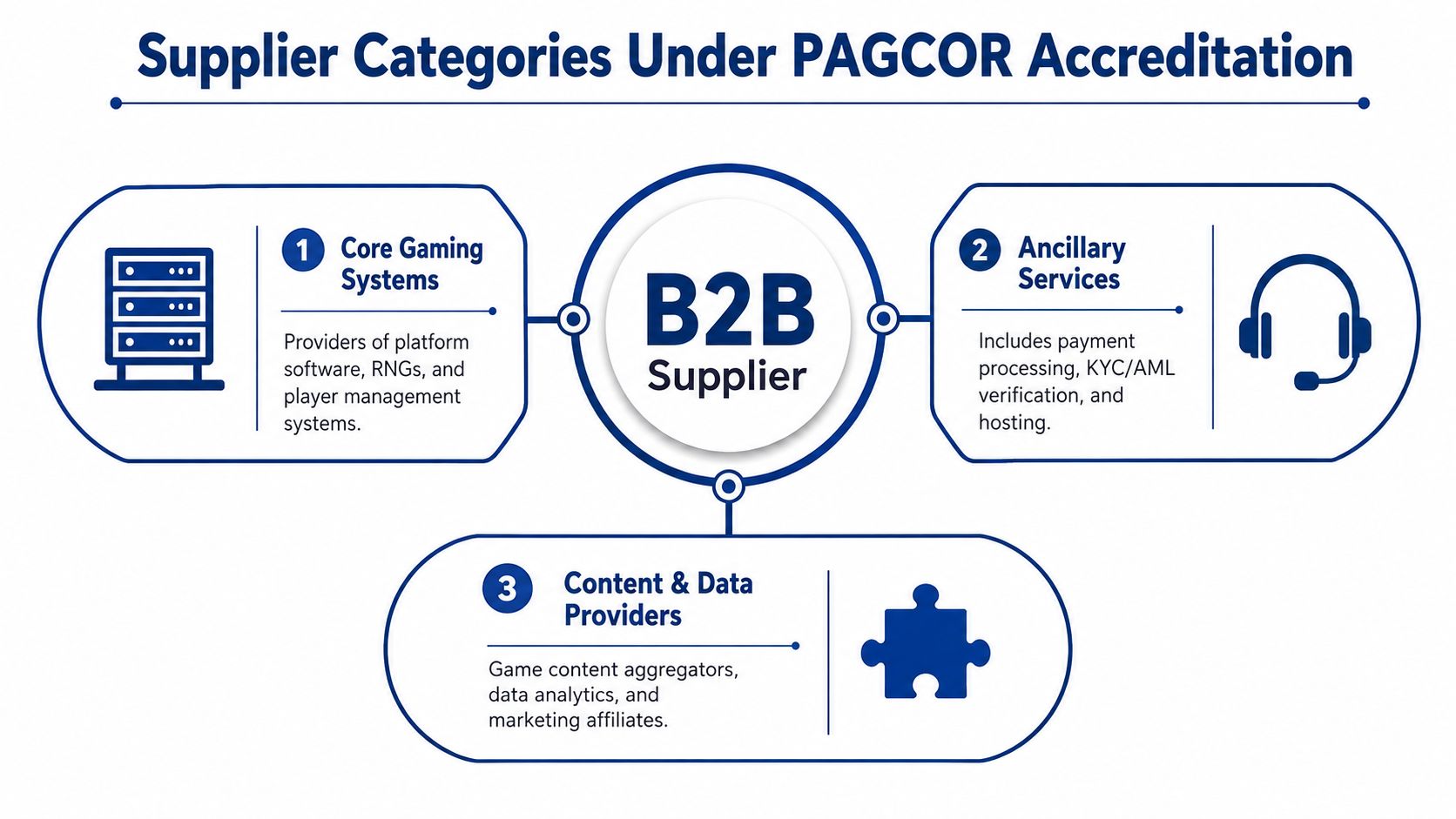
The quickest way to waste filing time is to approach PAGCOR without first testing whether the business sits inside the B2B perimeter. The regime is broad, but it is not limitless. Industry coverage confirms that PAGCOR's updated rules reach foreign and local B2B suppliers serving licensed operators, and the practical question is whether the company's function is part of regulated gaming delivery or adjacent to it.
A practical decision tree
Start with a simple test. Does the business directly help a PAGCOR-licensed operator offer gaming, manage players, process data, or run technical infrastructure? If the answer is yes, the firm is likely within scope. If the service is remote, generic, and disconnected from regulated gaming operations, the case for accreditation is weaker. That distinction matters because PAGCOR is regulating the supplier function itself, not every technology company that happens to have a Philippine customer.
The most exposed categories are straightforward. Game content providers are the clearest example, especially where they supply titles or live-dealer content to licensed platforms. Support service providers can include hosting, verification, payment, and operational services when the supplier's work is built into regulated gaming delivery. Gaming affiliates sit closer to acquisition, but they can still fall within scope if their role is directly tied to licensed gaming activity. PAGCOR B2B accreditation and supplier scope
A useful test is whether the operator can keep its regulated offer running without the supplier's function. If the answer is no, the supplier should expect scrutiny.
Foreign and local treatment
Foreign providers should pay close attention to market-access structure. As noted earlier, unaccredited foreign providers were expected to secure accreditation or appoint a Philippine-registered distributor or accredited Gaming System Administrator by the compliance deadline, with full alignment later tied to decommissioning risk. The operational point is simple. A foreign supplier that wants to keep revenue flowing cannot treat local representation as a paper formality. PAGCOR will look at whether the Philippine entity has real operational substance, not just a mailing address.
For live-dealer and content businesses, that creates a very specific question. Is the Philippine entity a true operating representative, or just a mailbox? PAGCOR's regime is built to find out. For a closer look at how live-dealer products are positioned in the local market, see Top 1 Rank's live dealer casino coverage.
Application Process and Documentation Requirements
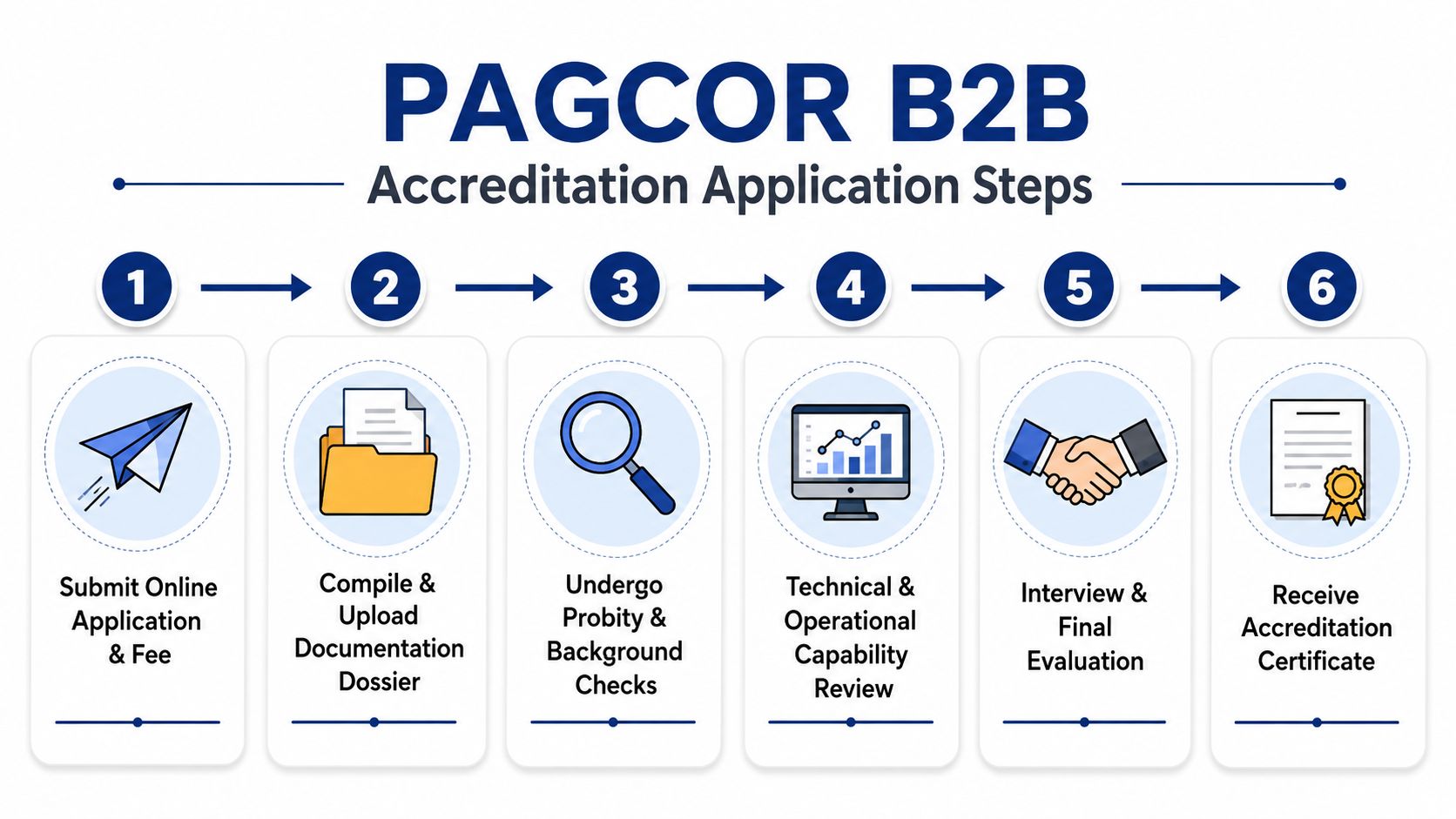
A supplier that wants to keep servicing licensed operators in 2026 has to treat PAGCOR accreditation as a staged file review, not a one-time upload. The application moves through successive checks, and any missing piece can stop the process. As noted in regulator coverage, the sequence includes application submission, probity and background checks, on-site or ocular inspection, live electronic gaming system testing, and the posting of the Performance Cash Deposit before service can continue.
What the file has to prove
The application has to show more than legal existence. PAGCOR expects the applicant to demonstrate that it can operate inside a regulated supply chain, with clear ownership, clean background records, working systems, and a setup that can withstand review. The updated regime also relies on documentary probity checks, on-site inspections, and live system testing, so the file has to support each of those stages with documents that line up with each other.
In practical terms, that means the submission has to be orderly, traceable, and internally consistent. Corporate papers, technical architecture, and ownership disclosures should tell the same story. If they do not, the file can stall before the regulator even reaches testing. That delay is often self-inflicted, because many suppliers still treat the submission as a form upload rather than a regulatory record.
The PHP 1,000,000 Performance Cash Deposit also has to be handled as a live compliance step, not a symbolic cost. Under the updated regime, it is required per accredited provider or service category, and it sits alongside the probity and technical review phases as part of the approval stack. For suppliers that are still trading through a transition period, that means cash planning has to happen early, before the application reaches the final gate.
The order matters
The sequence drives the risk. A supplier can prepare for technical testing and still fail if probity support documents are incomplete. A supplier can pass documentary review and still be stranded if the deposit is delayed after inspection. The safest applications are built to satisfy each gate in the same order the regulator uses.
A useful working file usually includes the following:
- Corporate identity records, to confirm who the applicant is and where it is registered.
- Ownership and control information, so PAGCOR can assess who ultimately benefits from the business.
- Operational and technical documentation, to support system testing and capability review.
- Compliance policies and internal controls, especially where the supplier handles player data, payments, or verification.
- Local representation documents, where foreign suppliers are using a Philippine-registered distributor or accredited administrator.
For foreign suppliers, the local structure has to be real, not decorative. If a Philippine entity is being used to keep commercial activity flowing, PAGCOR will look for actual operating substance, not a mailbox arrangement. For suppliers entering the market through a local commercial partner, Top 1 Rank's Go Perya registration guide is useful background for how Philippine-facing gaming products are often packaged commercially.
Navigating the Transition Period and Operational Continuity
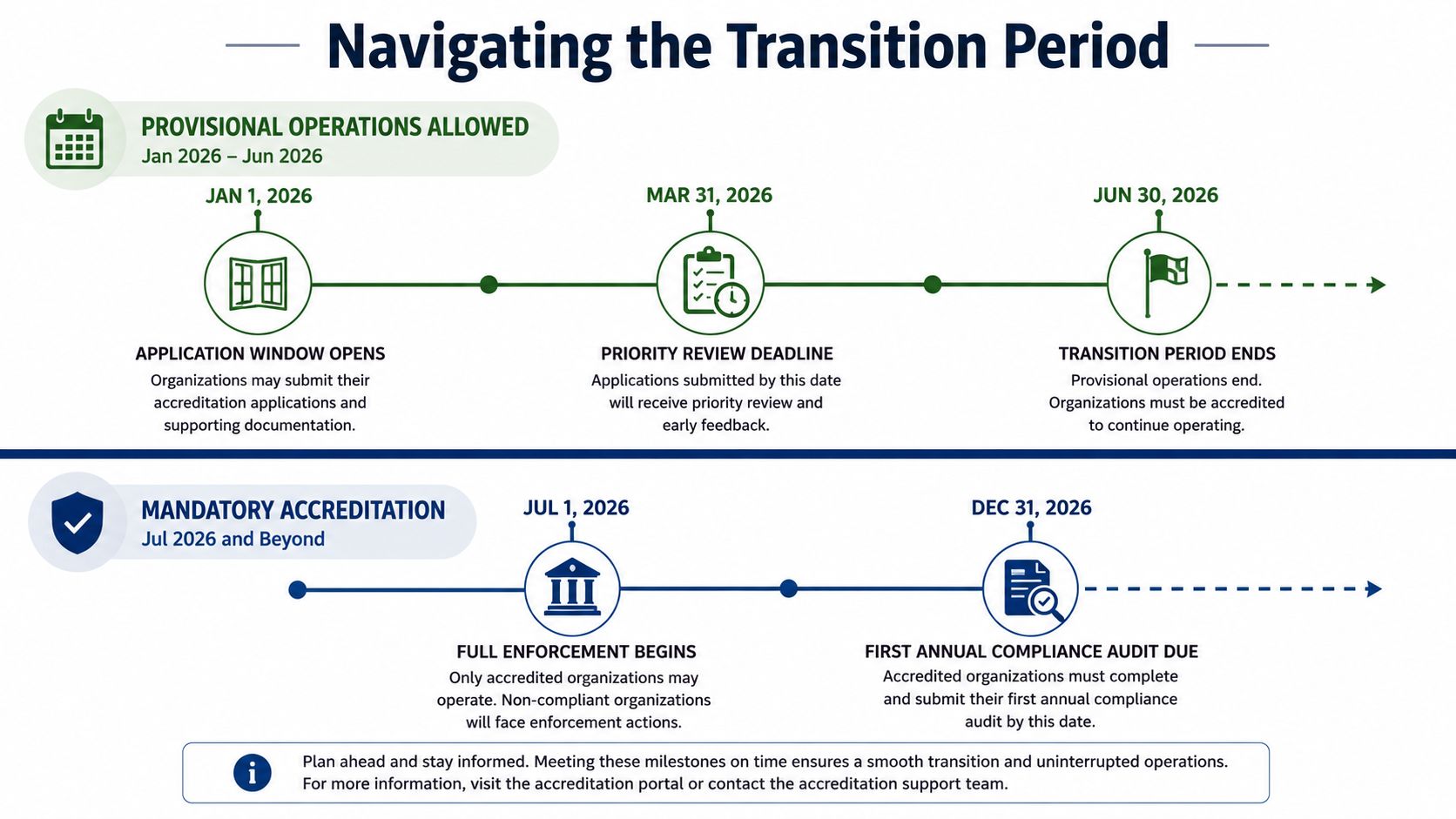
The biggest mistake in 2026 is assuming that filing the application keeps revenue flowing on its own. It doesn't. PAGCOR's memos created a narrow bridge between submission and approval, and that bridge has conditions. Providers that submitted by 31 May 2026 could continue operating only until 31 July 2026, while non-compliant firms faced decommissioning from 1 August 2026. ASgam on the transition timeline and vendor-chain verification
What continuity means during review
Continuity is not approval. While a file is under review, the supplier still absorbs every delay inside the process. If a probity check needs follow-up, if a system test exposes an integration issue, or if an inspection surfaces an operational mismatch, the supplier can sit in limbo while the calendar keeps moving. That is why the staged deadlines inside 2026 matter so much. They turn review time into a commercial risk factor that has to be managed, not assumed away.
Regulatory guidance also requires GSAs and operators to submit full supplier lists for verification. That makes vendor-chain compliance a separate issue from the supplier's own filing, because the operator's paperwork can affect whether the supplier remains visible in the regulated supply chain. The contract may continue on paper, but the supply relationship can still be blocked if the vendor is not properly listed.
Commercial reality: a contract signed before accreditation does not guarantee uninterrupted service during review. The regulator can still require the operator and GSA to clean up the vendor chain.
The practical response is to treat cash flow as part of compliance planning. Renewal conversations, billing cycles, and service milestones need to be built around the possibility that a file will not clear on the first pass. Suppliers that communicate early with operators usually avoid the worst surprises, especially where live content or platform hosting is central to the client's launch schedule.
That same continuity problem shows up in payment workflows. If player-facing withdrawals are part of the operating model, a delay in one control point can create pressure elsewhere, and Top 1 Rank's GCash withdrawal coverage for the Philippines is a useful reference for how tightly regulated payment continuity affects day-to-day market operations.
Compliance Best Practices and Common Pitfalls
The cleanest applications usually look boring. That's the point. PAGCOR is not looking for marketing language, it is looking for evidence that the supplier can be controlled, tested, and monitored. The most useful applications are the ones that answer questions before the regulator has to ask them.
What works
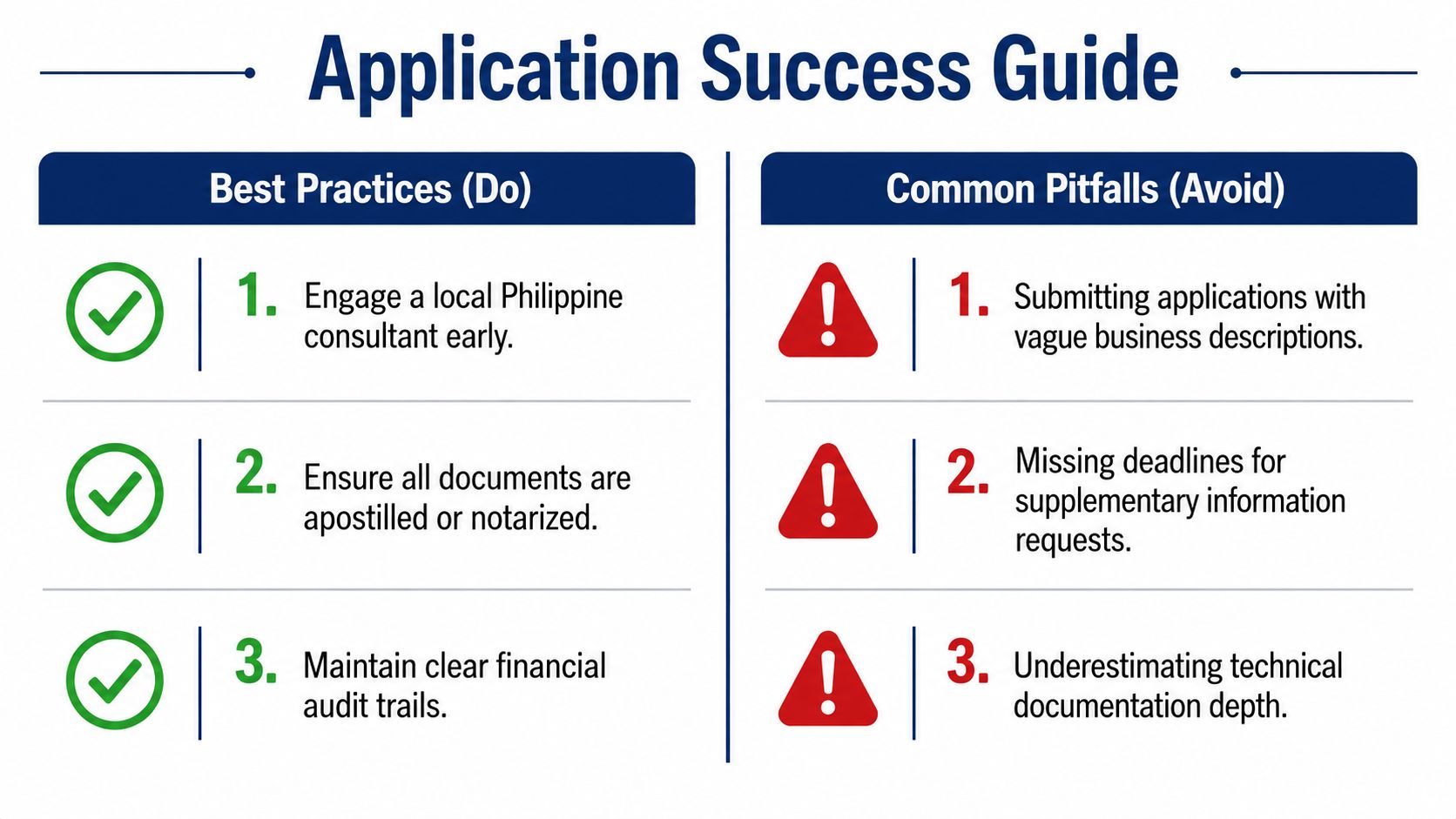
The strongest submissions usually begin with a local compliance lead who can coordinate documents, inspections, and follow-up questions without delay. Foreign suppliers, in particular, need a Philippine-facing point of contact who can keep the process moving when time zones and document legalization slow everything else down. That is not a formality, it is a practical necessity.
The second strength is document discipline. The file should be internally consistent, clearly labeled, and supported by notarized or apostilled records where required by the supplier's own corporate structure. When ownership, technical architecture, and operational descriptions all line up, probity review becomes much easier to complete. Where they don't, the file tends to boomerang.
A short checklist helps:
- Use a local coordinator early, so inspection scheduling and regulator follow-up do not stall.
- Keep business descriptions precise, because vague descriptions invite more questions.
- Maintain audit trails, especially where payment flows, onboarding, or player data are involved.
- Prepare technical files in depth, because live testing can expose gaps that a sales deck will never reveal.
What usually fails
The common failures are predictable. Vague business descriptions make it harder for PAGCOR to understand the service model. Missed requests for supplementary information can freeze the file. Thin technical documents often force a second round of review, especially where live-dealer, platform, or hosting services depend on multiple systems working together.
Foreign suppliers also underestimate how much representation matters. Appointing a nominal local entity is not enough if that entity cannot answer compliance questions, support inspection logistics, or manage the operational side of the application. The market has little patience for paper structures that cannot function under regulator scrutiny.
A supplier should assume that every weak document will be treated as a risk signal until it is corrected.
For teams that need a broader risk-awareness lens, Top 1 Rank's guide to phishing scams and avoidance is a relevant reminder that compliance failure often starts with weak operational controls, not just regulatory ignorance.
Post-Approval Obligations and Long-Term Compliance Strategy
Approval starts the relationship, it does not finish the work. Under the updated regime, accreditation is generally valid for 2 years from Board approval, so compliance now runs on a recurring cycle instead of a one-time filing. That changes how suppliers budget, staff, and negotiate with operators. Chambers on the 2-year validity period
What changes after approval
Once accredited, the supplier still has to treat its operating model as live regulatory territory. Any material change in corporate structure, service scope, or representation should be checked against the accreditation file, because the approval follows the business as assessed, not just the brand name on the contract. If the supplier expands into another service category, the deposit and documentation burden can change with it, since the framework links the PHP 1,000,000 cash deposit to the accredited provider or service category. Chambers on the deposit structure
That has direct strategic value. Accredited status can improve operator confidence, reduce friction in vendor onboarding, and make procurement conversations easier, because the supplier has already cleared the regulator's control stack. In a market that now treats third-party access as a licensing gate, accreditation becomes part of commercial positioning.
The key pressure point is the period between approval and steady-state operations. Suppliers that grow cleanly keep ownership records current, preserve technical audit trails, and maintain a local compliance rhythm that can stand up to periodic review without slowing sales or delivery. Firms that separate compliance from operations usually pay for it later, first in manual rework, then in delayed updates when the file no longer matches the business.
Post-approval planning also has to account for continuity. A supplier cannot assume the first approval solves the next renewal, the next scope change, or the next request for supplementary material. Teams that keep a standing document set, assigned review owners, and a clear escalation path are better placed to keep revenue moving while the file remains under regulatory scrutiny.
For suppliers, the lesson is straightforward. PAGCOR B2B accreditation requirements 2026 are not just a deadline problem, they are an operating model change. The businesses that adapt early will spend less time firefighting and more time staying eligible.
To track how the Philippine gaming market keeps moving through this transition, follow Top 1 Rank for continuing PAGCOR coverage, supplier compliance updates, and market intelligence that helps operators and vendors act before the next enforcement window closes.


Join thousands of gaming professionals receiving the latest iGaming news, regulatory updates, and market insights.
