

A new GSA filing in the Philippines is no longer a routine vendor paperwork exercise. Under PAGCOR's 2026 B2B overhaul, the role now sits at the center of market access, because a gaming system administrator can't connect software and wait for approval. It has to prove that its corporate structure, upstream providers, technical stack, and shutdown process all fit inside a regulator-controlled operating model.
That shift matters for operators, suppliers, and compliance teams for one simple reason. PAGCOR has turned the Gaming System Administrator into a compliance gate, not a voluntary registration label, and every commercial decision now has a regulatory shadow. The question is no longer whether a provider can sell into the market, but whether it can keep a live product set authorized through approval, audit, and deactivation.
Table of Contents
- What PAGCOR's 2026 B2B Overhaul Means for Gaming System Administrators
- Who Is Covered and Who Qualifies as a GSA
- Personnel Qualifications and Organizational Controls
- Technical and Security Specifications for the Gaming System
- Accreditation Testing, Inspection, and the Performance Cash Deposit
- Post-Approval Obligations and the New Shutdown Rules
- Common Pitfalls and How PAGCOR Triggers a Shutdown
- Practical Compliance Checklist and Strategic Outlook
What PAGCOR's 2026 B2B Overhaul Means for Gaming System Administrators
A provider that still treats the GSA label like a renamed vendor category is reading the framework too narrowly. PAGCOR's 2026 B2B overhaul made accreditation mandatory for entities supplying content, systems, or technical support to PAGCOR-licensed operators, and it reclassified former Gaming System Service Providers as Gaming System Administrators (GSAs). That is a structural shift, because GSA status now functions as the market entry condition for the Philippine B2B channel, not a marketing label attached after commercial terms are already set PAGCOR's 2026 B2B overhaul.
The new compliance gate
Under the new framework, PAGCOR-licensed casinos, eGaming operators, and GSAs must use only accredited B2B providers. The practical effect is that a GSA now sits inside the control chain for upstream suppliers, because it must keep its own accreditation intact before any operator can rely on the service below it. The framework also extends the accreditation term to 2 years from board approval, up from the previous 1-year term, while requiring a PHP 1 million performance cash deposit before operations begin PAGCOR B2B accreditation requirements for 2026.
Practical rule: if a supplier cannot show accreditation readiness, it should assume it cannot legally support a PAGCOR-licensed operator, even if the commercial contract is already signed.
That changes procurement behavior immediately. Operators need contract language that ties go-live and renewal rights to accreditation status, while suppliers need timeline buffers for board approval, testing, and deposit clearance. The measurable consequence is that Philippine market entry now depends on compliance sequencing, not just product readiness.
Why the timeline matters
A longer accreditation term suggests administrative stability, but the front end is heavier. A provider has to clear more evidence before it can enter the market, then maintain traceable compliance throughout a longer live period. For operators, vendor onboarding has to be managed like a regulated release, not a sales handoff.
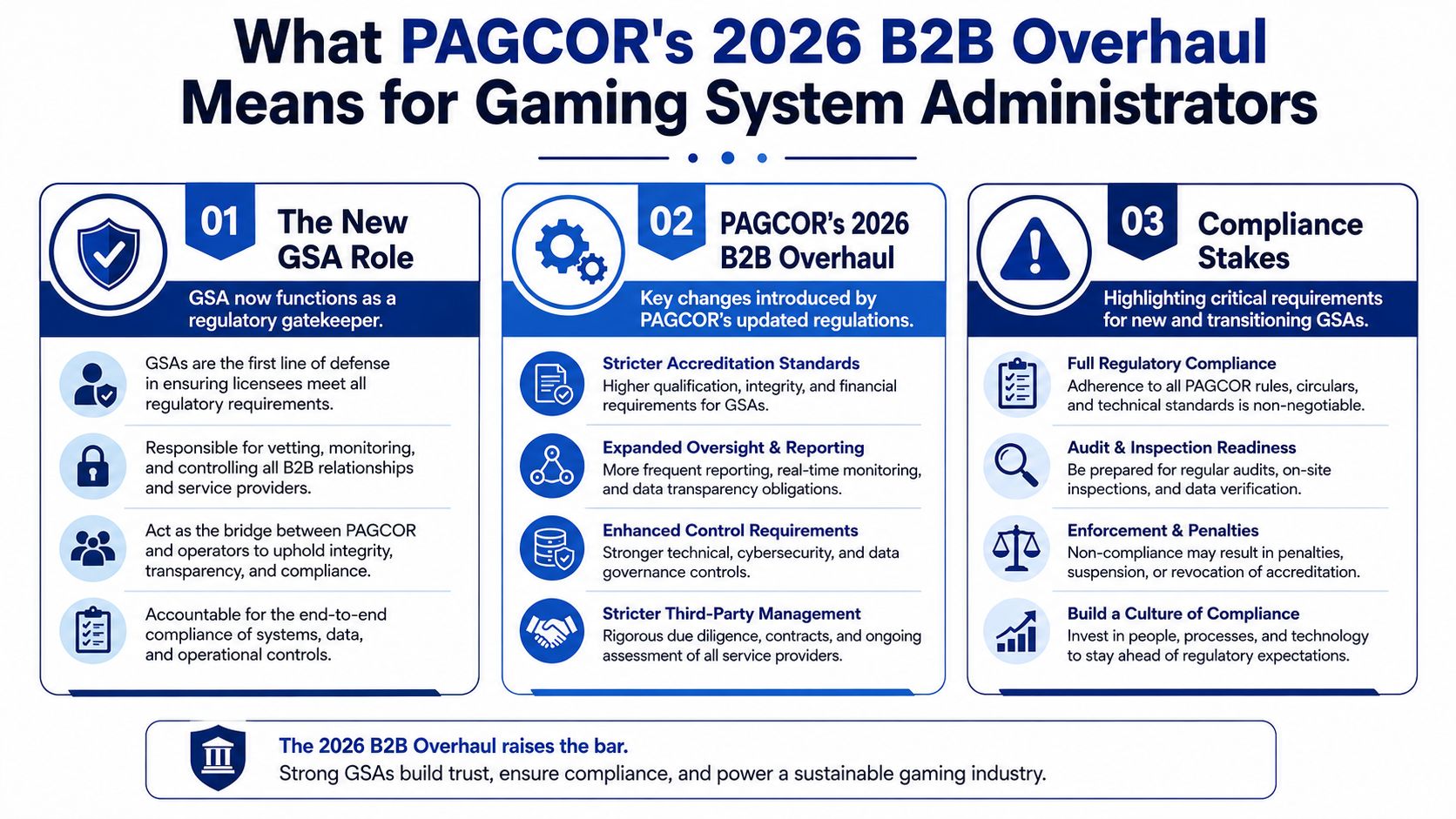
The clearest reading is that PAGCOR has moved the Philippine B2B market from permissive supplier participation to controlled ecosystem permission. For operators, compliance officers, and suppliers, that makes planning around PAGCOR B2B accreditation requirements for 2026 a board-level issue, not just a licensing task.
Who Is Covered and Who Qualifies as a GSA
A supplier can be in scope even if it never runs a player-facing brand. PAGCOR's framework reaches entities that provide gaming content, platforms, systems, or technical support to licensed operators, which pulls upstream technology firms into the regulated perimeter as soon as their product supports a live operator. The practical shift is that supplier status now carries a compliance consequence, not just a commercial one.
Corporate eligibility comes first
The entry test is corporate, not individual. Industry reporting on PAGCOR's framework says only SEC-registered corporations that meet probity and financial-soundness standards can qualify, which excludes informal structures and thinly documented partnerships from the accreditation path PAGCOR B2B accreditation and compliance framework. The regulator is looking for a legally durable counterparty, not only a capable software team.
That filter changes how a GSA application is built. If the applicant cannot show a clean corporate shell, the technical stack is irrelevant until the legal file clears review. For operators and suppliers, the consequence is simple, procurement has to start with entity qualification, not product demonstrations.
The probity review matters just as much as the corporate form. Industry reporting on PAGCOR's framework shows that director, shareholder, and ownership review sits inside the due diligence process, so hidden control relationships can block approval before testing begins PAGCOR B2B accreditation and compliance framework.
A weak ownership file can stop a strong product from reaching review.
That is why governance papers, beneficial ownership records, and financial documents are part of deployment planning. A GSA applicant should treat them as evidence that the company behind the system can remain accountable across the life of the accreditation, not as back-office formalities. The same logic appears in PAGCOR support service provider accreditation requirements, where corporate readiness functions as the gate before operational approval.
What this means for structuring
The corporate consequence is direct. A group seeking Philippine exposure may need to rationalize holding entities, clean up director records, and align ownership documentation before submission. If those records do not match, the technical stack may never receive full review, even if the product itself is market-ready.
For market entrants, the prudent approach is to map every regulated function to one legal entity and verify that entity can pass probity, finance, and governance checks. Anything less turns the accreditation queue into a delay point, and in a market that now treats B2B accreditation as a gating control, delay can become commercial exclusion.
Personnel Qualifications and Organizational Controls
A GSA is a regulated operating unit, and PAGCOR expects identifiable people behind each control point. In practice, that means the personnel file has to show who owns compliance, who owns technology, and who can answer for the business when a regulator asks for accountability. The compliance gate is not the platform alone, it is the set of named individuals tied to it.
Build named control owners
Every critical function needs a named owner. Technical leadership, compliance oversight, and operational sign-off cannot sit inside a generic team label. They need to be tied to specific individuals whose roles can be reviewed, challenged, and audited against the accreditation file.
That is why documentation matters as much as capability. A GSA should keep curricula vitae, training records, and signed statements of responsibility ready for submission, because those records show more than experience. They show whether the company has assigned control ownership in a way PAGCOR can test against the application and the live operating model.
Staff gaps become regulatory gaps
A missing role does not stay a staffing issue for long. If compliance leadership is not documented, the review team cannot see who owns remediation. If technical ownership is vague, the platform's evidence trail becomes harder to rely on. If sign-off authority is unclear, the provider may look operationally capable while still failing the traceability test that governs approval.
Operational takeaway: every critical function should be traceable to one person, one responsibility set, and one evidence file.
That discipline affects how PAGCOR reads readiness. An applicant with clear control ownership can move through review with fewer clarifications, while a company with blurred responsibilities creates friction before the technical content of the filing is even examined. The operational consequence is measurable, more questions, slower processing, and a higher chance that the application is treated as incomplete.
Internal documentation also needs to stay consistent with the legal entity applying for accreditation. If the team, the ownership records, and the applicant name do not align, PAGCOR gets a fragmented picture of responsibility. That mismatch matters because the framework treats the GSA as a compliance gate, not a vendor relationship that can be resolved later.
For teams building a submission pack, the practical test is simple. A third party should be able to open the file and see who controls each key risk without asking follow-up questions. If that is not possible, the application is not ready.
Use this 2026 PAGCOR B2B accreditation checklist to verify that the personnel file, governance records, and control assignments line up before submission.
Technical and Security Specifications for the Gaming System
A GSA is no longer judged only on commercial readiness. Under PAGCOR's current framework, the gaming system itself has to be built from PAGCOR-accredited B2B providers, and any component that falls outside that chain can make the live setup unauthorized and exposed to shutdown. The compliance question now starts upstream, with the provenance of each game, platform, and support service before it ever reaches production.
Version control is now a compliance control
PAGCOR's transition rules require existing GSAs to submit the approved game list by game name, version, and type, and each approved title must stay within the prescribed RTP range and minimum-bet rules before implementation. Release management is therefore a regulatory function, because every version change carries a potential compliance effect.
That has direct operational consequences. If a code update, RTP adjustment, or configuration change shifts the product outside the approved submission, the GSA can no longer show that the live build matches the reviewed file. Deterministic audit logs become the evidence layer that proves what changed, who changed it, and whether the change stayed inside the approved technical envelope. Without that record, the system looks current to operators but nonconforming to PAGCOR.
EGS and OGP must stay traceable
The electronic gaming system (EGS) and online gaming platform (OGP) have to be documented as a traceable architecture, not as a loose collection of modules. That means the upstream supplier chain, the approved game catalogue, and the exact production configuration all need to line up with the submission on file. If any part of that chain is unclear, the platform cannot prove that live operation matches what PAGCOR reviewed.
The GSA owns the control plane, not just the game content. It has to know which provider supplied which module, which version is live, and whether any change alters the approved risk profile. That is the practical dividing line between a platform that runs and a platform that can withstand regulatory review.
For payment and platform integration teams, the same control logic applies across the regulated stack. PAGCOR payment gateway accreditation requirements show how dependency tracking extends beyond the game engine itself, so every live connection needs to be documented before use.
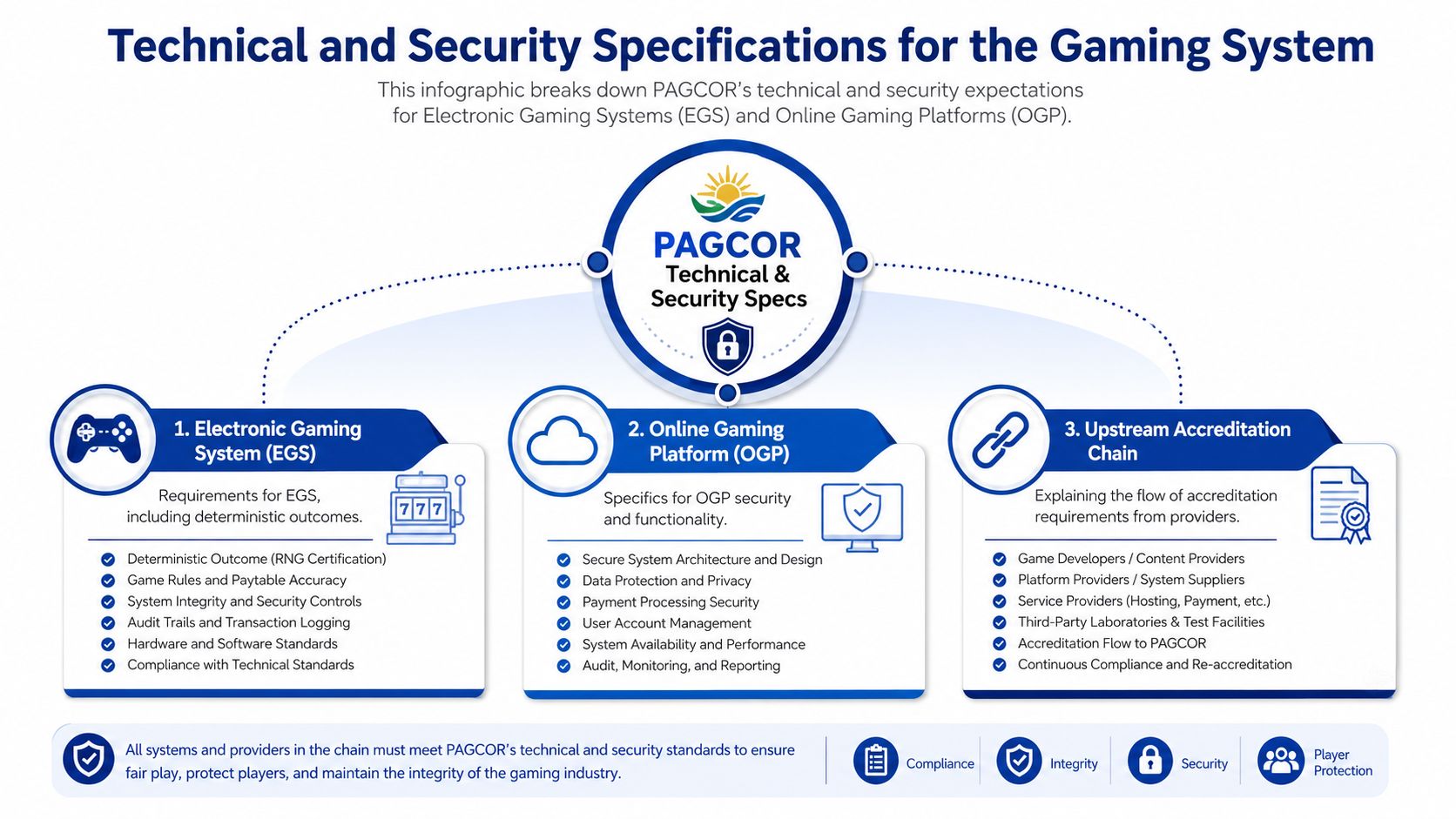
The structural shift is clear. PAGCOR is not reviewing a static product brochure, it is reviewing a controlled technical ecosystem, and the GSA sits at the center of that compliance gate.
Accreditation Testing, Inspection, and the Performance Cash Deposit
PAGCOR's accreditation process does not end with paper review. Industry reporting indicates that approval can depend on live testing of the electronic gaming system (EGS) and online gaming platform (OGP), an on-site facility inspection, and the completion of the PHP 1 million performance cash deposit before approval or interim continuation of service. The sequence matters because each gate proves a different layer of readiness.
What the approval chain really tests
System testing checks whether the live stack behaves the way the submission says it should. The inspection checks whether the physical or operational facility matches the application. The deposit gives PAGCOR financial assurance that the provider can meet obligations if something goes wrong. Together, those steps turn accreditation into a controlled sequence, not a one-time filing.
A GSA that misses a submission deadline or fails testing can face an immediate stop in the review process. PAGCOR's reported approach allows the regulator to stop reviewing technical specifications and return system-evaluation requests without action when the file is not ready. That changes go-live planning into a scheduling problem, because laboratory bookings, remediation time, and a fallback plan all have to be in place before the first review cycle begins.
The inspection layer is the part many operators underweight. It creates a direct link between the submitted control environment and the actual one, so any mismatch in premises, procedures, or operational setup can stall approval even if the software itself is sound.
The deposit changes the economics of readiness
The PHP 1 million deposit is more than a financial formality. It shows that PAGCOR expects a provider to have capital at risk before operations start. Paired with the 2-year accreditation term, it also means the approval hurdle is heavier at the front end, while the operating horizon is longer once the provider clears it.
Approval should be treated as a project milestone, not a launch date.
That distinction matters for both budgeting and sequencing. If testing slips, the deposit may already be ready while the platform is not. If the inspection finds a mismatch, the filing can stall even when the product is technically sound. The workable approach is to align the submission package, lab evidence, facility readiness, and finance planning before the regulator starts its review.
For teams comparing cost structures, PAGCOR B2B accreditation fees should be read alongside the deposit requirement, because the financial burden sits across several approval gates, not in one line item.
Post-Approval Obligations and the New Shutdown Rules
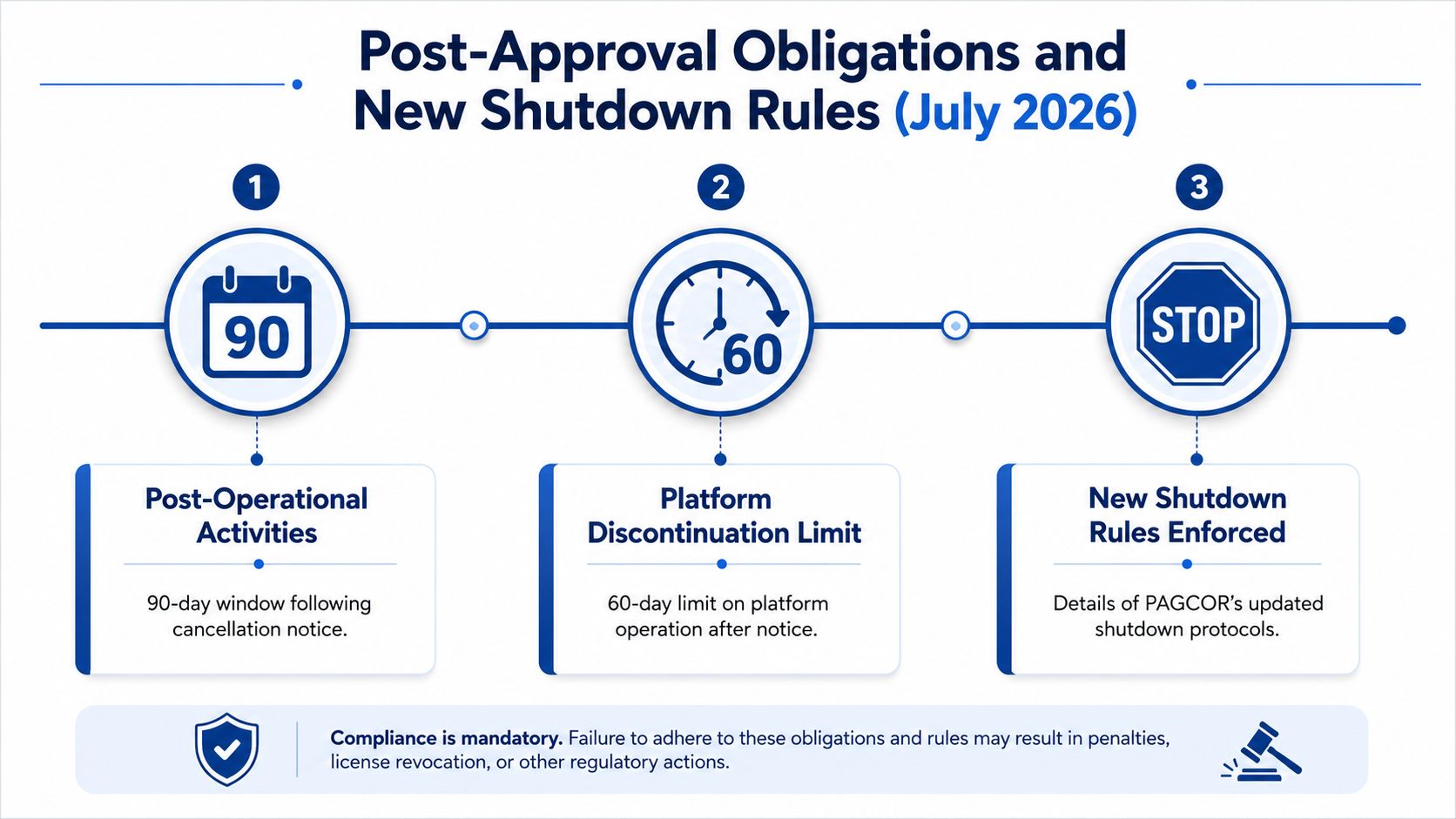
Approval does not end PAGCOR's control over a GSA. The 2026 shutdown framework shifts the post-approval phase into a managed exit process, with post-operational activities required to finish within 90 days of a cancellation notice and platform access allowed for up to 60 days only for player fund withdrawals. The practical effect is clear. A GSA is no longer just a vendor relationship after approval, it becomes a compliance gate that still has to satisfy closure duties after live operations stop. A timeline graphic outlining PAGCOR's post-approval obligations and new shutdown rules effective July 2026.
The shutdown clock now has two tracks
One track covers operational closure. The other covers withdrawal access. They move at the same time, but they serve different regulatory purposes. A GSA cannot keep commercial activity running because withdrawal handling is still permitted, and it cannot treat the shutdown as finished until the post-operational obligations are completed.
PAGCOR also requires GSAs to remain liable for unsettled player funds after deactivation, and to remove PAGCOR branding, certificates, and other agency materials within the same 90-day period PAGCOR shutdown rules for GSAs. That turns deactivation into a controlled handoff. Financial responsibility continues even after the platform is taken offline, so closure planning has to cover both money movement and regulator-facing housekeeping.
Why refund handling changes the risk model
The shutdown rule set becomes stronger because it is tied to the performance cash deposit. If player funds are still unsettled, the provider cannot treat deactivation as a clean exit. The deposit sits inside the enforcement logic, since it supports PAGCOR's expectation that obligations can still be met after live operations stop PAGCOR shutdown rules for GSAs.
That changes the way operators and suppliers should structure contracts and treasury controls. A provider now needs a closure playbook, not only a launch playbook. It also needs task-level tracking for branding removal, certificate surrender, and player-fund reconciliation, because each one sits on a separate deadline path and each one can expose a different part of the compliance chain if it slips.
Common Pitfalls and How PAGCOR Triggers a Shutdown
The failure pattern is consistent. PAGCOR has already made clear that missed submission deadlines, non-accredited upstream providers, and incomplete technical files can stop a provider from advancing, and non-compliance can lead to shutdown. A significant mistake is treating each weak point as if it sits outside the approval chain PAGCOR accreditation requirements and shutdown risk.
The enforcement chain is cumulative
A missed deadline does more than delay one document. It can stall technical evaluation entirely. A non-accredited upstream provider does more than create procurement risk. It can undermine the legality of the downstream system. An unapproved game version is not a minor configuration issue. It can make the live product set unauthorized under the transition rules PAGCOR transition guidelines for existing B2B providers.
The practical point is that PAGCOR reads these failures together, not separately. A clean corporate file will not rescue a system built on an unaccredited vendor chain. A valid platform submission will not cure a version mismatch in the deployed product set. Each defect can block the next approval step, so the operational consequence is delay first, then exposure to enforcement if the provider keeps pushing live use without a clean file.
A GSA can pre-empt most shutdown paths
- Check upstream accreditation first. Every content, platform, and support dependency needs to come from accredited B2B providers, or the entire chain can fail before launch.
- Lock version control before submission. The approved game list has to match the deployed product set by name, version, and type.
- Plan testing before board timing. If lab work arrives late, the submission can be returned without action, which pushes the go-live schedule out and leaves the provider exposed to a prolonged review gap.
- Treat shutdown readiness as a live control. The closure, withdrawal, and branding-removal duties need to sit in the operating playbook before any notice arrives.
If the provider waits until review is underway, it is already behind. The approval file, the deployed build, the vendor register, and the wind-down plan all need to line up at the same time. That is the structural shift in the 2026 framework. The GSA is no longer just a vendor relationship. It is the compliance gate that determines whether the rest of the operating stack can stay live.
For operators, the commercial lesson is direct. One weak supplier link can become a shutdown trigger for the whole arrangement, so due diligence now sits inside deal value, not outside it as a back-office task.
Practical Compliance Checklist and Strategic Outlook
A GSA-ready file should be built like a control framework, not a stack of attachments. The sequence matters because PAGCOR reviews the company first, then the people who control it, then the upstream suppliers, then the technical proof, then the financial security, and finally the shutdown controls. Each layer can stop approval if the prior layer is weak.
| GSA Compliance Checklist at a Glance | Action Required |
|---|---|
| Corporate eligibility | Use an SEC-registered corporation with clean probity and ownership records |
| Control owners | Assign named individuals for compliance, technology, and operational sign-off |
| Upstream providers | Source content, systems, and support only from accredited B2B providers |
| Technical file | Submit approved game lists by name, version, and type |
| Product governance | Keep deployed RTP and minimum-bet settings inside approved parameters |
| Testing evidence | Complete EGS and OGP testing before approval or interim continuation |
| Facility review | Prepare for on-site inspection with matching operational documentation |
| Financial assurance | Post the PHP 1 million performance cash deposit |
| Shutdown plan | Build the 90-day closure and 60-day withdrawal handling process |
That checklist reflects a deeper shift in the 2026 framework. PAGCOR is not treating the GSA as a conventional vendor relationship. It is treating it as the compliance gate that determines whether the operating stack can stay live, and that changes how operators and suppliers have to build their files, systems, and contracts.
The practical consequence is clear. Operators will need suppliers that can prove accreditation discipline, because product speed no longer matters if the upstream chain fails review. Suppliers will need to budget for longer onboarding cycles, more change control, and more document coordination with the regulated operator. Investors will also have to price the Philippine market differently, because readiness for review now carries more value than speculative entry.
A market entry plan should therefore start with dependency mapping. Every GSA link should be checked against the framework, from corporate standing and personnel assignment to technical evidence, deposit readiness, and post-approval wind-down duties. The more tightly those elements line up, the lower the risk of a delayed file, a blocked launch, or a shutdown event later in the cycle.
For operators and compliance teams, the strategic takeaway is simple. PAGCOR has made the GSA a compliance gatekeeper with technical, financial, and post-closure obligations attached. A company entering the market should expect its go-to-market plan to be judged by its ability to survive review, not just by its ability to sell.



Join thousands of gaming professionals receiving the latest iGaming news, regulatory updates, and market insights.
