

A foreign SaaS vendor can have a polished pitch deck, a live product, and a willing Philippine operator on the line, then still get stuck on the same blunt question from PAGCOR, can this company serve licensed operators in a controlled, reviewable way? That is where PAGCOR support service provider accreditation requirements stop being a paper exercise and start behaving like a commercial gate. For payment, KYC, customer service, marketing support, testing, and platform vendors, the difference between being legally eligible and being operationally acceptable is the whole game.
PAGCOR's current B2B framework made accreditation mandatory for entities providing gaming content, technology, or support services to PAGCOR-licensed operators, and it restricts the applicant pool to SEC-registered corporations that satisfy PAGCOR's probity and documentary standards, with filing routed to the Electronic Gaming Licensing Department and accompanied by a non-refundable application fee PAGCOR accreditation framework summary. The paperwork is only half the story. The harder part is proving commercial readiness in a way PAGCOR will accept, while also navigating the 2026 transition clock that many vendors still underestimate.
If a supplier is already live with a licensed operator, the risk is sharper. A contract can be technically in force while the vendor itself is drifting toward non-compliance if its accreditation timing is off. That's the part most public guides gloss over, and it's why this topic matters to operators, suppliers, and investors who need uninterrupted service, not just a filed form. Philippines online casino compliance context
Table of Contents
- Why PAGCOR Accreditation Matters for B2B Vendors in 2026
- Eligibility Criteria Every Applicant Must Satisfy
- Required Documents and the Capability Disclosure Trap
- Application Process From Filing to Board Approval
- Fees, Timelines, and the 2026 Transition Rules
- Common Pitfalls and How to Avoid Them
- Pre-Application Checklist and Ongoing Compliance Plan
Why PAGCOR Accreditation Matters for B2B Vendors in 2026
A Manila procurement lead gets a proposal from a foreign payment provider. The product works, the commercial terms are acceptable, and the operator wants continuity. Then compliance asks the fundamental question: is this vendor already accredited, or is the business about to enter a period where live service turns into a regulatory problem?
PAGCOR's regime makes accreditation mandatory for support service providers to PAGCOR-licensed operators, and it treats accreditation as a prerequisite for lawful B2B supply, not as an operator's license. PAGCOR framework summary For vendors, that changes the sales cycle immediately. Commercial teams cannot rely on relationship momentum alone, because operators now need a regulator-backed basis to keep a supplier in the stack.
What the market actually feels
Foreign SaaS, payment, KYC, marketing, customer service, and testing vendors are the ones most exposed. Their products can be excellent and still fail the practical review if the business cannot show the right controls, corporate standing, and supporting evidence. That is why accreditation in 2026 is really a vendor-governance test wearing a licensing label.
Practical rule: If the operator cannot explain the vendor's regulatory status in one sentence, the vendor is not ready to sit in the live chain.
The issue extends beyond entry, continuity is equally critical. A supplier that is still sorting out its documentation while a licensee needs uninterrupted service creates replacement risk, contract friction, and avoidable procurement delays. The transition period also matters because the market is already moving under the new framework, and the 31 March 2026 cliff is where late planning stops being a harmless administrative slip. If a vendor misses that window, the commercial problem becomes operational fast.
Why this guide is different from the usual checklist
Published PAGCOR guidance lists required documents, but it does not address commercial readiness. That gap matters because the core question is not whether a file exists, it is whether the company can convince PAGCOR that it is ready to serve the market under scrutiny. The published materials leave that part underdeveloped, and experienced compliance teams spend most of their time filling that gap. Vendors get caught there, especially foreign suppliers used to jurisdictions where incorporation and a clean file are enough. PAGCOR expects more than form completion, and commercial readiness is where many otherwise credible applicants stall.
If you want the broader market context behind the rule change, start with the online casino and PAGCOR compliance overview.
Eligibility Criteria Every Applicant Must Satisfy
The first filter is blunt. If the applicant is not the right legal entity, the rest of the file is irrelevant. PAGCOR's current framework limits applications to SEC-registered corporations that meet its probity and documentary standards, and the application goes to the Electronic Gaming Licensing Department with a complete package and fee. Sole proprietorships, informal arrangements, and loosely structured offshore setups are out before the review even starts.
That legal gate matters because PAGCOR is screening a regulated B2B vendor, not a side project with a good pitch deck. If you want a quick read on how the market is being regulated at a consumer level, review this online casino legality guide, then strip that back and apply a stricter standard for supplier eligibility.
Legal eligibility comes before technical talent
A strong product team does not fix weak corporate housekeeping. Directors, officers, beneficial owners, and the company itself need to survive probity scrutiny, because the review is about more than software capability. It is about who controls the business and whether the structure can stand up to regulatory review. If ownership is unresolved, shareholding is opaque, or governance is loose, fix that before filing.
The simplest self-test is direct, does the corporate file read like a regulated vendor or like a startup selling speed? PAGCOR wants the first one. It wants a company that can show it exists, operates cleanly, and can be traced through its ownership and control chain without confusion.
Self-assessment gate for applicants
| Decision gate | Pass case | Fail case |
|---|---|---|
| Corporate form | SEC-registered corporation | Unregistered or wrong entity type |
| Ownership clarity | Clean, disclosed ownership chain | Opaque or inconsistent control structure |
| Probity posture | Officers and shareholders can withstand screening | Disqualifying issues or unresolved integrity concerns |
| Operational readiness | Staff, systems, and controls are in place | Vendor is still building its service model |
| Documentary discipline | Package is complete and internally consistent | Filing depends on follow-up fixes |
Operational readiness is where the split appears. A company can be legally eligible and still be a poor filing candidate if it lacks staffing, internal controls, technical evidence, service contracts, or a clear way to describe how the business delivers the scoped service. That is why experienced advisors treat accreditation as a readiness review, not a registration exercise. The entity has to be genuine, and it has to be usable by an operator.
There is also a timing trap that many guides skip. The market is already moving under the new framework, and late planning becomes a commercial problem long before anyone gets to a board room. The published rules also leave a gap around transition timing and accreditation validity, so vendors should expect reviewers to focus on whether the applicant is ready now, not merely eligible on paper. If your internal plan still assumes the old comfort of “file later, fix later,” it is already behind the curve.
Required Documents and the Capability Disclosure Trap
The document list gets most of the attention, but the most consequential item is the one that sounds routine. PAGCOR's form requires a notarized disclosure that the company has the capability to provide the scoped services and gaming equipment “in accordance with PAGCOR's prescribed standards” support service provider form. That sentence looks harmless. It is not. It forces the applicant to prove operational readiness without giving away the exact benchmark, testing method, or evidence threshold.
Tiered document package
| Document Tier | Key Items | Reviewer Focus |
|---|---|---|
| Corporate documents | SEC registration, constitutional papers, authority documents | Whether the applicant exists in the right legal form |
| Probity materials | Officer, director, shareholder, and control disclosures | Integrity, ownership clarity, and fit for market access |
| Financial support | Evidence of financial capacity and commercial stability | Whether the business can sustain the service promise |
| Operational file | Service description, staffing profile, control structure | Whether the vendor can actually perform the scoped role |
| Technical evidence | Platform, security, and service capability proof | Whether the offering is real, supportable, and auditable |
| Capability disclosure | Notarized statement of readiness | Whether the applicant can meet PAGCOR's prescribed standards |
The trap is obvious once you've seen enough filings. Vendors treat the disclosure like a signature page. PAGCOR treats it like a substantive assertion. If the company says it can deliver, the rest of the file has to prove it through internal controls, documented processes, staff qualifications, technical architecture, and supporting contracts.
What a serious reviewer wants to see
The published materials do not define the benchmark cleanly, which means applicants need to bring their own evidence stack. That usually means a business plan, probity disclosures, and the other items PAGCOR may still ask for during review. The process stays partly discretionary, not fully checklist-driven, so the filing has to make the capability claim believable on its own terms.
A clean file should answer five questions without prompting. What service is being provided, who is responsible for it, how is it controlled, what systems support it, and how does the vendor prove it can operate in a compliant way?
A capability disclosure should read like an evidence summary, not a marketing statement.
The smartest applicants treat this as a governance exercise. They attach the papers that make the notarized statement believable, then make sure the service description matches the operator contract, the internal controls, and the technology being offered. Anything less leaves the reviewer with room to doubt the business, and once that doubt appears, the application usually slows down.
Application Process From Filing to Board Approval
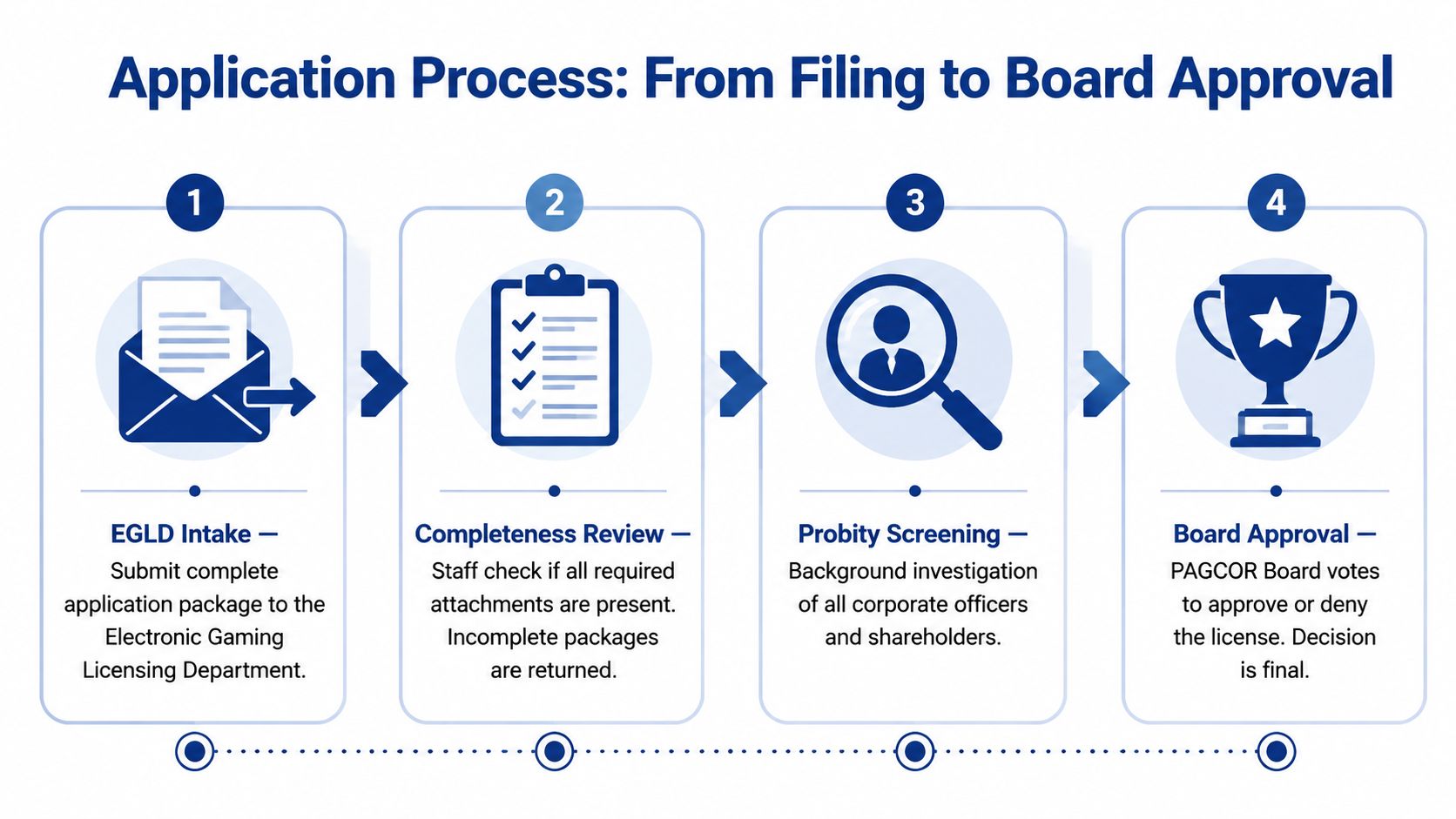
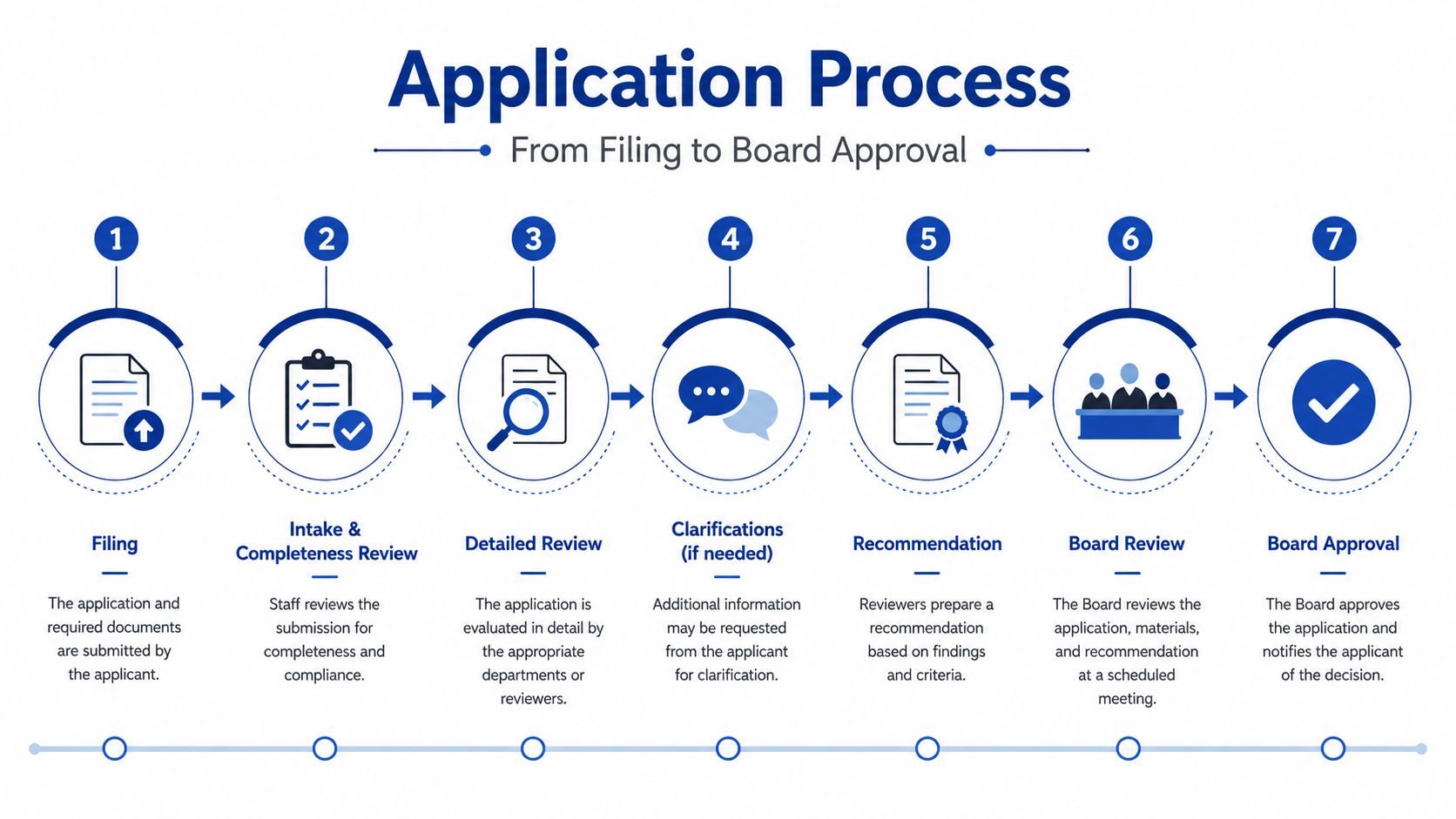
A filing hits the Electronic Gaming Licensing Department first, and that stage matters because weak submissions get exposed before they ever reach a board room. The file has to survive intake, completeness review, and the early screening that separates a paper application from a credible one. Filing marks the beginning of review, not the conclusion.
The practical path after submission
The first checkpoint is intake. If the package is incomplete, it can be pushed back before a serious review even starts, and that is where many applicants waste time. PAGCOR is not going to chase missing attachments for you.
Once the file is accepted, it moves into completeness review and probity screening. Public materials make clear that the entity and its principals are checked as part of the process, even if the internal benchmark is not fully published. That means the ownership chart, officer details, and supporting declarations need to line up before filing, not after.
Where discretion begins
PAGCOR does not publish every evidence request in advance. The public application form shows that supporting materials such as a business plan may be requested during review, which makes the process feel less like a static checklist and more like a case-by-case assessment. support service provider form
Experienced vendors prepare for that gap. They build the file with supplemental evidence already on hand, so the reviewer can keep moving instead of waiting for a second round of submissions.
The best applicants answer the questions before they are asked. They prepare for scrutiny on service scope, staffing, control measures, and the relationship between the applicant and the licensed operator. That approach shortens the remediation cycle and keeps the case from bouncing between legal, commercial, and technical teams.
For operators comparing vendor compliance burdens across markets, cost reduction strategies for compliance-heavy vendors can help frame internal prep work, but the primary point is simpler. A clean filing moves faster than a clever filing, and Board approval comes only after the lower gates are cleared. The process rewards discipline, not optimism.
Fees, Timelines, and the 2026 Transition Rules
The money side is straightforward. The timing side is where vendors get caught. PAGCOR's framework requires a non-refundable application fee, and the wider B2B regime also uses a Performance Cash Deposit structure that has been discussed heavily in market commentary. For vendors, the issue is not only what gets paid, but whether the business is ready in time to avoid service disruption.
Key 2026 milestones for SSP applicants
| Milestone | Date | Operational Impact |
|---|---|---|
| Existing SSP application deadline | 31 March 2026 | Existing support service providers contracted by PAGCOR-accredited GSAs had to apply by this date |
| Late application consequence | After 31 March 2026 | Failure can render the SSP's system or services non-compliant and unauthorized |
| Early filing window for longer initial term | 31 December 2025 | Applicants that filed before this date were reported to qualify for a three-year initial accreditation |
| Other PAGCOR documentation reference | Board approval-based term | Separate materials reference a two-year term from Board approval, creating a timing inconsistency |
The transition cliff matters because it reaches into live service, not just future sales. Separate reporting says unaccredited foreign content providers can be removed from licensed platforms after 31 March 2026, while applicants that filed before 31 December 2025 could receive a three-year initial accreditation, even though PAGCOR documentation elsewhere references two years from Board approval Yogonet reporting on the 2026 deadline. That inconsistency should stay on the radar. It affects renewal planning, contract duration, and replacement clauses for vendors that sit inside live operating workflows.
What operators should do with that inconsistency
Operators should not wait for the market to resolve the contradiction on its own. If a vendor is still unaccredited near the deadline, the operator has to plan for service continuity, fallback suppliers, and contract terms that survive a regulatory interruption. That matters most for foreign content, SaaS, and payment providers inside critical live processes.
The commercial impact is blunt. A late or unsuccessful application does not stay a paperwork issue. It can interrupt delivery, force replacement planning, and shift negotiation power toward locally registered or already-accredited intermediaries. For teams working through transition costs, these cost reduction strategies are worth reviewing before lock-in dates get too close.
Common Pitfalls and How to Avoid Them
Most applications don't collapse because the underlying business is bad. They stumble because the vendor treated accreditation like a filing task instead of a governance review. That's the wrong mindset for PAGCOR support service provider accreditation requirements, and it shows up quickly once the reviewer starts asking questions.
The failures that keep repeating
- Weak capability disclosure: The company signs the notarized statement but can't back it with staffing, controls, or technical proof. The fix is to make the disclosure the last page of a tightly built evidence pack, not the first page of a hope-filled submission.
- Treating probity as a formality: Some applicants assume the company is the only thing under review. That's a mistake. Officers, shareholders, and control persons all need to be cleanly documented and internally consistent.
- Incomplete filing to EGLD: Missing attachments, mismatched corporate records, or vague service descriptions create avoidable delay. The answer is simple, do not file until the package is review-ready.
- Ignoring the transition clock: Vendors that wait too long can run into the 31 March 2026 cliff and then discover their service position is no longer safe. The deadline is not a media headline, it's an operating constraint.
- Confusing incorporation with readiness: Being registered locally doesn't mean the business is ready to serve licensed operators under PAGCOR's standards. The company still has to prove it can do the work.
That last mistake is common among foreign vendors entering through a local entity or distributor. They assume the legal wrapper solves the market access problem. It doesn't. PAGCOR is using accreditation as a vendor-governance filter, and that means the applicant must show discipline in how the service is run, not just how the entity is formed.
For teams worried about document spoofing, identity fraud, and rushed vendor onboarding, this scam-avoidance guide is a useful reminder that weak controls show up everywhere, not only in licensing files. The corrective action is the same each time. Build a clean internal record, align legal and operational facts, and file only when the business can defend every material statement it makes.
Pre-Application Checklist and Ongoing Compliance Plan
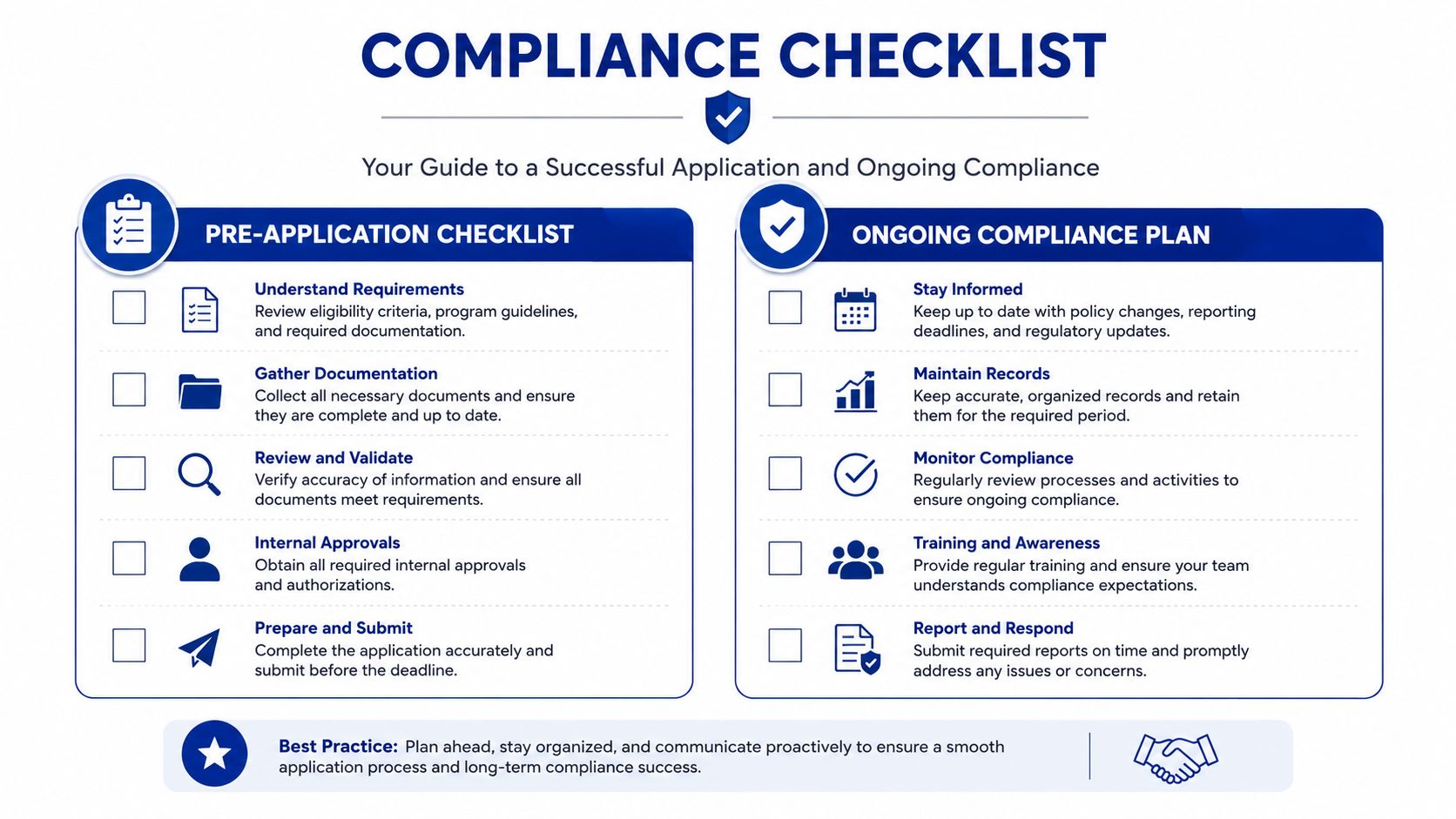
Accreditation only works when the business treats it like an operating rhythm. The applicant needs a clean pre-filing pack, a named owner for every document, and a calendar that starts before submission and keeps running after approval. That's the only way to avoid scrambling when the regulator or operator asks for proof.
Pre-application checklist
- Corporate file owner: Confirm SEC registration, constitutional documents, and signatory authority are current and consistent.
- Probity pack owner: Reconcile director, shareholder, and control disclosures before the filing is assembled.
- Operations owner: Prepare the service description, staffing model, and control narrative that match the actual delivery model.
- Technical owner: Attach the evidence that shows the platform or service is real, supportable, and controlled.
- Submission owner: Review the entire package for completeness before it goes to the Electronic Gaming Licensing Department.
Strong filings don't happen by accident. They happen because one person owns the file from draft to submission.
Post-filing discipline
Thirty days after submission, the project owner should verify whether any clarifications or supplemental documents are pending. At sixty days, the team should assess whether the operator-facing contract language still matches the application record. At ninety days, the business should be ready to respond quickly to review questions without rewriting the core story.
By the 18-month mark, renewal planning should already be visible in the compliance calendar, even if the formal renewal window has not opened yet. Vendors that wait until the end of the term are already behind. The disciplined approach is to maintain the same evidence standard after approval that was required before filing, then update the file whenever staffing, control, or service scope changes.
For the latest legal and market developments that affect supplier accreditation and operator diligence, keep a close watch on this S-5 compliance resource. The smartest vendors don't file once and forget the file. They build a compliance routine that can survive renewals, audits, and contract renegotiation without drama.
PAGCOR's B2B regime is forcing a cleaner market. Vendors that can prove legal eligibility, operational readiness, and documented control will move faster, and operators will trust them more. The next step is simple. Build the file properly, assign one owner to the submission, and don't sign a live contract until the accreditation path and the transition timing both make sense.



Join thousands of gaming professionals receiving the latest iGaming news, regulatory updates, and market insights.
