

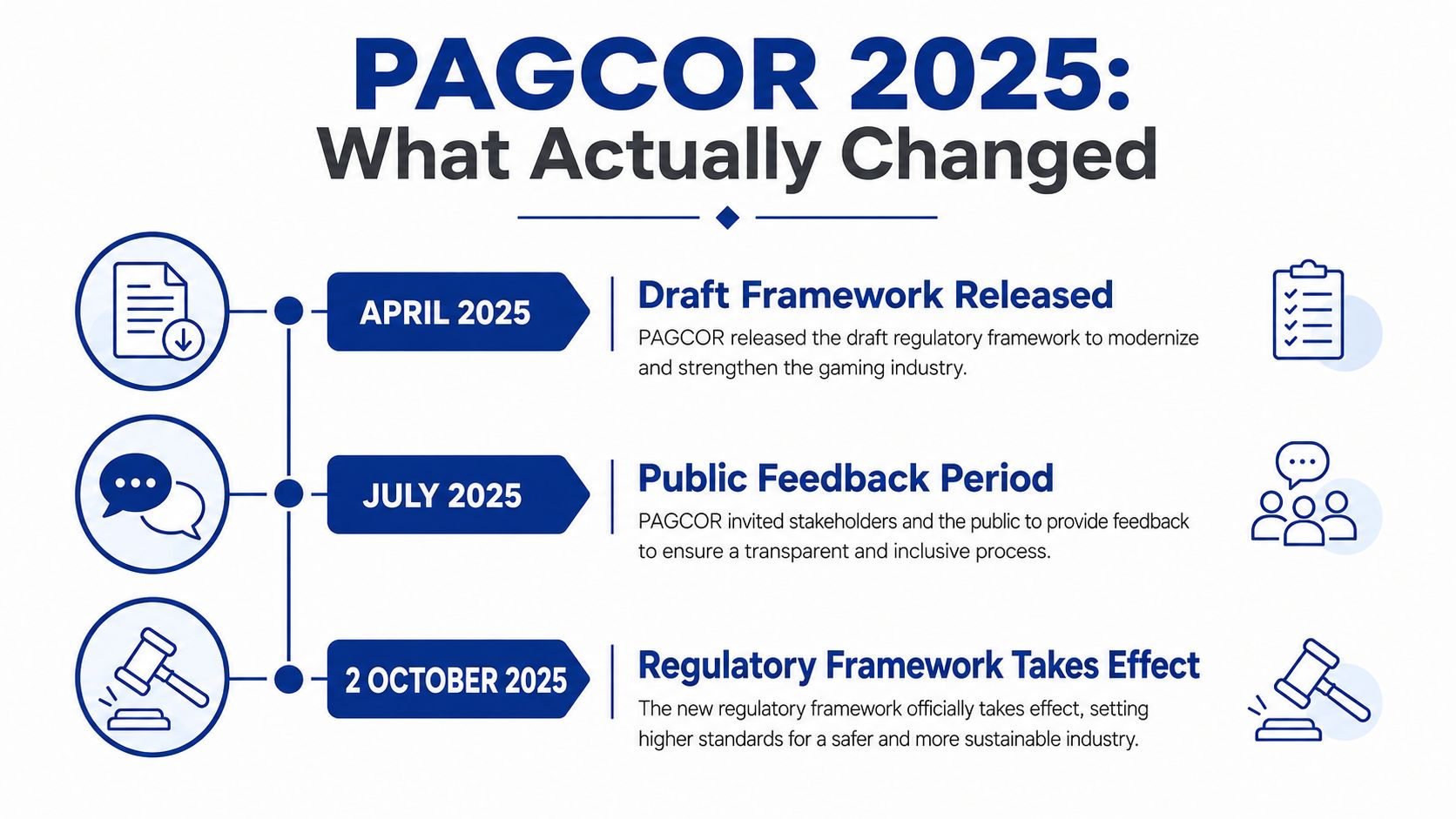
PAGCOR's Regulatory Framework for the Accreditation of Gaming Affiliates and Support Service Providers took effect on 2 October 2025, and Game Content Providers are now accredited per game offering, not under a single umbrella approval. For studios, that turns Philippine market entry into a per-category compliance and capital decision, not a one-time filing.
Table of Contents
- What PAGCOR's Accreditation Framework Actually Changed in 2025
- Eligibility and Documentary Checklist for Applicants
- Technical and Security Standards for Game Content
- Testing, Certification, and the Application Workflow
- Fees, Deposits, and the Cost Structure of Multi-Title Portfolios
- Ongoing Compliance and Renewal Obligations After Accreditation
- Common Rejection Reasons and How to Remediate Them
- Strategic Implications for Operators and Providers in 2026
What PAGCOR's Accreditation Framework Actually Changed in 2025
PAGCOR's B2B regime stopped being an informal expectation on 2 October 2025, when the regulatory framework for accreditation became effective. From that point, game content supply to PAGCOR-licensed operators moved into a formal, mandatory approval structure, which matters because the regulator is now controlling market access at the supplier level instead of relying only on operator oversight. PAGCOR's B2B accreditation framework overview
A different regulatory unit, not a lighter version of licensing
The key shift is that Game Content Providers are now treated as a distinct category. That classification matters because the accreditation is tied to the content being supplied, not just the legal entity behind it. A studio cannot assume that one approval covers every title, vertical, or product line it plans to place with Philippine operators.
That distinction changes procurement conversations immediately. Operators now have a regulator-backed reason to ask which specific offerings are accredited, which ones are still pending, and whether a supplier's commercial roadmap is aligned with the pace of accreditation.
Why the per-game model changes the business logic
Under a single umbrella approval, a studio can spread compliance cost across a broad portfolio. Under PAGCOR's per-game model, each category of content requires its own accreditation, so expansion creates additional regulatory touchpoints. The result is a narrower, more expensive path to scale, especially for multi-title studios trying to enter the market quickly.
The practical effect is easiest to see in portfolio planning. A provider that wants to supply several game categories has to treat each one as a separate entry decision, with separate timing, separate documentation, and separate approval risk. That is why the framework is better understood as a portfolio gate than a simple registration process.
For readers tracking Philippine gaming market access more broadly, Top 1 Rank's Philippines online casino coverage remains a useful reference point for the operator-side context.
Practical rule: if a title line cannot stand on its own in testing, documentation, and control evidence, it should not be budgeted as approved market inventory.
Eligibility and Documentary Checklist for Applicants
A studio entering PAGCOR's accreditation process is screened first as an applicant, then as a supplier. That ordering matters because the regulator requires identity, financial, integrity, competence, and criminality checks before the technical review carries much weight, so the company's structure and the people behind it must already be defensible. The practical implication for multi-title entrants is straightforward. Accreditation is not one approval that covers an entire catalogue, it is a set of separate market-entry decisions that begin with the corporate file. PAGCOR accreditation procedures manual
Corporate standing and probity screening
For compliance teams, the first issue is whether the applicant can pass a clean screening. PAGCOR expects statutory and operational documentation that establishes corporate registration, governance, control, and the way the business is run.
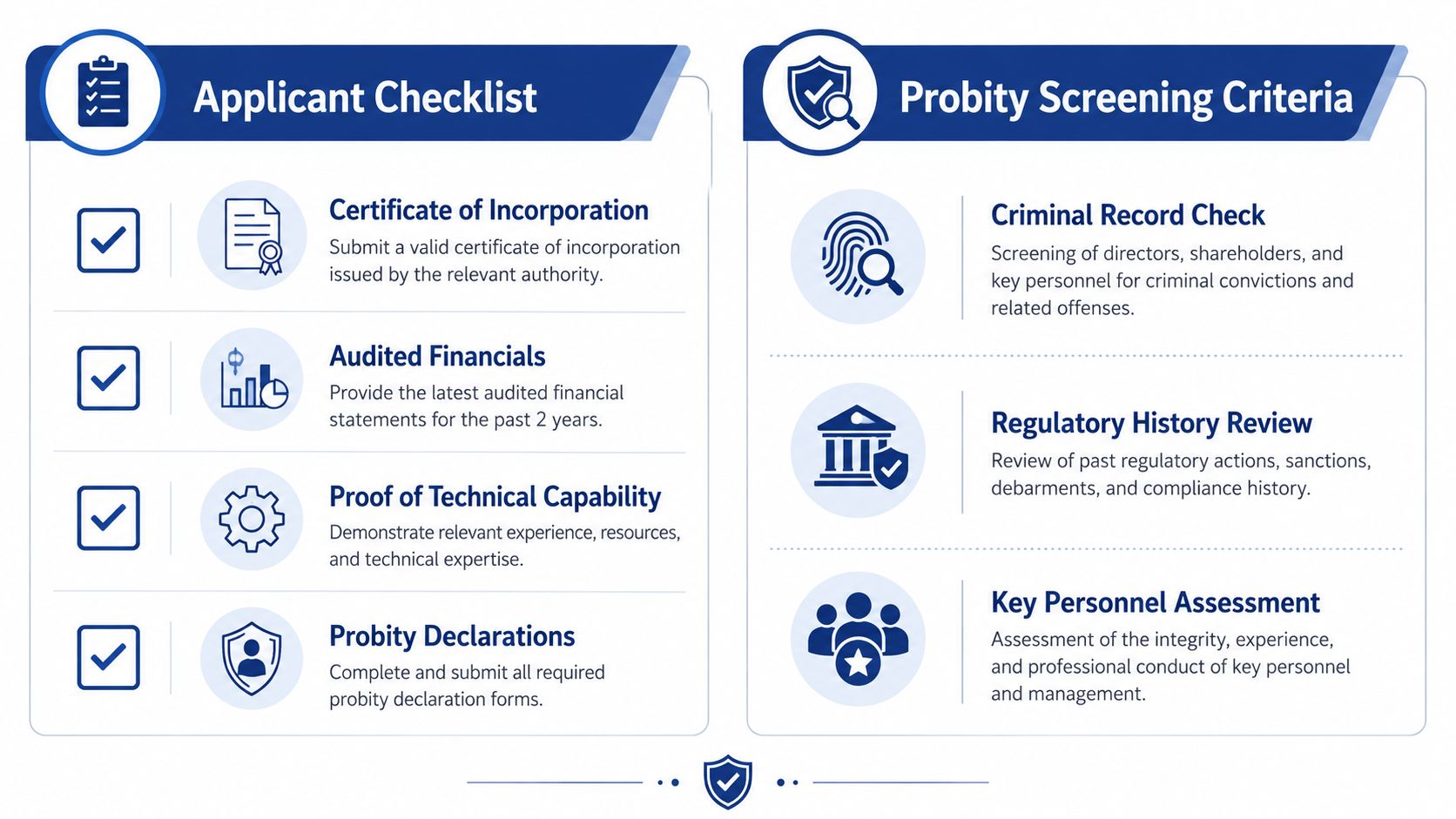
The probity review reaches beyond the entity itself. PAGCOR can assess whether the business and its principals raise any integrity, competence, or criminality concerns, which means the ownership chart, director records, and internal declarations sit inside the approval risk, not outside it. That is one reason studios with layered holding structures or recently changed boards often face more documentary scrutiny than they expect.
What should be prepared before any lab conversation
A studio's compliance pack should be assembled before a testing lab gets involved. The aim is to avoid sending an incomplete file into a process that already treats each offering as a separate regulatory object. A pre-filing pack usually includes the following:
- Corporate formation records: legal evidence that the applicant exists in good standing and is authorised to operate.
- Financial evidence: audited or otherwise supportable materials showing the business can sustain its obligations.
- Probity declarations: clear disclosures covering directors, shareholders, and key personnel.
- Operational descriptions: enough detail to explain what the applicant supplies and how the offering is controlled.
- Technical capability evidence: an organised record showing the platform and game stack are real, supportable, and more than marketing material.
The sequence matters. If the probity file is weak or incomplete, the technical materials may never receive full attention on their own merits. In practice, that is where many applicants lose time, not because the game cannot be assessed, but because the company itself is not yet cleanly documented.
For readers comparing how Philippine market access is being approached in practice, Top 1 Rank's registration resource on Go Perya is a useful market-side reference.
A clean submission is not the same as a strong submission. PAGCOR's regime rewards evidence that is internally consistent, complete, and easy to verify.
Technical and Security Standards for Game Content
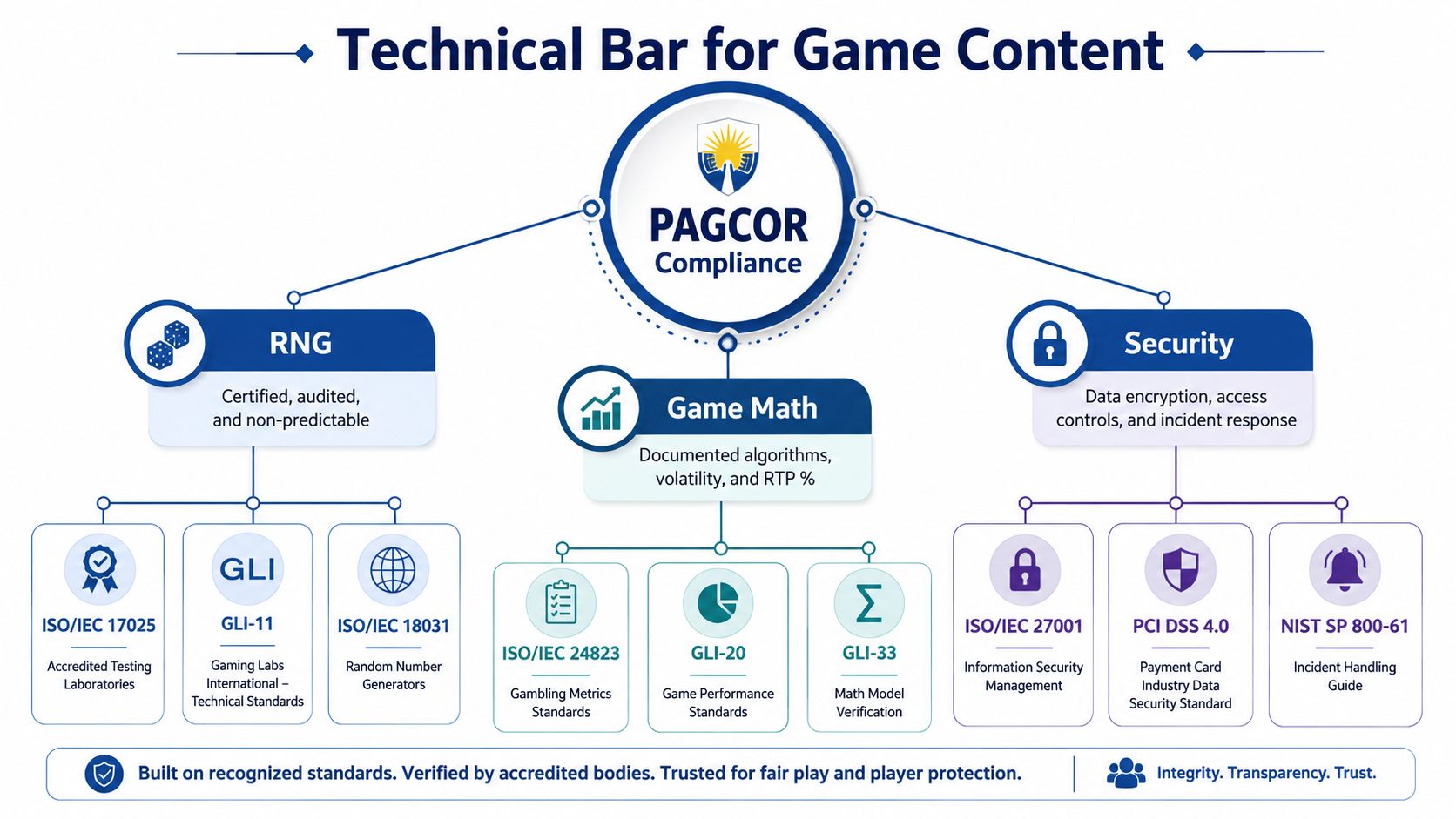
A game can clear the paperwork and still fail on substance. PAGCOR's review of content providers reaches into independent testing, documented game mathematics, RTP settings, and security controls, so the accreditation file has to show that each title is controlled, explainable, and ready for audit.
What the technical file has to prove
The technical narrative has to prove that the game does not behave like a black box. For a regulator, the question is whether the offering can be examined against declared design, not whether the studio says it is fair or stable.
That is why the file needs evidence that the build matches the specification. The supplier has to show what was tested, who verified it, and how the observed output lines up with the stated logic, so the reviewer can trace the game from design through to implementation.
Why engineering evidence matters more than promotional claims
A testing lab is looking for behaviour, not branding. The mathematics of the game, the return settings, and the relevant control points need to be documented in a way that can be checked against the actual build.
Operational insight: if the product team cannot explain a game's logic to a compliance reviewer, the build is usually not ready for accreditation.
Security evidence belongs in the same file. The framework expects the supplier to show control maturity, which means the submission needs enough detail to demonstrate that access, data handling, and platform integrity are governed in practice. That makes the accreditation work a joint task for product, engineering, security, and compliance teams, not a narrow legal filing exercise.
Why studios should separate content design from launch readiness
A game can be commercially attractive and still be unfit for Philippine distribution. The regulator is approving a controlled offering that can be tested, explained, and supported, so the question is whether the title is ready for review, not whether the concept is appealing.
For teams building the filing pack, Top 1 Rank's guidance on avoiding phishing scams is a useful reminder that security discipline now sits inside the commercial perimeter, not just the IT checklist.
Testing, Certification, and the Application Workflow
PAGCOR's workflow is a dependency chain, not a filing checklist. Submission comes first, then review, then testing and integration, and final accreditation only becomes possible once each earlier step clears. That structure is visible in the regulator's own process materials and in the Top 1 Rank S-5 registration guide, which is useful context for how Philippine onboarding tends to be staged.
Where delays usually start
The first delay is usually document review. If the corporate file is incomplete or the probity disclosures are unclear, the application can stall before technical testing even begins. That matters because the testing workstream is often the most expensive part of the process, so applicants want the base file in order before they trigger it.
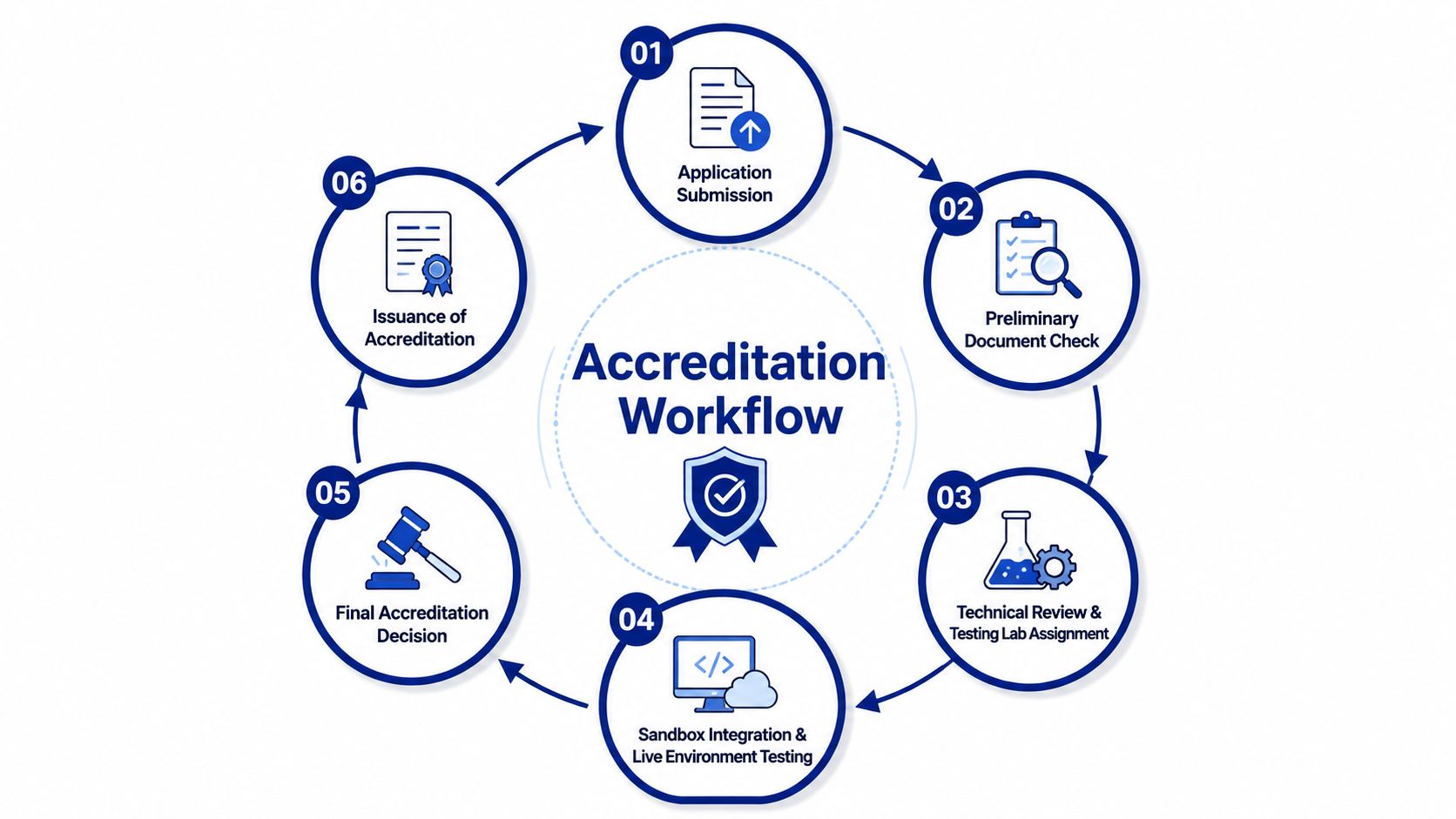
A second delay appears once the build reaches the testing environment. Integration mismatches, sandbox mismatches, or missing control evidence can force a retest cycle. Mature applicants avoid that by running document readiness and technical validation in parallel, instead of waiting to prepare engineering evidence until after filing.
How applicants should sequence the work
The cleanest approach is to treat the application as a dependency map.
- Submission first: the file has to exist in a reviewable form, with the legal and probity pieces already in place.
- Document screening next: the regulator, or its process, checks whether the applicant is complete enough to move forward.
- Testing assignment follows: the content is then connected to the relevant testing pathway.
- Sandbox validation comes before live use: the game and platform need to behave correctly in a controlled environment.
- Final decision closes the loop: only after the evidence chain is complete does the accreditation decision become viable.
Process discipline: build the filing so that legal review, technical review, and finance approval can happen without waiting on each other.
That sequencing matters even more for studios with several titles in development. A provider that waits until the first game is ready for commercial launch will often find that accreditation timing, engineering timing, and operator launch timing do not line up cleanly. The practical result is idle development work, delayed rollout plans, and more pressure on internal teams to keep multiple builds moving at once.
Fees, Deposits, and the Cost Structure of Multi-Title Portfolios
The largest cost item in the framework is the PHP 1,000,000 Performance Cash Deposit per accredited game offering. Because the deposit applies per category, market entry in the Philippines becomes a portfolio decision rather than a one-time licensing event. A studio with one title can treat that deposit as a contained compliance commitment, while a studio with several titles has to fund each accredited offering separately.
Why the deposit changes portfolio economics
The per-offering structure changes how capital is allocated. The deposit is not a broad entry ticket to a catalogue, it is locked capital attached to each accredited build, so every added title increases the amount of cash that must stay outside normal operating use.
That creates two immediate planning issues. Finance teams have to model the deposit as restricted working capital, not as a routine operating cost. Product teams may also need to stagger launches, because pushing several categories at once can pressure treasury even when the engineering work is ready.
Estimated Cost Structure for a PAGCOR Game Content Provider
| Cost Component | Basis | Illustrative Amount |
|---|---|---|
| Performance Cash Deposit | Per accredited game offering | PHP 1,000,000 per offering |
| Application and processing costs | Regulatory submission and review | Qualitative, not specified in the verified data |
| Testing and certification costs | Independent validation and lab work | Qualitative, varies by build and scope |
| Internal compliance preparation | Legal, finance, and technical documentation | Qualitative, depends on portfolio complexity |
| Renewal and maintenance work | Ongoing control upkeep | Qualitative, recurring operational burden |
What a multi-title launch looks like in practice
A studio with five distinct accredited offerings is not facing one deposit. It is facing five separate deposits, which means PHP 5,000,000 in performance cash deposits alone, before internal, testing, or administrative costs are added. That is why the framework rewards capital-ready providers and penalises launches built on thin cash buffers.
The strategic implication is straightforward. Portfolio breadth now carries a hard regulatory price tag, so studios have to decide whether to enter with a narrow launch set or with a wider multi-title push. For many suppliers, the lower-risk path is to begin with fewer products, prove that the control stack holds, and add more offerings only after the first approvals are in place.
Ongoing Compliance and Renewal Obligations After Accreditation
Accreditation is not the finish line. Once a provider is approved, the business still has to maintain the same level of control that justified market access in the first place, because a per-game approval model only works if the approved game continues to behave the way it was documented. Top 1 Rank's Philippine online casino legality guide
Why ongoing control matters more in a per-game regime
The framework's structure means a change to one accredited offering can have regulatory consequences for that offering, even if the rest of the portfolio remains intact. That makes post-approval monitoring critical, because studios cannot assume that an approved build stays approved if the mathematics, controls, or operating conditions change.
For compliance teams, the main burden is notification discipline. Material changes, incident handling, and internal escalation have to be organised so that the operator relationship stays clean and the regulator is not surprised by a product change that should have been disclosed.
What durable market access looks like
Durable access depends on three habits. First, maintain the control evidence that supported the original approval. Second, keep change management tight enough that the accredited build is still the build on the screen. Third, tie operational reporting to a clear internal owner so that support teams do not treat accreditation as a one-off legal event.
Market access becomes fragile when product teams, compliance teams, and commercial teams keep different versions of the truth about the same title.
That's the part many studios underestimate. Accreditation is often sold internally as a launch gate, but in practice it becomes an operating model. If the business cannot sustain the obligations after approval, it will struggle to keep operator confidence even if the regulator has not yet raised a formal issue.
Common Rejection Reasons and How to Remediate Them
For studios entering PAGCOR's accreditation process, refusals usually come from a narrow set of fixable defects. The pattern is consistent: probity files do not line up, technical evidence does not match the build under review, or the submission leaves the regulator with an unresolved traceability gap. In a framework built around per-offering scrutiny, that kind of mismatch can stop a title even when the rest of the portfolio is in order.
Four failure points that can be fixed before resubmission
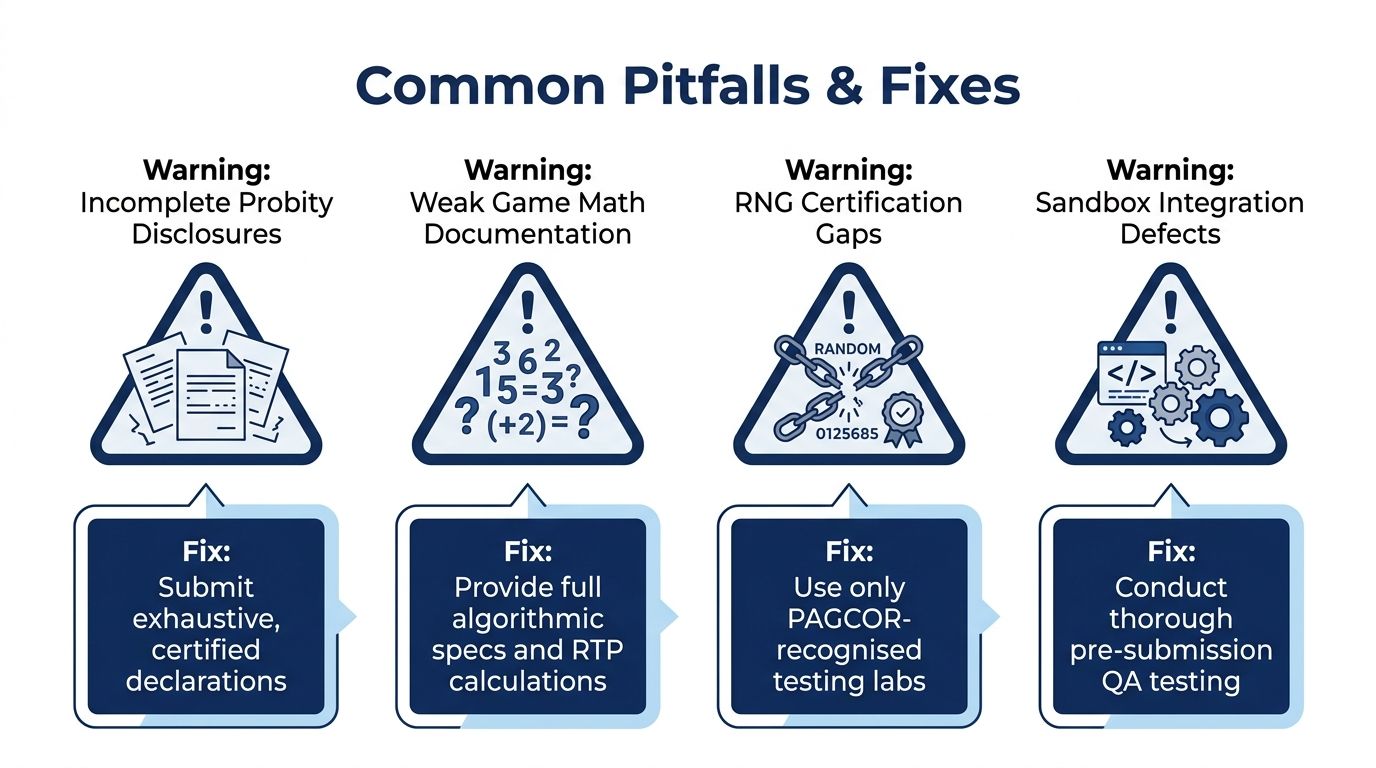
- Incomplete probity disclosures: submit certified declarations that are complete, internally consistent, and aligned across ownership, control, and personnel filings. A mismatch between corporate records and the application pack usually creates more delay than the missing form itself.
- Weak game math documentation: provide the algorithmic specification, RTP explanation, and enough supporting material for an external reviewer to follow the logic without guessing. If the math cannot be traced back to the accredited offering, the file looks unfinished.
- RNG certification gaps: use independent test evidence that is current and tied directly to the exact build being reviewed. Older reports, partial extracts, or certificates that cover a different version rarely solve the problem.
- Sandbox integration defects: run full pre-submission QA, because errors found after filing are often harder and costlier to unwind than the technical fix itself.
The graphic above captures the practical pattern. Most refusals are not about one dramatic failure, they come from small inconsistencies that add up to doubt.
The pre-flight checklist that saves the most time
The fastest way to reduce rejection risk is to make the submission pack internally coherent before anyone else sees it. If a regulator, operator, or lab asks for a document, that document should already be in the file, and it should say the same thing as the rest of the submission. Legal, product, and engineering teams need one controlled version of the truth, especially where the accredited build, the declarations, and the technical test evidence must all align.
That discipline matters because PAGCOR accreditation works on evidence, not intent. A strong resubmission usually does not win on rhetoric, it wins on a cleaner paper trail, a corrected technical record, and declarations that finally match the ownership and control picture. Studios that fix those points tend to recover faster than those that keep reshaping the commercial story around the same unresolved gaps.
Strategic Implications for Operators and Providers in 2026
The 2025 framework gives operators a stronger vendor-filtering tool and gives capital-ready providers a structural advantage. Because accreditation is tied to specific offerings, the negotiation power shifts toward studios that can show control, documentation, and cash readiness without hesitation. That will matter even more in 2026 as procurement teams get more selective about which suppliers can support Philippine launches.
What changes in operator negotiations
Operators no longer evaluate content in the abstract. They now have to ask whether the relevant game is accredited, whether the supplier can maintain that status, and whether the provider's launch plan can survive regulatory timing. That turns supplier diligence into a commercial weapon for operators, because they can insist on cleaner evidence and faster remediation before committing distribution.
Providers feel the pressure in the opposite direction. The per-game model rewards studios that can sequence launches intelligently and absorb the cost of compliance without damaging margins. Smaller or thinner-capitalised suppliers may still enter, but they will need sharper portfolio choices and a tighter launch cadence.
The decision framework for 2026
The smartest way to approach the market is to sort titles into three buckets. Titles with clean evidence and strong control maturity should move first. Titles that need more testing or documentation should be held back. Titles that cannot justify the deposit and ongoing support burden probably should not be part of the Philippine plan yet.
That is the key takeaway from the regime. PAGCOR has not just raised the paperwork bar, it has re-priced market access around product-level proof and capital discipline. Providers that understand that early will negotiate better, launch cleaner, and keep their operator relationships intact for longer.
For readers tracking the wider regulatory shift across the Philippine market, Top 1 Rank will continue following the practical impact of PAGCOR's B2B framework, including how it reshapes supplier strategy, operator diligence, and studio economics in the year ahead.




Join thousands of gaming professionals receiving the latest iGaming news, regulatory updates, and market insights.
