

You're probably here because you've watched a real Tongits game unfold at a family gathering, in a tambayan, or on your phone, and it looked fast. Someone drew, someone discarded, somebody said “Draw”, and suddenly the whole table reacted like the winner was obvious. If you're new, that moment can feel confusing.
The good news is Tongits is easier to learn once you stop treating it like a list of rules and start seeing its rhythm. You draw, you organise, you decide what to show, and you protect your hand value. That's the part most beginners miss when searching for Tongits how to play.
Table of Contents
- Welcome to the World of Tongits
- Game Setup and Your Main Objective
- The Flow of Gameplay Your Turn Explained
- Ending the Round Tongits Draw or Challenge
- Scoring and Beginner Strategy
- Tongits Online and Common Variations
Welcome to the World of Tongits
A newcomer usually learns Tongits the same way many of us in the Philippines did. You sit beside the players first. You watch the cards slap the table. You hear someone say “bahay”, “sapaw”, or “Draw”, and little by little the game starts to make sense.
What makes Tongits fun is that it isn't only about luck. You're reading discards, hiding information, lowering your points, and deciding whether to stay quiet or force the hand to end. Even if you're still learning, one good decision can swing the round.
A lot of beginners think they need to memorise everything before joining. You don't. You only need a clear picture of how a hand moves and why players choose certain actions. Once that clicks, the game stops feeling chaotic and starts feeling logical.
Tongits gets much easier when you stop asking “What are all the rules?” and start asking “What should I do on this turn?”
If you also enjoy other Filipino card and gaming formats, you've probably already seen Tongits discussed around local gaming communities such as Insta Play Online Casino. But whether you play at the table or on a screen, your first job is the same. Learn how to keep your hand efficient and your options open.
Game Setup and Your Main Objective
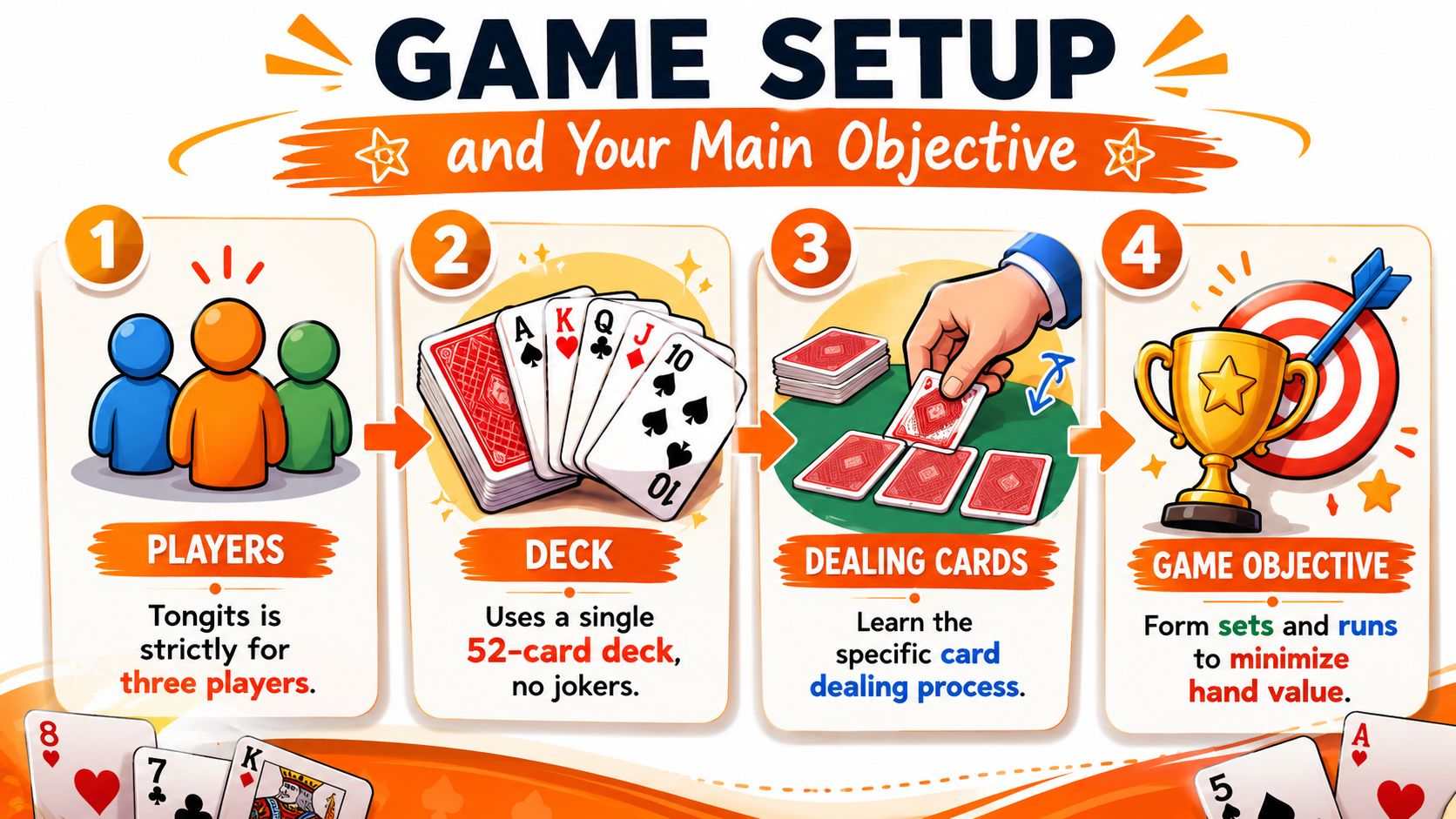
The round starts, but a lot is already decided the moment the cards are dealt. In Tongits, three players share one standard deck. The dealer begins with 13 cards, and the other two players get 12 each. The rest form the stock pile in the center.
A beginner often looks at that opening hand and asks only one question: “May nabuo ba ako?” That helps, but it is only the first layer. A better question is, “Which cards are helping my hand stay light, and which cards could punish me later if the round ends early?” That shift matters because Tongits is not just about laying down pretty combinations. It is also about avoiding dead weight, hiding useful information, and keeping yourself safe if somebody calls Draw or forces a challenge.
The table before play starts
Keep these starting facts clear:
- Players: Tongits is played by three players.
- Deck: You use one 52-card deck.
- Initial hands: The dealer gets 13 cards. The two other players get 12 cards each.
- Stock pile: The undealt cards stay in the middle for drawing during the hand.
That setup stays simple. The decisions do not.
What you're actually trying to do
Your job is to turn scattered cards into melds while keeping your unmelded cards, often called deadwood, as low as possible. Melds usually come in two forms. A set is the same rank in different suits, and a run is a straight sequence in the same suit.
If you use up all your cards properly, you can win by Tongit. If the round ends through Draw or another stopping point, your remaining hand value suddenly matters a lot. Aces count low, face cards count high, and loose honors can sit in your hand like unpaid utang. They look harmless for a turn or two, then become the reason you lose a close round.
That is why your main objective is really two goals working together. Build melds. Keep your points under control.
How to read your starting hand
A starting hand in Tongits works like a small bahay under construction. Some cards are already strong posts. Some are useful but still need support. Some are just taking up space.
Use this quick check before anyone settles into the rhythm of play:
- Spot ready-made melds first. These are your cleanest assets.
- Mark near-melds next. A pair that needs one matching rank, or two suited connectors waiting for one card, can become playable fast.
- Find your dangerous cards. High cards with no partner are often your first discard candidates.
- Notice flexibility. A card that can fit two possible melds is usually more valuable than one that fits only one pattern.
This practical reading habit helps both in live games and on regulated online platforms, where the pace is faster and you have less time to stare at the table. The rules stay familiar. The pressure to decide cleanly gets higher.
If you already enjoy combination-based card games, you may recognise some pattern-reading habits in Pusoy terms explained in English. Tongits asks for a different kind of judgment because you are balancing two risks at once. You want enough strength to build or sapaw, but you also want a hand that will not collapse on points if the round is cut short.
Main takeaway: At the start of a Tongits round, do not judge your hand only by what you can lay down now. Judge it by what it can become, what it might cost you, and how safely it lets you play the next few turns.
The Flow of Gameplay Your Turn Explained
A Tongits turn has a rhythm. Once you feel that rhythm, the game becomes much less intimidating.
Read your hand before you act
A sound opening habit is to identify your natural melds right away, then decide whether to open your hand or hold back. Rule guidance also notes that taking from the discard pile is generally allowed only when that card completes a meld, which is why discard-pile reading matters so much in Tongits, as explained in Denexa's Tong-its rules guide.
That one idea helps beginners avoid a common mistake. They see a useful-looking discard, grab it emotionally, then realise it doesn't improve the hand in a legal or practical way.
Try this mental check when your cards first arrive:
- Group obvious pairs and sequences. Put possible sets together and sort suited runs side by side.
- Separate your risky cards. High cards that don't connect well deserve attention.
- Decide your early posture. If your hand is close to strong, you might hold back information. If it's clunky, you may need a safer, point-control approach.
What a normal turn feels like
On your turn, you usually think in this order:
- Draw first: Take a card from the stock, or from the discard pile if it completes a meld in the proper way.
- Meld if it helps: If you can expose a valid set or run, you may do so.
- Lay off if possible: If there's a legal chance to add to an existing exposed meld, that can trim your hand.
- Discard one card: End your turn by throwing one card face-up.
Here's a simple example. Say you're holding two cards that are waiting for one exact match to complete a set. The top discard gives you that match. Taking it makes sense because it immediately becomes part of a meld. But if the discard only looks “maybe useful later”, it's often safer to draw blind and keep your options hidden.
A lot of beginners also reveal too much too early. That can help opponents read your shape. If they know what suits or ranks you're building, they can avoid feeding you with careless discards.
For a visual walk-through of the basic flow, this clip is a helpful companion while you read:
One more practical thought. Don't treat every turn as isolated. Your current discard tells the table something. Your previous draw tells observant players something too. Good Tongits players aren't just playing cards. They're managing information.
If you enjoy comparing local card rules, Lucky 9 rules in plain language can also sharpen the habit of reading turn flow carefully. Different game, same need for discipline.
Ending the Round Tongits Draw or Challenge
Most beginners learn how to draw and discard first. The harder lesson is knowing when the round should end, or when you should try to end it.
Winning by Tongit
The cleanest finish is Tongit. That happens when a player uses all cards through valid melds and related play, leaving nothing in hand. If you can do that, the round ends decisively.
This is the finish everyone notices because it's dramatic. But in actual games, plenty of rounds don't end that way. Many hands are decided by pressure, timing, and hand value.
When calling Draw makes sense
A major decision in real Tongits is whether to call Draw. Standard rule references note that Draw can only be called under specific conditions, and if challenged, the lowest-point hand wins. They also point out that tie-breaks such as the last-card rule matter more than beginners realise, as discussed in Pagat's Tong-its rules page.
That means calling Draw isn't just about feeling confident. It's about reading the whole table.
Ask yourself:
- Have I already lowered my risk enough? If your hand still carries ugly unmatched cards, Draw may backfire.
- What have the others exposed? A player with visible melds may have already trimmed danger from their hand.
- Who has been drawing in a way that suggests control? Quiet, tidy play can be a warning sign.
Practical rule: Call Draw when your hand is hard to beat, not when it merely feels better than before.
How challenge pressure changes decisions
The game shifts to require strategic thinking. If someone calls Draw, the rest of the table has to judge whether challenging is worth it. New players often decide emotionally. Experienced players look at clues.
Suppose one opponent has exposed useful melds and has been discarding calmly. That player may be in a strong position to challenge. On the other hand, a player who has looked stuck and has thrown awkward cards may be less likely to survive comparison.
The stock running out creates another ending path. If nobody wins by Tongit and no Draw ends the hand earlier, the remaining hands are compared and the lower total wins. So even when the game looks slow, every discard is still shaping the final count.
What confuses many learners is this: Tongits rewards both aggression and restraint. Sometimes you should push for the end. Sometimes you should keep the game alive because your hand still needs repair. The right choice depends on your remaining cards, what the table has revealed, and whether a challenge favours you or the opponents.
Scoring and Beginner Strategy
You are near the end of a round. One player has exposed clean melds. Another has stayed quiet. You look at your hand and see two face cards, an Ace, and one card that almost became a set. That is the moment scoring stops being a rule you memorized and starts becoming the way you decide.
The basic idea is simple. If the round ends by hand comparison, the player with the lowest unmatched card points wins. In local games, players often call those leftover cards deadwood. If you keep that picture in mind, many Tongits choices become easier to read.
Tongits card point values
The values are easy to remember:
| Card | Point Value |
|---|---|
| A | 1 |
| 2 to 10 | Face value |
| J | 10 |
| Q | 10 |
| K | 10 |
Face cards hurt. Aces are light. Number cards sit in the middle, so their danger depends on timing.
One detail catches beginners. In a Draw situation, ties do not always feel neutral. If points are equal, the challenger has the edge, as explained in wikiHow's Tongits guide. That small rule changes real decisions at the table. A hand that looks “safe enough” may still be too weak if you expect a tie.
How scoring should shape your play
New players often chase pretty combinations and forget the cost of waiting. Tongits works like packing for a sudden trip. Cards that might become useful later can still weigh you down if the round closes before they fit anywhere.
That is why beginner strategy starts with point control, not fancy plays.
A practical habit is to look at your hand in two layers. First, ask which cards already belong to a meld or are close to one. Second, ask which cards would punish you if someone ends the round soon. Those danger cards usually deserve attention first.
Here are habits that help right away:
- Drop heavy deadwood early when it is safe: A loose King or Queen can turn one bad ending into a lost round.
- Hide information unless revealing helps now: Exposing a meld can protect cards, but it also tells opponents what you are building.
- Watch ignored discards: A card nobody wants may tell you a suit or rank is drying up.
- Keep a flexible hand: A tidy-looking discard is not always the best discard. Leave yourself more than one route to finish.
A simple way to decide between options
Suppose you are choosing between discarding a 10 that has no partner and holding it because it might still form a set. If your hand already carries other deadwood, keeping that 10 is like keeping extra baggage on a jeepney ride when space is tight. It might become useful, but it is costing you right now.
On the other hand, if the table is slow and you already have low points, you can afford a little patience. This is the gap many basic guides miss. Good Tongits play is not only about knowing the legal move. It is about reading the round and judging whether future value is worth present risk.
That matters even more online. On regulated platforms, the app counts for you and the pace is faster, so players often react late because they never built the habit of estimating deadwood in real time. If you can glance at your hand and spot your dangerous points quickly, you make better calls whether you are playing on a tabletop in the barangay or in a timed digital room.
If you are exploring beginner offers while learning the game, some players check a free sign-up bonus for new users. Keep your decisions separate from the promo mindset. Tongits still rewards calm counting, sharp observation, and knowing when a “maybe later” card is already too expensive to keep.
Tongits Online and Common Variations
House rules exist, especially in casual play. One group may be stricter about when players expose. Another may explain challenge situations in a more local, shorthand way. That's normal. What matters is agreeing before the round starts.
What usually stays the same
The heart of Tongits stays familiar. You're still reading melds, managing deadwood, and deciding whether ending the round helps you. The tension between hiding strength and lowering risk remains the same whether you're at home or playing digitally.
What feels different online
A useful modern angle is the gap between classic tabletop Tongits and digital play. Beginner confusion often comes from features such as matchmaking, timers, automated scoring, and platform flow, which can affect how players experience draw and challenge decisions, as discussed in this piece on digital Tongits and regulated platform play.
Online, the system usually handles the counting for you. That removes arithmetic pressure, but it also makes the pace feel faster. You may have less time to think, so knowing the logic of Draw, challenge, and hand value becomes even more important.
If you're exploring card and casino-style games on mobile, many players compare options through guides about games that can earn money through GCash. Just make sure any platform you choose is regulated, clear about its rules, and easy for you to follow. Tongits is best when the rules are transparent and the play feels fair.
If you want a locally familiar gaming platform to explore after learning the basics, Insta Play Online Casino is one option Filipino players may recognise. It presents itself as a PAGCOR-licensed platform with a beginner-friendly welcome offer, including a Free ₱3,000 Bonus, plus access to popular online gaming categories.





Join thousands of gaming professionals receiving the latest iGaming news, regulatory updates, and market insights.
