

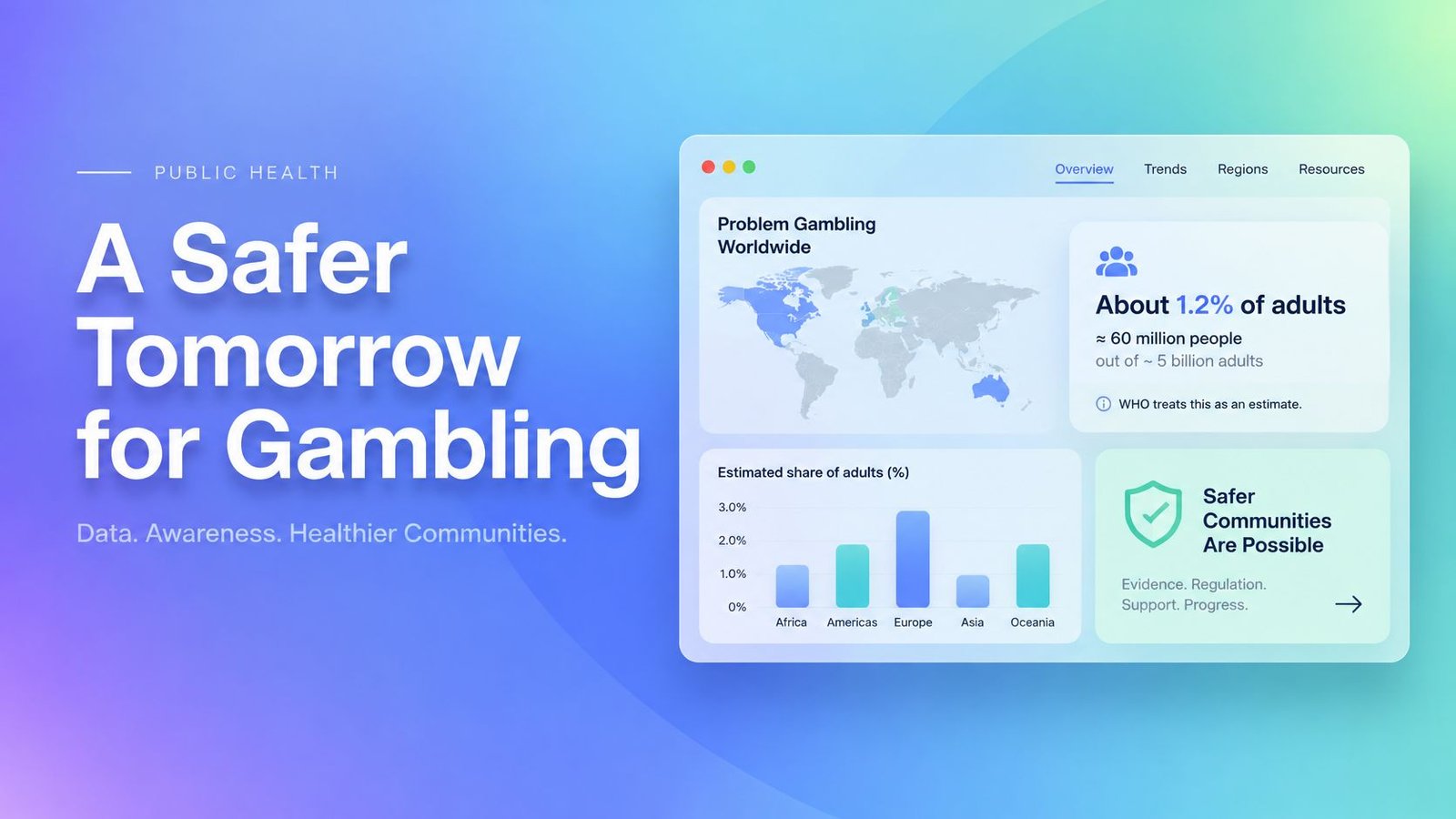
Approximately 1.2% of the world's adults have gambling disorder, according to the World Health Organization, which cautions that standardized global estimates remain limited. That finding reframes responsible gambling: the central question isn't whether operators offer a limits menu, but whether players receive meaningful protection before financial, personal or psychological harm escalates.
Table of Contents
- What Responsible Gambling Means and Who It Protects
- Player Tools Compared Side by Side
- Warning Signs and Screening Scores
- Operator Duties and Regulatory Expectations
- Where Individual Tools Fall Short
- Measuring Whether Protections Work
- Frequently Asked Questions
What Responsible Gambling Means and Who It Protects
The WHO's gambling fact sheet estimates that approximately 1.2% of adults have gambling disorder, equivalent to about 60 million people when applied to roughly 5 billion adults; it also estimates that only 0.14% of the population seeks formal or informal help for current gambling problems. Those population measures aren't a treatment-conversion calculation, but they illustrate why protection cannot depend entirely on people identifying their own difficulties.
Responsible gambling means the policies, product designs, operational controls and player tools intended to reduce gambling-related harm. A seatbelt provides a useful analogy: it doesn't prevent every dangerous journey, but protection shouldn't depend on the passenger anticipating the exact moment something goes wrong. Unlike a seatbelt, however, a gambling safeguard cannot establish that an activity is safe.
Say a customer sets an entertainment budget but starts gambling more frequently after losing employment. A deposit limit addresses money entering the account, while an operator's monitoring and intervention process should address the changed circumstances. Neither replaces access to appropriate support.
Responsibility extends beyond the player
The WHO links gambling harm with financial stress, relationship breakdown, family violence, mental illness and suicide. That scope makes consumer protection and public health more appropriate benchmarks than the visibility of a safer-gambling logo.
- Players control participation, personal boundaries and requests for assistance.
- Operators control product access, marketing, account monitoring and customer interactions.
- Regulators establish enforceable requirements and assess whether licensees meet them.
The distinction between individual choice and service-provider duties also appears in alcohol regulation. TP Training's resource to understand your NSW RSA obligations offers useful context for that separate regulated activity, although alcohol-service qualifications don't establish gambling competence.
Likewise, a directory of Philippines online casino games describes products, not proof that every associated operator supplies adequate protection.
Public-health test: A safeguard should still protect someone who hasn't recognized, disclosed or accepted that gambling is causing harm.
Player Tools Compared Side by Side
Player protection tools compared
| Tool | What It Limits | Typical Setting | Who Sets It | Reversible Early? |
|---|---|---|---|---|
| Deposit limit | Money paid in per period | Daily, weekly or monthly amount | Player | Tightening immediate; loosening usually delayed |
| Loss limit | Net losses per period | Daily, weekly or monthly amount | Player | Tightening immediate; loosening usually delayed |
| Session time reminder | Time spent playing | Alert at a selected interval | Player or operator default | Yes, where settings permit |
| Reality check | Elapsed time and total spend | Periodic on-screen summary | Player or operator default | Yes, where settings permit |
| Cool-off period | All play for a short break | A specified temporary suspension | Player | No, runs for the chosen period |
| Self-exclusion | Access to an operator or participating scheme | The scheme's published exclusion period | Player | No, runs for the applicable period |
These descriptions explain the tools' functions, not universal contractual terms. Exact durations, calculation methods and reversal rules require checking against the operator's licence conditions and published controls.
Deposit limits and loss limits solve different problems
A deposit limit restricts incoming money. A loss limit restricts net losses under the operator's calculation method, which needs particular attention where balances, winnings or unsettled bets are involved.
A customer can deposit little during a period yet lose substantially more from an existing balance. Conversely, repeated deposits don't necessarily equal the same amount of net loss if withdrawals occur. Neither measure should be mistaken for a complete account of affordability.
Before activating either tool, the customer should establish when the period resets, which transactions count, and whether the limit covers every product attached to the account. A casino-only restriction shouldn't be assumed to constrain sports betting under the same brand.
Tightening immediately while delaying increases is a sensible protective design because it separates a decision to spend more from immediate access to additional funds. However, the actual waiting rule must be checked rather than inferred from another operator's interface.
Reminders provide information, not a barrier
Session reminders tell a customer that time has passed. Reality checks add an account summary, but neither necessarily stops play.
A cool-off period serves a different purpose: it temporarily removes access instead of asking the player to reconsider while gambling remains available. Self-exclusion is the stronger access restriction and should be considered when repeated attempts to stay within limits aren't working.
The Gambling Commission's self-exclusion material explains the coordinated British framework, including GAMSTOP, and reports that 6% of gamblers had ever self-excluded, 34% knew about self-exclusion but hadn't used it, and more than half were unaware of it. The practical problem is therefore both access and awareness.
GAMSTOP allows a single request to cover participating licensed online operators in Britain, rather than requiring separate applications to each company. Players should confirm the scheme's coverage and terms before relying on it.
Practical sequence: Establish financial boundaries first, add visibility through reminders and reality checks, and use access restrictions when continued play defeats those boundaries.
The existence of a tool doesn't establish its effectiveness. Evaluation should distinguish whether customers enabled it, whether it constrained activity, and whether harm decreased, without assuming that individual controls substitute for safer commercial practices.
Warning Signs and Screening Scores
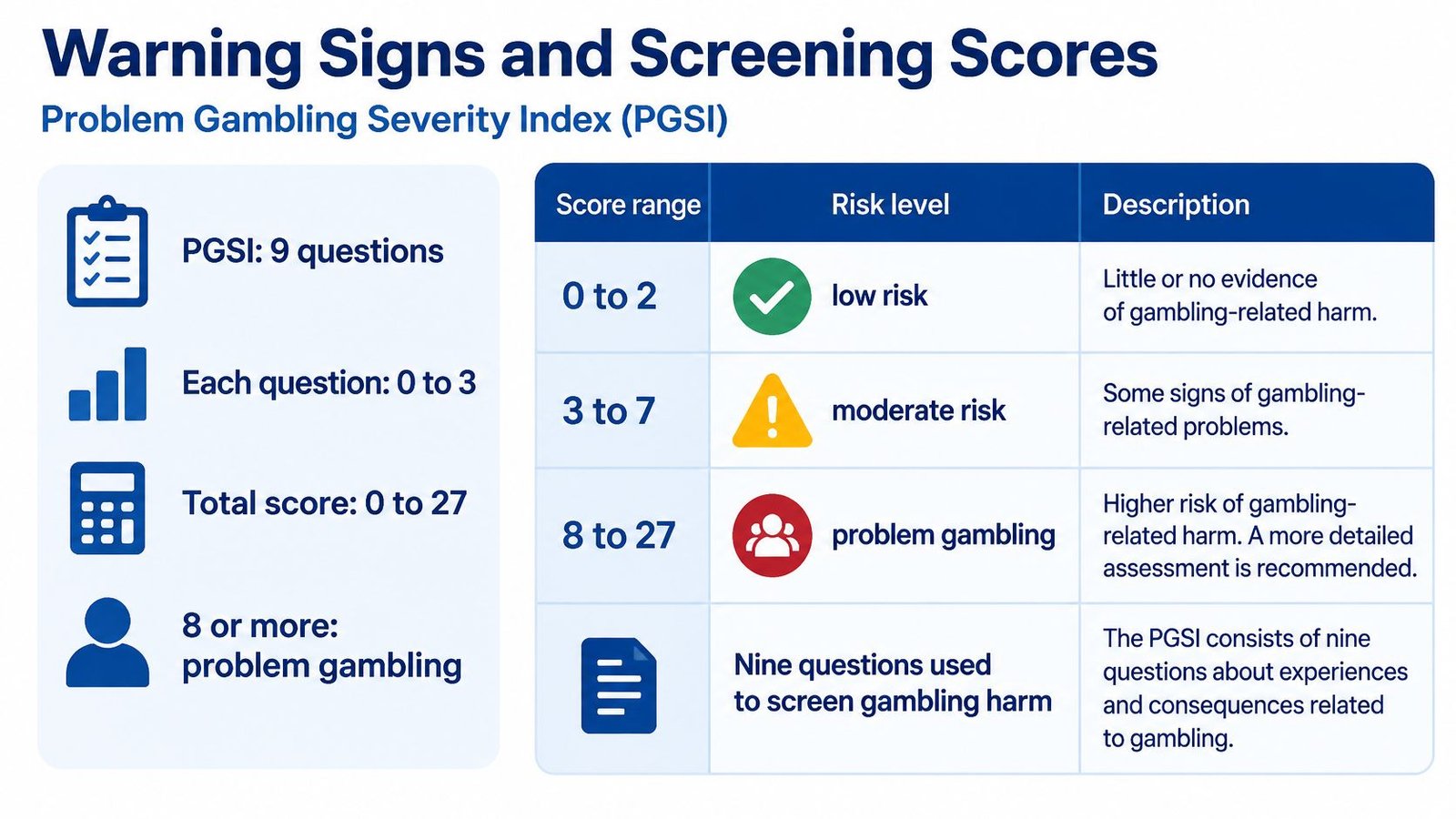
The Problem Gambling Severity Index, or PGSI, uses nine questions scored from zero to three, producing a total from zero to twenty-seven. A score of 8 or more is the problem-gambling threshold used in the Gambling Commission's 2024 adult survey reporting, which found that 2.7% of adults aged 18 and over in Great Britain met that threshold.
A screening score organizes responses; it isn't a stand-alone clinical diagnosis or a reason to disregard disclosed harm. The responses below are practical triage categories, not automatic regulatory decisions.
PGSI score bands and typical responses
| PGSI Score | Classification | Typical Response |
|---|---|---|
| 0 | Non-problem gambling | Standard information only, unless other concerns emerge |
| 1 to 2 | Low risk | Information and access to player tools |
| 3 to 7 | Moderate risk | Tools, check-in and brief advice |
| 8 to 27 | Problem gambling | Specialist referral and stronger controls |
Consequences matter alongside scores
In Great Britain in 2024, 1.6% of adults who had gambled in the previous 12 months reported relationship breakdown as a severe consequence of their own gambling, according to the Gambling Commission's annual participation publication. An assessment that focuses only on account expenditure can overlook consequences outside the platform.
The Gambling Commission's youth survey found that 1.5% of young people in Great Britain scored 4 or more on its youth-adapted screen in 2024, compared with 0.7% in 2023. This is a different instrument and population from the adult PGSI measure; the results shouldn't be treated as interchangeable.
A screening increase alone doesn't identify its cause. Analysts should examine detection and measurement alongside the possibility of greater harm.
Behavioural checks that warrant attention
- Chasing losses: Returning to gambling primarily to recover money already lost.
- Raising stakes: Increasing wagers in an attempt to repair earlier losses.
- Borrowing to play: Using credit or money intended for essential expenditure.
- Concealing expenditure: Hiding account activity or understating losses.
- Escaping distress: Using gambling as the principal response to stress.
An explanation of color game probability can clarify game mathematics, but understanding probability doesn't resolve compulsive behaviour. Operators should read behavioural indicators alongside account activity rather than wait for a customer to cross a preset spending line.
Operator Duties and Regulatory Expectations
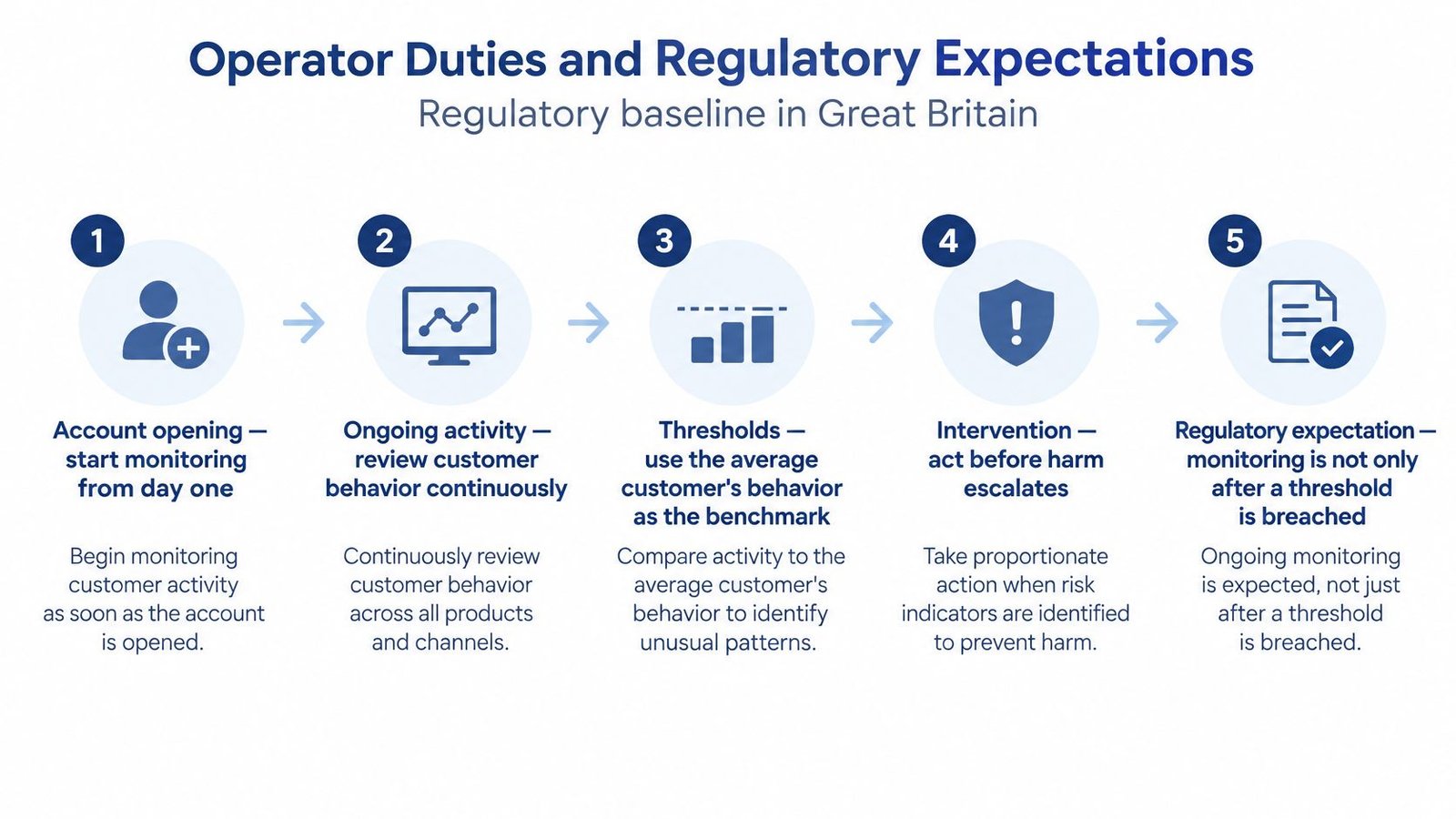
In Great Britain, remote licensees must monitor customer activity from account opening, according to the Gambling Commission's customer-interaction guidance. The regulator warns that thresholds set too high can miss customers already experiencing significant harm and expects realistic thresholds informed by customers' average available income.
The guidance also distinguishes disposable income from discretionary income. Even money remaining after living costs may be subject to unavoidable commitments, so an income label shouldn't become automatic permission for gambling expenditure.
Build monitoring around the customer journey
Map every point where evidence becomes available. Account registration, payment activity, gameplay, customer-service contacts and requests to change restrictions belong in the monitoring design. The common failure is treating safer gambling as a separate support function that sees only customers who explicitly ask for help.
The operational map should identify who owns each signal, which systems receive it and what happens when automated information conflicts with a customer disclosure. An operator shouldn't require a customer to repeat a distressing explanation because separate teams cannot access the relevant record.
Calibrate deposit and loss triggers against income information. A threshold should generate scrutiny, not certify that spending beneath it is affordable. Compliance teams should document the population assumptions, exclusions and limitations behind every trigger.
A frequent design error is selecting a high threshold because it produces a manageable alert queue. That approach solves a staffing problem by reducing visibility of potentially vulnerable customers.
Combine signals rather than assigning decisive weight to a single amount. Spend, deposit frequency, session length, escalation, time of day and account changes should inform the assessment together. A sudden change in behaviour may warrant attention even when total expenditure remains comparatively modest.
Apply financial checks within the correct legal scope
Financial vulnerability checks became required in Great Britain on 31 August 2024, and from 28 February 2025 the relevant remote-gambling trigger became deposits minus withdrawals exceeding £150 over a rolling 30-day period, according to the Gambling Commission's account of financial vulnerability requirements. These checks use publicly available information, including bankruptcy orders, county court judgments and individual voluntary arrangements, without requiring customers to submit information for the initial check.
The calculation is important: it is not just gross deposits or a calendar-month total. Implementation teams should test transaction timing, withdrawals, and rolling-period logic before relying on a production alert.
Where potential vulnerability appears, operators may take proportionate action, such as a deposit limit, and request further financial information where appropriate. This shouldn't become an inflexible sequence that delays protection while staff wait for documentation.
A completed financial check is evidence that a process ran. It isn't evidence that the customer can afford every subsequent loss.
Recognize vulnerability beyond transaction records
The Gambling Commission's premises-based customer-interaction guidance identifies financial difficulty, homelessness, domestic or financial abuse, caring responsibilities, bereavement and other life changes as relevant vulnerability factors. Its requirements concern premises-based operators, but the circumstances illustrate why financial indicators alone cannot describe every customer's situation.
Staff training should use realistic disclosures rather than keyword lists alone. A customer asking to restore access after mentioning bereavement requires contextual judgment, not merely confirmation that a numerical restriction has expired.
The common slip is recording the disclosure without assigning an action owner. A useful case record connects the evidence, assessment, intervention, responsible employee and follow-up decision.
Assign governance and review responsibilities
A practical operating model should include:
- Named accountability: Specify who can impose restrictions, escalate concerns and approve reopening decisions.
- Documented reasoning: Record why an intervention was proportionate to the evidence available.
- Outcome review: Examine whether customers continued showing concerning behaviour after contact.
- Regular recalibration: Schedule quarterly reviews as an internal governance practice, not as a claimed universal legal requirement.
PlotStudio AI's guide to building a practical governance roadmap offers a general framework for ownership and documentation. Gambling-specific licence conditions must remain the binding reference.
A jurisdiction matrix should connect each product, customer location and licence to the relevant requirements. A resource covering PAGCOR and Philippines online casino licensing can support orientation, but no editorial summary replaces confirmation with the applicable regulator.
For suppliers, the corresponding requirement is contractual clarity: which party detects a signal, which party acts, and how evidence passes between them. Outsourcing software shouldn't leave either the supplier or operator assuming that the other owns the intervention.
Where Individual Tools Fall Short
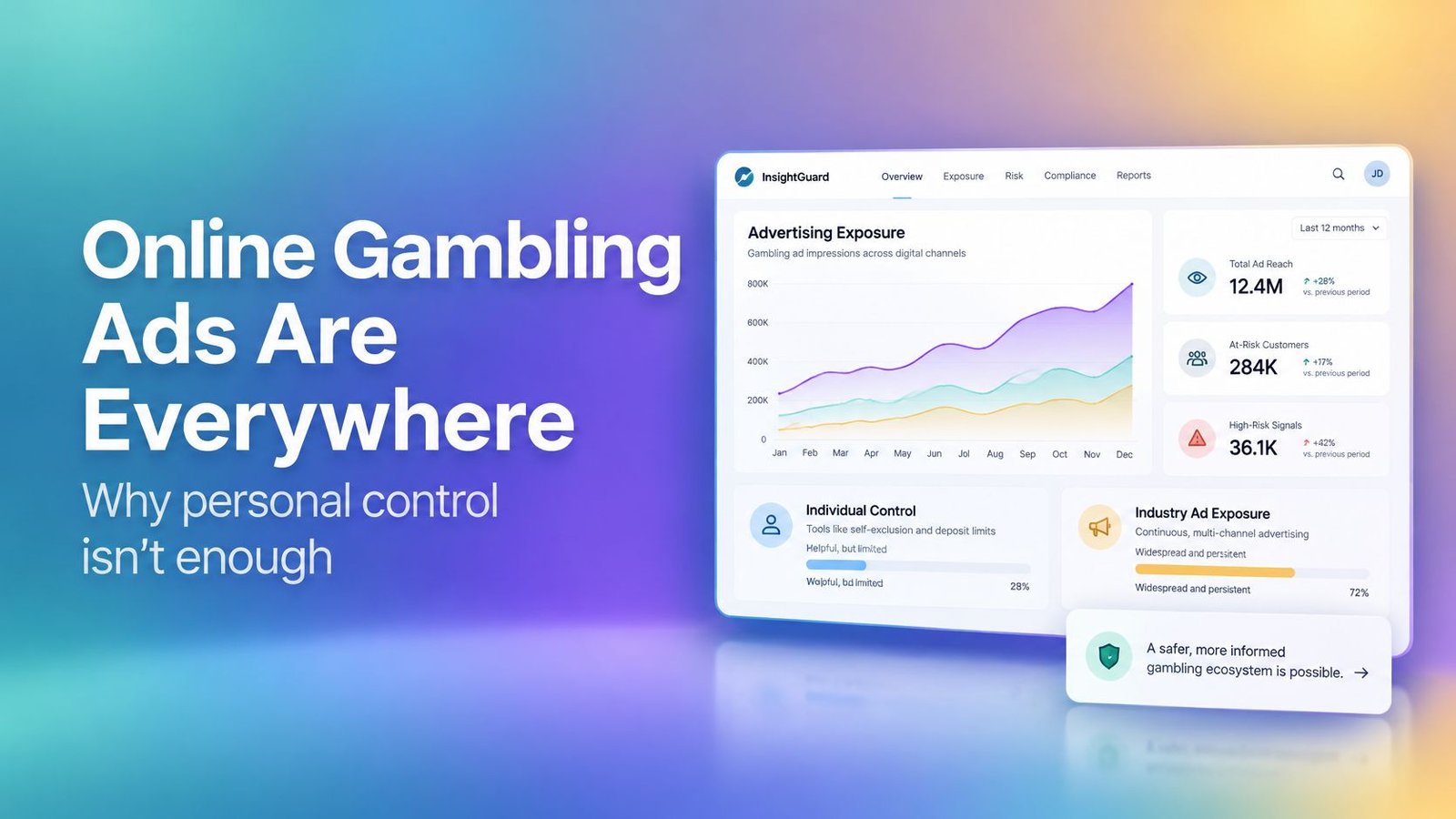
A 2025 longitudinal study found that exposure to online gambling advertising was associated with problem-gambling severity and, among online gamblers, a greater likelihood of debt enforcement, with stronger associations among offshore gamblers, as described in the International Gambling Studies article. These are associations, not proof that advertising caused every observed outcome.
The finding nevertheless challenges a narrow compliance model. An operator cannot credibly assess protection only through customer-set limits while ignoring the promotional environment that encourages further participation.
Separate gaming from gambling mechanisms
Ordinary gaming, gambling-like monetisation and real-money gambling shouldn't be treated as the same activity. A conventional game purchase, a randomized paid reward and a wager create different questions about expenditure, uncertainty and regulatory coverage.
The GREO snapshot of a 2025 youth-intervention scoping review_Research%20Snapshot_Mitigating%20gambling-related%20harms%20in%20children%20and%20young%20people_final.pdf) identifies promising approaches combining methods, trained practitioners, developmental relevance and digital technology, but notes limited long-term follow-up and shortcomings involving measurement, environmental factors and youth participation. That evidence doesn't justify claiming that every gaming activity causes problematic gambling.
For operators and regulators, the practical question is which product mechanisms and commercial exposures require additional safeguards. Proposed measures include advertising restrictions, platform targeting controls, influencer standards, offshore-site blocking and transparent risk labels; each requires its own assessment rather than an assumption of equal effectiveness.
Test market protection instead of trusting a badge
A usable licensed-market test asks whether the specific domain and operating entity are authorized to serve the player's location. A licence from another jurisdiction doesn't, by itself, settle that question.
- Verify the authorization: Match the domain and legal entity against the relevant regulator's register.
- Check enforceable protection: Identify exclusion coverage, customer-interaction obligations and the complaint route.
- Inspect commercial conduct: Establish whether marketing preferences and restrictions apply across associated brands and channels.
The distinction is between locally applicable safeguards and their absence, not between domestic and foreign ownership alone. An offshore business may hold a licence elsewhere without providing the protections required in the player's market.
Coverage of PAGCOR gambling advertising rules provides a jurisdiction-specific starting point for examining promotional conduct. The analytical priority is whether commercial exposure undermines the protection an operator claims to provide.
Measuring Whether Protections Work
A licensee should measure outcomes, not merely list available tools. A regulator should also distinguish between evidence that a process operated and evidence that customers experienced less harm.
Use an outcome-focused monitoring dashboard
Monitoring coverage: Measure the share of accounts included from opening. Excluded products, payment channels or legacy systems should be visible rather than hidden in a headline coverage rate.
Time to proportionate interaction: Record the interval between a meaningful indicator and an appropriate response. Fast automated messages shouldn't count as successful intervention when the situation requires a restriction or human assessment.
Threshold drift: Compare current triggers with the income assumptions used to establish them. A quarterly internal review should document whether those assumptions remain defensible and who approved changes.
Escalation outcomes: Track whether flagged customers reduce expenditure, take a break, receive stronger restrictions or enter a referral pathway. Reduced spending alone doesn't establish recovery, particularly if activity may have moved elsewhere.
Population indicators: Follow adult problem-gambling measures and youth-screen results with their sampling and detection methods attached. A movement in a survey measure requires interpretation, not an automatic declaration that a particular intervention succeeded or failed.
Make the audit trail useful
An initial quarterly baseline can establish the starting position for internal comparisons. Every interaction should carry a date, reason, action owner and subsequent outcome, with unresolved cases visible to compliance leadership.
Self-exclusion enrolment belongs alongside evidence about implementation and subsequent access attempts. More enrolments may indicate better awareness, greater need, or both; the count alone cannot establish prevention.
Decision standard: Protection should be judged by earlier identification and reduced harm, not the number of buttons available in an account menu.
A credible report should disclose missing information and alternative explanations. That candour gives management and regulators a better basis for action than a dashboard composed entirely of completed-process totals.
Frequently Asked Questions
Does GAMSTOP cover offshore gambling sites?
No, not sites outside the British licensed online market covered by the scheme. GAMSTOP shouldn't be treated as a worldwide prohibition on accessing gambling websites, and offshore location alone isn't the decisive test; authorization and participation matter.
A player considering a site outside that framework should establish which controls actually apply and which authority can enforce them. A website's own exclusion option isn't automatically equivalent to coordinated market-wide protection.
Is certainty about a gambling problem necessary before seeking help?
No. Concern about borrowing, secrecy, distress or repeated failed limits is sufficient reason to contact a gambling-support or treatment service in the relevant country.
The person can describe what has changed without assigning a diagnosis. Before disclosing sensitive information, the service's confidentiality and safeguarding arrangements should be checked.
Does a real-money casino guide establish that an operator is safe?
No. A guide to real-money online casinos in the Philippines can provide product context, but editorial inclusion doesn't establish authorization, affordability or effective customer protection. Those questions require separate checks.
Operators should commission an end-to-end test of a customer-risk case, from the first indicator to the final intervention, and document every missed handoff. Players concerned about their gambling should pause deposits, check available access restrictions and contact an appropriate support service rather than wait for certainty.





Join thousands of gaming professionals receiving the latest iGaming news, regulatory updates, and market insights.
