

Debit cards still account for 42% of global iGaming payment preference, while digital wallets have reached 38%, according to Paysafe's 2026 payment analysis. That near-parity changes the procurement question. An operator choosing an online casino payment provider isn't just selecting the cheapest gateway. It's deciding which rail should acquire deposits, which one should fund withdrawals, and which compliance route can survive jurisdictional scrutiny.
The strongest stack is therefore rarely a single provider. Cards remain important for reach, wallets and open banking often perform better for acceptance or speed, and regional alternatives can determine conversion in markets where global methods are secondary. The comparison below treats deposits, payouts, and regulatory routing as separate procurement problems.
Table of Contents
- Why the Right Payment Stack Now Decides Operator Margins
- The Seven Criteria That Actually Matter in a Payment Provider Comparison
- Side-by-Side Comparison of Leading Online Casino Payment Providers
- Deposit Performance and First-Pass Acceptance Rates
- Payout Speed and Withdrawal Experience
- Regulatory Reach Across the US UK EU and Emerging Jurisdictions
- Best Payment Providers by Operator Scenario
- Scoring Methodology and Frequently Asked Questions
Why the Right Payment Stack Now Decides Operator Margins
Payment processing should be evaluated as a commercial function, not a back-office utility. Every failed deposit interrupts the player journey, every delayed withdrawal creates support workload, and every restricted rail can force an operator into a less efficient fallback. The relevant trade-offs are consistent: acceptance versus cost, speed versus control, and geographic reach versus licensing complexity.
A procurement team should begin by separating three questions:
- Which method gives the best first-pass deposit acceptance in the target market?
- Which rail can deliver winnings within the operator's promised timeframe?
- Which provider can legally monitor, route, and settle those transactions in each jurisdiction?
The regulatory background makes the third question unavoidable. In the United States, the Federal Reserve's Regulation GG guidance follows the restrictions created by the Unlawful Internet Gambling Enforcement Act of 2006. In the European Union, rules can require banks and payment institutions to block payments connected with unauthorized gambling services. A provider's technical coverage therefore doesn't prove that its gambling route is commercially usable.
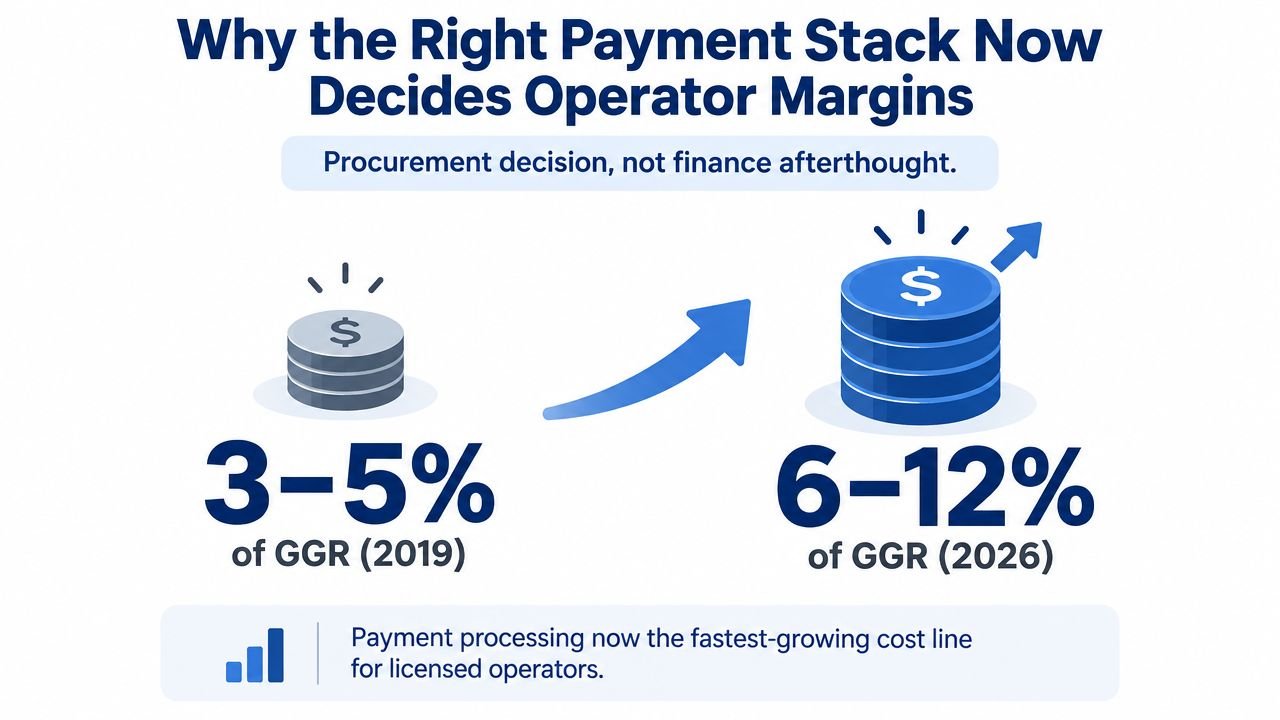
The practical implication is a routing architecture, not a vendor beauty contest. A card acquirer can provide broad reach, while an open-banking provider may improve approval performance and a wallet can make cashout more attractive. Operators assessing user acquisition cost alongside payment economics should include payment failure, withdrawal support, reconciliation, and compliance review in the same model.
The market is also moving toward faster bank payments. Under the European Central Bank's summary of Regulation (EU) 2024/886, providers that offer regular credit transfers must also offer instant transfers, and instant-transfer fees can't exceed equivalent standard-transfer fees. That makes bank-rail capability a strategic procurement issue, particularly for euro-facing casinos.
The Seven Criteria That Actually Matter in a Payment Provider Comparison
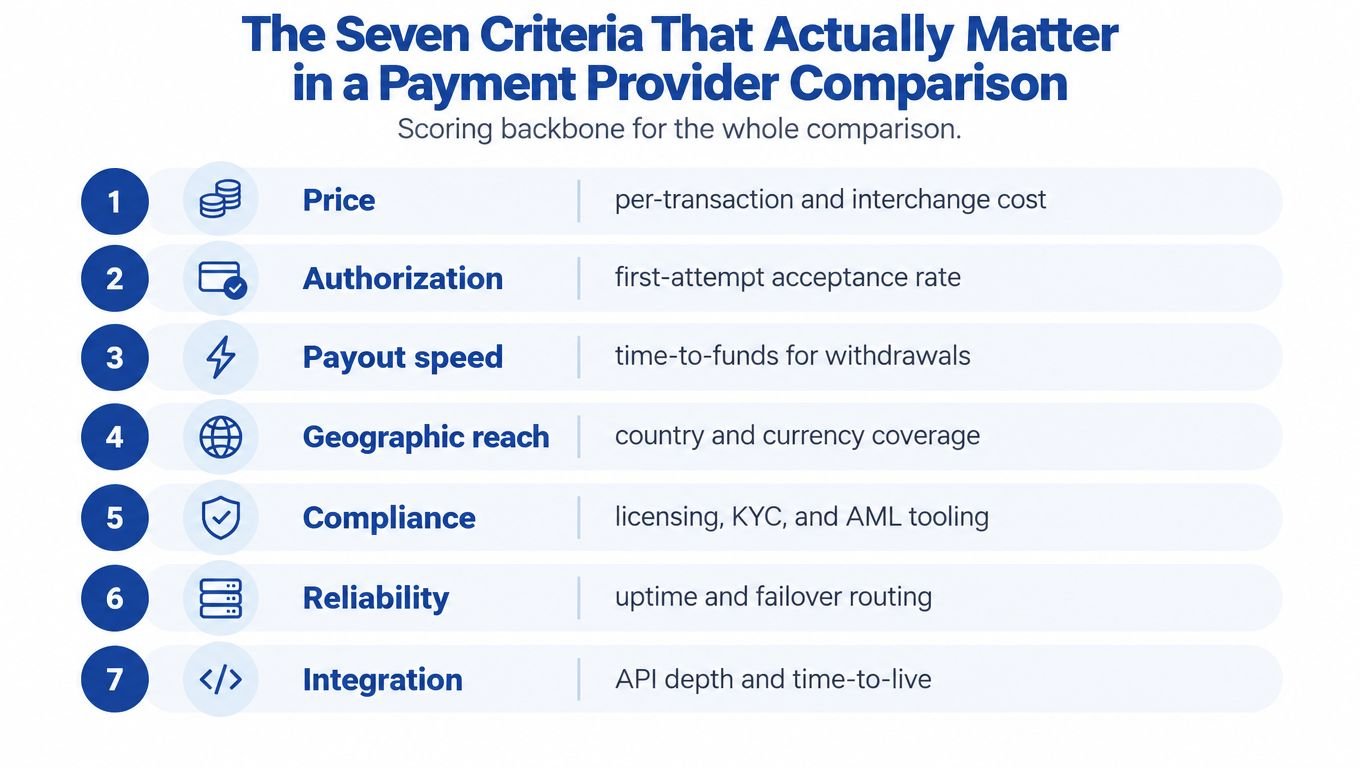
A useful online casino payment providers comparison needs more than a list of brands. Procurement teams should score each provider against the commercial and operational conditions that determine whether a transaction succeeds, settles, and remains compliant.
Cost is only the first filter
Per-transaction pricing includes the processor fee, interchange, scheme costs, currency conversion, reserve requirements, and possible chargeback exposure. A blended quote may simplify forecasting, while interchange-plus pricing can provide greater transparency. Neither structure is automatically cheaper without the operator's transaction mix.
First-attempt authorization measures whether the initial deposit succeeds before retries, customer service intervention, or alternative-method prompts. The 2026 iGaming payments benchmark places pay-by-bank methods such as Trustly and Zimpler at 90–96% approval, compared with 82–90% for cards using 3DS2 with network tokens and 74–84% for cards without tokens. Skrill and Neteller typically fall within 88–94%, while Apple Pay and Google Pay are described at 88–95%.
Payout settlement speed should be measured from withdrawal request to funds received, not merely from operator approval to processor acceptance. The difference exposes hidden queue time in compliance reviews, bank cutoffs, and treasury operations.
Market and currency coverage must distinguish technical availability from licensed gambling availability. A method listed in a provider's documentation may still be unusable for a specific operator, player location, currency, or licence.
Integration depth covers hosted checkout, APIs, tokenization, webhooks, ledger exports, and compatibility with an orchestration layer. A provider that launches quickly but creates weak reconciliation can impose costs later.
Compliance and alternatives determine resilience
KYC, AML, fraud scoring, and chargeback tooling influence approval quality and regulatory defensibility. Gambling transactions require controls that can identify unusual funding, account ownership issues, velocity anomalies, and restricted corridors.
Crypto and alternative-method support should be assessed as a routing option, not a marketing badge. Regional bank methods, eCash, wallets, and account-to-account rails can outperform globally familiar cards in particular markets.
Procurement rule: A provider should receive separate deposit and payout scores. A strong deposit score must not conceal weak withdrawal operations.
The same distinction applies to accreditation. A gateway's ability to process payments isn't equivalent to gambling-sector approval, so operators should verify the relevant PAGCOR payment gateway accreditation context when the Philippines is part of the target footprint.
Side-by-Side Comparison of Leading Online Casino Payment Providers
A provider can rank strongly for deposits and still underperform on withdrawals. The table is therefore a procurement map, not a universal league table. Public documentation and rail benchmarks support directional comparison, but providers do not publish a consistent set of gambling-specific prices, approval rates, or payout windows. Qualitative ratings avoid unsupported precision where comparable data is unavailable.
| Provider | Card Pricing (interchange+ / blended) | Deposit Acceptance | Payout Settlement | Market Coverage | Integration Complexity | Fraud/KYC Tooling | Crypto Support |
|---|---|---|---|---|---|---|---|
| Adyen | Interchange+ and blended options vary by market | Strong | Same day to several business days, route-dependent | Broad global card and local-method coverage | Moderate | Strong | Limited or partner-dependent |
| Stripe | Blended and market-specific pricing | Strong | Route-dependent | Broad technical coverage, gambling eligibility varies | Easy | Strong | Limited, product and jurisdiction dependent |
| Worldpay | Interchange+ and blended structures | Strong | Card and bank route-dependent | Strong card-scheme reach | Complex | Strong | Limited |
| Trustly | Method and market-specific pricing | Strong | Seconds to same day on supported bank rails | Strong selected European and other bank-payment corridors | Moderate | Strong | No core crypto focus |
| Skrill/Neteller, Paysafe | Wallet pricing varies by corridor and account | Strong | Instant to a few hours commonly described | Broad wallet footprint, market restrictions apply | Easy | Strong | Limited or indirect |
| PayPal | Blended, market-specific pricing | Strong | Immediate to several business days, route-dependent | Broad wallet coverage, gambling approval varies | Easy | Strong | Limited |
| Coinbase Commerce | Crypto and conversion economics vary | Limited | On-chain and conversion route-dependent | Crypto-first international reach | Moderate | Moderate | Strong |
| Circle | Contractual and corridor-specific | Limited | Stablecoin and banking route-dependent | Stronger where regulated digital-asset infrastructure is available | Complex | Strong | Strong |
These ratings describe relative fit, not audited performance. Acceptance depends on issuer mix, player location, transaction value, authentication design, risk rules, and the operator's licensing position. Integration complexity also changes with the required orchestration, reporting, reconciliation, and local-method coverage.
Payout routing produces a different ranking from deposit routing. Wallets such as Skrill and Neteller are commonly described as instant to a few hours, while Visa Direct and Mastercard Send generally operate within 30 minutes to 24 hours. SEPA Instant and Faster Payments settle in seconds on supported routes, SEPA Credit Transfer typically operates on T+1, and SWIFT wires can take 3–7 business days.
The procurement implication is direct. Trustly may suit operators prioritizing bank-based deposits, while wallet or card-linked providers may offer a better withdrawal experience in specific corridors. No single row should be treated as the complete payment stack.
Operators reviewing online casinos with good payouts should test the full withdrawal chain, including approval queues, sanctions checks, settlement timing, player notifications, and reconciliation. A headline payout window is useful only when those operational stages are measured separately.
Deposit Performance and First-Pass Acceptance Rates
First-pass acceptance varies materially by payment rail. Cards offer broad recognition, but gambling-related merchant category codes, issuer restrictions, 3DS authentication, and cardholder-bank policies can cause declines even when funds are available. Network tokens improve card routing, yet supported European markets still show stronger results for leading pay-by-bank methods.
| Payment rail | Provider examples | First-pass auth rate | Typical decline causes |
|---|---|---|---|
| Pay by bank | Trustly, Zimpler | 90–96% | Bank availability, customer authentication, account restrictions |
| Tokenized cards with 3DS2 | Adyen, Worldpay | 82–90% | SCA friction, issuer decline, gambling restrictions |
| Cards without network tokens | Acquirers and gateways | 74–84% | Issuer risk models, card blocks, failed authentication |
| E-wallets | Skrill, Neteller | 88–94% | Wallet balance, account verification, risk controls |
| Apple Pay and Google Pay | Apple Pay, Google Pay | 88–95% | Device authentication, token or issuer restrictions |
These figures come from Fluid Payments' 2026 iGaming payment gateway benchmark, and they are not a guarantee for every operator. Market, issuer mix, player tenure, transaction value, authentication design, and fraud rules can change the outcome.
The procurement conclusion is more useful than the ranking alone. A card-first cashier supports familiar methods, but may lose transactions at the issuer layer. Wallet-heavy or open-banking routing can raise first-pass acceptance where supported, while adding account-verification requirements and excluding players who prefer debit cards or cash-based methods.
Routing should respond to the decline reason
A resilient deposit flow uses decline intelligence rather than applying one fallback rule to every failed payment. Issuer restrictions should trigger an approved alternative. Authentication failures should route to a method that does not repeat the same friction. Fallback prompts also need testing for preserved amount, currency, and promotional eligibility.
Payment preferences differ by market. Paysafe's 2025 player-payment research records debit cards at 42% global preference and digital wallets at 38%, while eCash adoption reached 30% in Colombia and 25% in Ecuador. The implication is operational: acceptance rate and method preference must be assessed together, not scored as separate provider advantages.
The best deposit provider may therefore differ from the best withdrawal provider. A localized cashier can outperform a broader technical connection if it matches the player's preferred funding method and the operator's licensing route. For Filipino traffic, support for casino payments through GCash may matter more than another generic card connection. Procurement teams should compare first-pass deposits, fallback conversion, and market coverage as separate measures.
Payout Speed and Withdrawal Experience
A withdrawal request passes through several clocks before funds reach the player. Provider comparisons often quote payment-rail settlement while excluding operator approval, KYC review, bank cutoffs, and treasury availability. Procurement teams should record each stage separately and calculate time to funds, the measure that reflects the player's actual experience.
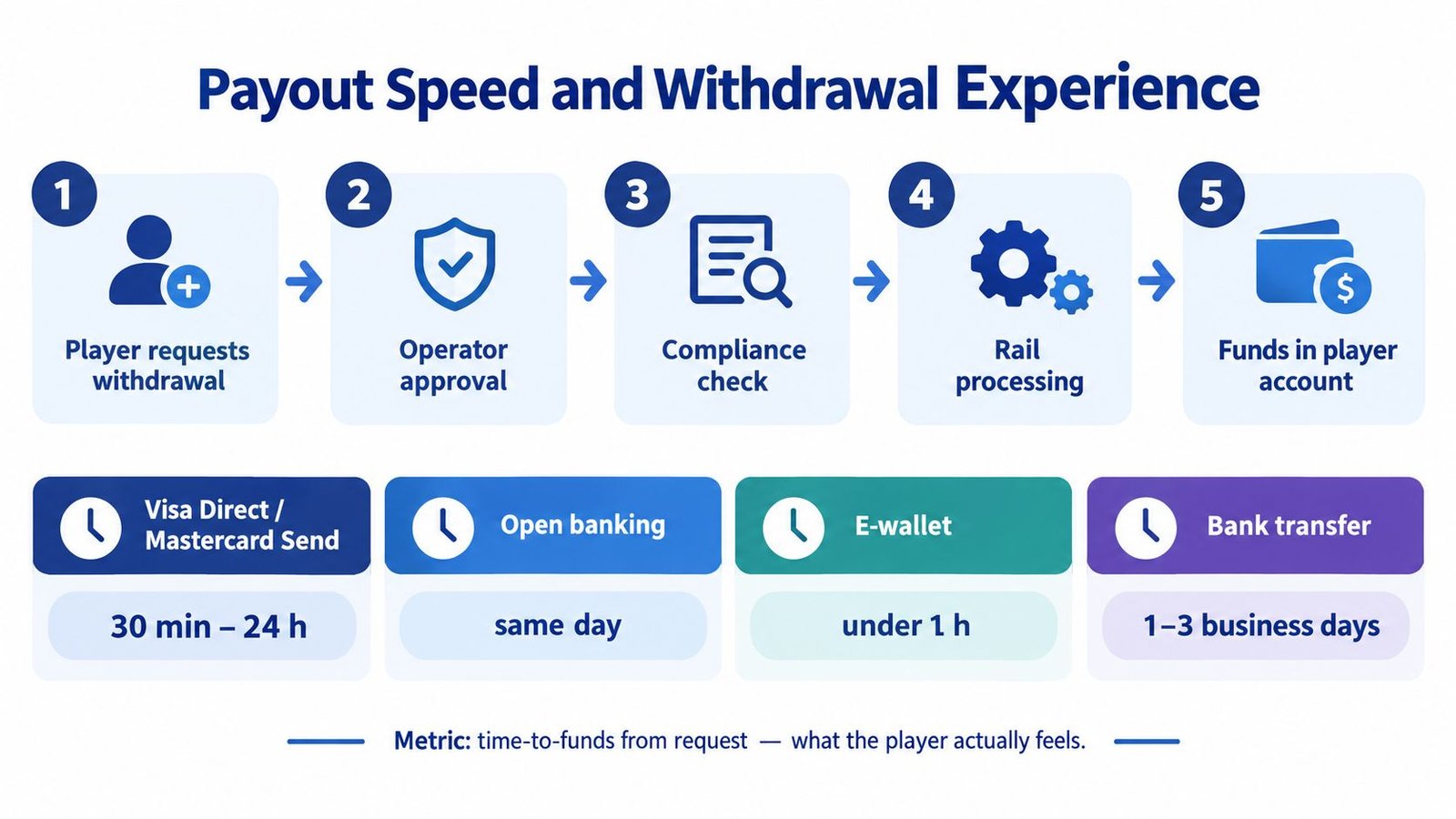
The payout hierarchy remains useful, provided teams distinguish rail capability from end-to-end delivery:
- E-wallets: Skrill and Neteller are commonly described as instant to a few hours.
- Push-to-card rails: Visa Direct OCT and Mastercard Send generally clear within 30 minutes to 24 hours.
- Instant bank rails: SEPA Instant and Faster Payments settle in seconds where supported.
- Standard bank transfers: SEPA Credit Transfer is typically T+1.
- SWIFT wires: Commonly take 3–7 business days.
These benchmarks are documented in the casino payment methods payout guide. They also explain why the strongest withdrawal provider may specialize in wallets or instant bank payments, while another provider remains better suited to deposits.
Operational controls determine whether those rail times survive production. Approval queues, compliance holds, reconciliation events, and treasury liquidity can add delay after a payment method reports settlement. Faster rails may carry higher transaction charges, complicate refunds, and require funds outside conventional banking hours. Operators benchmarking real withdrawal timelines can compare operator-level results in our Arena Plus withdrawal analysis.
Operational test: A provider that settles quickly but cannot expose approval status, compliance holds, and reconciliation events creates a fast player experience only on paper.
VIP and retention-sensitive cohorts should be tested separately from deposit traffic. An operator may use cards and local methods to broaden acquisition coverage, then route eligible withdrawals through wallets or push-to-card rails. The appropriate design depends on licensing, player preference, risk appetite, and the operator's ability to fund each rail continuously. In practice, the best deposit provider and the best withdrawal provider are rarely the same company.
Regulatory Reach Across the US UK EU and Emerging Jurisdictions
Regulatory coverage has two layers. The first is technical reach, meaning that a provider can connect to a country or payment method. The second is licensed-money coverage, meaning that the provider can legally support the operator, player, transaction type, and settlement corridor.
| Provider | US states | UK | EU/EEA | LATAM | Other notable |
|---|---|---|---|---|---|
| Adyen | Selective, subject to gambling and state approvals | Possible with eligible merchants and methods | Broad regulated-market capability, subject to local rules | Selective local-method coverage | Strong enterprise acquiring profile |
| Stripe | Gambling eligibility is restricted and jurisdiction-dependent | Eligibility must be confirmed | Technical coverage does not guarantee gambling acceptance | Selective | Strong developer tooling |
| Worldpay | Broad acquiring presence, state and merchant approval dependent | Strong card reach, credit-card gambling restrictions apply | Broad card reach | Broad but corridor-specific | Card-scheme reach |
| Trustly | Selective bank-payment availability | Market and licence dependent | Strong selected bank-payment corridors | Selective | Pay-by-bank specialization |
| Skrill/Neteller, Paysafe | Market and gambling eligibility dependent | Wallet route subject to gambling rules | Broad wallet presence, local restrictions apply | Selected | Wallet-led payout capability |
| PayPal | State and merchant eligibility dependent | Market and gambling approval dependent | Broad wallet reach, local conditions apply | Selected | Consumer wallet familiarity |
| Coinbase Commerce | Digital-asset and gambling legality must be assessed state by state | Crypto and gambling permissions require review | MiCA and local rules apply | Corridor-specific | Crypto-first settlement model |
| Circle | Digital-asset, money-transmission, and gambling permissions require review | Regulatory and product eligibility dependent | MiCA-relevant operating framework | Corridor-specific | Stablecoin infrastructure |
The US is a patchwork of state gambling licences and money-transmitter obligations. UIGEA restrictions also mean that a technically available processor isn't automatically a lawful gambling route. In the UK, the Gambling Commission's payment guidance must be read alongside the credit-card gambling ban introduced in 2020, which changes the acquiring and fallback design.
European operators face a different pressure. The European Parliament's instant-payment summary states that euro instant transfers must execute within ten seconds, regardless of day or hour, and that payee verification must be free to the payer. The European Central Bank's SEPA Instant overview identifies the scheme as launched in November 2017.
Norway blocks payments to unlicensed operators, while the EU's MiCA framework governs crypto payments effective December 2024, as summarized in Gambling.com's payments coverage. Brazil, Colombia, Ontario, and African markets add their own licensing and settlement questions. Regional approval should therefore determine the shortlist before price negotiation begins.
Best Payment Providers by Operator Scenario
No provider wins every scenario because the payment job changes with the licence, player base, and withdrawal promise. The most defensible procurement decision combines a primary acquisition rail with an independent payout route and a controlled fallback.
| Operator Scenario | Primary Deposit Rail | Payout Rail | Crypto Option | Accepted Trade-off |
|---|---|---|---|---|
| Regulated European casino | Trustly and card acquiring through a regulated PSP | Skrill, Neteller, Visa Direct, or SEPA Instant where supported | Limited and licence-dependent | More extensive KYC and jurisdiction controls |
| Latin American growth operator | Local acquiring and market-specific bank or wallet rails | Local bank and wallet payouts | Stablecoin route only where lawful and controlled | Higher operational complexity and potentially higher fee stack |
| Crypto-first brand | Regulated crypto gateway or merchant processor | Regulated euro or local-currency payout processor | Coinbase Commerce, Circle, or another approved digital-asset route | Crypto cannot replace licence-specific fiat controls |
For a regulated European casino, Trustly can support pay-by-bank deposits and, in suitable corridors, faster bank settlement. Skrill or Neteller can address wallet-oriented withdrawals, while Visa Direct can widen payout coverage. The combination accepts heavier compliance work, but it avoids forcing one rail to perform every function.
A Latin American operator should prioritize local acquiring and payment behavior rather than copy a European stack. Paysafe's research shows stronger eCash adoption in Colombia and Ecuador, which demonstrates why local alternatives can matter even when cards lead globally. Pix, Mercado Pago, and stablecoin options may each serve different segments, but each requires a separate legal, treasury, and reconciliation assessment.
A crypto-first brand should not assume that crypto deposits justify crypto-only settlement. A hybrid model can pair a crypto merchant processor with a regulated euro or local-currency payout provider, preserving a conventional route for winnings and compliance review.
Decision principle: The right provider is the one that solves the operator's highest-value constraint without creating an unmanageable second constraint.
The practical shortlist should contain a deposit leader, a payout leader, and an orchestration or fallback candidate. That structure costs more to integrate than a single gateway, but it gives procurement teams control over acceptance, withdrawal experience, and regulatory routing.
Scoring Methodology and Frequently Asked Questions
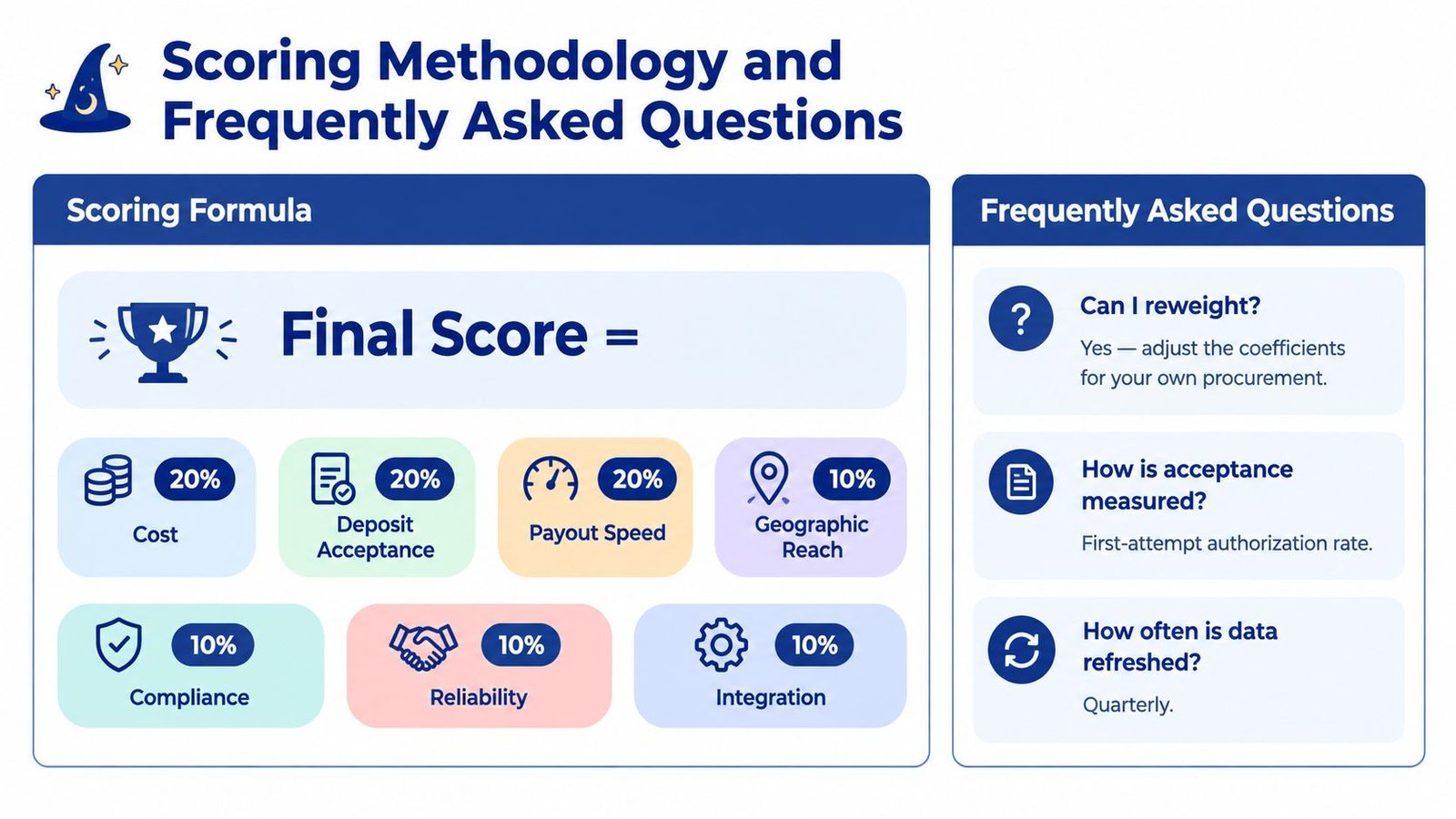
A transparent score should be adjustable. The proposed formula uses a 1-to-10 sub-score for each criterion, based on public fee schedules, provider documentation, and observed operator testimonials:
- Cost: 20%
- Deposit acceptance: 20%
- Payout speed: 20%
- Geographic reach: 10%
- KYC and fraud tooling: 10%
- Crypto support: 10%
- Regulatory standing: 10%
The formula creates a weighted baseline, not a universal truth. An operator serving a crypto-permitted niche may increase the crypto coefficient, while a regulated European operator may assign greater importance to regulatory standing, euro settlement, and payee verification.
Frequently asked questions
Can one provider cover both deposits and payouts?
Yes, some providers can support both, but capability doesn't establish equal performance. The deposit score should reflect first-pass acceptance, while the payout score should reflect time to funds, approval workflow, and settlement reliability.
How should chargebacks be handled when gambling MCCs trigger scrutiny?
The operator should confirm MCC treatment, issuer response procedures, representment support, fraud evidence, and account-ownership controls during the RFP. A provider that only reports the final chargeback ratio won't reveal where the operational burden sits.
Should US operators use crypto?
Only after reviewing state gambling permissions, money-transmitter obligations, sanctions controls, customer identification, transaction monitoring, and tax treatment. Regulation GG and UIGEA make payment legality inseparable from the operator's licence and transaction flow.
How can an operator switch stacks without breaking reconciliation?
Run parallel ledger mapping before migration, preserve transaction identifiers, reconcile deposits and withdrawals separately, and define ownership for refunds, chargebacks, dormant balances, and compliance holds. A staged pilot is safer than changing every rail at once.
The comparison table should serve as the starting shortlist, not the final award decision. Procurement teams should issue a market-specific RFP, test deposits and withdrawals under realistic compliance conditions, and require each bidder to document fallback routing, settlement timing, data exports, and licence coverage.
Operators evaluating an online casino payment providers comparison should build a three-part shortlist: deposit acceptance leader, payout performance leader, and regulatory-routing provider. Top 1 Rank's global iGaming intelligence coverage can support the next stage with market, compliance, fintech, and operator analysis, while the procurement team validates every commercial and legal assumption directly with shortlisted providers.





Join thousands of gaming professionals receiving the latest iGaming news, regulatory updates, and market insights.
