

More than 45,000 games from over 355 studios is the scale attributed to EveryMatrix Aggregation in an independent 2026 comparison. The same comparison lists SOFTSWISS Game Aggregator with more than 40,000 titles from over 300 providers, while Hub88 and Alea each exceed 26,000 games. These figures come from a 2026 comparison of casino aggregators. They also show why catalogue size is a weak buying signal: volume does not confirm licensing, localization, reporting quality, or commercial fit for a target market.
The aggregator model has developed from a technical shortcut into a distribution and compliance layer. Early platforms connected operators and studios through an API. Current offerings can include jurisdiction filters, back-office controls, reporting, tournament tools, real-time analytics, and AI-assisted recommendations. A 2026 industry analysis estimated that aggregators represented about 35% of the global iGaming platform market and valued the broader platform market at $655 billion in 2026, according to Yogonet's analysis of the changing aggregator landscape.
The practical decision is therefore operational. Operators should assess whether a provider fits their licence, jurisdictions, reporting obligations, content priorities, and commercial model, while preserving control over the player experience.
Table of Contents
- What Casino Game Aggregator Providers Actually Do
- How the Aggregator Model Evolved Into a Distribution Layer
- The Technical Mechanics Behind a Single Integration
- Commercial Models and Revenue Share Structures
- Mapping the Competitive Ecosystem in 2026
- Choosing the Right Aggregator for Your Market
- Regulatory Controls, Market Trends, and the Road Ahead
- Actionable Recommendations for Operators and Suppliers
What Casino Game Aggregator Providers Actually Do
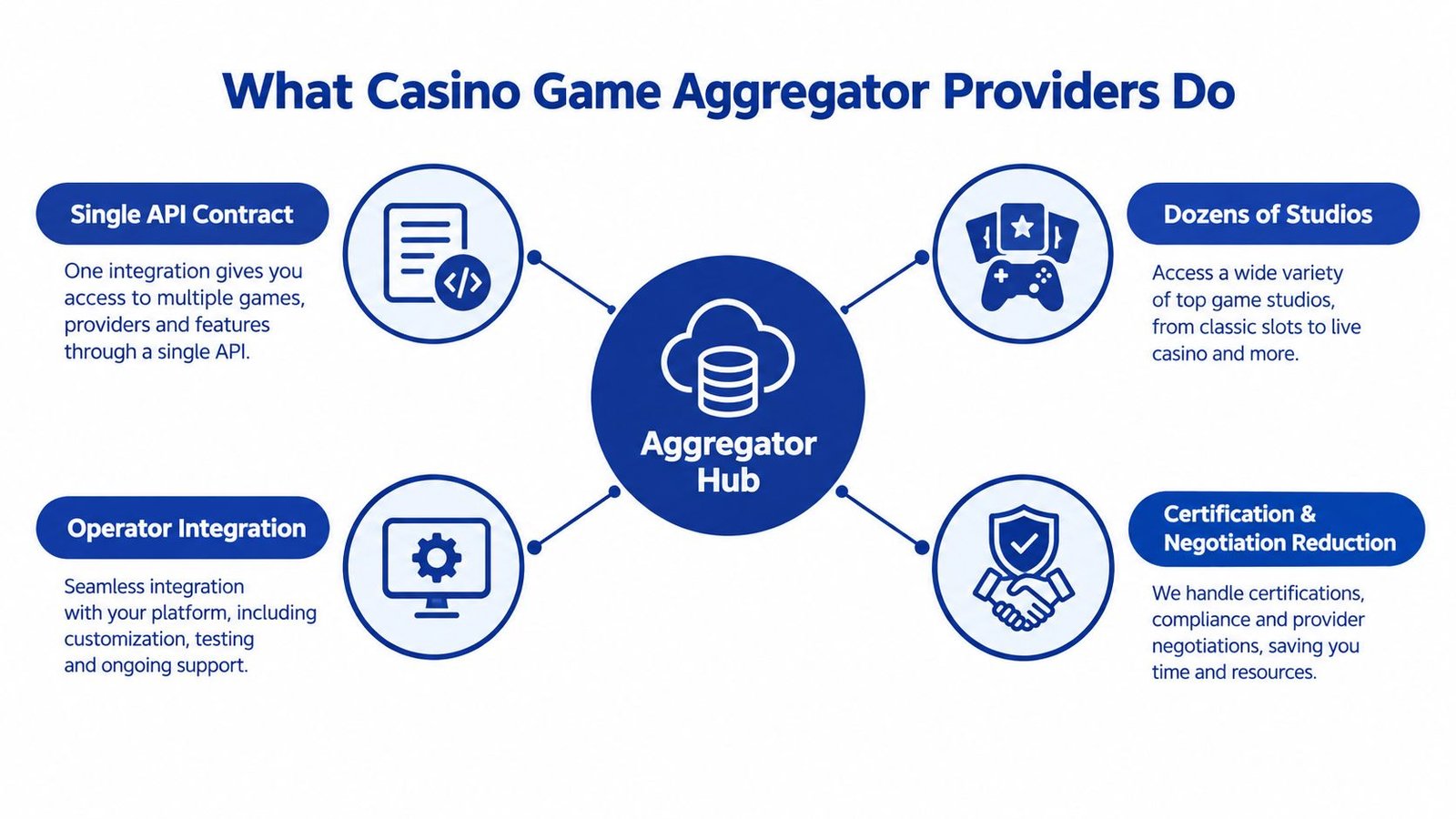
A casino game aggregator provider sits between an online casino and multiple game studios. The operator connects once, while the aggregator manages the technical and commercial relationships required to distribute content from many suppliers. The model is described directly by ST8's explanation of casino game aggregation, which identifies the single integration as the core architecture.
Three functions define the model:
- Integration: The aggregator converts different studio APIs, SDKs, authentication methods, and event formats into a normalized operator-facing interface.
- Distribution: It makes games available for launch, organizes lobby placement, and can support promotional surfacing through tools such as tournaments or featured content.
- Operations: It supports reporting, reconciliation, content updates, bonus compatibility, incident handling, and compliance documentation.
The operator still owns the player relationship. Its wallet, KYC process, responsible-gambling controls, customer account, and regulatory licence remain the operator's responsibility. The aggregator generally owns the studio relationships, technical plumbing, content onboarding, and the operational connections that sit behind the game catalogue.
What the operator gains and what it gives up
A single contract and integration can replace numerous provider-specific connections. That usually improves speed and reduces duplicated maintenance, but it also introduces dependency on an intermediary. If the aggregator has an outage, reporting error, or delayed provider update, several content relationships can be affected at once.
The operator also gives up some direct control over studio negotiations and technical priorities. That trade-off can be sensible for a new market launch, but enterprise operators may still maintain direct relationships with strategically important studios.
For market research on available casino content, operators can also review online casino games in the Philippines alongside the aggregator's certified catalogue. The useful comparison isn't the raw count. It is the availability of approved content, market-specific controls, reporting quality, and commercial clarity.
How the Aggregator Model Evolved Into a Distribution Layer
The model developed in stages, and each stage shifted work away from the operator.
Stage one involved direct studio connections
In the earliest model, an operator connected separately to each game provider. Every studio supplied its own API, launch flow, wallet events, certification process, and reporting format. Operators absorbed the engineering work and had to manage separate commercial agreements.
That structure made content expansion slow and difficult to govern. A new studio didn't just add games. It added another technical relationship, another testing process, and another operational dependency.
Stage two introduced multi-vendor API bridges
Early aggregators in the early 2010s mainly connected operators to multiple studios through a simple API. By the middle of that decade, platforms had added centralized dashboards, back-office tools, reporting, and jurisdiction-based filtering. This history is outlined in Yogonet's account of aggregator development.
The commercial pitch at this stage focused heavily on catalogue breadth. Operators wanted more content with less integration work, and providers competed by adding studios and titles.
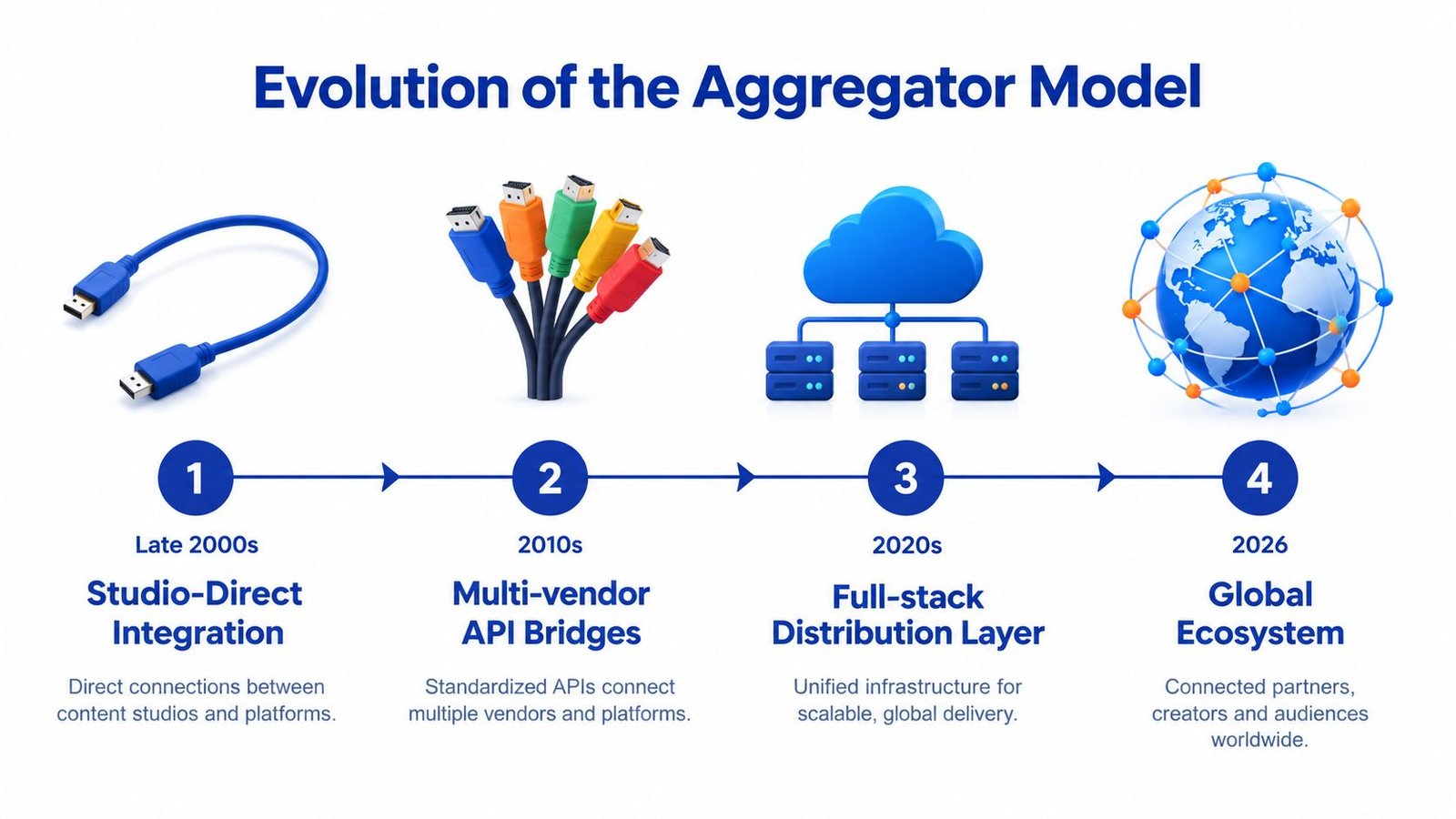
Stage three made compliance part of the product
Regulated markets forced the model to mature. Aggregators began supporting responsible-gambling hooks, jurisdiction-aware content restrictions, per-market configurations, and evidence required for certified deployments. The platform stopped being merely a connector and became part of the operator's control environment.
By the 2020s, aggregators were described as offering thousands of games, tournament tools, real-time analytics, and AI-driven recommendations. The implication is important: once major platforms reached very large catalogues, adding another title became less valuable than improving how an operator selects, restricts, monitors, and monetizes content.
Analyst view: Catalogue depth opens the door. Operational fit determines whether the relationship survives regulatory scrutiny and commercial pressure.
The Technical Mechanics Behind a Single Integration
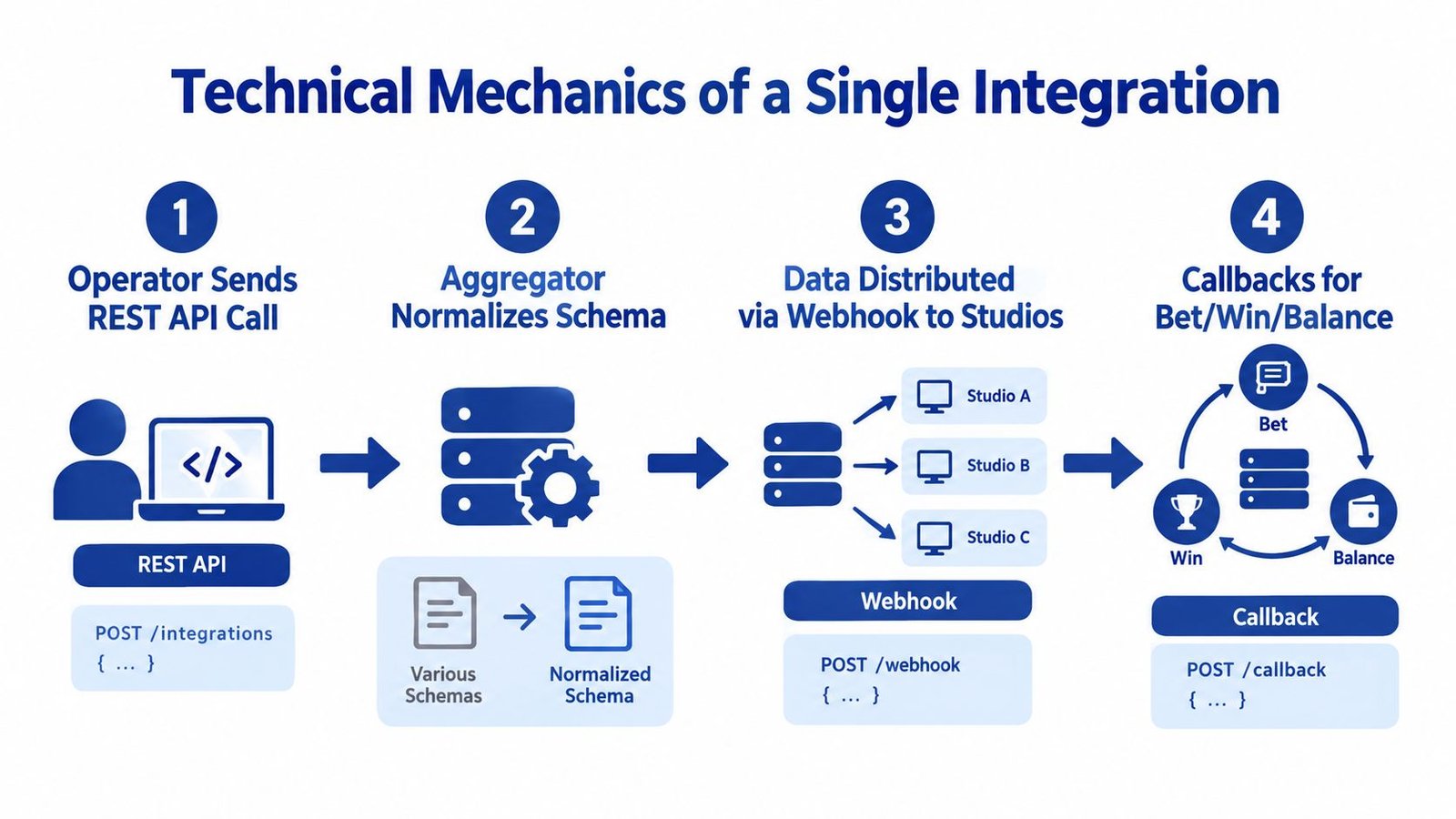
The visible promise is simple, but the underlying work is a chain of translations. An operator connects to a single REST endpoint or webhook layer. The aggregator then routes launch requests, session data, wallet events, and reporting information to the relevant studio.
The most important translation is the normalized callback schema. Studios may describe a wager, win, rollback, refund, balance request, or session event differently. The aggregator maps those provider-specific payloads into one schema so the operator's wallet can process a consistent event stream.
A practical example is a new Hacksaw title launched through an aggregator. The casino's wallet doesn't need a separate implementation for every Hacksaw payload. The aggregator translates the studio's messages, while the operator receives the normalized events required to settle the round, process a free-bet trigger, and record a tournament contribution.
Sessions connect the casino identity to the studio round
The player begins with an identity created by the operator. When the game launches, the aggregator passes a token or session reference to the studio. That reference links the casino account, the game session, the wallet, and the round without requiring the studio to own the operator's complete player account system.
The operator's wallet remains authoritative for balances and transactions. The aggregator handles provider-level session logic and forwards the events required for settlement.
Testing separates certification from production
A competent integration includes a sandbox or staging environment. Developers test launch flows, mock wallets, callback handling, error states, game restrictions, and reconciliation before production approval. The example described by Big Bang Casino's aggregation API documentation exposes one REST endpoint, normalizes callbacks from 22 providers, and includes sandbox testing with a 100K EUR virtual balance.
The distinction between server-to-server and client-rendered integrations also matters. Server-to-server flows carry wallet and settlement instructions between systems, while the client layer launches the game interface and handles the player's visible session. Weak documentation in either layer creates operational risk.
For operators assessing technical readiness, PAGCOR gaming system administrator requirements can provide useful context for the governance and administrative responsibilities surrounding a gaming platform.
Commercial Models and Revenue Share Structures
The commercial agreement determines whether the aggregator lowers the operator's cost of distribution. Headline revenue share is only one input. Contract duration, minimum commitments, setup fees, certification work, reporting access, support levels, and exit rights can change the effective margin substantially.
A revenue-share agreement gives the aggregator a percentage of net gaming revenue generated by supplied content. A fixed monthly minimum guarantee shifts more risk to the operator, even if the nominal share looks attractive. Cost-per-active-player arrangements can suit operators that want predictable acquisition economics, while hybrid models combine setup fees, minimums, and a variable share.
The requested commercial comparison is often unavailable in public evidence, so operators should treat quoted ranges as negotiation inputs rather than market facts.
| Model | Typical Range | Best Fit | Hidden Cost |
|---|---|---|---|
| Revenue share | Negotiated | Operators seeking variable cost | Margin pressure as content scales |
| Monthly minimum guarantee | Contract-specific | Established brands with predictable volume | Payment obligation during weak demand |
| Cost per active player | Negotiated | Campaign-led or emerging launches | Definitions of an active player |
| Hybrid structure | Negotiated | Operators needing onboarding and flexibility | Setup fees, minimums, and layered charges |
| Volume-based profit share | Tiered by contract | High-volume operators | Complexity in reconciliation and thresholds |
The apparent discount can hide control terms
A low revenue share may come with a minimum guarantee, an exclusivity clause, limited reporting rights, or restrictions on direct studio relationships. A higher share may purchase faster onboarding, broader regulatory support, stronger account management, or priority incident response.
That makes the contract a product decision, not just a finance decision. Operators should model the cost of delayed launches, unavailable games, re-certification, manual reconciliation, and an eventual migration.
Practical rule: Compare effective margin retained after every mandatory fee, not the percentage printed at the top of the proposal.
Emerging-market launches can add another layer. An aggregator may fund or coordinate compliance work in exchange for a longer commitment. That structure can accelerate entry, but the operator should confirm who owns the documentation, who pays for future changes, and what happens if a regulator changes the market rules.
Mapping the Competitive Ecosystem in 2026
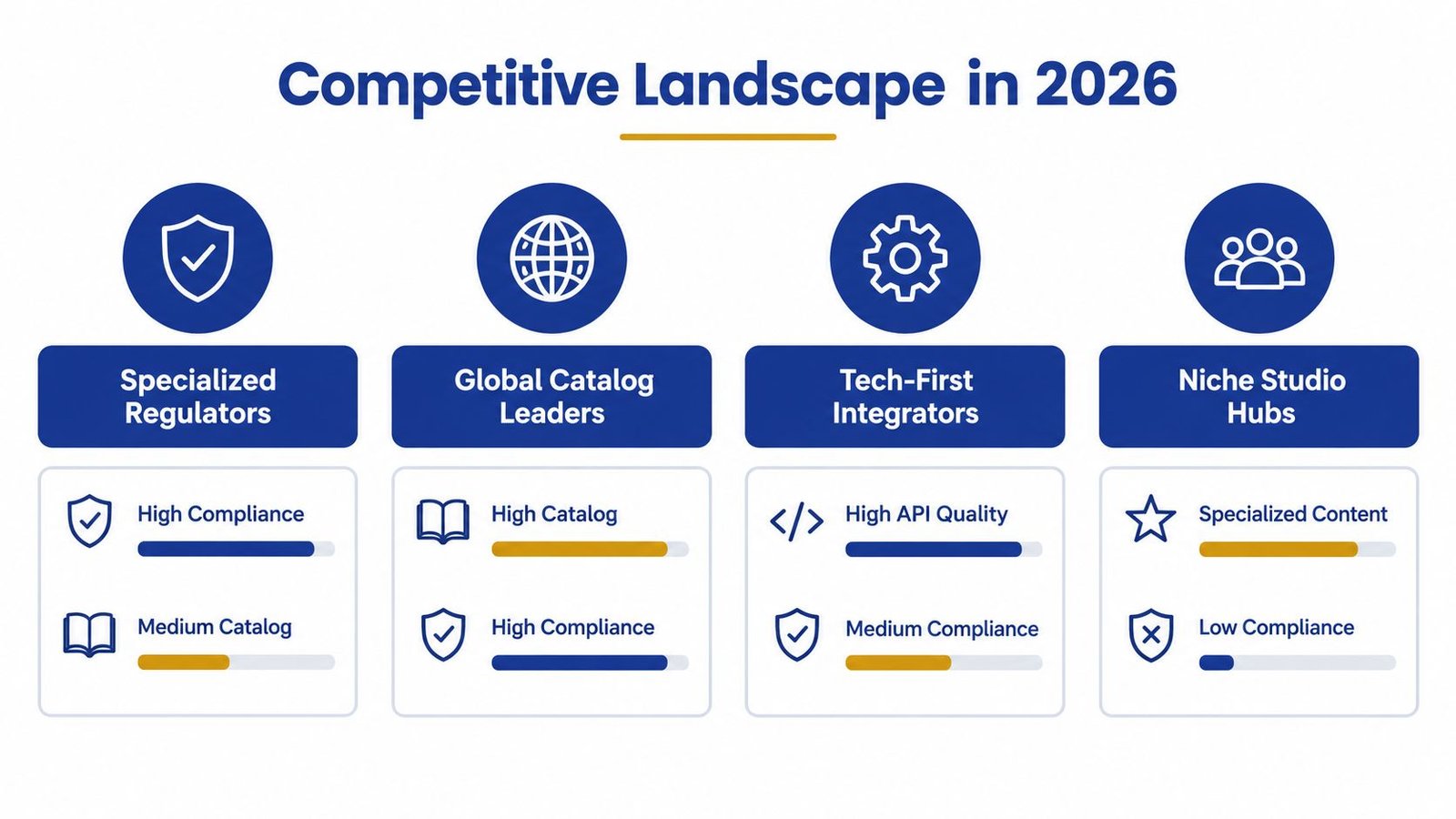
The competitive ecosystem is clearer when providers are grouped by strategic role rather than catalogue size. Public comparisons show extensive libraries across EveryMatrix Aggregation, SOFTSWISS Game Aggregator, Hub88, and Alea, making scale a baseline capability instead of a decisive differentiator. The operator's real question is what the platform does around that content.
Regulated-market specialists
Providers built around licensed markets typically emphasize certification, jurisdiction filtering, reporting, and market-specific controls. They suit operators that value predictable deployment and documented governance over unrestricted content breadth.
The trade-off may be narrower commercial flexibility or slower onboarding when each title requires market evidence and approval. That friction can represent governance rather than weak service. It also reduces the risk of introducing content that later requires removal or re-certification.
Crypto-native platforms
Crypto-focused aggregators tend to prioritize multi-currency wallets, rapid launches, and content suited to offshore or hybrid operating models. They can appeal to operators testing markets where speed and payment flexibility carry more weight.
Their main limitation is regulatory portability. A platform designed for flexible crypto distribution may need additional controls, documentation, and supplier screening before supporting a tightly regulated European deployment. Operators should assess the compliance work required to move beyond the original operating model.
Turnkey and aggregation hybrids
EveryMatrix and Pragmatic Solutions illustrate the hybrid model described in industry coverage. These platforms combine aggregation with broader platform, sportsbook, player-management, promotional, or operational capabilities.
The benefit is fewer vendor relationships and a more unified operating stack. The cost is concentration risk. Replacing one component may become harder when several functions depend on the same supplier, so contract portability and exit procedures deserve review before implementation.
Emerging-market challengers
Providers focused on Latin America and Africa often compete through local relationships, payment knowledge, regional support, and faster commercial execution. Their strength may be market understanding rather than global catalogue depth.
That advantage is credible only when supported by durable certification processes, reliable reporting, and a clear route into additional jurisdictions. Regional knowledge should therefore be assessed alongside operational controls, not treated as a substitute for them.
The 2026 shift is toward higher-value services. As some studios approach major operators directly, aggregators face pressure on distribution margins and must justify their role through compliance, CRM, jackpots, analytics, and engagement layers. Operators reviewing PAGCOR regulatory updates for 2026 should assess governance capability, reporting quality, and operational support, not only the studio roster.
Choosing the Right Aggregator for Your Market
Selection should start with the target jurisdiction, not the game catalogue. A platform that works well for an offshore crypto operation may be poorly suited to a licensed European launch. A regional specialist may outperform a global provider in Latin America if it supplies better local reporting and certification support.
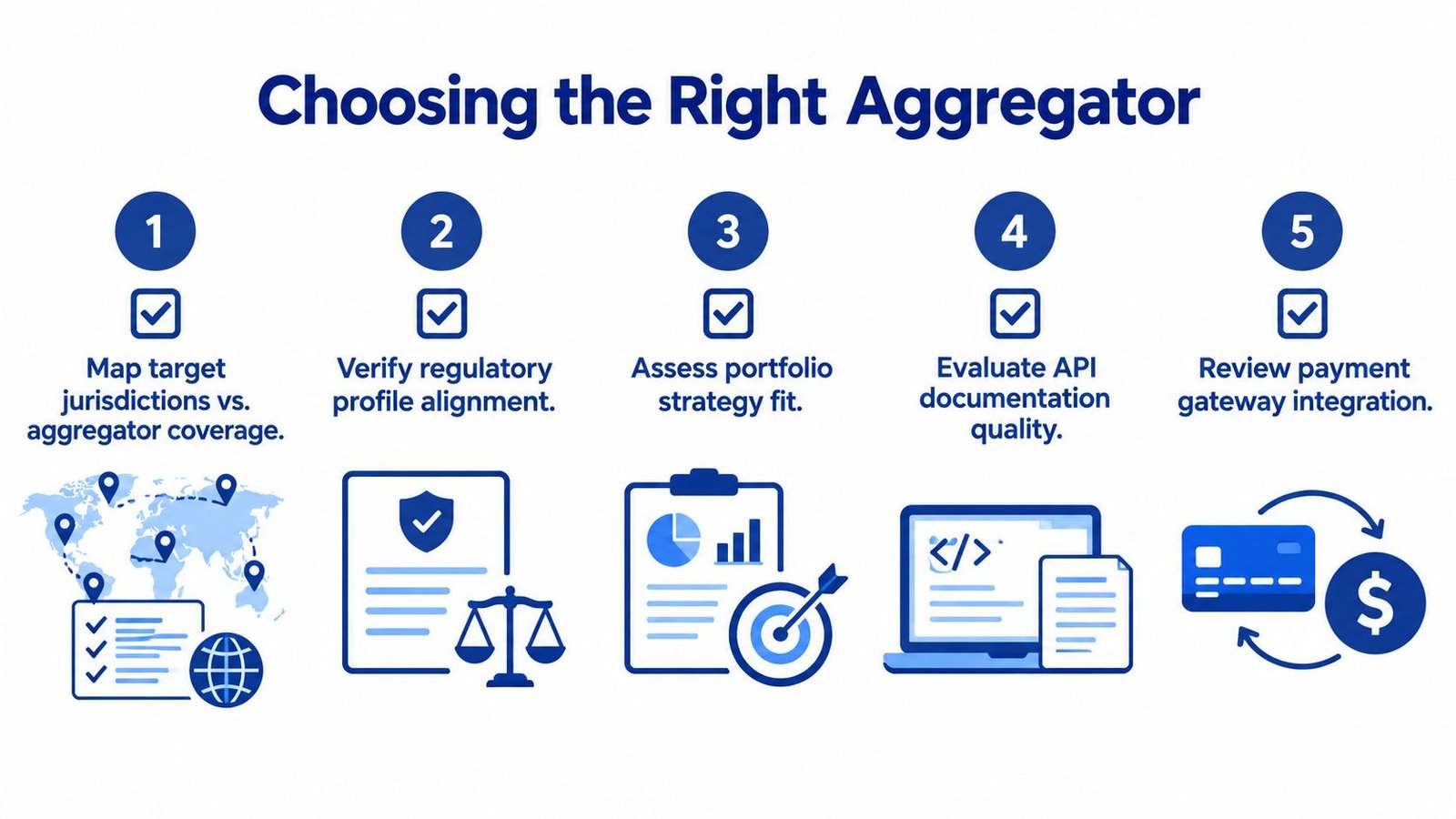
Five checks produce a more reliable shortlist
Map jurisdiction coverage. Compare the operator's target markets with the aggregator's certified content, restrictions, reporting capability, and documentation. UKGC, MGA, Curaçao, Ontario, and Brazil's SPA can require different evidence and operating controls.
Test portfolio fit. Separate the catalogue into the categories that matter to the audience. A broad slots portfolio doesn't compensate for weak live dealer coverage, limited crash games, or unsuitable crash and skill hybrids.
Audit the integration. Review API documentation, sandbox stability, authentication, callback latency, error handling, reporting granularity, and dispute workflows. A polished sales demo can't substitute for a failed settlement test.
Calculate total cost of ownership. Include revenue share, minimum guarantees, setup charges, certification re-cuts, reporting fees, support costs, migration work, and exit obligations. The cheapest quoted share can produce the highest operating cost.
Check roadmap alignment. Scaling operators may need regulated live dealer, jackpots, real-time analytics, and AI-driven personalization. Market testers may prefer a clean API and quick onboarding over a broad product suite.
The decision should include a failure scenario
The evaluation team should ask what happens when a studio changes an endpoint, a title loses market approval, a round remains unsettled, or an operator exits a territory. The answers reveal whether the aggregator is a real operating layer or just a catalogue broker.
An operator can also compare direct content relationships with aggregation. Direct integration may make sense for a strategically important studio, while an aggregator remains efficient for long-tail content. The strongest architecture may be deliberately mixed.
Regulatory Controls, Market Trends, and the Road Ahead
Regulation is turning aggregation into infrastructure. Jurisdiction-level game blocking, per-market RTP configuration, session and reality-check controls, transaction audit trails, and certified RNG content determine whether an operator can legally and operationally offer a game. OHS Gaming's description of casino game aggregator controls identifies these mechanisms as practical differentiators.
Three pressures are converging.
| Trend | Impact on Aggregators | Regions Most Affected | Operator Response |
|---|---|---|---|
| Regulatory fragmentation | More certification, filtering, and reporting work | Licensed and multi-market operations | Require market-specific evidence before onboarding |
| Crypto-native distribution | Faster flexible launches, with heavier scrutiny in regulated markets | Latin America, Africa, and Europe | Separate payment flexibility from licensing suitability |
| Proprietary versus third-party content | Aggregators must provide distribution value beyond access | Global operator and studio markets | Build a portfolio that combines owned and supplied content |
| AI-assisted discovery | More emphasis on recommendation and engagement layers | Operators with large content libraries | Demand explainable controls and usable analytics |
The proprietary-content debate illustrates why aggregation remains relevant. Recent coverage reported that proprietary games grew 70% year over year in Q4 2025, while third-party content still contributed 48.9% of Q1 2026 revenue. Those figures are reported in Partnerkin's coverage of casino game aggregators. The conclusion isn't that operators should choose proprietary content over aggregation. It is that aggregation remains valuable even as operators and studios seek more control over differentiated content.
The next generation of providers will function less like brokers and more like compliance and analytics systems. They will need to show why a title is available in a market, how a restriction was applied, how a transaction was reconciled, and what operational evidence can be supplied to a regulator.
For operators examining PAGCOR game aggregator accreditation requirements, the central test is accountability. A platform that distributes content without producing reliable evidence creates work rather than removing it.
Actionable Recommendations for Operators and Suppliers
Operators can improve vendor selection by turning demonstrations into controlled tests. The following checklist focuses on evidence that can be verified before a contract is signed.
- Confirm market coverage: Request the jurisdiction list, certified game inventory, restriction logic, and documentation for every planned launch market.
- Model the full commercial outcome: Add revenue share, minimum commitments, setup fees, reporting charges, certification changes, support, and exit costs.
- Run the sandbox: Test game launch, balance calls, bet, win, rollback, refund, timeout, and reconciliation scenarios with realistic failure handling.
- Validate bonus compatibility: Confirm whether free spins, tournaments, jackpots, loyalty features, and bonus-engine triggers pass cleanly through the integration.
- Review incident ownership: Define response times, escalation routes, status reporting, and responsibility when a studio or market restriction changes.
- Negotiate exit rights: Address exclusivity, content removal, data portability, outstanding rounds, and migration assistance before launch.
Suppliers need a different checklist. They should sequence certification work around the markets where the aggregator has genuine distribution strength, define data and reporting responsibilities in the studio agreement, and maintain commercial influence where direct operator relationships remain strategically important.
A game provider should also ask whether the aggregator can protect the studio's content positioning. A giant catalogue may increase distribution, but poor lobby placement, weak reporting, or unrestricted duplication can reduce the value of a distinctive release.
Operators assessing business-to-business entry can review the PAGCOR B2B provider application process as part of the broader licensing and supplier-readiness analysis. Top 1 Rank can also be used as one market-intelligence resource for tracking regulation, supplier positioning, and iGaming technology developments.
The immediate action is practical: shortlist providers by jurisdiction, run the same technical test against each platform, calculate effective margin under comparable assumptions, and reject any proposal that cannot explain its compliance and exit mechanics. For operator teams planning a launch, that process will reveal more than another catalogue comparison ever could.
Operators and suppliers should use this framework before the next aggregator negotiation. Map the target markets, request certification evidence, run a sandbox settlement test, and compare total cost rather than advertised game counts. A provider that passes those tests is worth a serious commercial review.





Join thousands of gaming professionals receiving the latest iGaming news, regulatory updates, and market insights.
