

Esports betting data is usually sold as a growth story. That framing is too simple. The sharper question for operators is not how fast the category grows, but what kind of data exists, who controls it, and how much of it can be trusted for pricing, surveillance, and compliance.
That distinction matters because esports wagering is measured through a patchwork of surveys, operator feeds, regulator aggregates, and integrity alerts, each with different definitions and blind spots. A market can look large in a forecast and still remain hard to measure cleanly, hard to price efficiently, and hard to police consistently.
Table of Contents
- Why Esports Betting Data Is Harder Than It Looks
- The Core Data Types Operators Actually Use
- Data Quality Standards and Chain of Custody
- Pricing Models and the Calibration Problem
- Integrity Monitoring and the Detection Paradox
- Participant Restrictions and the ESIC Compliance Layer
- Reading Participation Surveys the Right Way
- Building an Esports Data Program That Holds Up
Why Esports Betting Data Is Harder Than It Looks
The biggest mistake in esports betting analysis is to treat one market-size figure as if it were settled fact. It isn't. Reported 2025 global estimates range from $12.59 billion to $16.29 billion, a spread of roughly 29%, because regulators don't usually publish esports as a separate category and national definitions vary on what counts as an esports wager Track360's market-size review.
Measurement comes before strategy
That spread is not a footnote. It means operators, investors, and compliance teams are often looking at different objects and calling them the same thing. A participation survey, an operator revenue figure, and a modelled market-size estimate each answer a different question, so they can't be used interchangeably.
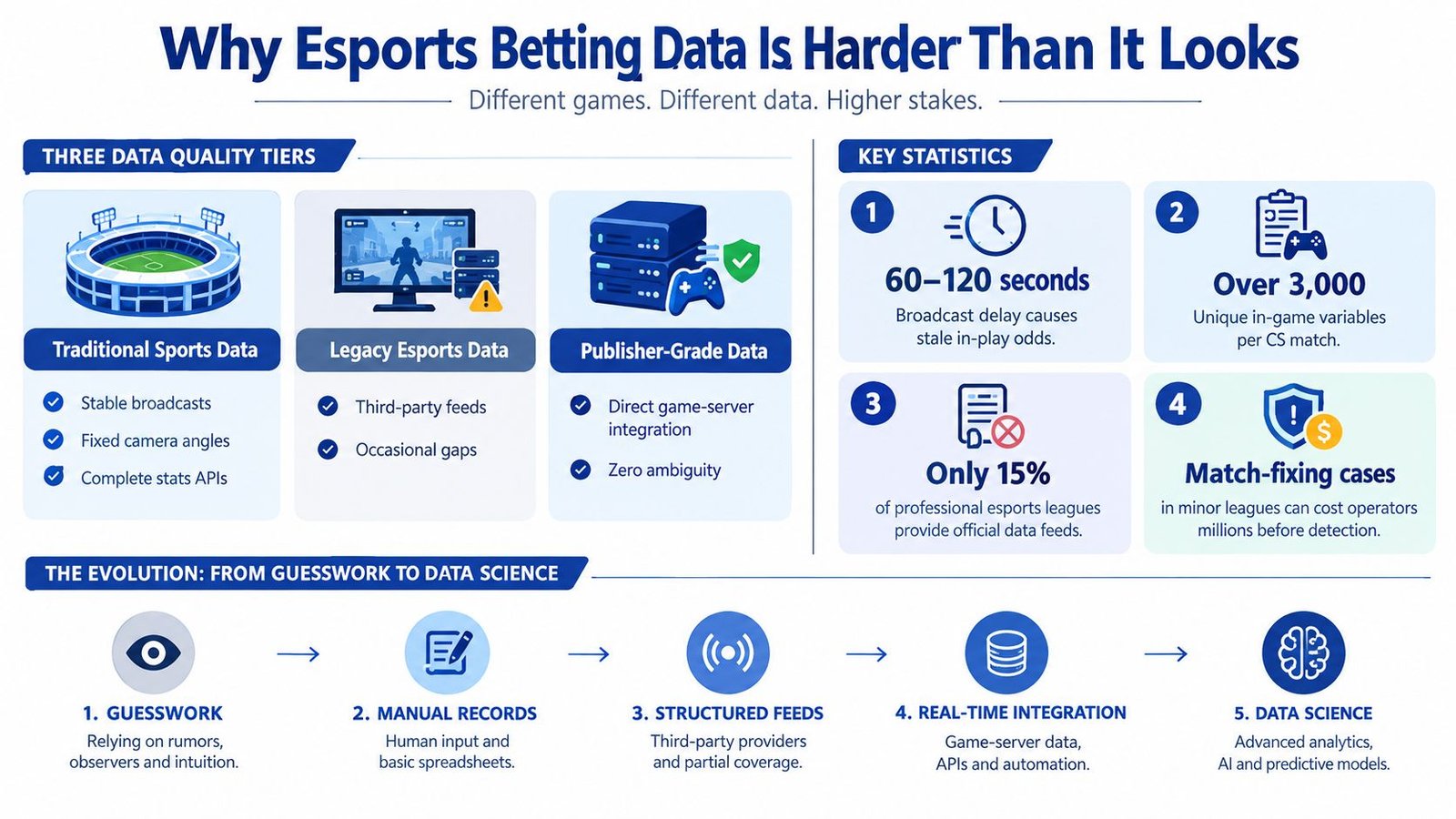
The useful starting point is to separate observable activity from commercial inference. Participation surveys can show whether people wagered. Operator telemetry can show what was staked on a platform. Integrity feeds can show suspicious patterns. None of those, by itself, gives a clean total of the global market.
Practical rule: if the figure doesn't state the population, age band, geography, and measurement window, it isn't precise enough for board-level planning.
That's why esports betting data is better treated as a measurement stack than a single dataset. The stack becomes more useful when it's read with the right question attached. Is the team sizing demand, checking compliance exposure, evaluating liquidity, or testing integrity risk? The answer changes the data that matters.
For product and trading teams, that matters immediately. A forecast based on broad market-size estimates can mislead margin planning. A compliance benchmark based on participation data can misstate exposure. A surveillance program built on one operator's transaction logs can miss activity outside its footprint.
A cleaner framing is to treat esports betting as a category where prevalence, handle, revenue, and integrity risk all need different evidence. That sounds obvious, but most commentary still blurs them together. It's why so much of the market remains noisy even when the underlying activity is real.
For a parallel example of why data quality shapes pricing judgments in gaming products, see the discussion of probability and variance in color-game formats. The same discipline applies here, just with a far more complex market structure.
The Core Data Types Operators Actually Use
The operational view starts with four data types that do different jobs. Odds feeds show where the market is pricing probability. Telemetry shows what happened in the game. Liquidity and matched-volume data show how much money is moving. Account-level records show how individual customers behave inside one operator's own perimeter.
What each feed can, and can't, tell a trading desk
Odds feeds are the fastest read on consensus, but they don't explain why a line moved. A price change might reflect genuine information, a delayed feed, roster news, or a bookmaker's own risk response. Telemetry is richer because it captures game state, yet it doesn't solve the question of whether the data arrived on time or was filtered before it reached the trader.
Liquidity data is useful for telling the difference between a thin market and an active one. It helps risk teams avoid over-reading small movements in low-volume titles. Account-level data is the most direct way to see customer behavior, but only within the operator's own books, which means it can't show the full market picture.
Odds tell the desk where the market is. They don't tell it why the market got there.
A useful workflow is to assign each data type a specific question:
- Odds feeds: Where is implied probability being priced right now?
- Telemetry: What was the actual in-game state when the market moved?
- Liquidity data: Was the move supported by real participation or just a thin book?
- Account-level records: Did a small group of accounts concentrate the action?
That separation matters because the wrong feed can make the right trader look wrong. A live market with poor telemetry can produce false confidence. A customer file without broader odds context can make local activity look abnormal when it's merely isolated.
For esports, the best internal question isn't “do we have data?” It's “which decision does each feed support, and which decision does it not support?” That discipline keeps traders from asking account records to do the job of telemetry, or asking odds feeds to prove intent.
For operators comparing market coverage and live pricing systems, the practical distinction between raw odds and deeper data stacks is the same one used in MPBL betting odds workflows. Feed depth and market context are separate advantages.
Data Quality Standards and Chain of Custody
The first question in esports betting data is not volume or speed. It is whether the feed can be defended later, record by record. The International Betting Integrity Association standards set that bar through game-server integration with the organiser or publisher, without delay distribution, post-match quality assurance, linkage to documented user activity for each record, and retention for at least three years IBIA data standards.
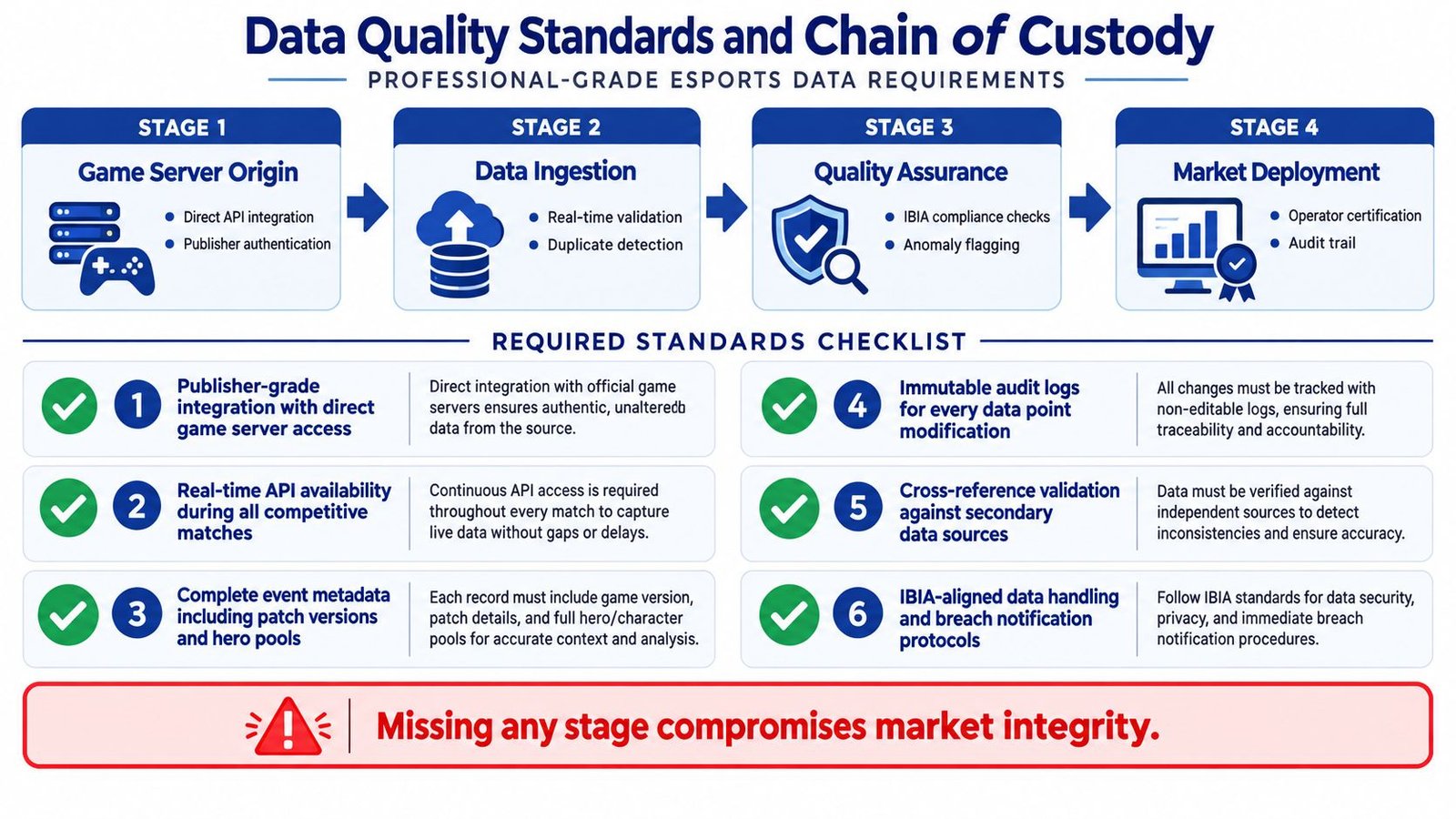
A weak chain of custody creates three problems at once. Pricing errors rise when live markets lean on a delayed or incomplete feed. Settlement becomes harder to defend if the underlying event record cannot be traced cleanly. Integrity reviews also lose value when the operator cannot show where each record came from.
Bayes Esports made the same case to Nevada gaming authorities, arguing for non-delayed, official data for in-game predictions and settlement, and for approving only events that provide that feed Bayes presentation to Nevada gaming authorities. That is a trading control, not a preference about vendor quality. It tells the desk which events can be priced and settled with confidence, and which ones should stay outside the book.
Vendor review should stay pointed and operational:
- Origin: Does the feed come from the publisher or game server, or from a reconstructed third party source?
- Latency: Can the supplier prove non-delayed delivery during live markets?
- Audit trail: Can every record be linked to a user action and retained for review?
- Assurance: Are post-match checks and breach notifications built into the workflow?
- Operational fit: Does the feed support settlement, monitoring, and investigations without manual reconciliation?
The control question is simple. If the chain of custody cannot survive an internal challenge, the feed is not ready to carry live risk. A market may still open, but it opens on evidence that is hard to defend.
Teams working through local licensing and data-governance rules will recognize the same logic in the PAGCOR gaming system administrator requirements. Process control and output control need to match.
Pricing Models and the Calibration Problem
Esports pricing is not just a margin exercise. It is a calibration problem, and the clearest evidence can cut against intuition. A study of 3,075 Counter-Strike: Global Offensive matches found a reverse favorite-longshot bias, which means bettors assigned too much implied probability to longshot outcomes. That points to markets that may not be well calibrated, at least in that sample study of CS:GO matches.
Why the bias matters to a sportsbook
The trading implication is simple. If longshots are priced too aggressively relative to favorites, a flat margin assumption across every odds band will blur the signal. Traders need to compare implied probability with realized win frequency after removing the bookmaker's hold.
Aggregation hides the problem. A market can look acceptable overall and still be mispriced in specific bands. Closing-line performance should be reviewed by probability band, game title, tournament tier, and market type. Blended esports averages are too coarse for trading decisions.
A practical calibration loop is straightforward:
- Strip the margin from the bookmaker price.
- Bucket markets by implied probability band.
- Compare implied probability with realized win frequency.
- Weight recent data more heavily than older data.
- Separate by title and tier, since roster churn, patches, and map pools move quickly.
The point is not to prove every esports market shares the same bias. The point is to avoid treating one hold target as fit for all titles. Counter-Strike does not behave like a low-tier regional circuit, and a live line on a major event is not the same market as a pre-match price on a minor fixture.
Trading rule: evaluate calibration by price bucket first, then by title and competition tier.
That rule also limits the damage from stale history. In esports, older samples lose relevance faster than in many traditional sports because the game changes, not only the participants. A model that weights last season and this season equally can end up fitting a version of the game that no longer exists.
The stronger approach is continuous model maintenance. Traders who monitor calibration by segment can see where the book is drifting before that drift becomes structural.
Integrity Monitoring and the Detection Paradox
Integrity monitoring works best when a suspicious move is treated as a lead, not as proof. The useful workflow starts with expected probabilities from forecasting models, compares them with observed odds across multiple books, and then sends large residuals to review. Esports-focused integrity work also uses crawler tools to watch for unusual market movement integrity detection workflow.
How the surveillance stack should work
The best setup pulls from several layers. Forecasting models set the baseline. Odds crawlers show whether books are moving together. Account-level data, where it can be used legally, shows whether activity is clustered. Game-state telemetry and outside event data help explain whether the move fits the match context.
Alerts should be sorted by quality, not just counted. Persistence matters. Cross-operator synchronization matters. Abnormal volume matters. Timing relative to the game matters. A line that moves before a roster update points to a different risk than one that moves after a scoring event.
The detection split is the main operational clue. A report on esports integrity cases recorded 46 suspicious esports matches, with 39% flagged in pre-match markets only, 26% in live markets only, and 35% in both. That pattern means live-only monitoring would miss a meaningful share of the signal.
Operational warning: a sharp move is an alert, not a verdict.
That distinction matters because not every price dislocation is malicious. Latency, roster news, feed errors, and data-quality problems can all pull a market away from fair value. Automatic suspension without review can hurt trading efficiency just as much as ignoring the move can hurt integrity.
A cleaner workflow applies these filters before escalation:
- Persistence: Does the move survive more than one update cycle?
- Synchronization: Do several operators move together?
- Volume: Is the change supported by real money, or only thin liquidity?
- Timing: Did it happen before a game event, after one, or out of sequence?
The detection paradox is straightforward. Suspicious-match counts are detection data, not prevalence data. More alerts can mean the monitoring net improved, not that the underlying sport deteriorated. Analysts, regulators, and compliance teams need to keep that distinction intact when they read the numbers.
For related risk checks around suspicious activity and account behavior, the same investigative discipline applies in guidance on avoiding phishing and account compromise, because compromised access can look like anomalous betting until the source is verified.
Participant Restrictions and the ESIC Compliance Layer
Odds feeds do not catch the person who already knows more than the market. The Esports Integrity Commission code bars participants from betting on matches or events in games where they play professionally or otherwise take part, including as a manager, coach, or agent. It also reaches in-game item wagering and daily fantasy contests where local law treats those products as betting ESIC code.
The trading issue is simple. A participant can see roster changes, scrim results, strategy shifts, or team intent before the market does. None of that appears in an odds feed until after the line has already moved.
So the compliance layer has to identify relationships, not just bets. Screening account records against known participants is one control. Monitoring item-based wagering is another. Product classification matters too, because fantasy formats can fall under different rules depending on jurisdiction.
A sportsbook team should answer three questions before it trusts the market view:
- Who is restricted: players, coaches, managers, agents, and related personnel.
- What is restricted: betting on matches or events in their own games, plus item-based and fantasy formats where applicable.
- How it is enforced: account screening, participant declarations, and product-level monitoring.
A useful rule is to treat item value as cash-like where the jurisdiction does. Skins and similar products can create the same conflict-of-interest risk as conventional fixed-odds betting, even if the transaction surface looks different.
Restricted access has to be mapped to the product catalog, not just to the sportsbook brand. For advertising and product governance, that also means checking the wider compliance setting, including PAGCOR gambling advertising rules, so messaging does not conflict with internal betting restrictions.
The broader point is that participant controls and market surveillance solve different problems. One checks who may bet. The other checks how markets move. A sportsbook that only runs one of those controls remains exposed in ways it will only see after the event.
Reading Participation Surveys the Right Way
Survey data helps, but only if analysts treat it as participation evidence, not a proxy for turnover. The UK Gambling Commission estimated in 2017 that 8.5% of adults had bet on esports, while the Emerging Adults Gambling Study found that 2.9% of 3,549 surveyed 16-to-24-year-olds in Great Britain had bet on esports in the previous year UK and Emerging Adults findings.
The two figures sit in different frames. One uses an adult population. The other focuses on a younger sample and a previous-year window. Read together, they show why esports betting data has to be handled as measured participation, not as a single market headline.
A survey can show whether betting exists and how far it reaches. It cannot show stake, frequency, or operator margin. It also cannot be turned into a handle estimate without live betting records.
The useful reading sequence is simple:
- Check the population: adult sample or youth sample, broad or narrow age band.
- Check the geography: Great Britain is not a global proxy.
- Check the window: previous year, point-in-time, or lifetime experience.
- Check the metric: participation is not spend, and spend is not handle.
Participation surveys show reach. They do not show revenue.
That distinction matters for affiliates, investors, and operators. A survey can support the view that esports betting has reached awareness in a market. It cannot support a turnover estimate unless operator or regulator data fills the gap.
The boardroom question should therefore be tighter than “how big is the market?” It should be: how many people participated, under what definition, and what other data is needed before anyone tries to infer commercial value? That framing is more cautious, and it is more accurate.
Building an Esports Data Program That Holds Up
The strongest esports data programs are built in the same order they fail least often. Start with publisher-grade feeds and auditable custody. Layer in continuous probability calibration by title and tier. Add integrity surveillance that combines model residuals with odds crawling. Then enforce participant restrictions that cover item wagering and fantasy formats.
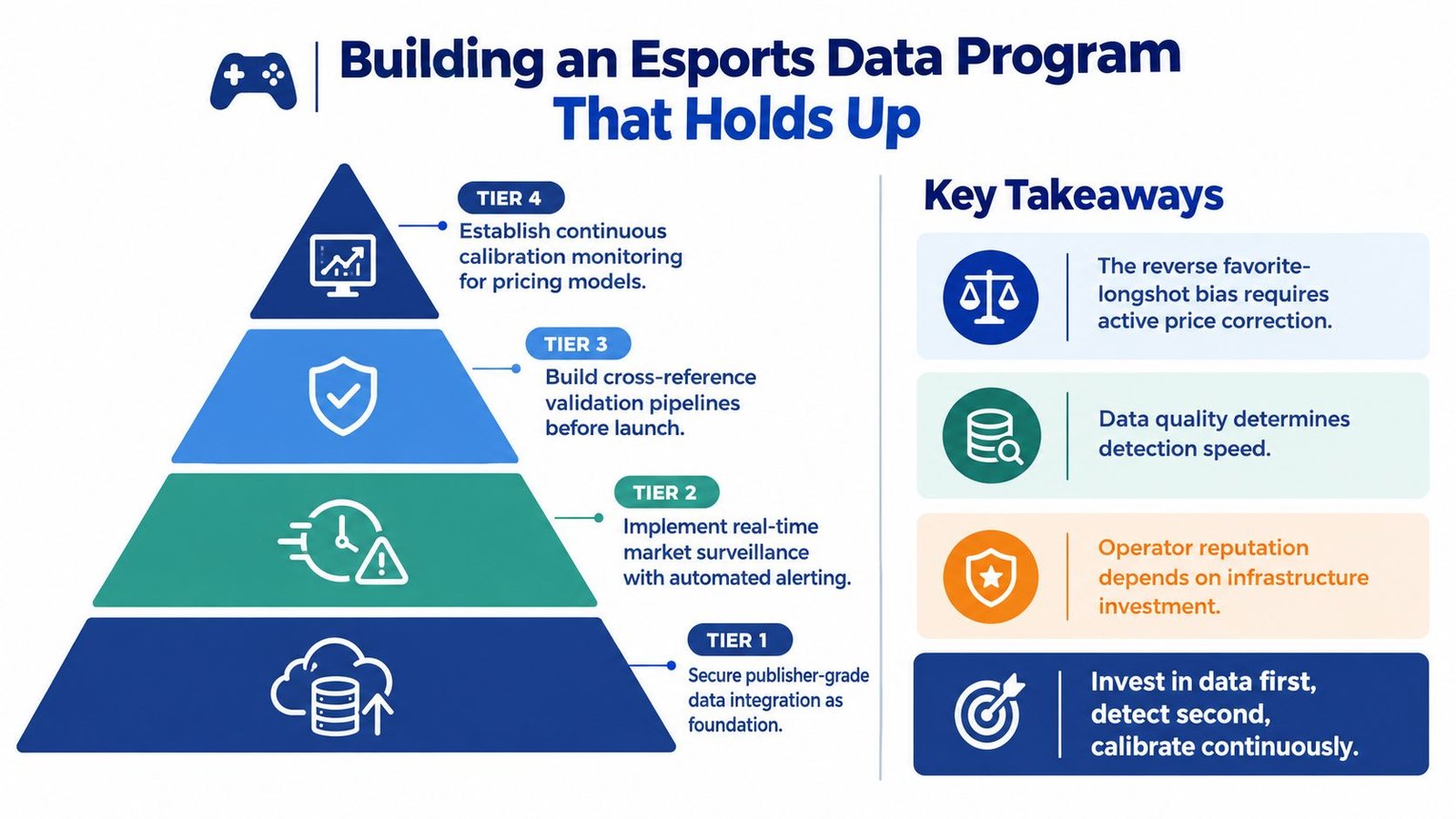
A practical verification checklist
- Source integrity: Can every live-market input be traced to an official or publisher-grade source?
- Calibration discipline: Are probability bands reviewed separately by title and competition tier?
- Surveillance coverage: Does the integrity stack look at pre-match, live, and cross-operator movement together?
- Participant screening: Are players, coaches, managers, and agents screened against betting and item-based products?
- Data interpretation: Are suspicious-match counts being normalized as detection data rather than read as prevalence?
The core conclusion is simple. In esports betting, infrastructure isn't a back-office issue. It determines how fast a desk sees risk, how well a book prices probability, and how confidently a compliance team can defend a market decision. The operators that treat data as an edge, not a utility, will be the ones that can scale without guessing.
For a deeper editorial and commercial briefing on esports betting data, operators and compliance teams can follow the latest analysis from Top 1 Rank at instaplayph.com, where market intelligence and regulatory context are tracked for gaming professionals.





Join thousands of gaming professionals receiving the latest iGaming news, regulatory updates, and market insights.
