


Europe's online gambling economy generated €47.9 billion in 2024, but the headline total conceals two different commercial systems. Online casino produced €21.5 billion, while online sports and events betting generated €13.7 billion, according to the European Gaming and Betting Association's market figures. The difference isn't cosmetic. Casino depends on continuous-play mathematics and game availability, while sportsbook performance depends on event calendars, data feeds, trading decisions, and market suspension controls.
For operators, suppliers, regulators, investors, and affiliates, treating online casino and sportsbook as one interchangeable category creates avoidable errors. Customer acquisition, technology procurement, compliance testing, safer-gambling controls, and revenue forecasting all need product-specific assumptions. Top 1 Rank examines the structural divide.
Table of Contents
- Market Sizing and Revenue Composition
- Divergent Product Mechanics and Mathematics
- Product-Level Regulatory Interventions
- Technology Stack and Infrastructure Requirements
- The Withdrawal and Verification Friction Point
- Safer Gambling and Product Risk Profiles
- Strategic Imperatives for Operators and Investors
Market Sizing and Revenue Composition
Europe's gambling market reached an estimated €123.4 billion in 2024, with online gambling contributing €47.9 billion, or approximately 39% of the total, compared with 37% in 2023. As noted above, online casino and sportsbook account for different portions of that digital activity. The relevant question for operators and investors is how those portions translate into different revenue engines, cost bases, and exposure to market conditions. These figures are reported in the EGBA European Gambling Market Key Figures 2025 Edition.
| Product vertical | Revenue in 2024 | Market share |
|---|---|---|
| Online casino | €21.5 billion | 45% |
| Sports and events betting | €13.7 billion | 29% |
The larger casino share reflects an always-available product. Customers can open games throughout the day, and revenue accumulates through repeated play. Sportsbook activity follows a different schedule. Demand concentrates around competitions and markets such as match results, football, and horse racing, creating greater exposure to fixtures, seasonality, and event availability.
Great Britain provides a separate view of the same divide. The UK Gambling Commission's official industry statistics cover April 2023 to March 2024, alongside historical data reaching back to 2009. During the latest reporting year, the gambling industry generated £15.6 billion in gross gambling yield, up 3.5% year over year and 10.2% above the April 2019 to March 2020 pre-lockdown period.
Why the revenue split changes operating models
Online casino games generated £4.4 billion in Great Britain during that reporting year. Slots produced £3.6 billion, approximately 82% of online casino yield, indicating the importance of high-frequency, continuous-play formats. Remote betting generated £2.4 billion, including £1.1 billion from football and £771.1 million from horse betting.
These figures support separate planning rather than a single blended forecast. Casino models should track yield, game-level activity, and retention. Sportsbook models should also account for handle, margin, event concentration, fixture cancellations, data interruptions, and market suspensions.
Investor implication: A shared brand can combine customer relationships, but casino and sportsbook still require distinct assumptions about supply, activity, risk, and compliance.
National markets add another layer of variation. Online casino represented more than 60% of online revenue in countries such as Malta, Estonia, and Latvia, while sports betting dominated in Cyprus and Slovakia, according to the European online gaming market overview. Regulation, taxation, product availability, consumer preferences, and sporting culture help explain the different mixes.
Acquisition economics should reflect that variation. Customer acquisition cost measured against blended platform revenue can obscure weak performance in one vertical or overstate the quality of another. Operators assessing user acquisition cost in iGaming should separate casino and sportsbook cohorts, then compare payback, activity quality, promotional exposure, and regulatory restrictions by jurisdiction. The resulting view is more useful for allocating marketing capital and valuing each product line independently.
Divergent Product Mechanics and Mathematics
Casino and sportsbook products generate risk through different mechanisms. A slot or table game applies a defined mathematical model and random-number generator to produce outcomes. A sportsbook continuously prices uncertain outcomes as information changes, then decides whether to accept, reprice, or suspend wagers.
The UK Gambling Commission's RNG technical standards require RNG output to be statistically demonstrably random, uniformly distributed across its range, and mapped to outcomes according to declared theoretical probabilities. The generator must be computationally infeasible to predict without complete knowledge of its algorithm and seed. It must also avoid repeated or synchronized output streams across instances, with seeding and reseeding methods that do not introduce predictability.
Casino certification therefore depends on controlled change management, not only an original approval. A change to probability tables, scaling logic, game-state mapping, randomization code, or seed management can alter the fairness claim. For instance, an operator can log the game ID, mathematics version hash, RNG configuration file, and test-lab certificate ID in a versioned registry, then block deployment when the hash differs from the approved build.
Sportsbook pricing is a live market
In-play sportsbook pricing follows a different technical rhythm. Score, possession, player status, serve, and remaining time can change the conditional probability of an outcome. The trading system must ingest event data, update its model, recalculate prices and margin, and coordinate those prices with bet acceptance and market suspension logic, as described in the academic review of in-play betting.
Microbetting compresses that process into shorter intervals, such as the next tennis serve. If a bettor sees a price based on an older event state and submits before synchronization completes, the operator can accept exposure that no longer reflects its model.
A useful comparison separates the control points:
- Casino outcome control: RNG integrity, mathematical mapping, game-state logic, and approved configurations.
- Sportsbook outcome control: Event data, pricing models, market suspension, bet acceptance, and confirmation timing.
- Casino revenue pattern: Continuous-play products, with slots a major contributor in the Great Britain data.
- Sportsbook revenue pattern: Scheduled events and distinct sports markets, including football and horse racing.
- Primary failure concern: Incorrect or unpredictable game outcomes in casino, stale or unsynchronized prices in sportsbook.
Operators evaluating MPBL betting odds technology should assess the trading stack separately from casino aggregation and game certification. A shared wallet can connect customer experiences, while mathematics, data, testing, and incident management remain separate operating disciplines.
Product-Level Regulatory Interventions
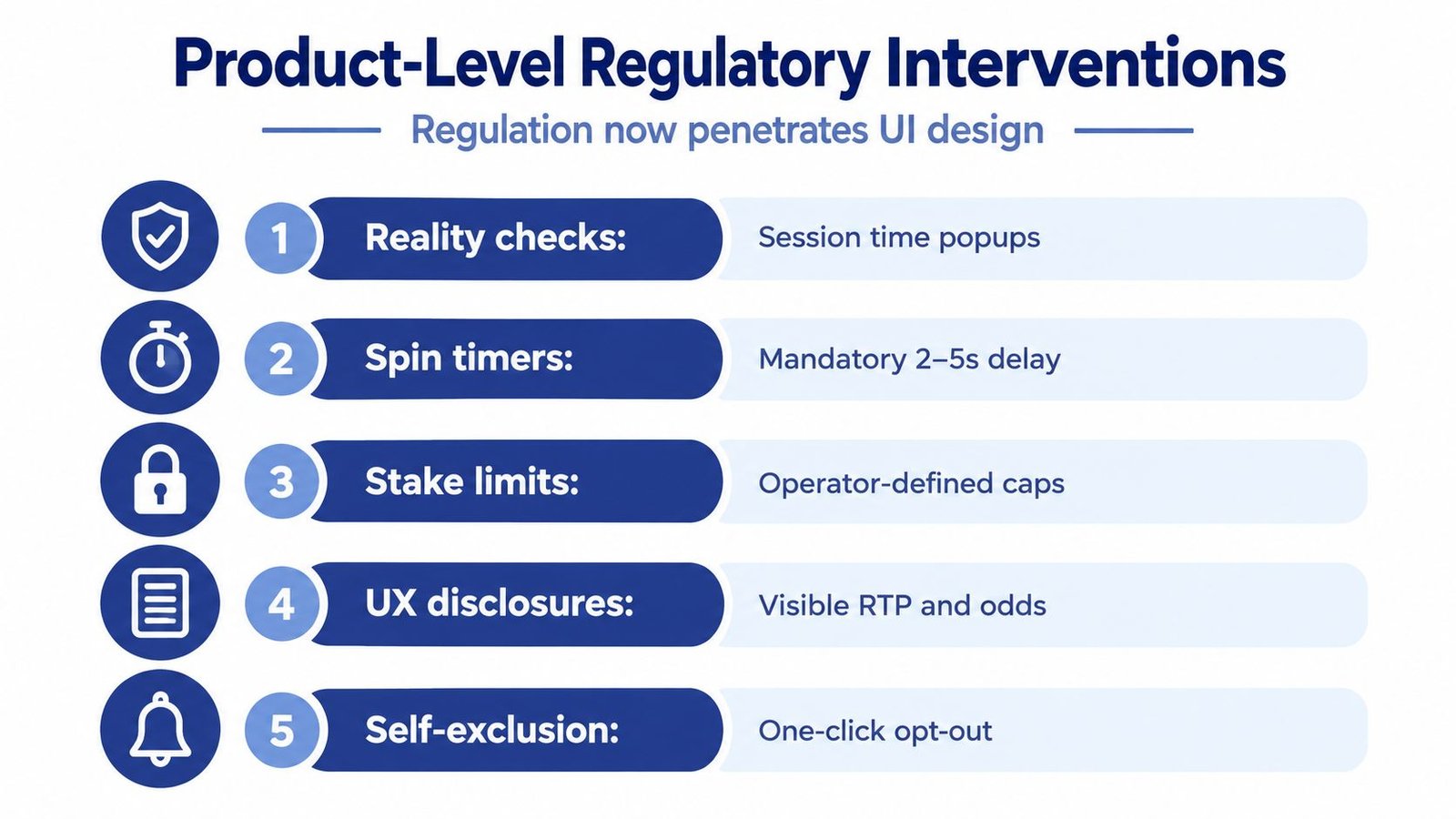
Regulation increasingly reaches inside the product. The United Kingdom's online-slots rules demonstrate why a unified gambling platform needs granular controls that distinguish a slot game from roulette, blackjack, and sportsbook markets.
From 21 May 2025, customers aged 18 to 24 faced a maximum stake of £2 per online-slots game cycle, while customers aged 25 and over faced a maximum of £5, according to the UK Gambling Commission's online-slots stake-limit guidance. The rule applies to online slots offered under remote-casino operating licences. It doesn't apply to other online casino games such as roulette or blackjack.
That scope creates a specific engineering requirement. The platform must identify the customer's age category, apply the correct threshold, and prevent an over-limit wager before the relevant slot cycle is accepted. A generic account-level betting limit isn't enough if it can't distinguish the regulated product and the game cycle.
Game design rules affect the interface
Great Britain's controls also address speed and presentation. Rules introduced by the Gambling Commission in October 2021 require a minimum 2.5-second play speed per spin, prohibit losses disguised as wins, and restrict features that intensify play or create an illusion of control. The UK government's reform publication identifies prohibited functionality including slam stops, turbo modes, autoplay, and concurrent play across multiple slot games.
Operators must also display money and time spent during a customer's session. This requirement affects more than legal wording. Game studios need market-specific configurations, suppliers must demonstrate approved functionality, and operators need evidence that the deployed version matches the tested version.
The resulting architecture has at least three compliance layers:
- Customer layer: Age category, account status, limits, session information, and safer-gambling settings.
- Product layer: Slot-cycle stake enforcement, spin speed, feature restrictions, and approved game configuration.
- Control layer: Testing records, audit trails, change management, and incident escalation.
Sportsbook doesn't inherit every casino rule, and casino roulette doesn't inherit the slot stake ceiling. That distinction is commercially important because product teams can't treat compliance as a single switch applied across the entire lobby.
Operational rule: Product regulation should be implemented at the narrowest level that matches the legal requirement, then tested at the point where the customer submits the wager.
The deeper strategic conclusion is that regulation can change user-interface design, wallet behavior, session logic, game deployment, and supplier contracts. Compliance engineering therefore belongs in product planning from the start, not as a release-stage review.
Technology Stack and Infrastructure Requirements
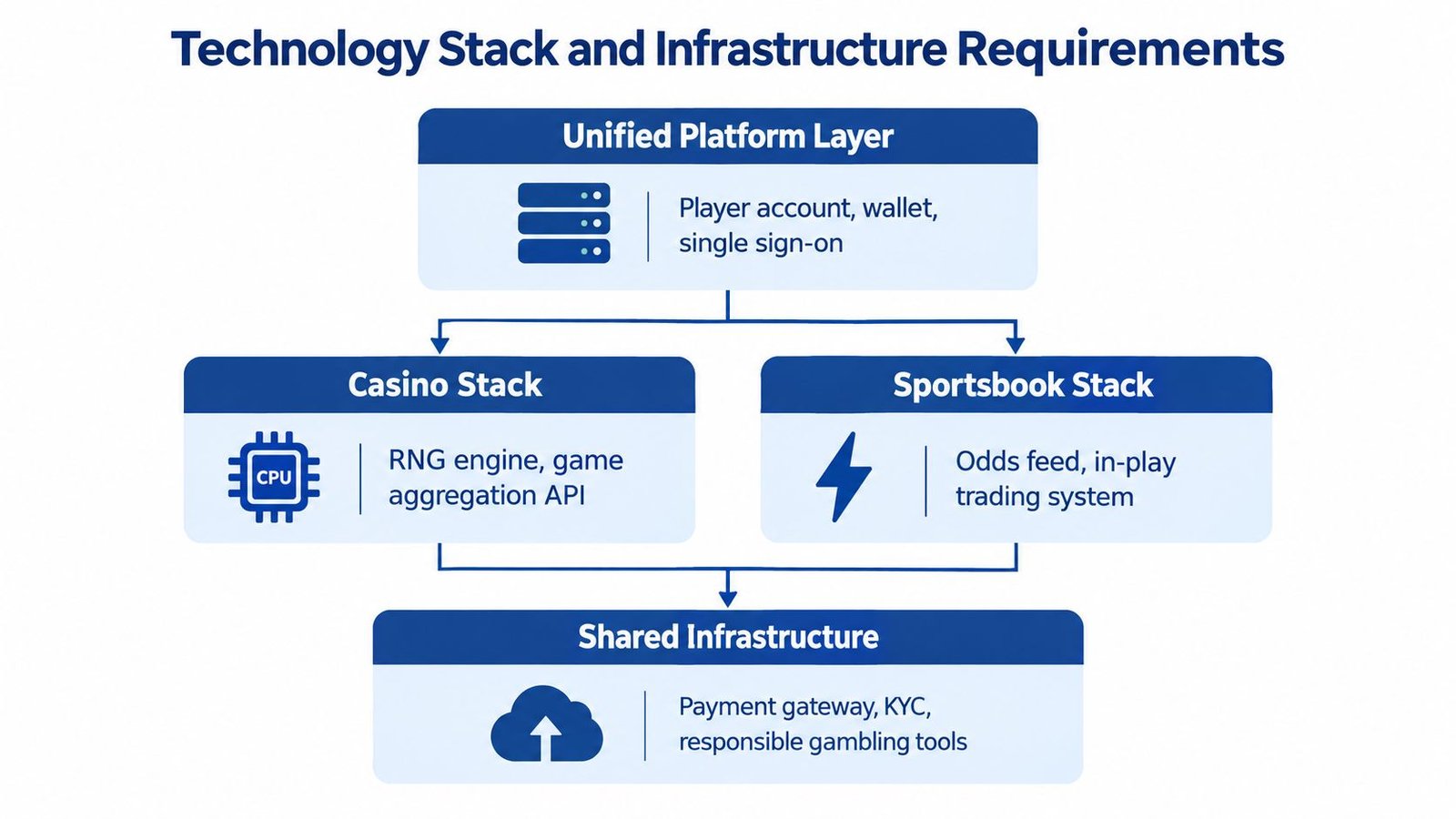
A combined platform can share account, wallet, authentication, payments, KYC, and responsible-gambling services. Its casino and sportsbook layers should remain operationally distinct. They process different evidence, timing requirements, supplier inputs, and control events.
Casino infrastructure depends on game aggregation, mathematical configuration, RNG governance, content certification, and release management. Operators need a reliable record of the live game build, applicable probability tables, content supplier, certification evidence, and configuration changes. From an infrastructure perspective, that requires immutable configuration storage, signed releases, controlled deployment permissions, and automated detection of differences between the certified mathematics file and the production version.
Sportsbook infrastructure is built around event data and decision speed. During in-play betting, stale feeds or delayed state propagation can leave displayed prices out of step with the event. Trading systems therefore need monitoring for data-feed timestamps, pricing-to-display latency, bet-to-confirmation latency, suspension frequency, rejected-bet rates, and price-movement anomalies by sport and market type, consistent with the review of dynamic in-play betting cited in the product mechanics section.
Build a control map before selecting vendors
Architecture reviews should identify where each decision is made and how the operator can reproduce the relevant evidence.
- Wallet and identity: Can the account layer apply product-specific limits, age categories, payment ownership checks, and account restrictions?
- Casino content: Can suppliers provide versioned mathematics, RNG evidence, configuration history, and deployment records?
- Sportsbook trading: Can the system retain feed timestamps, price changes, suspension events, rejected bets, and confirmation outcomes?
- Payments and compliance: Can the operator distinguish a withdrawal request from completed settlement and retain the related screening record?
- Safer gambling: Can casino and sportsbook risk signals be assessed together while allowing different interventions for each product?
Casino controls must extend beyond the customer interface. The technical record should connect certified game mathematics to configuration files, infrastructure settings, release approvals, and production monitoring. Change detection is therefore an operational requirement, not merely a testing exercise. A discrepancy between the approved build and the deployed build can create both compliance exposure and uncertainty over financial results.
Payment connectivity is another shared dependency. Operators assessing PAGCOR payment gateway accreditation should examine whether a gateway supports the jurisdiction's verification, ownership, settlement, and record-retention expectations. One provider may serve both verticals while handling different transaction patterns, including frequent casino payments and event-linked sportsbook deposits or withdrawals.
Top 1 Rank is an iGaming intelligence and publishing platform covering casino, sportsbook, compliance, regulation, market research, technology, and operator intelligence. Its resources can support market monitoring, while certification evidence, trading controls, and regulator-facing records remain the operator's responsibility.
The Withdrawal and Verification Friction Point
Promotional reviews often lead with bonuses, odds, game selection, and licensing. The operational question that determines trust comes later: what can delay or block a withdrawal, and what can the customer do before depositing to avoid preventable friction?
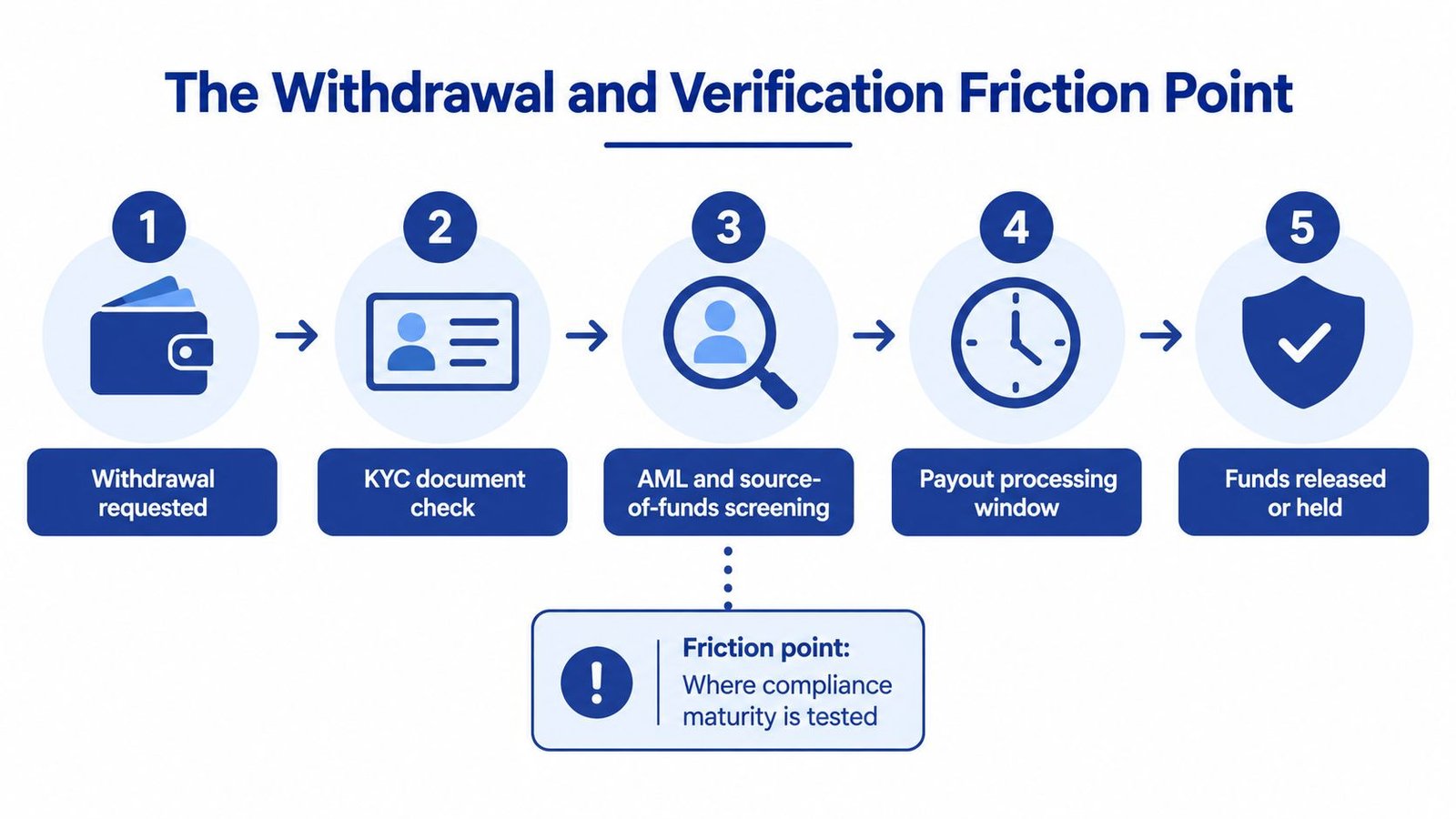
The UK Gambling Commission's account-withdrawal expectations identify withdrawal delays as the regulator's number-one complaint subject, with roughly 2,000 complaints a year. The same guidance states that operators shouldn't request information at withdrawal if they could reasonably have requested it earlier.
A delayed payout doesn't automatically prove misconduct. KYC checks, anti-money-laundering screening, payment-provider controls, mismatched account details, and ownership questions can all create legitimate review requirements. The consumer-trust problem begins when the operator explains those requirements late, applies them inconsistently, or uses unclear status labels.
A payout process should expose its decision states
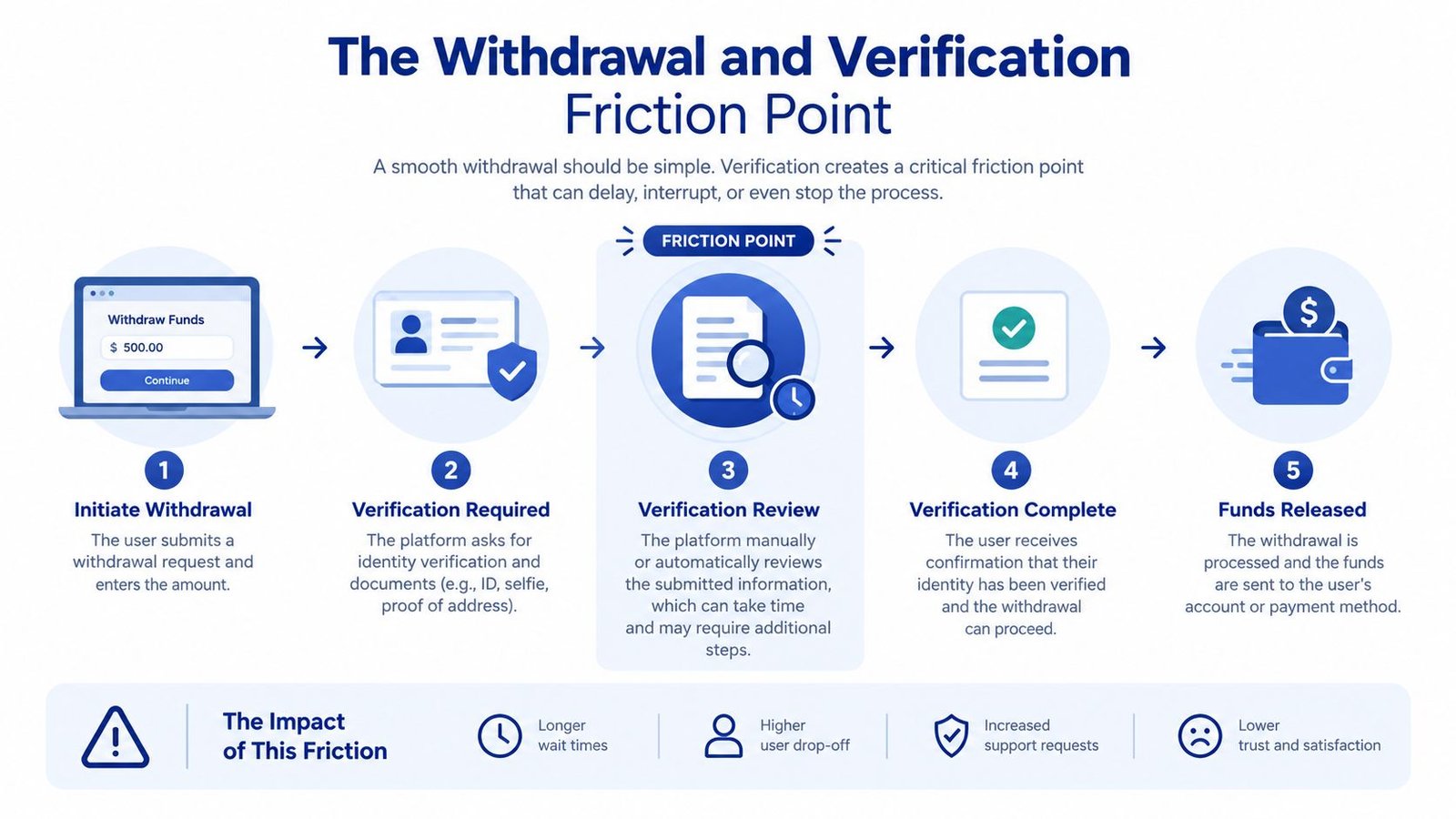
Operators can reduce confusion by separating the stages of a withdrawal rather than presenting every delay as one generic pending status.
- Requested: The customer has submitted the withdrawal and the platform has recorded the instruction.
- Approved: Internal checks have cleared the request for processing.
- Processed: The operator or payment provider has initiated the transfer.
- Settled: The funds have reached the relevant account or payment destination.
- Held: A documented compliance, ownership, wagering, or payment issue prevents release.
The customer-facing checklist should cover identity documents, payment ownership, wagering conditions, dormant-account rules, chargebacks, and dispute escalation. Pre-deposit verification is usually easier to understand than a first request for documents after a customer has won and requested funds.
Practical rule: A lawful verification step becomes a trust problem when the operator could reasonably have requested the information earlier but waits until withdrawal.
The same principle applies across casino and sportsbook, but the trigger can differ. Casino activity may raise questions through repeated game play or payment patterns, while sportsbook activity can intersect with event-linked transactions, price disputes, or account restrictions. The compliance team needs a consistent policy, while customer support needs product-specific explanations.
A withdrawal review should also distinguish payment failure from compliance hold. The former may involve a provider or settlement route. The latter may require identity, source-of-funds, account ownership, or anti-money-laundering review. Clear terminology helps customers understand what has happened and gives regulators a more reliable audit trail.
Operators can assess online casino withdrawal options using GCash by examining more than advertised processing speed. The relevant questions include which documents are required, whether payment ownership is checked before deposit, how reversals and chargebacks are handled, and how a customer escalates a disputed hold.
Safer Gambling and Product Risk Profiles
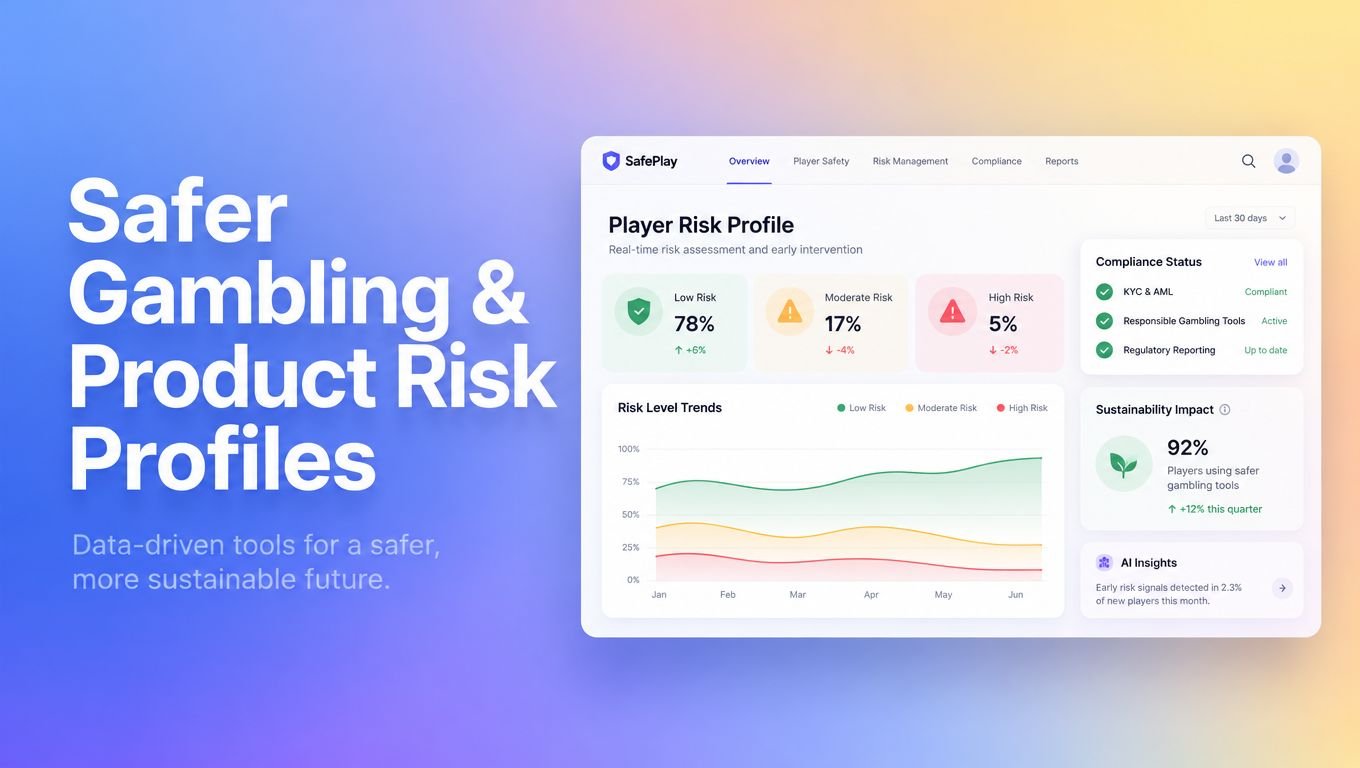
Casino and sportsbook risk shouldn't be compared through a simple claim that one vertical is safer. The product mechanics create different exposure patterns, so operators need controls that reflect speed of play, decision frequency, loss visibility, marketing context, and access conditions.
Casino products, particularly continuous-play slots, can compress repeated decisions into a single session. Sportsbook introduces event-based wagering, but in-play markets can also create rapid decision cycles as prices change. Mobile access, promotional inducements, and the illusion of skill can make sportsbook participation more persistent than a basic comparison between “one bet per match” and “one casino spin” suggests.
A 2025 New York State assessment reported that 65.2% of 3,470 respondents experienced consequences that may indicate gambling harm or gambling disorder, according to the New York State gambling assessment. The same evidence base includes Harvard reporting that cited estimates of 2.5 million U.S. adults with severe gambling problems and another 5–8 million with significant issues.
Product speed should shape intervention design
A jurisdiction-neutral risk framework can compare the products without declaring a universal hierarchy.
| Risk dimension | Online casino | Sportsbook |
|---|---|---|
| Decision rhythm | Often continuous, especially in slots | Event-based, potentially rapid during in-play markets |
| Outcome visibility | Game results appear immediately | Results may remain unresolved until an event or market settles |
| Skill perception | Usually tied to game choice or strategy claims | Can be reinforced by sports knowledge and pricing decisions |
| Useful safeguards | Session time, spend visibility, stake controls, cooling-off tools | In-play monitoring, exposure limits, cooling-off tools, affordability review |
| Core measurement need | Speed of play and repeated activity | Bet frequency, market timing, live price behavior, and repeated decisions |
This framework helps compliance and product teams avoid a common mistake, applying identical interventions to dissimilar products. A session reminder may be essential for continuous casino play, while sportsbook monitoring may need to examine rapid in-play sequences, repeated deposits, and decisions made as markets move.
The evidence base also has limitations. Harvard reporting noted that gambling-related health problems and suicides aren't tracked with the same systematic infrastructure used for alcohol or tobacco. That gap matters for investors and regulators because the absence of a precise measurement system shouldn't be mistaken for the absence of risk.
Operators should connect safer-gambling tools to observable product behavior, then document why an intervention was triggered and whether the customer could understand it. Self-exclusion portability, deposit limits, cooling-off tools, affordability checks, and marketing controls should be evaluated across both verticals, while retaining product-specific thresholds and escalation logic.
Strategic Imperatives for Operators and Investors
A shared brand does not create a shared business model. Online casino and sportsbook may use one login and wallet, yet they depend on different commercial and technical systems. Casino operations require certified game mathematics, controlled releases, and continuous availability. Sportsbook operations require event data, trading models, low latency, and market-integrity controls.
The distinction should shape forecasts and governance. Use the 2024 product split to stress-test projections, modelling casino and sportsbook separately against the European overview's 7.5% and 6.3% CAGR projections. A blended assumption can conceal different supplier costs, compliance burdens, payment patterns, and margin risks. The relevant source is the European online gaming market overview, which should appear only once when evaluating these projections.
Capital should follow the bottleneck
Operators and investors can apply four decision tests:
- Market selection: Establish whether the target jurisdiction favors casino, sportsbook, or a mixed model. Country-level composition can differ substantially, so regional averages may hide product exposure.
- Technology fit: Require evidence of RNG controls, mathematical versioning, event-data resilience, trading latency, wallet enforcement, and auditability.
- Regulatory granularity: Model product-specific interventions, including online-slot stake limits and game-design restrictions in Great Britain.
- Customer trust: Assess withdrawal clarity, verification timing, payment ownership, and dispute handling as operating capabilities, not merely support functions.
Supplier reviews need the same separation. A casino aggregator can distribute content without providing sportsbook trading. A sportsbook feed can supply event data without addressing safer-gambling controls, withdrawals, or customer-risk monitoring. Shared identity and payment infrastructure should reduce duplication while preserving clear ownership of failures within each vertical.
Revenue growth projections do not establish operating quality. Investors should test exposure to compliance costs, payment friction, product restrictions, and data-feed incidents alongside topline assumptions. The variation between published European growth scenarios is itself a reason to model casino and sportsbook independently, then test how changes in regulation, supplier performance, or customer behavior affect each line.
A review of PAGCOR B2B accreditation fees belongs within a broader jurisdictional assessment covering licensing, supplier obligations, payments, player protection, and technical certification. Fee visibility alone does not establish commercial viability.
The strongest operating model is modular. Account, wallet, identity, payment, and safer-gambling foundations can be shared, while casino mathematics, sportsbook trading, product testing, customer-risk analytics, and incident response remain distinct. Governance and procurement should reflect those boundaries, even when the customer experience appears unified.
Operators, suppliers, affiliates, and investors preparing a combined launch should begin with a product-by-product audit. Map each market's licensing scope, revenue mix, casino controls, sportsbook data dependencies, withdrawal workflow, and safer-gambling interventions before committing capital. Follow Top 1 Rank for further iGaming market intelligence, regulatory analysis, technology developments, and operator strategy updates.





Join thousands of gaming professionals receiving the latest iGaming news, regulatory updates, and market insights.
