

A market can generate dozens of integrity alerts in a year and still record suspicious activity in only a tiny fraction of monitored matches. That tension defines modern esports wagering. Professionals need more than market menus and generic warnings. They need a practical Esports Betting Guide that explains scale, pricing, regulation, and the difference between suspicion and proof.
Table of Contents
- What Esports Betting Is and Why It Matters
- Market Structure and the Challenge of Measuring Scale
- Betting Markets and Odds Explained
- Risk Management and Integrity Monitoring
- Regulation and Compliance Across Key Jurisdictions
- Operator Platforms and Player Protection
- Trends, Forecasts, and the Road Ahead
What Esports Betting Is and Why It Matters
Esports betting covers wagers placed on competitive video game events through regulated sportsbooks, betting exchanges, and other platforms. The underlying contests range from major tournaments to lower tier fixtures, and each event carries different liquidity, data quality, and integrity exposure. That variation matters commercially. A headline final with established teams doesn't present the same operational risk as a lightly watched qualifier with limited independent oversight.
The product also sits inside sports wagering law rather than under one global esports framework. Operators therefore inherit established licensing, taxation, advertising, and consumer protection rules, then adapt them to competitions controlled by game publishers and tournament organizers. Participant age, rapidly changing rosters, software patches, and digital event formats add issues that traditional sportsbooks don't face in identical form.
Legal History Shaped Market Access
Nevada legalized sports betting in 1949, Congress enacted the Professional and Amateur Sports Protection Act in 1992, and the U.S. Supreme Court overturned that law in 2018, according to Vanderbilt's summary of the legal development of esports wagering. Nevada had already amended its law in 2017 to clarify that “other events” could be eligible for wagering. The sequence explains why state decisions, rather than a single federal esports authorization, now determine U.S. access.
That history also explains the persistence of event approval. Regulators often assess a competition before wagering begins because they need confidence in its governance, participants, rules, and integrity controls. A sportsbook menu isn't evidence that every listed title has the same legal status in every place where the site can be viewed. Licensing and approved event catalogues separate lawful supply from mere online availability.
- Jurisdiction determines availability: A market that's lawful in one state or country may be unavailable, restricted, or unlicensed elsewhere.
- Event governance affects risk: Clear rules, identifiable organizers, and enforceable participant codes support more reliable wagering.
- Game structure shapes pricing: Maps, drafts, vetoes, patches, and side selection can alter win probability before play begins.
Why Industry Readers Need a Different Guide
Casual guidance usually concentrates on choosing a winner. Professional decision making starts earlier, with market definition, source quality, licensing, and controls. Operators must decide which competitions meet internal risk standards. Affiliates must avoid directing audiences toward products that aren't authorized locally. Investors must separate audience enthusiasm from regulated revenue.
Core principle: Market access depends on jurisdiction, licensing, approved events, and integrity controls, not simply on whether a sportsbook displays an esports menu.
The same discipline applies to interpretation. Handle isn't revenue, an integrity alert isn't a sanction, and a young audience profile doesn't remove age restrictions. Those distinctions run through market sizing, odds analysis, compliance, player protection, and forecasting. Treating them carefully produces a more useful esports betting guide and reduces the chance that a commercial decision rests on an inflated or misclassified number.
Market Structure and the Challenge of Measuring Scale
Market sizing is the first analytical trap. Published totals may combine regulated sportsbook wagers, exchange activity, skin betting, informal wagering, and unlicensed platforms. A figure built from that mixture can't be compared directly with licensed operator revenue. Professionals should identify the unit, geography, period, and collection method before using any estimate in planning.
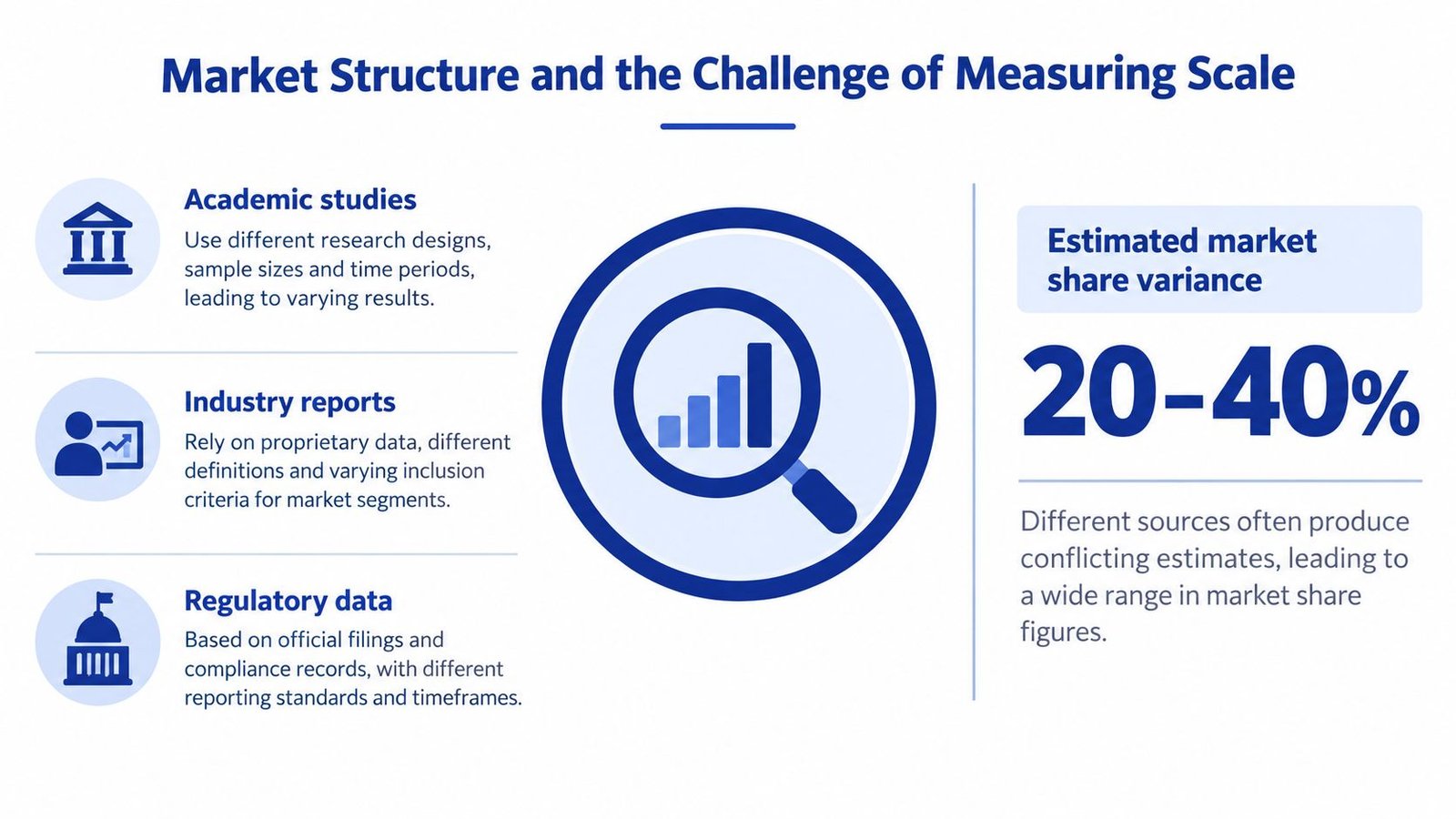
Academic research summarized earlier estimates valuing global esports betting at approximately $5 billion in 2016 and more than $12 billion by 2020, as reported in research reviewing esports betting definitions and participation. Those figures show substantial reported expansion, but they shouldn't be presented as a precise current total. Different source years and definitions sit behind them, and some underlying activity may fall outside regulated betting.
Four Measures That Should Never Be Merged
Handle represents amounts staked. Gross gaming revenue represents operator revenue after winning bets are paid, before relevant operating costs and taxes are considered under local reporting rules. Active bettors count people who placed wagers during a defined period. Audience size counts viewers or followers, many of whom may never bet.
Confusing those measures produces misleading conclusions. A large streaming audience can coexist with modest regulated handle if viewers are underage, located in restricted jurisdictions, or uninterested in wagering. High handle can also produce limited revenue where margins are thin or results favor customers. Each measure answers a different business question and belongs in a separate forecast line.
| Measure | Business Question | Common Error |
|---|---|---|
| Handle | How much wagering volume occurred? | Treating stakes as operator income |
| Gross gaming revenue | How much did operators retain from wagering? | Ignoring local reporting definitions |
| Active bettors | How many customers actually wagered? | Counting registered accounts as active users |
| Audience | How many people watched or followed events? | Assuming viewers are eligible bettors |
Participation data requires the same care. UK Gambling Commission research summarized in the academic source estimated that 8.5% of UK adults had bet on esports, with men representing 58% of esports bettors and women 42%, while 2.9% of respondents aged 16 to 24 reported betting during the previous year. Those are survey based participation indicators, not global market share figures. Age bands, recall periods, and national regulation limit how far they can be generalized.
Demographics and Commercial Interpretation
A market monitoring source estimated that bettors aged 19 to 35 represented 69% of the esports betting audience in 2025, according to Sharpr's global esports betting monitor. The concentration points to strong representation among younger adults. It doesn't establish that underage betting is acceptable, nor does it remove the need to distinguish audience age from legal gambling age and verified customer eligibility.
Commercial teams should consequently test every headline number against its denominator. Comparative market context, including coverage such as TNT versus Meralco betting coverage, can illustrate fixture level interest without proving sector wide revenue. Reliable analysis states whether a number reflects regulated turnover, estimated unlicensed activity, survey participation, or media reach. Without that label, scale becomes a promotional claim rather than evidence.
Betting Markets and Odds Explained
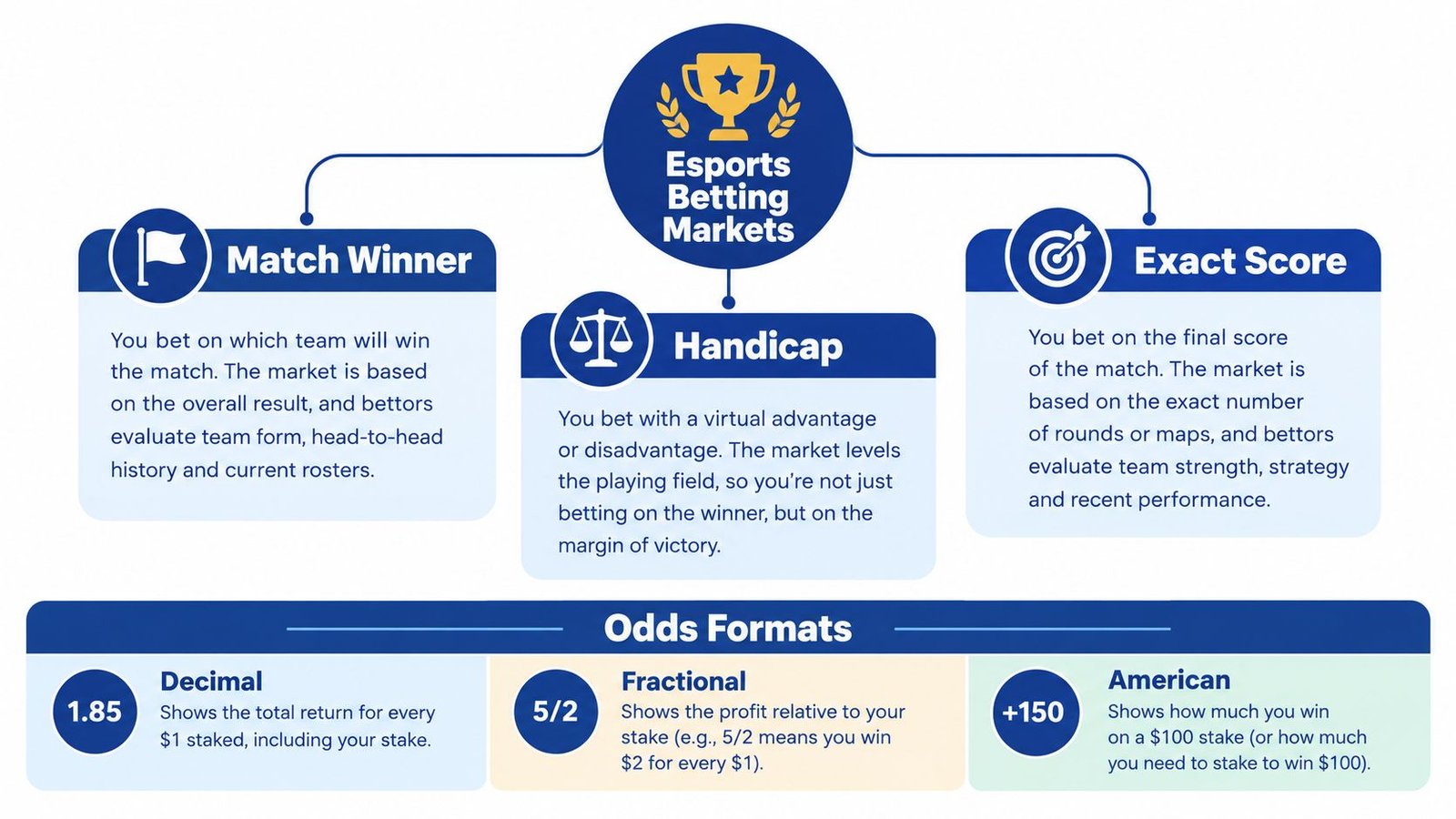
A decimal price of 1.80 implies roughly a 55.6% chance before the margin is removed. Every product on an esports board reduces to that conversion: price in, probability out. What separates the products is what they settle on and how much information the price is likely to hold.
| Market | Settlement basis | Primary pricing risk |
|---|---|---|
| Match winner | Team or player winning the series | Public flow skewing the favorite |
| Handicap (maps or rounds) | Adjusted result after the spread | Line built on stale roster or patch data |
| Exact score | Precise series outcome | Narrow settlement paths and wide margins |
| Live markets | In-play state updated per event | Latency, suspension timing, thin volume |
Depth and accuracy measure different things. A long market list gives customers choice, yet thinly traded side markets often rest on limited information and can move sharply on small volume. Operators manage that exposure through suspensions, stake limits, and price changes, so a displayed number can lag the actual state of the book. Before treating any price as meaningful, an analyst needs operational answers:
| Question the desk asks | What it reveals |
|---|---|
| How many customers wagered? | Whether interest was broad or concentrated in a few tickets |
| When was the price recorded? | Which information set the number reflects |
| Did the market stay continuously available? | Whether suspensions hid adverse flow |
Reading the Margin Out of a Price
Decimal odds convert into implied probability by dividing one by the odds. Summed across every outcome, the implied probabilities exceed a fair set because the bookmaker margin sits inside the market. A detailed explanation of why esports odds exceed 100 separates that margin from the underlying assessment. Removing it gives the analyst a cleaner market probability to compare against an independent model.
A study of 3,075 Counter-Strike Global Offensive matches found evidence of a reverse favorite longshot bias in pari-mutuel esports betting, according to Springer research on pricing in those matches. Favorites and underdogs were priced asymmetrically. Market prices aggregate many participants and still carry systematic distortion, so they require testing rather than deference.
The evaluation sequence stays fixed even when inputs change. Record the price and its timestamp before roster, veto, or patch news alters the information set. Strip the margin and normalize the outcomes into fair probabilities. Build an independent estimate from team strength, map pool, veto order, roster stability, and patch specific performance. Discount the apparent edge for estimation error, stale prices, and variance. Back test calibration by grouping forecasts into probability buckets and comparing predicted rates with realized results, which exposes overconfidence that a return figure alone would hide.
When Expected Value Is Real
A positive expected value signal exists only when an independently modeled probability beats the margin adjusted market probability by enough to cover uncertainty. If a model assigns 60% while fair market probability sits at 55%, the five point gap still falls short of proof. Late substitutions, side selection, map vetoes, connectivity problems, or a mid event patch can make either estimate obsolete.
A favorite's brand, ranking, or recent highlight performance isn't a probability model.
Documented assumptions matter because post match explanations tend to disguise information that was unavailable before the wager. Traditional sport markets show how public information flows into a price, and MPBL betting odds analysis offers a useful fixture level reference. Esports compresses that process: game updates and map selection can reshape team strength inside a single event, so price literacy has to travel with game specific context, disciplined record keeping, and skepticism toward any edge that vanishes once margin and uncertainty are counted.
Risk Management and Integrity Monitoring
A live market suspends after a cluster of exact score wagers lands during a technical pause. The first record is an alert: activity that merits review, not a finding. If betting records, match data, participant evidence, lawful communications, and event circumstances point the same way, the matter becomes an investigation. A sanction arrives only after a disciplinary finding under an applicable code. Treating the first signal as proof inflates prevalence and weakens cases that later need clean evidence.
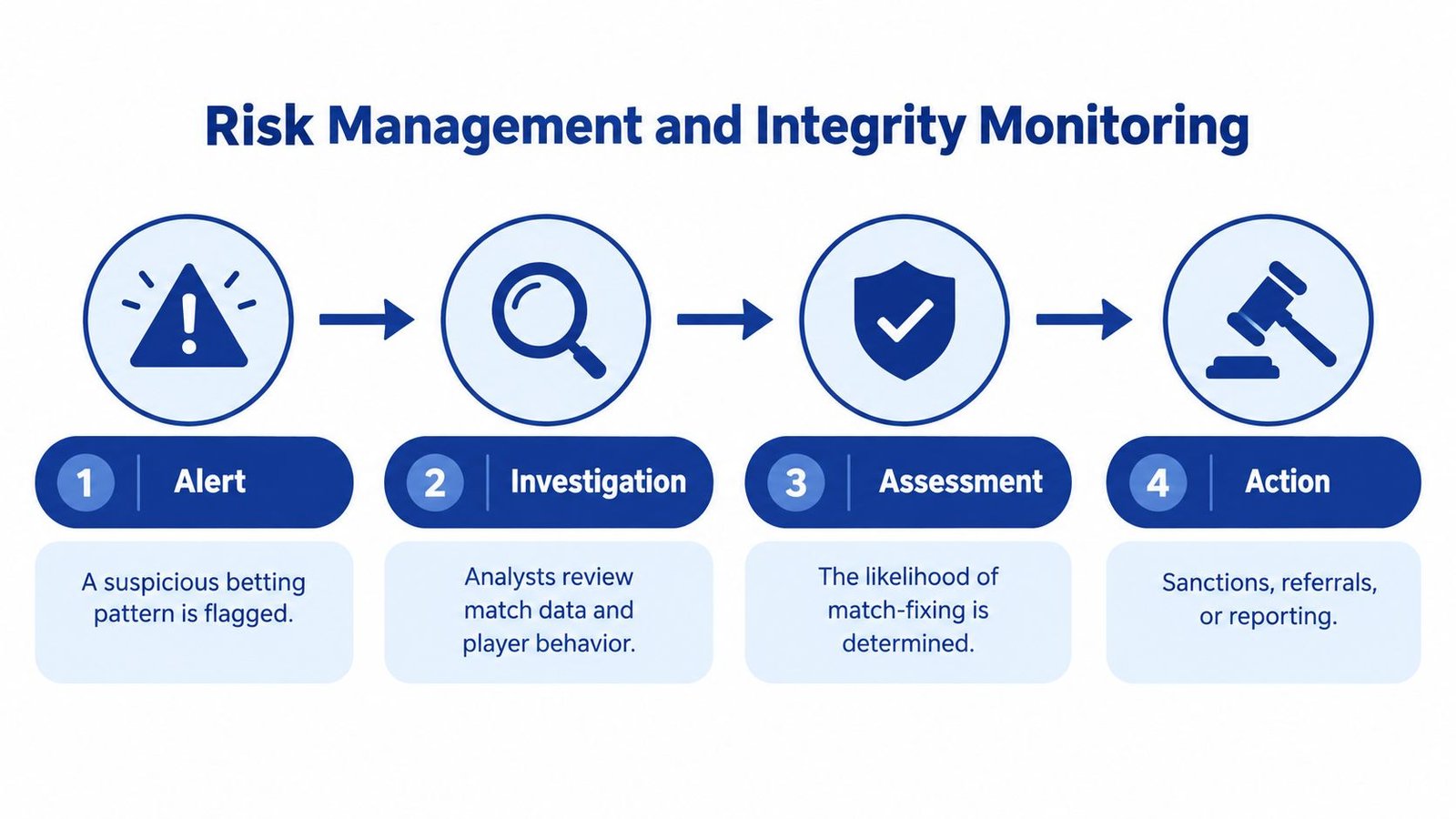
The measured risk is material but easy to misstate. The International Betting Integrity Association reported 300 suspicious betting alerts across 16 sports in 2025, including 34 involving esports, in IBIA's 2025 sports betting integrity report. Those are alerts, not adjudicated fixes, so they should be read as workload for review rather than a confirmed corruption rate.
How a Detection Pipeline Works
| Stage | Evidentiary value | Common failure |
|---|---|---|
| Signal capture | Synchronized odds, volume, timing, and account data across operators | Gaps in in play records or delayed feeds |
| Baseline comparison | Prices normalized into implied probabilities and measured against similar fixtures | Comparing a thin lower tier market with a major final |
| Context enrichment | Roster news, vetoes, pauses, connectivity incidents, implausible in game actions | Treating a legitimate news move as manipulation |
| Case decision | Escalate, monitor, or close with reasons recorded | Preserving too little for later reconstruction |
Surveillance still covers only part of the threat set. Research on esports integrity identifies cheating software, cyberattacks intended to impair opponents, match fixing, and doping among major threats, alongside vulnerabilities involving skins, young participants, fragmented competitions, and game specific practices, as described in Springer analysis of integrity threats in esports. Betting data works best as one stream beside anti cheat review, tournament operations, participant education, and disciplinary enforcement.
Exposure Depends on Product, Liquidity, and Timing
The unit of analysis is the market, not the sport. Exact score, handicap, and lower tier live markets can carry exposure that a match winner market at a major event does not. A niche outcome may be influenced without changing the winner, thin liquidity can magnify a small number of wagers, and delayed markets can reward whoever sees pictures, data, or prices first. Risk scoring should price the product and event together.
A large price move supports escalation. It does not establish manipulation.
Suspension protects customers and the book while facts are reviewed; settlement after review reflects rules and process, not public certainty about every participant. ESIC's StarCraft II investigation shows the stronger standard: betting records, sportsbook data, and participant evidence tested before sanctions. That discipline depends on accountable records, the same control logic behind PAGCOR gaming system administrator requirements, where defined responsibilities make oversight defensible.
Regulation and Compliance Across Key Jurisdictions
Regulatory fragmentation is the practical constraint behind esports expansion. Sports betting legality doesn't automatically create permission for every esports title, tournament, or wager type. Regulators may require event approval, integrity information, participant safeguards, and product notifications before launch. Market entry teams should map those requirements title by title rather than relying on a generic sportsbook license.
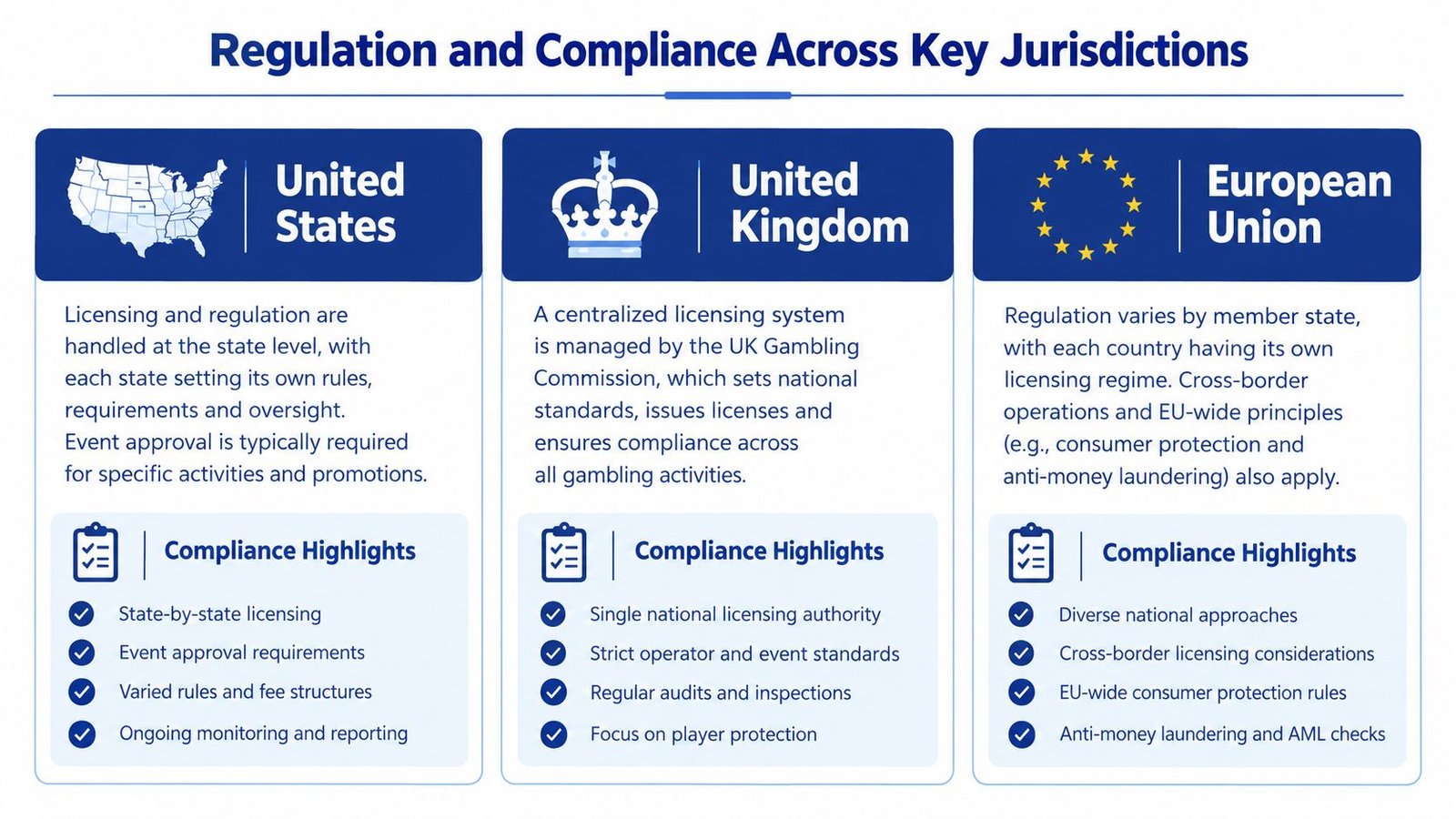
A legal analysis reported that esports wagering was expressly permitted or recognized in Nevada, New Jersey, Colorado, Tennessee, Virginia, West Virginia, and Washington. Even within that group, approval mechanics and permitted products can differ. Event by event review remains common because competitions vary in governance and integrity controls. A national product roadmap still requires state level implementation.
New Jersey Shows the Approval Step Clearly
New Jersey requires a sports wagering operator to notify the Division of Gaming Enforcement before accepting wagers on a new category of wagering event or wager type. Guidance states that notification should be submitted at least 72 hours before the event or wager is offered, and Division approval is required before launch, according to New Jersey sports wagering guidance from the Division of Gaming Enforcement. The submission must identify the governing body and describe applicable integrity policies and procedures.
The Division may prohibit wagering, cancel wagers, or require refunds where an event conflicts with state public policy. That authority turns product approval into a continuing compliance obligation, not a one time filing. Operators need tournament documentation, escalation contacts, market rules, and settlement procedures ready before marketing begins. Launch dates that ignore approval lead times create avoidable regulatory and reputational risk.
Great Britain Applies Live Event Controls
In Great Britain, esports betting is treated as betting on a live event, not as a separate low risk category. Parliamentary evidence summarizing Gambling Commission requirements states that businesses must be licensed and maintain age and identity verification procedures, as set out in House of Lords Library analysis of gambling harm among young people. Digital delivery doesn't exempt an operator from ordinary customer eligibility controls.
That classification has operational consequences for onboarding, advertising, affiliate content, and safer gambling tools. Marketers also need jurisdiction specific legal review, supported by resources such as FindClout's gambling advertising law guide and local rules including PAGCOR gambling advertising rules. The central point is comparative rather than promotional. Rules governing audience targeting and claims can change the lawful route to market even when the underlying wager is permitted.
Regulatory Approaches to Esports Betting by Jurisdiction
| Jurisdiction | Approach | Event Approval | Key Compliance |
|---|---|---|---|
| Nevada | Sports wagering framework with an “other events” route | Event specific review may apply | Licensing and regulator confidence in event integrity |
| New Jersey | State sports wagering authorization | Notification and Division approval for new event or wager types | Governing body identification and integrity policies |
| Other listed U.S. states | Express permission or recognition within state systems | Requirements vary by state and product | State licensing, geolocation, and market controls |
| Great Britain | Licensed betting on a live event | Product and operator controls under the licensing regime | Age and identity verification and prevention of underage access |
Esports specific licensing often doesn't exist even where sports betting is legal. Compliance teams must therefore translate general wagering rules into controls for publisher owned competitions, younger audiences, online only events, and rapidly changing formats. That's the difference between legal awareness and an operational esports betting guide.
Operator Platforms and Player Protection
A customer disputing a voided wager on an unlicensed skin betting site has no regulator to petition, no approved market rules to cite, and frequently no verified legal entity behind the account. The same dispute inside a licensed sportsbook follows a documented complaints procedure under supervisory oversight. That gap in recourse, not market depth or payout speed, is the dividing line between platform types.
Licensed sportsbooks operate under approved market rules, identity controls, and complaint mechanisms. Betting exchanges match customers against one another and still require licensing where applicable. Skin betting and informal platforms blur gambling, virtual items, and unregulated payment flows, which leaves customers exposed when balances, settlements, or account access are contested.

Licensing status comes before feature comparison.
Fast settlement, broad markets, or anonymous registration cannot compensate for absent licensing, and offshore availability doesn't establish local legality. Operators and affiliates should present eligibility restrictions plainly rather than using game culture or streaming formats to make wagering appear separate from gambling regulation. For compliance teams assessing counterparties, the first question is which regulator holds supervisory authority and what complaint and enforcement channels that authority gives the customer.
The Control Stack in Regulated Markets
Regulated operators combine several controls into a single account framework. Each addresses a different failure mode, and esports changes the weight attached to each one.
| Control | Core function | Why it carries more weight in esports |
|---|---|---|
| Age and identity verification | Confirms legal eligibility and limits duplicate or fraudulent accounts | The audience skews toward younger adults, so underage exposure is higher |
| Geolocation | Restricts wagering to territory where the product is licensed | Online only events and remote viewership widen where demand originates |
| Safer gambling tools | Self exclusion, deposit and activity limits, timeouts, account closure | Streaming led acquisition shortens the path from viewing content to placing a bet |
| Payment oversight | Transaction monitoring, protection of credentials, withdrawals, stored methods | Virtual item economies and credential theft expand the attack surface |
| Transparent settlement rules | Predefined treatment of postponements, technical failures, disqualifications, integrity outcomes | Format volatility makes unambiguous house rules harder to draft and enforce |
Registration journeys should separate viewing content from wagering access and should never imply that game knowledge removes financial risk. Account security education is part of the same framework, including guidance on how phishing scams work and how to avoid them, because stolen credentials can defeat otherwise sound platform controls.
Participant Restrictions Under ESIC Rules
Customer-facing controls are only half of platform protection. The Esports Integrity Commission Anti Corruption Code prohibits participants from betting on any match, event, or aspect of a match in the game in which they play professionally or are otherwise involved, and the definition of participant extends to managers, coaches, and agents under ESIC's Anti Corruption Code. The prohibition covers direct and indirect bets, daily fantasy contests where legally classified as betting, in game betting, and wagers involving real value items such as skins.
The same code prohibits fixing or improperly influencing a match, arranging a specific incident for betting purposes, and soliciting or accepting rewards connected to manipulation. Operators therefore need participant exclusion processes that reflect those boundaries, while tournament organizers need education and reporting channels that reach support staff as well as players. Player protection in esports covers two populations at once: customers, who need safer gambling and account controls, and participants, who need unambiguous prohibitions that keep inside involvement out of related markets.
Trends, Forecasts, and the Road Ahead
Demographic concentration among younger adults will keep age assurance and safer gambling design near the center of product strategy. That doesn't make esports a youth betting product. It makes the boundary between media audience and verified adult customer a defining compliance issue. Operators that treat streaming reach as an addressable betting market without eligibility filters will continue to overstate commercial potential.
Measurement Should Improve as Regulated Supply Clarifies
Forecasts become more credible when regulated handle and revenue are separated from unlicensed activity, skin wagering, and informal betting. Better source labeling would also help investors compare jurisdictions on consistent terms. Until then, older global estimates provide context, not a dependable baseline for current revenue projections. The strongest forecasts state definitions, source years, and exclusions alongside every growth assumption.
Regulatory fragmentation is likely to remain a major operating condition. Event approval, advertising controls, identity checks, and product restrictions can move at different speeds across markets. Suppliers that build jurisdiction specific catalogues and auditable integrity workflows will be better positioned than platforms relying on one global market feed. Compliance capability becomes part of product quality rather than an administrative afterthought.
Technology Raises Both Detection and Evidentiary Standards
AI based anomaly detection can flag irregular betting patterns across online sites in real time, giving investigators earlier triggers for review. Automation doesn't convert an anomaly into proof. Human analysts still need match context, reliable timestamps, participant evidence, and due process before a sanction can be defended. As detection improves, raw alert counts may become less informative than investigation outcomes and the quality of evidence sharing.
Forecast discipline: Growth claims are credible only when audience, eligible customers, handle, and revenue remain separate.
The road ahead combines mainstream sportsbook distribution with stricter questions about event quality. Major competitions with transparent governance should be easier to approve and monitor than fragmented lower tier events. New products will still depend on whether regulators can understand the contest, identify responsible bodies, and test integrity arrangements. Commercial opportunity therefore favors operators, suppliers, and affiliates that can document legality, price responsibly, protect customers, and explain risk without exaggerating either danger or safety. A professional esports betting guide should ultimately help decision makers reject weak numbers, recognize uncertain prices, and distinguish an alert from a proven case.
Operators, suppliers, affiliates, and investors evaluating esports wagering should build market entry plans around approved events, auditable odds data, explicit integrity escalation, and jurisdiction specific player protection. Follow Top 1 Rank for continuing regulatory coverage, market intelligence, and evidence based analysis that helps leadership teams act before fragmented rules or weak data turn an opportunity into a compliance failure.





Join thousands of gaming professionals receiving the latest iGaming news, regulatory updates, and market insights.
