


Britain's gambling regulator conducted more than 9,700 compliance activities in 2024–25, approximately 131% more than the preceding year, even as headline financial sanctions fell. Its annual report and accounts shows why penalty totals alone can mislead anyone following gambling compliance news: supervisors also assess consumer protection, investigate control failures and disrupt illegal distribution.
For operators, suppliers and investors, the more useful question is what a regulatory development requires a business to change. A stake restriction affects game configuration. An exclusion requirement affects account access. An AML finding can expose weaknesses across customer onboarding, payments, escalation and management oversight.
The developments below distinguish confirmed enforcement evidence, reform-planning questions and unresolved legal positions. British and American primary-source evidence provides concrete benchmarks, while the other jurisdictional discussions identify operational questions that require confirmation against current local legislation and regulator publications. They shouldn't be read as confirmation of an implementation date, a numerical limit or a particular court outcome.
Editorial distinction: A proposal, an enacted rule and an enforceable technical requirement belong in different categories. Compliance teams should establish which category applies before changing a live product.
That distinction matters across Europe, North America and Latin America. Businesses need more than a regulatory headline: they need a documented owner, an implementation decision and evidence that the resulting control works.
Table of Contents
- 1. UK Gambling Act Review and Online Slot Stake and Affordability Reforms
- 2. Germany's GGL Licensing Framework and Cross-Operator Player Protection
- 3. EU AML Harmonisation and Gambling Operators' Control Readiness
- 4. US Prediction Markets and Sports Event Contracts
- 5. Brazil's Betting Framework and Payment-Channel Compliance
- 6. Ontario's AGCO Oversight and Player-Protection Readiness
- 7. Netherlands Ksa Enforcement and Evidence of Player Protection
- 8. Spain's Advertising Controls and RGIAJ Exclusion Checks
- Gambling Compliance News: 8-Regime Comparison Matrix
- Turn Regulatory Developments into an Immediate Action Plan
1. UK Gambling Act Review and Online Slot Stake and Affordability Reforms
The central planning issue for British-facing operators is separating product restrictions from customer-risk controls. A maximum stake setting determines what a game permits; an affordability or safer-gambling assessment determines whether an operator should intervene in a customer's activity. Passing one control doesn't demonstrate that the other works.
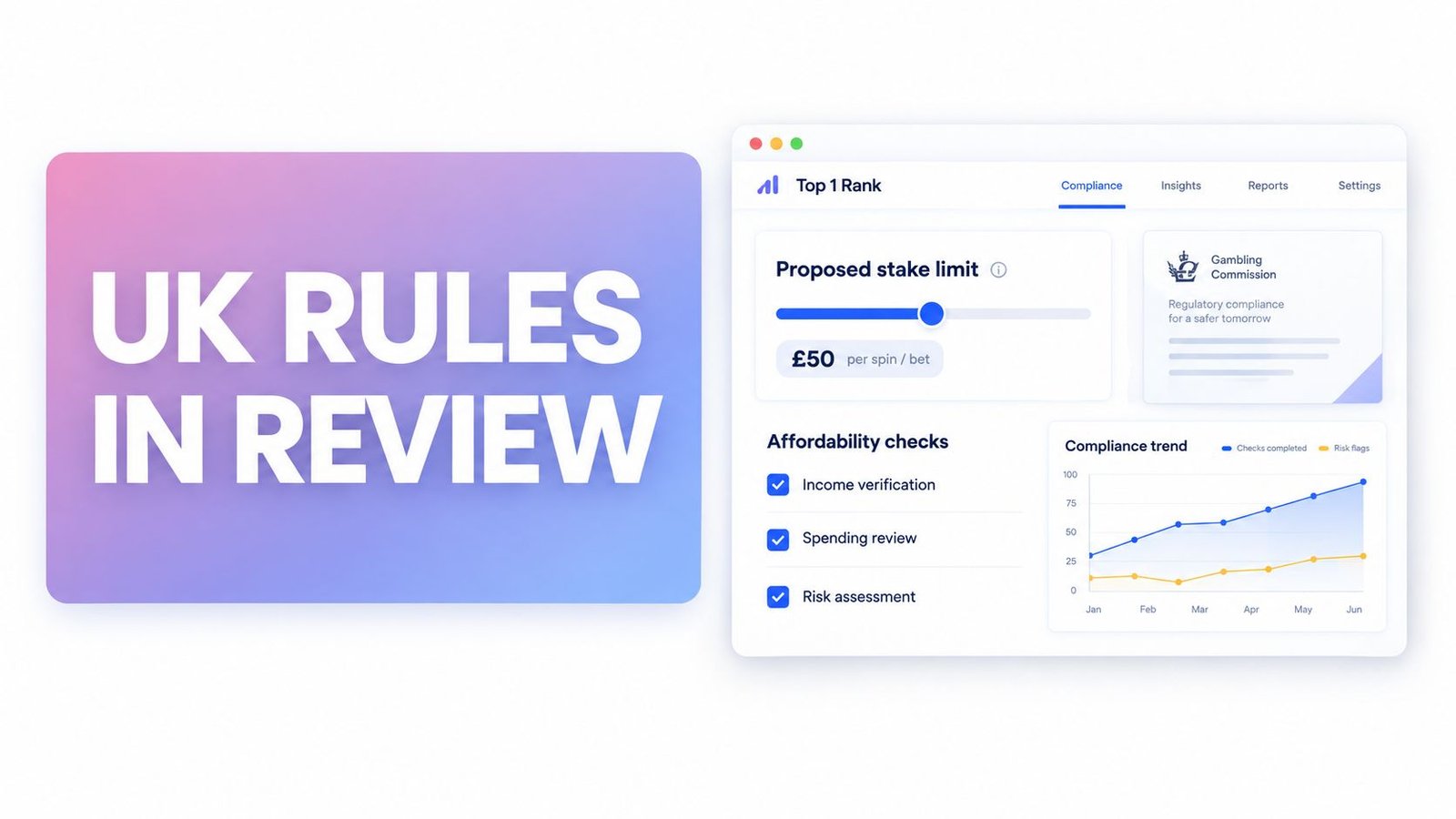
Specific stake thresholds, age-related settings and commencement dates require current official confirmation. Teams shouldn't treat a reform announcement as proof that every associated provision remains proposed, nor assume that publication automatically establishes an immediate implementation deadline.
The evidence on automated intervention warrants particular caution. Commentary describing research on 945 European online-casino players reported a best-performing Random Forest model accuracy of 0.729, while also discussing misconfigured and poorly understood algorithmic controls identified in regulatory casework, according to The Gaming Boardroom's affordability-governance analysis. That's secondary-source evidence, not a universal benchmark for gambling-risk models.
Separate configuration from intervention decisions
A hypothetical operator could correctly restrict a slot's stake while failing to escalate a customer's repeated risk indicators. Its product configuration would be working, but its intervention process would still need investigation.
- Product ownership: Record who approves stake settings, age-related configurations and changes supplied by game studios.
- Model governance: Test false positives, false negatives, incomplete-data handling and human override procedures.
- Decision evidence: Preserve the information available when staff chose to intervene or continue monitoring.
For comparative research, Top 1 Rank's PAGCOR regulatory updates offer a separate jurisdictional reference, not an interpretation of British requirements. The practical priority is a release process that connects legal interpretation, configuration testing and customer-protection evidence.
2. Germany's GGL Licensing Framework and Cross-Operator Player Protection
Exclusion checking and deposit-limit monitoring aren't interchangeable functions. German market-entry planning should distinguish OASIS-related exclusion questions from the separate requirements governing deposit-limit monitoring, rather than treating every central control as a single integration.
That distinction matters because an account may pass an identity check while still requiring an exclusion decision or a separate limit assessment. Operators should confirm the relevant system, permission, response handling and legal obligation for each function before approving a German-facing launch.
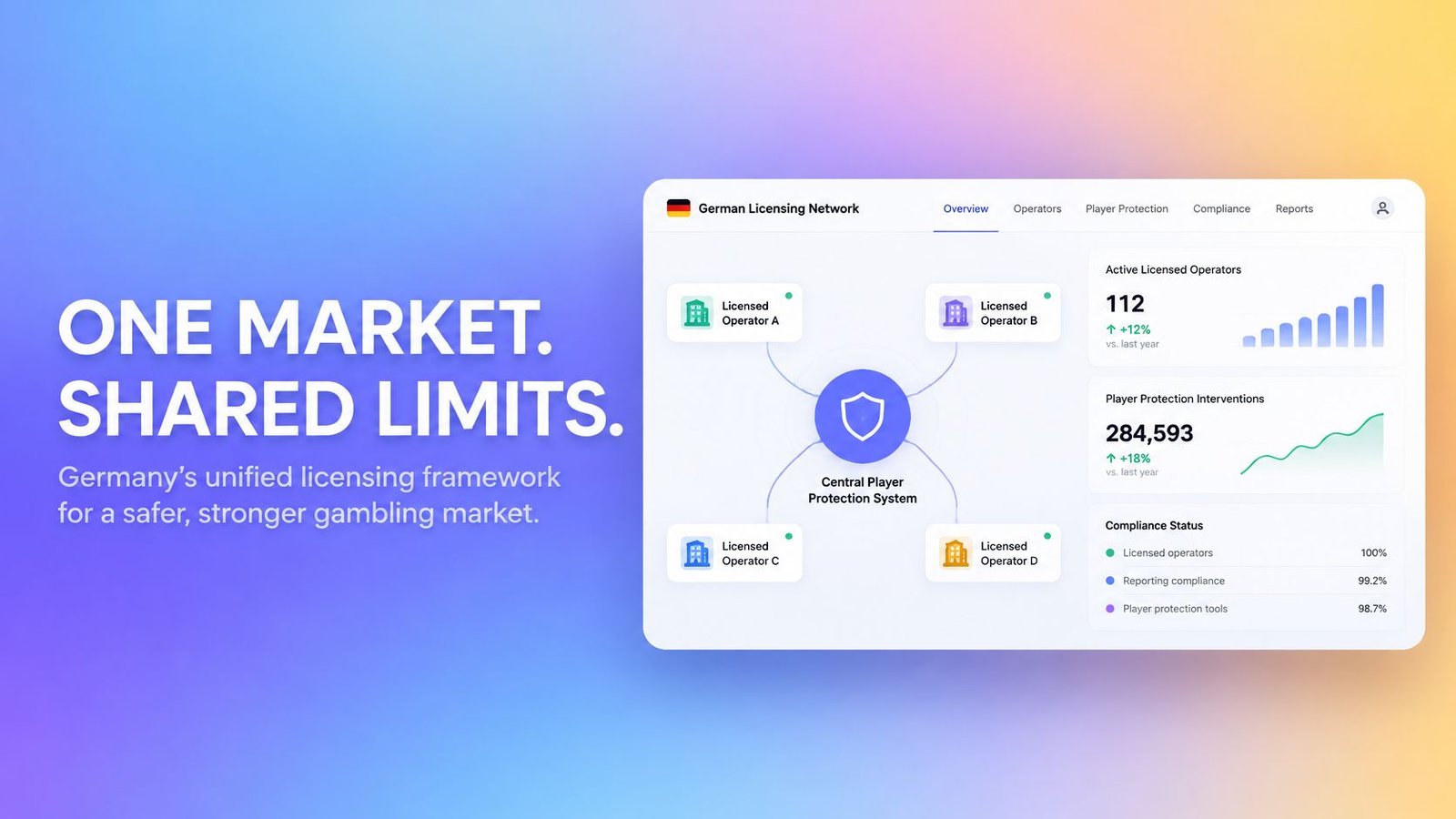
A hypothetical platform migration illustrates the operational risk. If a replacement wallet retains an operator's internal deposit history but loses the connection supporting a required external check, the migration may appear successful to finance while remaining unacceptable to compliance.
Treat central checks as release dependencies
Before deployment, legal and engineering teams should agree on what happens when an external service times out, returns an ambiguous result or identifies a restricted customer. The release record should distinguish a successful technical connection from a correctly enforced business decision.
A functioning interface isn't enough. The operator also needs evidence that its platform interprets the response correctly and prevents the prohibited action.
Supplier due diligence should therefore examine supported workflows, change notifications, incident handling and access to audit records. Commercial teams should separately verify advertising and promotional permissions rather than infer them from a licensing approval.
Top 1 Rank's PAGCOR business-to-business provider application overview offers a useful comparative prompt for supplier onboarding. It doesn't establish German requirements, but it reinforces the need to assess provider eligibility separately from operator authorisation.
The business implication is architectural: player-protection integrations should be treated as operational dependencies, not optional features added after launch.
3. EU AML Harmonisation and Gambling Operators' Control Readiness
For gambling groups assessing European AML harmonisation, the immediate task is control mapping, not assuming that a common policy document resolves every local obligation. Application dates, exemptions, supervisory responsibilities and technical standards require verification against the applicable legal text before implementation commitments are made.
A group-wide framework can still serve a useful purpose. It can define common customer-risk terminology, escalation responsibilities and evidence standards while allowing jurisdiction-specific requirements to remain visible.
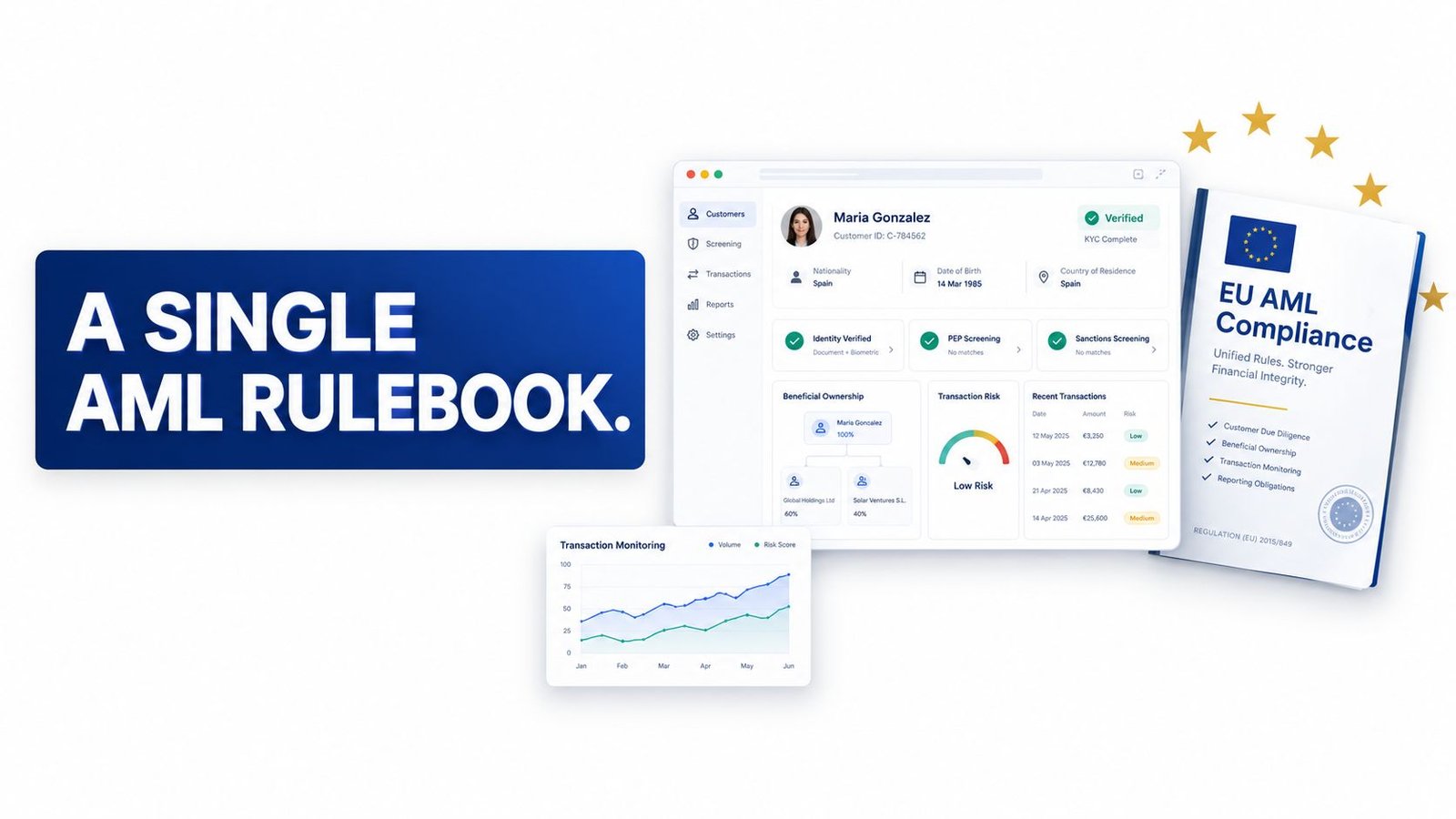
Britain provides a documented comparator, not a substitute for EU law. The Gambling Commission's AML and terrorist-financing regulatory framework explains that Licence Condition 12.1.1 requires written policies, effective implementation, regular review and revision when necessary, with controls reflecting business-model risk.
Standardise evidence without erasing local differences
A hypothetical group operating separate European brands might collect customer information through different platforms. Consolidating its policy wording won't resolve inconsistent beneficial-ownership records, inaccessible source-of-funds documents or investigations that can't follow activity across relevant accounts.
- Data definitions: Establish what each system means by customer risk, verification status and unresolved investigation.
- Local requirements: Maintain jurisdiction-specific reporting routes, permissions and legal interpretations.
- Testing evidence: Check whether staff can retrieve the material supporting a decision, not merely whether a policy exists.
Payment partners and platform suppliers should be included in that assessment. Contracts should identify which party supplies relevant information, who investigates anomalies and how unresolved issues reach the licensed operator.
The analytical conclusion is that harmonisation should reduce avoidable inconsistency without concealing legally important differences. A defensible programme needs both a common control language and a clear record of where local rules require a different process.
4. US Prediction Markets and Sports Event Contracts
Sports-related event contracts raise a threshold question: which legal framework governs the product, its distribution and the customer relationship? A financial-market description doesn't, by itself, resolve a gambling-law classification question.
For commercial decisions, the precise procedural position matters. A platform's argument, a regulator's objection, an interim order and a final judgment shouldn't be presented as equivalent legal outcomes.
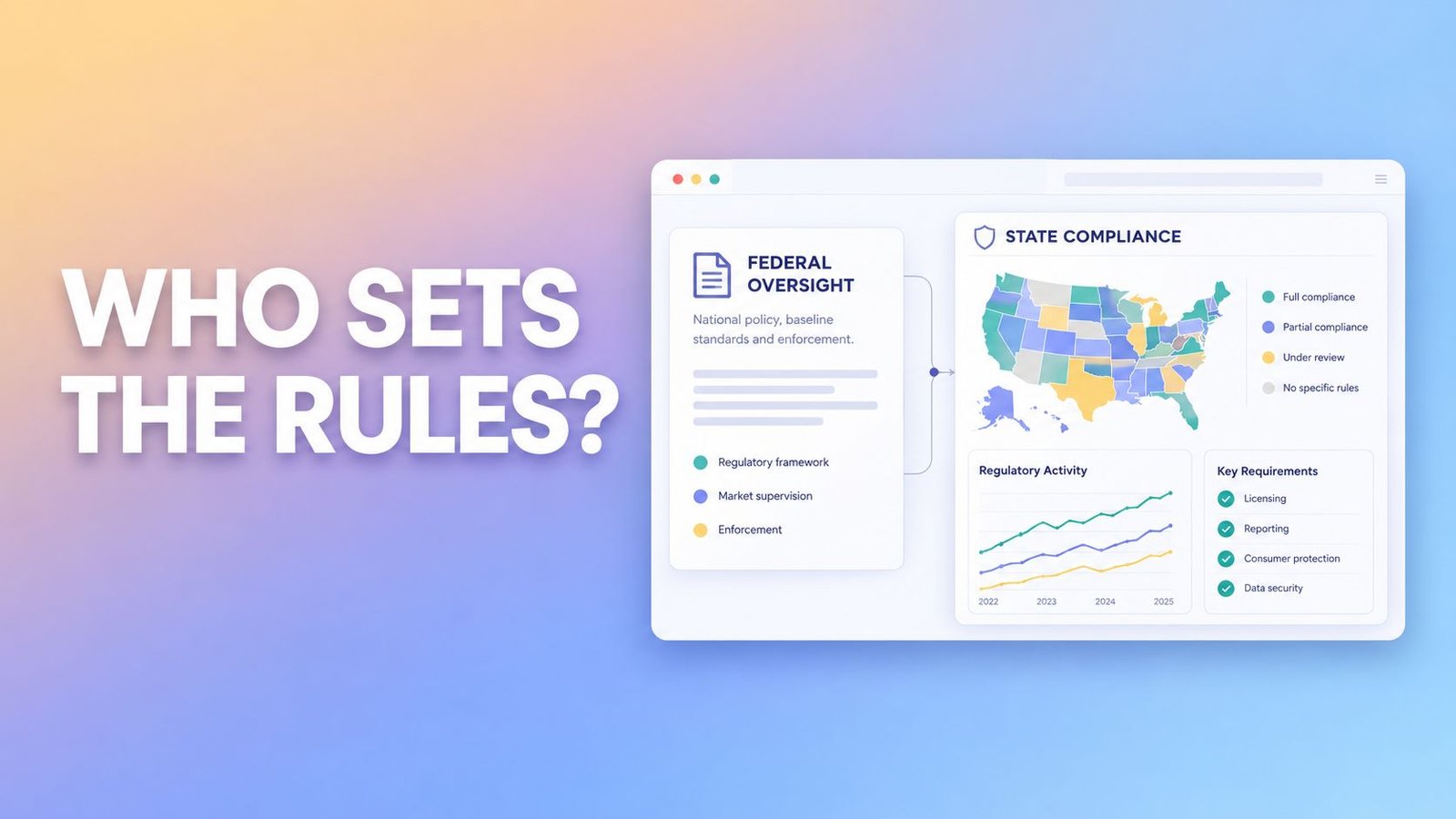
No particular prediction-market judgment or state licensing outcome is established by the evidence cited here. Operators evaluating such products should obtain a current, jurisdiction-specific legal assessment rather than infer nationwide permission from a product's availability.
Keep product classification separate from other obligations
Confirmed American casino reporting requirements illustrate why compliance questions need separate treatment. Under Internal Revenue Service casino suspicious-activity guidance, a transaction conducted or attempted at, by or through a casino requires reporting when it involves or aggregates at least $5,000 and the casino knows, suspects or has reason to suspect suspicious activity.
That rule isn't evidence that casino reporting obligations automatically apply to an event-contract platform. It demonstrates the importance of identifying the regulated entity, covered activity and triggering conditions before configuring controls.
Consider a hypothetical sportsbook supplier asked to add an event-contract interface. The supplier should seek documented decisions about product classification, customer eligibility, distribution geography and responsibility for monitoring, rather than accepting a commercial label as the legal analysis.
Launch boundary: An unresolved classification question should remain visible in the approval record. It shouldn't disappear inside a supplier warranty or a general compliance statement.
For investors, the material issue is not whether litigation exists. It's whether management has identified which products, partnerships and revenue assumptions depend on a disputed interpretation.
5. Brazil's Betting Framework and Payment-Channel Compliance
Brazilian market-entry planning should connect authorisation, customer acquisition and payment processing from the outset. A business shouldn't assume that preparing a licensing application also establishes permission for every payment method, promotional offer or affiliate arrangement.
Specific legal provisions, tax rates, authorisation conditions and payment restrictions require current Brazilian official confirmation. Describing the market as an opportunity doesn't resolve those operational questions or establish that a particular business model is permitted.
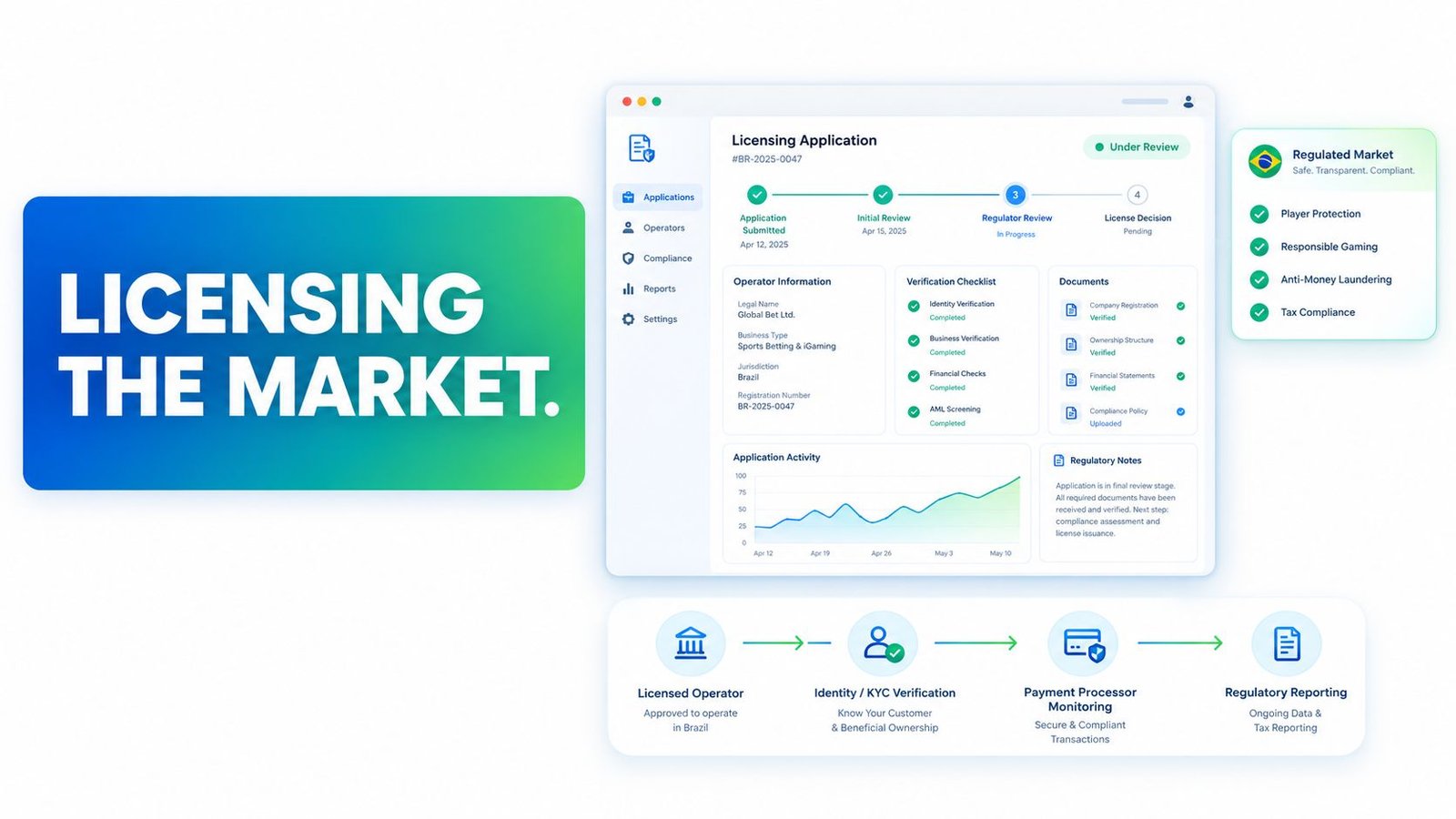
A hypothetical international operator could complete its corporate documentation while leaving uncertainty over merchant identities, payment intermediaries or affiliate landing pages. The resulting launch risk would sit between departments rather than within the licensing file alone.
Follow the full customer and payment journey
A useful readiness review traces how a customer discovers the brand, opens an account, deposits, wagers and withdraws. Each step should identify the responsible legal entity, relevant supplier and evidence needed to demonstrate compliance.
- Authorisation alignment: Reconcile brand names, domains, contracting entities and payment arrangements.
- Payment controls: Document accepted channels, transaction exceptions, reconciliation and escalation responsibilities.
- Marketing ownership: Require approval and monitoring of affiliate communications, not just centrally produced advertising.
British enforcement offers a documented example of distribution-channel exposure, although it doesn't establish Brazilian law. The Gambling Commission reported 516 cease-and-desist requests, 352 requests targeting advertisers or affiliates, and search-engine removal of 95,705 illegal gambling URLs in its illegal-market disruption reporting.
The transferable lesson is that regulators can act beyond the operator's own website. Top 1 Rank's PAGCOR payment-gateway accreditation coverage provides a separate comparative reference for assessing payment-provider permissions and dependencies.
6. Ontario's AGCO Oversight and Player-Protection Readiness
An Ontario launch assessment should distinguish operator registration, supplier eligibility and market participation arrangements. Teams should verify the respective requirements associated with the Alcohol and Gaming Commission of Ontario and iGaming Ontario instead of treating every approval as a single licensing event.
The practical concern is the handover between commercial onboarding and live operations. A contract may allocate responsibility for a player-protection tool without proving that the configured product behaves correctly.
Consider a hypothetical operator replacing its account-management platform. The migration review should establish whether customer restrictions, intervention records and relevant account settings remain available and enforceable after the change.
Test the customer journey, not the feature list
A supplier demonstration can establish that a responsible-gambling feature exists. It can't, on its own, establish that the operator has selected the correct settings, connected the feature to the right accounts or retained adequate records.
- Registration mapping: Identify the operator, suppliers and relevant individuals whose status needs confirmation.
- Behavioural testing: Test account restrictions, customer communications and access decisions through realistic scenarios.
- Evidence retention: Preserve approvals, test results, defects and remediation records in an auditable form.
The same discipline should govern marketing. Legal reviewers should verify Ontario-specific requirements rather than approve material solely because it has already run in another North American jurisdiction.
Top 1 Rank's Philippine online-casino and PAGCOR overview provides comparative licensing context, not evidence of Ontario permissions. Cross-market research is useful when it identifies questions, but dangerous when it encourages teams to copy legal conclusions.
For suppliers, a stronger commercial proposition is a clearly documented control boundary: what the product enforces, what the operator configures and what neither party should assume. That clarity helps buyers assess implementation work before procurement becomes a launch deadline.
7. Netherlands Ksa Enforcement and Evidence of Player Protection
For Dutch-facing businesses, the useful question is how to translate Kansspelautoriteit publications into specific control tests. Teams should distinguish the wording of a binding requirement from guidance, an enforcement allegation or the facts of an individual decision.
No particular Dutch sanction or current advertising threshold is established by the evidence cited here. Operational changes therefore require confirmation against the relevant Ksa publication and applicable legal provisions.
A hypothetical affiliate review shows the difference between policy and evidence. An operator may prohibit unsuitable promotional messaging in its contracts, yet still need a process to inspect live landing pages, preserve examples, demand corrections and record the outcome.
Read enforcement decisions as control evidence
When reviewing a regulator's decision, compliance staff should identify the conduct, the failed control and the remediation expected. A headline penalty is less useful than understanding why an intervention, review or approval process didn't work.
Britain's enforcement record supports that analytical approach. The Gambling Commission reported action against 24 operators and £4.2 million in fines or settlements for the relevant reporting period, while explicitly cautioning against using annual penalty totals as the sole measure of impact in its trust-statement performance report.
A lower aggregate penalty doesn't establish weaker supervision. Case composition, licence interventions and remediation requirements also matter.
That principle is useful when assessing Dutch gambling compliance news, without implying that British findings establish Dutch obligations. Analysts should ask whether a development changes the control standard, clarifies an existing expectation or demonstrates how the regulator applies a rule.
For operators, the resulting work should be concrete: revise an approval route, improve intervention records or test affiliate monitoring. For investors, management's ability to explain those changes is more informative than reassurance that a policy has been updated.
8. Spain's Advertising Controls and RGIAJ Exclusion Checks
Spanish-facing operators should treat advertising permission and exclusion enforcement as separate approval questions. A campaign can satisfy an approved creative process while still reaching a customer whose account status requires different treatment.
The relevant Directorate General for the Regulation of Gambling publications and current legal position should determine advertising timing, channels, content and exclusion-check requirements. Teams shouldn't infer the required frequency of RGIAJ checks from a general description of the register or reuse a schedule designed for another jurisdiction.
A hypothetical sponsorship campaign illustrates the connection. Before publishing approved creative, an operator should establish which audiences receive associated account messages and whether suppression rules reflect the applicable customer restrictions.
Join marketing approval to account controls
Legal, marketing and engineering teams need a shared account of how exclusion information affects registration, access and communication. Each department should know which decisions its own system makes and where another system supplies the necessary status.
- Check timing: Confirm the legally required points for exclusion verification and document the resulting workflow.
- Suppression testing: Test how relevant restrictions affect direct messages and customer-targeting tools.
- Partner governance: Require affiliates and agencies to follow current approvals and withdraw outdated materials.
Top 1 Rank's PAGCOR gambling advertising rules coverage provides a comparative research reference, not a substitute for Spanish legal review. The useful comparison concerns governance practices, not the assumption that advertising permissions travel across borders.
For platform suppliers, the practical deliverable is traceability. An operator should be able to establish which status was checked, when the decision occurred and what action followed, subject to applicable data-handling requirements.
The broader analytical point is that central exclusion mechanisms require more than connectivity. Operators must verify how an external status changes the customer's actual experience, including any marketing consequences required by the applicable rules.
Gambling Compliance News: 8-Regime Comparison Matrix
| Regulatory Item | Core Requirements | Implementation Complexity and Resources | Expected Outcome | Ideal Use and Key Advantage |
|---|---|---|---|---|
| UK Gambling Act Review | Proposed online slot stake limits, affordability reforms, advertising changes, statutory levy and stronger regulator powers | High; may require product, customer-check, marketing and funding changes; proposals and timing need confirmation | Stronger consumer protections and more consistent standards | UK-licensed operators planning ahead; advance notice supports compliance preparation |
| Germany's GGL Framework | Licensing, €1,000 monthly deposit limit, OASIS integration, and advertising and bonus restrictions | High; requires licensing work, technical integration and ongoing reporting | Centralized player-limit and exclusion controls across licensed operators | Operators entering Germany; shared controls provide clearer rules and cross-operator oversight |
| EU Anti-Money Laundering Regulation | Harmonized customer due diligence, monitoring, reporting and beneficial ownership checks; scheduled to apply from July 2027 | High; requires system upgrades, data improvements, staff training and policy alignment | More consistent AML controls across EU member states | Gambling operators active across the EU; a common rulebook can reduce national fragmentation |
| US Prediction Markets and Sports Event Contracts | Federal CFTC oversight intersects with state gaming authority and ongoing litigation | High and uncertain; requires jurisdiction-specific legal review and continued monitoring | Potential clarification of regulatory boundaries, subject to court and regulator decisions | Operators assessing event-based products; monitoring helps manage an unsettled compliance landscape |
| Brazil's Betting Framework | Federal authorization, advertising restrictions, tax obligations, player protections and payment controls | High; requires licensing preparation, tax planning, payment controls and marketing review | A regulated route to market with enforcement against unlicensed operators | Operators considering Brazil; formal authorization provides a path into a large market |
| Ontario's Regulated iGaming Market | AGCO oversight, iGaming Ontario framework, technical standards, advertising rules and player-protection measures | High; requires registration, technical compliance, reporting and responsible-gambling tools | A licensed multi-operator market with defined regulatory standards | Operators and suppliers entering Ontario; transparent requirements support launch planning |
| Netherlands Ksa Enforcement Priorities | Licensing conditions with active oversight of advertising, player protection and responsible-gambling duties | Moderate to high; requires ongoing audits, marketing review and evidence of player interventions | Compliance expectations may evolve as the regulator responds to market data | Operators in the Dutch market; public enforcement decisions offer practical guidance |
| Spain's Advertising Rules and RGIAJ | Advertising restrictions, player verification and checks against the national self-exclusion register | High; requires reliable register integration, data synchronization and marketing controls | Restrictions on promotion and broad self-exclusion coverage across licensed operators | Operators serving Spain; centralized exclusions strengthen player protection |
Turn Regulatory Developments into an Immediate Action Plan
The strongest response to gambling compliance news is a controlled implementation process, not a larger collection of policy documents. Stake settings, affordability decisions, AML monitoring, marketing permissions, payment arrangements and exclusion checks involve different teams, but the licensed business needs a coherent account of how they work together.
A jurisdiction-by-jurisdiction register should distinguish proposals, enacted provisions, commencement dates, supervisory guidance and unresolved litigation. Each entry should identify the affected product, accountable owner, legal interpretation, technical dependency and evidence required before closure.
Make every regulatory decision testable
The first management question should be what changes in practice. If the answer is only that staff received an updated policy, the review should establish whether a system setting, investigation workflow, supplier obligation or approval process also needs attention.
- Legal and compliance: Confirm status, scope and applicability before converting a headline into an operational instruction.
- Product and engineering: Translate the requirement into testable behaviour, including failures and exceptions.
- Payments and AML: Map customer activity, investigation ownership and access to supporting records.
- Marketing and partnerships: Reconcile campaign approvals with affiliate oversight and relevant account restrictions.
- Management assurance: Require evidence that remediation works rather than accepting completion statements alone.
Independent scrutiny can also become part of enforcement outcomes. A £650,000 Videoslots penalty was accompanied by an independent third-party audit condition, according to CMS's review of Gambling Commission regulatory action. The implication is practical: remediation may require external validation, not merely an internal promise to improve.
That doesn't mean every operator needs the same audit scope or technology stack. It means management should understand which controls carry material risk, who tests them and what happens when testing identifies a failure.
For suppliers, the corresponding obligation is commercial clarity. Product documentation should distinguish built-in functionality from operator configuration and identify dependencies that could prevent the customer from meeting its obligations.
Top 1 Rank's editorial priority is to connect regulatory developments with those operational decisions while keeping confirmed facts separate from legal uncertainty. A useful roundup should help readers identify what is established, what still needs verification and which business process deserves attention.
Operators, suppliers and affiliates should assign an owner to every unresolved issue identified in their target jurisdictions, obtain the current official legal position and schedule evidence-based testing before the next relevant release or campaign. Decision-makers can use Top 1 Rank's iGaming intelligence coverage to support ongoing monitoring, while retaining local legal review and documented operational approval as the basis for action.





Join thousands of gaming professionals receiving the latest iGaming news, regulatory updates, and market insights.
