


What does an iGaming operator buy when it pays an affiliate: a new player, a recorded conversion, or defensible evidence that a customer was acquired through lawful promotion? Those outcomes aren't interchangeable. A commission report can establish who received credit without proving that the acquisition was incremental or that the advertisement was permitted.
Affiliate marketing in iGaming is best assessed as a compliance-governed attribution system. Commission rates matter, but the more consequential decisions concern market access, qualifying events, evidence retention, and responsibility for promotional conduct. Operators and publishers need those foundations before acquisition volume becomes a useful measure of success.
Table of Contents
- What Affiliate Marketing Means in iGaming
- Commission Models Compared
- Tracking and Attribution Architecture
- Compliance Across Fragmented Jurisdictions
- KPIs and Player Value Beyond Surface Metrics
- Tech Stack for Operator and Affiliate Programs
- Case Snapshots of Affiliate Programs in Practice
- Best Practices and Common Failure Modes
What Affiliate Marketing Means in iGaming
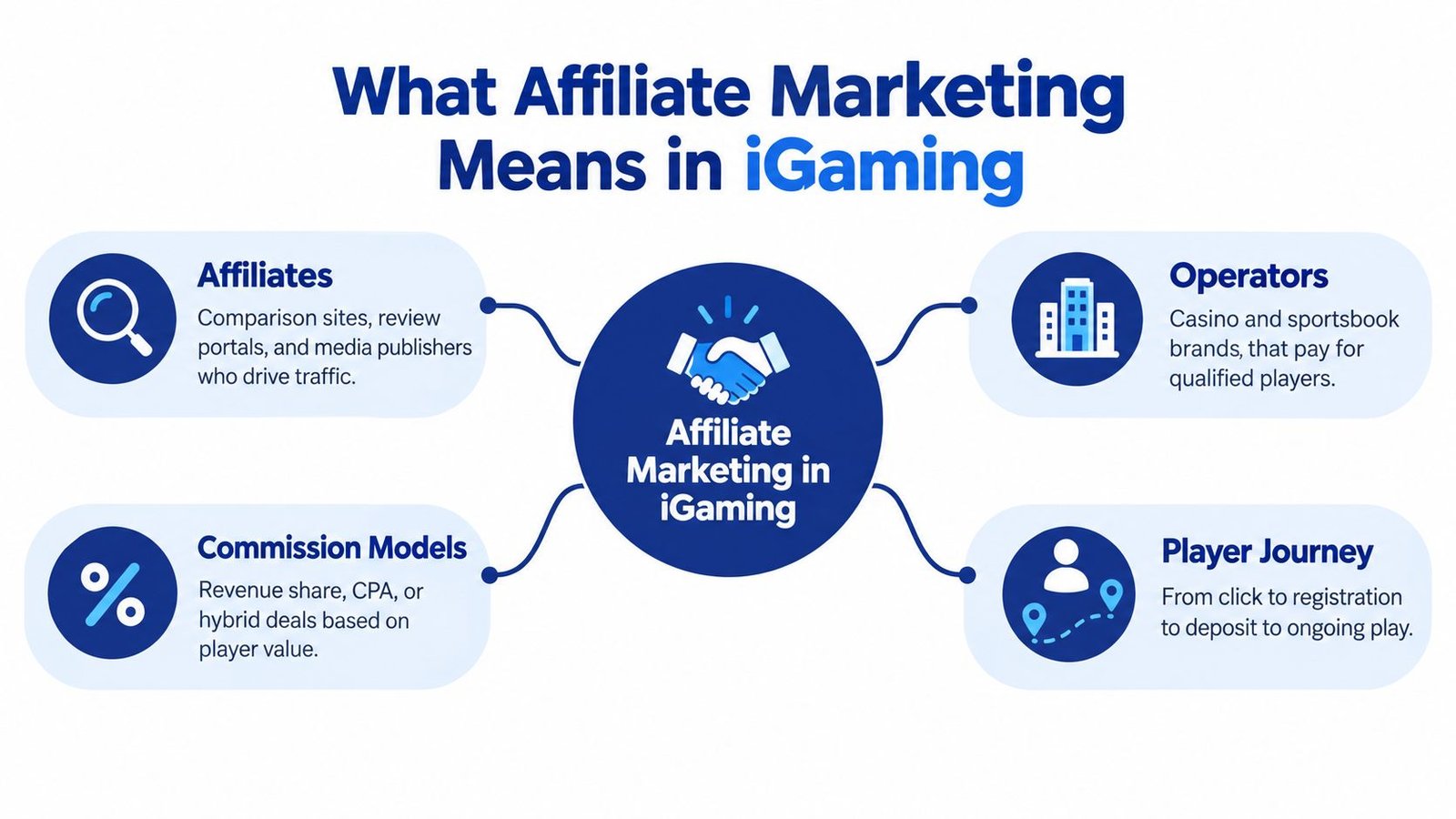
An iGaming affiliate addresses an audience-segmentation problem: connecting people researching gambling products with operators authorized to serve their location. Comparison websites, review portals, media brands, and content creators organize that discovery through editorial content and commercial referrals.
The channel became foundational during the expansion of internet casinos and sportsbooks in the early 2000s. Industry estimates place affiliate-driven acquisition at approximately 50% to 80% of new depositing players in mature regulated markets, although granular primary-source evidence remains limited. The estimated €38.2 billion European online gambling market in 2023 provides context for the commercial importance of that distribution relationship, not proof of any individual affiliate's contribution (iGaming affiliate market reference).
A commercial relationship with regulatory boundaries
The working definition is straightforward: an independent publisher refers prospective customers to a licensed gambling operator and receives compensation under an agreed performance model. The operator supplies the gambling service; the affiliate supplies discovery and referral activity. Neither role makes the other party's responsibilities disappear.
A general commercial resource such as the RedirHub affiliate program offers a useful reference point for examining referral-program arrangements outside gambling. It shouldn't be treated as evidence of gambling-market authorization or as a substitute for jurisdiction-specific assessment.
For iGaming, the important distinctions are operational:
- Audience eligibility: A relevant visitor isn't necessarily eligible to receive the promotion or open an account.
- Brand authorization: An operator's availability must be assessed against the location being targeted.
- Payment qualification: A referral must satisfy the contract's conditions before it becomes payable.
Analytical distinction: Traffic is an input. A lawful, contractually qualified acquisition is the commercial outcome.
That distinction prevents publishers from treating translation as localization and operators from treating referral volume as a complete acquisition strategy.
Commission Models Compared
CPA, revenue share, and hybrid agreements allocate uncertainty differently. The correct comparison isn't just which model promises the highest payment. It is which party bears the risk that a referred customer won't produce sufficient value.
Reported industry ranges commonly place CPA at approximately $50 to $250 per depositing player and revenue share at 20% to 50% of net gaming revenue. These are indicative commercial ranges, not audited universal benchmarks, and vary by jurisdiction, product, brand, and player quality (affiliate economics and governance analysis).
Commission model comparison for iGaming affiliate programs
| Model | Risk allocation | Cash-flow timing | Best-fit traffic | Key contract risks |
|---|---|---|---|---|
| CPA | Operator bears subsequent player-value risk after qualification | Payment follows validation of the agreed acquisition event | Acquisition sources requiring a clear payable outcome | Rejected acquisitions, qualification disputes, reversals |
| Revenue share | Affiliate participates in uncertainty over future NGR | Earnings depend on revenue generated over time | Audiences with credible potential for sustained engagement | NGR deductions, negative carryover, termination treatment |
| Hybrid | Parties divide upfront and continuing exposure | Initial acquisition payment plus subsequent revenue participation | Partners seeking acquisition funding and longer-term participation | Overlapping conditions and inconsistent settlement rules |
Choosing according to evidence, not convention
A flat fee can suit an affiliate that needs a predictable payment basis and an operator confident in its qualification controls. However, a predictable commission isn't the same as predictable profitability. The operator still needs a defensible expectation of customer value after paying the acquisition cost.
Revenue share places greater weight on the continuing relationship. Its usefulness depends on whether the affiliate can understand and verify the revenue calculation. A headline percentage provides little negotiating clarity if the underlying deductions remain ambiguous.
Hybrid arrangements can bridge those preferences, but they shouldn't be described as a universal default without stronger evidence. Their practical attraction is flexibility: an upfront component can support acquisition expenditure while ongoing participation preserves exposure to later player value.
- For operators: Model expected contribution after commissions and operational costs, rather than comparing advertised rates alone.
- For affiliates: Assess settlement transparency and contractual durability alongside the headline payout.
- For both parties: Confirm that the compensation basis is permissible in the target jurisdiction before negotiating its size.
The strongest commercial agreement is therefore not necessarily the most generous. It is the agreement whose payment basis both parties can verify and lawfully operate.
Tracking and Attribution Architecture
An affiliate click doesn't establish a payable customer. The tracking design must connect referral activity to account creation, identity and age checks, deposit approval, wagering, and the revenue calculation relevant to the agreement.
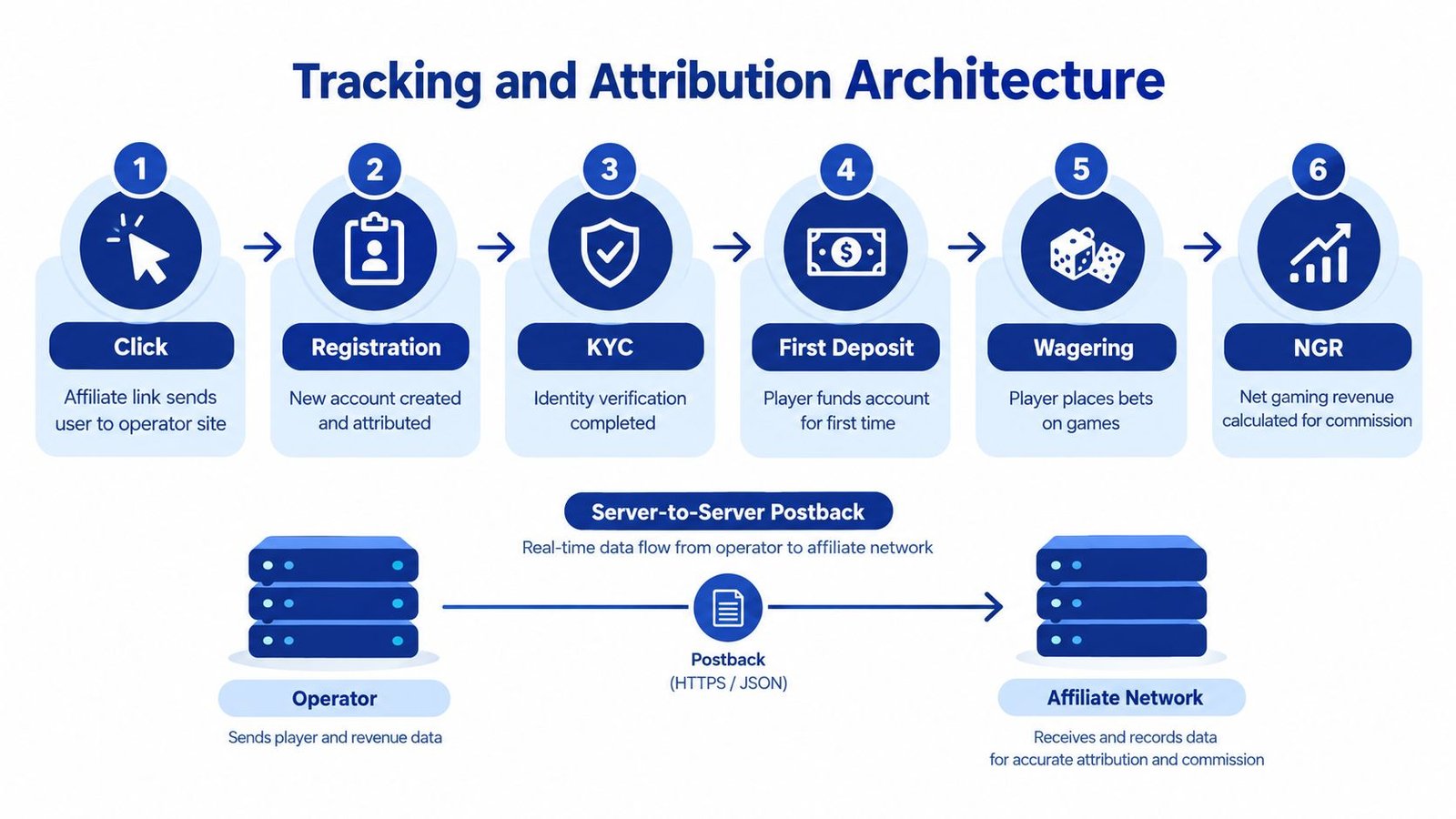
Cookie or URL identifiers and server-to-server postbacks serve complementary purposes. A stable click ID connects the referral to subsequent activity; transaction or player identifiers support event matching and deduplication. Browser restrictions, consent choices, ad blockers, attribution windows, competing channels, and time-zone differences can otherwise produce missing or duplicated credit (affiliate tracking and reconciliation guidance).
Define events before connecting systems
The implementation should distinguish a recorded event from an approved event. Registration, for example, shouldn't be treated as a proxy for successful verification, and a deposit notification shouldn't automatically establish commission eligibility.
A practical event specification should record:
- Event identity: Which customer or transaction the event concerns, using appropriately controlled identifiers.
- Qualification state: Whether the milestone is pending, approved, rejected, or reversed.
- Attribution basis: Which referral receives credit under the agreed attribution window.
- Processing history: When the event occurred, arrived, and changed status.
The Refport attribution overview can serve as supplementary reading on affiliate-link tracking concepts. Gambling implementations still need operator-specific event definitions and a controlled relationship between tracking records and approved customer milestones.
Separate technical accuracy from commercial interpretation
S2S postbacks aren't a substitute for contract clarity. They can transmit approved milestones without exposing sensitive player information in the browser, but the parties must still specify first-click versus last-click credit, qualifying deposits, bonus-abuse exclusions, chargebacks, negative carryover, and the NGR formula.
Reconciliation should compare network records with CRM and advertising-platform records, then classify discrepancies by cause. A difference explained by an attribution window isn't equivalent to a missing deposit, and neither should be presented as additional performance.
A tracking platform can execute an attribution rule accurately even when the rule gives commercially misleading credit.
For Philippine-facing infrastructure assessments, PAGCOR gaming system administrator requirements provide a separate due-diligence topic. Technical implementation and local regulatory classification should remain distinct workstreams rather than assumptions embedded in the same integration ticket.
Compliance Across Fragmented Jurisdictions
A contract requiring an affiliate to obey applicable law doesn't establish that any particular campaign is lawful. Compliance requires evidence about the actual advertisement, audience, destination, and compensation arrangement.
Comparative research reports explicit affiliate-marketing prohibitions in Italy, Latvia, and Estonia, gambling-advertising requirements affecting affiliates or influencers in France, Portugal, and Spain, and restrictions in Germany on compensation linked to player turnover, stakes, or deposits. The supplied cross-market analysis also identifies a Dutch requirement to demonstrate that 95% of advertising reaches people aged 24 or older. These findings warrant current local verification before publication or market entry (comparative affiliate regulation research).
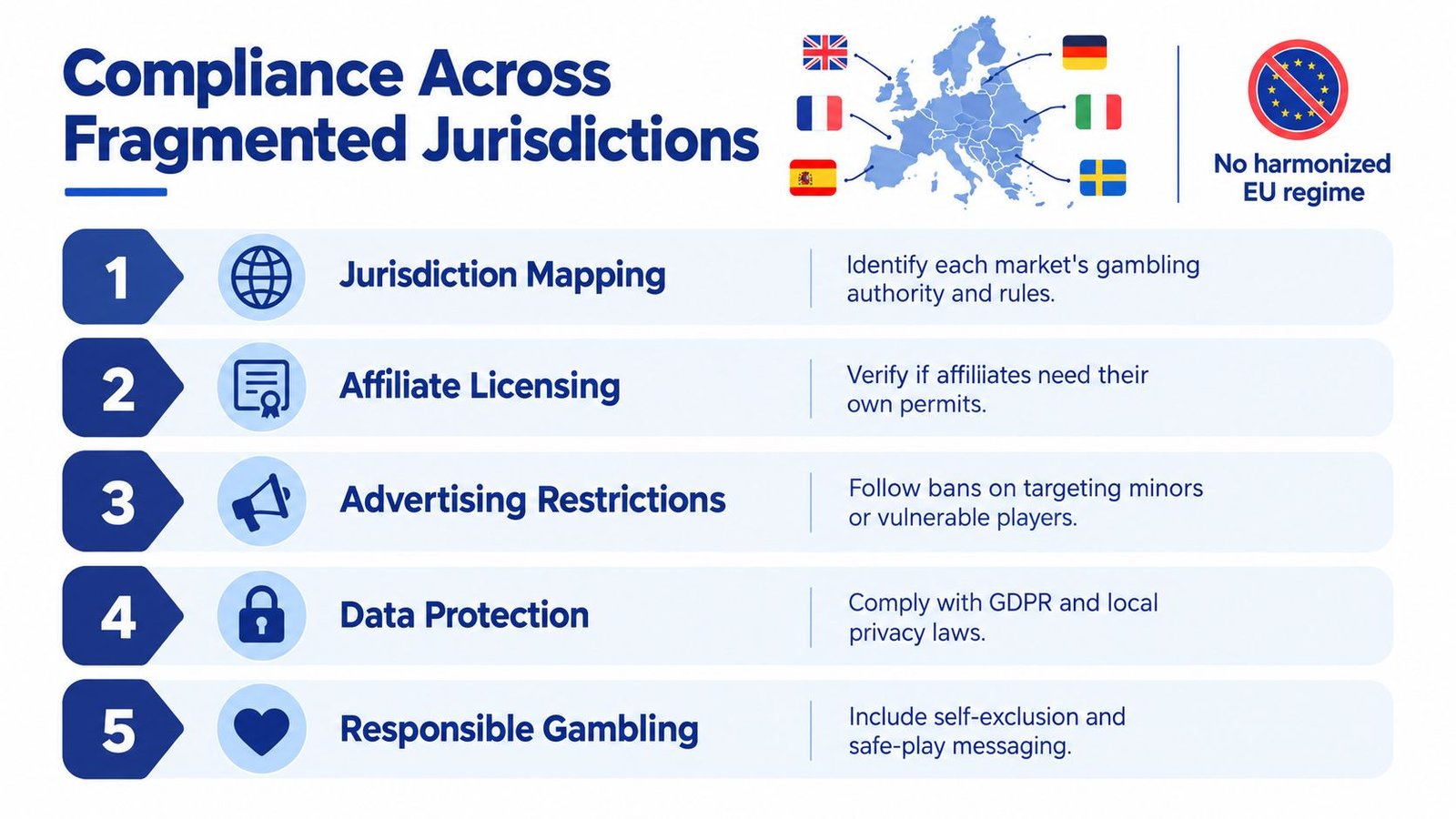
Translate rules into inspectable controls
In Great Britain, Section 16 of the CAP Code covers third parties, including affiliates, acting on an advertiser's behalf. The ASA also places responsibility on operators to ensure third-party compliance, with particular emphasis on protecting children, young people, and vulnerable people (ASA gambling advertising rules).
The UK Gambling Commission requires significant promotional conditions to appear prominently and close to headline offers. Where space is limited, key conditions must still appear as far as possible, and full online terms must be no more than one click away; incentive terms must remain available throughout the promotion (Gambling Commission advertising and marketing requirements).
| Control area | Evidence to retain | Publication consequence |
|---|---|---|
| Market permission | Current legal assessment and operator-license validation | Block unsupported jurisdictions |
| Audience eligibility | Age-targeting settings and audience-delivery records | Restrict placements lacking adequate evidence |
| Offer presentation | Approved creative, landing-page capture, and terms version | Prevent publication of incomplete incentives |
| Distribution chain | Named affiliates, sub-affiliates, and approved channels | Escalate undisclosed placements |
Google adds platform-specific conditions. Its gambling-promoting-content policy covers comparison and affiliate destinations, requires geographic licensing alignment, and restricts destinations from offering gambling themselves or linking to gambling services they own. Affiliates not requiring their own licence must link exclusively to authorized entities in the relevant geography and display the specified footer confirmation (Google gambling advertising policy).
Make publication conditional
A defensible approval sequence asks whether the format is permitted, the brand is authorized, the audience can be controlled, and the offer is accurately presented. Missing evidence should trigger review, not automatic publication.
Philippine campaigns require their own assessment through resources such as PAGCOR gambling advertising rules. European clearance shouldn't be treated as transferable permission.
The strategic implication is that market access belongs inside campaign governance. It isn't merely a legal document stored outside the publishing workflow.
KPIs and Player Value Beyond Surface Metrics
A large acquisition count can coexist with weak commercial value. Operators therefore need to distinguish recorded conversions, qualified customers, realized contribution, and incremental contribution rather than presenting them as equivalent outcomes.
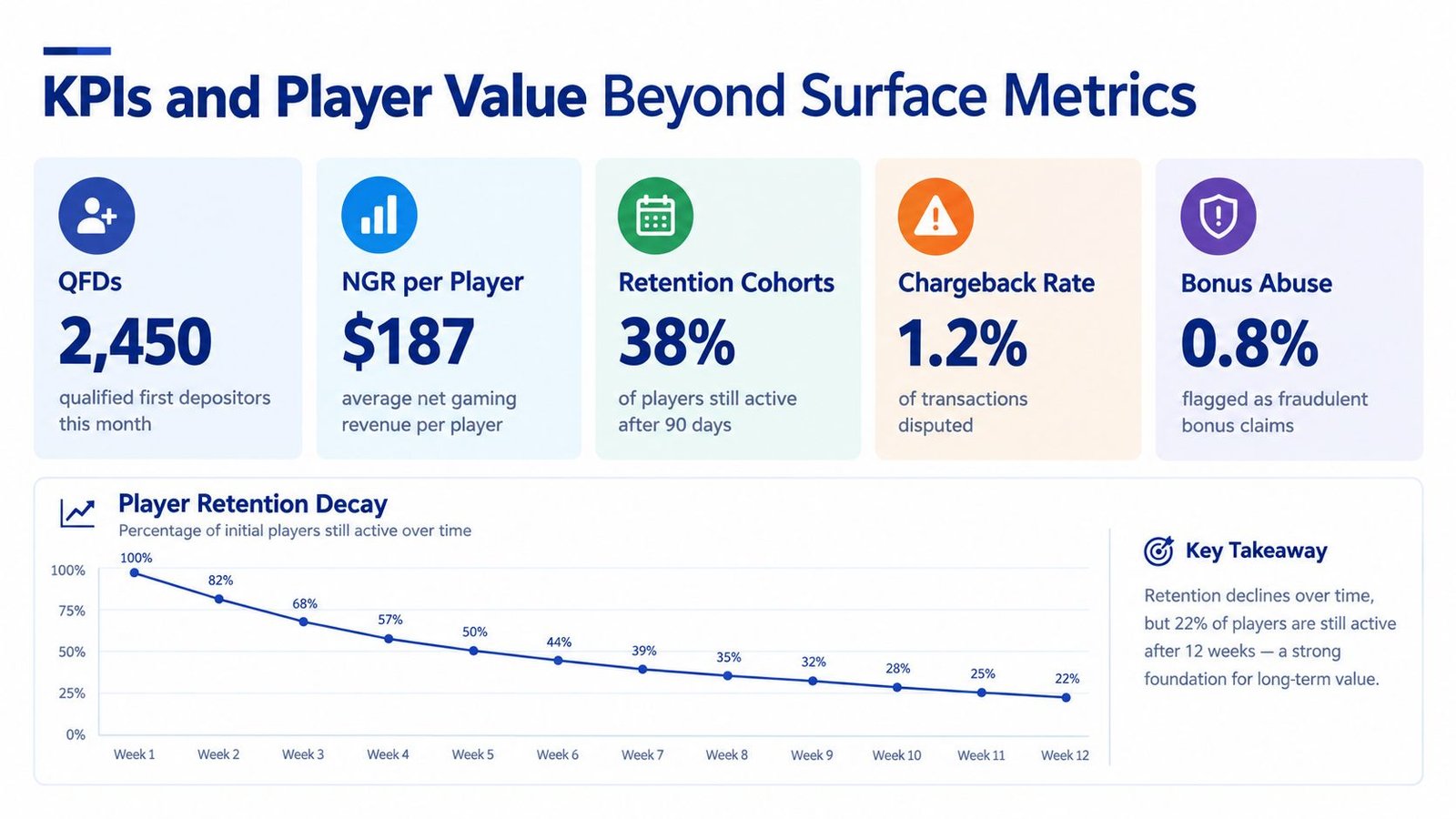
The dashboard below should be treated as a layout illustration only. Its displayed figures aren't verified market benchmarks, reported operator results, or inputs to the analysis.
Build a decision-oriented KPI stack
The useful question for each metric is what decision it enables.
- Qualified first depositors: Customers satisfying the agreed acquisition conditions, rather than every account that funds a balance.
- Verification completion: The share of referred registrations passing required identity and age checks.
- NGR per player: Contract-defined revenue assessed over comparable observation periods.
- Retention cohorts: Groups organized by acquisition period and source to distinguish continuing engagement from initial activity.
- Chargebacks and bonus-abuse exposure: Payment reversals and flagged activity assessed separately from approved revenue.
These are proposed analytical definitions, not a claim that every operator uses an identical dashboard. Customer economics should also incorporate the broader cost perspective discussed in user acquisition cost, rather than treating affiliate commission as the entire expense.
Test whether credited value was created
An industry report claims that markets with tighter gambling-advertising restrictions have affiliate shares of new-depositor acquisition 6–11 percentage points higher than comparable less-restricted markets. Because the finding comes from a commercial report, it shouldn't be treated as independently established causation (cross-market affiliate industry report).
The analytical question is whether restrictions increase affiliates' discovery value or merely concentrate attribution around the remaining measurable touchpoints. Operators should examine branded search referrals, assisted journeys, existing-customer status, and overlaps with other acquisition channels before drawing a conclusion.
Decision standard: Attribution identifies the credited partner. Incrementality asks whether the operator would have acquired the customer without that partner.
A proposed evaluation can compare matched customer cohorts or use controlled exclusions where lawful and operationally appropriate. Those methods should be designed before commercial renegotiation, not selected afterward to justify a preferred outcome.
Responsible-gambling indicators also require separate interpretation. A partner shouldn't be judged more favorably merely because its referred customers generate greater wagering activity; commercial performance doesn't override customer-protection obligations.
Tech Stack for Operator and Affiliate Programs
The relevant technology question isn't which platform has the longest feature list. It is whether the operator can reconstruct a commission payment from the approved promotion through the underlying event records to final settlement.

Organize systems around evidence ownership
A proposed architecture separates responsibilities rather than asking the affiliate tracker to become the authoritative system for everything.
| System layer | Proposed responsibility | Procurement question |
|---|---|---|
| Affiliate platform | Partner records, attribution settings, commission calculations | Can rule changes and historical calculations be exported? |
| CRM and verification systems | Customer status and approved qualification outcomes | Which system authorizes each payable milestone? |
| Postback integration | Controlled transmission of approved events | Can failed or repeated messages be investigated? |
| Payment workflow | Settlement approval and payment records | Can finance trace a payment to its approved calculation? |
| Risk and content controls | Flagged activity, creative approvals, publication history | Can reviewers retrieve the supporting evidence? |
Fraud-review requirements should be specified explicitly, including how teams investigate suspected bonus abuse, multi-accounting, and potentially stolen payment instruments. These are proposed controls, not a claim that any particular software product detects them reliably.
Compare deployment models by responsibility
A managed network should be evaluated for contractual access to data, partner transparency, integration support, and dispute handling. An in-house or self-hosted tracker should be evaluated for engineering responsibility, access management, maintenance, and the operator's ability to preserve historical records.
Neither arrangement automatically establishes audit readiness. Procurement teams should request demonstrations using rejected conversions, reversed deposits, amended terms, and disputed settlements, rather than accepting a dashboard tour as sufficient evidence.
- Data access: Establish what the operator can retrieve during a dispute or supplier transition.
- Change control: Identify who can alter commission rules and how approval is recorded.
- Exit readiness: Determine whether records remain usable after the commercial relationship ends.
For Philippine supplier assessments, PAGCOR support service provider accreditation requirements belong in the local due-diligence process. A technology purchase shouldn't proceed on the assumption that functionality alone resolves the supplier's regulatory position.
The architectural conclusion is straightforward: software selection should follow the evidence model, not define it accidentally.
Case Snapshots of Affiliate Programs in Practice
The following scenarios are hypothetical operational examples, not reported company case studies. They illustrate decisions arising from the controls and regulatory findings above without claiming measured outcomes.
A disputed deposit milestone
A European operator and an affiliate disagree because their systems recognize different versions of a deposit event. The affiliate sees a successful notification; the operator's customer record shows that qualification remains unresolved.
The proposed resolution is to establish an approved payable event, preserve pending states, and link any later reversal to the original record. Engineering validates message handling, finance reviews settlement consequences, and the affiliate receives a reason-coded explanation rather than an unexplained rejection.
The trade-off is less immediate reporting certainty in exchange for a clearer distinction between activity and payable acquisition.
A multilingual publisher restricts distribution
A publisher preparing Dutch-facing content discovers that geographic filtering alone doesn't establish compliance with the audience-age requirement described earlier. Language, location, and audience eligibility are separate questions.
The publisher would need audience-delivery evidence and a review of whether the intended placements can satisfy local requirements. If that evidence isn't available, the defensible decision is to withhold the affected promotion rather than assume that an age notice resolves the issue.
A market becomes unavailable
A publisher reviewing Latvian-facing pages identifies the reported prohibition discussed above. Subject to current legal confirmation, the appropriate response would be to stop the affected affiliate promotion, remove commercial referral pathways, and preserve the publication and withdrawal records.
Leadership would then need to distinguish permissible informational publishing from prohibited promotional activity through local advice. Replacing a bonus banner with a review label wouldn't, by itself, establish that the underlying commercial activity had changed.
Across these scenarios, the operational benefit isn't a promised performance increase. It is a documented decision that commercial, technical, and compliance teams can explain consistently.
Best Practices and Common Failure Modes
The most useful operating checklist pairs an action with the assumption it is intended to challenge.
- Record approvals: Preserve the approved creative, destination, and offer version. A contract disclaimer doesn't demonstrate that a specific placement was reviewed.
- Enforce restrictions: Connect geographic and promotional eligibility decisions to publishing and tracking controls. A licence claim shouldn't function as blanket international clearance.
- Reconcile regularly: Establish a monthly network-to-CRM review and assign discrepancy ownership. An unexplained reporting difference isn't additional acquisition value.
- Challenge commercial proxies: Evaluate approved customer cohorts and contribution, rather than treating a low CPA as proof of a strong partner.
- Separate content planning from permission: Resources such as SEO playbooks from Outrank can support editorial planning, but search strategy doesn't establish gambling-advertising compliance.
Turn review findings into accountable work
Operators should assign named owners for unresolved tracking rules, missing audience evidence, and unsupported promotional claims. Affiliates should maintain a market-specific publication register and a clear process for withdrawing affected material.
The immediate objective is a defensible operating record, not another summary dashboard.
For the current quarter, operators and affiliates should select an active market, trace a commission from publication to settlement, and document every unresolved approval or attribution question. Philippine-facing teams can use Top 1 Rank's PAGCOR regulatory updates to inform that review, then confirm applicable requirements before expanding distribution.





Join thousands of gaming professionals receiving the latest iGaming news, regulatory updates, and market insights.
