

A foreign slot studio can do everything right commercially, sign terms with a Manila-licensed operator, and still be blocked at launch because the Certificate of Accreditation is missing. That's the reality of the PAGCOR B2B provider application process. In practice, the regulator is not inviting suppliers to register their name and move on, it's filtering who can legally supply game content or support services to PAGCOR licensees and accredited GSAs, and it does that through documentary review, probity checks, technical evaluation, and Board approval before anything goes live. PAGCOR's own framework also makes clear that only SEC-registered corporations can apply, and each accredited provider, or each service category, must post the PHP 1,000,000 Performance Cash Deposit before launch. PAGCOR's accreditation rules for gaming affiliates and support providers frame this as a compliance gate, not a formality.
For operators and suppliers, the practical question isn't whether the process exists. It's whether the file is clean enough, the category is correct, and the launch calendar can absorb a review that takes weeks or months.
Table of Contents
- Why PAGCOR B2B Accreditation Matters in 2026
- Who Is Eligible to Apply as a PAGCOR B2B Provider
- Documents and Information You Must Prepare
- Technical, Compliance, and Facility Requirements
- Fees, Deposits, and Realistic Timelines
- Submitting the Application and Avoiding Common Pitfalls
- Post-Approval Obligations and Operator-Supplier Checklists
Why PAGCOR B2B Accreditation Matters in 2026
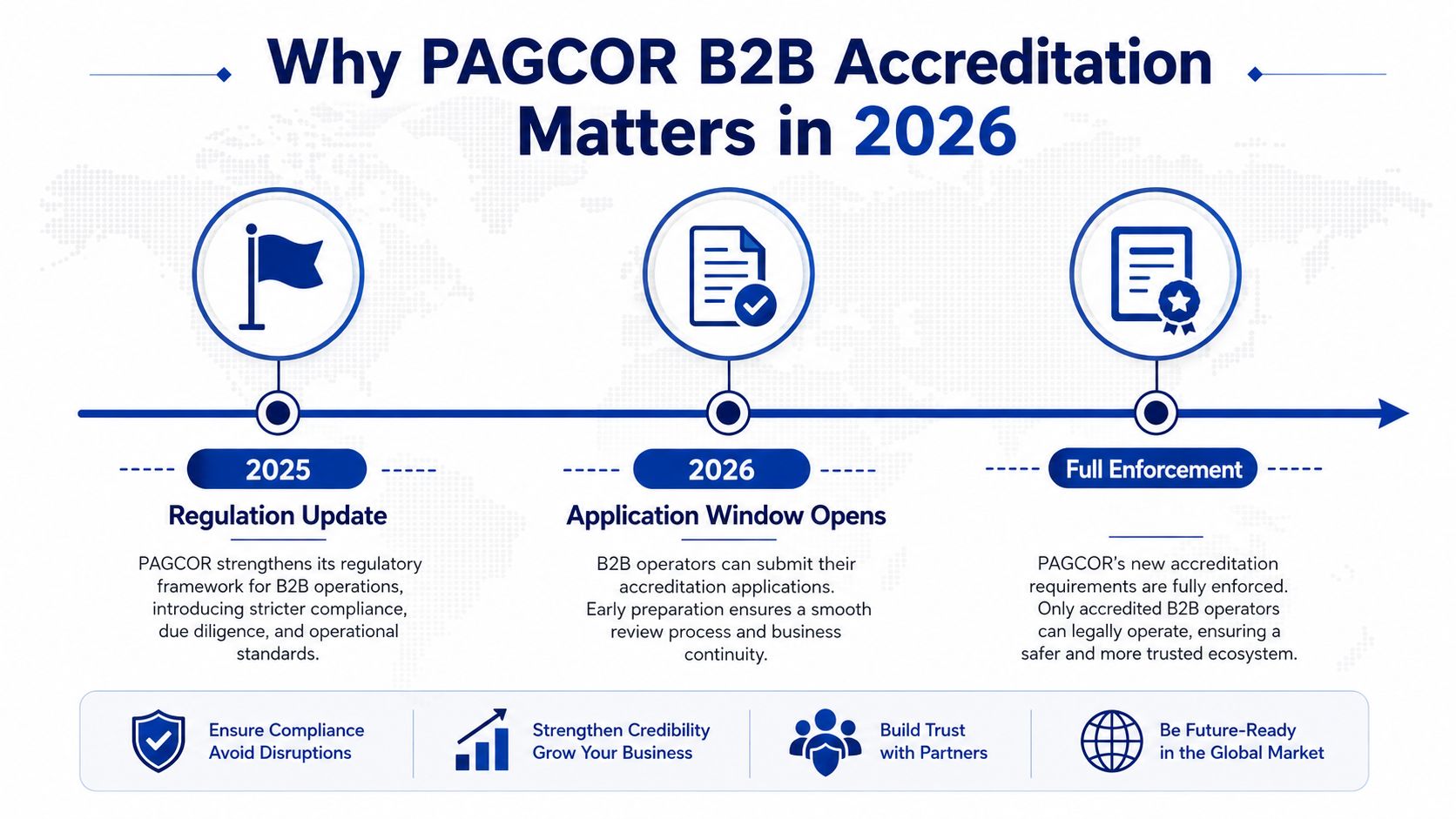
A foreign slot studio can't just wire up content to a Manila operator and assume the contract is enough. Under PAGCOR's current regime, the supplier needs accreditation first, because the regulator now supervises a wider B2B perimeter that includes aggregators, content providers, payment vendors, and KYC suppliers. That shift matters because it changes the point of failure. A commercial deal can be signed, integration work can be finished, and the launch can still sit idle until accreditation clears.
The regulator is supervising the supplier, not just the operator
That distinction is the core of the 2025 framework. Instead of only checking the licensed operator, PAGCOR now reaches into the supply chain and expects the supplier to pass a fit-and-proper style review before it touches regulated content or services. The result is a more formal compliance filter, and that filter is why a ready-to-launch file can still be delayed by a weak ownership narrative, an unclear service scope, or a technical stack that isn't fully explained.
The practical business impact is obvious. Suppliers that treat accreditation as a side administrative task tend to miss launch windows, while operators that wait for approval before reserving integration capacity often create their own bottlenecks. The strongest files are built like regulated submissions from day one, with the service category, ownership, technical model, and deposit obligation aligned before the first form is filed.
Practical rule: if the supplier can't explain exactly what it provides, to whom, and under which service category, PAGCOR will probably ask it to explain again in writing.
The shift also affects incumbents. Updated rules require existing B2B arrangements to be declared, so this isn't just about new market entrants. It reaches into live commercial relationships already operating on PAGCOR-licensed platforms, which is why legacy suppliers can't assume they're invisible to the new framework.
For market participants tracking the regime from the outside, the broader Philippine online gaming context is worth reading alongside the accreditation rules, especially the operator-side environment described on Top 1 Rank's Philippines casino coverage. Accreditation sits inside that wider compliance architecture, but the supplier file has its own logic and its own failure points.
Why 2026 planning starts now
PAGCOR's timing guidance makes early planning a necessity, not a preference. A supplier that thinks in launch dates only is already behind a regulator that thinks in review cycles, declarations, and Board approval. The right mindset is to treat the accreditation path as a regulated workflow with documentary checkpoints, not as a business development milestone.
Who Is Eligible to Apply as a PAGCOR B2B Provider
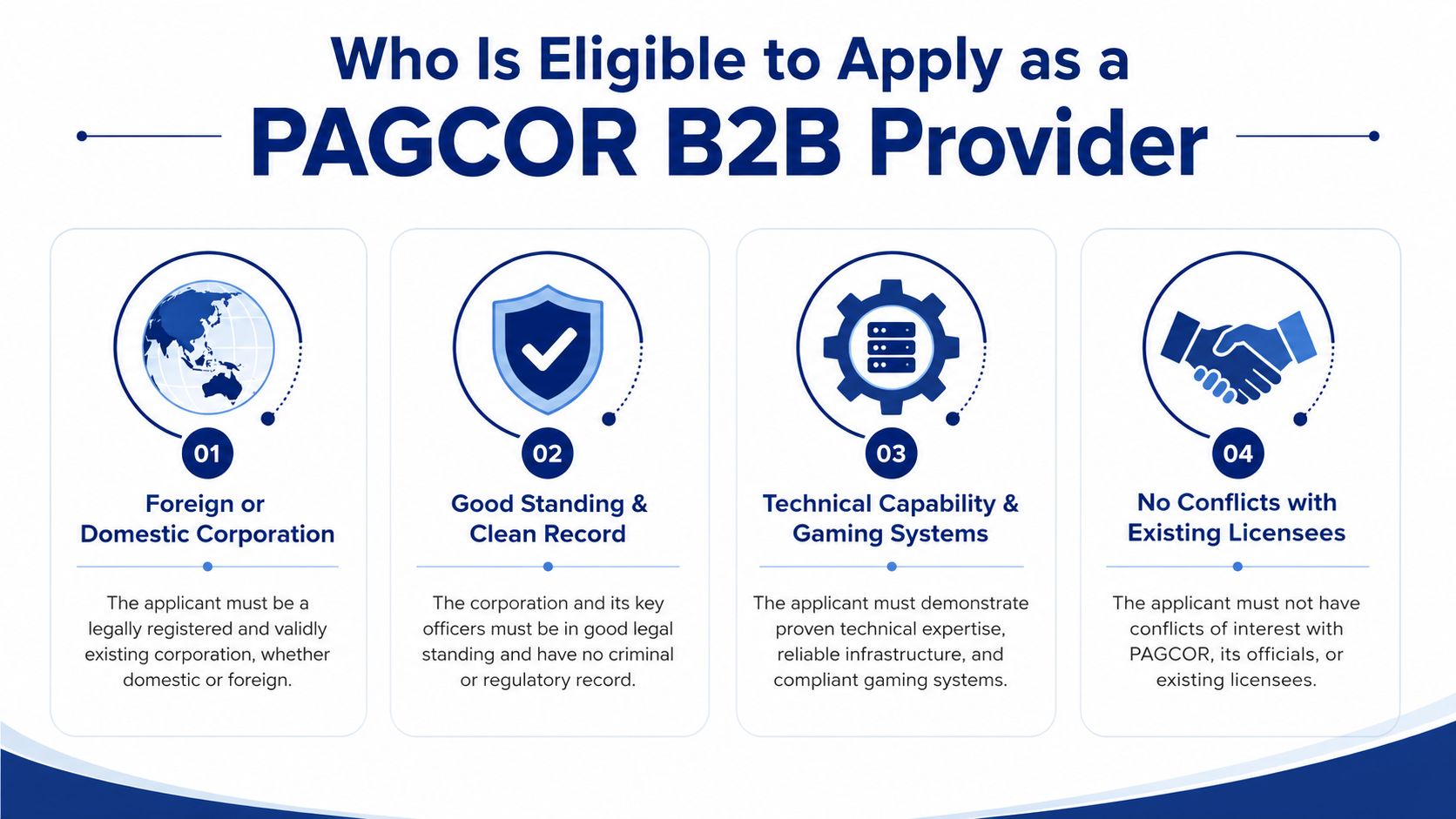
Eligibility starts with corporate form. PAGCOR's regime makes clear that only SEC-registered corporations can apply, so foreign branches, informal joint ventures, and unregistered project vehicles are not the right filing entity. That alone filters out a lot of rushed market entry plans, especially where a foreign parent wants to sign commercial terms before the Philippine entity is ready to stand on its own.
Map the service before the structure
The applicant should first decide what service category it fits. PAGCOR's B2B perimeter covers game content, aggregation, platform services, payment services, KYC services, and related support functions. That category choice matters because it determines both the documentation request and the PHP 1,000,000 Performance Cash Deposit obligation that attaches to each accredited provider or each service category.
A common mistake is forcing a business model into the wrong bucket because the commercial team wants the widest possible scope. That usually backfires. A narrow, accurate description makes the probity review cleaner, because PAGCOR can see what the entity does and what it doesn't do. An inflated description invites follow-up questions, especially when the file mixes platform functions with payment or compliance services that need different proof points.
A good internal test is simple. If the corporate structure, shareholders, and actual service stack can't be explained in one clean narrative, the application is probably not ready. That's especially true for special-purpose vehicles and foreign-backed local companies, where the regulator will look closely at who controls the entity and whether the scope of activity matches the submitted corporate purpose.
Top 1 Rank's separate guide on online casino legality in the Philippines is useful for teams trying to understand the broader legal environment, but the eligibility question for B2B suppliers is narrower. The corporation must exist properly in the Philippines, and the service scope must line up with the application category from the outset.
What tends to fail the first pass
PAGCOR's probity review is where applicants feel the gap between eligibility on paper and readiness in practice. Clean ownership records, clear directors' authority, and a coherent service description help. Vague shareholding chains, unexplained nominee structures, and mismatched supporting documents do not.
The file should read like a controlled corporate submission, not a sales deck with attachments.
That's the standard to use before filing. If the entity is right, the category is right, and the ownership picture is readable, the application can move into the documentary stage without avoidable friction.
Documents and Information You Must Prepare
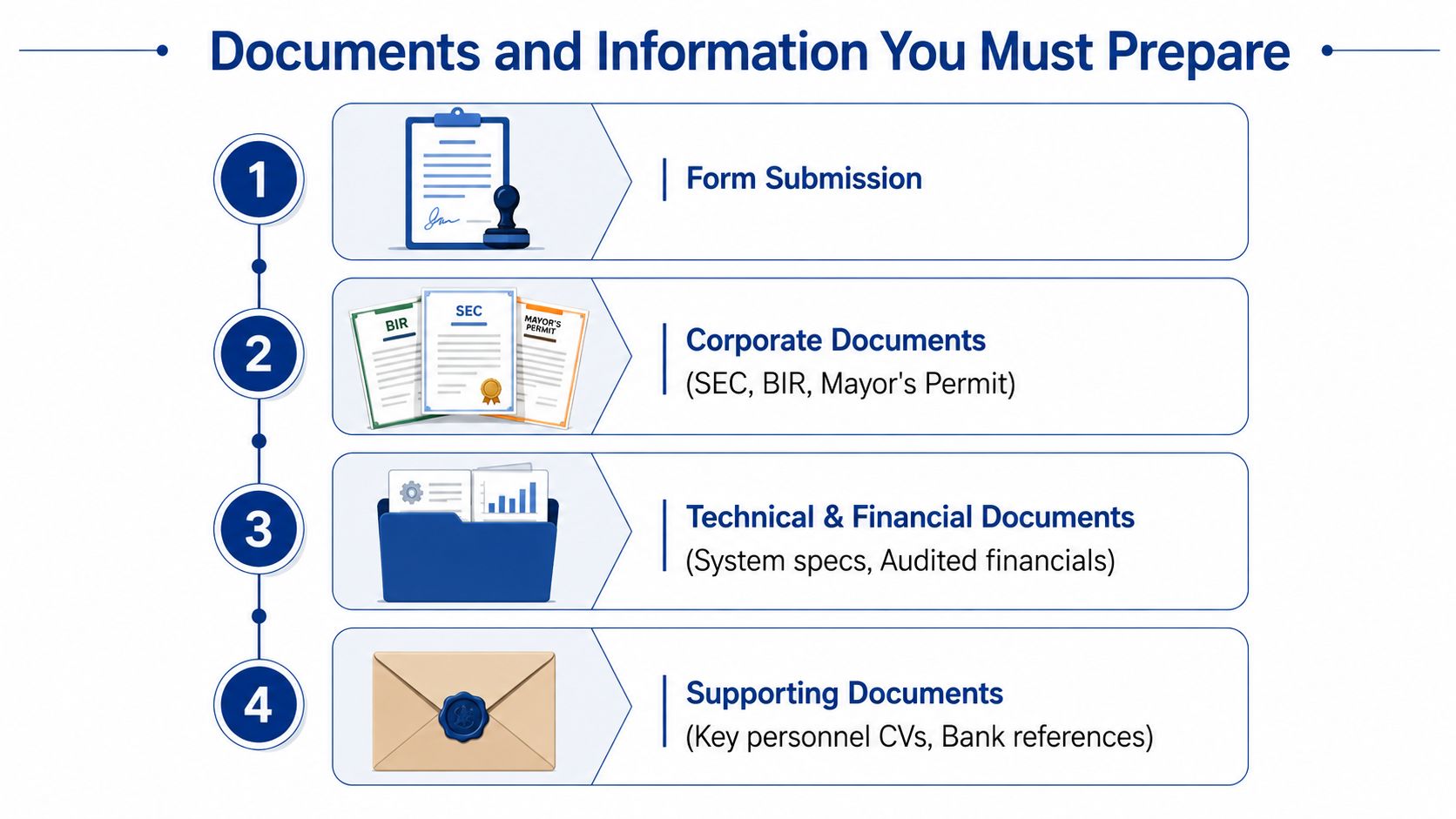
The document pack is where most applications gain or lose time. PAGCOR's workflow is document-first, and its Citizens' Charter shows that applicants start with prescribed forms, a notarized application, and supporting corporate documents before the regulator moves into documentary verification and evaluation. A complete submission is treated very differently from a file that needs repeated clarification.
Start with the forms PAGCOR expects first
The application package usually begins with the notarized form and the corporate authority to file. That means the board resolution authorizing the application, the applicant's SEC registration documents, and the basic company record set should all be clean, current, and internally consistent. If the legal name on the board resolution doesn't match the name on the SEC documents, the file has already created work for the reviewer.
The Citizens' Charter version of the process shows a 7 working-day processing target for registry inclusion once a complete submission is in hand, which is useful as a benchmark, not a promise of approval. PAGCOR's Citizens' Charter registration and procurement procedures make that distinction clear through the workflow itself. The practical takeaway is that completeness matters more than speed requests.
The corporate pack should also be arranged in a way that lets the Electronic Gaming Licensing Department see the structure quickly. Fresh SEC printouts, English-language documents, and properly notarized supporting papers reduce back-and-forth. A file that forces the reviewer to hunt for the authorization chain or corporate identity details is usually the file that gets set aside for clarification.
Build the supporting narrative around the business
Once the corporate basics are in place, the applicant needs to explain what the business does. That usually means a technical description of the platform or content stack, the commercial relationship with the PAGCOR licensees it intends to serve, and enough operational detail for the regulator to understand the delivery model. Supporting contracts or letters of intent help here, but they need to match the service category chosen at the front of the file.
Top 1 Rank's registration-oriented coverage is relevant for teams comparing how regulated product categories are presented in the Philippines market, but the supplier file itself should stay focused on the accreditation evidence PAGCOR asks for. The less the submission wanders, the easier it is to review.
Common return triggers are rarely dramatic. They're usually dull, avoidable mismatches, missing notarization, or a service description that doesn't explain the actual product stack.
Checklist point: every attachment should answer one question, who owns the company, what does it provide, and why does that service belong under this category?
That discipline is what keeps the file moving.
Technical, Compliance, and Facility Requirements
Once the paperwork is coherent, PAGCOR's review shifts from identity to substance. The regulator wants to know whether the service can operate safely, whether the controls are real, and whether the facility footprint, if any, fits the rules. For B2B suppliers, that means the technical architecture, compliance controls, and site profile all have to support the application narrative instead of contradicting it.
| Requirement Area | What PAGCOR Expects | Where Applicants Most Often Slip |
|---|---|---|
| Technical architecture | A clear description of the system, integration model, and service flow | The file describes the product in marketing language instead of operational terms |
| Compliance controls | AML, KYC, and responsible-gaming controls appropriate to the service scope | The controls are named but not actually documented |
| Content or game integrity | Supporting evidence where fairness, testing, or RNG relevance applies | Teams assume a vendor certificate is self-explanatory |
| Facility profile | A compliant operating site, if the applicant has a Philippine footprint | The site location conflicts with PAGCOR restrictions |
| Corporate evidence | Contracts, authority letters, and ownership support aligned with the service category | The documents point to a different line of business than the one filed |
The technical file has to show how the service works
PAGCOR's technical evaluation is not just a box-tick on product readiness. It examines how the system integrates, what controls sit around the platform, and whether the proposed service can be operated in a regulated environment without hidden dependencies. Where RNG, fairness, or game integrity documentation is relevant, the applicant should be ready to show that the content stack is verifiable and that the technical explanation matches the commercial scope.
The strongest submissions separate platform description from compliance policy. That helps the reviewer see where the system ends and where the control environment begins. If the same paragraph tries to explain architecture, KYC, AML, and game distribution all at once, the file usually reads like a pitch rather than a compliance pack.
For teams thinking commercially, the trade-off becomes visible here. A more complex integration model can support more partners, but it also lengthens review and raises the chance of clarification requests. A simpler, cleaner scope often moves faster because the technical evidence is easier to validate.
Top 1 Rank's analysis of user acquisition costs is useful context for commercial planning, but the compliance lesson here is different. If the technical model is overbuilt before the regulatory file is stable, the launch plan tends to absorb the delay.
Facility rules matter if the applicant has a Philippine site
PAGCOR's authorized-provider requirements add a physical layer that some applicants underestimate. The operating site must have a maximum floor area of 10,000 square meters, must not be in a residential area or any other area restricted by PAGCOR, and must be supported by lease or ownership documents plus, where applicable, a local government Letter of No Objection. PAGCOR's authorized provider requirements spell those limits out plainly.
That means the address on the file is not just a formality. A location that looks fine commercially can still fail if the zoning, lease, or local clearance story is weak. The safest approach is to lock the site evidence before submission and ensure the address matches the operational plan exactly.
Fees, Deposits, and Realistic Timelines
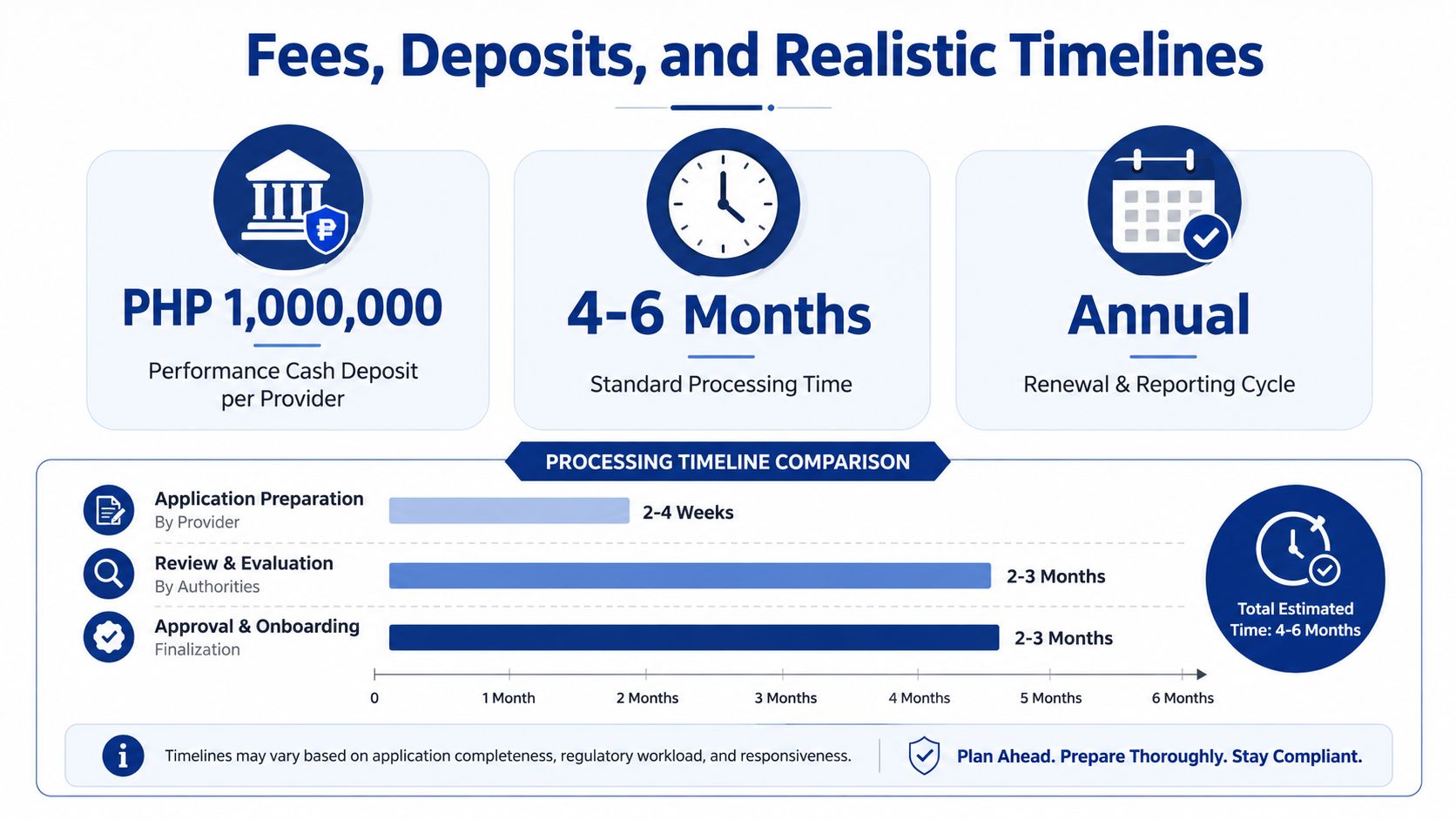
The financial and time commitment is where many applicants make the wrong commercial call. PAGCOR's B2B regime has a defined capital friction point, the PHP 1,000,000 Performance Cash Deposit for each accredited provider or service category, and that deposit has to be in place before any content or service can launch with PAGCOR operators. That alone changes budgeting, because the application isn't only a legal exercise, it's also a working-capital decision.
The timeline depends on file quality and integration complexity
Published guidance points in the same direction from different angles. Chambers' 2025 Philippines gaming guide says operators should consult PAGCOR at least six months before intended operations, while B2B applications can take two to three months depending on system complexity. Another published benchmark puts the processing period at 30 to 45 working days when documents are complete. That range is not contradictory, it reflects the difference between a clean file and a real integration.
A supplier that presents a simple service scope, clean ownership, and complete documents can sometimes move through the review faster than a complex platform provider with many moving parts. But where the technical stack is layered, the reviewer usually needs more time, especially if the integration touches multiple operator systems or compliance interfaces.
The Citizens' Charter's 7 working-day registry-inclusion target is still useful, but only as a marker for a complete submission. It shouldn't be confused with the full approval cycle, and it definitely shouldn't be used to promise a launch date to a counterpart who hasn't seen the file.
The early-filer incentive changes the planning calendar
PAGCOR also created a time-limited incentive for early filers. Applications submitted by December 31, 2025 with complete requirements could receive an initial 3-year accreditation instead of the standard 2-year term. That matters because the filing window itself becomes part of the commercial strategy, not just the legal one. A supplier deciding whether to rush a file or wait for more internal polishing has to weigh the upside of the longer initial term against the risk of filing an incomplete package.
This kind of transition incentive usually rewards teams that are already organized. It doesn't fix an incomplete file, and it won't rescue weak ownership documentation or a vague technical description. It gives well-prepared applicants a better starting term if they meet the cutoff.
The wrong assumption is that approval speed and accreditation term are separate issues. In this regime, the filing date can affect both.
A sensible launch budget should therefore account for the deposit, the time locked up in review, and the possibility that a rework cycle pushes commercial start dates further than the original plan.
Submitting the Application and Avoiding Common Pitfalls
The submission itself is straightforward only when the file is already complete. PAGCOR's workflow runs through the Electronic Gaming Licensing Department, which receives the documents, issues acknowledgment, and moves the application into documentary verification, evaluation with the issuing office, and probity review before Board approval can happen. The sequence sounds administrative, but each stage can expose a different weakness in the file.
Top 1 Rank's phishing and scam avoidance guide is relevant to the broader supplier ecosystem, but the same discipline applies here. A clean compliance process depends on controlled documents, traceable authority, and no assumptions about what the regulator will infer from context.
Most delays come from mismatched narratives
The biggest mistake is not missing one form. It's submitting a file where the ownership story, the service category, and the technical evidence don't say the same thing. A beneficial-ownership disclosure that's incomplete, a board resolution that authorizes a different scope, or expired SEC printouts can all create enough doubt to trigger clarification and extend the review.
The same is true for AML or RNG documentation that exists in principle but not in the specific form PAGCOR expects to see. A policy document that looks polished but doesn't connect to the actual service model won't carry the file far. The regulator wants evidence that the supplier can operate the declared business, not just that it can write about it.
Incumbent suppliers need to be careful as well. The updated framework requires existing B2B arrangements to be declared, so a supplier already active on a PAGCOR-licensed platform can't treat the new process as if it only affects new entrants. That declaration duty changes the conversation with operators too, because the operator now has to verify whether the supplier's status is current and properly disclosed.
Rejection usually means repair, not surrender
A returned file is often fixable if the issue is documentary rather than structural. Missing notarization, misaligned corporate records, or an under-explained service scope can usually be corrected and resubmitted with much less pain than an unsuitable applicant structure. The problem is time, because the clock usually runs longest on the files that were rushed the first time.
- Check ownership first: Beneficial ownership disclosures should match the corporate chain exactly.
- Match the service category: The category selected at filing should reflect the actual service, not the broadest commercial story.
- Use current corporate records: Outdated SEC documents are a common reason for follow-up.
- Authorize the filing properly: Board resolutions should clearly authorize the applicant entity.
- Close AML and technical gaps before submission: Silent missing pieces tend to surface during review, not after approval.
That's why the best files are assembled as if the reviewer has already found the weak points. It saves time, and it usually saves the commercial relationship with the launch partner too.
Post-Approval Obligations and Operator-Supplier Checklists
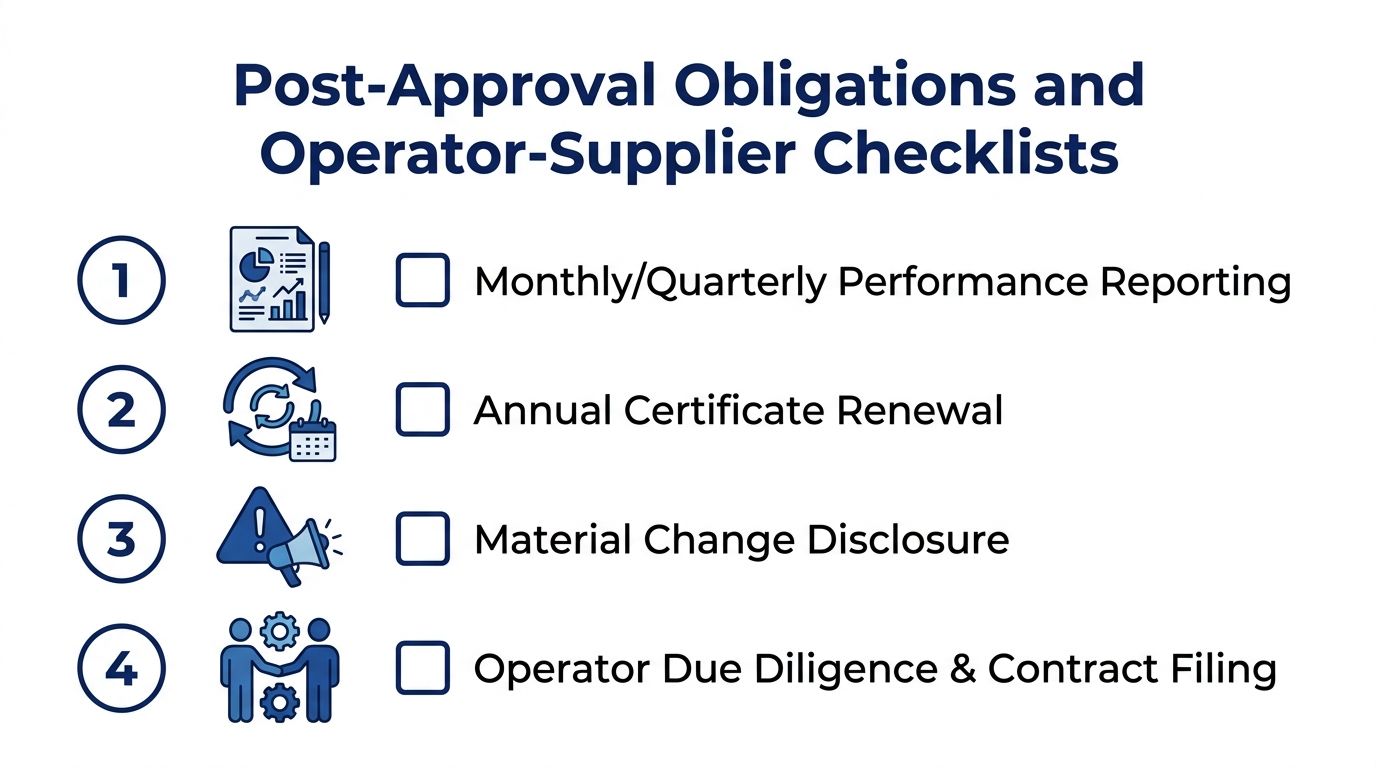
Once the Certificate of Accreditation lands, the file doesn't disappear. The supplier moves into an ongoing compliance relationship with PAGCOR, and the operator that hires the supplier inherits a parallel due-diligence burden. The approval is the start of supervised activity, not the end of it.
What changes after approval
The accredited provider needs to keep its reporting posture clean, renew on time, and disclose material changes in ownership or technical infrastructure. That matters because the regulator approved a specific corporate and operational profile, not a blank cheque to change the business without notice. If the service stack shifts materially, the original approval story can stop matching the live business, which is exactly what compliance teams try to avoid.
Operators should treat accredited suppliers as regulated counterparties, not interchangeable vendors. Due diligence still matters, and the operator should keep its own file on the supplier's accreditation status, scope, and material disclosures. The regulator's approval doesn't erase the operator's obligation to understand who it is contracting with.
Supplier checklist for first-time applicants
- Confirm the SEC entity: Use the correct Philippine corporation, not a placeholder vehicle.
- Lock the service category: Make the category match the actual product or support service.
- Prepare the deposit: Ensure the PHP 1,000,000 Performance Cash Deposit is planned before launch.
- Package the documents cleanly: Notarization, board authority, and corporate records should align.
- Document the technical model: The platform or service flow should be easy for PAGCOR to follow.
- Plan for renewals and change notices: Accreditation is an ongoing obligation, not a one-time event.
Operator checklist for vendor onboarding
- Verify accreditation scope: Confirm the supplier is approved for the specific service category being contracted.
- Review corporate consistency: Ownership, authority, and company records should be coherent.
- Request relevant compliance evidence: AML, KYC, and technical controls should be visible in the file.
- Track material changes: New ownership, new infrastructure, or a scope expansion should trigger review.
- Keep the contract file current: The agreement should match the approved service model and the live operating setup.
Useful rule for operators: if the vendor can't show a current accreditation scope in plain language, the contract probably needs a pause.
FAQ
How long does the PAGCOR B2B provider application process usually take?
Published guidance places complete-file processing in the 30 to 45 working day range, while more complex integrations can take two to three months and launch planning should allow about six months of lead time. The 2025 Philippines gaming guide is the clearest public benchmark in the available material.
Can a foreign-only entity apply directly?
No. PAGCOR's accreditation framework says only SEC-registered corporations can apply, so the applicant needs a Philippine corporate vehicle.
What happens if the launch date slips after approval work has started?
The practical answer is that the file still needs to stay aligned with the timing of the review, the deposit, and the contract scope. If the launch slips materially, the applicant should reassess the filing strategy rather than assume the original timeline still fits.
What happens when the initial term expires?
The initial term is 2 years under the standard regime, or 3 years for complete applications submitted by December 31, 2025 under the early-filer incentive. After that, the provider moves into the renewal cycle and must remain current on reporting and disclosure obligations.
Compliance teams that want a clean PAGCOR filing should start by locking the corporate entity, service category, and deposit plan before the first document leaves the office. Operators vetting suppliers should ask for accreditation scope, ownership evidence, and the technical summary in the same conversation, not after integration has already begun. For teams building their own filing pack, the next sensible move is to assemble the corporate documents, technical narrative, and board authority into one controlled submission folder, then review it against the regulator's current guidance before filing.


Join thousands of gaming professionals receiving the latest iGaming news, regulatory updates, and market insights.
