

A routine deposit pattern can put an online casino under AML scrutiny before anyone sees an obviously criminal transaction. A customer may use several payment instruments, make linked deposits, place limited wagers, and then request a withdrawal through a different channel. Each action can appear ordinary in isolation. Together, the pattern may raise questions about identity, payment ownership, source of funds, or attempts to avoid a monitoring trigger.
That is the operating reality behind online casino AML requirements. These controls affect licensees, platform suppliers, payment providers, compliance teams, investors, and affiliates whose commercial relationships depend on a casino maintaining regulatory approval. Weak controls can create more than a reporting problem. They can lead to enforcement action, tighter licence conditions, disrupted payment access, banking friction, and reputational damage.
The same principle applies in markets where casino activity is connected to national registration and reporting systems. Operators assessing the Philippine market, for example, should treat AML controls as part of the wider regulatory environment described in the PAGCOR online casino regulatory context, not as an isolated KYC exercise.
A credible programme shows that the operator understands its customer base, payment flows, products, and geographic exposure. It also shows that the operator can explain why controls are proportionate, how alerts are investigated, and what changes when risk changes. Regulators increasingly look for evidence that policies operate in practice, rather than existing in a compliance folder.
This guide moves from the legal foundation to operational design, jurisdictional differences, emerging payment and identity risks, governance, technology, and a practical review checklist.
Table of Contents
- Introduction Why Online Casino AML Requirements Matter Now
- Legal Foundations Behind Online Casino AML Requirements
- Core Components of an Effective AML Program
- Jurisdictional Variations Operators Must Manage
- Crypto Payments and Emerging Financial Crime Risks
- Governance Technology and Enforcement Consequences
- Actionable Compliance Checklist for Online Casino Operators
Introduction Why Online Casino AML Requirements Matter Now
For an online casino, AML exposure often begins with a mismatch rather than a dramatic event. A customer's identity may be verified successfully, yet the payment account belongs to another person. Deposits may arrive through several wallets, while the requested withdrawal goes to a channel that has no clear connection to the original funding source. A player may also refuse additional identification when a compliance team asks for clarification.
Those details matter because online gambling creates fast, low-friction movement between registration, payment, wagering, and withdrawal. A static check at account opening can't explain the customer's later behaviour. It also won't show whether several apparently small transactions belong to one linked activity pattern.
Practical rule: An AML control should explain the relationship between the customer, the payment method, the wagering activity, and the final destination of funds.
The regulatory stakes extend beyond a potential suspicious transaction report. The UK Gambling Commission's AML framework requires licensees to assess whether their business may be used for money laundering or terrorist financing, embedding the assessment into licensing responsibilities rather than treating it as a standalone policy. Its AML materials also state that operators must maintain adequate controls to prevent gambling businesses from being used for those purposes. The UK Gambling Commission's remote and non-remote casino AML responsibilities illustrates the regulator's focus on control effectiveness.
For suppliers, the issue is equally practical. A monitoring engine, identity service, payment orchestration layer, or case-management platform can support compliance, but the licensed operator remains responsible for understanding how the technology works, what data it receives, and what gaps remain. Investors and commercial partners also use AML maturity as a signal of operational resilience.
A strong programme therefore protects several dependencies at once:
- Licensing continuity: Weak implementation can influence supervisory action and licence conditions.
- Payment access: Banks, wallets, and payment partners may require evidence of effective controls.
- Investigation quality: Clear customer and transaction histories help compliance teams make defensible decisions.
- Business credibility: Documented governance reassures regulators, suppliers, and counterparties.
The relevant question isn't whether an operator performs KYC. It is whether the operator can demonstrate a live, proportionate, and evidenced response to the risks created by its products, customers, payment rails, and markets.
Legal Foundations Behind Online Casino AML Requirements
Online casino AML requirements form a hierarchy. International standards establish the baseline. National laws and regulatory guidance convert that baseline into duties. Licensing frameworks then make those duties operational through policies, accountable staff, systems, testing, and records.
The global foundation is FATF Recommendation 22, which classifies casinos, including online casinos, as Designated Non-Financial Businesses and Professions, commonly called DNFBPs. This brings casinos within expectations for customer due diligence, record-keeping, suspicious transaction reporting, and beneficial ownership verification. The AML and CFT guidance for gambling operators explains how these obligations apply to gambling businesses.
From international standard to operator duty
The classification creates an active management obligation. Operators must assess their own exposure to money laundering and terrorist financing, using the business they run as the reference point. The assessment should cover product types, customer locations, payment methods, transaction behaviour, and the distribution model. A generic document copied from another operator cannot show that those risks have been considered.
Regulators also expect the assessment to influence decisions. A higher-risk payment route may require stronger verification or closer review. Fragmented deposits and withdrawals across several instruments can change the interpretation of customer activity, even where each individual transaction appears ordinary. Crypto exposure may require separate consideration of wallet ownership, source of funds, and transaction traceability.
Beneficial ownership is another foundation. Under the FATF-style structure described in the guidance, a natural person holding 25% or more of shares, voting rights, or profit entitlement is typically treated as a beneficial owner. The threshold directs attention to the people who ultimately own or control a corporate customer or business relationship.
Why licensing changes the analysis
A national regulator turns broad AML principles into licensing conditions, reporting processes, and supervisory tests. The UK Gambling Commission's LCCP framework requires licensees to assess whether their business may be used for money laundering or terrorist financing. Its guidance updates have connected operator obligations with changes to the Money Laundering Regulations 2017 and Proceeds of Crime Act rules. Operators therefore need a process for monitoring current requirements, not a policy that remains unchanged after approval.
The hierarchy also assigns practical responsibility. The board sets risk appetite. Compliance converts it into procedures. Operations applies those procedures to real activity. Technology preserves evidence and supports detection. Independent testing checks whether controls work as designed, and whether decisions can be explained to a regulator.
Operators reviewing regional duties can consult PAGCOR regulatory updates for 2026 as part of jurisdiction-specific monitoring. Across markets, the standard is increasingly practical: controls should be proportionate to actual exposure, active in day-to-day operations, and supported by evidence that shows what happened and why.
Core Components of an Effective AML Program
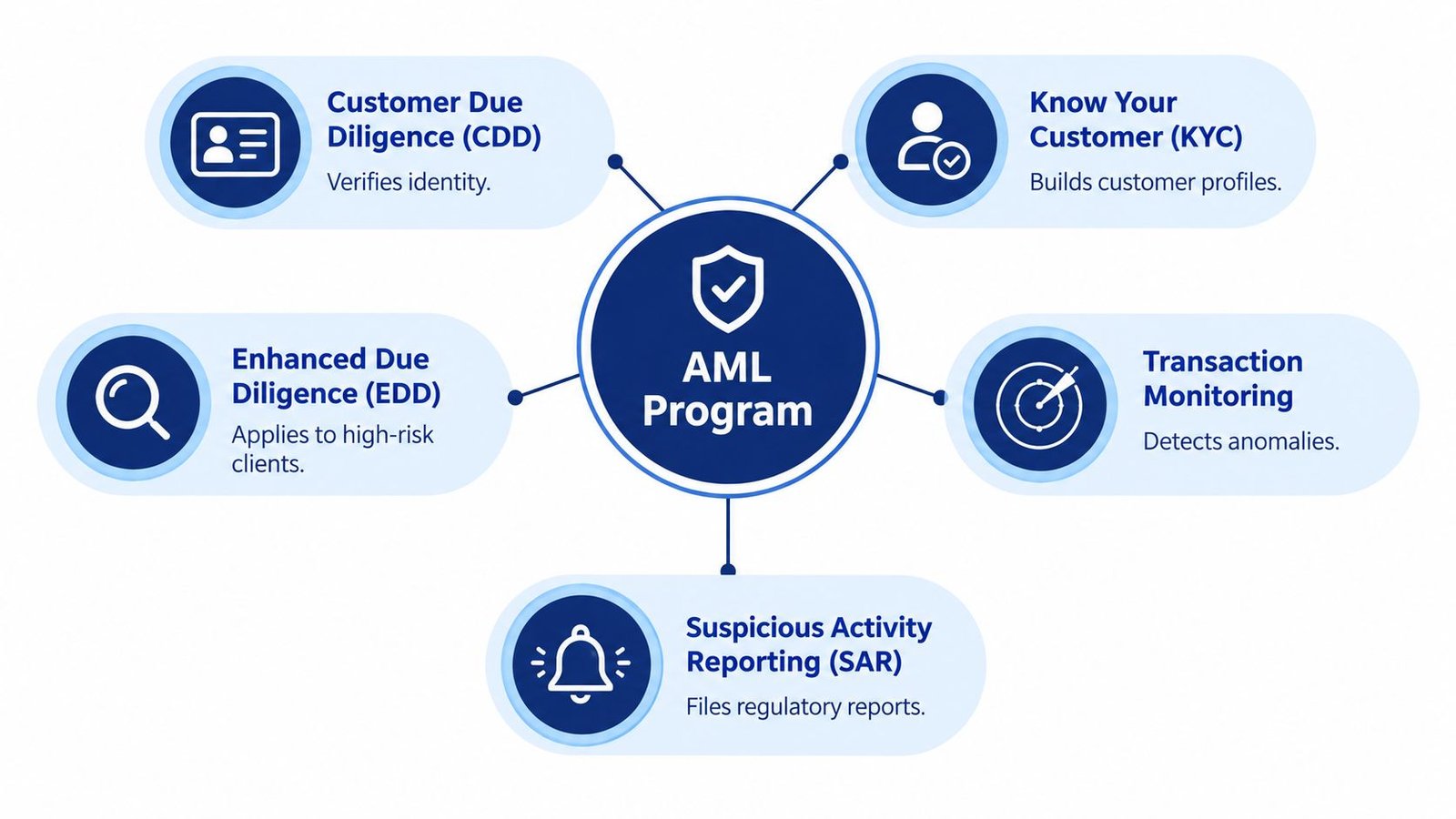
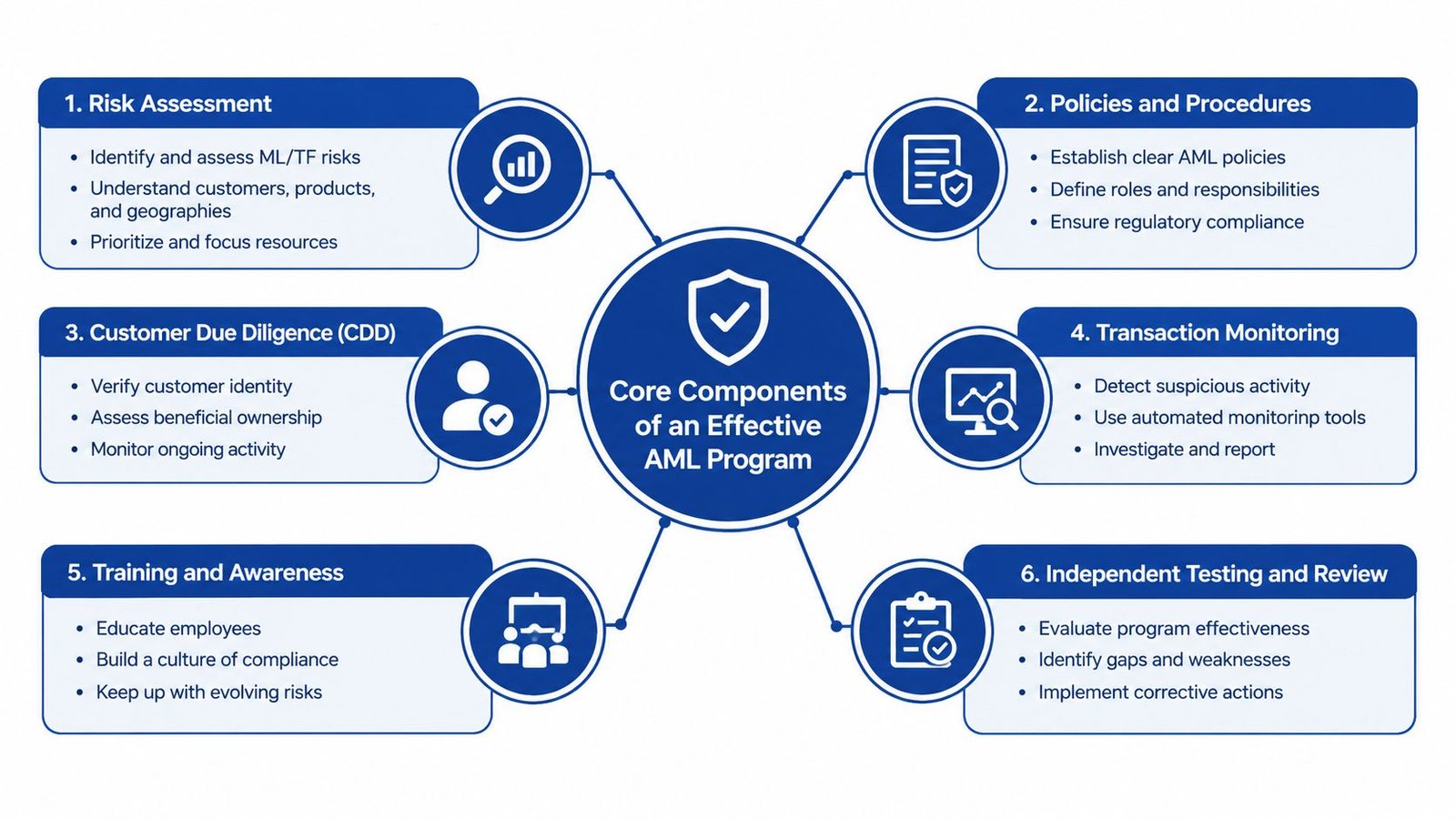
An online casino AML programme works as a connected system. KYC identifies the customer, CDD establishes the relationship and risk, monitoring tests later activity, investigations assess alerts, and reporting sends qualifying concerns to the relevant authority. A failure in one component can weaken the others.
Identity and customer risk
KYC should establish who the player is and whether the identity information is credible. CDD goes further by creating an understanding of the relationship, expected activity, payment ownership, and relevant risk factors. For corporate customers or commercial partners, the process includes identifying beneficial owners and understanding control structures.
A customer's profile shouldn't remain fixed after registration. Changes in geography, payment behaviour, account usage, or product access can alter risk. The operator needs a process that refreshes information when those changes matter, rather than waiting for a routine review disconnected from actual activity.
Enhanced due diligence applies when the relationship presents higher risk. That may involve deeper source-of-funds questions, additional ownership checks, closer transaction review, or senior approval. The precise response should follow the operator's documented risk methodology, and the file should show why the measures were selected.
Monitoring linked activity
Online monitoring must connect deposits, withdrawals, wagers, payment instruments, accounts, devices, and sessions where the operator is legally permitted and technically able to do so. A rule that reviews each deposit separately can miss structuring across linked transactions.
The UK remote gaming threshold approach identifies deposits or withdrawals of €2,000 or more as a control point, including linked or cumulative transactions, according to the Gambling Commission's threshold guidance. FATF-linked casino guidance also uses €3,000 as a threshold in relevant contexts. The operational lesson is more important than choosing a single number. The rules engine must aggregate activity and understand how separate events relate to the same customer or payment flow.
Screening, investigation, and reporting
Sanctions screening should operate alongside AML monitoring, with clear escalation for potential matches and ownership concerns. The system should preserve the data and reasoning needed to distinguish a genuine match from a false positive.
Suspicious transaction or suspicious activity reporting is not an automatic consequence of every alert. Investigators need documented procedures for triage, evidence gathering, decision-making, filing, and follow-up. Payment refusal, identity inconsistencies, unusual chip or payment behaviour, and attempts to avoid identification can matter even when an individual transaction doesn't reach a numeric reporting threshold.
Risk assessment completes the loop. It should change when the operator adds a product, enters a market, enables a new payment rail, or observes a material shift in customer activity.
The programme is credible when the risk assessment changes the controls, and the controls leave an audit trail.
Payment design also belongs inside the AML architecture. Teams assessing gateway relationships should evaluate ownership checks, reconciliation, data availability, withdrawal controls, and escalation support, including the issues raised in PAGCOR payment gateway accreditation.
Jurisdictional Variations Operators Must Manage
The same customer or payment pattern can create different duties across markets. A multi-jurisdiction operator cannot copy one threshold into every rules engine and call the programme consistent. It needs a jurisdiction matrix that maps customer due diligence, reporting, registration, and record-retention rules to each licensed operation. That matrix should also show which controls are live in each market and what evidence supports them.
| Jurisdiction | CDD Trigger | Reporting Obligation | Retention Requirement |
|---|---|---|---|
| United Kingdom | Remote gaming identification and verification applies at deposits or withdrawals of €2,000 or more, including linked or cumulative transactions. | Suspicious activity escalation follows the applicable AML and proceeds-of-crime framework. The casino defence threshold rose from £1,000 to £3,000 in July 2025, according to the UK casino guidance update. | Follow applicable UK AML, gambling, and proceeds-of-crime record requirements. |
| United States | Currency activity is assessed under the casino's defined reporting framework, while suspicious activity rules apply separately. | A CTR is required for more than $10,000 in currency during a 24-hour gaming day. A SAR applies to suspicious transactions or attempted transactions aggregating at least $5,000, where the casino knows, suspects, or has reason to suspect illicit activity or evasion. AGA AML best practices | Follow applicable federal recordkeeping and casino AML requirements. |
| Kenya | Internet casinos fall within the casino AML-CFT framework. | Casino registration with the Financial Reporting Centre through the GoAML platform is required, alongside applicable reporting and documented controls. | Follow the applicable Kenyan AML-CFT and reporting framework. |
| Philippines | Customer due diligence and transaction records support ongoing casino AML controls. | Suspicious activities and STR-related material must be preserved under the applicable casino rules. | Customer due diligence records, business correspondence, analytical results, casino transaction records, and relevant video footage must be kept for at least five years. Records linked to court cases continue beyond five years until the AMLC confirms resolution. Philippine casino AML rules |
The US model shows why currency and suspicious-activity logic must remain separate. A casino cannot rely only on a large cash transaction test. The American Gaming Association notes that operators may file SARs below $5,000 when patrons refuse identification, so behavioural escalation can matter as much as the amount involved. The AGA AML best-practices material reinforces that distinction.
Operators should use a common control framework with jurisdiction-specific settings. A central customer and transaction view can reduce duplicated work, while local rules determine the trigger, filing route, registration requirement, and retention schedule. The operating test is practical: can the team show that each local rule changes a workflow, and can it produce records proving the workflow ran?
That evidence matters when fragmented deposits, withdrawals, or linked accounts create a pattern that no single threshold captures. A control that exists only in a policy document will not demonstrate proportionate, live oversight.
Crypto Payments and Emerging Financial Crime Risks
Cryptoassets don't remove the operator's core AML duties. They make the relationship between identity, payment ownership, source of funds, and transaction history harder to establish when assets move through wallets, exchanges, intermediaries, or conversion services.
The same challenge appears with open-loop wallets and fragmented payment instruments. A customer can fund an account through channels that don't share the same ownership data or that provide limited information about the original source. An operator that checks only the immediate payment may miss a broader pattern involving several accounts or instruments.
Identity attacks change the control burden
AI-generated identity documents and fraudulent account creation undermine a narrow onboarding model. A document may pass a basic visual or automated check while the wider profile remains inconsistent. Compliance teams need to compare identity signals with device information, payment ownership, geography, account relationships, and later behaviour.
Misuse of money service business features creates another concern, particularly where a casino's payment ecosystem permits rapid movement between wallets or instruments. Cryptoasset-linked activity can also require closer review when the operator can't reasonably connect the funding source to the customer.
The EU AML package introduces customer due diligence at €2,000 for occasional transactions involving gambling service providers, as described in the casino-sector AML guidance update. This makes occasional-transaction logic relevant alongside account-based monitoring.
Governance must follow the risk
FinCEN's 2026 proposal would require casinos to formally document risk assessments, review national AML priorities, and maintain programmes approved by governing bodies, according to the same guidance update. Because it is a proposal, operators should distinguish proposed expectations from binding rules in their implementation registers and monitor the formal regulatory process.
The broader direction is clear. Thresholds still matter, but they can't carry the programme alone. A payment ownership mismatch, synthetic identity signal, refusal to provide information, or fragmented funding pattern may deserve escalation before a static amount trigger is reached.
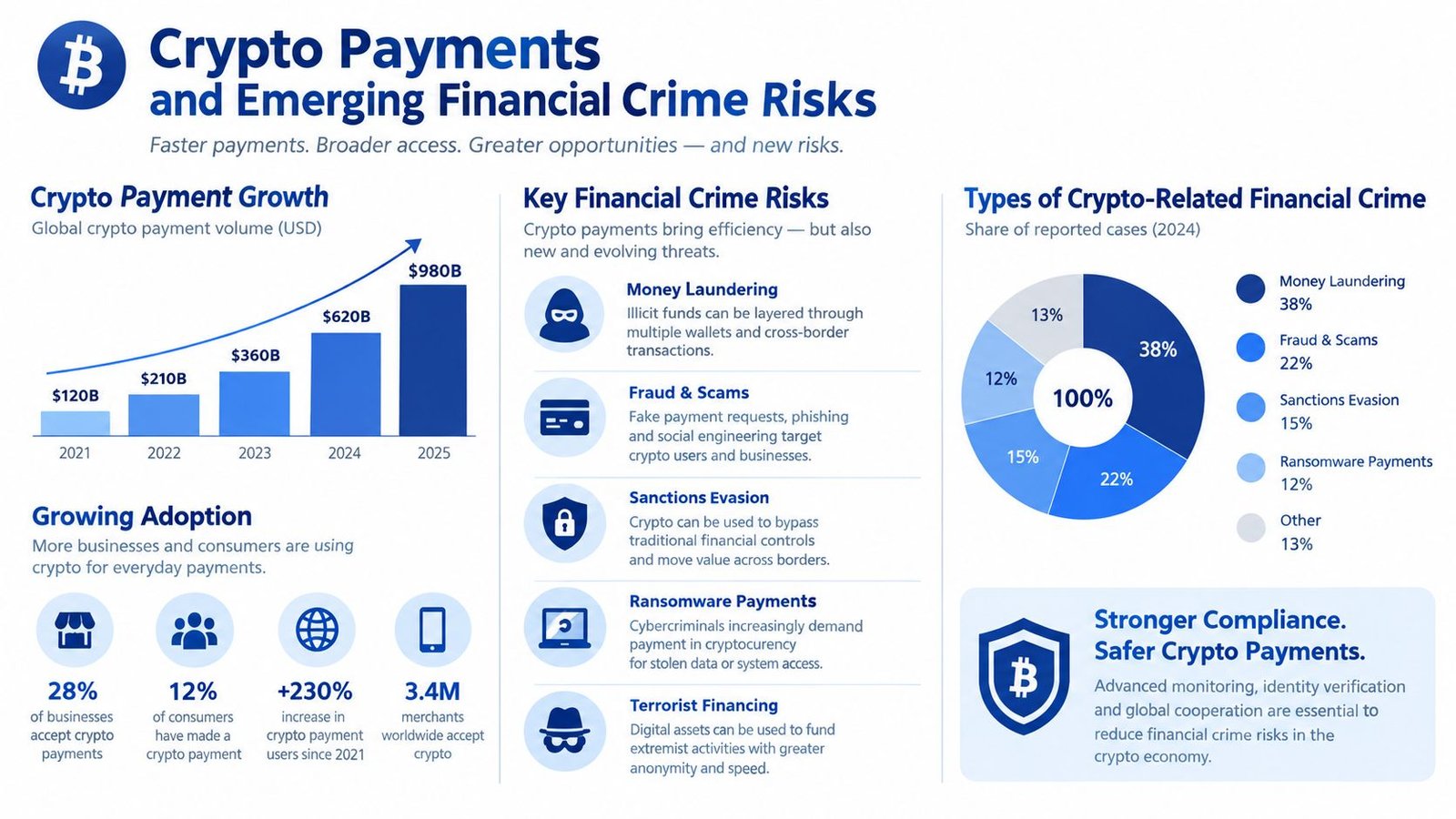
Operators evaluating local payment journeys, including GCash withdrawal considerations for Philippine online casinos, should ask whether payment data supports customer-level aggregation and investigation. The priority is continuous visibility across the entire flow, not a stronger checkbox at registration.
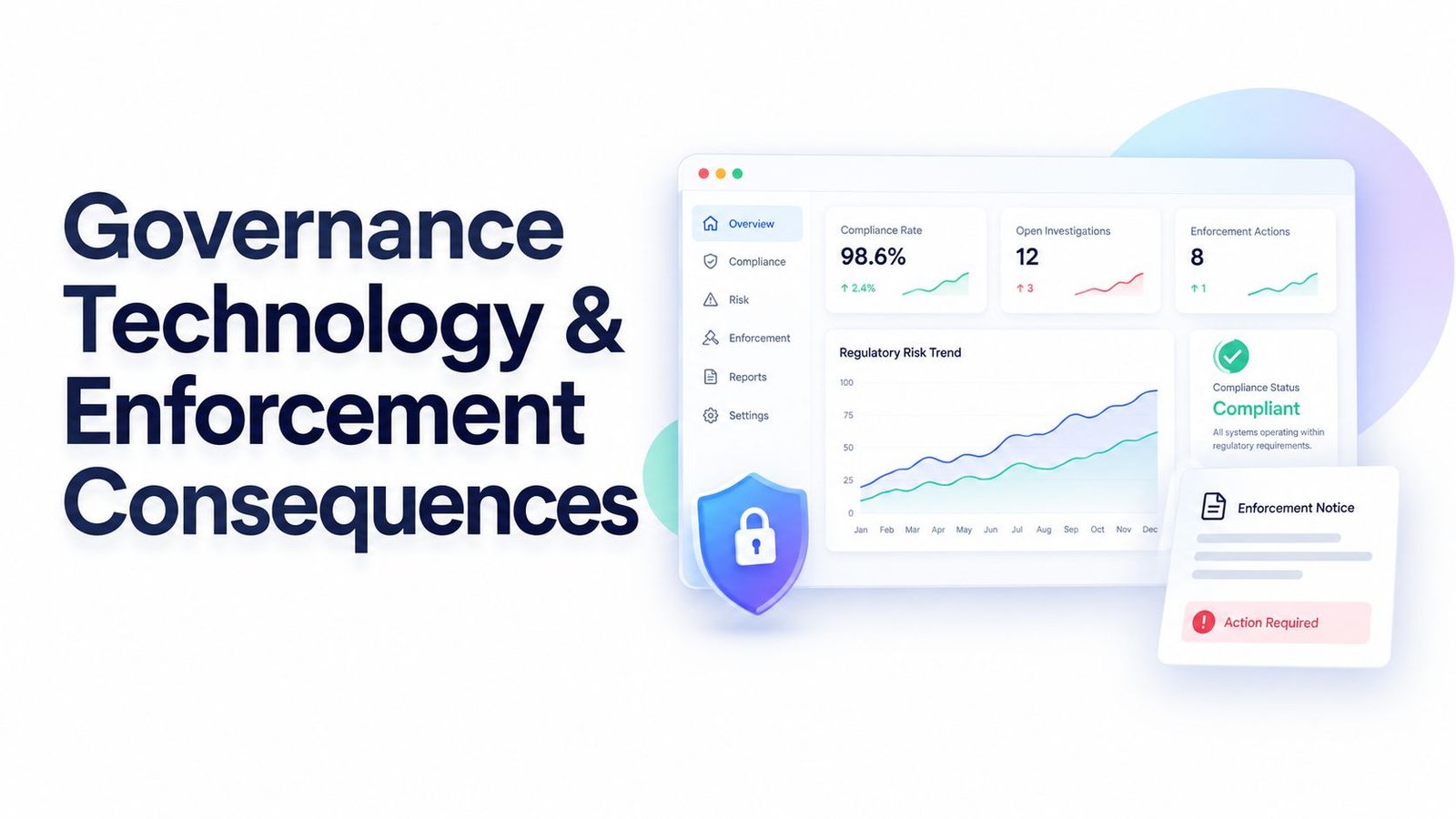
Governance Technology and Enforcement Consequences
A monitoring system can flag unusual activity, but it cannot decide what risk the operator accepts or who must act. Governance assigns those decisions to accountable people. The board or senior management should approve the programme, receive useful reporting, and understand material changes to products, payment rails, and customer geographies.
Clear ownership turns policy into operating practice:
- Board and senior management: Approve risk appetite, review escalations, and provide adequate resources.
- Money laundering reporting function: Make independent decisions about investigations and suspicious activity reports.
- Operations teams: Apply customer checks, payment controls, and account restrictions consistently.
- Technology owners: Record rules, data sources, model changes, access controls, and system limitations.
- Independent testing: Challenge both design and operating effectiveness, then track remediation until closure.
Technology needs an evidence trail
A transaction-monitoring engine should connect deposits, withdrawals, wagers, accounts, and related instruments, then produce alerts that investigators can explain. Sanctions-screening tools should preserve match decisions. Case-management records should show the alert, evidence reviewed, investigator reasoning, approval, filing decision, and follow-up.
The same evidence standard applies to fragmented payment activity. A customer who funds several accounts, switches instruments, or uses crypto alongside conventional payment methods may present a different risk from one visible transaction. Systems must therefore aggregate connected activity before investigators assess whether behaviour is proportionate to the customer profile and risk assessment.
Vendor selection requires testing rather than a product demonstration. Operators should confirm that a platform receives complete payment and wagering data, links related transactions, supports jurisdiction-specific rules, and preserves records for the required period. Contracts should define data access, service performance, change notification, security responsibilities, and exit support.
Regulators test implementation
A written policy does not compensate for a stale risk assessment or unexplained alert outcome. The UK Gambling Commission's AML materials emphasise operator-owned risk assessment. Its published updates also connect obligations with changes to the Money Laundering Regulations 2017 and Proceeds of Crime Act rules. The regulator published a new money laundering risk assessment in July 2026, so operators need a controlled process for reviewing updates and recording resulting changes.
Enforcement can bring financial penalties, added licence conditions, remediation demands, restrictions on business activity, and disruption to banking or payment relationships. The operational burden may include account reviews, delayed withdrawals, manual investigations, and urgent work on technology or governance.
Evidence beats assurance. A compliance team should show what changed, who approved it, how it was tested, and what happened when the control identified a problem.
Actionable Compliance Checklist for Online Casino Operators
A useful self-assessment asks whether the programme can show that controls work in practice, not merely whether policies exist. The evidence should connect risk decisions, customer activity, alerts, investigations, and management oversight.
- Map the exposure: Record products, customer geographies, payment rails, wallet types, corporate relationships, and cryptoasset touchpoints.
- Refresh the risk assessment: Log changes to products, payment methods, and customer segments, then record why controls changed.
- Verify the relationship: Keep KYC and CDD evidence, confirm payment ownership where appropriate, identify beneficial owners, and apply EDD to higher-risk relationships.
- Aggregate activity: Link deposits, withdrawals, wagers, accounts, instruments, and sessions. Fragmented payments can hide a pattern that looks ordinary when each transaction is reviewed alone.
- Separate reporting triggers: Configure local CTR, SAR, STR, registration, and escalation rules. A threshold in one jurisdiction does not automatically apply elsewhere.
- Preserve records: Apply the relevant retention schedule and document the rule used. Philippine casino requirements include keeping specified AML records and STR-related video footage for at least five years, while court-linked records remain available until resolution. Build that requirement into the records policy.
- Test the operating model: Sample alerts and case decisions, review sanctions screening, training, vendor performance, access controls, and management reporting. Record findings, owners, deadlines, and retest results.
- Escalate behavioural red flags: Refusal to provide identification, ownership mismatches, synthetic identity indicators, and unusual payment behaviour require review even when no numeric threshold is met.
The gap review should have named owners across compliance, operations, technology, and senior management. For Philippine market work, the 2026 PAGCOR B2B accreditation checklist can sit beside the AML evidence register, with each requirement mapped to the applicable licence and control owner.
Operators and suppliers should use the checklist to test whether AML controls are live, proportionate, and defensible. Top 1 Rank provides regulatory updates, market intelligence, and practical iGaming compliance analysis for teams addressing gaps before enforcement action.




Join thousands of gaming professionals receiving the latest iGaming news, regulatory updates, and market insights.
