

A player registers in minutes, passes a light sign-up flow, deposits successfully, plays for days, then hits a withdrawal block. Support sees the complaint first. Payments sees a paused payout. Compliance sees the problem. The operator treated KYC as a late-stage document request instead of a control that should have shaped the customer journey from the start.
That situation is common because many teams still think of KYC as an ID upload. In practice, online casino KYC requirements define who can deposit, who can play, when funds can move, which accounts need escalation, and how quickly suspicious behavior is detected. Product, fraud, payments, customer support, and AML teams all feel the consequences when those decisions are made too late.
Remote gambling makes the challenge sharper. The customer isn't physically present, the payment method can be misused, and the risk often changes after account opening rather than at the first click. A smooth registration flow can hide unresolved identity gaps, beneficial ownership issues, or source-of-funds questions that surface only when activity grows or behavior changes.
Operators that design KYC as a lifecycle control usually avoid the worst operational friction. Operators that bolt it onto withdrawals create preventable disputes, delayed revenue recognition, manual reviews, and regulatory exposure.
Table of Contents
- Introduction Why KYC Defines Online Casino Operations
- What KYC Means in Online Casinos and How It Works
- Global Laws and Regulatory Thresholds Operators Must Know
- Required Identity Checks Documents and Due Diligence Levels
- Verification Technologies and Onboarding Flow Design
- Ongoing Monitoring Recordkeeping and AML Integration in Practice
- Implementation Checklist and Next Steps for Compliance Teams
Introduction Why KYC Defines Online Casino Operations
For an online casino, KYC isn't just a compliance file. It's a gate on core business activity. If the checks happen too late, the operator may acquire a player it can't safely retain, allow play it later can't justify, or approve a payout it should have stopped for review.
The operational reality behind a blocked payout
A typical failure pattern looks simple on the surface. Marketing drives traffic. Registration is short. Deposits work. The customer reaches withdrawal and then gets asked for ID, address evidence, or proof that the payment method belongs to them. From the player's perspective, the operator changed the rules. From the regulator's perspective, the operator may have let gambling continue before completing the checks expected in that market.
In the United Kingdom, that timing issue is explicit. The Gambling Commission requires remote operators to verify, at minimum, a customer's name, address, and date of birth before allowing them to gamble, and age verification must also happen before a customer can deposit funds or use a free bet or bonus, as set out in the UK Gambling Commission age and ID verification rules.
Practical rule: If a market treats KYC as a pre-play control, the onboarding flow and the compliance framework can't be designed separately.
Who KYC protects
KYC protects several parties at once:
- The operator's license position by showing that identity, age, and AML duties are being met.
- The payments stack by reducing misuse of stolen or third-party payment methods.
- Legitimate players by making account takeover, mule use, and impersonation harder.
- Internal teams by giving support, fraud, and AML staff a common record of who the customer is and what has been verified.
Why the old mental model no longer works
The outdated view is that KYC happens once, usually near withdrawal. That model breaks down in regulated online gambling because question isn't only who is this player. It's also when must verification happen, what level of due diligence is required now, and what later events should trigger another review.
That's why strong KYC programmes don't stop at onboarding. They connect customer identity, risk scoring, transaction behavior, payment ownership, and escalation rules into one operating model.
What KYC Means in Online Casinos and How It Works
A player signs up in minutes, passes an ID check, makes a few modest deposits, then starts cycling funds through new payment methods and requests a large withdrawal. On paper, the account looked fine at the front door. In practice, the KYC work started after onboarding.
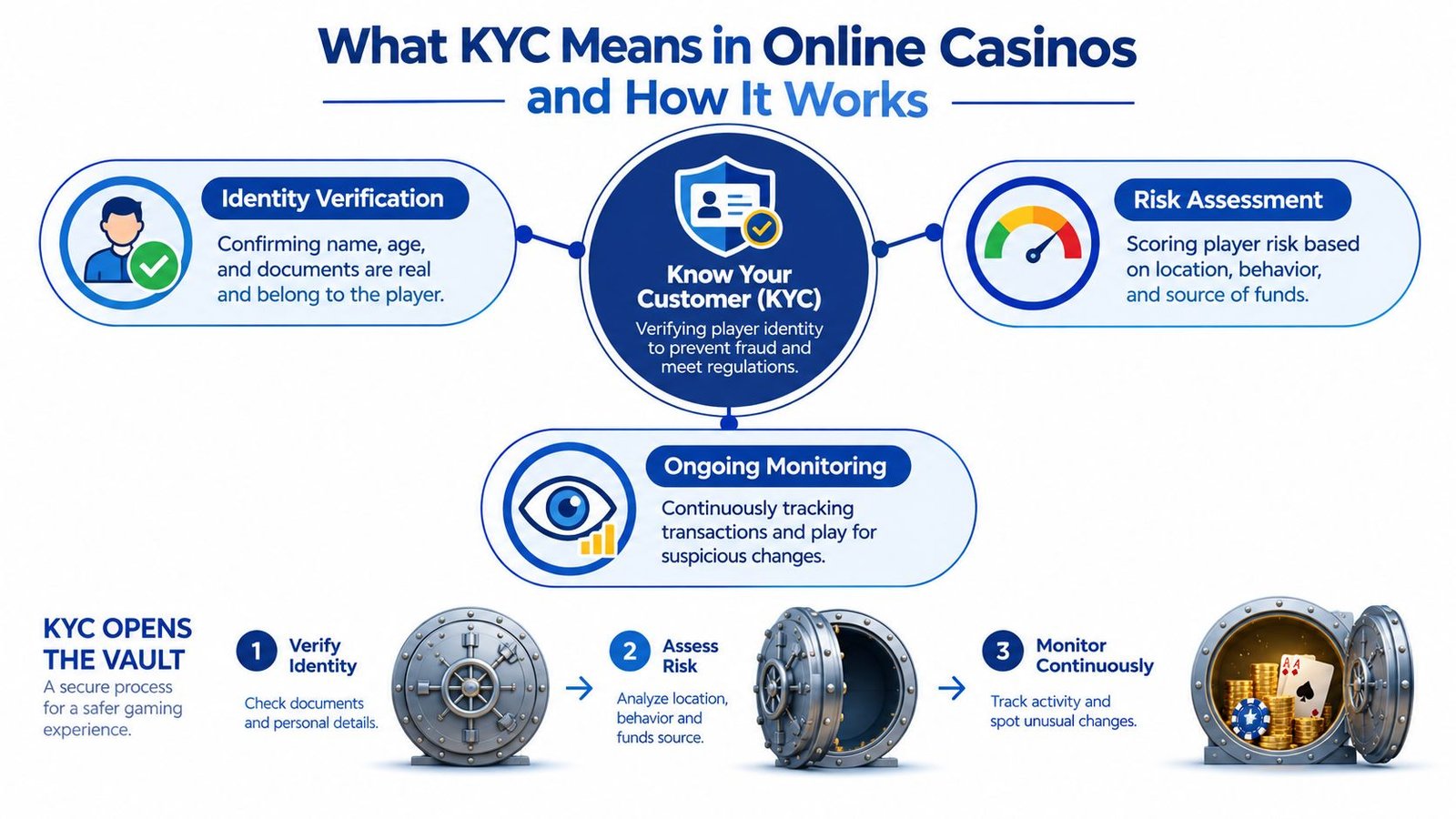
KYC in online casinos works like access control in a secure building. One check gets someone through reception. Other checks determine which rooms they can enter, whether they can stay, and when security needs to ask more questions. That is the right mental model for gambling compliance, because remote play creates risk over time, not only at sign-up.
KYC is a lifecycle, not a one-time upload
In operational terms, Know Your Customer covers three connected tasks:
- Establish who the player is.
- Judge the level of money laundering, fraud, sanctions, or impersonation risk attached to that player.
- Reassess the account when behavior, payment activity, or transaction value changes the risk picture.
This is the point many teams miss. A verified passport does not answer whether the payment method belongs to the player, whether the account is being used by a mule, or whether later transaction levels now require source-of-funds review. The document check opens the file. It does not close it.
For operators, the practical question is not just whether a customer is "verified." The useful question is narrower and more operational. Which risks have been checked already, which triggers remain open, and what event forces the next level of due diligence?
The terms matter because the workflow changes with each one
Teams often use KYC, CDD, and EDD as if they mean the same thing. They do not, and mixing them up usually leads to poor workflow design.
- KYC is the full framework for identifying the customer and keeping that understanding current.
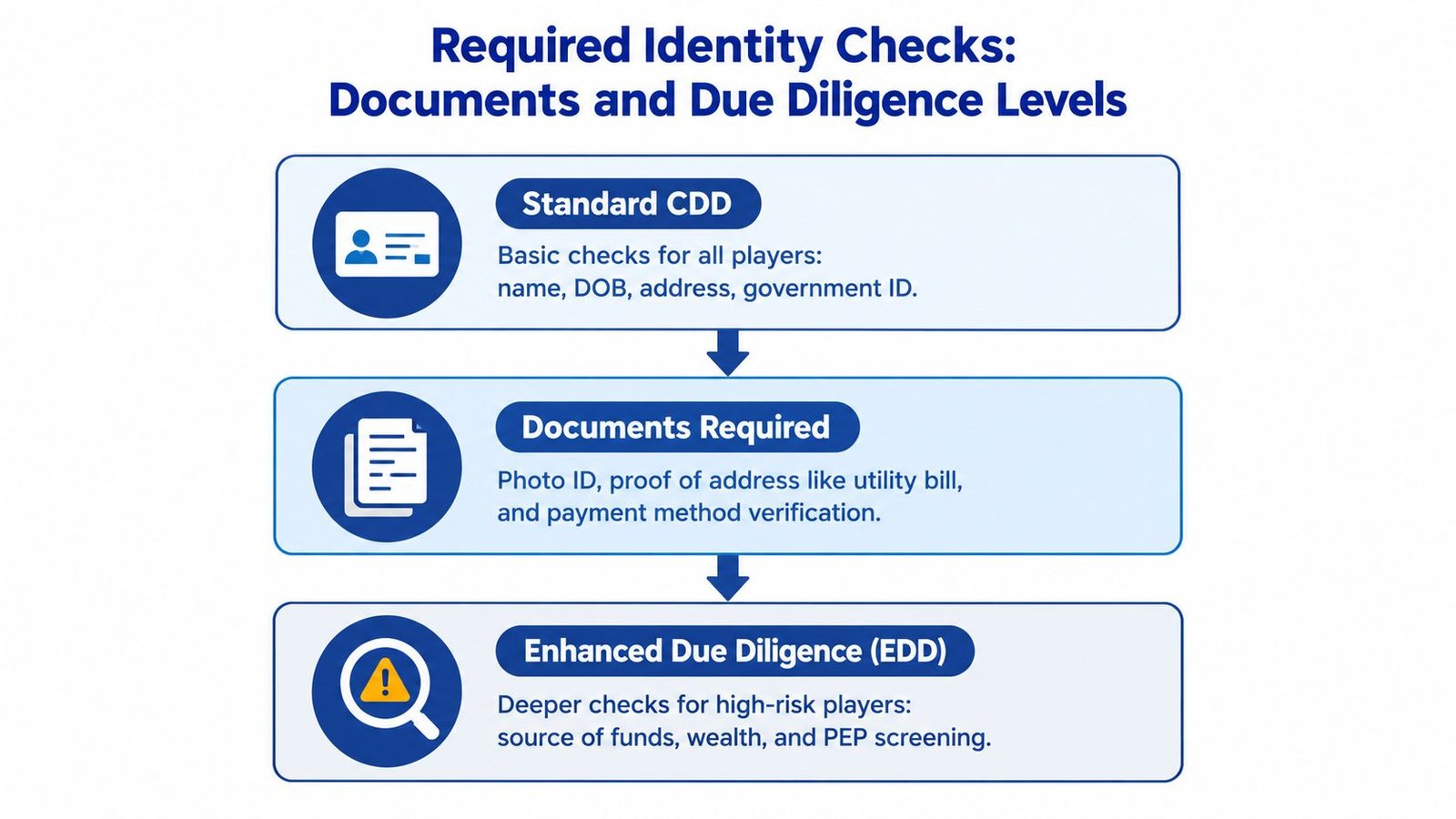
- Customer due diligence (CDD) is the baseline work. It covers identifying the customer, verifying that identity, and understanding enough about the relationship to assess normal use.
- Enhanced due diligence (EDD) is the added review for higher-risk cases. That may include closer scrutiny of transactions, adverse media checks, or deeper review of wealth and funding.
- AML integration means this information feeds monitoring, investigations, and suspicious activity decisions instead of sitting in a separate onboarding tool.
The Financial Action Task Force places casinos, including online casinos, within the AML framework for designated non-financial businesses and professions. That brings duties around due diligence, recordkeeping, suspicious transaction reporting, and beneficial ownership in relevant cases, as set out in the FATF Recommendations.
Trigger points matter more than the first check
Operators sometimes build KYC around a single moment, usually registration or withdrawal. That approach breaks down quickly in regulated gambling.
A better model treats KYC as event-driven. The first layer may be enough for low-risk onboarding. A later deposit pattern, a change in device or geography, use of a third-party card, unusual gameplay linked to fund movement, or a jump in cumulative value can trigger more checks. In many programmes, source of funds becomes the bottleneck, not basic identity, because it is harder to prove and slower for customers to satisfy.
That is why two players with the same passport can follow very different verification paths. One stays within expected limits and presents no conflicting signals. The other crosses a threshold, changes payment behavior, or creates doubts about who controls the funds. The second case needs more than ID.
Why remote casinos need layered verification
Remote operators cannot rely on face-to-face review, and that changes the control design. The UK Gambling Commission identifies non-face-to-face business as higher risk because criminals can use false identities, stolen credentials, and mule accounts to get through weak controls, as explained in the UK Gambling Commission guidance on remote betting risks.
The answer is layered verification. Operators usually combine document or database-based identity checks with payment ownership controls, screening where relevant, device or behavior signals, and monitoring after the account becomes active.
Strong KYC does not ask for every document from every player on day one. It asks for the right evidence at the point risk justifies it. That is how operators reduce friction for ordinary customers while still meeting AML obligations when the account profile changes.
Global Laws and Regulatory Thresholds Operators Must Know
A player opens an account in one market, deposits, and starts playing within minutes. The same journey in another market may stop before the first wager, or later when cumulative spend reaches a legal trigger. That difference is not a product choice. It is the rulebook in action.
Operators get into trouble when they treat KYC as a single upload at signup. Regulators do not. They treat KYC as a lifecycle tied to specific events: account creation, first deposit, linked transactions, suspicion, changes in behaviour, and, in higher-risk cases, source-of-funds review. Basic identity often moves quickly. Source of funds is usually the slower control, and the point where operations teams feel the strain.
The same AML objective, different legal trigger points
The core question is consistent across jurisdictions. The operator must know who the customer is, when enough evidence must be collected, and what event requires the file to be escalated.
In the United States, casino customer identification rules under 31 CFR § 1021.410(a) require collection of a customer's name, permanent address, and Social Security number before a covered event such as a deposit of funds, account opening, or extension of credit. FinCEN also issued limited online gaming relief in 2021 allowing certain non-documentary methods in specific online settings, as set out in the FinCEN casino exceptive relief notice.
In the UK, the trigger logic is broader and more dynamic. Customer due diligence is required when the business relationship begins, when money laundering or terrorist financing is suspected, when earlier identification data becomes unreliable, and for certain occasional or linked transactions. The UK Gambling Commission customer due diligence requirements set out a €1,000 trigger for occasional funds transfers and a €2,000 trigger for transactions, including split or linked activity.
That means two products with the same front end may need very different control points behind the scenes.
KYC trigger thresholds by jurisdiction
| Jurisdiction | Trigger event | Threshold and timing |
|---|---|---|
| United States | Deposit of funds, account opening, or extension of credit | Required customer identification data must be obtained before those events under 31 CFR § 1021.410(a) |
| United Kingdom | Business relationship, suspicion, doubt about prior data, occasional funds transfer, transaction value | CDD is required at relationship start, on suspicion or doubt, above €1,000 for occasional funds transfers, and for transactions of €2,000 or more, including linked transactions |
| Malta and broader EU practice | Gambling or payment activity reaching the local CDD point | Many operators use a €2,000 benchmark for gambling-related CDD escalation, but local implementation and risk factors can pull checks earlier |
| Europe benchmark used in iGaming operations | Full CDD escalation | The SEON guide to AML and KYC in iGaming describes EUR 2,000 as a common gambling-sector trigger point used in practice |
Why thresholds matter in real operations
Thresholds are not just legal numbers. They decide where friction appears in the player journey and what your systems must be able to stop, queue, or escalate.
A pre-play market needs verification gates before meaningful account use. A threshold-led market still needs accurate aggregation logic. If a player makes several smaller deposits or transactions that become linked in legal terms, the platform must recognise that pattern and trigger review at the right moment. A weak rule engine misses that. A strong one treats thresholds like tripwires across the whole customer lifecycle, not as one-off checks.
This is also where many teams underestimate source-of-funds work. Crossing a legal threshold does not always mean asking for more ID. Often the harder question is whether the customer's spending level matches the profile on file. The passport may already be verified. The bottleneck is proving where the money comes from, especially after rapid deposit growth, unusual payment-method changes, or high-value withdrawals.
For regional operators, the practical answer is jurisdiction mapping tied directly to registration, payments, and monitoring logic. Teams tracking Asia-facing rule changes can use PAGCOR regulatory updates and 2026 developments as a market watch reference, then map any local trigger points into product rules, review queues, and source-of-funds escalation paths.
Required Identity Checks Documents and Due Diligence Levels
Once the trigger point is clear, the next question is operational. What exactly must the operator collect, verify, and escalate?
Baseline checks for standard due diligence
Standard due diligence usually starts with core identity attributes. In the UK remote regime, operators must verify at least the customer's name, address, and date of birth before allowing gambling, as noted earlier in the UK rules. In the United States online casino context governed by FinCEN's casino rules, the required identification set includes name, permanent address, and Social Security number before the covered event.
A workable baseline file often includes:
- Identity details such as full legal name and date of birth, matched across registration data and submitted evidence.
- Address evidence where the local regime requires it, especially when address is part of the minimum verified set.
- Document authenticity review for passports, driving licences, or national IDs when documentary proof is used.
- Payment-method ownership checks to confirm the funding source belongs to the registered customer where market rules or internal controls require it.
For consumer support teams, many avoidable disputes begin here. If the payment name, account holder name, and registered player profile don't align, a smooth sign-up can still lead to a frozen withdrawal later. Consumer-facing examples of account verification friction appear frequently in wallet ecosystems such as this guide to GCash verification steps.
When enhanced due diligence starts
Enhanced due diligence begins when standard identity proof no longer answers the important risk question. A higher-spend or higher-risk customer may be who they claim to be, but the operator still needs to understand whether the money and activity are consistent with that profile.
That's why source-of-funds checks have become the bottleneck in many programmes. Industry commentary points out that basic KYC is only the starting point, and higher-risk players may need to provide bank statements, pay slips, tax records, or transaction trails. The same commentary notes that these reviews often take business days rather than minutes, which complicates claims of “instant verification,” as discussed in this analysis of KYC for iGaming operators.
Higher-value friction usually isn't about proving the player exists. It's about proving the activity and the funds make sense.
Beneficial ownership and entity relationships
Where the customer is a legal entity or uses a business-linked structure, identity work extends beyond the account signatory. FATF-aligned practice requires beneficial ownership verification, which means the operator needs to know who ultimately owns or controls the entity behind the relationship.
That isn't a niche edge case. It matters wherever corporate accounts, VIP structures, or third-party funding relationships appear.
Verification Technologies and Onboarding Flow Design
A player signs up in two minutes, deposits without trouble, and then hits a withdrawal block because the identity result in the KYC tool never reached the cashier. From the player's side, the casino looks inconsistent. From the operator's side, the problem is usually flow design, not one bad check.
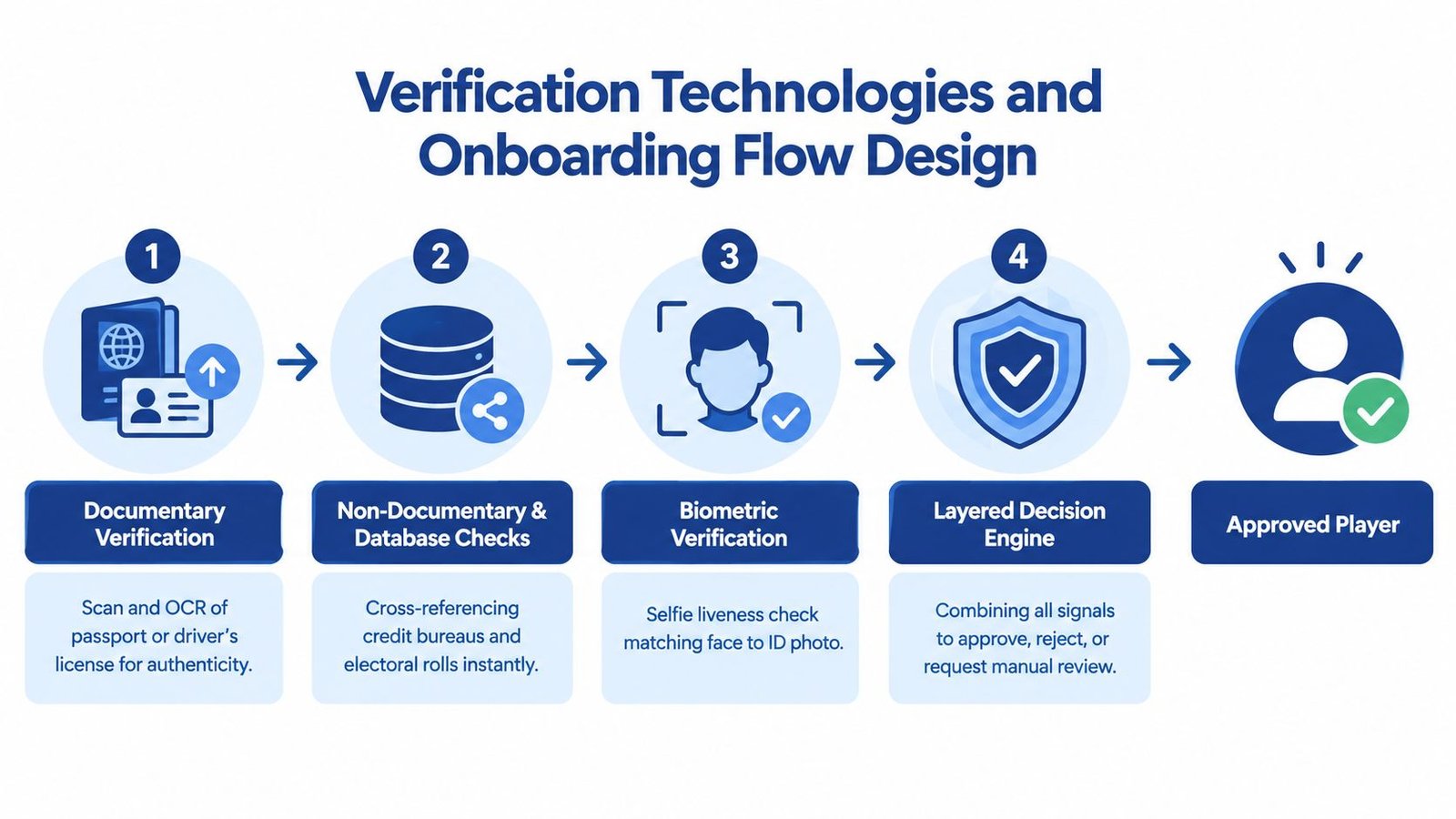
Verification technology only works well when each tool has a defined job and a defined trigger. An ID scan checks whether the document looks genuine. A database query tests whether the customer details line up with reliable records. A selfie or liveness step checks whether the person presenting the ID appears to be the same person opening the account. A decision engine then combines those results with age, geography, device, payments, and sanctions or PEP screening to decide whether the customer can proceed, needs more evidence, or should be stopped.
Operators create avoidable friction when they treat KYC as a single upload screen. In practice, remote gambling verification works more like an airport journey. Passport control, security screening, and customs do not happen in one question because each control answers a different risk. Online casino onboarding follows the same logic. The checks should appear in sequence, based on what the operator needs to know at that moment and what the local rules require.
FinCEN's 2021 online gaming exceptive relief showed this clearly in the U.S. context. Remote casino verification can use certain non-documentary methods in limited online scenarios. The obligation to identify the customer still remains. The channel changes. The standard does not.
A workable onboarding flow usually looks like this:
- Registration collects core data only. Capture the fields needed for account creation, age gating, and jurisdictional requirements. Do not ask for documents before the system has tested whether simpler checks can resolve the case.
- Automated checks run first where permitted. Screening, database matching, device review, and basic fraud rules can clear many low-risk customers or identify obvious failures within seconds.
- Document requests trigger for a reason. Ask for ID when law requires it, when automated matching fails, when location or age needs stronger proof, or when the customer profile carries higher risk.
- Manual review handles exceptions, not the whole book. Analysts should see the failed signal, the reason code, and the next required action. Sending every marginal case into a general queue creates delays and inconsistent decisions.
- Source-of-funds sits on a separate path. It should activate when spend, deposits, transaction patterns, or other risk markers cross the operator's threshold. That review is usually the slowest part of the lifecycle, so it should not clog the basic onboarding funnel.
That last point matters most. Many teams focus on getting identity approval rates up, then get stuck later because the operational bottleneck is source-of-funds review. Identity tools can return results in seconds. A funds review often depends on human assessment of bank records, payslips, business income, or transaction history. Good flow design accepts that difference and builds clear handoffs, customer messaging, and escalation rules around it.
Jurisdiction also changes the shape of the funnel. Some markets allow more reliance on database checks at account opening. Others expect documentary proof earlier, or impose lower trigger points before enhanced review starts. Payment architecture has to reflect that. Operators reviewing cashier and verification integration in regulated environments should also examine PAGCOR payment gateway accreditation considerations, especially where payment routing and licensing controls affect when an account can deposit or withdraw.
The strongest systems reuse verified data across KYC, fraud, payments, and customer support. If those teams work from different status fields, the customer gets repeat requests, the operator pays twice for the same checks, and analysts spend time reconciling conflicting results instead of investigating real risk.
Ongoing Monitoring Recordkeeping and AML Integration in Practice
A player clears onboarding in minutes, deposits modestly for several weeks, then starts cycling funds across payment methods and asks for a higher withdrawal limit. That account has not "passed KYC" in any final sense. It has entered a new risk stage.
Monitoring catches what sign-up cannot
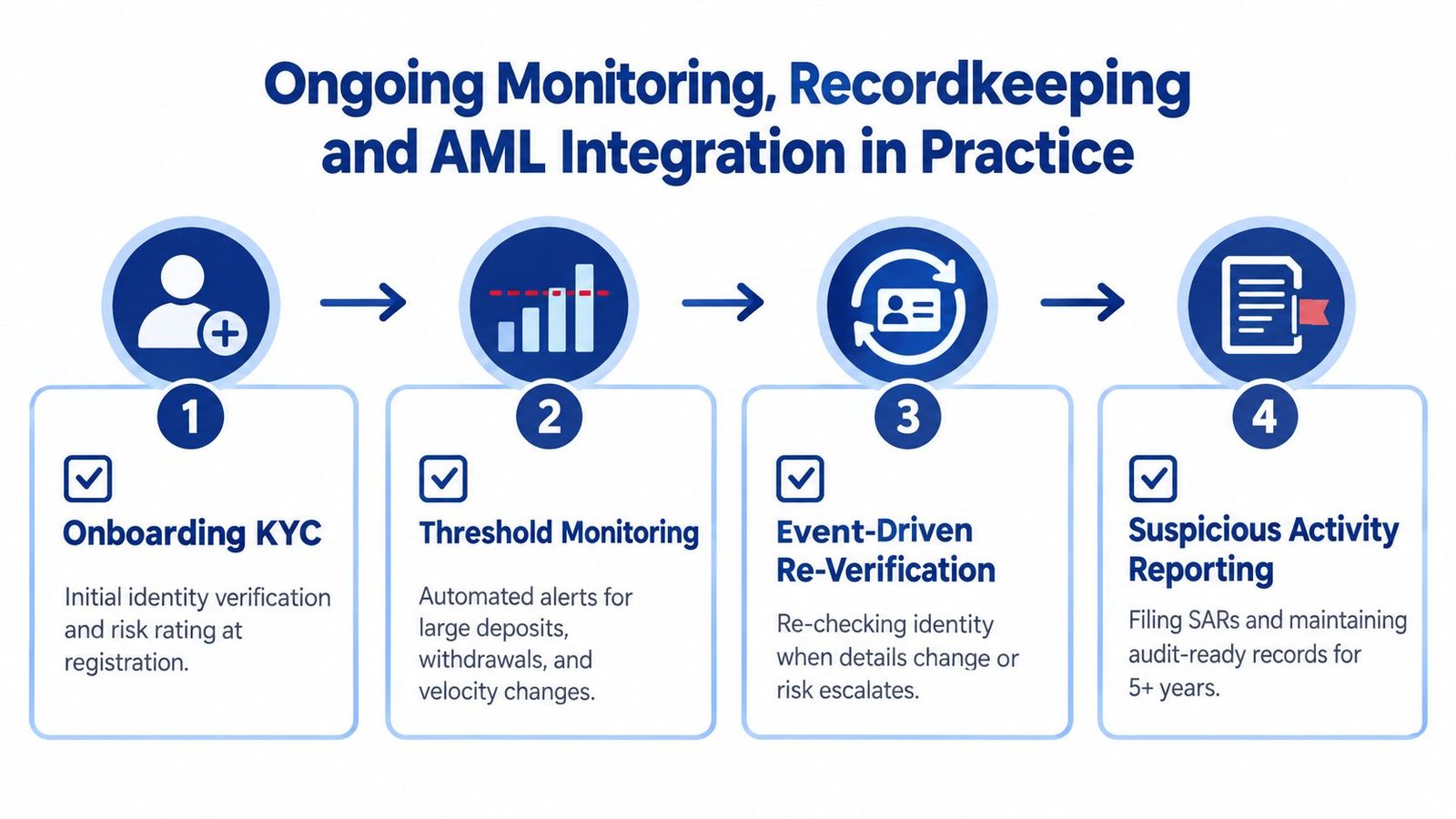
In online gambling, KYC works more like a series of checkpoints than a single gate. Initial identity approval answers one question: is this person likely to be who they claim to be? Ongoing monitoring answers harder ones: does current activity still fit the customer profile, do linked transactions now cross a trigger, and has anything happened that makes earlier evidence less reliable?
That is why operators must connect customer due diligence to transaction monitoring, payment controls, and case management. Under the UK CDD requirements detailed in Global Laws above, review is not limited to account opening. It must also be triggered by suspicion, doubts about earlier identification data, and threshold or linked-transaction events.
The operational lesson is simple. A verified account can still move into review later, and often should.
Common trigger points include:
- Behavior shifts that do not fit the player's earlier profile, such as a sudden change in spend, staking, or session pattern
- Linked transactions that look ordinary in isolation but cross a threshold when viewed together
- Changed account details such as a new name, address, device pattern, or payment instrument
- Third-party payment signals that suggest mule activity, account sharing, or misuse of another person's funds
- Source-of-funds triggers when spend rises to a level where basic identity evidence is no longer enough
That last item is where many programmes slow down. Identity checks are often automated. Source-of-funds review usually requires documents, analyst judgment, and follow-up with the customer. If operators treat those reviews as rare exceptions rather than planned lifecycle events, queues grow, withdrawals pause, and support teams end up explaining rules that the platform did not enforce clearly.
Recordkeeping proves the control worked
Recordkeeping is the audit trail for every KYC and AML decision. If an operator cannot show what evidence was collected, what rule or analyst decision changed the customer's status, and why an alert was closed or escalated, the control exists on paper more than in practice.
Good records should let another reviewer reconstruct the case from start to finish, even months later.
| Control area | What the operator needs to retain |
|---|---|
| Onboarding evidence | Identity data, verification result, decision time, and reviewer path |
| Risk assessment | Initial rating, trigger rationale, and any later change in profile |
| Escalation handling | Requests for added documents, source-of-funds review notes, and outcomes |
| AML linkage | Alert history, linked transaction analysis, and suspicious activity decision trail |
This matters across jurisdictions because retention periods, trigger thresholds, and escalation expectations are not identical. The principle stays consistent. Keep enough evidence to show what the customer did, what the system flagged, what the analyst reviewed, and why the final decision was reasonable under the local rules.
AML integration fails when systems speak different languages
Many operators store KYC status in one tool, payment risk in another, and AML alerts in a third. That setup creates blind spots. An account marked "verified" in the front end can still be under source-of-funds review in the AML queue, while support sees only that withdrawals are blocked. The customer receives mixed messages, and analysts waste time reconciling systems instead of assessing risk.
The better model is shared status logic. If monitoring creates a trigger, the cashier, CRM, and support console should all reflect the same control state and the same next action.
Remote fraud risk keeps evolving after onboarding
Remote customers present a known weakness because the operator never sees the person face to face. A forged document may survive a basic upload check. The clearer warning signs often appear later through device mismatch, payment instrument changes, unusual transaction timing, or networks of linked accounts.
Staff training helps here. So does customer education. Public guidance on phishing scams and how to avoid them is useful because account takeover, social engineering, and fake support outreach often sit next to identity abuse and payment fraud.
The practical standard is broader than collecting ID. Operators need a living control framework that reviews customers at the right moments, records each decision clearly, and ties KYC to AML action before risk turns into a regulatory problem.
Implementation Checklist and Next Steps for Compliance Teams
Operators don't need a theoretical KYC model. They need one that holds up in production, across payments, support, fraud, and AML review. The best starting point is to convert legal obligations into system rules, ownership, and escalation paths.
A practical implementation checklist
- Map each jurisdiction separately so product and compliance teams know whether verification is required before deposit, before play, at account opening, or at a transaction trigger.
- Define minimum data fields by market such as name, address, date of birth, or other locally required identifiers.
- Set tiered triggers in the platform so cumulative activity, linked transactions, and changed risk profiles automatically prompt the next due diligence step.
- Separate standard KYC from source-of-funds review because these are different workflows with different service expectations.
- Connect KYC to cashier and AML systems so an approved sign-up doesn't bypass later transaction controls.
- Write evidence standards for manual review including what counts as acceptable proof of address, payment ownership, and source-of-funds support.
- Train support teams on timing logic so customers get clear explanations when gambling or withdrawals are paused for legitimate compliance reasons.
- Maintain audit-ready records that show what was checked, when it was checked, who approved it, and why.
A compliant journey usually feels slower at the exact points where risk becomes harder to explain. That's normal. The failure is not the delay itself. The failure is discovering too late that the operator never designed for it.
Where many teams still misjudge the problem
The most common mistake is still treating KYC as a withdrawal event. The second is underestimating how often source-of-funds review becomes the blocker. Both mistakes create customer friction at the most sensitive moment in the lifecycle.
Teams working through supplier selection, licensing support, or B2B compliance planning in regulated markets may also find it useful to review the PAGCOR B2B provider application process.
For more regulatory analysis, operator briefings, and market intelligence across global gambling jurisdictions, follow Top 1 Rank at Top 1 Rank's iGaming intelligence hub.




Join thousands of gaming professionals receiving the latest iGaming news, regulatory updates, and market insights.
