


A campaign is ready. Creative has cleared brand review, affiliates have placements lined up, and paid media is waiting on trafficking. Then the compliance questions start. Can the same sports betting video run in the UK and Australia? Can a sponsorship creative that works in one market still appear on social in the Netherlands? Does a radio buy become non-compliant because of the hour it airs?
That's why a useful guide to gambling advertising regulations by country can't stop at “allowed” or “banned.” Operators and affiliates need to know which channel carries risk, where scheduling becomes the control point, and when audience gating matters more than copy. In practice, most advertising failures don't come from misunderstanding the existence of regulation. They come from underestimating how differently each jurisdiction treats broadcast, digital, sponsorship, and third-party promotion.
Table of Contents
- How to Use This Gambling Advertising Regulations Reference
- Core Regulatory Building Blocks Behind Every Market
- Mature Regulated Markets and Their Advertising Controls
- High Restriction and Rapidly Evolving Jurisdictions
- Channel by Channel Compliance Rules for Operators and Affiliates
- Recent Enforcement Cases and What Triggered Penalties
- Pre Launch Compliance Checklist for Multi Country Campaigns
- Quick Reference Directory and Primary Regulator Sources
How to Use This Gambling Advertising Regulations Reference
This reference works best as a planning tool for teams running cross-border campaigns. Legal and compliance teams can use it to identify the governing framework in each jurisdiction. Media buyers can use it to spot timing windows and placement limits. Affiliate managers can use it to separate markets where disclosure and audience controls are manageable from those where broad-reach distribution creates immediate risk.
Read by channel first, then by country
The most common mistake in multi-market planning is starting with licence status alone. That's necessary, but it isn't enough. Two regulated markets can produce completely different operational outcomes if one relies on a watershed and the other restricts untargeted digital reach or sponsorship.
A practical review usually starts with four questions:
- Which channels are in scope: Broadcast TV, radio, online display, social, sponsorship, affiliate inventory, and other formats often sit under overlapping rules.
- When can ads run: In some markets, timing is the primary restriction. A compliant creative can still become non-compliant if it airs in a protected window.
- Who can be targeted: Logged-in adults, age-gated users, and opt-out mechanisms can become mandatory design features rather than optional safeguards.
- Who is speaking on behalf of the operator: Affiliates, influencers, club partners, and media owners can all create separate exposure if controls are weak.
Use it as a campaign audit sheet
For operators, this material is most useful before insertion orders are signed. For affiliates, it matters before content calendars, bonus pages, or sponsored posts go live. Broadly, the guide supports three workflows:
- Market entry review for a new jurisdiction.
- Channel expansion review when a licensed operator adds radio, live sport, or influencer inventory.
- Pre-launch validation for a campaign already built but not yet trafficked.
Practical rule: In gambling advertising, legality rarely sits in the creative alone. It often sits in the combination of message, audience, format, and delivery window.
What matters most in the entries below
Readers looking up gambling advertising regulations by country should focus on the constraints that alter execution, not just the headline rule. Those constraints usually include timing bans around live sport, age-targeting conditions for digital delivery, restrictions on endorsements, and sponsorship phase-outs that remove inventory even when the operator itself remains licensed.
The result is a more useful compliance lens. Instead of asking whether a market permits gambling advertising in principle, the better question is whether the intended format can still reach the intended audience lawfully.
Core Regulatory Building Blocks Behind Every Market
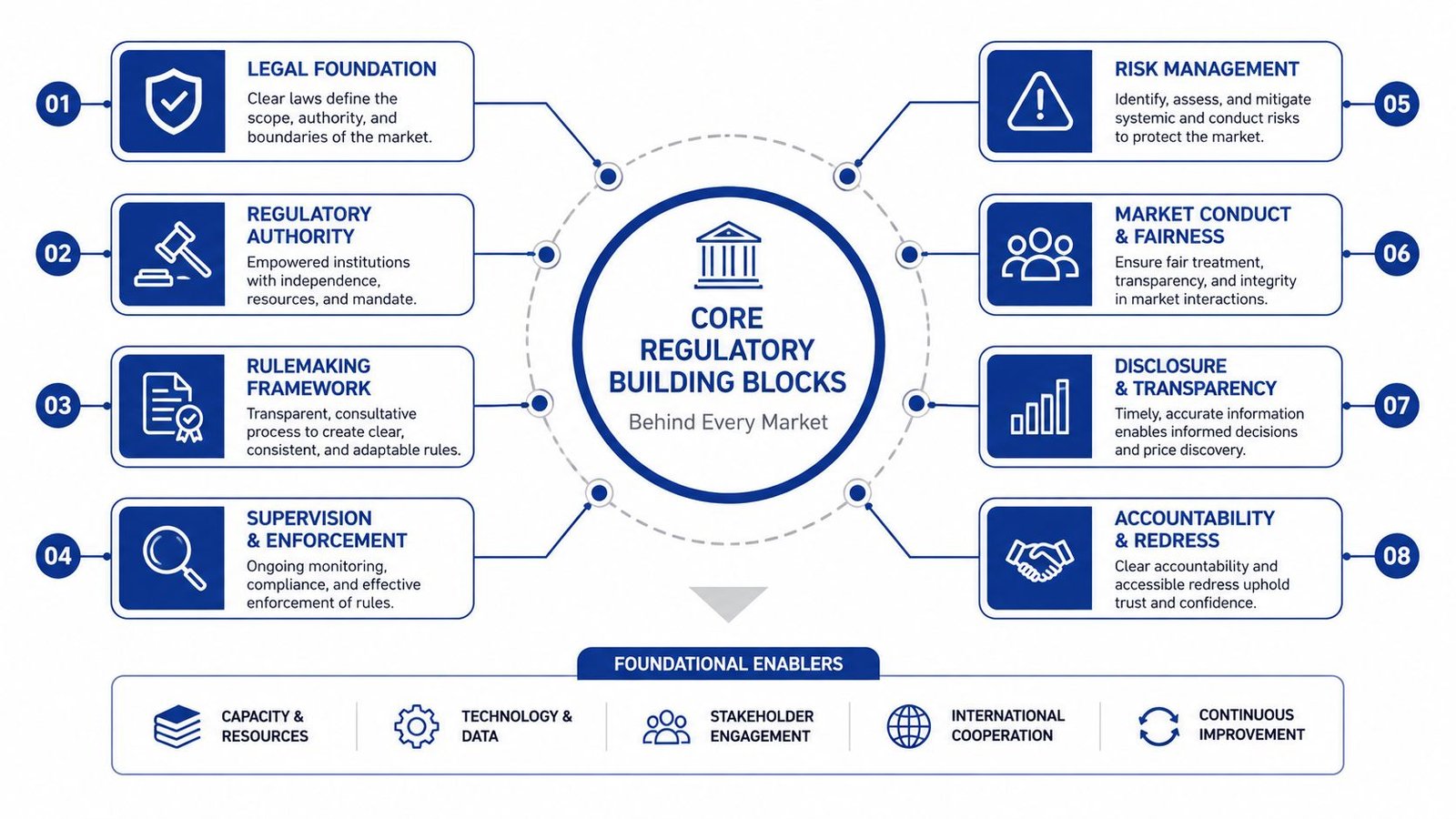
Across jurisdictions, gambling advertising rules usually rely on the same small set of regulatory mechanisms. What changes is where lawmakers place the burden. In some markets, creative review carries most of the risk. In others, media planning, trafficking, and audience verification do the heavier compliance work.
Placement controls and channel eligibility
The first building block is simple. Regulators decide which channels can carry gambling ads and which can't. That sounds basic, but the operational impact is large because a market may permit one type of gambling promotion while prohibiting another, especially around unlicensed or offshore interactive services.
Australia shows how technical this can become. The framework distinguishes legal sports betting promotion from prohibited advertising of offshore or otherwise unlicensed interactive gambling services under the Interactive Gambling Act framework and related channel restrictions. For compliance teams, that means channel approval isn't just a media issue. It's also a product-scope issue.
Timing rules and protected windows
The second building block is time. Watersheds, live-sport restrictions, and narrow broadcast windows often determine whether the same asset is usable at all. Timing rules are attractive to regulators because they're measurable and enforceable, but they shift the burden onto media operations.
Germany is a clear example. A 2026 country comparison says online casino, slots, and poker advertising is banned from 6:00 a.m. to 9:00 p.m. in Germany, while the same source also notes restrictions affecting athletes and affiliate compensation models in betting promotion, according to this regulatory comparison. That turns trafficking logic into a compliance function.
Audience gating and minors' protection
Another recurring mechanism is audience control. Regulators usually focus on minors and vulnerable groups, but the implementation differs. Some markets use content standards alone. Others require targeting restrictions, log-in conditions, or opt-out capability.
A useful way to assess risk is to separate broad-reach inventory from identity-based delivery:
- Broad-reach formats such as linear TV, radio, outdoor, and open social distribution often face the toughest scrutiny.
- Identity-based formats can remain viable if the operator can show age gating, logged-in status, and exclusion controls.
- Third-party distribution creates additional exposure because operators may not fully control audience composition or ad labeling.
Compliance burden rises when the operator can't prove who saw the ad, when they saw it, and why they were eligible to see it.
Content controls, endorsements, and mandatory messages
The final recurring block sits inside the creative itself. Regulators commonly police misleading claims, irresponsible messaging, appeal to minors, and endorsement choices. In some emerging frameworks, warnings become a design specification rather than a legal footnote. In others, disclosure requirements extend to affiliate and influencer communications, which means marketing attribution itself becomes regulated conduct.
That's why experienced teams treat gambling advertising as a system problem. Creative, placement, audience selection, affiliate governance, and scheduling all need to work together. A campaign can satisfy one layer and still fail another.
Mature Regulated Markets and Their Advertising Controls
The most instructive markets aren't the ones with outright bans. They're the mature regulated systems that still permit advertising while imposing precise controls by format, timing, and audience. The UK, Australia, and Germany all fit that profile, but they do so in different ways.
United Kingdom
The UK remains one of the clearest examples of a layered compliance model. Gambling operators must hold a Gambling Commission licence to advertise to British consumers under the Gambling Act 2005, and advertising must also comply with the BCAP broadcast code and other UK rules, according to the UK Parliament research briefing on gambling advertising.
The UK operational burden is best understood as a three-layer stack. Gambling advertising is governed by the Gambling Act 2005, the CAP and BCAP Advertising Codes, and Gambling Commission LCCP obligations. Broadcast ads face a 9 p.m. watershed, and all gambling advertising must be socially responsible under the ASA and CAP framework, as set out in the Gambling Commission's advertising and marketing rules and regulations guidance.
That structure matters because it regulates both placement and format. Broadcast scheduling, online targeting, promotional claims, and third-party endorsements each require separate review. Affiliate and influencer activity also needs clear disclosure of commercial relationships, which turns ad labeling into a compliance requirement rather than a brand preference.
Australia
Australia looks permissive at a distance and highly restrictive in execution. Gambling advertising has largely been regulated through industry codes enforced by the ACMA, but the policy setting is tightening. A 2026 government plan would cap broadcast TV gambling ads at three per hour between 6 a.m. and 8:30 p.m., ban them entirely during live sport in those hours, prohibit radio ads during school drop-off and pick-up times, and block online-platform gambling ads unless users are logged in, over 18, and able to opt out, according to the Australian Parliamentary Library policy brief.
The market context explains why those controls matter. Gambling and gaming advertising spend in Australia was estimated at A$187.75 million in 2024, down from A$239 million in the previous year, while ACMA reported that in the year to 30 April 2023, 68% of gambling ad spend was in free-to-air TV markets, over 1 million gambling ads aired on free-to-air TV and metro radio, and 50% of those spots promoted online gambling services, as summarised in the same Australian Parliamentary Library brief.
A separate report on the planned crackdown adds another practical control. The policy would also prohibit celebrities and sports players in gambling ads, according to the BBC coverage of the Australian proposal. For operators, that means frequency, scheduling, digital identity gating, and talent selection all become linked approval issues.
Germany
Germany is less visible globally in advertising policy debates than the UK or Australia, but the execution burden is significant. The defining feature is the time-based restriction on certain online gambling products. A 2026 comparison compiled from regulatory sources states that online casino, slots, and poker advertising is banned from 6:00 a.m. to 9:00 p.m., which narrows broadcast and comparable inventory windows considerably.
The same comparison says betting ads can't use active athletes and affiliate compensation can't be tied to player losses. Those aren't marginal details. They affect sponsorship strategy, influencer selection, and performance-marketing models directly.
| Jurisdiction | Broadcast Timing Rule | Digital Targeting Rule | Sponsorship Limit |
|---|---|---|---|
| United Kingdom | Broadcast ads face a 9 p.m. watershed | Campaigns need age-targeting safeguards and format-specific controls | Third-party endorsements and influencer activity require compliant disclosure and content controls |
| Australia | Planned 2026 rules would cap TV ads at three per hour between 6 a.m. and 8:30 p.m. and ban them during live sport in that window | Planned online-platform rules would limit ads to logged-in adults over 18 with opt-out capability | Planned rules would prohibit celebrities and sports players in gambling ads |
| Germany | Online casino, slots, and poker advertising is banned from 6:00 a.m. to 9:00 p.m. | Operators need targeting controls aligned to product-specific restrictions | Betting ads can't use active athletes |
For teams comparing Asian frameworks alongside these markets, the PAGCOR gambling advertising rules overview is useful as a separate jurisdictional reference point.
High Restriction and Rapidly Evolving Jurisdictions
Some of the fastest-moving markets no longer revolve around whether gambling can be advertised at all. Issue is how much usable inventory remains after untargeted reach, sponsorship visibility, and broad broadcast access are removed. The Netherlands, Belgium, Spain, Brazil, Kenya, and New Zealand illustrate that shift.
Netherlands and Belgium
The Netherlands has moved decisively against broad-reach promotion. Untargeted gambling advertising has been prohibited since 1 July 2023, with non-sports sponsorship ending on 1 July 2024 and sports sponsorship ending on 1 July 2025 after a transition period, according to the Netherlands market summary at iGaming Times. Commercially, that pushes operators away from mass awareness channels and toward age-gated, opt-in, or highly targeted acquisition routes.
Belgium follows a different but related path. A 2026 editorial comparison highlights Belgium's staged move from stadium advertising bans in 2025 to shirt and team sponsorship limits through 2028, as described in this international gambling advertising comparison. The key compliance lesson is that sponsorship rights can remain contractually active while shrinking in practical value.
Spain and Germany as timing-driven restriction models
Spain is often grouped with harder-line regimes because the workable linear TV window is narrow. The same 2026 comparison notes a 01:00 to 05:00 linear TV window and celebrity endorsement limits. That doesn't function like an outright ban, but for many mainstream campaigns it removes most meaningful broadcast value.
Germany appears in this comparison as well because of its 21:00 to 06:00 window for virtual slots and poker. The broader pattern matters more than the label. Timing windows can make a market look open on paper while reducing usable inventory to late-night or highly segmented placements in practice.
A market can remain licensed and still become commercially narrow if broad-reach placements disappear faster than operators can replace them with targeted channels.
Brazil, Kenya, and New Zealand
The more recent 2026 updates show another trend. Regulators are moving beyond channel bans and into operational specifications. Brazil now requires mandatory warning messages occupying at least 10% of ad space, while Kenya requires prior ad approval at least seven days before airing, according to the same 2026 country comparison.
New Zealand's renewed prohibition on advertising unlicensed online casino gambling, combined with much higher penalties in that same comparison, sharpens the risk around market eligibility itself. In these markets, a trafficking error or a creative version mismatch isn't just a standards problem. It can become a licensing or enforcement issue quickly.
For readers tracking how compliance expectations are shifting in Asia as well, the PAGCOR regulatory updates for 2026 provide a useful comparator outside Europe and Oceania.
What these markets change operationally
High-restriction and rapidly evolving jurisdictions tend to force the same strategic changes:
- Less reliance on untargeted reach: Open social, broad display, generic sponsorship visibility, and mass-market broadcast become harder to justify.
- More approval friction: Prior review, warning specifications, and format-specific conditions extend launch timelines.
- Greater transition risk: Sponsorship phase-outs create temporary periods where old deals and new rules collide.
- More pressure on affiliate control: If broad media shrinks, third-party acquisition becomes more important, which also increases supervision demands.
That's why the usual market map of green for allowed and red for banned is too crude. The distinction is between jurisdictions that still permit scalable media buying and those that permit only tightly controlled, highly filtered distribution.
Channel by Channel Compliance Rules for Operators and Affiliates
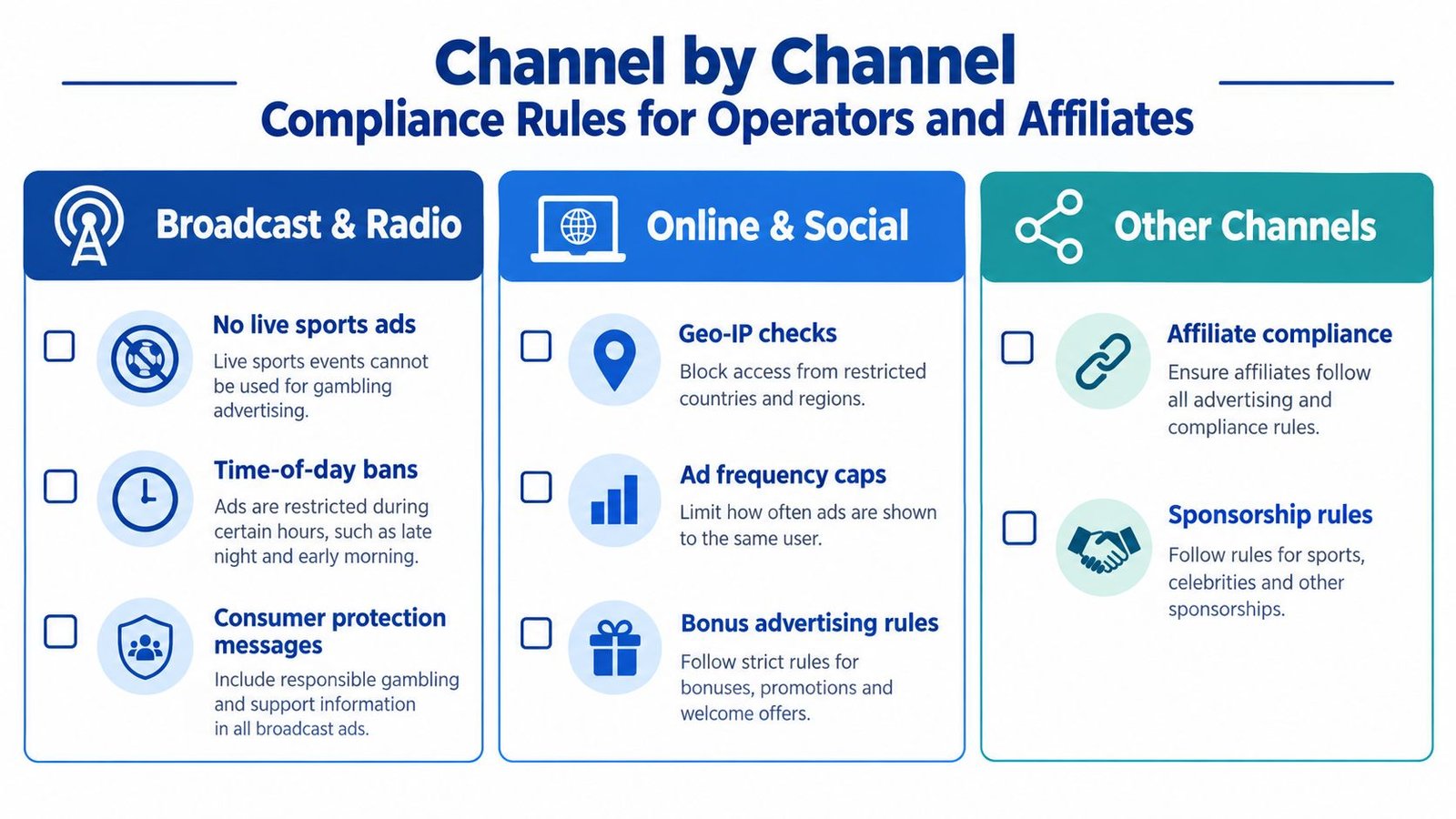
A jurisdictional summary is useful, but campaign execution happens by format. Media buyers traffic spots. CRM teams segment audiences. Affiliate managers approve publishers. Sponsorship teams clear rights and assets. The most reliable way to reduce risk is to convert country rules into channel-specific controls.
Broadcast and radio
Broadcast remains the clearest area for hard scheduling controls. Watersheds, live-sport exclusions, school-run radio restrictions, and product-specific time windows mean ad servers and trafficking teams need rule-based blocking, not manual reminders.
The safest operating model includes:
- Locked scheduling rules tied to local time zones and event windows.
- Creative segmentation by product so casino, poker, betting, and generic brand assets aren't interchangeable by default.
- Pre-approved daypart matrices maintained by compliance, not only by agencies.
Online and social
Digital channels are where many operators assume flexibility, but regulation increasingly narrows that assumption. In higher-control markets, lawful digital delivery may depend on age verification, logged-in status, opt-out capability, and whether the ad is targeted rather than untargeted.
That changes how social and programmatic teams should work:
- Use audience eligibility as a launch condition. If the platform can't support the required age or identity filter, the inventory may be unusable.
- Separate organic from paid governance. A compliant paid campaign doesn't automatically make an open social post acceptable if broad public visibility itself is restricted.
- Version warning and disclosure treatments carefully. Some markets regulate not just the message but also the prominence of the warning.
Sponsorship, stadium media, and out-of-home
Sponsorship creates a different problem. Rights agreements often span seasons, but regulatory changes can narrow what can appear on shirts, in stadiums, on perimeter boards, or in club content. Belgium's phased restrictions and the Dutch sponsorship phase-outs illustrate why sponsorship needs continuous review rather than one-time legal sign-off.
Out-of-home media raises similar questions. Even when not singled out in a headline rule, it's usually untargeted by nature. That makes it vulnerable in markets shifting away from public-facing gambling promotion.
Operational takeaway: If a format can't control audience composition, many regulators will treat it more strictly than a logged-in digital placement.
Affiliates and influencers
Affiliate and influencer activity sits at the intersection of advertising law, licence obligations, and content governance. The UK's approach is especially instructive because disclosure of commercial relationships is treated as part of the compliance specification, not an editorial preference.
Strong affiliate control usually includes:
- Contractual rules on disclosures, claims, bonus presentation, and prohibited audiences.
- Market-specific asset packs so publishers don't reuse one creative set across incompatible jurisdictions.
- Monitoring and takedown workflows for non-compliant placements, especially short-form video and social posts.
- Compensation review where local rules affect performance structures.
Operators assessing acquisition economics alongside compliance burden often compare channel costs with control depth. The user acquisition cost analysis for iGaming operators is relevant here because some of the cheapest distribution channels can become the most expensive once regulatory oversight and remediation are factored in.
Recent Enforcement Cases and What Triggered Penalties
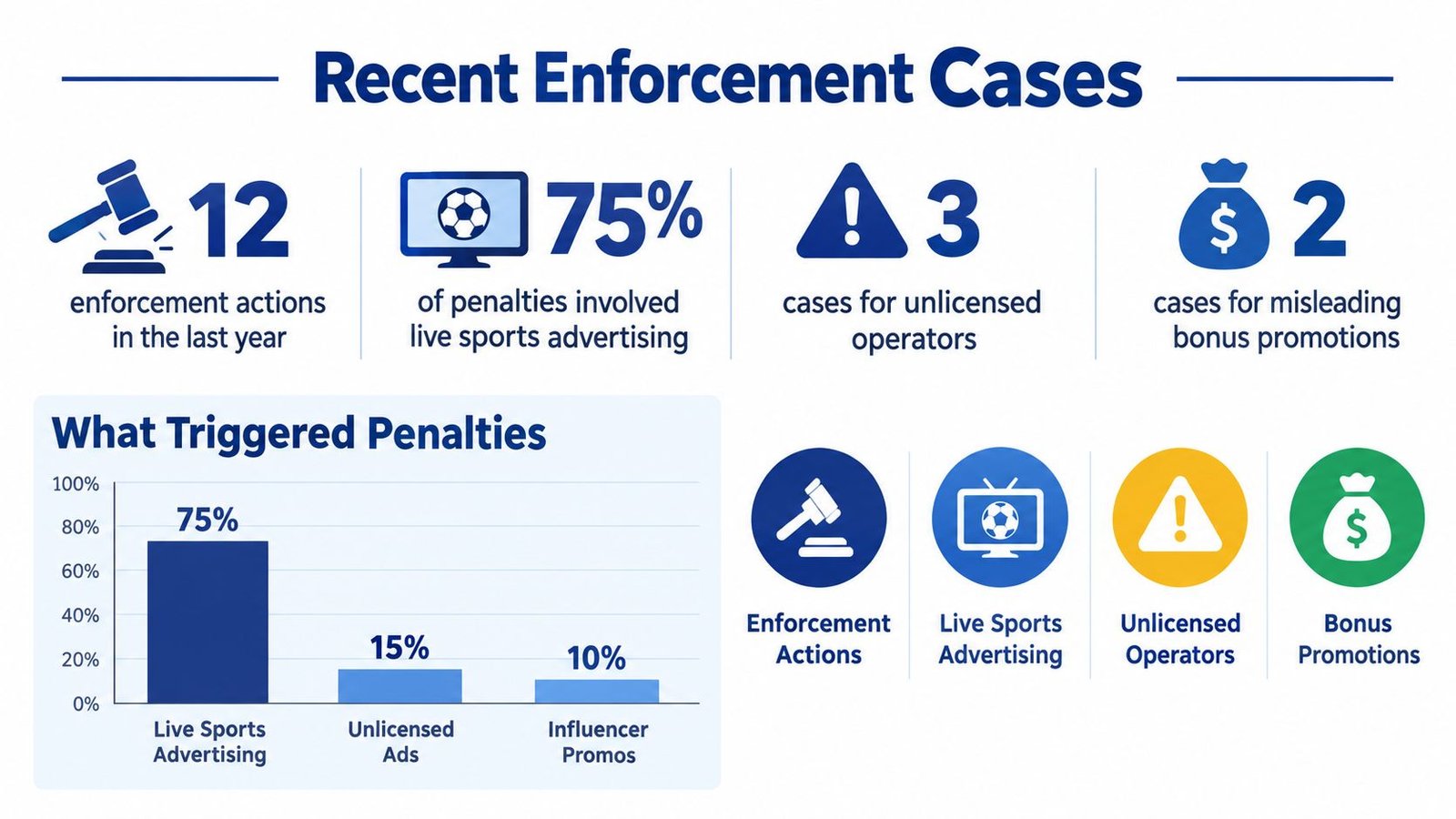
Enforcement usually concentrates on the same fault lines. Regulators focus less on abstract policy language and more on visible failures of control. In practice, that means timing breaches around live sport, digital reach that isn't properly gated, promotional claims that overstate or mislead, creative that appeals to minors, and advertising for unlicensed services.
The main enforcement triggers
The recurring triggers can be grouped into a few patterns:
- Timing failures: These usually arise when a lawful creative airs in a prohibited live-sport or protected time window.
- Audience control failures: Untargeted or insufficiently age-gated digital delivery remains a major risk in markets moving away from broad-reach advertising.
- Content failures: Misleading messaging, irresponsible framing, or child-appealing elements still draw attention even where placement is lawful.
- Licensing failures: Promotion of unlicensed or prohibited products often attracts the fastest intervention.
Australia and New Zealand are especially useful signals of enforcement direction. Australia's tightening framework shows that frequency caps, live-sport restrictions, and identity-gated digital delivery are becoming central policy tools. New Zealand's renewed prohibition on advertising unlicensed online casino gambling highlights how quickly advertising compliance can turn into a market-access issue.
What operators should learn from enforcement patterns
The practical lesson is that regulators don't need a campaign to be reckless to take interest. They only need a breach they can document clearly. A mistimed TV spot, a sponsored post visible to the wrong audience, or an affiliate landing page promoting a product outside local permissions can all meet that threshold.
Three controls matter most after launch:
- Evidence retention. Teams need records of approvals, schedules, targeting settings, and affiliate instructions.
- Ongoing monitoring. Initial sign-off doesn't protect against later trafficking errors or publisher deviations.
- Rapid correction. The response window often matters almost as much as the original mistake.
The campaigns most likely to face scrutiny aren't always the most aggressive. They're often the ones with weak documentation and fragmented ownership across internal teams and third parties.
Pre Launch Compliance Checklist for Multi Country Campaigns
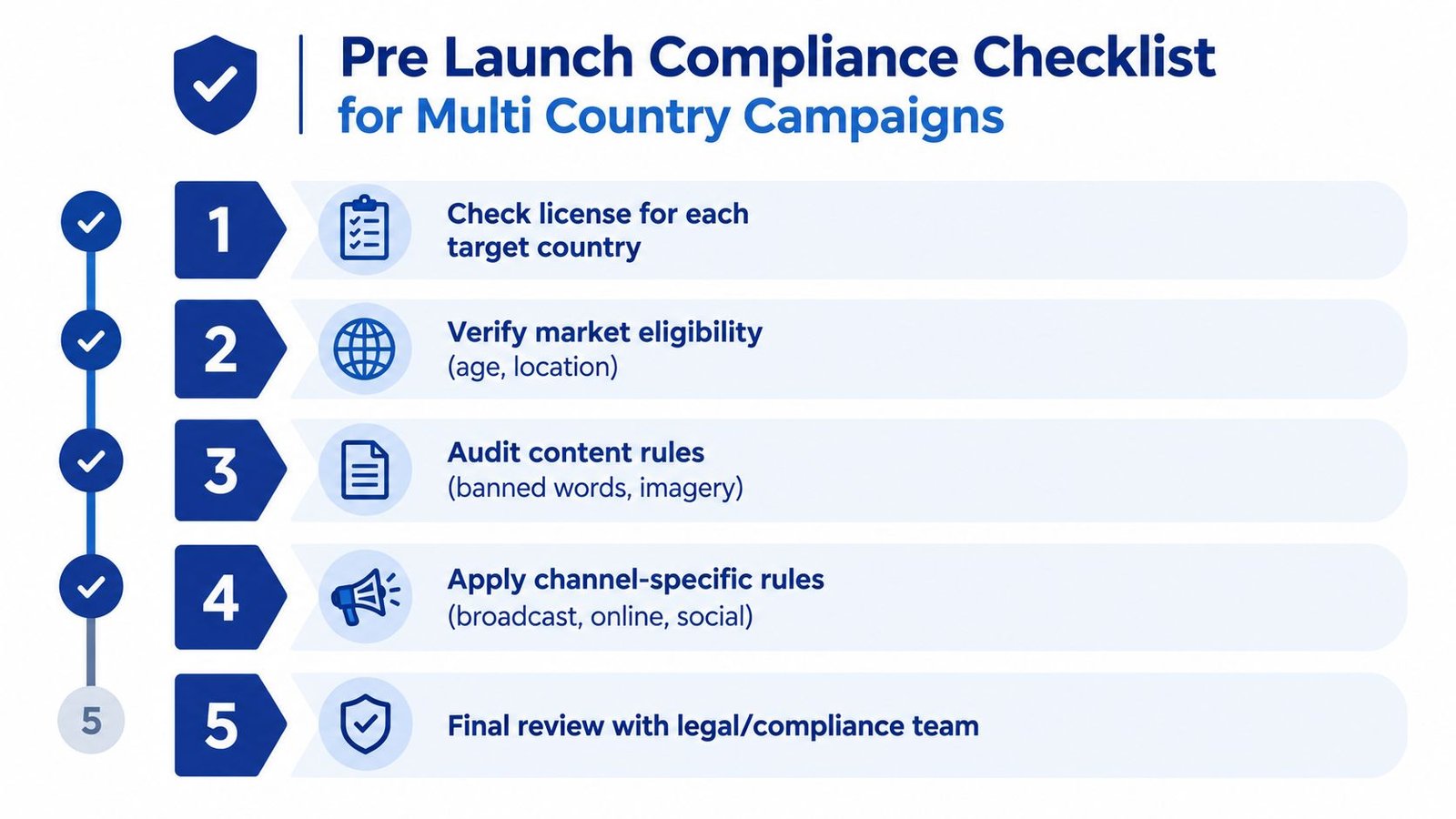
A multi-country campaign should clear the same sequence every time, regardless of channel mix. Consistency matters because the largest failures usually happen in handoffs between legal, media, creative, and affiliate teams, not in the legal interpretation alone.
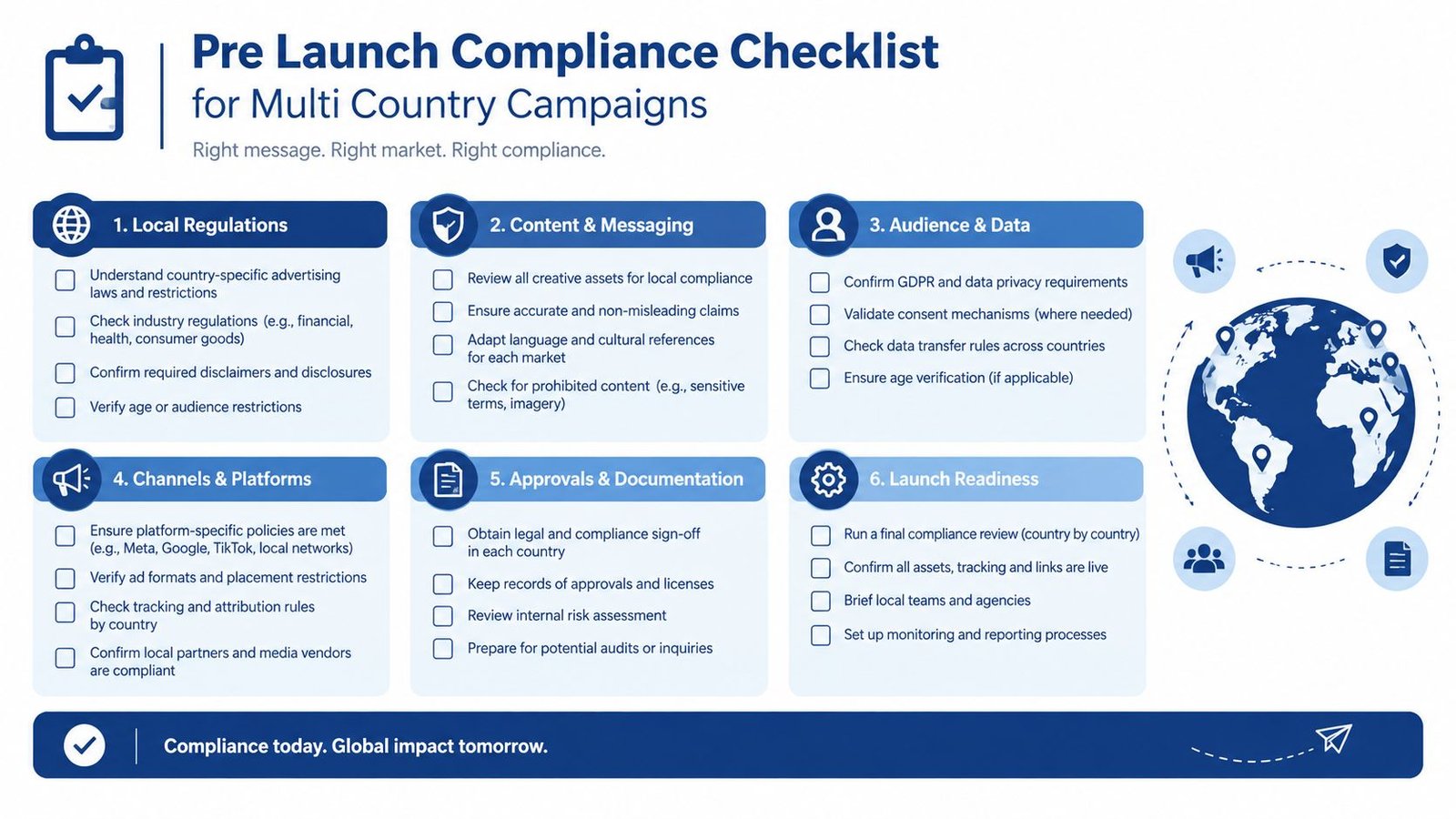
Five checks that should happen before launch
Confirm licence and product eligibility
Verify that the operator, promoted product, and target jurisdiction align. This is the first gate because no creative approval can cure a market-access problem.Map every asset to a channel and audience
Don't approve generic “campaign creative” in the abstract. Each asset should be tied to a delivery environment, intended audience, and jurisdictional rule set.Apply timing and placement controls in trafficking systems
Watersheds, live-sport exclusions, radio timing restrictions, and narrow broadcast windows should be hard-blocked where possible. Manual calendar checks aren't enough for repeat campaigns.Review content restrictions and disclosure mechanics
Check for prohibited endorsements, minor appeal, misleading framing, warning prominence, and affiliate or influencer disclosure language where required.Document ownership for third-party execution
Affiliates, creators, agencies, and media partners need written instructions, approved assets, and escalation routes for changes.
What a strong approval packet contains
A reliable approval packet usually includes the following:
- Jurisdiction list with licence basis and product scope.
- Channel matrix showing where each asset may and may not run.
- Scheduling rules for local time windows and event-based restrictions.
- Targeting proof for age gates, logged-in status, or opt-out controls where relevant.
- Third-party controls covering affiliate disclosures and sponsorship usage rights.
For teams building repeatable operational workflows, the PAGCOR B2B provider application process overview is a useful example of how licensing and supplier due diligence can intersect with broader market-entry compliance planning.
The key discipline
The strongest compliance teams treat advertising approval like release management. Nothing goes live because one department is comfortable. It goes live because legal basis, channel suitability, timing controls, audience filters, and third-party accountability have all been checked against the same market file.
That discipline becomes more important as country rules become less binary and more format-specific. In modern gambling advertising regulations by country, the difference between compliant and non-compliant often sits in execution detail.
Quick Reference Directory and Primary Regulator Sources
For day-to-day use, the fastest way to assess a market is to identify the regulator or official rule-set owner, then match that with the campaign format under review. The list below is designed for quick verification rather than narrative reading.
Quick jurisdiction directory
| Jurisdiction | Primary regulator or official framework | Key advertising point | Primary reference |
|---|---|---|---|
| United Kingdom | Gambling Commission, with advertising rules also operating through CAP, BCAP, ASA, and licence conditions | Licensed operators can advertise to British consumers, but ads must be socially responsible and broadcast advertising faces a 9 p.m. watershed | UK Gambling Commission advertising and marketing rules |
| Australia | ACMA and the federal legislative framework, including Interactive Gambling Act restrictions and proposed reforms | Existing and proposed controls are highly placement-specific, with strong focus on live sport, timing, and digital audience gating | Australian Parliamentary Library gambling advertising policy brief |
| Netherlands | National gambling framework reflected in current advertising restrictions | Untargeted advertising is prohibited and sponsorship channels have been phased out in stages | Netherlands gambling restrictions summary |
| Germany | National regulatory framework reflected in comparative regulatory reporting | Product-specific time bans and endorsement limits create high operational burden | As noted in the earlier Germany comparison section |
| Belgium | National framework reflected in evolving restrictions | Stadium, shirt, and team sponsorship visibility is being reduced on a staged timeline | As noted in the earlier high-restriction comparison section |
| Spain | National framework reflected in comparative reporting | Narrow linear TV windows and endorsement limits reduce broadcast utility | As noted in the earlier high-restriction comparison section |
| Brazil | National framework reflected in recent comparative reporting | Warning-message specifications affect creative design directly | As noted in the earlier high-restriction comparison section |
| Kenya | National framework reflected in recent comparative reporting | Prior approval before airing adds launch lead time | As noted in the earlier high-restriction comparison section |
| New Zealand | National framework reflected in recent comparative reporting | Advertising unlicensed online casino gambling carries elevated risk | As noted in the earlier high-restriction comparison section |
A practical reading of the directory
The most useful pattern across these markets is this. Regulation is becoming less about the simple permission to advertise and more about whether the operator can prove control over format, audience, and timing. That's why reference checks should start with the channel under consideration, not just the jurisdiction name.
For readers benchmarking these frameworks against Southeast Asian market structure, the Philippines online casino and PAGCOR overview provides additional context on how licensing authority and market supervision can shape advertising expectations.
For ongoing global iGaming compliance coverage, regulatory comparisons, and market intelligence, follow Top 1 Rank.




Join thousands of gaming professionals receiving the latest iGaming news, regulatory updates, and market insights.
