

Most advice about online gambling regulations starts in the wrong place. It treats licensing as a paperwork exercise, when the true dividing line is operational: where the customer is located, when identity and age are checked, how product code is tested, and whether enforcement can keep up with the market. That matters to operators, suppliers, affiliates, investors, and compliance teams because the same product can be lawful in one jurisdiction, restricted in another, and exposed to enforcement risk everywhere if the control stack is weak.
This tracker uses a different lens. It groups regimes by how they work in practice, then ties each model to the controls that shape launch, growth, and ongoing risk. The result is a reference that can be used by market entry teams, product managers, legal teams, payment specialists, and auditors without forcing them to translate every statute into an operational plan from scratch.
Table of Contents
- How to Use This Global Regulatory Tracker
- Three Regulatory Models That Shape Online Gambling Worldwide
- United Kingdom Regulatory Framework
- United States State-by-State Framework
- European Union Principles and the Malta Model
- Licensing Requirements and Revenue-Based Triggers
- Identity and Age Verification Compliance
- Player Protection and Safer Gambling Obligations
- Enforcement Actions and the Illegal Market Gap
- Quick-Reference Compliance Checklist and Glossary
How to Use This Global Regulatory Tracker
A single global rulebook for online gambling regulations does not exist, and that is the first thing to accept. The practical question is never just whether a market “allows” online gambling, it is how the regulator defines the licensed perimeter, what has to happen before launch, and which actors can be pulled into enforcement once activity moves outside that perimeter.
Read the tracker by role, not by page order
Operators should start with the jurisdiction entries, then move to licensing triggers, identity controls, and player-protection duties. Suppliers should read the technical standards and disclosure sections first, because platform templates, RNG controls, and customer-facing modules often determine whether a market can go live at all. Affiliates need the enforcement section, because promotion can create exposure even when the affiliate never holds a licence. Investors and deal teams should focus on the model overview and the revenue-trigger section, because licence scope can change as digital turnover scales.
A useful navigation rule is simple, compliance obligations sit in different layers. Licensing answers who may operate. Technical standards answer what systems must prove before release. Ongoing obligations answer what has to stay true after launch. Enforcement answers what happens when those layers fail.
Practical rule: Treat this tracker like an operating map, not a legal memo. If a control affects registration, payments, verification, or game deployment, it belongs in the launch plan, not in a later remediation file.
One cross-reference is worth flagging early. For a practical example of how market access and local frameworks can be presented at a platform level, see the Philippine-focused overview at Instaplay's PAGCOR online casino page.
Three Regulatory Models That Shape Online Gambling Worldwide
The global market breaks into three working models. The labels vary by country, but the operational logic does not. Some jurisdictions use a national licence with one regulator. Others leave authority to states or provinces. A third group uses principle-based regional frameworks that set consumer-protection expectations without creating a single harmonized gambling permit.
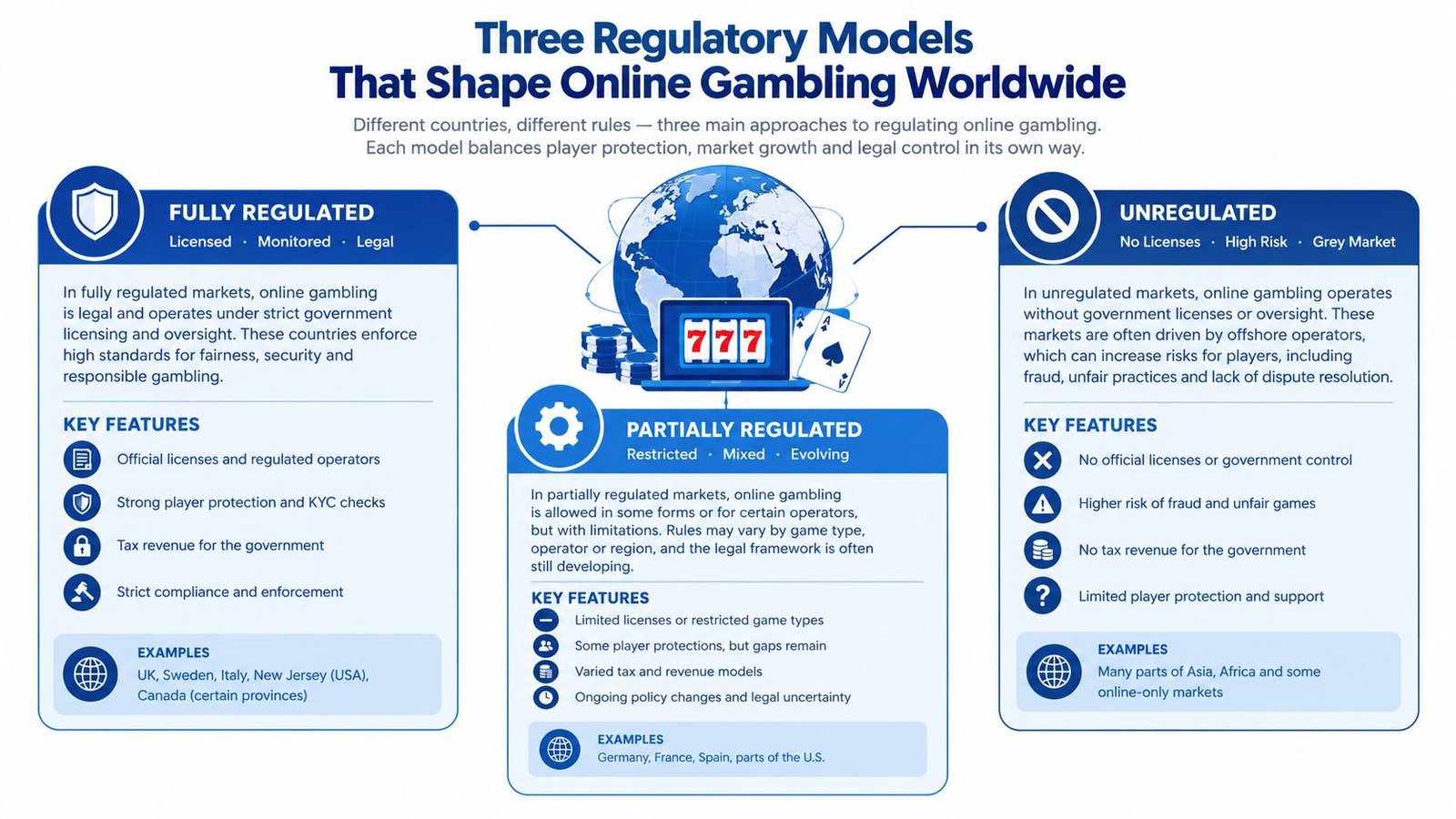
Regulatory Models at a Glance
| Regulatory Model | Example Jurisdiction | Licensing Authority | Compliance Approach |
|---|---|---|---|
| National licensing | Great Britain | Gambling Commission | Point-of-consumption authorization, technical standards, verification, and enforcement under one principal regulator |
| State-by-state authorization | United States | Individual state regulators | Separate licences, local product rules, and market access determined by state law |
| Principle-based regional framework | European Union consumer-protection framework | National authorities map the principles locally | Common protection principles translated into local licensing, retention, and data rules |
The key idea is that consumer access is regulated by the customer's location, not just the operator's corporate home. That principle shows up in the British model and, in a different form, in U.S. state-by-state authorization. It also explains why operators cannot assume that a licence in one market carries over into another without rechecking the territorial rule.
Why the model matters for market entry
National licensing usually creates the cleanest operating architecture, because one regulator can align licensing, testing, and enforcement. State-by-state systems create more friction, but they also let markets open unevenly and quickly. Principle-based regional frameworks sit in the middle, because they set common consumer expectations while leaving the exact licence conditions to local law.
For market entry teams, the first task is classification. A new jurisdiction is never just “regulated” or “unregulated.” It belongs to a model, and that model determines whether a product needs one approval, many approvals, or a localized control mapping exercise before launch.
United Kingdom Regulatory Framework
Great Britain's online gambling regulations are built on the Gambling Act 2005. The law took full effect in September 2007, brought remote gambling into a formal licensing and enforcement system, and established the Gambling Commission as the main regulator for licensing, compliance monitoring, and enforcement. The decisive shift came in 2014, when the regime moved to a point-of-consumption model. Any online gambling company serving British customers needs authorization, regardless of where it is based. That structure ties regulation to the customer's location, not the supplier's domicile, and it is one of the clearest examples of operational regulation in practice. UK Gambling Act review and call for evidence
The British model moved from websites to ecosystems
The market is no longer just a website issue. The official review noted that by 2019, 21% of surveyed British adults had gambled online in the previous four weeks, 95% of online gamblers reported doing so at home, and mobile use among online gamblers aged 18 to 24 reached 76%. It also recorded that online gambling's gross gambling yield grew by 18% in real terms between 2015 to 2016 and 2018 to 2019. The regulatory implication is straightforward. Oversight had to expand beyond static website licensing to remote access, device use, and the wider player journey. UK Gambling Act review and call for evidence
Technical standards operate as pre-launch gates
The Gambling Commission's Remote Gambling and Software Technical Standards require demonstrable randomness. RNGs, game engines, lotteries, and virtual-event outcomes must be statistically random to a high degree of confidence using accepted analytical methods. Testing must cover the raw RNG, scaling, mapping, and any transformation that turns random output into game results. The standards also require operational resilience, including recovery from interruption, restoration of the pre-failure state where possible, and voiding or suspension procedures where appropriate. Gambling Commission RTS
Operational takeaway: Compliance evidence should not sit in a folder after launch. It should function as a release gate, with version-controlled game mathematics, independent statistical testing, immutable logs, and replayable transaction histories ready before a product goes live.
That launch discipline matters because the Commission's testing approach expects new products to be tested by an approved test house before release, with evidence supplied to the regulator. For operators and suppliers, the practical lesson is clear. Technical compliance belongs in product engineering, release management, and incident recovery, not in a post-launch cleanup queue.
United States State-by-State Framework
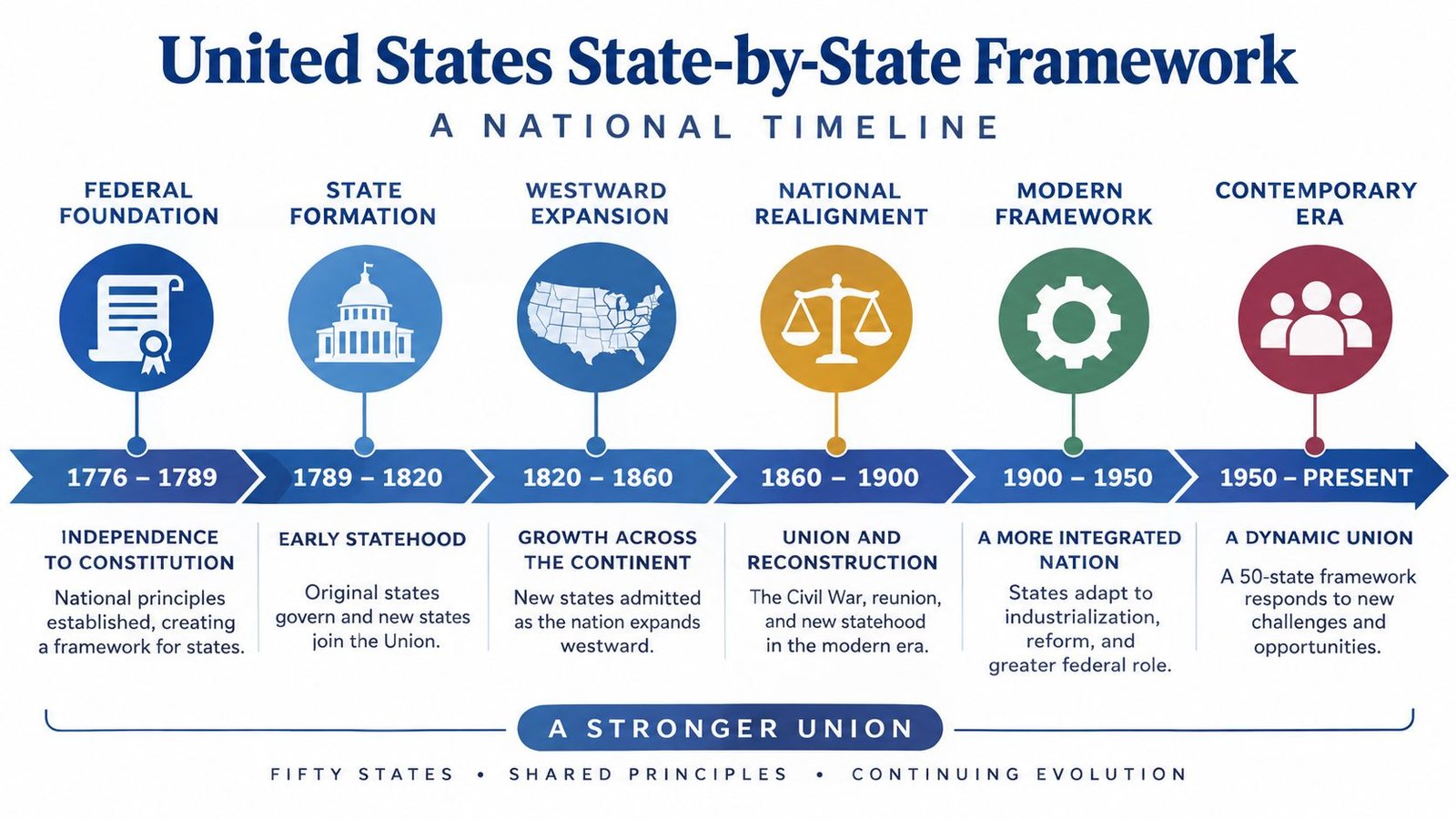
The U.S. market changed direction on May 14, 2018, when the Supreme Court invalidated PASPA in Murphy v. NCAA. That ruling removed the federal barrier that had largely kept states outside Nevada from authorizing sports betting, and it pushed the market into a state-by-state model. The result was a fragmented operating environment, with each state setting its own licence terms, tax treatment, permitted products, advertising limits, and mobile-access rules.
A federal ruling created state-level operating complexity
Within about one year of the ruling, seven states beyond Nevada had launched legal sports-betting markets, and those jurisdictions had accepted nearly $8 billion in wagers. Later Congressional Research Service reporting said 39 states and the District of Columbia had legalized state-regulated sports gambling in some form. ESPN on the post-PASPA market shift
That pace explains the operating reality. Operators are not choosing between a single federal licence and no licence. They are deciding which states to enter, which products to offer, which mobile controls to support, and how to align tax, advertising, and responsible-gambling obligations market by market.
How to evaluate a new state market
The useful questions are operational.
- Licensing scope: Does the state authorize sports betting only, or broader online gambling products too?
- Permitted channels: Are mobile and remote bets allowed, or is access restricted?
- Advertising rules: Are there limits on affiliate promotion, messaging, or bonus offers?
- Compliance stack: What geolocation, age verification, and identity controls are required before play?
The U.S. entry in this tracker sits in the state-by-state column from the model overview. That matters for launch planning, because a product that fits one state's rules can fail in the next state even when the operator already holds a licence elsewhere.
European Union Principles and the Malta Model
European regulation is best understood as two layers. At the first layer, the European Commission's consumer-protection framework sets common principles, including effective player registration, age and identity controls, reality checks, no-credit policies, fund protection, self-restriction tools, customer support, and complaint handling. It is not a single harmonized gambling licence. Operators have to map those principles into local licensing conditions, retention rules, and data-protection obligations. EU online-gambling consumer protection summary
Malta turns broad principles into concrete interface rules
Malta's Player Protection Directive is more specific. Licensed gambling websites must display the licensee's details, an underage-gambling prohibition notice, a responsible-gaming message that uncontrolled gaming can be harmful, information about player-support measures, and links to gambling-help organisations. The relevant information must be clear, intelligible, and accessible within one click from anywhere on the website. Operators also have to show a message before the first deposit explaining available responsible-gaming tools and limits. Malta Gaming Authority player protection requirements
That one-click rule is important because it changes interface design, not just policy wording. Footer navigation, registration flows, deposit screens, and content governance all become compliance issues. Suppliers should care too, because platform templates and customer-facing modules need to support the required disclosures.
Practical rule: In EU-facing markets, the legal team cannot own compliance alone. Product, CRM, and payments teams have to build the required access paths and disclosures into the journey itself.
The contrast between Brussels and Malta is useful for operators expanding across Europe. One layer sets the control philosophy. The other layer turns that philosophy into site-level obligations that can be tested, audited, and broken by poor UX design.
Licensing Requirements and Revenue-Based Triggers
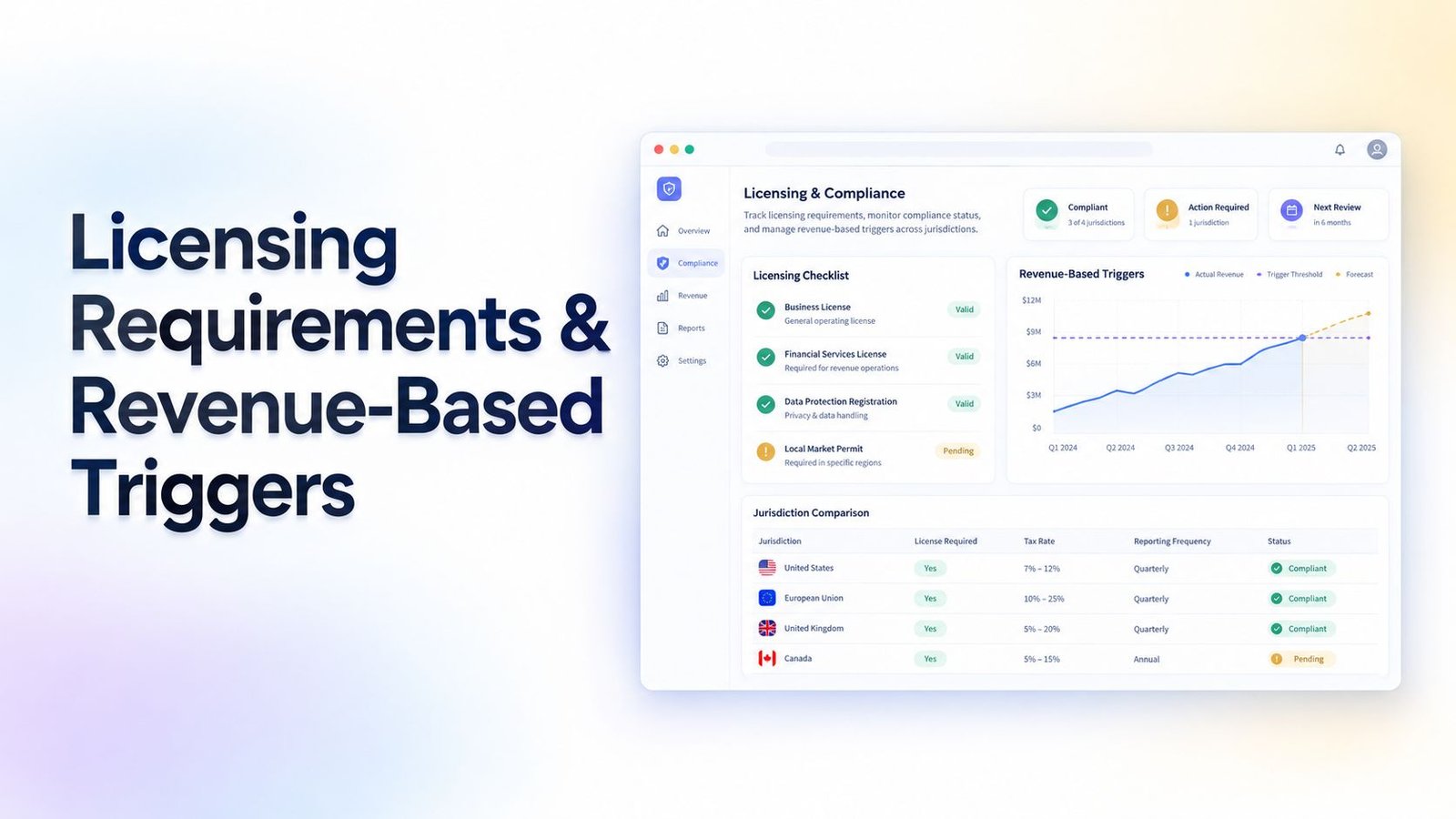
Licence scope is not static. As a gambling business scales, the category that looked sufficient at launch can stop being enough once remote revenue or expected proceeds cross a threshold. That is why licence planning has to include forecasting, not just application work.
The UK society-lottery rule shows how thresholds change obligations
Great Britain provides a clear example. The Gambling Commission's remote technical standards say an operator generally needs a full remote licence if it accepts payments by remote means and does not hold a qualifying non-remote society-lottery licence. A limited exception applies where a society lottery operator has both non-remote and ancillary remote authorisation, but if expected remote proceeds exceed £250,000 per year, the operator must obtain a full remote society-lottery operating licence. Gambling Commission remote technical standards
That threshold is more than a legal detail. It turns revenue planning into licence planning. Charities, lottery operators, platform suppliers, payment teams, and investors all need to know when a digital channel stops being ancillary and becomes licensable on its own terms.
A practical planning sequence
- Forecast remote turnover early: Category changes often depend on expected rather than realized revenue.
- Check the licence trigger before launch: Do not assume a temporary or ancillary permission will survive scale.
- Map the new obligations: A full remote permission usually brings additional technical, compliance, and reporting duties.
- Revisit contracts and payment flows: Suppliers and payment providers can inherit operational risk if the licence category changes midstream.
For teams comparing markets, the discipline is the same regardless of jurisdiction. Revenue thresholds are not just finance metrics. They are legal tripwires that can change which regulator has authority, which tests must be passed, and which reporting obligations apply.
For platform teams that need market-access context in one place, the PAGCOR B2B provider application overview is a useful point of comparison.
Identity and Age Verification Compliance
In Great Britain, remote operators must verify a customer's identity before allowing that customer to gamble. The minimum information includes name, address, and date of birth, and the operator must take reasonable steps to keep those records accurate. Before accepting a deposit, the operator also has to explain what identity documents or other information may be needed, when they may be requested, and how they should be supplied. Gambling Commission customer identity verification
Verification belongs at onboarding, not at withdrawal
That timing matters because a withdrawal request is not supposed to become the first point at which the operator asks for information it could reasonably have requested earlier. Identity verification is therefore an onboarding-stage control, not a cleanup step. Registration, KYC checks, payment onboarding, and account monitoring have to be designed as connected processes.
Age verification is stricter still. Remote operators in Great Britain must verify a customer's age before the customer can deposit funds, access free-to-play games, or gamble with personal funds, free bets, or bonuses. That requirement closes the common loophole where promotional journeys sit outside the age-control perimeter. Gambling Commission reminder on remote verification requirements
The practical risk sits in the product journey
Age and identity controls shape account creation, bonus configuration, game-lobby access, CRM segmentation, and affiliate traffic flows. If free-to-play products or bonus paths are accessible before verification, the operator has already allowed a regulated activity to begin.
Payment gateway accreditation and KYC integration must align before customer deposits are accepted, see the PAGCOR payment gateway accreditation page for the applicable requirements. Where payments and identity checks sit in separate systems, the failure is usually operational rather than legal, but the compliance impact is the same.
A short implementation list helps teams translate the rule into product work.
- Block access early: Do not allow deposit, free-play, or bonus wagering before age checks are complete.
- Connect the records: The customer profile used for deposits should match the identity record used for gambling access.
- Explain evidence needs upfront: Tell the customer what may be requested before money enters the account.
- Audit affiliate routes: Marketing pages must not bypass the verification step through direct-to-game links.
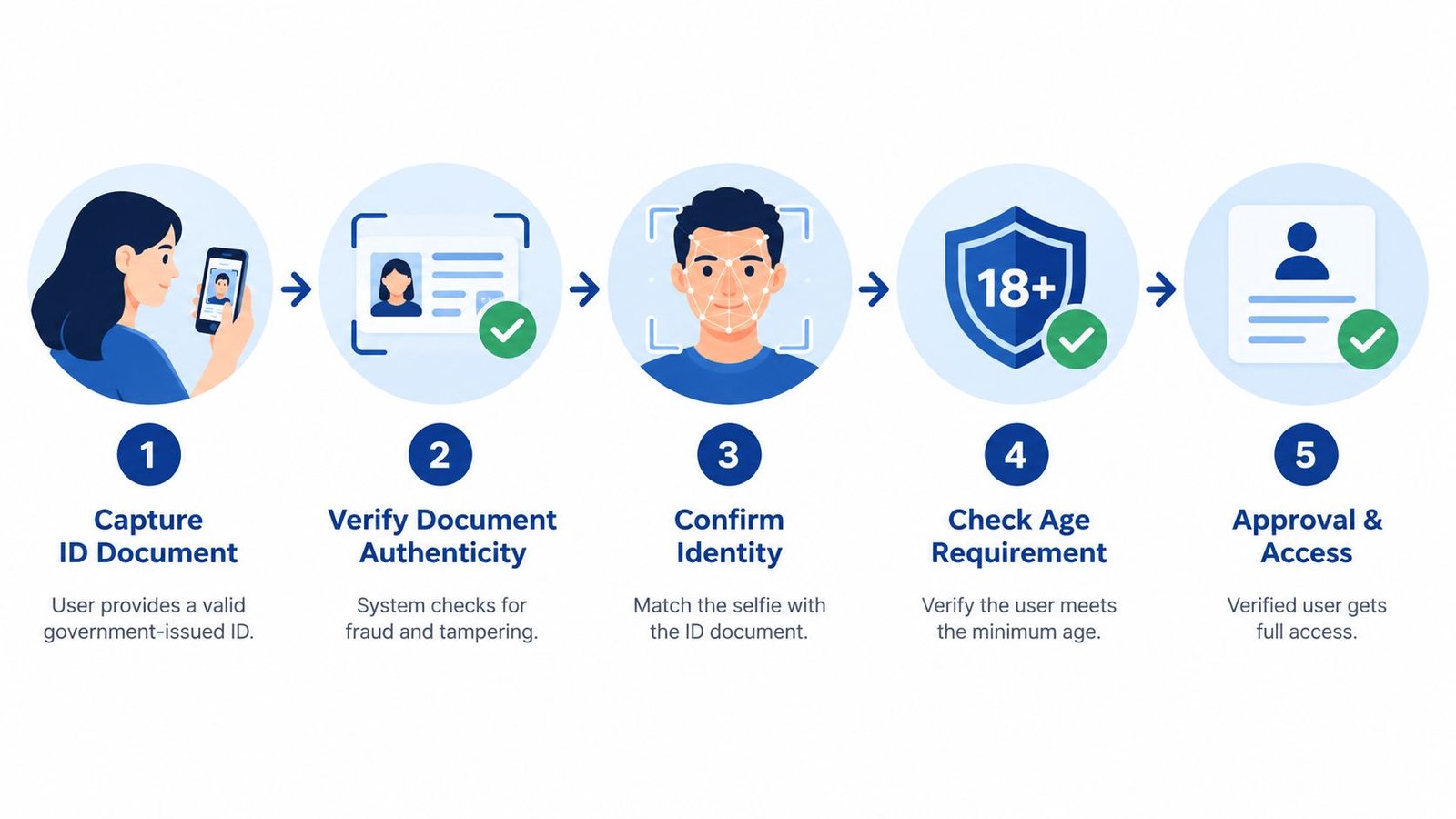
For operators and suppliers, the message is direct. Verification is not a back-office function. It is a product-control system that has to work before the first wager, the first bonus, and the first deposit.
Player Protection and Safer Gambling Obligations
The European Commission's consumer-protection framework turns safer gambling into a structured control set. It includes effective player registration, age and identity checks around money movements, reality checks, no-credit policies, player-fund protection, self-restriction tools such as time, spending, and exclusion limits, customer support, and complaint handling. Those measures are not optional help pages. They are the operational floor for a safer-gambling programme. EU online-gambling consumer protection summary
Safe gambling works only when it is built into the architecture
The strongest insight here is architectural. If limits, checks, and complaints live only in a footer menu, the system is already too weak. Identity checks need to sit before gambling access, deposit and withdrawal monitoring need to bind to the same customer profile, and configurable limits need to be auditable when a customer changes them.
That architecture matters across product, payments, and support. Reality checks have to appear in context. Self-exclusion and time limits need to be enforced across the account, not just documented in policy. Evidence of interventions, customer contact, exclusions, and complaints must be retained because regulators will ask how the control behaved in practice.
How teams should interpret the control set
The European framework, Malta's disclosure rules, and Great Britain's verification duties all point in the same direction. Safer gambling cannot be bolted on after launch. It has to sit inside onboarding, billing, and account administration.
- Registration: collect enough information to support identity and age controls.
- Payments: tie deposits and withdrawals to the same customer record.
- Limits: make spending, time, and exclusion tools visible and auditable.
- Support: ensure complaints and intervention records are recoverable for review.
For commercial teams, this is not only a compliance matter. It affects customer friction, conversion flow, and the design of the account journey. For regulators, it is a test of whether the operator can prove that the safeguard worked when the customer actually needed it.
The PAGCOR gambling advertising rules overview is a useful reminder that safer-gambling controls and marketing controls often overlap in practice, especially around bonus messaging and player-facing disclosures.
Enforcement Actions and the Illegal Market Gap
Stronger licensing does not automatically mean stronger consumer protection. The UK Gambling Commission's recent enforcement figures make that gap visible. In the 2024 to 2025 financial year, the Commission carried out more than 9,700 compliance activities, more than twice the previous year's total, and enforcement against 24 operators produced £4.2 million in fines or regulatory settlements. UK Gambling Commission annual report foreword
Illegal-market control depends on more than the licence
The same report shows how much of the work happens outside the licensed perimeter. Since April 2024, the Commission's illegal-market programme referred 447,778 URLs to Google and Bing and removed 287,961 URLs. In April to June 2025 alone, 321 websites were referred to search engines, 214 were removed, and 108 illegal lotteries were referred to social-media platforms. Those figures show enforcement at scale, but they also show the size of the operational problem.
The hard question is not whether rules exist. It is who can implement them across search engines, affiliates, payment providers, hosts, and social platforms. An unlicensed operator promoted by an affiliate raises a different accountability question than a licensed operator with a weak KYC process. Payment blocks and geo-blocks also depend on industry coordination, not just statutory wording.
Enforcement that removes one domain does not always remove the underlying demand. In practice, takedowns can displace activity to new URLs, which is why cross-industry monitoring matters as much as formal licensing.
That is why the illegal-market gap matters to operators, affiliates, and payment teams. The market can look tightly regulated on paper while consumer exposure persists through promotion, mirror sites, or fast-moving domain changes. The practical response is sustained operational capacity, not just tougher language in the statute.
Quick-Reference Compliance Checklist and Glossary
A useful compliance review starts with the same questions in every jurisdiction. If the answers are weak, the market entry plan is weak too. This checklist turns the tracker into a fast audit tool.
Compliance checklist
- Licence category: Confirm whether the market uses national licensing, state-by-state authorization, or a principle-based regional framework.
- Verification timing: Check whether identity and age verification must happen before deposit, before play, or only at withdrawal.
- Technical standards: Confirm whether RNG testing, resilience controls, and approved test-house evidence are required before release.
- Disclosure rules: Review website notices, responsible-gaming messages, and one-click access requirements.
- Player protection: Map limits, exclusions, fund protection, support, and complaint handling to the account and payments architecture.
- Enforcement exposure: Check which external channels can trigger risk, including affiliates, search engines, payment providers, hosts, and social platforms.
Glossary
Gross gambling yield is the amount staked minus winnings paid.
Point-of-consumption regulation means the market is governed by the customer's location, not just the operator's home base.
Remote licence is a permission to offer gambling through remote means such as online or telephone channels.
RNG means random number generator, the core randomness control for many digital gambling products.
Test house is an approved independent body that evaluates product compliance before launch.
Regulatory settlement is a formal resolution between a regulator and an operator, often alongside or instead of a fine.
Self-restriction tools are controls such as time limits, spending limits, and exclusion settings that customers can apply to themselves.
The PAGCOR regulatory updates page for 2026 is a useful reminder that this kind of tracker only stays valuable if it keeps changing with the law. Market access rules, technical standards, and enforcement patterns move quickly, and compliance teams should revisit them on a regular cycle.
For operators, suppliers, and compliance teams that need to benchmark market entry or review existing controls, the next step is to map one jurisdiction against one product line, then test whether the licence, verification, technical, disclosure, and enforcement layers all line up before launch.





Join thousands of gaming professionals receiving the latest iGaming news, regulatory updates, and market insights.
