

An operator locking a 2026 product roadmap is not facing one rule change. The same planning quarter can contain a UK duty step-up, tighter British stake rules, US sweepstakes enforcement, and a 2027 EU anti-money-laundering deadline. Each item below is a compliance decision: what changed, which teams own it, the date that matters, and a next step that can be scheduled now. Facts that regulators have already published are treated as settled. Outcomes still in court, including prediction-market litigation and parts of the US sweepstakes fight, are marked as open.
These regulatory compliance updates sit on different calendars, so a single legal memo won't cover them. Finance, product, payments, affiliates, and compliance each carry a piece. Britain's remote gaming duty is a margin event. Stake limits and deposit controls are product-logic events. Sweepstakes and event contracts are market-access events. The EU rulebook, Germany's channeling regime, Brazil's licence regime, and Ontario's advertising standards are operating-model events. Operators that wait for a final statute or a final judgment will miss implementation windows that vendors and banks already treat as live.
The practical response is one shared calendar, not eight disconnected briefings. Assign an owner per jurisdiction, record the evidence each control must produce, and review regulator bulletins on a fixed cycle. Where the law is still moving, contracts and geo controls do more work than a press statement.
Table of Contents
- 1. UK Remote Gaming Duty Increase (Effective April 2026)
- 2. UK Gambling Commission Stake Limits and Affordability Checks
- 3. US State Action Against Sweepstakes Casinos
- 4. Federal-State Dispute Over Sports Event Contracts and Prediction Markets
- 5. EU Anti-Money Laundering Regulation and the Creation of AMLA
- 6. Germany's Licensed Online Casino Framework and the GGL
- 7. Brazil's Regulated Betting Market Under Law 14.790/2023
- 8. Ontario's Regulated iGaming Market and Advertising Standards
- Key Regulatory Changes at a Glance
- Turning Eight Regulatory Shifts Into a Working Compliance Calendar
1. UK Remote Gaming Duty Increase (Effective April 2026)
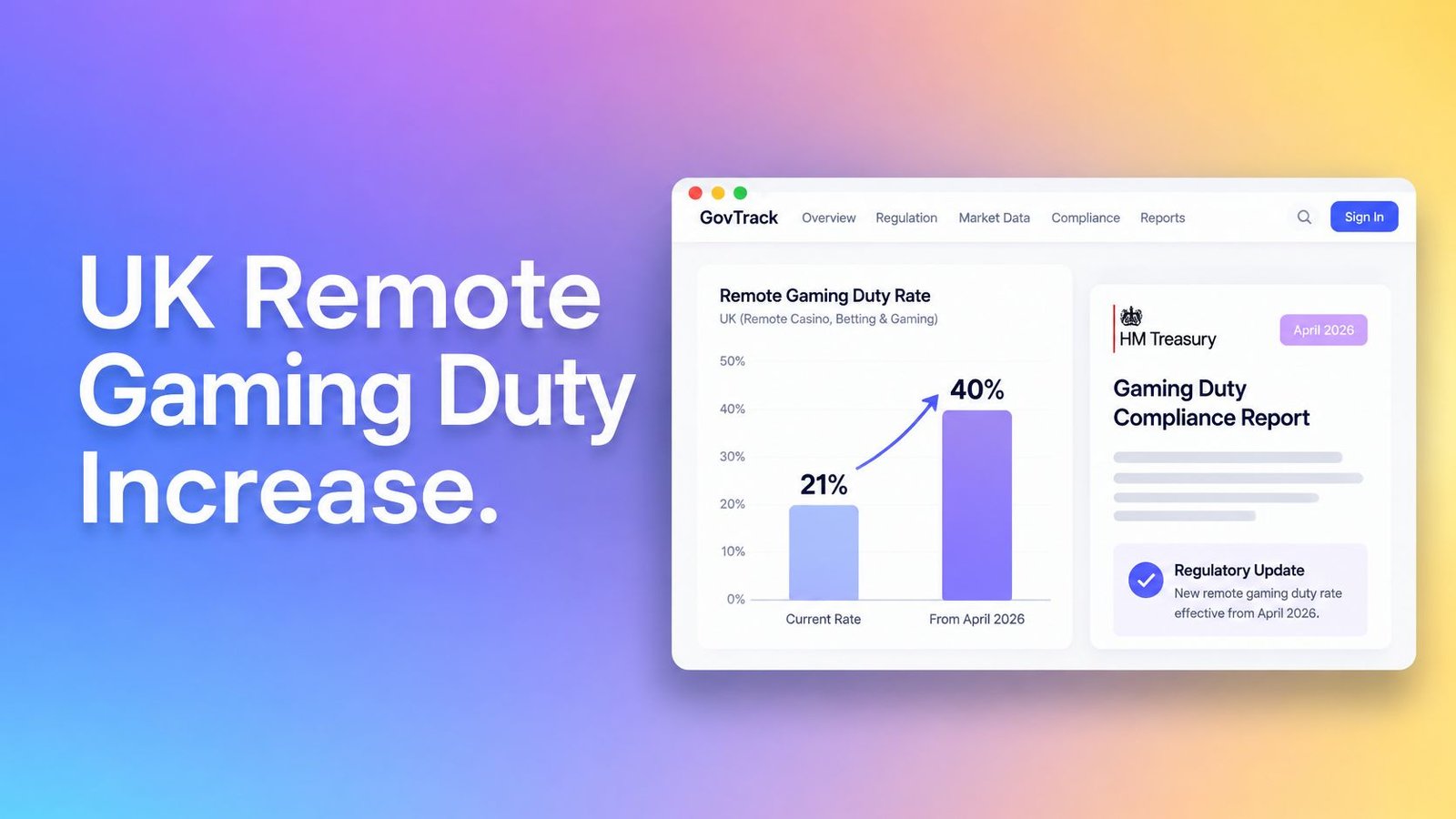
In the October 2024 Autumn Budget, the UK government said Remote Gaming Duty on online casino gross gaming yield will rise from 21% to 40% from 1 April 2026. The charge covers remote gaming, including online casino, slots, and similar products. Remote Betting Duty, which governs sportsbook yield, is unchanged. Because the duty sits on gross gaming yield rather than net revenue, a promotion that looks affordable after costs can erase margin once the higher rate applies.
Ownership splits four ways. Finance owns the model. Product and CRM own the offer book. Procurement owns multi-year affiliate deals priced on current unit economics. Legal should track HMRC guidance between the announcement and the mechanics that apply on returns. The rate and start date are settled in Budget documents. What remains open is commercial behaviour: whether smaller brands exit, whether groups consolidate, and whether some play shifts to unlicensed sites if regulated prices stop competing. None of that is a government finding. Treat each as a planning risk to monitor, not an outcome to assume.
The decision is also worth benchmarking outside Britain. An operator following PAGCOR regulatory updates for 2026 alongside the Budget can compare how another licensing regime sequences tax and product decisions, which gives the UK change a reference point rather than leaving it as a single-market guess.
What to model before contracts renew
- Gross yield, not net revenue: Run the 40% rate against gross gaming yield so bonus cost isn't hidden in a net figure.
- Affiliate term length: Don't lock multi-year acquisition contracts until post-April 2026 contribution is signed off.
- Guidance drift: Re-read HMRC and Treasury notes before go-live. Calculation detail can move after a headline rate is announced.
Practical rule: If a promotion only works when duty is still 21%, it is not a 2026 promotion.
2. UK Gambling Commission Stake Limits and Affordability Checks
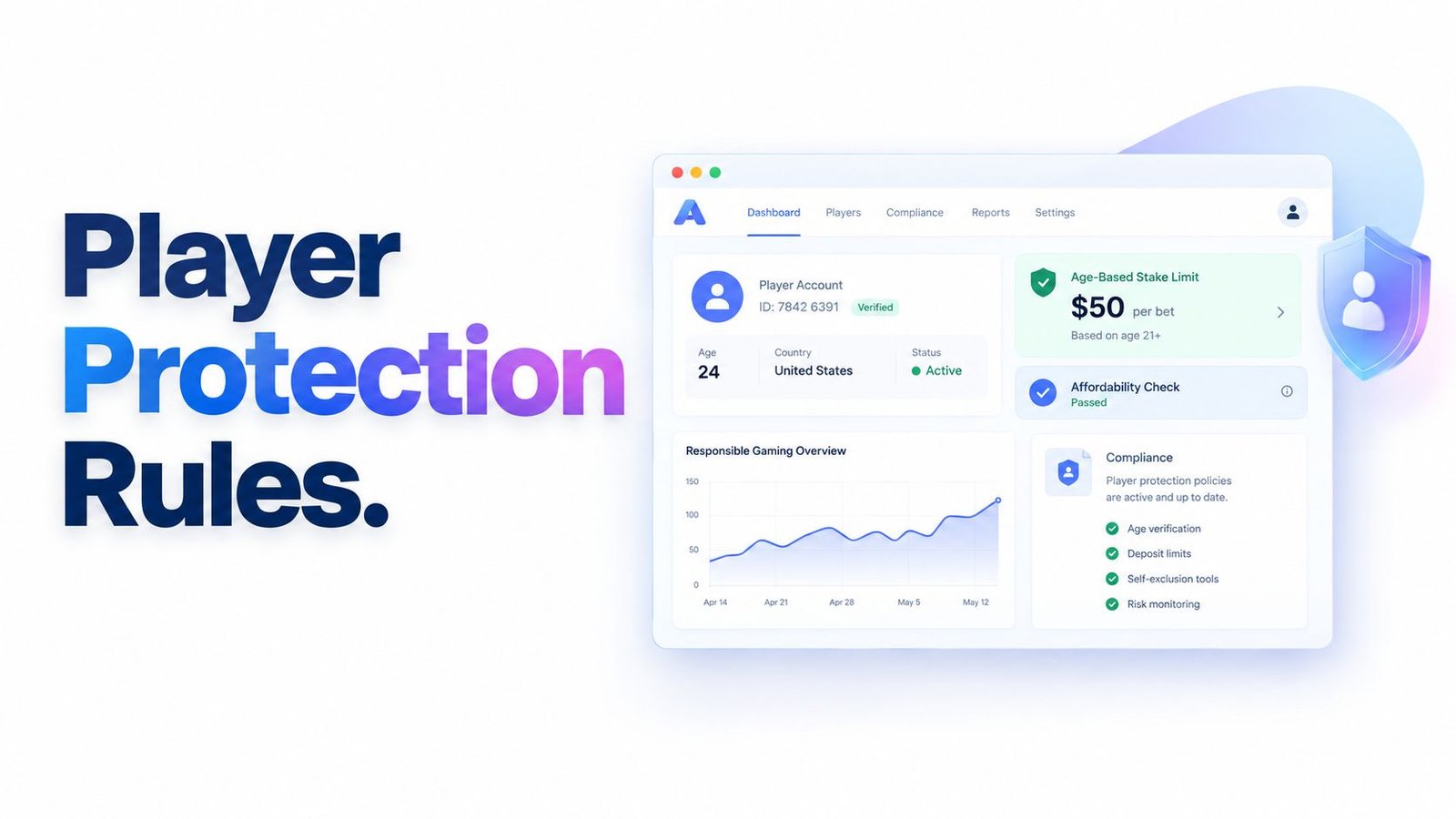
Two Commission rule changes now set the UK product calendar. The Gambling Commission's remote gambling and software technical standards cap the online-slots stake at £5 per spin for players aged 25 and over from 9 April 2025, and at £2 for 18-to-24-year-olds from 21 May 2025. Product teams, game suppliers, and wallet engineering share the obligation. A third-party slot that ignores the age band is still the operator's breach.
The next date that matters is 30 June 2026. From that point, remote licensees must offer a control defined strictly as a deposit limit, calculated on money paid in over a period, under the Commission's deposit-limit notice. Withdrawals cannot offset deposits, and a loss limit must not carry that label. The technical standards also specify how the control must behave once set: systems must block further deposits when a gross deposit limit is reached, and a player's request to raise a limit takes effect only after a 24-hour cooling-off period.
Affordability assessment has moved from policy wording to evidence of decisions. A CMS review of recent Commission regulatory action records a run of enforcement outcomes in which operators let customers continue depositing substantial sums without obtaining source-of-funds information, and treats that pattern as a warning against relying on self-declared finances. A control that only fires an alert, without a recorded decision, escalation, and closure, is unlikely to withstand scrutiny.
What an assessment-ready file looks like
Map every title, including third-party supplier builds, to the correct stake and age logic before each release. For each financial-risk check, keep the trigger, the evidence reviewed, and the outcome on file, and train both agents and automated journeys on vulnerable-customer escalation. Whether tighter limits reduce harm or only displace some play to unlicensed sites remains an open measurement question. Implementation alone does not settle it.
3. US State Action Against Sweepstakes Casinos
A compliance lead approving a sweepstakes casino merchant this quarter is taking a legal position. The model runs on virtual currency with a prize-redemption path, and it rests on one argument: a free-entry route removes "consideration" from the classic prize-chance-consideration test. States are now ruling on that argument. Their answers diverge.
Two answers are legislative facts with dates attached. Connecticut's Public Act 25-112 (Senate Bill 1235), signed in June 2025 and effective 1 October 2025, prohibits sweepstakes-model online casino games and extends to parties that promote or support them. California's Assembly Bill 831, signed in October 2025 and effective 1 January 2026, does the same and names payment processors among the covered actors. A third answer is enforcement rather than statute: New York's attorney general issued cease-and-desist letters to sweepstakes casino operators in June 2025, a position operators can still contest in court.
Separate settled bans from open fights
- Statute versus letter: The Connecticut and California bans are enacted law with fixed effective dates. A cease-and-desist letter states a regulator's position and remains open to challenge.
- Partner exposure: Both statutes reach beyond the operator. A media buyer or processor serving licensed and unlicensed merchants needs its own state screen.
- Entry design: Geolocation and age checks should match the strictest state the product can reach, not the friendliest one in the deck.
Counsel should rerun the three-element test before any launch or white-label deal, and calendar the two effective dates above. The open question is commercial: whether operators exit those markets, litigate, or relabel the same loop under a new currency name.
A free-play button does not answer consideration when the paid currency is what players actually use.
4. Federal-State Dispute Over Sports Event Contracts and Prediction Markets
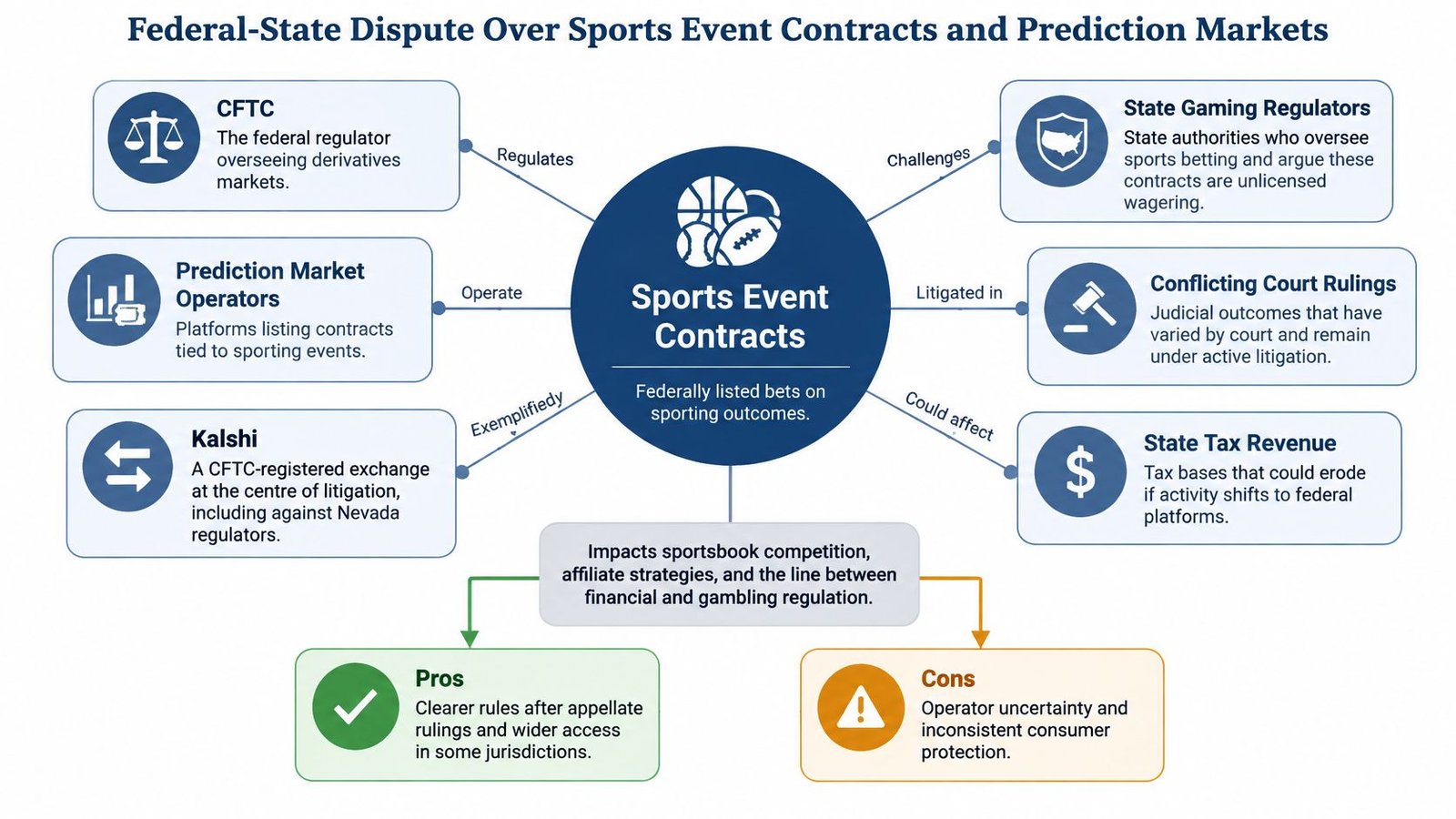
A contract listed on a federally supervised exchange can be lawful in one courtroom and an illegal bet in the next. The US Commodity Futures Trading Commission supervises derivatives venues. State gaming regulators supervise sports betting. Kalshi, a CFTC-registered exchange, has listed contracts tied to sporting events, and Nevada regulators classify those listings as unlicensed wagering. Litigation between the two sides has produced conflicting rulings, with appeals pending. Filings in other states run on separate dockets, so no court has set a national answer and the operative rule today differs by jurisdiction.
The split lands on sportsbooks, affiliates, and anyone packaging event markets beside a betting brand. If federal registration controls, these products can appear in states that do not license sports betting. If state gambling law controls, the same listing is an illegal book.
Contract language keyed to litigation events
Each protection should trigger on a court event, not a policy review cycle. Affiliate agreements need a legality-change clause drafted around injunctions, so commission stops when an order bars the product in a state rather than after a final judgment months later. Market entry should be reversible per state: geo blocks, creative takedowns, and payment shutoff that activate where a regulator has filed. Due diligence should hold event contracts in their own risk category, separate from a state sportsbook licence, until the pending appeals resolve.
The same ownership question sits behind other licensing borders, including whether online casino play is legal in the Philippines, though the US dispute is harder because it pits two regulators inside one market against each other. The analysis here, not a court holding, is that the outcome will redraw the line between financial regulation and gambling regulation. No operator should book it as certain.
5. EU Anti-Money Laundering Regulation and the Creation of AMLA
A gambling group operating in six member states currently answers to six interpretations of anti-money laundering law. The EU Anti-Money Laundering Regulation ends that patchwork: it is a single rulebook that applies directly, with no transposition window for national governments to soften. For gambling service providers, the settled facts are these. Customer due diligence on occasional transactions triggers at EUR 2,000. The regulation sets July 2027 as its application date, which is a legal deadline rather than a forecast. And it creates the Anti-Money Laundering Authority, seated in Frankfurt, as the EU-level supervisor.
What AMLA's direct mandate means in practice needs stating precisely, because most commentary oversells it. The authority can directly supervise only a limited number of obliged entities, selected through a risk-based assessment and restricted to the highest-risk groups operating across multiple member states. A licensed operator that is not selected remains supervised by its national authority, which is bound by the same rulebook. The settled facts are the threshold, the seat and the date. What stays open is the selection list itself: which gambling groups, if any, meet the cross-border risk criteria will only be known once AMLA is operational and has run its assessment.
The obligation lands on four functions at once: onboarding, transaction monitoring, beneficial-ownership records and data retention. A group already running source-of-funds checks under a UK licence should not assume coverage, because the EU trigger, the required data fields and the supervisory chain all differ. Outside the EU, some regulators extend oversight to the payment rails themselves; PAGCOR's payment gateway accreditation is one example of processor-level control sitting beside the AML framework, not inside it.
Use the transition, don't spend it
Run a gap review now on CDD triggers, ownership data and retention, rather than waiting for national guidance. Map the group's cross-border footprint against the direct-supervision criteria to judge whether AMLA selection is plausible or whether national supervision continues. Align the internal risk assessment with the EU supranational risk assessment so no file gets written from scratch later. Groups that treat the pre-2027 window as build time will meet supervision in better shape than groups that treat the date as a go-live surprise.
6. Germany's Licensed Online Casino Framework and the GGL
A compliance lead pricing a German licence faces a different question from most markets in this roundup: not whether the jurisdiction is regulated, but whether the product can be rebuilt to fit it. The 2021 State Treaty created the regime for online casino and betting, with the Joint Gambling Authority of the German States, the GGL, as central regulator. Player protection is written into the technical specification. Licensed operators enforce a monthly deposit limit of EUR 1,000 across all licensees, a maximum stake of EUR 1 per online-slot spin, and a minimum spin time of five seconds. OASIS, the central limit system, is what makes the cross-operator caps hold. The policy aim is to pull demand off unlicensed sites.
The obligation lands on product and engineering, not only legal. A slot configured for other markets will not carry a EUR 1 stake ceiling or a five-second spin in its standard build, so a global catalogue needs a Germany-specific configuration rather than a reskin. OASIS certification runs on the authority's and the test lab's calendar, which makes "integrate after the licence" a scheduling risk rather than a plan. Advertising and technical circulars continue to move after the treaty text, so the rulebook cannot be archived on licence day.
Germany sits at the prescriptive end of a wider range. For contrast, the PAGCOR online casino framework in the Philippines authorises operators without prescribing per-spin stakes or spin timing, which shows how much of Germany's licence cost is product engineering rather than paperwork.
Build sequence that actually ships
- OASIS first: Start certification early. The calendar belongs to the authority and the test lab, not to the marketing launch.
- Separate game config: Keep the EUR 1 stake and the five-second spin out of the global maths build and under its own release control.
- Circular watch: Assign someone to GGL notices on ads and technical standards, with a logged change when a circular shifts a control.
Payment partners that also serve unlicensed merchants need a documented refusal path. As noted earlier, German authorities have reportedly already pressed banks and payment institutions on that duty, so treasury should treat it as a live perimeter rather than a future one.
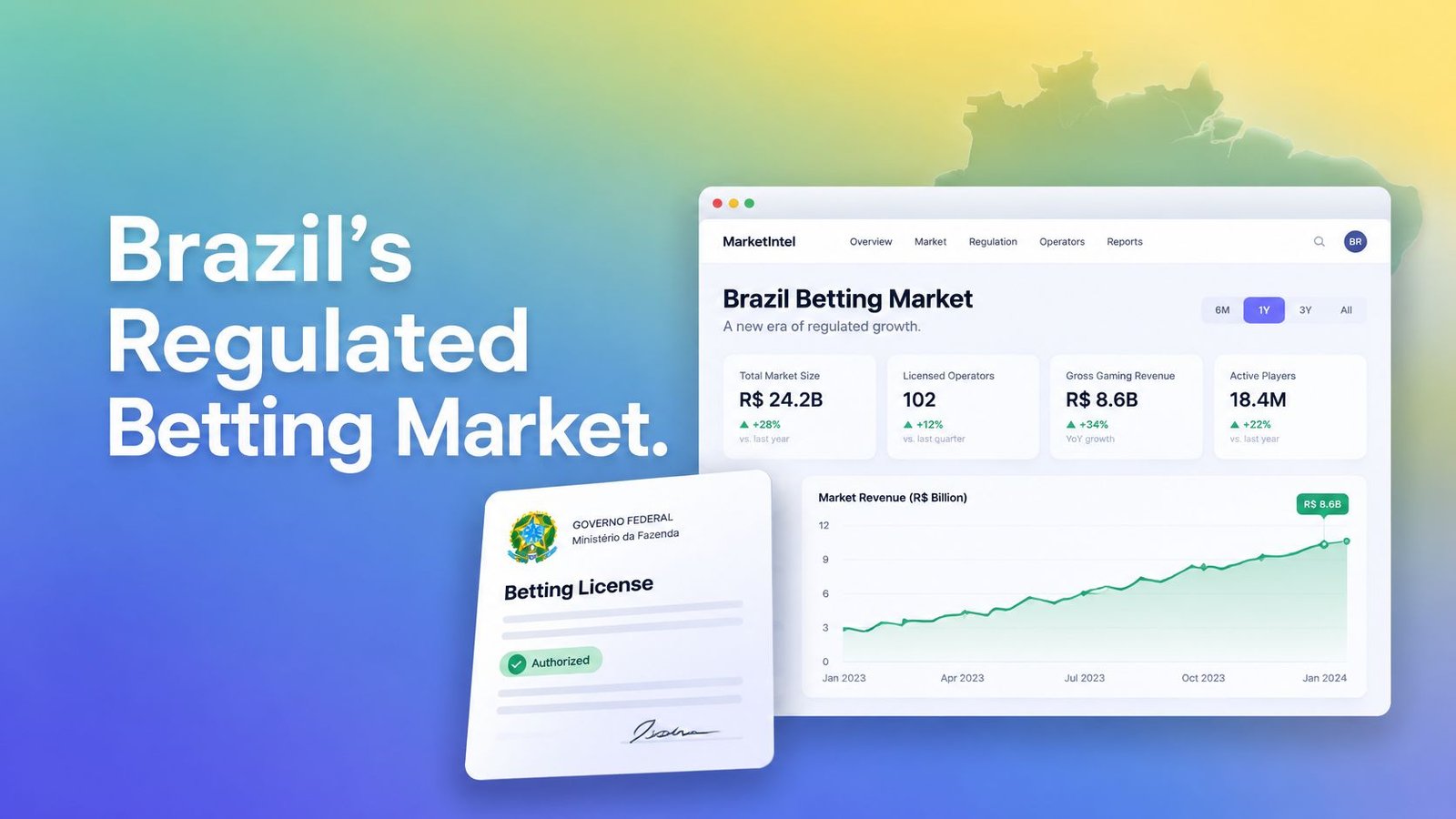
7. Brazil's Regulated Betting Market Under Law 14.790/2023
Brazil's fixed-odds and online casino market did not drift into regulation. Law 14.790/2023 created the framework, and the regulated market took effect on 1 January 2025. The Secretariat of Prizes and Bets (SPA), inside the Ministry of Finance, handles authorisation and supervision. Operators need authorisation, pay licence fees, and pay a gross gaming revenue tax set at 12% by the statute. That rate is the element of the framework most exposed to revision, so it belongs on the verify list for each reporting cycle rather than in the assumptions column.
Two obligations sit below the statute. In 2024 the government barred credit cards and cryptocurrency for betting deposits, pushing the market onto PIX rails and making payment traceability a licensing condition in practice. The statute itself covers advertising, consumer protection, anti-money laundering, and bans on betting by public officials and sports participants.
Local controls after the licence letter
The card and crypto ban arrived through 2024 implementing rules rather than the statute itself. That is the pattern to plan around: SPA acts at ordinance level after the law, so a compliance pack drafted at authorisation ages quickly. Tax, ads and AML belong on one owner matrix, because the obligations land on payments, marketing and compliance teams at the same time. Confirm with acquirers which payment methods remain permitted, and reconcile PIX flows so an examiner can follow the trail. Portuguese disclosures and local responsible-gambling tools are licence conditions, not localisation extras. Set a dated review of SPA issuances, and check the tax rate against the rule in force before each filing rather than relying on the number written at launch.
8. Ontario's Regulated iGaming Market and Advertising Standards
An operator cleared to take bets in Ontario can still fail an advertising review in the same week its campaign goes live. The Alcohol and Gaming Commission of Ontario sets registration and standards. iGaming Ontario runs the operating framework under which registered operators trade. That split defines the compliance decision: registration with AGCO is the entry ticket, and meeting AGCO's enforced standards is the ongoing obligation. Since the market opened on 4 April 2022, multiple registered operators have competed for legal play rather than a single provincial site holding the channel, which makes Ontario structurally different from most Canadian jurisdictions.
The obligation lands on marketing and compliance teams together. AGCO's standards cover player protection, responsible gambling, data security, and advertising. On advertising, they restrict creative aimed at vulnerable groups and promotions that encourage excessive play. AGCO has taken enforcement action where advertising or player-protection controls failed, and the reach extends to affiliates. Paying a third party to run an ad does not move the breach off the operator's file.
Advertising as a controlled process
Treat AGCO bulletins and standards updates as a dated quarterly task owned by a named person in compliance, not left to whoever happens to read the news. The working checklist needs three columns: creative content, audience targeting, and affiliate activity. Before a national campaign is cut, map the Ontario checklist against the rules in force in each province where the campaign will run, because an execution that passes AGCO review can still breach a different provincial requirement. Teams benchmarking ad rules across regimes can keep PAGCOR gambling advertising rules as a comparison file, though AGCO's own text remains the binding document.
Settled: the 4 April 2022 launch, the split between AGCO's standards role and iGaming Ontario's operating role, and the multi-operator market. Still open: whether the advertising standards tighten further, and how far enforcement reaches into affiliate networks.
Key Regulatory Changes at a Glance
Each row pairs the obligation with the party that carries it and the date that drives the next compliance step. Where a date is not confirmed in the body sections, the table says so.
| Item | Regulator | Key Date | Affected Parties | Status |
|---|---|---|---|---|
| UK Remote Gaming Duty Increase | HM Treasury; HMRC | Announced October 2024; effective 1 April 2026 | UK-facing online gaming operators | Scheduled rate increase from 21% to 40% |
| UK Gambling Commission Stake Limits and Affordability Checks | UK Gambling Commission | £5 online slot stake cap from 9 April 2025; £2 cap for players aged 18–24 from 21 May 2025; deposit-limit rule from 30 June 2026 | UK-licensed remote gaming operators and players | Stake caps in force under licence conditions; deposit-limit requirement still to take effect |
| US State Action Against Sweepstakes Casinos | State gaming regulators and legislatures | Connecticut prohibition enacted in 2025; cease-and-desist actions in California, New York, and Nevada, dates not specified | Sweepstakes casino operators and users | State-by-state restrictions and enforcement; legal position varies |
| Federal-State Dispute Over Sports Event Contracts and Prediction Markets | CFTC and state gaming regulators | Active litigation; no single key date stated | Prediction market operators, sportsbooks, affiliates, and consumers | Unresolved, with conflicting court rulings |
| EU Anti-Money Laundering Regulation and the Creation of AMLA | European Union; AMLA | Applies from July 2027 | Gambling service providers and other covered entities in the EU | Transition period underway |
| Germany's Licensed Online Casino Framework and the GGL | GGL | Framework established under GlüStV 2021 | Operators serving Germany and their players | Licensing and player-protection framework in operation |
| Brazil's Regulated Betting Market Under Law 14.790/2023 | Secretariat of Prizes and Bets, Ministry of Finance | Regulated market effective 1 January 2025 | Betting and online casino operators, bettors, and payment providers | Regulated market in operation |
| Ontario's Regulated iGaming Market and Advertising Standards | AGCO; iGaming Ontario | Market launched 4 April 2022 | Registered operators, affiliates, and players in Ontario | Competitive regulated market in operation |
Prediction-market litigation and sweepstakes enforcement stay in the watch column, off the calendar.
Turning Eight Regulatory Shifts Into a Working Compliance Calendar
A compliance lead opens the next planning cycle with eight jurisdictions, five usable dates, and two files that still move. A Budget rate becomes HMRC mechanics. A stake cap becomes a supplier build, then an assessment file. A state prohibition becomes geo-blocking, contract wording, and evidence retention. The dated changes can be scheduled now; prediction markets and sweepstakes stay undated because courts and states are still setting the perimeter.
Put one calendar in front of finance, product, payments, legal, and affiliate teams:
- Ontario market live since 4 April 2022; Germany's GlüStV 2021 deposit, stake, and spin rules already sit in licence conditions.
- Brazil's regulated market live since 1 January 2025; UK online stake limits already in force on 9 April 2025 and 21 May 2025.
- Remote Gaming Duty from 1 April 2026; deposit-limit labelling from 30 June 2026; EU AMLR application in July 2027.
- Sweepstakes exposure as a rolling state screen, with Connecticut's 2025 prohibition and reported 2025 enforcement showing why there is no single date.
- Sports event contracts as a litigation watch: rulings conflict, appeals remain pending, and launch decisions wait for jurisdiction-level clarity.
Assign one accountable owner per jurisdiction, then name the functions underneath. Finance owns tax and duty timing. Product owns limits, labels, and game builds. Payments owns blocks and partner exits. Affiliate owners carry advertising claims and clawback wording. For open files, the working protection is contractual: termination if legality changes, affiliate clawback, and a payment-partner exit that does not need a new board paper.
Evidence belongs inside the same calendar. The Commission can assess licence conditions remotely and can move from enhanced compliance to settlement, review, or formal action, as its own description of what it regulates makes clear. The gambling-specific case for audit-ready files is in its strategic focus report: more than 9,700 compliance activities in 2024–2025 against more than 4,200 the year before, plus 516 cease-and-desist requests to illegal operators and 352 aimed at advertisers or affiliates.
Build the calendar this month, name the owners, and book the first quarterly review of Commission notices, Brazilian ordinances, GGL circulars, state sweepstakes actions, and event-contract dockets. Teams that want a standing view of licensing, payments, and advertising across markets can follow Top 1 Rank's regulatory desk at instaplayph.com.




Join thousands of gaming professionals receiving the latest iGaming news, regulatory updates, and market insights.
