

The PAGCOR compliance deadlines 2026 framework is not one deadline. It is a staged enforcement sequence that moved from supplier disclosure and early accreditation requirements to a filing gate, an interim operating period, and eventual decommissioning. The most important timing distinction is the 61-day window from May 31 to July 31, 2026, during which eligible providers had to complete accreditation, documentation, probity checks, inspections, system testing, and cash-deposit requirements, as reported in PAGCOR's July compliance timeline.
For operators, Gaming System Administrators, platform suppliers, content providers, payment businesses, resellers, and foreign vendors, the practical issue is continuity of service. A provider's filing date determined whether it could remain in the market during the interim period, while later deadlines determined whether its systems, platforms, games, and equipment could continue operating.
Table of Contents
- Understanding the 2026 PAGCOR Enforcement Structure
- Complete 2026 Compliance Calendar Overview
- March 2026 Compliance Framework and Early Deadlines
- May and July 2026 Accreditation Deadlines
- September 2026 Extension (Scheduled) and Final Decommissioning
- Required Documents and Submission Channels
- Penalties and Financial Consequences for Non-Compliance
- Remediation Steps for Missed Deadlines
- Quick-Reference Compliance Checklist
- Frequently Asked Questions About 2026 Compliance
- Does the September 30 extension apply to every supplier?
- What happens to a supplier that missed May 31?
- What happens to existing distributorship agreements?
- How are foreign content providers affected?
- Is the Php1 million performance cash deposit refundable?
- What proves eligibility for the three-year term?
- What should operators do before a decommissioning date?
Understanding the 2026 PAGCOR Enforcement Structure
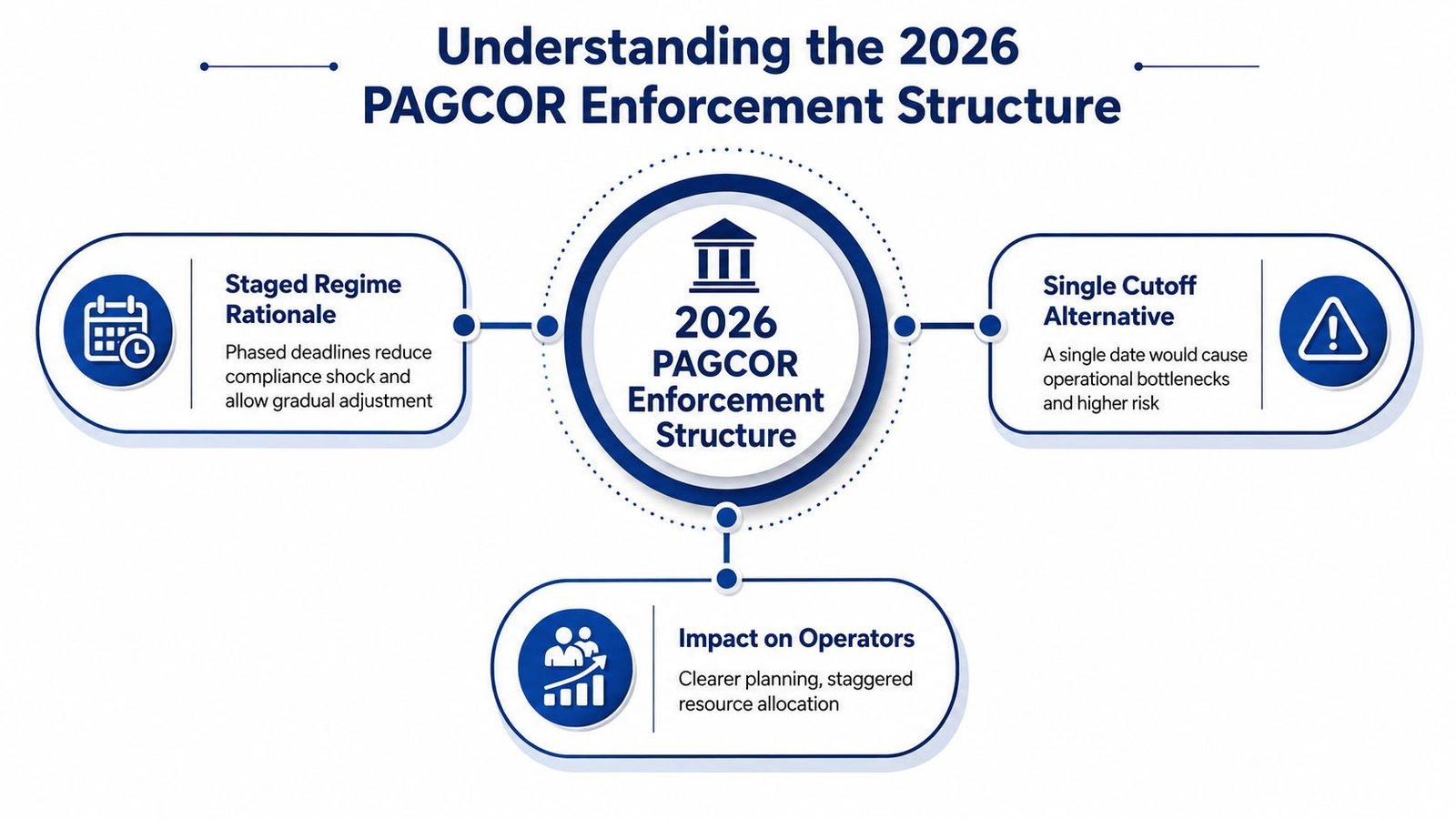
PAGCOR's 2026 approach created a sequence rather than a single compliance event. Gaming System Administrators first had to identify the B2B suppliers supporting their operations. Suppliers then faced earlier accreditation and capital requirements, followed by the May filing window and the later deadline for completing outstanding requirements.
That design matters because each milestone created a different regulatory consequence. A company could be operating during an interim period without having completed every accreditation step, but only if it had filed by the required date. A late filer didn't receive the same protection, and an applicant that remained incomplete after the final applicable deadline faced decommissioning.
Why the staged model matters
The framework affected several layers of the supply chain:
- Gaming System Administrators, which had to submit supplier lists and manage vendor exposure.
- B2B platform and content suppliers, which had to seek accreditation and complete technical and probity requirements.
- Game content providers, which faced the performance cash deposit requirement.
- Resellers, which had separate compliance obligations.
- Foreign content providers, which faced consequences if they remained unaccredited after the applicable cutoff.
- Operators, which had to understand whether their suppliers could legally continue supporting gaming activity.
A single cutoff would have concentrated documentation, inspections, system testing, and regulatory review into one operational bottleneck. The staged structure instead created several control points, allowing PAGCOR to distinguish between companies that engaged with the process and companies that failed to file or complete it. That distinction is central to the Philippine PAGCOR online casino regulatory context.
The strongest analytical conclusion is that PAGCOR treated accreditation as a market-access condition, not merely as an administrative certification. The filing date preserved an interim operating position, but it didn't remove the obligation to finish. In other words, the 2026 model gave compliant participants additional time, not a permanent exemption.
Practical rule: A supplier's status should be assessed across three questions: whether it filed on time, whether it completed the requirements, and whether the relevant deadline was later extended for that specific applicant.
Complete 2026 Compliance Calendar Overview
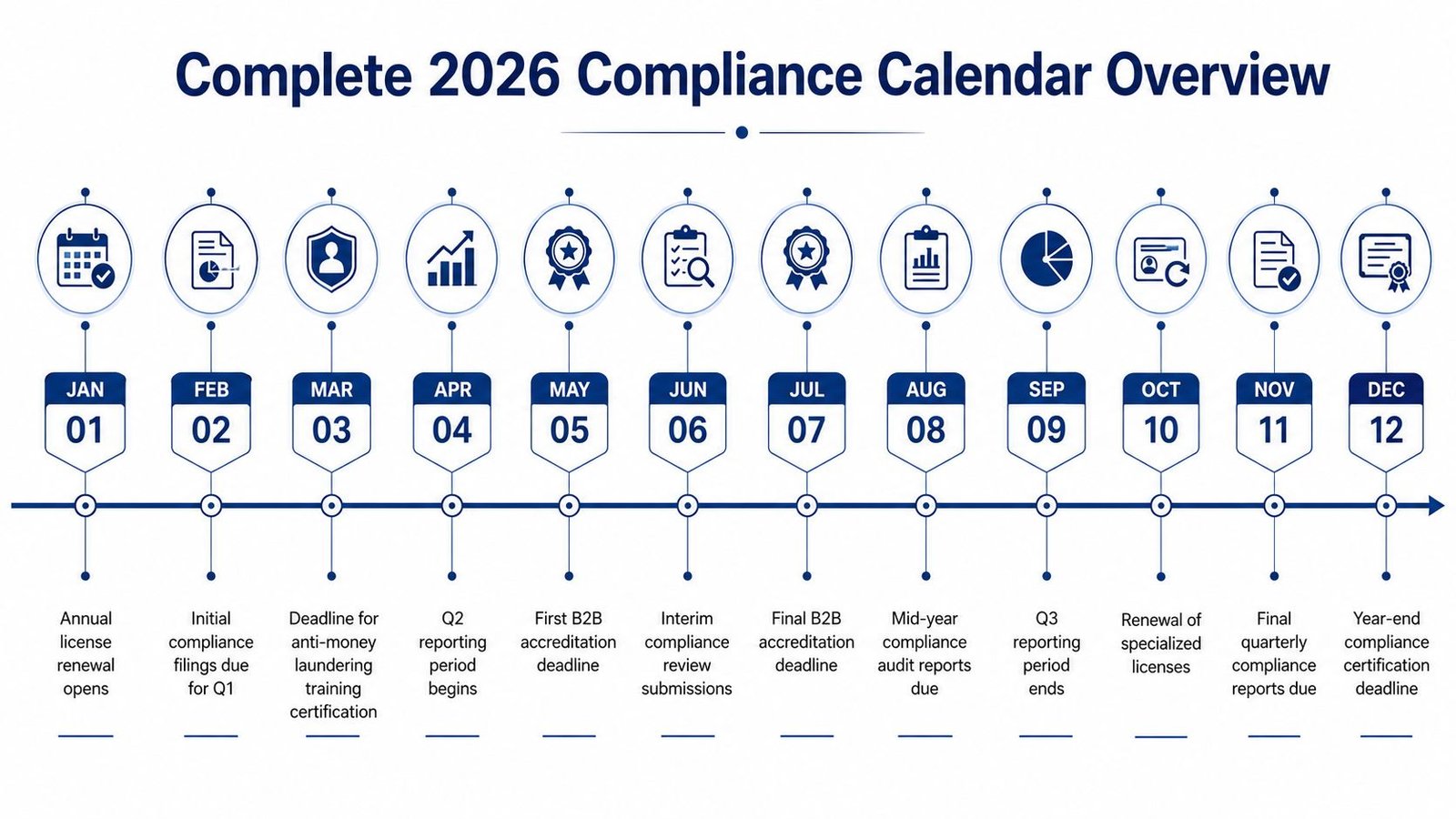
The 2026 calendar uses several control points rather than one universal cutoff. Supplier reporting came first, followed by substantive accreditation and deposit obligations in March. The May filing window preserved interim continuation rights for qualifying applicants, while the scheduled September extension created a final completion period before reported decommissioning activity.
The framework covers supplier lists, B2B accreditation, performance cash deposits, distributorship declarations, and final accreditation. It does not confirm the additional annual licensing, AML training, tax, reporting, or audit dates that appear in generic compliance calendars. Those items require separate regulatory confirmation.
Confirmed and scheduled milestone calendar
| Date | Affected party | Required action | Regulatory significance |
|---|---|---|---|
| December 31, 2025 | Foreign content providers | Submit the relevant application by this date to qualify for the longer initial accreditation term | Eligible applicants qualified for a three-year initial accreditation term rather than the standard two-year term, according to ASGAM's report on the B2B framework |
| February 12, 2026 | Gaming System Administrators and operators | Submit lists of all B2B suppliers | PAGCOR gained visibility over the supplier network before later accreditation enforcement |
| March 31, 2026 | B2B suppliers, game content providers, resellers, and applicable foreign providers | Complete B2B accreditation, pay the Php1 million performance cash deposit where required, satisfy reseller obligations, establish a Philippine live-dealer studio or branch where applicable, and apply for a Permit to Hold gaming equipment and paraphernalia | Unaccredited foreign providers could be treated as non-compliant and unauthorized after the deadline |
| May 31, 2026 | Contracted B2B providers | Submit accreditation applications | Applicants filing by this date received interim continuation rights under the later memorandum |
| June 1, 2026 | Existing B2B contracting parties | Declare all existing distributorship agreements to PAGCOR | Undeclared agreements became void, as outlined in the March regulatory update |
| July 31, 2026 | Covered contracted providers | Complete all accreditation requirements, subject to the later extension for qualifying applicants | The original final completion date preceded decommissioning reported to begin August 1 |
| September 30, 2026 (scheduled) | Suppliers covered by the later extension | Complete accreditation if they had already filed by May 31 | The reported extension moved final completion for that group to this scheduled date |
| October 1, 2026 (scheduled) | Suppliers still incomplete after the extension | Avoid continued operation without completed accreditation | Decommissioning was reported as scheduled to begin for suppliers that still had not completed accreditation |
The sequence links each deadline to the next enforcement stage. February established visibility, March imposed early substantive obligations, May determined eligibility for interim continuation, and the scheduled September extension applied only to a defined group. Compliance teams should retain filing receipts, declarations, payment evidence, and correspondence. A final-date tracker alone cannot show whether an applicant qualified for the available continuation period.
March 2026 Compliance Framework and Early Deadlines
The March framework introduced the first major substantive cutoff for B2B online platform and content suppliers. It also made clear that PAGCOR expected the market to regularize its supply chain before the later July enforcement window.
The process began with visibility. Gaming System Administrators and operators had to submit lists of all B2B suppliers by February 12, 2026. That requirement placed the responsibility on the entities controlling regulated gaming relationships, not only on the suppliers seeking accreditation.
March deadline matrix
| Deadline date | Affected party | Required action | Consequence of non-compliance |
|---|---|---|---|
| December 31, 2025 | Foreign content providers | Submit by the earlier cutoff to qualify for the longer initial accreditation term | Eligible applicants received a three-year initial term instead of the standard two-year term |
| February 12, 2026 | Gaming System Administrators and operators | Submit complete lists of B2B suppliers | The supplier could face later scrutiny without the operator having met its reporting obligation |
| March 31, 2026 | B2B platform and content suppliers | Apply for accreditation and satisfy the applicable framework | Providers that remained unaccredited could be treated as non-compliant and unauthorized |
| March 31, 2026 | Game content providers | Pay the Php1 million performance cash deposit | Failure to satisfy the capital requirement left the provider outside the applicable compliance position |
| March 31, 2026 | Resellers | Complete reseller compliance | The reseller's activity could be treated as non-compliant |
| March 31, 2026 | Applicable foreign content providers | Establish a live-dealer studio or branch office in the Philippines where required and apply for a Permit to Hold gaming equipment and paraphernalia | Failure to complete applicable local-presence and equipment obligations undermined accreditation eligibility |
The December cutoff created an important distinction for foreign content providers. Providers that submitted by December 31, 2025 qualified for a three-year initial accreditation term, while the standard term for other qualifying applicants was two years. That difference made early submission commercially relevant, not merely administratively convenient.
The Php1 million performance cash deposit also shows that PAGCOR linked market access to financial assurance. The requirement was not merely about filing forms. Game content providers had to demonstrate readiness to support their regulated role with a specified capital commitment, while applicable suppliers had to address local-presence, equipment, reseller, and accreditation requirements.
The March deadline therefore functioned as a screening point. A supplier that missed it couldn't assume that the later May filing window would erase the earlier consequence. The later process gave certain contracted providers a route to interim continuation, but it didn't retroactively make every March obligation irrelevant.
May and July 2026 Accreditation Deadlines
The May and July milestones formed a two-stage enforcement test. May 31 was the filing gate, while July 31 was the original completion deadline. A contracted B2B provider needed to meet both dates to retain a compliant operating position under the initial timetable.
Providers that submitted accreditation applications on or before May 31 could continue serving Gaming System Administrators during the interim period, with applications pending until July 31. That continuation was conditional. It did not remove the need to complete documentation, probity checks, inspections, system testing, or cash-deposit obligations. See the detailed PAGCOR B2B accreditation requirements for 2026 before treating an application as operational protection.
How the two-stage test operated
The compliance sequence was:
- Verify the May filing date. A contracted provider that filed by May 31 qualified for interim continuation. Missing the filing gate removed that basis for continued service to Gaming System Administrators.
- List every outstanding requirement. The application itself was insufficient. Accreditation, supporting records, probity checks, inspections, system testing, and cash-deposit requirements still had to be addressed.
- Complete the original July milestone. Under the initial framework, all requirements had to be completed by July 31.
- Test any extension independently. The later September extension applied only to suppliers that had already filed by May 31. It did not reopen the May application window.
The period from May 31 to July 31 covered 61 days, according to the reported PAGCOR deadline structure. That interval required coordination across corporate records, regulatory review, probity checks, inspections, technical testing, and financial assurance. The timetable therefore operated as a staged regularization process, not as a single filing event.
Operational test: The supplier file should contain evidence of both application submission and requirement completion. Either record alone leaves a material compliance gap.
Under the original schedule, failure to complete the process by July 31 triggered decommissioning of electronic gaming systems, platforms, games, and related equipment from August 1. For operators, the exposure included disrupted content availability, platform functionality, integrations, and support for regulated gaming activity.
September 2026 Extension (Scheduled) and Final Decommissioning
The later extension creates a final compliance window for a defined group of B2B suppliers. Suppliers covered by that extension, and that had submitted accreditation applications by May 31, 2026, are scheduled to complete accreditation by September 30, 2026. Decommissioning for covered suppliers that remain incomplete is reported to begin on October 1, 2026, according to the report on the September compliance deadline.
The September date does not reopen the application process. Eligibility depends on the earlier filing condition. A supplier that missed the May 31 submission deadline cannot claim the later extension solely because another provider received additional time.
The eligibility question
Operators and Gaming System Administrators should test three points for each supplier claiming the scheduled extension:
- Application evidence: Did the supplier submit its accreditation application on or before May 31?
- Coverage evidence: Is the supplier included in the group covered by the later extension?
- Completion status: Which requirements remain outstanding, and has PAGCOR accepted the relevant submissions?
Record the result at supplier level. Describing an application as “in process” does not establish eligibility where access to the September window depends on a documented filing date and confirmed coverage.
What decommissioning means
Decommissioning extends beyond suspending a supplier's commercial account. The reported consequences cover electronic gaming systems, platforms, games, and related equipment. Operators should map every supplier to the systems and products it supports, identify suspension or replacement procedures, and check whether player-facing or back-office functions depend on that provider.
The scheduled extension therefore serves as a controlled final remediation period, not an open-ended delay. Operators should obtain formal evidence, track unresolved requirements, and prepare a managed transition before September 30 if accreditation remains incomplete. That approach links supplier-level verification to system continuity and reduces the risk of an abrupt service disruption when decommissioning is scheduled to start.
Required Documents and Submission Channels
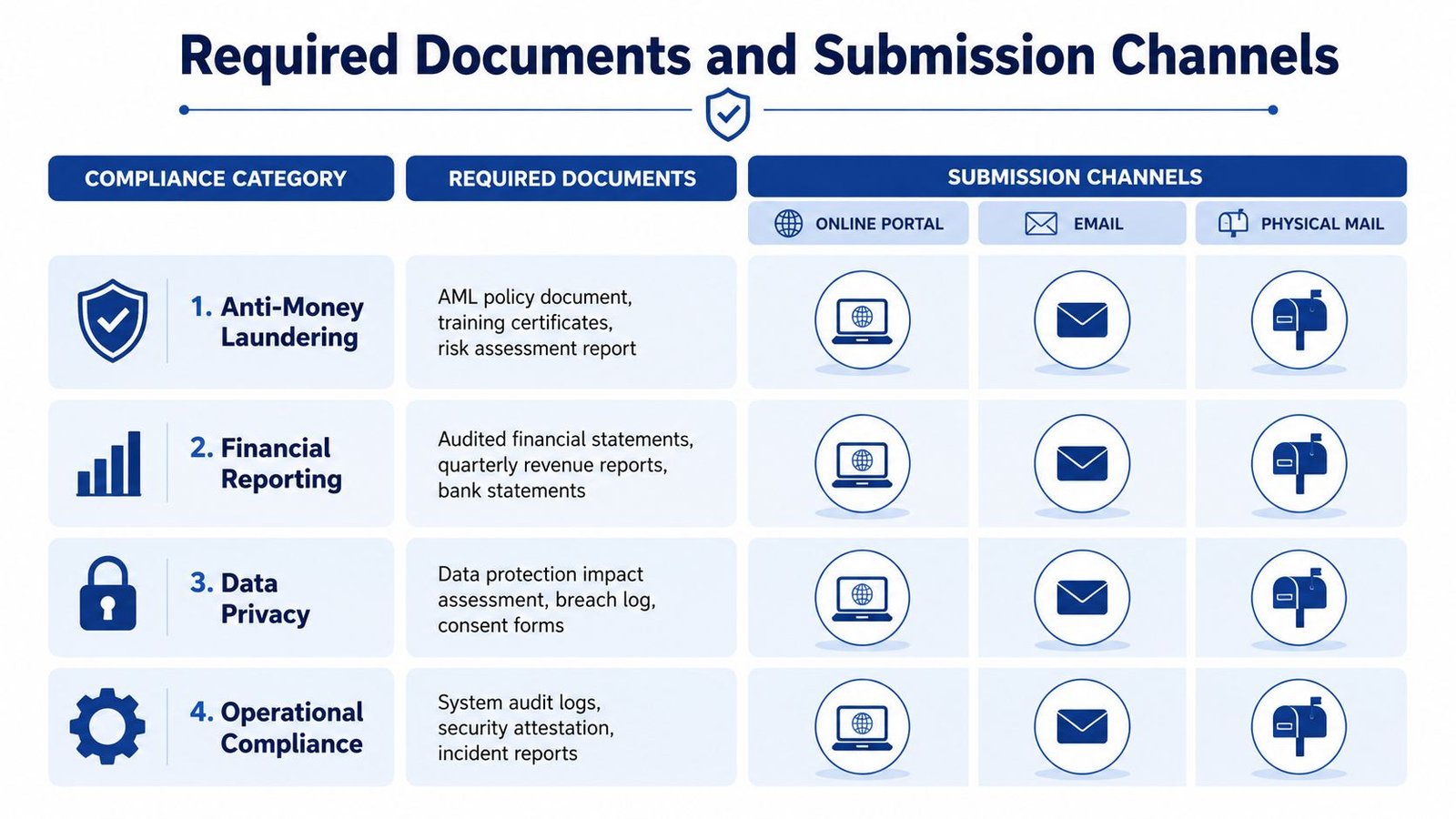
The verified 2026 data identifies several required compliance actions, but it doesn't specify a universal PAGCOR portal, designated email address, document format, notarization rule, certified-translation requirement, or processing timetable for each category. Compliance teams shouldn't invent those details internally or rely on an unverified submission route.
The safer approach is to build a controlled evidence pack around each obligation and confirm the accepted channel directly with PAGCOR or the applicable regulatory contact.
Evidence pack by obligation
| Compliance category | Evidence that should be assembled | Channel control |
|---|---|---|
| Supplier listing | Complete supplier inventory, entity names, service descriptions, and proof of submission by the Gaming System Administrator or operator | Confirm the official PAGCOR filing route before submission |
| B2B accreditation | Application form, corporate information, ownership and probity materials, technical information, and a requirements tracker | Preserve the application receipt and all PAGCOR correspondence |
| Performance cash deposit | Deposit confirmation, payment reference, and internal approval record for the Php1 million requirement applicable to game content providers | Reconcile the payment evidence to the accreditation file |
| Distributorship declaration | Full list of existing distributorship agreements and the declaration submitted by June 1, 2026 | Retain the submitted declaration and confirmation |
| Philippine presence | Evidence of a live-dealer studio or branch office where applicable | Confirm which corporate and premises documents PAGCOR requires |
| Gaming equipment | Permit to Hold application and supporting equipment information where applicable | Track the permit request separately from the accreditation application |
| Technical review | System descriptions, testing records, inspection responses, and remediation evidence | Keep version-controlled copies of materials provided for review |
The PAGCOR payment gateway accreditation resource can help teams frame payment-provider questions, but it shouldn't replace direct confirmation of the regulator's current channel requirements.
Submission discipline
A strong file uses an owner, deadline, status, reviewer, submission date, receipt reference, and follow-up action for every item. Foreign providers should also document their corporate structure, local presence where applicable, and the evidence supporting their accreditation-term position.
The key control is traceability. A supplier should be able to show what it submitted, when it submitted it, which requirement the document addressed, and whether PAGCOR requested further action. That record becomes particularly important when an operator evaluates whether a provider qualifies for interim continuation or the September extension.
Penalties and Financial Consequences for Non-Compliance
PAGCOR's 2026 enforcement model creates exposure beyond a single fee or deposit. Under the earlier compliance framework, game content providers faced a Php1 million performance cash deposit, linking accreditation to financial assurance and the deadlines to continued market access, as reported in the PAGCOR deadline briefing.
The financial and operational consequences depend on the missed milestone:
- Missing February 12: The Gaming System Administrator or operator fails to submit the required supplier list, reducing PAGCOR's visibility over the supply chain.
- Missing March 31: An applicable supplier may remain unaccredited and unauthorized. Game content providers and resellers may also leave separate obligations incomplete.
- Missing May 31: A contracted provider loses the right to continue supplying Gaming System Administrators during the interim period.
- Failing to complete by July 31: Under the original schedule, decommissioning of electronic gaming systems, platforms, games, and related equipment could begin August 1.
- Remaining incomplete after the scheduled September 30, 2026 deadline: For suppliers covered by the later extension, decommissioning is reported to begin October 1, 2026.
- Failing to declare distributorship agreements by June 1: Those agreements became void under the applicable regulatory update.
The calendar therefore operates as a staged enforcement regime. Early listing and filing obligations establish visibility, the March and May milestones test accreditation status, and the July and September dates determine whether continued market access can be maintained.
Affected operators may face content disruption, platform restrictions, technical changes, replacement work, contract disputes, integration costs, and interrupted service. These risks can arise even when the operator has submitted its own materials correctly, because supplier eligibility remains a separate dependency.
The PAGCOR B2B accreditation fees reference can support internal budgeting. Fee planning, however, does not resolve the larger exposure: whether the supplier remains legally and operationally available to support the regulated ecosystem.
Remediation Steps for Missed Deadlines
A missed date should trigger an escalation process, not an assumption that the supplier is automatically beyond recovery. The verified framework doesn't establish a universal late-filing mechanism, so each affected company needs confirmation from PAGCOR rather than relying on informal market practice.
Immediate response sequence
- Freeze unsupported assumptions. The supplier should identify precisely which date was missed, whether an application was filed, and which obligations remain incomplete.
- Create a dated evidence file. The file should include the application status, supplier agreements, payment evidence, technical materials, correspondence, and an explanation of the current gap.
- Contact PAGCOR through a confirmed official channel. The request should ask whether late submission, supplemental filing, correction, or another remediation route is available.
- Separate eligibility from completion. A provider that filed by May 31 may have a different position from one that didn't. The September extension depends on the earlier filing condition.
- Notify affected counterparties. Gaming System Administrators and operators need a factual status report so they can assess service continuity and contingency requirements.
A supplier that missed the February 12 listing obligation should ask the relevant Gaming System Administrator or operator to confirm whether a corrected or supplemental list can be submitted. A provider that missed March 31 should distinguish the accreditation application from the performance cash deposit, reseller obligations, Philippine presence requirements, and Permit to Hold application.
The PAGCOR B2B provider application process guide can support internal process mapping, but regulatory acceptance still needs confirmation from PAGCOR.
Escalation standard: Every remediation request should state the missed deadline, the reason for the gap, the corrective action already completed, and the exact regulatory decision being requested.
For operators, supplier verification should include filing-date evidence and current accreditation status. If a supplier cannot prove that it filed by May 31, the operator shouldn't treat the September extension as available. Before any applicable decommissioning date, the operator should identify replacement providers, preserve operational records, and document the decision to continue, suspend, or transition the relationship.
Quick-Reference Compliance Checklist
Use this checklist as an internal control sheet for operators, Gaming System Administrators, and B2B suppliers. It separates earlier documentation duties, the March cutoff, the May filing condition, and later accreditation milestones. The staged sequence matters: eligibility for the September extension depends on an earlier filing, while the scheduled decommissioning date creates the final operational control point.
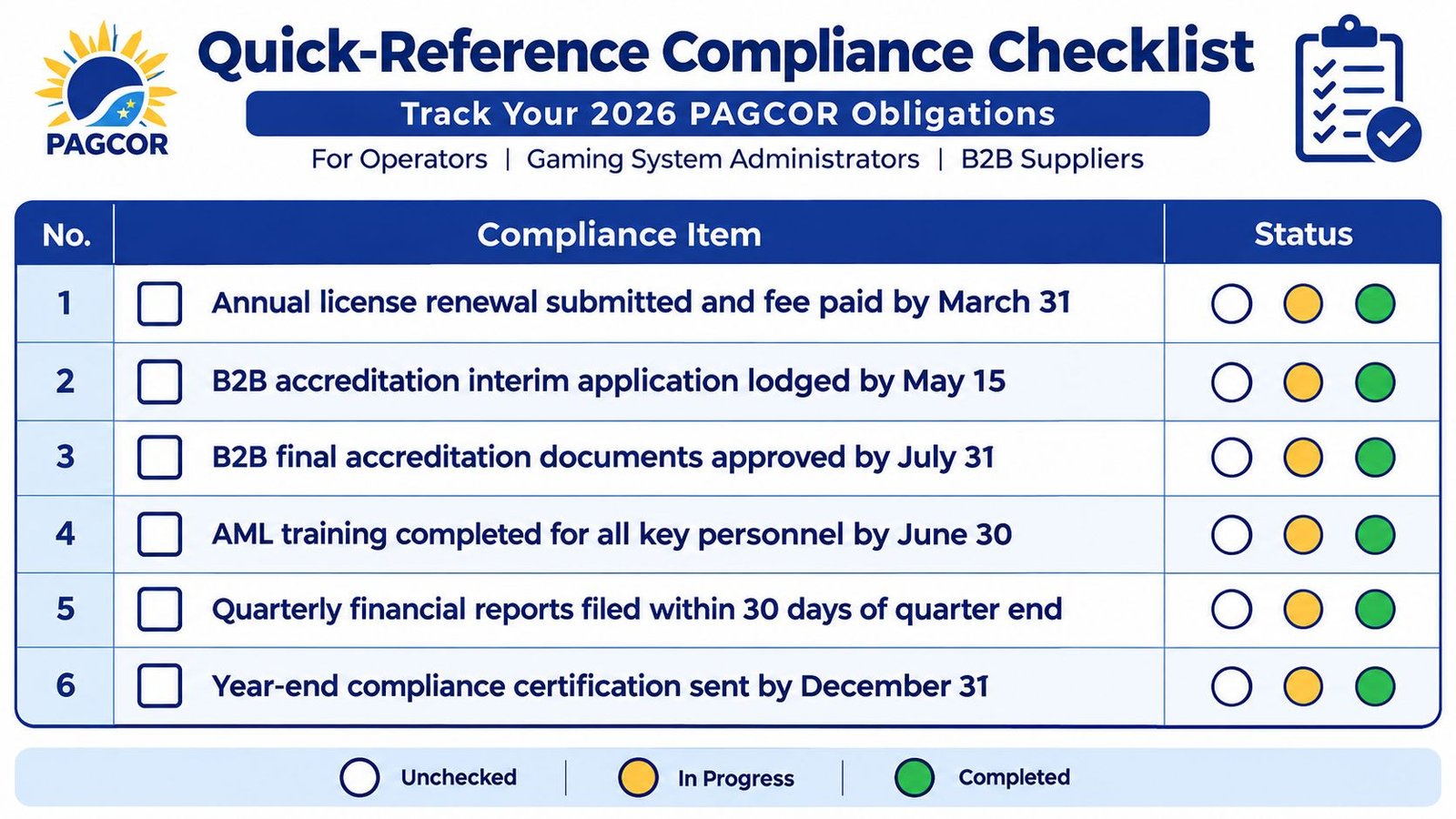
| Done | Deadline | Responsible party | Control action | Evidence and follow-up |
|---|---|---|---|---|
| ☐ | December 31, 2025 | Foreign content provider | Verify whether the earlier submission supports the three-year initial accreditation term | Application receipt and accreditation-term confirmation |
| ☐ | February 12, 2026 | Gaming System Administrator or operator | Submit the complete B2B supplier list | Filed list, receipt, and correction log |
| ☐ | March 31, 2026 | B2B supplier | Submit accreditation materials and complete applicable obligations | Application file and PAGCOR correspondence |
| ☐ | March 31, 2026 | Game content provider | Satisfy the Php1 million performance cash deposit requirement | Payment reference and reconciliation |
| ☐ | May 31, 2026 | Contracted B2B provider | File the accreditation application to preserve interim continuation eligibility | Time-stamped filing proof |
| ☐ | June 1, 2026 | Contracting party | Declare existing distributorship agreements | Declaration receipt and agreement register |
| ☐ | July 31, 2026 | Covered B2B provider | Complete all accreditation requirements under the original timeline | Approval record and closure of outstanding items |
| ☐ | September 30, 2026 (scheduled, if covered by extension) | Supplier covered by the extension | Complete accreditation under the later extended deadline | Extension eligibility proof and final approval |
| ☐ | October 1, 2026 (scheduled start of decommissioning) | Operator and Gaming System Administrator | Confirm that no incomplete supplier remains operational where decommissioning applies | Supplier-status review and contingency record |
The control owner should record the filing status, confirmation receipt, unresolved issue, and assigned next action for every row. A spreadsheet or compliance workflow is sufficient if supporting evidence remains retrievable and each supplier is assessed separately.
The May filing row should be tested before the September row is marked available. The September deadline is therefore a conditional control, not a general replacement for earlier obligations. The October row should trigger a final supplier-status review, including the operational decision and its supporting record where decommissioning applies.
Frequently Asked Questions About 2026 Compliance
Does the September 30 extension apply to every supplier?
No. The reported extension applies to suppliers that had already filed accreditation applications by May 31, 2026. A company that missed that filing date shouldn't assume it receives the same protection.
What happens to a supplier that missed May 31?
A contracted provider that missed the filing date lost the right to continue providing services to Gaming System Administrators during the interim period. The supplier should seek direct confirmation from PAGCOR about any available remediation route and notify affected counterparties.
What happens to existing distributorship agreements?
Existing distributorship agreements had to be declared to PAGCOR by June 1, 2026. Undeclared agreements were void under the March regulatory update cited earlier.
How are foreign content providers affected?
Foreign content providers faced the March accreditation framework and could be treated as non-compliant and unauthorized if they remained unaccredited after the applicable deadline. Providers that submitted by December 31, 2025 qualified for a three-year initial accreditation term instead of the standard two-year term.
Is the Php1 million performance cash deposit refundable?
The verified data confirms the requirement, but it doesn't establish refund terms. Affected game content providers should obtain the applicable deposit conditions directly from PAGCOR and retain the written response with the accreditation file.
What proves eligibility for the three-year term?
The decisive evidence is the provider's time-stamped submission by December 31, 2025, together with PAGCOR's treatment of that application under the applicable framework. Internal records should include the filing confirmation and any regulatory correspondence.
What should operators do before a decommissioning date?
Operators should verify each supplier's filing date, extension eligibility, outstanding requirements, and final accreditation status. Where a supplier remains incomplete, the operator should document a transition or suspension plan before the applicable decommissioning date.
PAGCOR's 2026 framework should be managed as a chain of linked controls, not as a single calendar reminder. Operators and suppliers should review every filing receipt, declaration, deposit record, accreditation requirement, and extension claim now, then escalate unresolved gaps directly to PAGCOR. For continuing regulatory analysis, deadline tracking, and global iGaming intelligence, follow Top 1 Rank at instaplayph.com.




Join thousands of gaming professionals receiving the latest iGaming news, regulatory updates, and market insights.
