

A lot of game aggregators are in the same position right now, with Philippine operators waiting for a clear answer on whether suppliers can keep servicing licensed platforms without creating compliance risk. The practical problem isn't the headline rule alone, it's the operational burden behind it, the corporate files, the inspection cycle, the cash deposit, and the timing pressure that can stall a clean application at the last step.
PAGCOR's game aggregator accreditation requirements now sit at the center of that squeeze. For B2B providers, this is no longer a light registration exercise, it's a formal accreditation regime that can decide whether a supplier stays live in the market, passes operator due diligence, or gets pushed into a long remediation loop.
Table of Contents
- Understanding the New PAGCOR B2B Accreditation Framework
- Corporate Eligibility and Required Documentation
- Financial Obligations and the Performance Cash Deposit
- Technical Standards and System Testing Procedures
- Compliance Requirements for AML and Responsible Gambling
- Application Timeline and Common Rejection Reasons
- Your Accreditation Action Plan and Next Steps
Understanding the New PAGCOR B2B Accreditation Framework
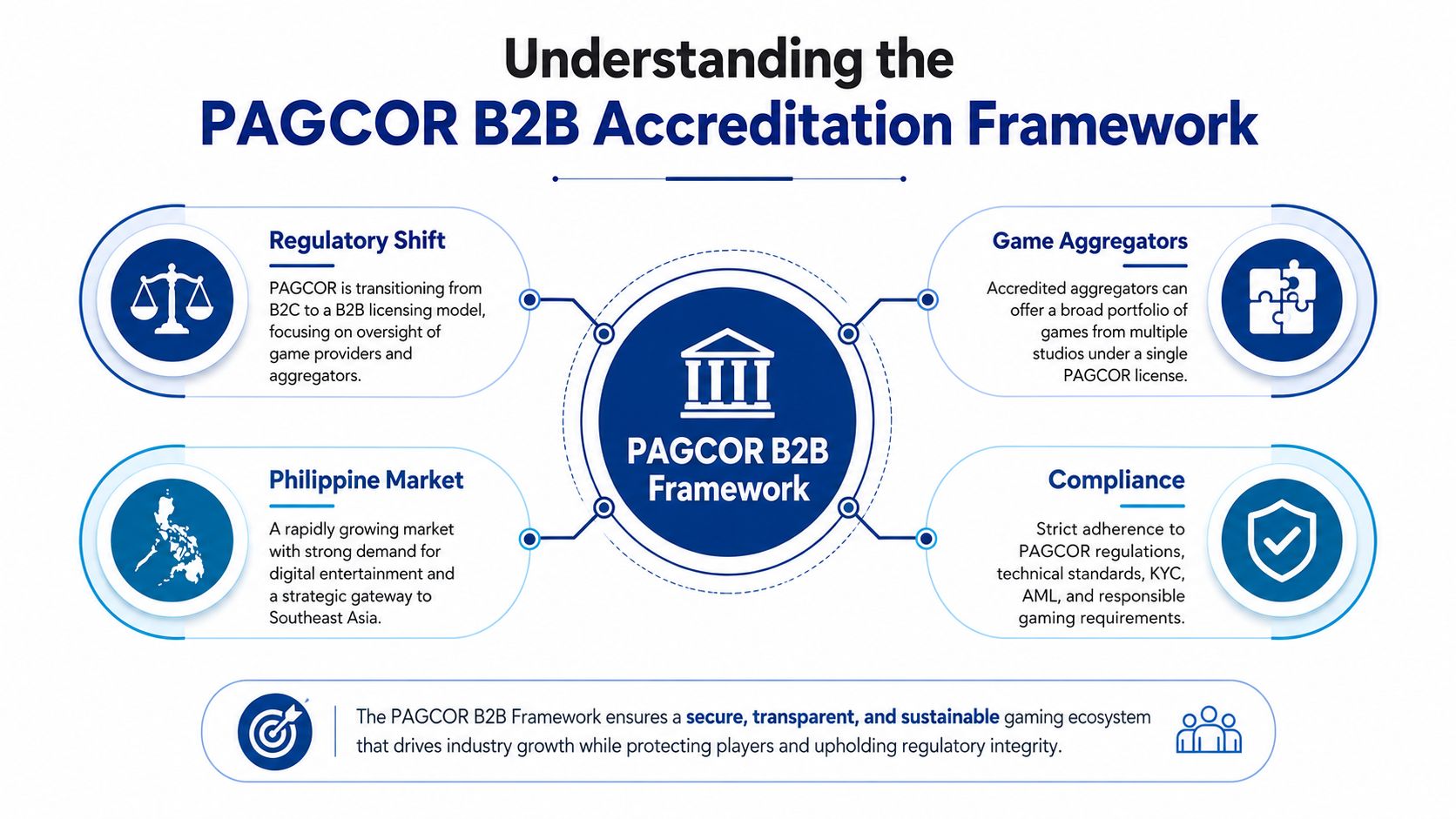
PAGCOR's current framework marks a real regulatory shift because it moves the Philippines away from lighter-touch supplier registration and toward a more formalized B2B licensing model. The regime is mandatory for game aggregators and other support providers serving PAGCOR-licensed operators, and it also covers game content providers, payment gateways, marketing or promotional services, independent game testing laboratories, and other third-party suppliers. That broader scope matters because it captures the full supply chain, not just the studio that makes the game or the operator that sells it PAGCOR B2B framework summary.
The practical consequence is direct. If a platform touches content distribution, payments, testing, promotion, or technical support, PAGCOR expects the provider behind it to sit inside the accreditation net. For operators, that changes vendor selection, contract drafting, and onboarding because every unaccredited supplier can delay launch or force a commercial reset. It also changes how the Philippine opportunity is evaluated at the supply-chain level, which is why a closer look at the local market context, such as the Philippine online casino market overview, becomes part of the compliance conversation rather than a separate commercial exercise.
Why the scope widened
The regulator's wider lens works as a supply-chain control measure. By covering aggregators and adjacent service providers, PAGCOR can assess who is moving content, who is facilitating transactions, and who has operational access to licensed gaming activity. That lets the regulator manage risk across the ecosystem instead of only policing the endpoint operator.
Practical rule: if a supplier can affect player access, transaction flow, or content integrity, expect the accreditation question to come up early.
The rollout also shows that PAGCOR wants governance consistency, not one-off approvals. A company cannot treat the Philippine market as a simple distribution territory anymore. It needs a documented compliance posture, a live technical setup, and a corporate structure that can survive probity screening and ongoing supervision.
For aggregators, commercial readiness has to line up with regulatory readiness. A deal with a local operator may look straightforward on paper, but the gate is whether the supplier can prove it belongs inside PAGCOR's supervised B2B environment.
Corporate Eligibility and Required Documentation
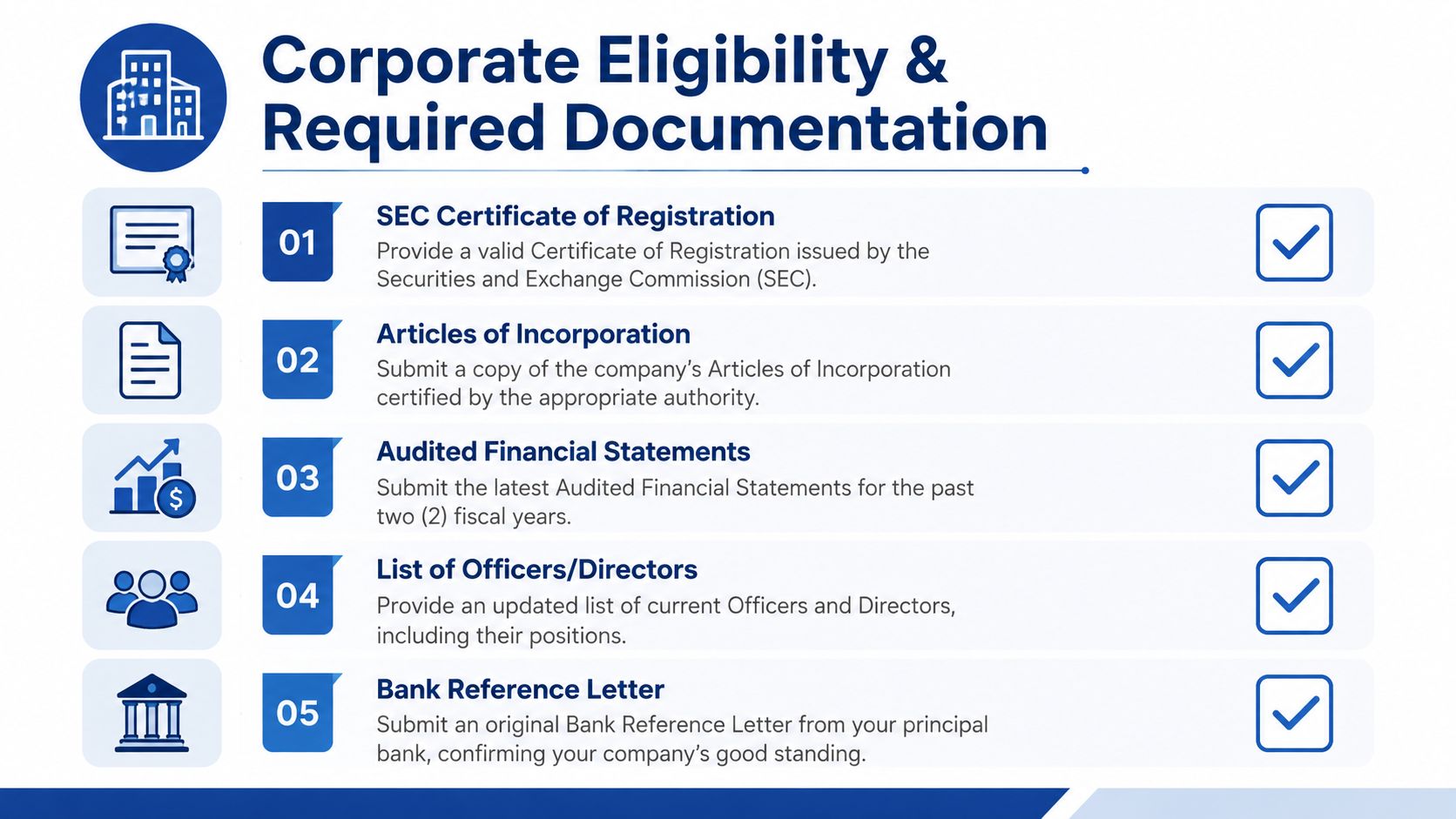
Only corporations duly registered with the Securities and Exchange Commission (SEC) may apply for accreditation, so the first filter is corporate form, not product quality PAGCOR document requirements. That sounds basic, but it's where many applications slow down, especially when a foreign-owned supplier is still deciding whether it has a Philippine entity in place, or whether the local company is properly aligned with the activities being accredited.
PAGCOR requires the company profile, Articles of Incorporation, By-Laws, latest General Information Sheet, and proof of business registration before it processes the application PAGCOR document requirements. Those are not box-ticking attachments. They are the regulator's first test of whether the applicant exists as a stable corporate vehicle with clear ownership and authority to operate.
Where applications usually go wrong
The most common failure point is inconsistency across documents. Names, addresses, corporate purposes, officer listings, and dates need to match cleanly across the submission pack. When they don't, the examiner has to ask whether the discrepancy is clerical or substantive, and that usually means delay.
A second issue is incomplete corporate authority. Companies often submit the right documents, but in the wrong state of readiness, for example, outdated filings, unsigned versions, or annexes that don't reflect the current board and shareholding structure. Those errors matter because PAGCOR's review is not only administrative, it is also probity-driven.
A clean file is faster than a persuasive explanation. If the company profile and SEC documents don't line up, the application already has a credibility problem.
Practical document discipline
The file should be assembled as if an examiner will cross-check every page against the next one. The Articles of Incorporation should support the company's actual business line. The latest General Information Sheet should reflect the current officers and ownership picture. Proof of business registration should be traceable without guesswork.
For operators and suppliers that already use structured onboarding, this stage feels familiar. The difference is that PAGCOR isn't just asking whether the company is real. It's asking whether the company can be trusted as a regulated intermediary in a gaming supply chain.
A useful internal comparator for teams is a standard vendor-onboarding package used for regulated markets, but Philippine applications need tighter document control. For a practical local reference point, some teams also keep an operational checklist aligned with their wider launch workflow, such as the one used in the registration process guide for Go Perya, then adapt it to the stricter B2B file format that PAGCOR expects.
Financial Obligations and the Performance Cash Deposit
A PAGCOR application can fail on cash planning long before it reaches technical review. The financial profile of PAGCOR game aggregator accreditation requirements is unusually sharp because it combines an application-stage process with a fixed PHP 1,000,000 Performance Cash Deposit (PCD) per accredited provider, as outlined in the Chambers overview of PAGCOR's regime. That deposit has to be posted before operations begin, so it is not a post-approval convenience. It sits inside the operational entry cost, and treasury teams need to account for it from the start.
The deposit structure also changes with the applicant's role. For a game content provider, the PCD applies per game offering. For a support service provider, it applies per service category. That difference matters for aggregators that bundle several studios or several support functions under one commercial relationship, because the regulatory exposure can grow faster than the commercial model suggests.
Financial planning that works
A workable approach is to separate the accreditation budget into three layers. First comes the application cost. Second comes the deposit requirement. Third comes internal readiness spend, which usually covers legal review, documentation cleanup, and technical preparation. Teams that fold those items into one vague compliance budget usually miss the true cash drag.
Rule of thumb for treasury teams: the deposit should be treated as a locked regulatory commitment, not as a commercial buffer.
That point matters even more when a supplier is active across multiple categories. A company that sees itself as one aggregator may find that PAGCOR treats separate service lines as distinct regulatory footprints. The financial model needs to reflect that before the application is filed, not after the regulator asks for more detail.
The standard accreditation term is two years, counted from Board approval. That longer cycle helps planning, but it also means the deposit and compliance controls have to stay in place for the full operating period. For teams that manage renewal risk tightly, the issue is not the length of the term. It is the cost of keeping a live regulated status for that entire period.
| Requirement | Game Content Provider | Support Service Provider | Game Aggregator |
|---|---|---|---|
| Application process | Non-refundable application fee applies before review | Non-refundable application fee applies before review | Non-refundable application fee applies before review |
| Performance Cash Deposit | PHP 1,000,000 per game offering | PHP 1,000,000 per service category | Structured according to the services and game content the aggregator distributes |
| Start of operations | Deposit posted before operations begin | Deposit posted before operations begin | Deposit posted before operations begin |
| Validity period | Two years from Board approval | Two years from Board approval | Two years from Board approval |
Source note. The requirement summary above reflects PAGCOR's published regime, with the deposit and timing expectations discussed in the Chambers overview of PAGCOR's regime.
For budgeting teams, one other reference point helps frame internal stakeholder discussions. The same commercial launch review often sits beside customer acquisition planning, and that is where payment timing, vendor selection, and launch sequencing can collide. A useful adjacent benchmark is user acquisition cost planning, because accreditation spend has to be aligned with launch economics, not handled as a separate legal bill.
Technical Standards and System Testing Procedures
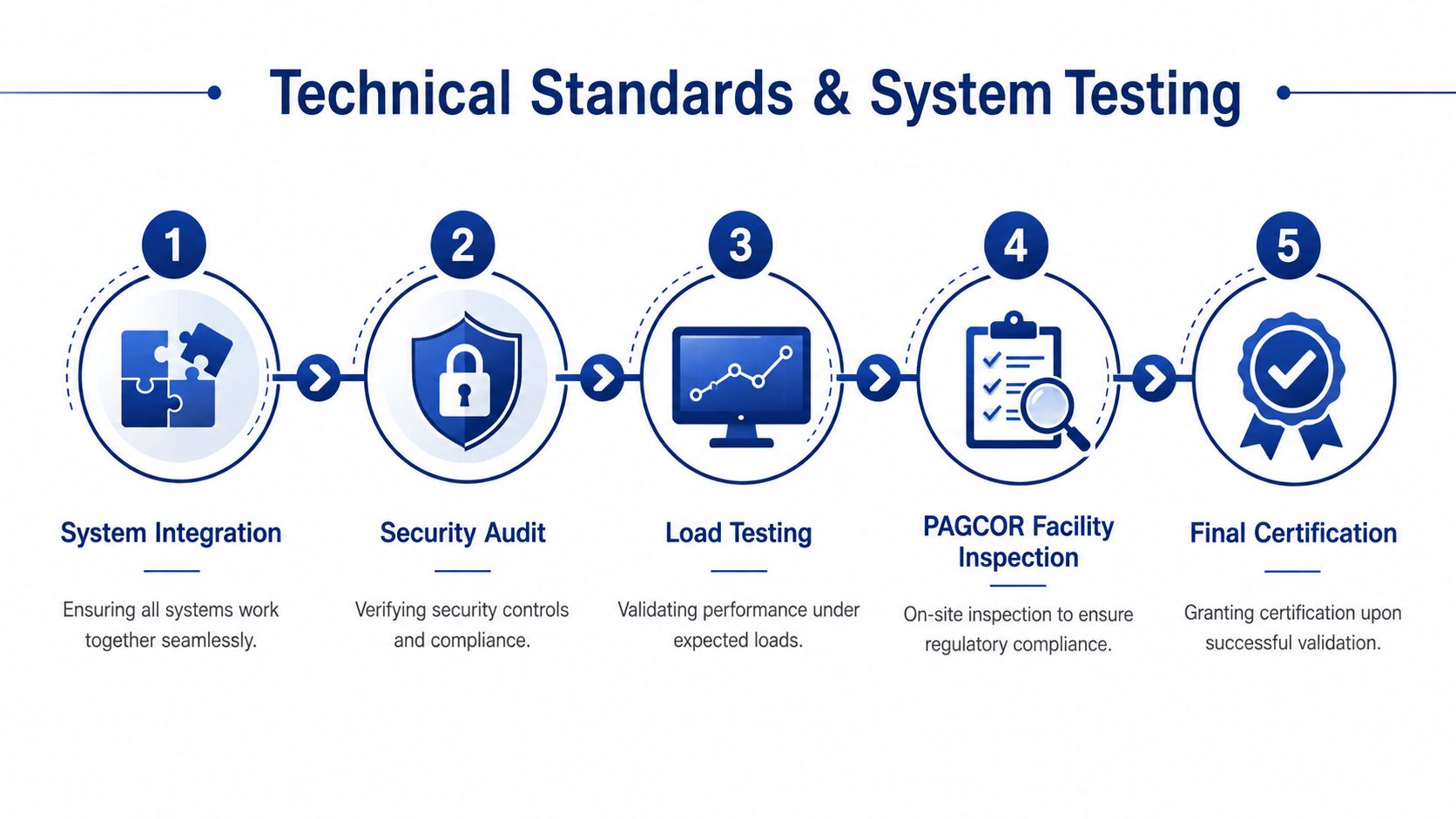
A team can have clean corporate documents and still stall here. PAGCOR will still expect facility inspection and system testing, and this is usually where delays surface because the live setup does not match the paper file, or the technical team cannot explain the evidence trail under pressure. The review is practical. It checks whether the aggregator can deliver regulated games, preserve integrity, and keep operations controlled once the system is live.
What PAGCOR is checking
The regulator wants the live environment to line up with the application file. Integration pathways, access controls, logging, and operational discipline all have to tell the same story. If the technical narrative says one thing and the platform behaves another way in inspection, the review slows down immediately.
Independent game testing laboratories now sit within the wider set of regulated categories, which shows how seriously PAGCOR treats technical verification PAGCOR coverage of regulated categories. For an aggregator, the lab report cannot live in isolation. It has to support the accreditation file, the system diagram, and the operational procedures the team will use on day one.
That connection becomes visible during integration testing. If a partner reviews a PH 777 casino app download workflow or any similar content path, the test records should show which build was checked, which endpoint was used, and who approved the release. Examiners do not want a marketing summary. They want a chain of proof that connects the provider, the aggregator, and the licensed operator environment.
What usually causes delay
Traceability gaps cause the most trouble. If game ID X moves from provider to aggregator without a logged hash, examiners cannot verify content integrity, and the file starts to look unreliable. The same problem appears when version control is weak, when checksum records are missing, or when the operator cannot show exactly when a game build changed.
Another common issue is incomplete operational readiness. Accreditation does not turn on a technical deck alone. The staff on the ground need to know who handles incident escalation, who signs off on content changes, and where the evidence trail sits during testing. Without that structure, the exercise becomes reactive instead of controlled, and reviewers notice the difference quickly.
Practical insight: the fastest applicants rehearse the inspection before PAGCOR arrives. They know where the logs are stored, who opens the facility, which engineer answers technical questions, and which file proves the current build is the approved one.
Teams that already work with testing vendors or maintain compliance dashboards still need to sequence the work properly. Internal integration review comes first, then the independent testing evidence, then the facility walkthrough that confirms the live setup matches the submission. If those pieces are out of sync, the regulator ends up checking the company's own confusion instead of verifying a ready system.
Technical readiness is a control issue, not a branding issue. In the Philippine market, it is part of the proof that the supplier can operate inside the regulated gaming stack without creating avoidable risk.
Compliance Requirements for AML and Responsible Gambling
A filing can look clean and still fail the operating review. PAGCOR's expectations continue after approval, so AML controls, player protection, and ongoing reporting have to remain active throughout the accreditation period. Suppliers often miss that point because they focus on the entry package and underinvest in post-approval governance.
The operating logic is plain. Aggregators sit between content distribution and, in many cases, payment-adjacent activity, so they need monitoring that can flag unusual behaviour and support compliance review. The framework also pushes responsibility upstream, since the games a supplier distributes should not come from studios that cannot meet baseline compliance expectations.
What a compliant operating model needs
A workable AML setup should support transaction monitoring, alert escalation, audit trails, and suspicious activity review. It does not need to look complex on paper. It needs to be usable, documented, and aligned with the risk profile of the business. PAGCOR's broader direction shows tighter oversight of supplier governance, payment ecosystems, and third-party due diligence industry background on PAGCOR's compliance direction.
Responsible gambling controls need the same level of discipline. If an aggregator's platform or distribution layer affects player access, it should also be able to support the operator's protection tools and policy enforcement. That does not make the aggregator the operator's compliance owner. It means the aggregator cannot create a weaker control point in the chain.
The compliance record also has to stay current. Ongoing reporting, issue escalation, and documentation retention matter because PAGCOR can reassess whether the provider still deserves accredited status if controls deteriorate. That concern becomes sharper when the supplier serves multiple operators or distributes content from several studios.
For teams comparing tooling, the market now has enough RegTech options to automate screening and monitoring workflows without forcing compliance staff into manual checks. For a legal context on the wider market, see online casino legality in the Philippines. A practical content and intelligence resource used by industry teams is Top 1 Rank's iGaming compliance coverage, which can help teams track how regulatory expectations are changing across the sector.
Accreditation is easier to lose than to win when ongoing controls are treated like paperwork instead of operations.
Application Timeline and Common Rejection Reasons
A late filing can turn a clean application into a stalled one. For existing B2B providers, PAGCOR's transition memo and the related deadline notice set the compliance clock around July 31, 2026, after a memorandum dated May 21, 2026 fixed that date as the final point for completing accreditation Casino.com deadline report. By that point, providers were expected to have the application fee, documentary and probity checks, facility inspection, system testing, and the performance cash deposit in place Casino.com deadline report.
The commercial impact is straightforward. A missing corporate document delays the review file. A delay in the performance cash deposit slows the approval path. A weak response in probity review sends the package back for correction before the file is ready for final evaluation.
The grandfathering window
Early applicants had one practical advantage. Applications submitted to the Electronic Gaming Licensing Department on or before 31 December 2025 could qualify for a first accreditation valid for three years, which differs from the standard two-year term PAGCOR transition memorandum. For providers weighing the filing schedule, that changes more than timing. It changes the value of the first accreditation cycle and the pressure on the internal filing team.
Common rejection triggers and fixes
- Probity check failure due to undisclosed beneficial ownership. Fix by aligning the ownership chart, supporting declarations, and corporate records before submission.
- Corporate inconsistency. Fix by reconciling the company profile, SEC filings, and current officers before filing.
- Incomplete probity pack. Fix by checking shareholder and director disclosures against the latest corporate records.
- Weak technical evidence. Fix by running a pre-review of integration, logging, and system test artifacts.
- Deposit not ready. Fix by ring-fencing the cash before filing, not after the request arrives.
- Late filing. Fix by building backward from the deadline and leaving room for follow-up questions.
The teams that clear the process fastest usually treat accreditation as an operational workstream, not a one-time legal filing. That matters because each missing item creates another review loop, and each loop consumes time the business cannot recover later.
Your Accreditation Action Plan and Next Steps
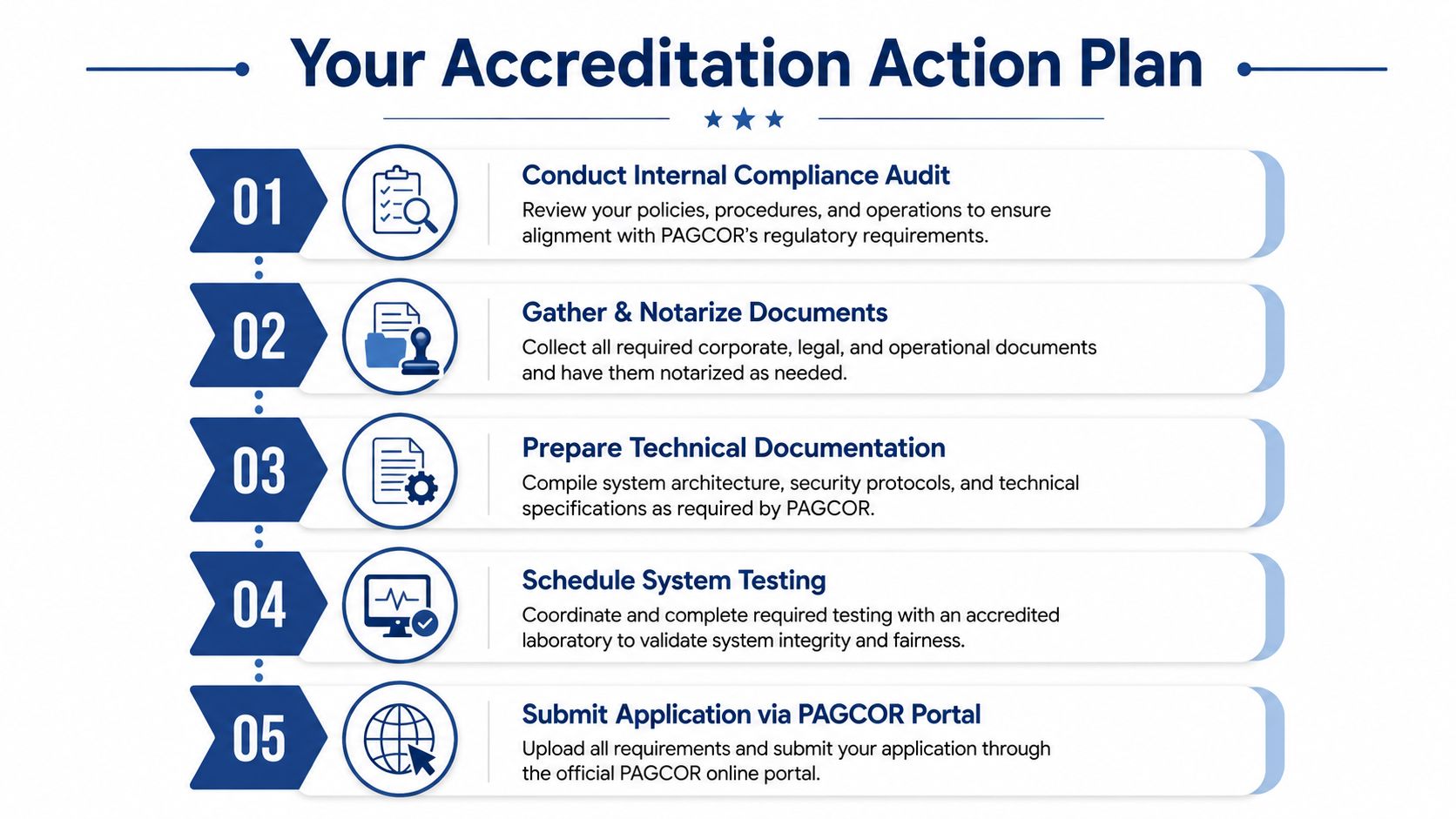
The cleanest way to handle PAGCOR game aggregator accreditation requirements is to build the filing in the same order PAGCOR will inspect it. Start with the corporate entity, then secure the financial commitment, then prove the technical stack, and only then send the application into review. That sequence reduces the common failure point where a technically credible submission gets held up by weak corporate records or a deposit that is not ready when PAGCOR asks for it.
A practical preparation sequence
Conduct an internal compliance audit. Map the legal entity, product scope, operator relationships, ownership structure, and filing authority before any paperwork is submitted. This is the point where teams usually discover that the commercial structure does not match the regulatory story, or that the person signing the file cannot support the declarations in it.
Gather and notarize documents. Collect the SEC registration materials, Articles of Incorporation, By-Laws, latest General Information Sheet, and proof of business registration. Check every name, date, purpose statement, and officer detail against the current corporate record, because PAGCOR will notice gaps that look small on paper but point to a weak control environment.
Prepare technical documentation. Assemble architecture notes, access controls, testing evidence, and operating procedures. Keep the narrative aligned with what the live environment does, and make sure the evidence is consistent across the production stack, the test environment, and the internal control documents.
Assign owners before the file moves. Legal should own corporate accuracy, finance should confirm the deposit position, operations should coordinate the business narrative, and the technical lead should control system evidence and testing readiness. A simple ownership matrix prevents the usual stall point, where everyone assumes someone else has checked the last version.
Set the filing window and review gate. Build the submission calendar backward from the internal target date, leave time for follow-up questions, and hold the application until the deposit, documents, and technical pack can survive scrutiny together. If the file is pushed early, it usually creates avoidable clarification rounds.
For aggregators with multiple jurisdictions or parallel launch plans, the main risk is resource dilution. Accreditation work pulls legal, finance, operations, and technical teams at the same time, and the delay often starts when one of those functions is treated as a side task instead of a managed workstream.
Best practice: keep one internal owner responsible for deadline tracking, document version control, regulator follow-up, and issue escalation. Missing ownership is usually the hidden reason solid applications stall.
A sample internal timeline helps keep the work moving. In week one, the team can finish the compliance audit and lock the entity chart. In week two, legal and finance can reconcile the corporate records and confirm the cash deposit position. In week three, the technical lead can complete the evidence pack and the testing coordinator can book the review window. In week four, the filing owner can run one last consistency check and submit only when every attachment matches the same corporate profile.
The grandfathering window deserves a serious look for any provider that can file early, because the first accreditation term may be longer under the transition rules. For teams still building the Philippine rollout, that can change the economics of the first cycle and justify pulling the submission forward instead of waiting for a more comfortable internal calendar.
PAGCOR's regime is demanding, but it is predictable if the process is run properly. Start with the entity, clean the paperwork, secure the deposit, rehearse the testing, and file with enough margin to answer follow-up questions. For operators and suppliers preparing now, the next move is to turn the checklist into a live project plan and assign internal owners before the compliance window tightens further.



Join thousands of gaming professionals receiving the latest iGaming news, regulatory updates, and market insights.
