


A University of Bristol study, published through UK advertising-regulator research, found that only 25% of organic sports-betting advertisements on social media carried the safer-gambling messages and helplines that industry codes require, even though paid advertisements met the same requirements. The finding matters because it shows where a paid-media ban can redirect promotion rather than remove it.
For operators and affiliates, that gap points to a central issue in sports betting regulation: compliance risk can sit outside the media an operator buys and controls directly. Accountable oversight has to reach influencer posts, affiliate content and other organic channels, not just purchased ad inventory.
Rules also diverge sharply by jurisdiction. One market may permit licensed online wagering while prohibiting in-play bets; another may cover remote sportsbooks, esports and live betting under a national operating licence. Those differences shape market entry, product design, marketing oversight and the evidence a business must be ready to show a regulator.
Table of Contents
- Sports Betting Regulation Models Compared Worldwide
- Recent Legal Developments and Tax Divergence in the United States
- Licence Scope and Core Operator Obligations
- Integrity Monitoring and Suspicious-Activity Escalation
- Enforcement Tools and Penalties Operators Face
- Advertising Rules and the Organic Content Gap
- Whether Advertising Restrictions Reduce Betting Harm
- Map Accountability and Market Entry Checks
Sports Betting Regulation Models Compared Worldwide
Within roughly a year of the U.S. Supreme Court's decision in Murphy v. NCAA, seven additional states had launched full-scale sportsbooks and collectively handled nearly $8 billion in wagers, according to ESPN's review of the first year after the ruling. Markets can open fast once a legal barrier falls. The rulebook governing them still forms locally.
On May 14, 2018, the Supreme Court invalidated the Professional and Amateur Sports Protection Act (PASPA), which had generally prevented states other than Nevada from authorizing sports wagering. Authority returned to individual state governments, each now setting its own rules on market access, mobile betting, licensing, tax, advertising and integrity requirements. Most states now accept sports wagers, while a smaller group has legalized betting without yet launching a market.
A model is defined by who may offer bets, which products are allowed and who sets the commercial rules. Australia illustrates a product-specific approach: its Interactive Gambling Act 2001 permits licensed online wagering but prohibits online in-play sports betting, online casino-style table games and online gaming-machine products. Great Britain runs a national licensing framework covering remote betting, in-play markets and esports under one operating licence. The same product, in-play betting, sits inside the licence in one model and outside it in the other.
| Model | How it works | Example jurisdictions | Main trade-off |
|---|---|---|---|
| Open licensing with product bans | Licensed operators may take sports bets, but specified products are barred online. | Australia under the Interactive Gambling Act 2001 | Broad market access, with in-play sports betting and online casino-style products prohibited. |
| State-by-state licensing | Each state sets its own licence, tax, product and advertising rules. | United States, where most states now accept sports wagers | Fragmented rules and tax rates across jurisdictions. |
| National licence with statutory classification | One operating licence covers remote sportsbooks, in-play betting and esports. | Great Britain under the Gambling Commission | Wide licence scope with a defined classification of bets. |
| Exclusive state operator | One state-owned or state-licensed operator holds the market. | Norway and Finland | Revenue flows to the state, but competition is limited. |
| Restricted or prohibited | Sports betting is banned or sharply limited. | United Arab Emirates | Unlicensed offshore supply is a recurring enforcement concern. |

The model also decides where accountability for marketing sits. Advertising permissions attach to the licence rather than to a media plan, so an operator's obligations can reach channels beyond the placements it buys directly. A market-entry plan that checks only paid-media rules misses the wider perimeter of what the licence controls.
Licence scope can separate adjacent verticals even under one regulator. In the Philippines, online casino operations run under a distinct PAGCOR framework, which this overview of PAGCOR-regulated online casino operations sets out. A sportsbook authorisation does not automatically extend to casino products, and a mobile bet can cross operational boundaries without changing the jurisdiction that governs the customer's access.
The regulatory principle is straightforward: legalization can expand quickly, but the terms of market access remain local. Operators can't treat a licence, product approval or advertising permission in one jurisdiction as evidence that the same activity is allowed elsewhere.
Recent Legal Developments and Tax Divergence in the United States
State tax rules are diverging in both mechanism and level. Illinois has moved to charge on each wager, while New Jersey has raised the rates applied to internet gaming and online sports-betting revenue. The two approaches tax different things, and the difference flows directly into product economics.
A per-bet tax applies to each wager, whether the customer wins or loses. A gross-revenue tax applies to the operator's net gaming revenue, so its cost moves with what the book retains after paying out winnings. That distinction matters when an operator assesses high-volume, low-stake products, promotional offers or the contribution a market can make after tax.
Hypothetical comparison: At 25 cents per bet, an operator taking 400,000 bets would pay $100,000 in per-bet tax. At a 19.75% rate, $100,000 in net gaming revenue would produce a $19,750 tax bill.
These figures illustrate two mechanisms rather than comparing real state liabilities. The per-bet example taxes wager count; the gross-revenue example taxes retained revenue. Operators can rerun the calculations using their own bet volume, stake profile, net revenue and the rate that applies in each jurisdiction.
What tax structure changes in practice
A charge on every wager weighs most heavily on high-volume products with small average stakes, because each additional bet adds liability. A gross-revenue tax scales with what the operator retains, so product margin and customer outcomes shape the tax base. The burden is measurable either way: count of bets under one model, net revenue under the other. Where the tax lands determines which products absorb it, and that can feed through to odds, promotions, product mix, market-entry decisions and the budget left for compliance and integrity controls.
The tracking task is broader than rate-watching.
Enacted statutes set current liability, but pending bills, litigation and regulator notices can change the base, the rate or the products a licence covers before the next filing period. An operator that models only today's rate can be caught by a change in the tax base that arrives without a headline rate announcement, so the current rule in each state should be checked against the relevant official notice before a product is priced or a promotion is costed.
Licence Scope and Core Operator Obligations
A licence defines what may be sold, not only who may sell it. In Great Britain, businesses providing sports betting, including remote online sportsbooks, generally need a Gambling Commission operating licence, as set out in the Commission's betting-sector guidance. The regulatory definition of betting is broad: wagers on a race, competition, event or process, on whether something will happen, or on whether a statement is true.
That breadth is the operational risk. A market that looks like a novelty price can still sit inside betting, in-play betting is expressly within scope, and esports betting is treated in the same regulatory manner as betting on other live events. Australia shows the boundary from the other direction: online product prohibitions can block a product there even when it is permitted under a British licence.
| Obligation | What the regulator expects | Evidence to keep |
|---|---|---|
| Operating licence | Each remote sportsbook, in-play product and betting category covered by the correct licence. | Licence certificate and product map. |
| Identity and age checks | Verification before account activation and before the first wager. | Verification logs and failed-check records. |
| Player protection tools | Deposit limits, time-outs and self-exclusion where the jurisdiction requires them. | Configuration history and usage reports. |
| Product scope | Esports, live and novel markets classified under the applicable licence terms. | Product inventory reviewed against the licence. |
| Tax reporting | Local per-bet, gross gaming revenue or betting-duty returns filed in the required format. | Returns and payment records. |
| Records and audit trail | Bet, account and transaction data retained for regulator inspection. | Retention schedule and access logs. |

The checklist is an operating control set, not a claim that every jurisdiction imposes identical requirements. Outside Great Britain, obligations can change again, so the market file should be built from that market's own rules; for the Philippines, the separate PAGCOR regulatory updates page tracks local notices rather than British licence scope.
Three gaps to test before launch
- New markets added without a licence review. A product team can launch a new market type before compliance confirms that the existing licence and approvals cover it.
- Esports and in-play products classified under old terms. A classification built for pre-match conventional sports may not reflect the product being offered now.
- Records retained in unusable formats. Data may exist but still fail a practical inspection if it cannot be searched, reconciled or accessed in the required way.
Accountability is measurable at this point: every offered market should resolve to a licence permission, a configuration and a retrievable record. If a market cannot be matched to an approval and an auditable trail, resolve that gap before expansion.
Integrity Monitoring and Suspicious-Activity Escalation
Unusual activity is a statistically or behaviorally abnormal deviation, such as an unusually large wager or an event-specific spike in betting volume. Suspicious activity is an unexplained abnormality that may indicate match-fixing, event manipulation, misuse of inside information or other illicit conduct. The distinction matters: an anomaly is a signal to investigate, not proof of wrongdoing.
Virginia shows how granular these duties can get. Sportsbook permit holders must identify unusual or suspicious wagering, immediately notify the regulator and keep separate records for unusual activity, later suspicious classifications, initial reports and actions taken, with the monitoring system remotely accessible to the director, under the Virginia administrative code provision on suspicious wagering. Some jurisdictions also give operators a direct response option once a report arrives: suspending or cancelling related bets, or withholding associated funds. That power is jurisdiction-specific, so the escalation playbook has to record which remedies each licence permits.
Great Britain adds an information-sharing layer on top. Licence Condition 15.1 requires licensed operators to share relevant information with the Gambling Commission, while Licence Condition 15.1.2(2) requires specified information to go to sports governing bodies listed in Schedule 6 of the Gambling Act 2005, as explained in the Commission's betting-integrity decision-making framework. The practical effect is that a single suspicious case can create parallel reporting duties to two different recipients, each with its own content expectations.
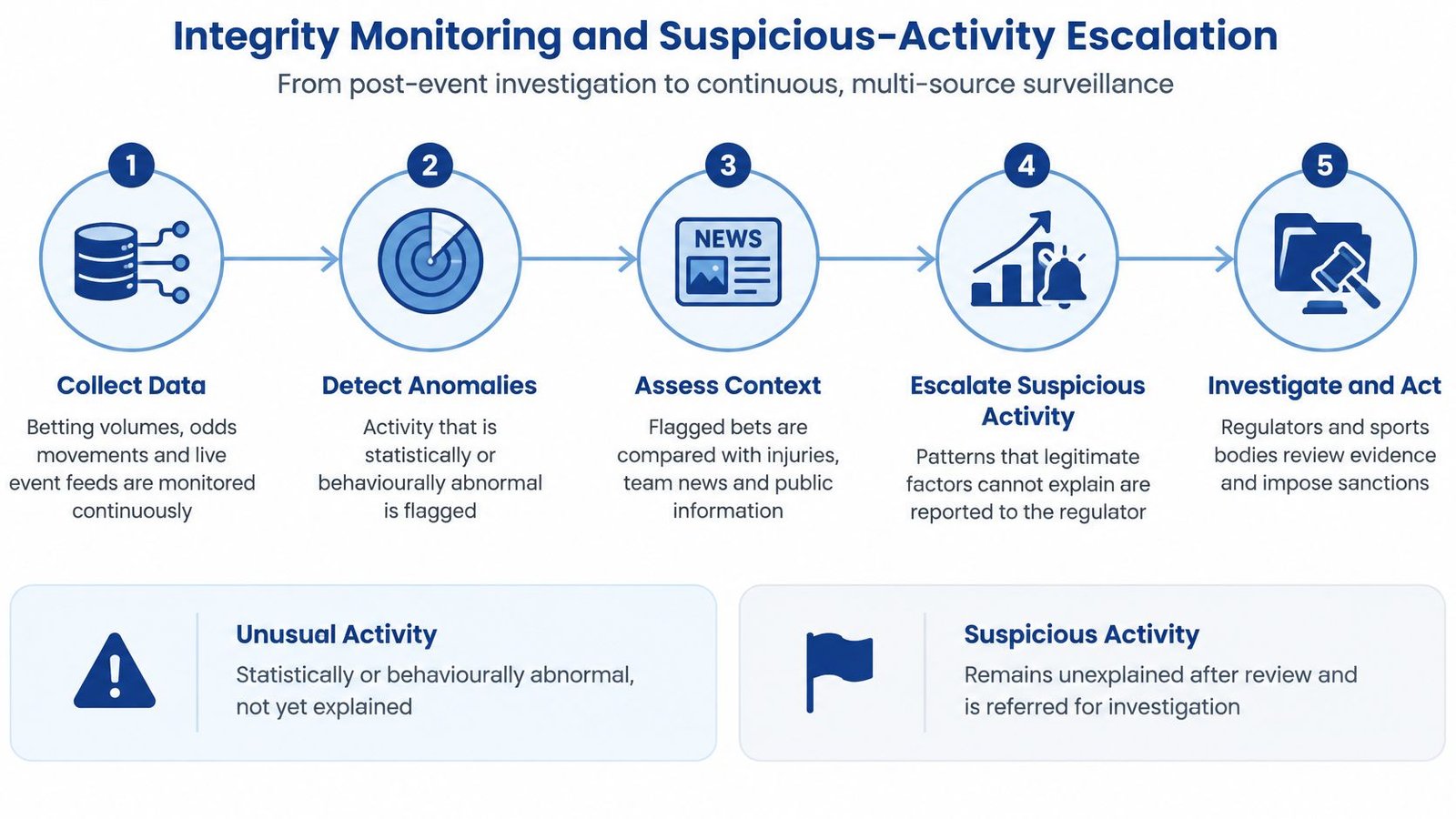
Build the escalation path in sequence
- Detect against an event baseline. Compare bets, odds movements and account activity with the expected pattern for that event and market.
- Classify and preserve the case. Mark the signal as unusual or suspicious, and record the initial report even if later review changes its classification.
- Notify and share. Notify the regulator immediately where required, then share specified information with eligible governing bodies under the applicable rules.
- Control related betting where permitted. Suspend or cancel related bets, or withhold associated funds, only where local rules allow the action.
- Log the response and review thresholds. Preserve each action in an immutable case history, then assess whether escalation criteria need adjustment.
That sequence depends on event-level baselines, account and market anomaly detection, documented escalation thresholds and rapid information-sharing channels. The accountability surface also runs wider than the detection workflow itself: transaction channels carry separate obligations in some markets, and teams mapping those duties can review this overview of PAGCOR payment-gateway accreditation as a distinct workstream from suspicious-betting escalation.
Continuous monitoring exists to produce a traceable route from alert to decision. An unusual bet should trigger a documented review, never an automatic presumption of misconduct.
Enforcement Tools and Penalties Operators Face
In Great Britain, enforcement can move from licence action to criminal prosecution. The Gambling Commission may review an operating or personal licence and issue a formal warning, amend licence conditions, suspend or revoke a licence, or impose a financial penalty. Separately, the Gambling Act 2005 makes cheating at gambling a prosecutable offence, including conduct intended to enable or assist another person to cheat, as set out in the Gambling Act 2005.
| Tool | Typical trigger | Possible outcome |
|---|---|---|
| Formal warning | Compliance concern found on licence review. | Written record of the concern and an expectation of remediation. |
| Licence condition change | A gap in controls or conduct. | Conditions added, removed or amended. |
| Suspension or revocation | A serious or repeated failure. | An operating or personal licence is paused or ended. |
| Financial penalty | A breach the regulator chooses to sanction financially. | Monetary sanction set by the regulator. |
| Criminal prosecution | Cheating, including conduct intended to help another person cheat. | Up to 51 weeks' imprisonment, a fine not exceeding level 5 on the standard scale, or both for certain offences. |
The ladder is not a fixed sequence in which every case passes through each stage. The regulator's response can reflect the nature and seriousness of the breach, whether the conduct was deliberate, and how promptly the business identifies and remedies the control failure. Personal licences can also be reviewed alongside operating licences, so individuals in compliance roles may face exposure separate from the company's.
A formal warning is often the least costly point at which to correct a control gap. Operators should treat it as a clear signal to assign an owner, document remediation and test that the revised control works, rather than as a matter that can be closed with a policy update alone.
Advertising Rules and the Organic Content Gap
Compliance exposure extends beyond purchased media. UK advertising-regulator research, including a University of Bristol study of sports-betting advertising on social media, concludes that betting marketing can normalize gambling within sport. It identifies young male internet bettors, especially those receptive to sponsorship and promotional messaging, as particularly vulnerable, with risk also rising alongside betting frequency, spending, broader gambling involvement, impulsivity and in-play betting.
The same research gives operators a measurable benchmark for how far their controls reach in practice. Paid advertisements in the Bristol study complied with industry-code requirements for safer-gambling messages and helplines, but only 25% of organic advertisements did so. That gap is an accountability question, not just a marketing one: an operator that meets code requirements in centrally bought campaigns but not in organic posts has a control failure in content it may still have funded, approved or distributed.

Audit the full advertising ecosystem
A review should include influencer content, affiliate pages, user-generated posts and organic social media, not only paid placements. Operators and rights partners should also monitor promotions around live events, where quick in-play prompts can intensify impulsive decisions.
For each content item, preserve:
- Age-targeting settings, including the audience criteria applied.
- Responsible-gambling disclosures, with evidence of what viewers saw.
- Approval records, including the responsible reviewer and the version approved.
The compliance test is then concrete: do safer-gambling messages appear at the same rate in organic content as in paid placements? Answering it requires tracing who created or distributed each item, who approved it, and whether the approval record matches the published version. A business that can only evidence controls for centrally managed campaigns is treating a large share of its promotion as out of scope, which is exactly where the Bristol findings suggest failures concentrate. For context on how one regulator frames these duties, see this guide to PAGCOR gambling advertising rules.
Whether Advertising Restrictions Reduce Betting Harm
Judge an advertising restriction by what it measurably changes, which may be narrower than what it prohibits. The clearest natural experiment is Spain: a systematic review of gambling restrictions associated the country's broad 2020 restrictions with approximately 263,000 fewer new gambling accounts and a €216 million reduction in total bets, while finding little effect on already-active gamblers and a shift toward bonuses as a marketing channel.
Read as evidence about market entry, that picture sharpens. New account creation, total wagering and high-risk play are separate outcomes, and Spain's results moved mainly on the first two. Established customers kept gambling at comparable levels while promotional effort migrated into bonuses, a pattern consistent with substitution rather than reduced demand.
Follow promotion when it changes channels
Limits aimed at broadcast windows leave sponsorships, social media, influencer marketing, podcasts, affiliate content and in-play product promotion in place. Gambling references can still run through a televised match in those forms, so audience exposure may hold steady even as conventional airtime for bookmaker ads falls. Measuring only the restricted channel overstates the policy's reach.
A stronger evaluation tracks four outcomes separately: advertising exposure, new customer acquisition, total wagering and high-risk gambling, each split by new, casual and high-risk bettors. Segmentation guards against a specific misreading: a decline in new accounts can be reported as reduced harm even when the group generating most risky betting was barely touched by the intervention.
The evidence remains thin on whether restrictions lower risky gambling or mainly redirect marketing and customer behavior. Regulators and operators should treat exposure, acquisition, wagering and harm as distinct measures, and any claim that a ban worked should name the outcome it improved.
Map Accountability and Market Entry Checks
The public and the rulebook measure accountability differently. In the 2025 Sacred Heart University sports-gamblers poll, 46.8% of sports gamblers named players and coaches as most accountable for gambling violations, ahead of 20.0% for leagues and 13.4% for sportsbooks. The same poll recorded 84.0% support for stricter oversight and 68.3% concerned that sports-betting advertising could encourage risky or unethical behavior.
The gap between those results is the analytical point. Respondents assign blame to individuals while demanding stronger institutional controls, and only the second demand sits within an operator's reach. Players and coaches answer for their own conduct; operators, leagues, data providers and regulators control market design, promotional incentives, suspicious-bet monitoring and information sharing. Individual accountability remains part of the picture, yet it produces nothing a regulator can audit. A documented control system does, and that is what a market-entry file has to evidence.

Before entering or expanding in a market, an operator should be able to answer six practical questions.
- Does the licence cover every product? Check in-play, esports and novel markets against the relevant licence scope.
- Who receives integrity reports? Map the escalation path, including the regulator and eligible governing bodies.
- What tax applies to the actual product mix? Model per-bet and gross-revenue structures using realistic volume and margin assumptions.
- Does advertising review cover organic promotion? Test influencer, affiliate and user-generated content against the paid-media standard, since a review limited to purchased placements will miss promotion that shifts into other channels.
- Who owns each control? Name a responsible person for each obligation and confirm who answers regulator queries.
- When will legal changes be checked again? Set a review date for pending legislation and regulator notices before launch.
A market-entry file should connect each answer to an owner and an auditable record. Supplier-side obligations belong in that file where a jurisdiction licenses suppliers separately, and PAGCOR's published B2B provider application process illustrates how one regulator structures that application track.
For the next market launch or product expansion, assign owners to these six checks, document the evidence each one requires, and confirm outstanding legal changes directly with the relevant regulator before taking bets.





Join thousands of gaming professionals receiving the latest iGaming news, regulatory updates, and market insights.
