

In 2025, 87% of surveyed game developers reported using AI agents in their work, according to Google Cloud and The Harris Poll, as covered by GamesIndustry.biz. That share pulls AI in gaming out of the lab and onto the trading desk, the CRM stack and the content pipeline.
Adoption still isn't harm reduction, and a score that fits one book isn't a model that survives a second licence. Operators, suppliers and compliance leads should judge each use by the outcome it moves, by any clash with revenue optimisation, and by whether the behaviour holds when the market, the reward or the rule changes.
The useful question is narrow. Which decision does the system own, which profit-and-loss line should move, and which failure shows up if the model is accurate in the wrong way?
Table of Contents
- Where AI in Gaming Changes the P&L
- How Gaming AI Models Actually Decide
- Why Production Models Break
- What to Measure Before You Scale
- Patterns from Studios and Betting Floors
- Vendor Landscape and Return on Investment
- Harm Reduction, Regulation and Model Risk
Where AI in Gaming Changes the P&L
Grand View Research estimates that the global gaming segment for generative AI will grow from USD 2,292.5 million in 2024 to USD 14,244.3 million by 2030, a 36.6% compound annual growth rate from 2025 through 2030. That estimate signals rising investment, not proof that a particular deployment reduces costs or improves player outcomes. Operators still need to connect each use to a measurable P&L result and check whether it holds in another market.
Six jobs and the line they move
Near-term payback is easiest to assess when a system affects a price, a block or the speed of a build. Player-facing generation brings copyright, disclosure and quality risks that revenue figures alone do not capture. The play history used to lower user acquisition cost can also be used to encourage more frequent staking, creating a direct tension between revenue optimisation and player protection.
| Use | Decision the model makes | P&L effect | Failure that travels with it |
|---|---|---|---|
| Personalisation | Next game, offer or session prompt from play history | Retention and stake frequency | Same signals can intensify harmful play |
| Odds and pricing | Live probability, margin and liability | Sharper prices and controlled exposure | Error in thin or fast markets |
| Fraud and AML | Device, payment and behaviour anomaly score | Lower bonus abuse and payment loss | False positives block sound customers |
| Live-dealer augmentation | Bet recognition, chat moderation, stream checks | Faster games and fewer disputes | Latency or a misread bet |
| Game design | Assets, tests, localisation and balance | Shorter content cycle | IP, quality and player backlash |
| Responsible-play monitoring | Risk score and intervention trigger | Harm reduction and regulatory defence | Unvalidated model used to sell as well as protect |
Procurement test: Choose one row for a pilot. Require the supplier to name the P&L line it expects to affect and the failure mode the team will monitor.
These categories identify possible effects, not guaranteed returns. A pilot should show whether the intended gain appears without worsening the paired risk, and whether the result persists when the market changes.
How Gaming AI Models Actually Decide
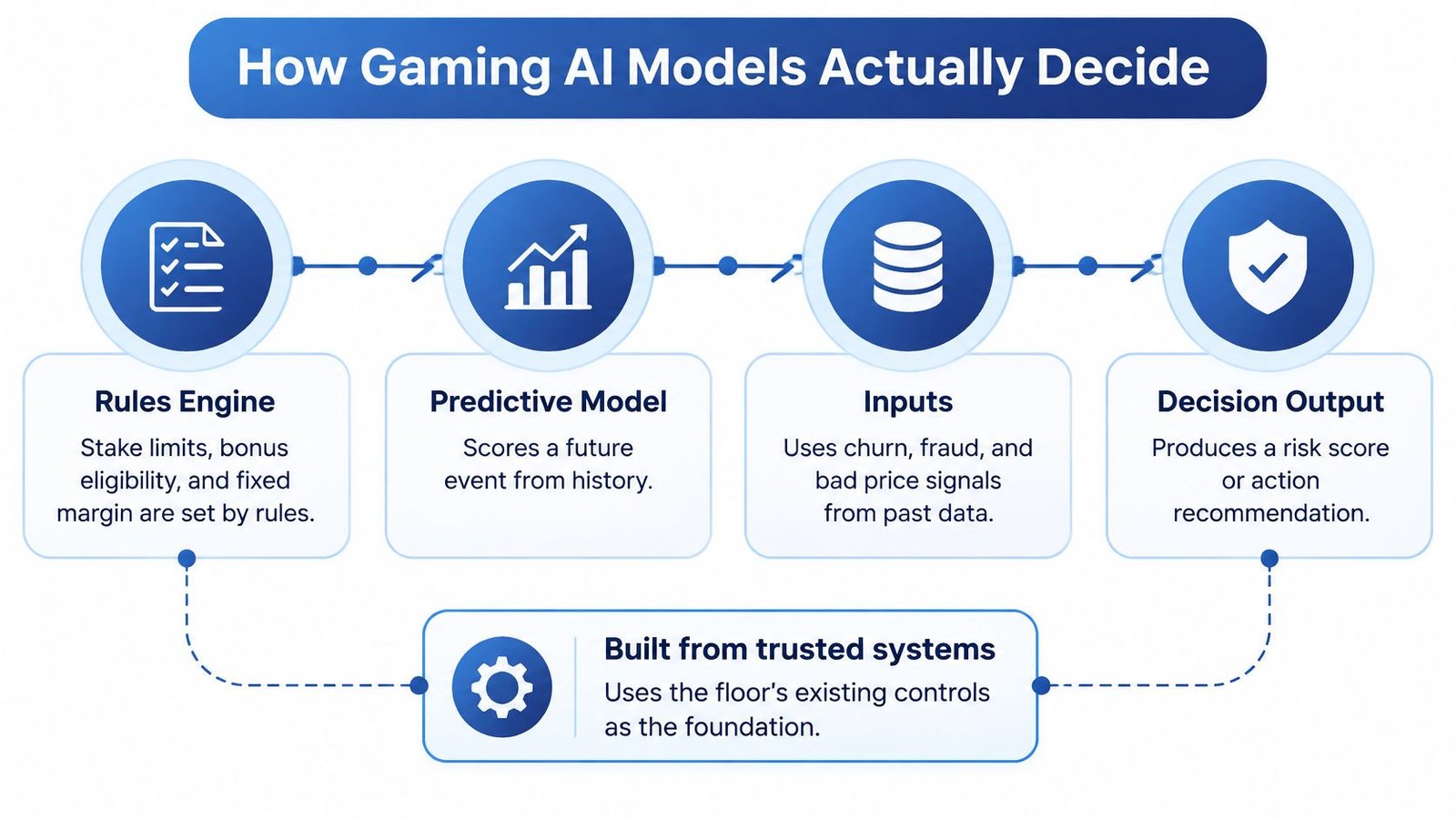
A sportsbook already trusts a rules layer before any model is switched on. Stake limits, bonus eligibility and a fixed margin are locked doors. A predictive model is a risk rating on the guest: churn, fraud, a bad price or risky play, scored from history. Generative systems draft art, dialogue, local copy and test cases overnight. They don't, by themselves, set an odd. Reinforcement learning is the dealer who changes strategy because yesterday's tips rewarded it. The policy follows the reward.
A stronger score isn't a portable policy
In a benchmark across eight General Video Game AI environments, Advantage Actor-Critic beat Deep Q-Network and Prioritized Dueling DQN in six games, and A2C on 12 CPU cores trained five times faster than DQN on a Tesla NVIDIA GPU, according to the General Video Game AI study. Performance still moved with mechanics, state representation, reward design and action space. A policy that looks strong in one title can farm a simulator rather than learn durable play.
Production tools change how fast a studio builds. Agentic systems inside the session change what the player sees and who is accountable when the output is wrong. Buyers comparing explanation methods, including work on evaluating AI explanation methods, should ask which of the four layers is shipping, and what is still a rule with a new label.
- Rules: They bind the floor even when the model is offline.
- Prediction: They rank a future event. They don't invent the offer.
- Generation: They draft. A human or a rule still releases.
- Reinforcement: They optimise the reward you wrote, not the brief you meant.
Why Production Models Break
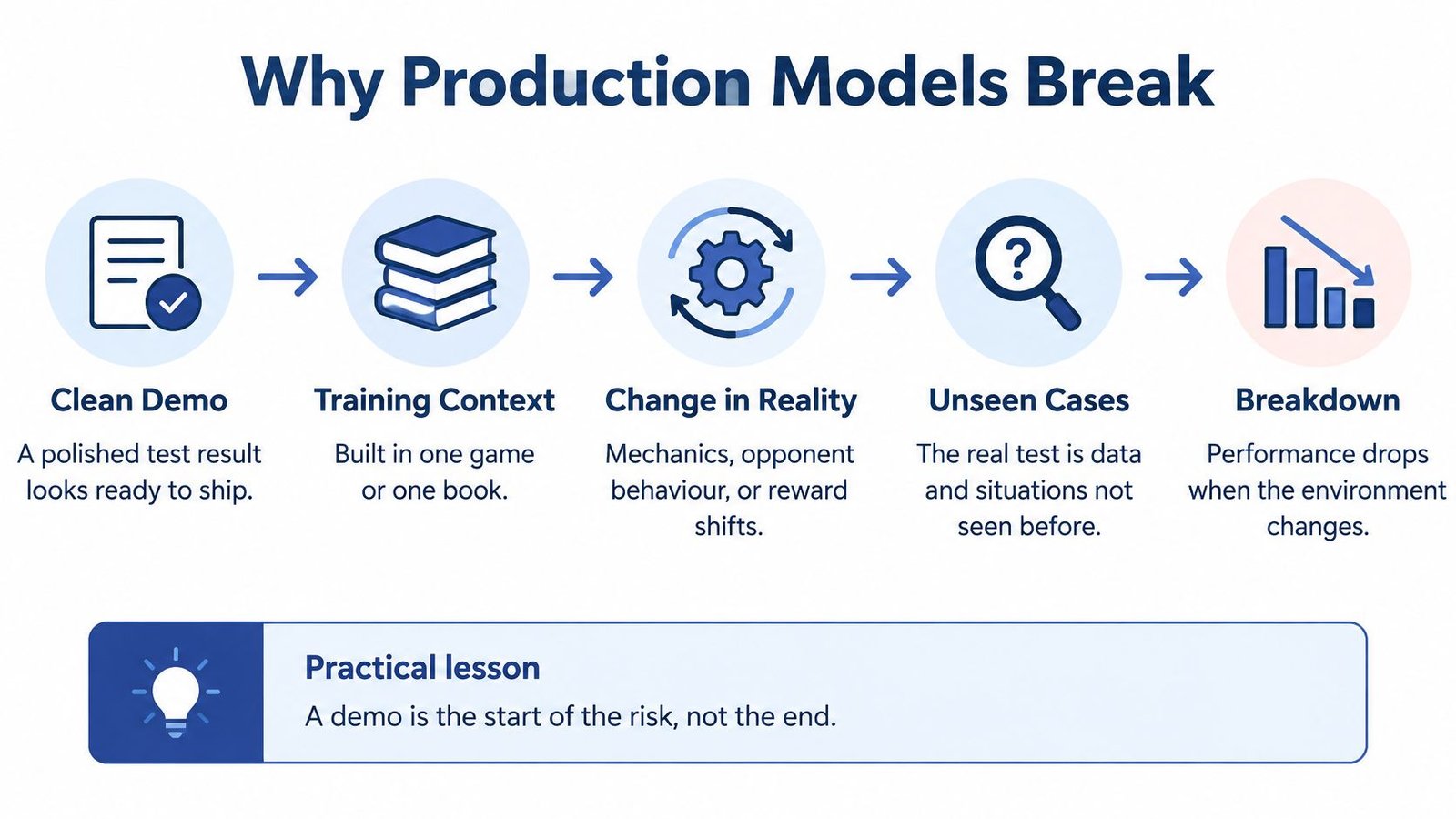
A clean demo is the start of the risk, not the end. A policy trained in one game or one book fails when mechanics, opponent behaviour or the reward change. The practical test is unseen conditions, altered strategies and a reward-ablation check, so the agent isn't farming a simulator bug.
Reward, latency and leakage
Reward design is the iGaming version of that bug. If the reward is session length or stake, the model will find it even when responsible play is intended. Live-dealer systems fail in milliseconds, not on a paper score. A correct bet call that arrives after the round is a dispute.
Data leakage is quieter. A group model trained across brands can carry a vulnerable-customer definition, an ad rule or an affordability signal into a jurisdiction where it is wrong. Generated assets fail on rights and on sameness. A faster pipeline that can't show training-data provenance is a release risk, which is why workforce policy now sits beside the tool. Administrators who already map duties under PAGCOR gaming system administrator requirements should treat model changes as controlled releases, not silent updates.
NPC-Bench reported that a prompting strategy lifted Gemini Flash 2.0 by 6 percentage points to 94% accuracy on character and world checks, while still treating harmful output as a separate test, in the NPC-Bench evaluation. One language-quality score isn't a release gate for a host, a chat assistant or a support bot that might give wagering advice.
A release bar worth enforcing: a per-title or per-market benchmark, hardware and stability reported with the score, human review on player-facing text, and a kill switch that doesn't depend on the vendor's dashboard.
What to Measure Before You Scale
A single accuracy number is false comfort. It can rise while the business outcome moves the wrong way, or while the same score is reused for a promotion. Usage proves a licence was switched on. It doesn't prove the P&L or the player outcome moved as intended.
The minimum pack for a go or no-go
Finance and compliance should refuse a vendor dashboard that shows only usage, latency or one accuracy figure. Each row below is a decision, not a vanity metric.
| Measure | Decision it informs | Healthy signal | Warning sign |
|---|---|---|---|
| Fraud and AML precision | Whether blocks save more than they cost | Reviewed true positives inside a stated false-positive budget | Blocks clustered on one country or payment method |
| Margin versus liability | Whether sharper prices still cap exposure | Both figures reported after every model change | Win rate up while unchecked liability rises |
| Content cycle time | Whether generative tools speed a real release | Cycle time down and rework flat or down | Throughput up and complaints up with it |
| Responsible-play outcome | Whether protection changes behaviour | Outcome stored apart from net gaming revenue | Same score triggers care and a promotion |
| Model drift | Whether yesterday's model still fits | Named owner, retrain record and rollback | Silent score shift after a market move |
| Cross-market transfer | Whether the model can leave its training market | Revalidated on local demographics, affordability and ad rules | One global threshold applied unchanged |
A fraud model isn't successful because it blocks more accounts. It is successful when reviewed true positives save more than false declines cost, and when blocks aren't clustered on one country or payment method. A pricing model isn't successful on win rate alone. Margin and maximum liability have to be reported together after every change, or sharper prices can hide a larger hole.
What finance should store apart
A content tool isn't successful on cycle time if rework, rejection and complaint rates rise by the same amount. A responsible-play score isn't successful because it fired. The post-intervention outcome has to be stored apart from net gaming revenue, or the same score will be reused to push an offer.
Drift needs an owner, a retrain record and a rollback, not a silent shift after a market move. Cross-market transfer needs a fresh check against local demographics, affordability tests and advertising rules. That file is the management pack. Without it, scale is a claim.
Patterns from Studios and Betting Floors
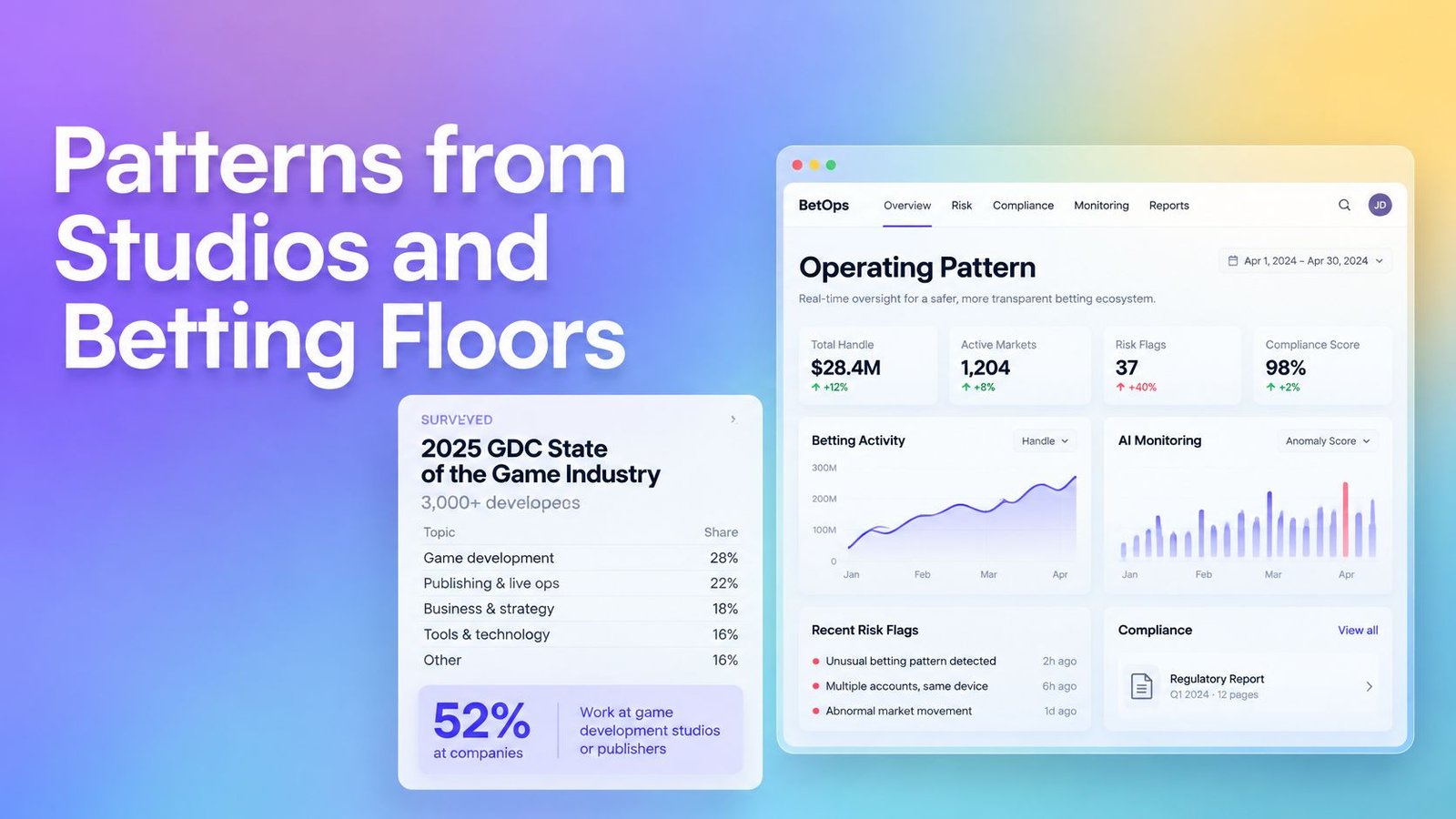
The 2025 Game Developers Conference State of the Game Industry survey drew responses from more than 3,000 developers. It found that 52% worked at companies using generative-AI tools, while 36% used them personally, up from 31% the previous year, according to the State of the Game Industry report. Company policies covered 64% of respondents, compared with 51% in 2024. Yet only 13% saw a positive industry impact, while 30% saw a negative one, a 12-point deterioration from the prior year.
Adoption and policy are rising, but neither establishes player value. The survey's sentiment figures also show that more use does not settle concerns about copyright or output quality.
Three operating patterns, not audited savings
These examples describe operating choices, not published savings figures.
Sportsbook trading. A model reprices a live market and helps cap liability. The trader retains authority over unusual cases and releases prices that could expose the book to a large loss. Faster repricing has commercial value only if the resulting liability stays within limits.
Casino CRM. A system can suppress an offer when a risk flag appears, but the protection score must remain separate from the retention score. Otherwise, the flag becomes a timing tool for a bonus tied to online casino games for real money. That use may support retention while undermining the protective purpose of the score.
Live studio and content. Bet recognition and chat moderation can help resolve disputes when they act before the wager cut-off. Generative tools can produce localisation, art variants and test cases, while a human release gate keeps the final decision with the studio.
Across these cases, AI adoption is not itself evidence of harm reduction or a model that will transfer to another market. Operators should judge each use by its measured outcome and by whether its incentives still hold when revenue goals, local rules or player behaviour change. Supplier claims should be weighed against filings and announcements, not demo reels.
Vendor Landscape and Return on Investment
Map the supplier market by job, not by brand. Five groups matter for iGaming buyers: sportsbook trading and pricing engines, player account management and CRM tools, KYC, AML and fraud scoring, live-studio bet recognition and moderation, and game content and asset generation.
Ask each vendor for the paired measure that matches the job. For pricing, margin and maximum liability together. For fraud, reviewed true positives against the false-decline budget by country and payment method. For live studios, latency measured against the wager cut-off. For content tools, cycle time together with rework, rejection and complaint rates. Teams that move from blank scene to rough asset still need provenance before a commercial skin ships, and content suppliers should already meet PAGCOR game content provider accreditation requirements.
How to build the return
Build return as incremental margin or loss avoided, minus licence fees, integration cost, human review time and compliance cost. Measure it against a control group or a held-out market. Treat vendor savings claims as unverified until the method, sample and period are disclosed.
- Name the decision the system owns.
- Name the P&L line it moves.
- Name the failure mode and who monitors it.
- Require a kill switch that doesn't depend on the vendor dashboard.
- Confirm purpose limits: player data is used only for the stated purpose, not for retention or promotion targeting.
Harm Reduction, Regulation and Model Risk
A player-risk model can identify behaviour associated with harm, yet its commercial value depends on what happens next. The same signals could trigger support or shape a promotional offer. Keep protection decisions separate from revenue optimisation, then measure whether interventions reduce harm without creating unfair or unexplained outcomes.
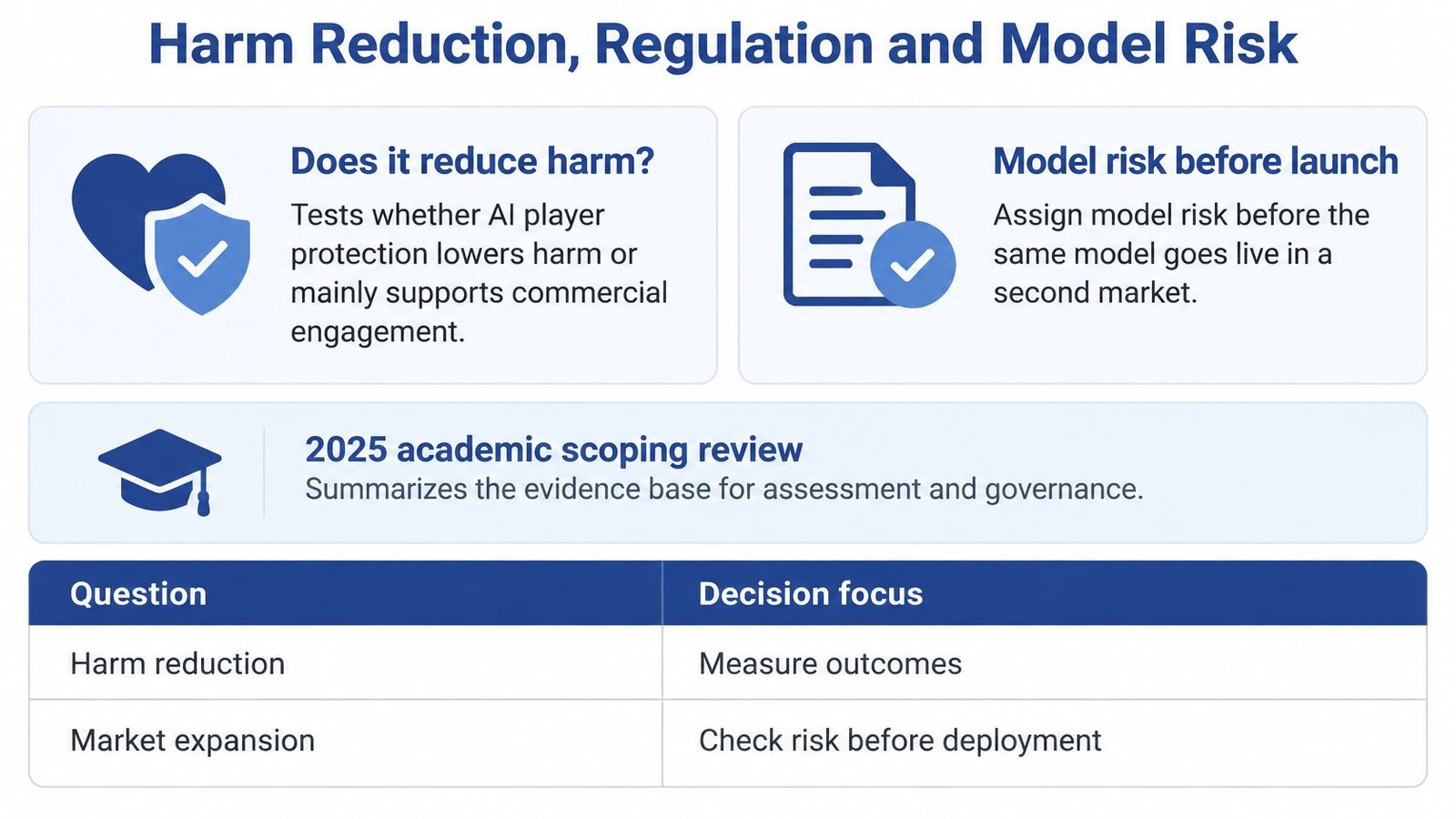
A hospitality and tourism scoping review identifies unresolved AI risks including explainability, exploitation, algorithmic flaws, consumer rights, accountability and human oversight. These are useful questions for gambling operators to examine, not direct evidence about gambling products or player outcomes. A protection pack should therefore report intervention accuracy, false positives, demographic bias, escalation responsibility and what happened after an intervention.
One model, four layers of authority
For multi-market operators, a European classification does not automatically apply in another jurisdiction. The guida ELECTE alla classificazione del rischio AI can help distinguish binding duties from internal policy or vendor statements. Operators tracking PAGCOR regulatory updates for 2026 should assess requirements under each relevant licence rather than assume one market's approach transfers with the code.
| Authority level | What it binds | Example from the research |
|---|---|---|
| Binding duty | Operator must comply | EU AI Act obligations applied through 2025, including general-purpose model rules |
| Regulator expectation | Supervisory practice | Regulators may issue guidance on responsible AI |
| Voluntary standard | Operator policy or framework | Internal responsible-AI policies set expectations beyond binding duties |
| Vendor claim | Commercial assertion | Accuracy or savings figures with no published method, sample or period |
Before switching on a shared model under another licence:
- Name one owner for model risk.
- Keep protection separate from revenue. The care score should not select an offer.
- Record inputs, versions and changes.
- Require human review for responsible-gambling actions and marketing suppression.
- Retest fairness against local demographics, affordability tests and advertising rules.
Investors should ask for six audit records: data inputs, drift, explainability, human review, a consumer appeal path, and separation between protection and revenue. These records show what must be reassessed before a model moves to another market.
Apply the pilot checklist before scaling: define the intervention, review its outcomes, and confirm that protection decisions remain independent of promotional targeting.





Join thousands of gaming professionals receiving the latest iGaming news, regulatory updates, and market insights.
