


Gambling advertising prompted 45% of online gamblers to spend, according to consumer-response evidence cited in the UK Gambling Commission's advertising guidance. For operators assessing affiliate marketing for gaming, that makes conversion an incomplete measure of success. A partner can generate deposits while also increasing exposure, compliance costs and player-protection risks.
The stronger commercial test is harm-adjusted, retained value: revenue remaining after acquisition costs, bonuses, chargebacks and servicing costs, assessed alongside complaints, self-exclusion and risky-play indicators. This isn't a standardised accounting measure or a way to price gambling harm. It's a management framework that prevents an attractive acquisition report from concealing an unsuitable partner.
Table of Contents
- Why Affiliate Marketing for Gaming Still Matters
- Commission Models and Where Each One Breaks
- Recruiting Partners Inside Licence Limits
- How to Launch a Compliant Affiliate Program
- Attribution When Browsers and Licences Disagree
- Judging Partner Value After the First Deposit
- Decide Which Partners and Markets to Scale
Why Affiliate Marketing for Gaming Still Matters
Affiliate marketing represented approximately one-fifth of global gambling-industry marketing expenditure in 2018, while gambling revenue-share commissions averaged about 30% of referred customer losses and could reach 50%, according to the Australian Communications and Media Authority's affiliate-services report. These are historical benchmarks, not recommended rates or a current global market estimate.
The commercial attraction is straightforward. Operators can move part of acquisition spending from prepaid advertising to payments triggered by qualifying customer activity. Comparison sites, tipsters and content publishers receive a way to monetise audiences without operating the underlying gambling service.
Performance payments change the incentive
Early online-casino partnerships used portal banners and payments connected to referred play or losses. The important development wasn't the banner format. It was the ability to connect a publisher's remuneration to the customer's subsequent gambling.
That connection explains the regulatory sensitivity. A publisher paid on losses has a different incentive from a publisher paid for a disclosed placement, even when both promote the same operator. Commercial due diligence therefore needs to examine what earns the fee, not whether the affiliate delivers traffic.
Commercial principle: A measurable payment trigger isn't automatically a suitable payment trigger.
Search strategy also needs that distinction. SemDash's guidance on how to target affiliate searches with buying intent can support keyword planning, but commercial intent should be filtered through permitted markets, audience eligibility and approved products.
The practical sequence starts with a lawful commission model, continues through controlled recruitment and launch, and ends with auditable attribution and retained-customer assessment. Treating those decisions separately leaves finance, acquisition and compliance teams judging different versions of the same partnership.
Commission Models and Where Each One Breaks
Gaming affiliate commission models compared
| Model | Typical commercial shape | Operator pays on | Main risk | Do not use when |
|---|---|---|---|---|
| CPA | Fixed fee per qualified player | First-time depositor or agreed qualifier | Bonus abuse and one-deposit players | The qualifier ignores wagering, product or jurisdiction |
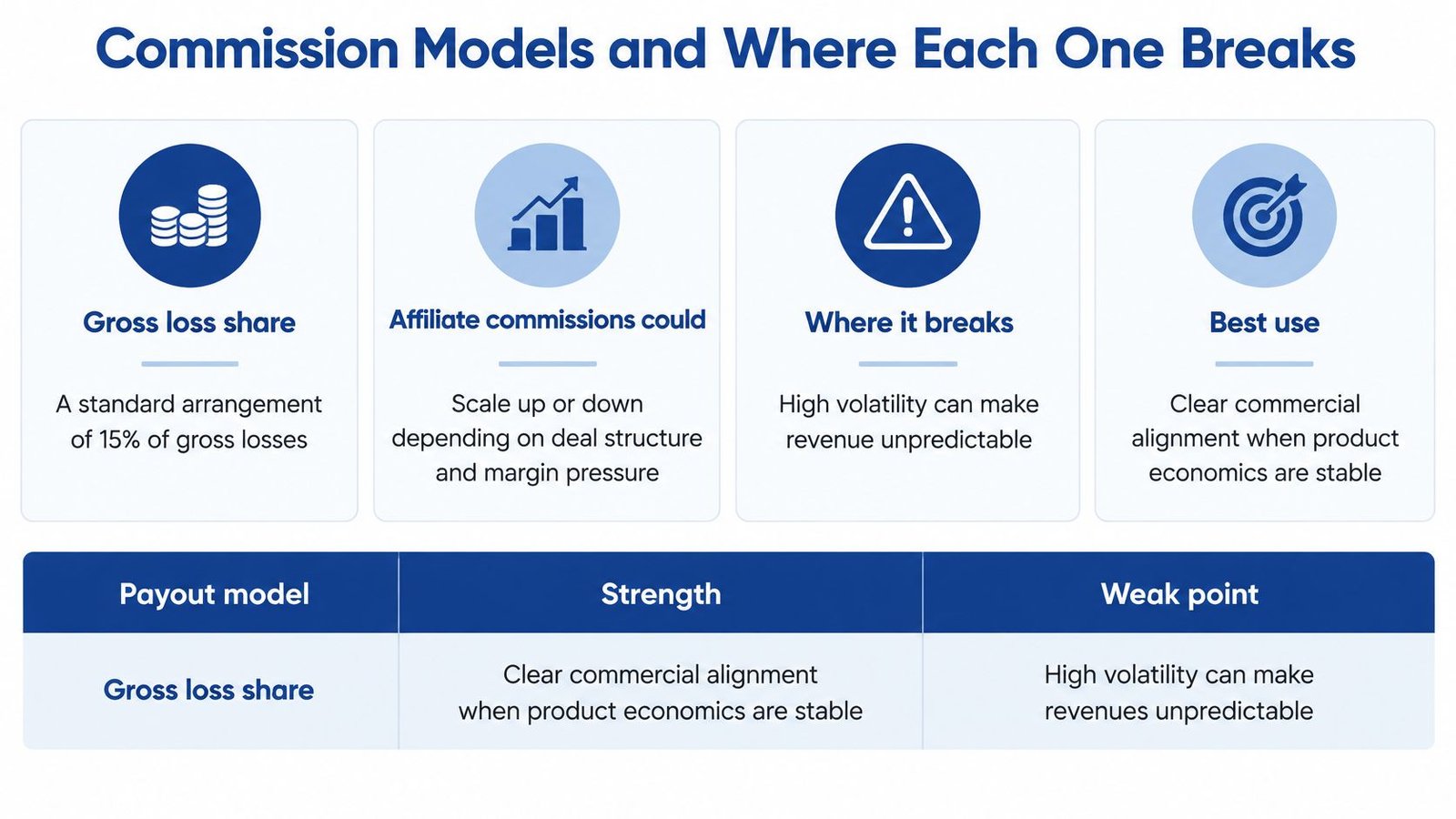
| Revenue share | A cited standard deal paid 15% of gross losses, according to the 2024 wagering-affiliate study | Contract-defined net gaming revenue or customer losses | Incentive to push ongoing play | Activity-based commission is prohibited |
| Hybrid | Reduced CPA plus a lower revenue share | Qualifier plus later revenue | Disputes over which event earned which fee | Attribution cannot separate the CPA event from later NGR |
| Flat or placement fee | Agreed media or content fee | Published placement, not player losses | Payment without a performance check | The placement is undisclosed advertising or targets a banned market |
Australia requires the remuneration question first. The ACMA explanation of the Interactive Gambling Act states that commissions to staff or affiliates based on customer activity are banned. An operator should assess the payment mechanism before applying an overseas loss-share arrangement to Australian acquisition.
The table describes different commercial structures, not recommended rates. Gross losses and net gaming revenue are not interchangeable. Contracts should define the revenue base, deductions and adjustments so both parties can calculate the same amount. Those terms also affect whether reported affiliate value survives reconciliation and compliance costs.
CPA buys a qualifying event, not proven value
A cost-per-acquisition agreement makes immediate liability easier to forecast. Its weakness is the qualification rule: a deposit alone does not establish product fit, lawful eligibility or retained value.
The commercial schedule should define eligible products, permitted geography, duplicate-account treatment and fraud exclusions. A publisher carrying a free welcome bonus casino page should be assessed on how clearly it presents eligibility and offer conditions, not just on bonus-related search volume.
CPA can cap exposure while lifetime value remains unproven. It cannot make low-quality or non-retained traffic economical.
Recurring payments need a precise revenue definition
Revenue share ties affiliate remuneration to customer economics over time. Finance should specify bonus deductions, payment costs, chargebacks, negative carryover and whether results are calculated across customers or individually. Without those definitions, headline percentages can produce incompatible forecasts and obscure the channel's retained value.
Hybrid agreements require a separate reconciliation: the operator must document which event earned the acquisition payment and which later revenue generated the share.
Flat fees remove the player-activity payment trigger, but advertising obligations remain. Placement contracts should specify location, duration, disclosure, approved destinations and evidence of delivery.
Select a commission model by legal eligibility and measurable economics, not by the largest advertised percentage.
Recruiting Partners Inside Licence Limits
Recruitment should begin with an approved market-and-product list, not a directory of publishers. Acquisition teams need a shared record of permitted brands, countries, audience restrictions and offers before approaching prospective partners.
Partner discovery can then follow traffic intent. Comparison websites and review publishers serve search-led evaluation; tipsters and sports creators attract betting audiences; influencer accounts provide a different route to audience access. The Affiliate Landscape on gaming affiliate networks offers a starting point for mapping potential relationships, but network membership shouldn't replace individual screening.
Screen the audience and the supply chain
A recruitment review should cover:
- Audience fit: Obtain geographic distribution, available age-profile evidence and the main acquisition channels.
- Editorial conduct: Inspect disclosures, bonus language, operator rankings and claims about winning.
- Commercial history: Identify brands previously promoted and investigate destinations that appear inconsistent with the intended market.
- Hidden intermediaries: Require disclosure of sub-affiliates, tipsters, influencer groups and purchased traffic.
A partner's claim that a market is accessible isn't evidence that the operator can advertise there. For Philippine-facing proposals, a market-specific resource such as an online casino legality guide for the Philippines can support initial questions, followed by verification against the relevant authorisation and legal advice.
The commercial sheet should state payout thresholds, payment timing, adjustment rights, permitted channels and suppression responsibilities. It should also require approval before traffic sources change.
Recruiters should reject guaranteed-earnings claims, concealed distribution and proposals to target markets outside the operator's permissions. Each accepted partner needs a named owner and an inventory entry recording market, model, channels and launch approval. That record makes subsequent monitoring possible without reconstructing the relationship from emails.
How to Launch a Compliant Affiliate Program
A compliant launch requires evidence that the operator can control the relationship after publication. A signed contract alone doesn't establish which pages are live, where advertisements appear or whether withdrawn offers remain accessible.
Establish permissions and contractual control
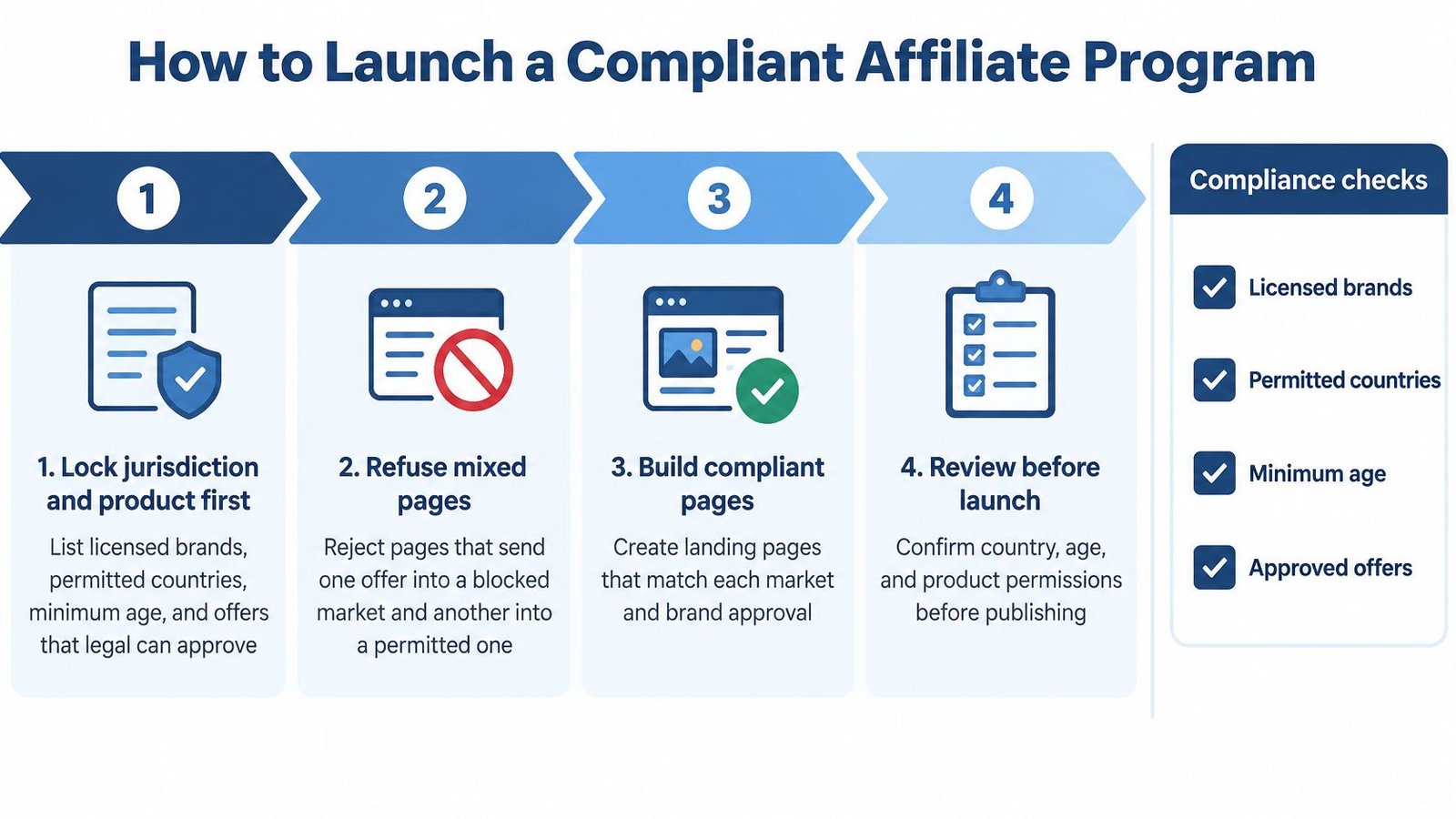
Lock jurisdiction and product first. Maintain approved brands, countries, audience restrictions and offers in a controlled register. Reject destinations that mix authorised and unauthorised operators for the targeted audience.
Verify the partner and its traffic. Record company identity, ownership, acquisition channels and underlying networks. Contracts should prohibit unapproved sub-affiliates and give the operator access to placement evidence.
Complete the commercial schedule. Define the qualifying event, revenue calculation, bonus treatment, negative carryover, chargebacks and grounds for withholding or recovering payments. Self-exclusion should trigger suppression and eligibility review, not an invitation to pursue further customer activity.
Attach licence-holder accountability to the contract. The UK Gambling Commission's third-party guidance states that operators remain responsible for affiliates, including compliance with the LCCP, the Data Protection Act 2018 and PECR, and connects that responsibility to social-responsibility code provision 1.1.2. Operators must take reasonable steps to prevent marketing reaching self-excluded customers and those whose exclusion has ended without a positive decision to return.
Approve publication and test live controls
Approve the complete creative. Review bonus claims, wagering requirements, expiry, eligibility and disclosure together. The FTC's endorsement guidance requires clear and conspicuous affiliate disclosures near the endorsement or link; video disclosures should appear in the video and its description. A footer notice shouldn't substitute for a disclosure visible at the decision point.
Check paid-platform permissions separately. Google's gambling-advertising policy requires certification, permitted-country targeting and applicable local compliance. For relevant affiliate destinations, outbound links must exclusively lead to entities licensed and authorised in the targeted region, with a prominent footer statement confirming that restriction.
Issue identifiers and suppression controls. Configure approved platform identifiers and server-side event reporting. Establish a secure process for suppression instructions, with limited access, documented processing and confirmation that affected campaigns have stopped.
Inspect the published journey. Keep an inventory of live pages, social accounts, messages and landing destinations. Test geo-routing, audience controls and offer text from the relevant market, rather than relying only on a screenshot supplied before launch.
Market rules that change affiliate pay and disclosure
| Market | Commission and pay rule | Disclosure and promotion rule | Suppression and data rule |
|---|---|---|---|
| Great Britain | Operator accountability applies to affiliate arrangements; commercial structure needs contractual review | Operator responsible for affiliate content and placement | LCCP, data-protection and electronic-marketing duties; self-exclusion suppression |
| Australia | Activity-based affiliate commissions prohibited | Banned-service advertising prohibited; credit offers restricted | Check inducement restrictions, BetStop status and at-risk customer controls |
| United States, FTC | Endorsement guidance doesn't set commission rates | Clear, conspicuous disclosure near endorsements and links; video disclosure also required | FTC endorsement guidance isn't a complete gambling-data or suppression framework |
| Google paid promotion | Advertising policy, not a commission rule | Certification, permitted targeting, licensed-only destinations and footer statement | Platform approval doesn't replace applicable privacy or consent obligations |
| Spain | Historical affiliate expenditure isn't a permitted-pay schedule | Local advertising restrictions require separate assessment | Confirm applicable consent and suppression duties before activation |
For Philippine campaigns, teams can use PAGCOR gambling advertising rules coverage alongside current official requirements and jurisdiction-specific legal review. The launch file should identify which version of each approval supported publication.
This sequence targets concrete failures: misleading bonuses, unlabelled advertorials, unsolicited messages and traffic from unauthorised countries. Each needs an accountable owner and a stop mechanism, not merely a clause stating that the affiliate must comply.
Attribution When Browsers and Licences Disagree
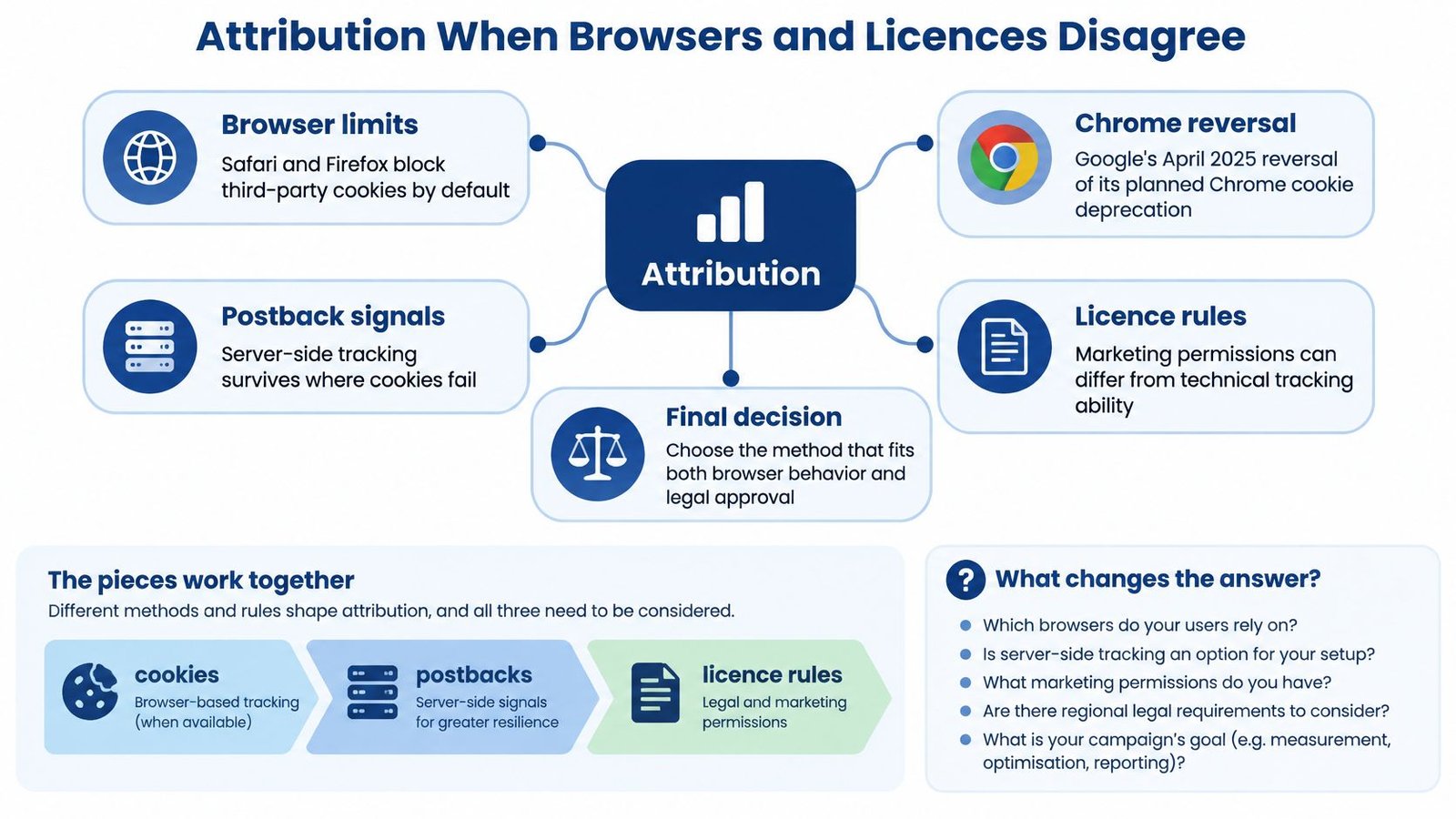
Google reversed its planned Chrome third-party-cookie deprecation in April 2025, while Safari and Firefox block third-party cookies by default, according to the GREO responsible-marketing evidence snapshot_Research%20Snapshot_Responsible%20marketing%20communication%20in%20online%20gambling_final.pdf). Advice built around a universal transition to cookieless measurement therefore misses the practical problem: browser behaviour remains fragmented.
Technical visibility and legal permission are separate tests. A postback can transmit an event without establishing that the parties are entitled to share it. A browser retaining cookies doesn't establish valid consent either.
Specify events rather than buying a tracking promise
The following is a proposed contractual design, subject to each market's data rules. It isn't a blanket statement that every event may be shared.
Attribution events to agree in writing
| Event | Shareable through | Dispute if missing |
|---|---|---|
| Click | Consented first-party tracking or approved server-side postback | Affiliate claims credit for an unpaid referral |
| Registration | Approved postback carrying a limited identifier | Parties dispute which journey earned the account |
| First deposit | Affiliate platform under applicable market data rules | CPA partner disputes an unpaid depositor |
| Net gaming revenue | Restricted platform reporting under market data rules | Revenue-share partner disputes unpaid NGR |
| Chargeback | Reconciliation report with necessary information only | Clawback disputes on commission already paid |
| Self-exclusion | Suppress-or-withhold flag, not a marketing profile | Excluded customers remain exposed to marketing |
| Lifetime value | Contractually agreed cohort aggregate | Forecast disputes over bonus cost and churn |
Consider a customer who visits a comparison site on a phone, follows an influencer promotion and later registers directly on a laptop. Without an agreed credit rule, each participant may describe a different acquisition journey.
The operator and affiliate should specify the lookback window, precedence between eligible referrals and treatment of direct returns. Duplicate-credit checks should identify competing claims without disclosing unnecessary customer information.
Make missing conversions replayable
Finance needs an audit log containing the relevant identifier, event time, consent or permission status, source record and adjustment history. The contract should name a fallback record for each payable event and explain what happens when attribution can't lawfully or reliably be reconstructed.
SourceLoop's explanation can help teams understand cookieless attribution accuracy tradeoffs, but modelled attribution shouldn't automatically become commission entitlement. Analytical estimates and payable events serve different purposes.
Control point: Server-side tracking can improve event delivery. It can't restore missing permission or prove a cross-device identity that the operator never established.
Missing depositor events affect CPA invoices; missing revenue events affect recurring payments. Resolving those cases before launch is cheaper and more defensible than negotiating a measurement policy after money is disputed.
Judging Partner Value After the First Deposit
A parliamentary review citing GambleAware found that 92% of 391 content-marketing advertisements from major gambling brands weren't clearly identifiable as advertising, according to the House of Commons Library briefing. That finding makes disclosure a material content-control issue, not a cosmetic addition to a conversion page.
A useful partner assessment connects editorial quality to downstream customer outcomes. A page can pass a factual review yet still attract an unsuitable audience; a profitable cohort can still originate from unacceptable promotion.
Apply linked content and customer checks
- Market alignment: Match each page to the permitted brand, product, geography, audience and offer.
- Commercial transparency: Check whether an ordinary reader can recognise the promotion before using the tracked link.
- Terms accuracy: Reconcile claims, eligibility, expiry and wagering conditions against the operator's current approved offer.
- Measurement integrity: Compare outbound traffic, registrations and depositor records with the affiliate's analytics and the operator's reconciliation records.
- Retained quality: Review fraud, bonus cost, chargebacks, complaints, retention and responsible-gambling interventions by source.
The review should distinguish a customer leaving voluntarily from a customer receiving a protective intervention. Self-exclusion isn't an obstacle to retention, and it shouldn't be treated as a reason for reactivation pressure.
Test incrementality, not just acquisition cost
A systematic review of online gambling marketing reports a 2025 Spanish study in which advertising restrictions reduced new accounts and operator marketing expenditure but didn't affect affiliate marketing. The same evidence base reports greater likelihood of certain medium-complexity bets when presented through an affiliate account.
Neither finding proves that every affiliate produces harmful or non-incremental acquisition. Together, they justify testing whether apparent efficiency reflects additional customers, migration from other channels or changes in wagering choices.
A user acquisition cost assessment should therefore include retained economics and comparison cohorts, rather than treating a low initial CPA as the final result. Controlled content tests should hold traffic intent reasonably constant while changing headlines, calls to action, offer framing or page depth.
Useful differentiation comes from jurisdiction-specific licensing explanations, odds comparisons that state their limitations, payment-risk analysis and responsible-gambling information. Generic rankings provide less information for either customers or compliance reviewers.
As an operating recommendation, teams should examine cohorts at 30, 90 and 180 days, rather than calling the first deposit a successful acquisition. Those are proposed review checkpoints, not evidence-based universal performance thresholds.
Decide Which Partners and Markets to Scale
The budget decision should be keep, pause or exit, supported by a record that acquisition, finance and compliance can all approve. Expand a partner only when its traffic stays within permitted channels, its remuneration is lawful, and its retained contribution remains acceptable without worsening player-protection outcomes.
Keep and selectively expand relationships with reconciled reporting, approved distribution and positive retained contribution. Make expansion conditional on the partner maintaining the same approved traffic sources. A search publisher's performance does not establish that an undisclosed influencer network is suitable.
Separate repairable gaps from unacceptable conduct
Pause a partner when tracking discrepancies, unclear offer language or missing placement evidence prevent a defensible assessment. Use the pause to investigate; don't allow traffic to continue indefinitely while documentation remains incomplete.
Exit relationships involving deliberate concealment, unauthorised distribution or repeated disregard for suppression instructions. A profitable report does not justify retaining a partner whose conduct the operator cannot control.
Market entry needs its own release gate. Obtain fresh approval when changing the targeted country, remuneration trigger, advertised brand or paid-media destination. Moving to CPA may address forecast uncertainty, but it does not resolve legal concerns where activity-based compensation is restricted.
Scale the relationship that can be explained and audited, not merely the relationship with the lowest acquisition cost.
Schedule portfolio reviews that include dormant pages and old social promotions, not just current invoices. Outdated content can remain accessible after a campaign ends, so termination should include removal requests, destination checks and retained evidence.
Ongoing monitoring should rely on official PAGCOR regulatory notices and legal advice. Confirm the permissions governing each campaign before acting on a regulatory update.
Before the next budget approval, the programme owner should complete a one-page partner scorecard recording the market, commission model, retained net contribution, attribution exceptions, disclosure status, player-protection flags and a named compliance owner. Finance and compliance should sign off on a clear keep, pause or exit decision before acquisition teams release additional spend.





Join thousands of gaming professionals receiving the latest iGaming news, regulatory updates, and market insights.
