

The headline figure in the APAC iGaming market report 2026 is a USD 29.70 billion online gambling market estimate for 2026, up from USD 16.85 billion in 2020 and USD 26.11 billion in 2025, according to IMARC's Asia-Pacific online gambling market estimate. Yet the most important boardroom question isn't the size of the market. It's how much of that value can be captured legally, sustainably, and with a product and compliance stack adapted to each jurisdiction.
A separate regional benchmark estimates USD 28.0 billion in APAC gaming revenue for 2026, with only 41% in regulated markets and roughly USD 16.5 billion outside licensed frameworks according to Track360's 2026 iGaming industry benchmark. The divergence between regulated and grey-market growth defines the opportunity. APAC isn't one market moving in one direction. It's a collection of licensing systems, restrictions, domestic channels, payment environments, and enforcement priorities that increasingly demand local execution.
Table of Contents
- APAC iGaming Market Size and Growth Trajectory
- Segment Performance and Vertical Shifts
- Country-by-Country Regulatory Overview
- Technology, Payments, and Compliance Infrastructure
- Competitive Dynamics and M&A Activity
- Strategic Recommendations for Operators and Investors
- Methodology and Data Sources
APAC iGaming Market Size and Growth Trajectory
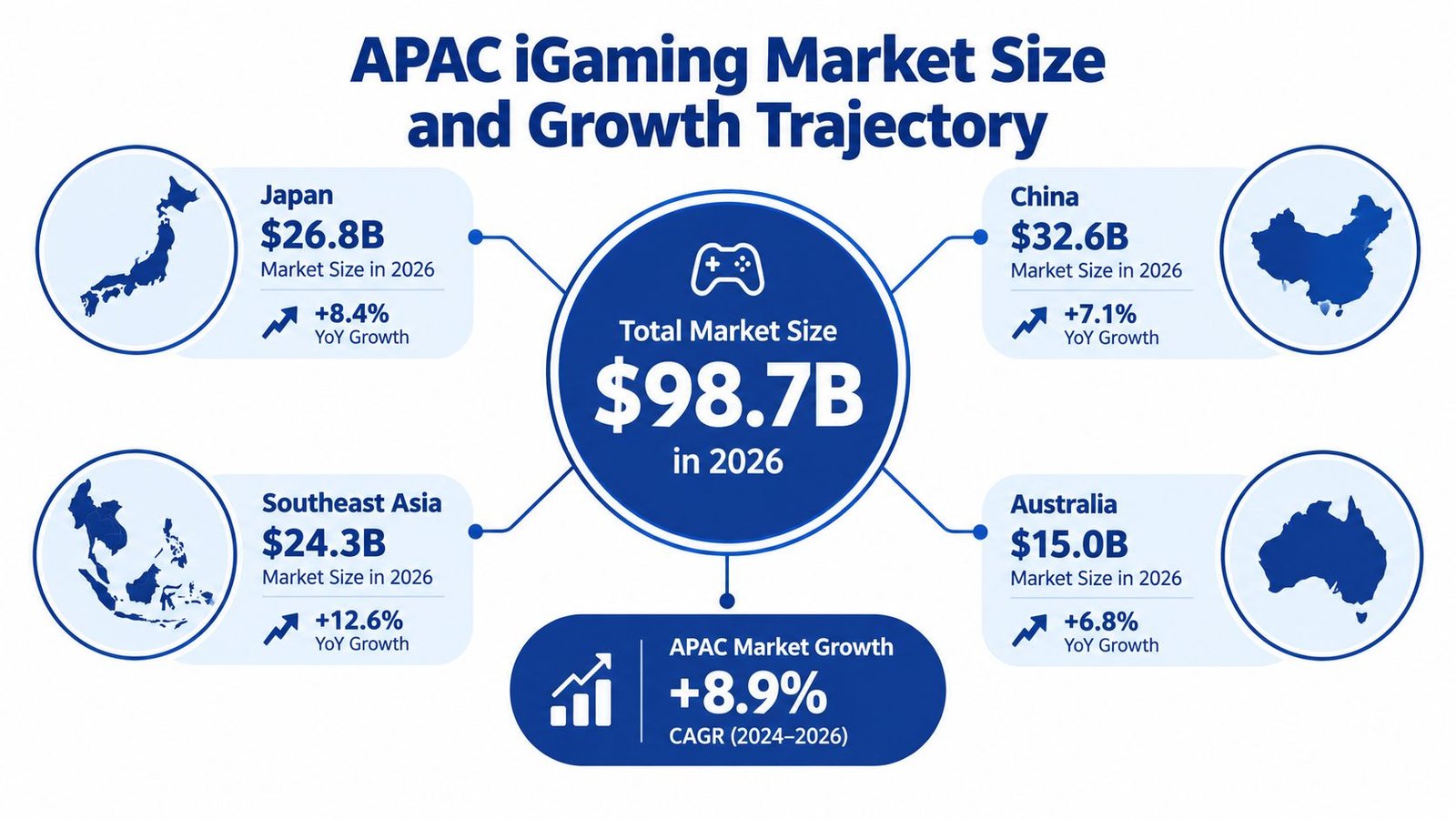
The APAC online gambling market is estimated at USD 29.70 billion in 2026, compared with USD 16.85 billion in 2020 and USD 26.11 billion in 2025, based on IMARC's regional market estimate. The figures establish the scale of regional demand, but they do not identify which portion is accessible to licensed operators or sustainable under tighter enforcement.
Market estimates should therefore be read as directional benchmarks, not interchangeable accounting measures. Differences in market definition, country coverage, included product categories, treatment of offshore activity, and forecasting assumptions can produce materially different totals. A headline estimate may capture consumer activity that has limited value for an operator unable to secure a licence, process payments, advertise lawfully, or offer the permitted product mix.
The investable market is narrower than the reported market. Its size depends on the overlap between demand, licensing access, payment approval, identity controls, and permitted verticals. That distinction is more useful for capital allocation than a single regional growth rate because it separates potential demand from revenue that can be captured and retained within a defensible operating model.
Regulated value and grey-market value
A regional legal overview estimates APAC's grey-market online gross gaming revenue at about USD 16.8 billion and places the regulated share at approximately 41%, according to the International Masters of Gaming Law regional overview. The figures illustrate a structural split: grey-market activity can expand the addressable demand pool while remaining difficult to finance, retain, or defend over time.
Regulated and unregulated operators also grow under different constraints. Licensed businesses must meet jurisdiction-specific approval requirements, responsible-gaming controls, KYC and AML obligations, advertising restrictions, and payment oversight. Grey-market operators may reach consumers without the same formal obligations, but payment disruption, enforcement action, platform exclusion, and weak legal recourse reduce the durability of that revenue.
Mobile connectivity and digital payments support online gambling expansion across APAC, particularly where smartphones are the primary access point to digital services. Conversion into compliant revenue still depends on the player's location, the legal classification of the activity, age controls, identity verification, and payment availability. A large mobile audience is therefore an acquisition signal, not proof of a viable market entry.
Regulatory tightening in key hubs widens the gap between the two growth paths. Operators can no longer assume that a single cross-border brand, payment stack, and product catalogue will perform consistently across the region. They must localize compliance controls and adjust product mix to the licence, enforcement posture, and approved channels of each jurisdiction.
Strategic reading: Market size is an opportunity indicator, not a market-entry decision. The investable opportunity sits where demand, licensing, payments, and permitted product categories overlap.
Customer acquisition economics require the same separation. Teams assessing user acquisition cost in iGaming should distinguish licensed acquisition from traffic that may be difficult to monetize or retain. The same channel can produce different economic value when payment approval, advertising permissions, and product legality change by market.
APAC consequently has a two-speed structure. Licensed hubs and domestic channels can support accountable operators and repeatable controls. Cross-border and grey-market activity may enlarge the headline total, but it does not offer equivalent durability. Investors that treat both pools as interchangeable risk overstating the quality of regional revenue.
Segment Performance and Vertical Shifts
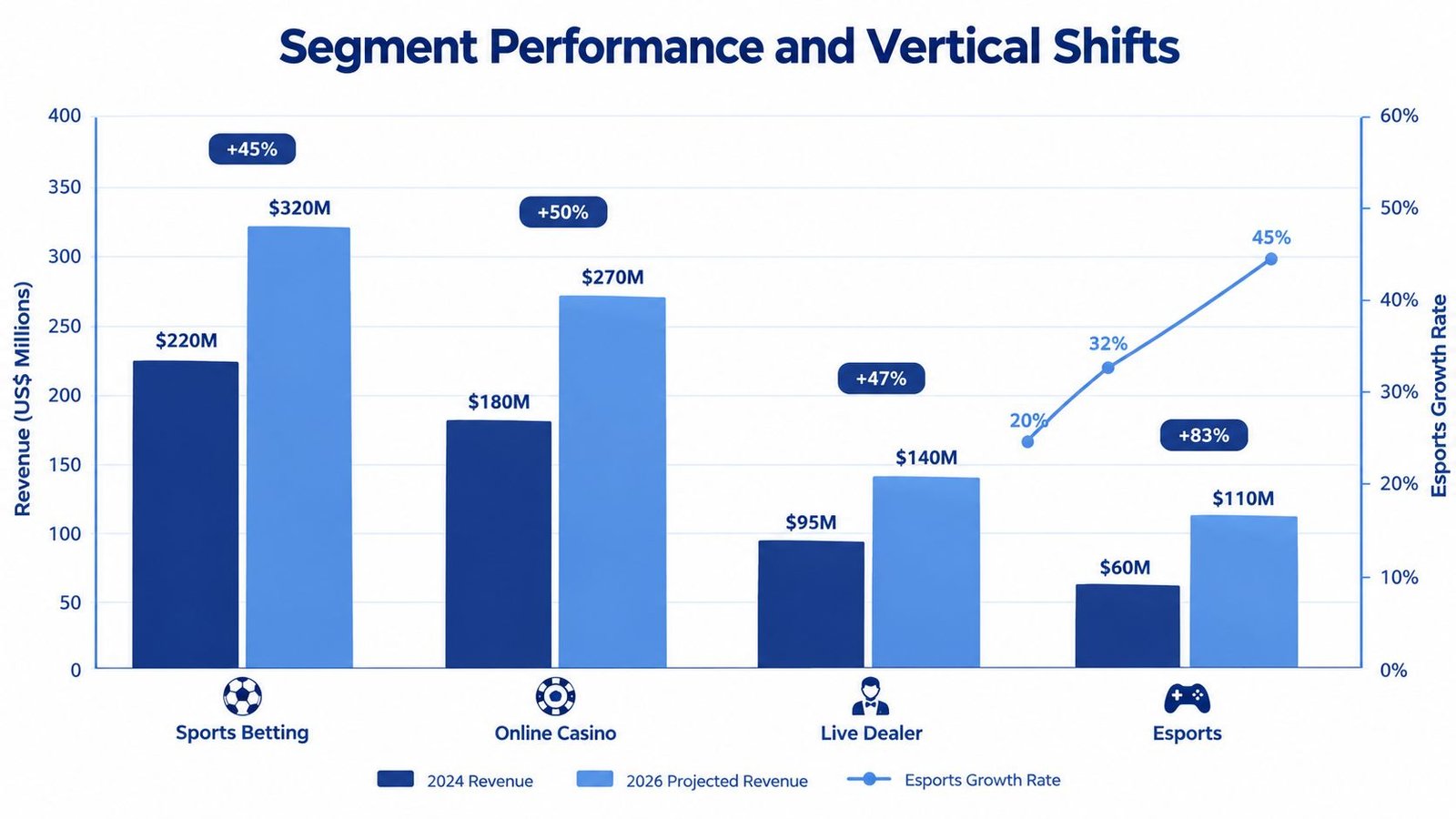
In the first quarter of 2025, domestic eGames generated 49.4% of the Philippines' total gross gaming revenue, or Php51.39 billion, making it the local gaming industry's leading revenue driver, according to Asia Gaming's Asia market roundup. The figure shows how regulated or locally accountable channels can capture demand more effectively than offshore models when products, payments, and player safeguards fit the jurisdiction.
The implication extends beyond the Philippines. Headline demand can grow while the share of that demand available to licensed operators contracts. Regulatory tightening in major hubs is separating legally convertible revenue from grey-market activity. Operators therefore need country-specific compliance controls and product decisions, rather than a uniform cross-border catalogue supported by the same payments and marketing model.
The strategic question is not whether eGames will lead every APAC market. It is whether each vertical can operate within the relevant licence, advertising rules, payment network, verification standards, and enforcement posture. Product resilience depends on the channel's legal and operational fit.
Why product mix is becoming a compliance decision
Sports betting, online casino, live dealer, and esports betting should be assessed separately. Their commercial potential depends on the product categories a jurisdiction permits, the licence available to an operator, the treatment of local and cross-border operations, and whether approved payment channels can support acquisition and retention. A format that performs well in one market may create regulatory exposure in another.
Recent regional developments reinforce that divergence. Coverage of India's online gaming crackdown in 2025 contrasts with the Philippines' move away from offshore POGO models. Macau also recorded a strong late-2025 rebound in its broader gaming market after weaker early-year growth. These developments indicate that land-based recovery, domestic gaming expansion, and online casino opportunity do not move as one regional cycle. The relevant evidence is summarized in the Asia Gaming regional market coverage.
A vertical review should test four conditions:
- Sports betting: Is the activity permitted, and can the operator obtain a local licence instead of relying on cross-border distribution?
- Online casino: Does the legal framework recognize online casino activity, or restrict play to other categories?
- Live dealer: Can the operator meet local requirements for studios, game integrity, hosting, and responsible gaming?
- Esports and emerging formats: Are classification, advertising, age controls, and payment treatment clear enough for commercial deployment?
The result is a narrower, locally justified portfolio. The strongest product is not necessarily the one with the widest international appeal. It is the one that remains permitted as regulation tightens and converts demand through approved payment and verification channels. Grey-market growth may raise regional totals, but regulated growth determines the durability and investability of revenue.
Country-by-Country Regulatory Overview
APAC has no single online gambling framework. The region combines fully licensed markets such as Macau and Singapore, a controlled but significant online market in the Philippines, and reform activity in Thailand, India, the UAE, and Uzbekistan. Online gambling remains prohibited or unregulated across much of the region, according to the International Masters of Gaming Law overview of Asia.
This fragmentation creates a clear divide between regulated and grey-market growth. Demand can cross borders quickly, but licences, permitted products, advertising rules, payment access, and consumer controls do not. Operators therefore need country-specific compliance and product decisions instead of a uniform regional rollout.
Australia represents the tightening end of the spectrum. The Interactive Gambling Act 2001 makes it illegal to offer several online gambling services to people in Australia, including online casinos, in-play sports betting, and betting services without an Australian licence, according to the Australian Communications and Media Authority's explanation of the Interactive Gambling Act. An amendment bill passed Parliament on 19 August 2026 and introduces stricter advertising rules, a global opt-out register, affiliate commission restrictions, and stronger enforcement against illegal services.
The Australian government's gambling reforms are scheduled to commence from 1 January 2027, according to Australian Department of Social Services guidance on the National Consumer Protection Framework for Online Wagering. The framework applies to licensed online wagering providers and contains 10 consumer-protection measures. Australian market access therefore depends on more than licensing. Marketing distribution, affiliate economics, consumer controls, and enforcement readiness also affect the viability of an operator's acquisition model.
The Philippines follows a different regulatory model. PAGCOR regulates games of chance and separately licenses and supervises local online gaming operations, including electronic casino games, sports betting, online poker, and numeric games. Its regulatory units also accredit service providers and assess gaming platforms and systems before approval, according to PAGCOR's regulatory information on electronic gaming.
Responsible gaming is another operating requirement. PAGCOR requires licensed and PAGCOR-operated entities to adopt the Responsible Gaming Code of Practice, which aims to reduce harm, prevent gambling addiction, and prohibit underage gambling. In 2026, PAGCOR also moved to replace responsible-gaming advertisements with promotion of a 24/7 National Problem Gambling Helpline, according to PAGCOR's responsible-gaming information.
APAC Jurisdiction Regulatory Matrix 2026
| Jurisdiction | Online Casino Status | Sports Betting Status | Primary Regulator | Key 2026 Compliance Focus |
|---|---|---|---|---|
| Australia | Several online casino services are illegal to offer to people in Australia | In-play sports betting and services without an Australian licence are restricted under the Interactive Gambling Act | Australian Communications and Media Authority, with licensed wagering oversight under the national framework | Advertising controls, opt-out mechanisms, affiliate commissions, consumer protection, and enforcement |
| Philippines | Local online gaming operations, including electronic casino games, can be licensed and supervised | Local online sports betting is among the activities separately licensed and supervised by PAGCOR | PAGCOR | Platform approval, service-provider accreditation, KYC and AML controls, responsible gaming, and underage-gambling prevention |
| Macau | Fully licensed market | Market treatment depends on the applicable local licensing framework | Local gaming authorities | Local licensing and product-specific compliance |
| Singapore | Fully licensed market under a tightly controlled framework | Subject to applicable local authorization and controls | Local regulatory authorities | Licensing discipline, consumer protection, and approved-channel compliance |
| Thailand | Online gambling remains subject to a restrictive and changing environment | Subject to local restrictions and reform developments | Relevant national authorities | Legal classification, market-entry review, and reform monitoring |
| India | Rules differ across jurisdictions and online gambling activity faces significant restrictions | Rules differ across jurisdictions and enforcement conditions | Relevant national and state authorities | Product classification, state-level analysis, advertising, payments, and enforcement risk |
| Other APAC jurisdictions | Many jurisdictions prohibit or do not formally regulate online gambling | Treatment varies substantially by jurisdiction | Relevant local authorities | Country-specific legal opinions, licensing analysis, KYC and AML readiness, and payment controls |
The matrix supports one operating principle: a cross-border compliance policy cannot replace local legal analysis. Before launch, operators need market-specific decisions on product approval, marketing, payment checks, customer controls, and escalation procedures.
Teams tracking PAGCOR regulatory updates for 2026 should distinguish a licence-policy change from a change in operational expectations. A regulator may leave a permitted product category intact while raising standards for platform accreditation, responsible gaming, advertising, or supplier oversight. This is why regulated growth requires local operating capability, while grey-market growth remains exposed to enforcement, payment disruption, and sudden product restrictions.
Technology, Payments, and Compliance Infrastructure
A translated front end does not create a localized iGaming operation. In APAC, localization must extend across identity capture, payment routing, risk decisions, withdrawals, reporting, and customer support. This infrastructure separates regulated growth from grey-market expansion. The former requires market-specific controls. The latter may reuse a cross-border model, but remains exposed to enforcement, payment disruption, and product restrictions.
Jurisdiction recognition is the first technical control. Before a user advances through the funnel, the operator should determine location, permitted product, licence scope, payment eligibility, and marketing consent. A single registration flow can create avoidable exposure when it treats a restricted player, a licensed-market customer, and an offshore visitor as equivalent users.
A localized transaction stack
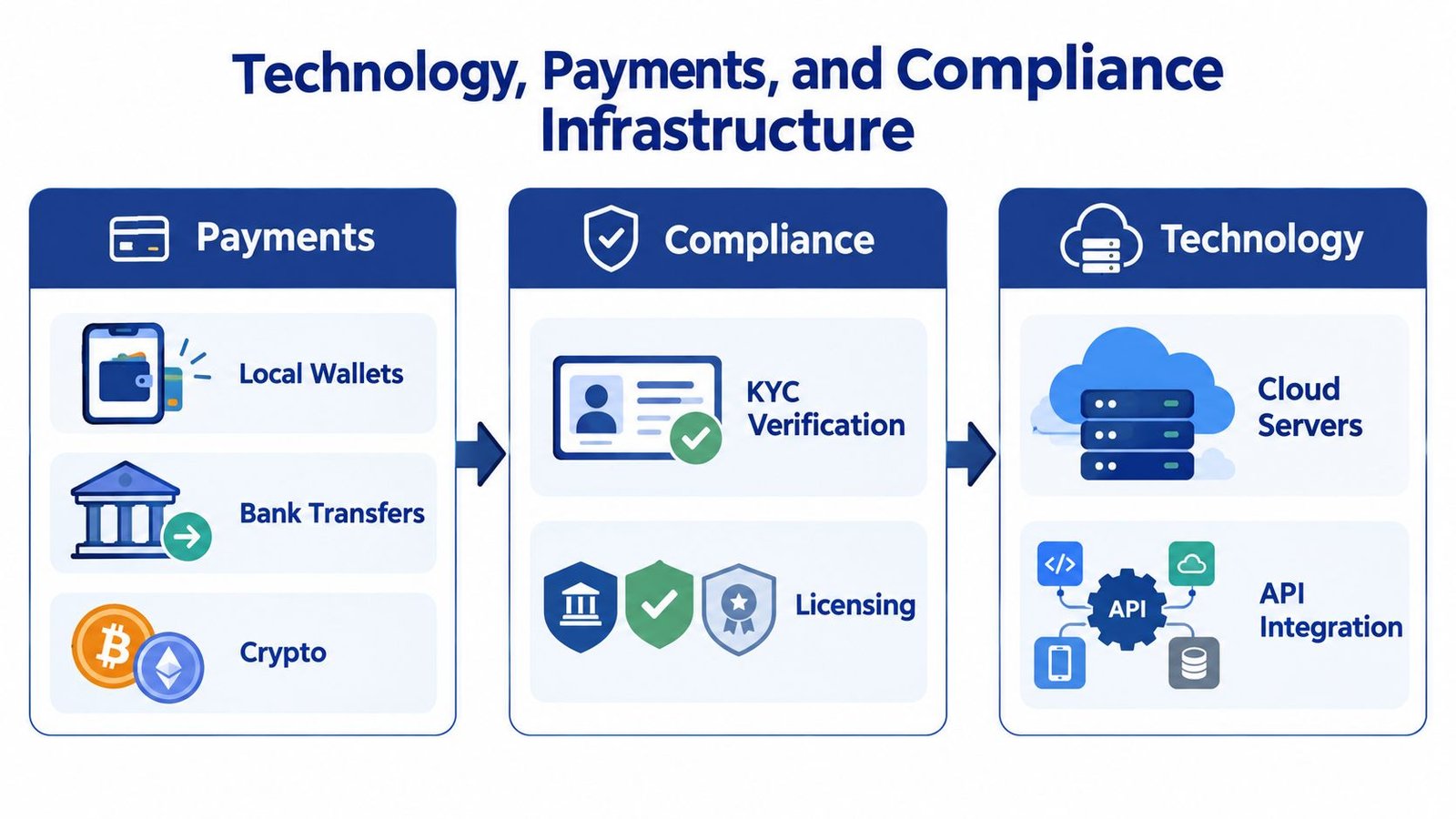
Payment localization begins with acceptance and continues through settlement, monitoring, withdrawal, and review. Routing rules should account for jurisdiction, currency, product eligibility, payment-instrument risk, withdrawal requirements, and the evidence needed for KYC and AML checks.
A transaction stack suited to regulated expansion typically includes:
- Local payment methods: Wallets, bank transfers, cards, and other approved methods should be mapped to the customer's jurisdiction and licence environment.
- Transaction monitoring: Deposits, withdrawals, chargebacks, velocity, account relationships, and unusual activity should feed a shared risk engine rather than separate operational systems.
- Identity verification: KYC should collect and validate the information required by the relevant regulator, with an audit trail for later review.
- Supplier governance: Payment gateways, platform providers, affiliates, and technology vendors need documented approval and ongoing monitoring.
- Reporting interfaces: Compliance teams need structured exports and regulator-ready records, not screenshots assembled after an incident.
In the Philippines, platform and supplier controls affect deployment because PAGCOR's regulatory units accredit service providers and assess gaming platforms and systems before approval, as described in the PAGCOR regulatory framework for electronic gaming. A payment provider is therefore part of the operating model, not merely a conversion tool. Accreditation, transaction controls, data handling, and reporting capacity can influence whether an operator can enter or continue serving a market.
KYC and AML as continuous controls
KYC should remain active after registration. A customer's risk profile can change after altered payment behaviour, a withdrawal request, linked-account activity, or interaction with a product carrying different compliance requirements. Controls must therefore connect onboarding data with transaction monitoring, account management, intervention, and escalation.
Australian operators also need to prepare for broader consumer-protection requirements that are scheduled to apply from 1 January 2027 under the National Consumer Protection Framework, as described by the Australian government's gambling reform guidance, including the framework's 10 measures. The technology stack must support account controls, customer communications, affiliate governance, and documented intervention alongside identity checks.
A local gateway can improve conversion only when it connects to the operator's risk and compliance logic. The appropriate PAGCOR payment gateway accreditation should be assessed with transaction monitoring, withdrawal controls, data retention, and escalation procedures. Otherwise, a business may reduce front-end payment friction while increasing back-end compliance exposure.
Competitive Dynamics and M&A Activity
APAC competition is shifting from broad geographic reach to controlled local execution. Offshore models can appear efficient because they reuse one platform, one brand, and one acquisition system across several markets. That efficiency weakens when regulators restrict advertising, payment providers reject transactions, affiliates face new obligations, or a product lacks a lawful route in the target jurisdiction. The result is a widening gap between regulated operators that can localize execution and grey-market businesses that depend on cross-border consistency.
The strongest strategic position combines three capabilities: an approved route to market, local knowledge of customers and payments, and technology that applies market-specific rules without disrupting the wider platform. Operators can build this combination internally, acquire it, or obtain it through a partnership. The right choice depends on whether the capability is a source of durable differentiation or a repeatable service available from specialist suppliers.
Where strategic value is concentrating
Platform suppliers with configurable compliance controls are better positioned than systems that require manual intervention for each market. Payment processors with strong local coverage can also become important infrastructure when operators must route transactions according to jurisdiction and risk, rather than maximize authorization rates alone.
Specialist providers can create value through:
- Regulatory technology: Identity verification, age checks, KYC, AML monitoring, exclusion controls, and reporting.
- Payment infrastructure: Local acquiring, wallets, bank-transfer connectivity, reconciliation, and withdrawal risk management.
- Platform modularity: Product, bonus, content, and responsible-gaming rules that can be activated by jurisdiction.
- Data and fraud intelligence: Account-link analysis, device signals, behavioral monitoring, and affiliate-quality controls.
- Local distribution: Partnerships that understand permitted acquisition channels and operate within local advertising rules.
The strategic case for consolidation is scale with control. A combined group can spread compliance engineering, legal review, monitoring, and operational governance across a portfolio, while keeping product and acquisition decisions specific to each market. That operating model is more defensible than forcing every jurisdiction into one template.
What investors should test
Public announcements rarely show whether a target has durable APAC value. Buyers should examine licence transferability, regulator relationships, payment approval rates, revenue by legal market, affiliate exposure, unresolved KYC and AML cases, and the share of revenue generated in jurisdictions without a stable licensing path.
A target with strong gross revenue but weak separation by market may carry more risk than a smaller business with clear licensed-market reporting. Customer data requires the same scrutiny. If acquisition channels include incentives, affiliates, or traffic sources that cannot be reconciled with responsible-gaming rules, the buyer may inherit compliance and reputational liabilities alongside the revenue.
The same diligence applies to casino brands. A buyer assessing an online casino with good payouts should test payout reliability through a regulatory lens, including whether payment processes, terms, identity checks, and complaint handling support the brand's claims in each market.
Investors should replace broad transaction narratives with verifiable operating tests. Review the last 12 months of payment authorization rates by jurisdiction and affiliate traffic logs before valuing cross-border revenue. Then reconcile those findings with licence scope, customer concentration, unresolved compliance cases, and the proportion of revenue that can continue under regulated local channels. Capital is likely to favor capabilities that reduce jurisdictional friction, while undifferentiated cross-border distribution faces a higher burden of proof.
Strategic Recommendations for Operators and Investors
APAC's opportunity rewards local operating discipline more than uniform regional expansion. Regulatory tightening in major hubs is widening the gap between licensed growth and grey-market demand. Operators and investors should therefore treat regulatory fit as a commercial variable that shapes product selection, distribution, payments, and customer economics from the start.
Licensed channels should receive priority because they offer clearer operating rules, more defensible payment access, and stronger foundations for durable customer relationships. Grey-market demand may increase the theoretical size of the opportunity, but it should not be valued as equivalent revenue. Its continuity depends on enforcement, payment access, and the operator's ability to localize controls.
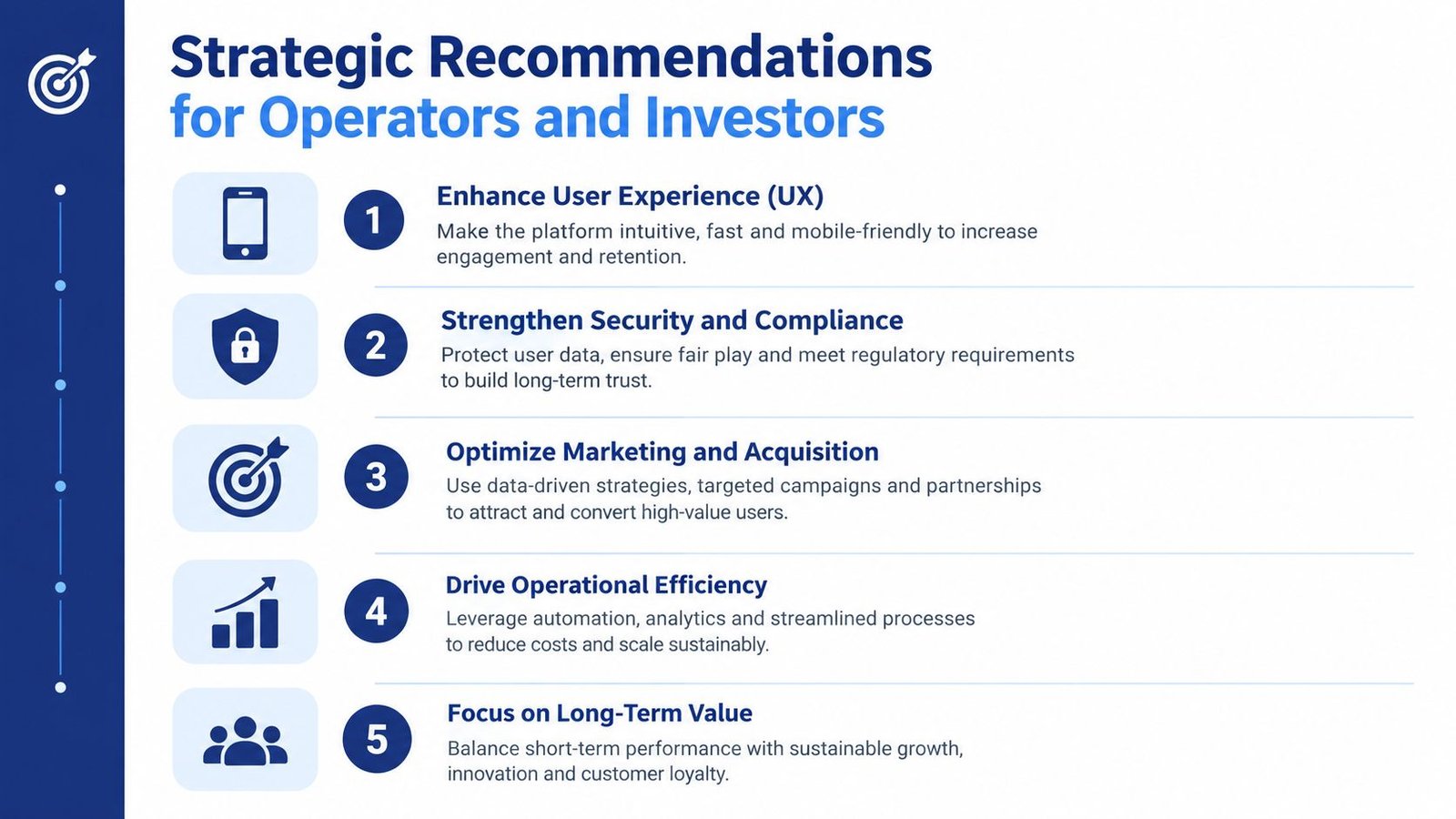
Five decisions for market entry
Select jurisdictions before selecting products.
Start with a legal map covering permitted products, licence requirements, advertising restrictions, payment constraints, and responsible-gaming obligations. Demand alone does not justify entry. A market may be commercially attractive while offering no reliable legal route for the intended product.Build a country-specific product mix.
The Philippines' eGames performance shows why domestic channels can become more valuable than offshore distribution. Product teams should assess whether casino, sports betting, live dealer, or other formats fit each local licence and consumer-protection framework. A standard international catalogue can create regulatory and commercial friction when consumer demand differs by market.Separate licensed revenue from grey-market exposure.
Financial models should report revenue, acquisition, payment success, compliance cost, and retention by legal market. The regional benchmark of 41% regulated share and roughly USD 16.5 billion outside licensed frameworks, as reported in Track360's market analysis, shows why blended regional reporting can overstate the quality of addressable demand.Treat affiliates as regulated distribution partners.
Australia's 2026 amendment bill includes affiliate commission restrictions and stronger enforcement against illegal services, according to the ACMA's Interactive Gambling Act update. Affiliate controls should cover jurisdiction targeting, creative approval, traffic monitoring, record keeping, and documented takedown procedures. These controls should be configured locally rather than applied as a single regional policy.Invest in infrastructure before acquisition scale.
Compliance, payment routing, customer support, fraud controls, and reporting should be operational before marketing expands. A cost-reduction strategy for iGaming operations can remove duplicated processes and manual friction while preserving identity, transaction, and responsible-gaming controls.
Implications for investors
Investors should prioritize businesses that make regulated revenue easier to build and defend. Payment infrastructure, compliance technology, configurable platforms, local content supply, and data systems can support multiple operators without depending entirely on one consumer brand.
Management teams should also explain their response to tighter regulation. Which markets would they exit? How quickly can the platform disable a product by jurisdiction? Can reporting distinguish licensed revenue from unlicensed or uncertain exposure? Answers to these questions reveal whether localization is embedded in the operating model or treated as a future project.
Australia deserves particular attention because reforms are scheduled to commence from 1 January 2027, according to the Department of Social Services reform guidance. The reforms are expected to affect licensed online wagering providers through the National Consumer Protection Framework. Investors should value regulatory readiness as an operating capability with engineering, legal, and customer-service costs, not as a policy document.
Board-level test: If a company cannot explain which customers, products, affiliates, payment methods, and suppliers are legal in each target jurisdiction, its regional growth forecast is not yet investment-grade.
Methodology and Data Sources
This APAC iGaming market report 2026 separates published market estimates from editorial interpretation. Market-size figures are treated as directional benchmarks, not as one consolidated regional total. Differences in market definition, inclusion of offshore activity, geographic coverage, currency conversion, and forecast assumptions make direct averaging inappropriate.
The source framework is summarized below.
| Source | Metric or evidence used | Geography | Caveat |
|---|---|---|---|
| IMARC | Regional market-size estimates and historical series | APAC | Published estimates may use a market boundary that differs from other research providers. |
| Track360 | Regional online gaming and regulated-share benchmarks | APAC | The methodology distinguishes licensed activity from volume outside licensed frameworks, but the classification is not an audited industry census. |
| International Masters of Gaming Law | Grey-market online GGR and regulated-market assessment | APAC | The estimate is used to frame market structure, not to reconcile every jurisdiction into one total. |
| Australian Communications and Media Authority | Interactive Gambling Act position, amendment milestones, advertising and affiliate rules, and enforcement direction | Australia | Regulatory guidance describes the legal framework. It does not confirm compliance by individual operators. |
| Australian Department of Social Services | Reform implementation timing and consumer-protection measures | Australia | The material supports interpretation of scheduled reforms, not a forecast of their commercial effect. |
| PAGCOR | Licensing, supervision, service-provider accreditation, platform evaluation, and responsible-gaming requirements | Philippines | The regulator's stated framework does not mean that every operator, product, or supplier will receive approval. |
| Asia Gaming | Philippine eGames performance, Indian enforcement developments, offshore POGO changes, and Macau market signals | Selected APAC markets | Regional reporting provides context for direction and divergence, rather than a uniform measure across countries. |
Regulatory verification
Regulatory claims are given priority over commentary. Australia's position under the Interactive Gambling Act, the 19 August 2026 amendment milestone, advertising and affiliate provisions, and enforcement direction are assessed separately from the implementation date of 1 January 2027 and the 10 consumer-protection measures. The latter measures are attributed to the Department of Social Services, while the former regulatory points are attributed to ACMA.
Philippine analysis uses PAGCOR material to distinguish regulator responsibilities from commercial outcomes. Its remit covers games of chance, local online gaming operations, accredited service providers, platform and system evaluation, and the Responsible Gaming Code of Practice. Those references establish the regulator's stated requirements. They do not establish that offshore or locally marketed products satisfy them.
Interpreting vertical and country signals
The Philippines' eGames performance, the reported Indian crackdown, the shift away from offshore POGO models, and Macau's late-2025 rebound are treated as separate signals. They illustrate how product demand, enforcement, and market access can move in different directions. They are not combined into a single APAC growth rate or presented as representative of every jurisdiction.
No unsupported M&A totals, vertical forecasts, operator case studies, conversion rates, customer-acquisition figures, or fraud percentages are introduced. Where a source does not establish a comparable number, the analysis remains qualitative. This protects the report from blending licensed revenue, prohibited activity, grey-market volume, and forecasts based on incompatible definitions.
The framework therefore supports jurisdiction-level decisions rather than false precision. Operators can test licensing, product, payment, KYC and AML, responsible-gaming, affiliate, and exit assumptions market by market. Investors can challenge blended regional revenue forecasts and identify infrastructure exposure. Top 1 Rank can use the same evidence base for regulatory intelligence, market analysis, and industry coverage that informs commercial planning.





Join thousands of gaming professionals receiving the latest iGaming news, regulatory updates, and market insights.
