

Esports match wagering in the Philippines is regulated as sports betting by PAGCOR, requires domestic-market authorization under the post-2024 framework, and carries a 21-year minimum gambling age, not the 18-year standard common elsewhere. Legal access depends on the operator's authorization and approved product scope, not merely on whether an esports tournament is available to watch or a betting website accepts Philippine customers.
That distinction changes the commercial question. A growing esports economy offers opportunities for sportsbooks, suppliers, and affiliates, but audience demand alone doesn't establish permission to accept wagers. Licensing, payment access, and consumer protection determine which opportunities can become viable regulated products.
Table of Contents
- The Philippine Esports Betting Landscape in 2026
- How Philippine Law Treats Esports Wagering
- The PAGCOR Licensing Pathway for Esports Sportsbooks
- Payment and Fintech Constraints for Philippine Esports Books
- Consumer Protection and Responsible Gambling for Young Esports Audiences
- Market Size, Operators, and Strategic Opportunities
- Practical Checklist for Operators and Affiliates
The Philippine Esports Betting Landscape in 2026
The Philippines' esports economy reached an estimated PHP1.47 billion in 2024 and is projected to reach PHP5.5 billion by 2032, implying a 23% compound annual growth rate. Sports betting was identified as the largest esports-revenue segment in available market estimates, according to the Philippine esports revenue forecast.
Those figures describe the broader esports economy. They aren't a measurement of authorized esports-betting turnover, sportsbook gross gaming revenue, or the number of eligible bettors. An investor cannot convert the industry forecast directly into a regulated sportsbook revenue forecast without separate evidence on authorization, customer eligibility, wagering activity, and operating costs.
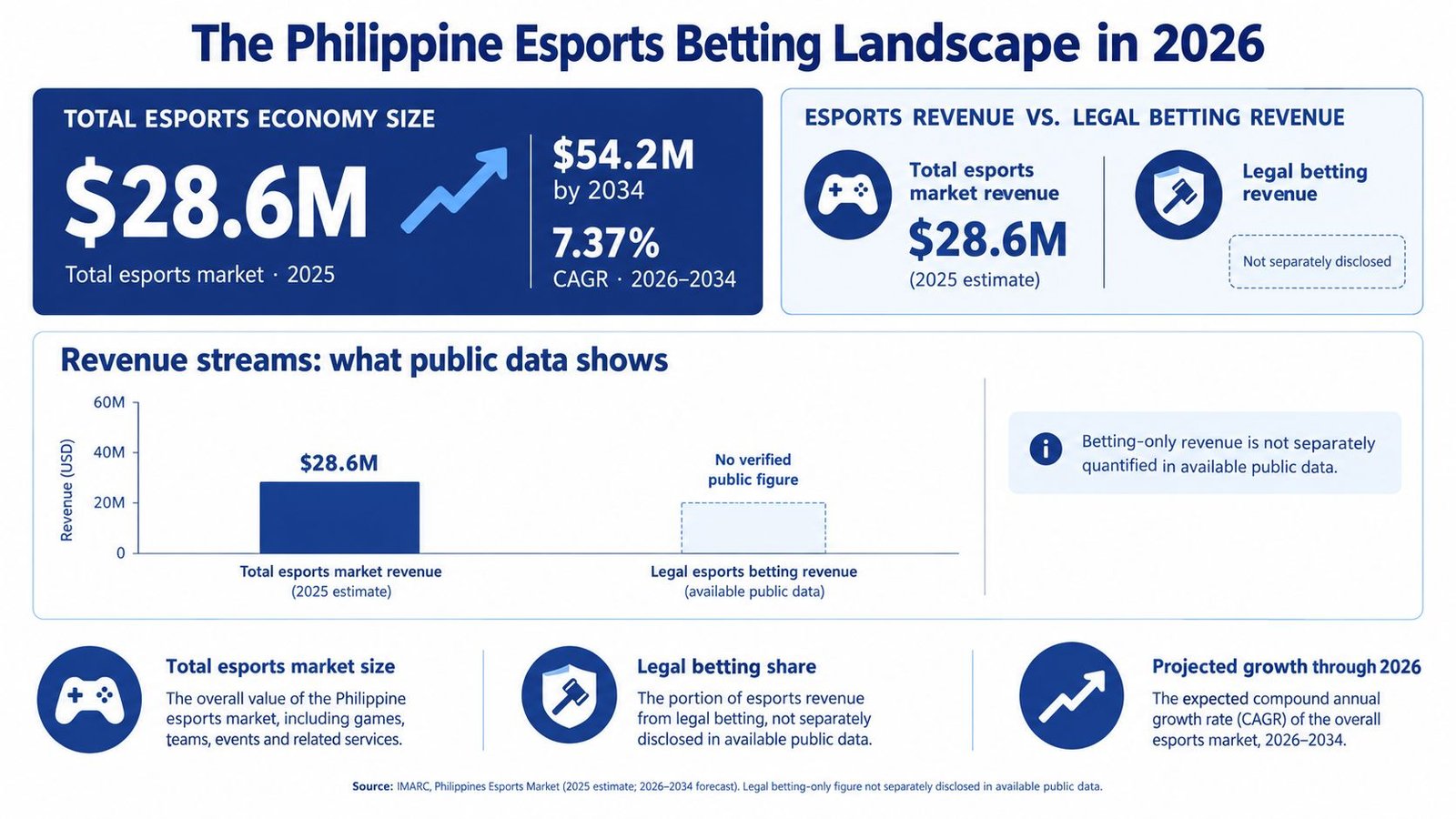
No verified legal-betting share or amount is established by the market figures cited here. Any visual comparison between total esports revenue and legal betting revenue should therefore be treated cautiously, rather than as a quantified market split.
A Growing Industry Within a Narrower Authorization Model
PAGCOR states that all offshore gaming licenses and authorized providers were cancelled effective December 15, 2024. Its subsequent guidance requires online gaming operations to serve only the domestic market and prohibits offering games to offshore players, as detailed in PAGCOR's offshore-gaming notices.
The practical distinction is between domestic authorization and a historical offshore connection. A former POGO association doesn't establish current permission to operate a sportsbook for Philippine residents. Equally, the offshore shutdown doesn't by itself mean every domestically authorized online-gaming product is prohibited.
For product planners, the relevant opportunity is consequently narrower than the total esports audience. Operators need an eligible domestic customer base, approved wagering content, and workable payment channels. Affiliates need to assess the platform behind an offer rather than treating availability in a browser as evidence of legality.
A forecast of esports-industry growth is a demand signal, not a license to accept bets.
The central analytical conclusion is that esports betting in the Philippines is an authorization-led business. Operators should assess the markets they can lawfully offer before estimating the audience they might acquire. Otherwise, commercial plans risk counting customers, products, or territories that the eventual operating model cannot serve.
How Philippine Law Treats Esports Wagering
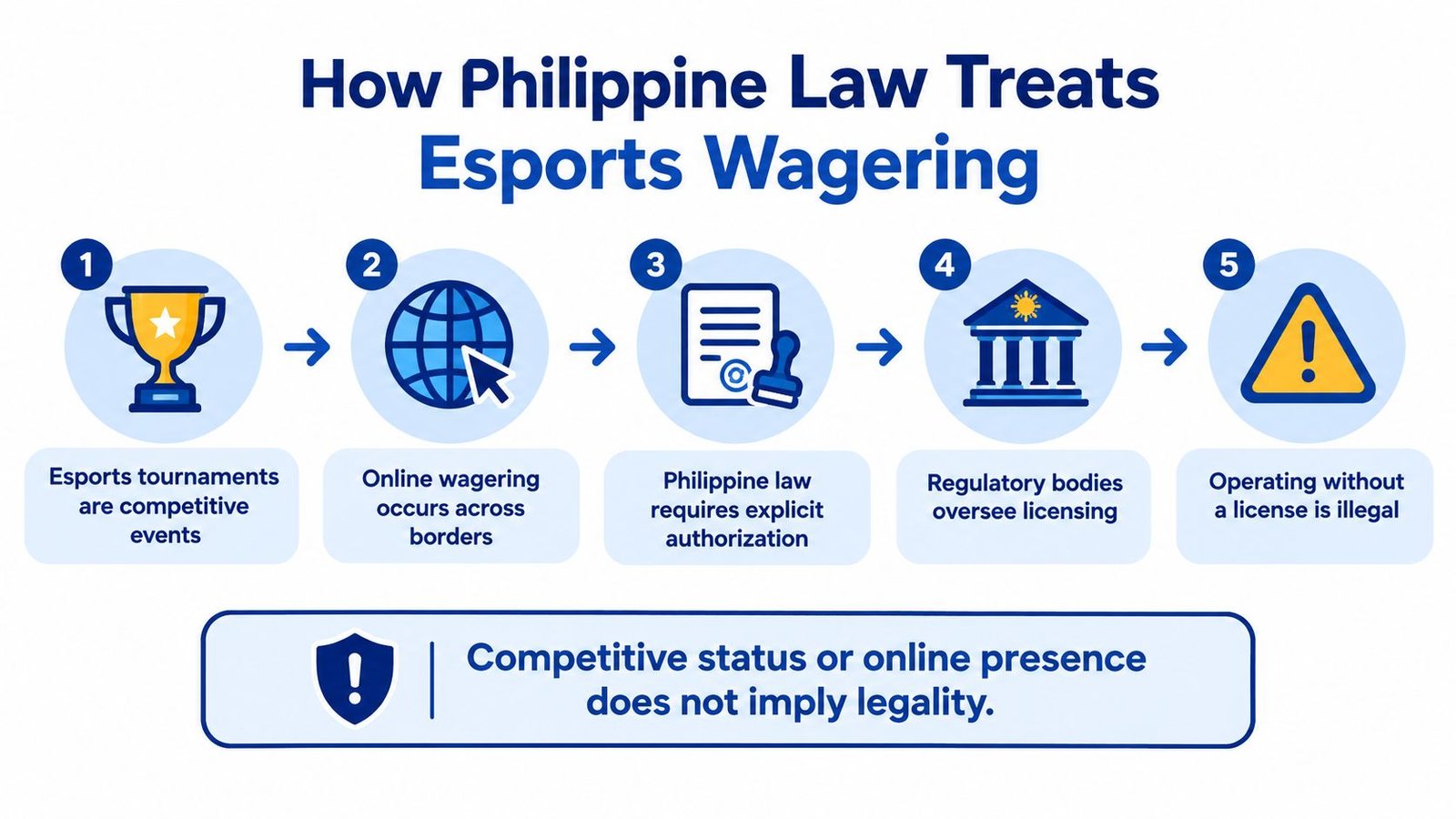
Competitive skill doesn't automatically exempt match wagering from gambling rules. Paying to participate in an esports competition and staking money on another team's result are different activities, even when both involve the same game.
Article 197 of the Revised Penal Code establishes a prohibition on betting money, property, or anything of value on boxing or other sports contests, subject to applicable authorization or exceptions. The historically stated penalties include arresto menor, a fine of up to 200 pesos, or both under the Revised Penal Code enacted in 1930. That provision should not be treated as a complete contemporary opinion on a specific esports product, but it makes clear why operators cannot infer legality from competitive status alone.
Why the Digital-Gambling History Matters
The country's modern online-gambling history began with PhilWeb Corporation's creation on November 5, 2002, followed within weeks by its partnership with PAGCOR, initially for internet sports betting. Earlier disputes highlighted that internet gambling didn't fit neatly within the activities authorized under Presidential Decree No. 1869, PAGCOR's original franchise, as described in the University of the Philippines online-gambling history.
That history explains the importance of classification and administrative approval. A platform's technology doesn't resolve whether its activity is authorized. The relevant question is whether the operator, delivery channel, and wagering content fall within the applicable Philippine framework.
A Practical Legality Test
A bettor or affiliate assessing League of Legends, Dota 2, or Mobile Legends wagering should examine:
- Current authorization. Match the operator's legal identity and platform details against PAGCOR's official information, rather than relying on a displayed logo.
- Approved product scope. Establish whether the authorization covers sports betting and the esports markets being offered.
- Domestic targeting and identity controls. Check that customer access reflects the domestic-only framework and applicable eligibility requirements.
- Unresolved claims. Seek clarification from PAGCOR when the platform's identity, domain, or license description doesn't match official records.
The guide to online-casino legality in the Philippines provides related context, but casino authorization shouldn't be assumed to cover every sportsbook product. A platform may be accessible without its specific esports offering having been established as authorized.
The PAGCOR Licensing Pathway for Esports Sportsbooks
PAGCOR's Electronic Gaming Licensing Department, or EGLD, regulates local operations offering sports betting alongside electronic casino, bingo, specialty, poker, and numeric games. It evaluates applications covering platforms, systems, games, and content before issuing licenses to qualified operators, according to PAGCOR's published electronic-gaming licensing remit.
The distinction matters for procurement. An operator's application cannot be treated as separate from the platform and content it intends to deploy. A supplier should be able to demonstrate how its proposed sportsbook configuration supports the operator's authorization, reporting, and customer-protection obligations.
The Compliance File Behind the Product
PAGCOR's 2023 framework establishes accreditation requirements for gaming-system service providers supporting electronic games, e-bingo, sports betting, and specialty games within its regulatory framework. It also warns that entities falsely claiming offshore authorization are unauthorized and should be reported.
A practical esports-sportsbook compliance file should therefore connect legal scope to technical implementation:
- Authorization mapping. Identify the operator, platform, suppliers, approved content, and intended domestic customer access.
- Market activation controls. Prevent teams from enabling unapproved competitions or bet types through ordinary back-office configuration.
- Bet and settlement evidence. Preserve accepted odds, market identifiers, event status, settlement inputs, and subsequent adjustments.
- Customer-control design. Document identity verification, age restrictions, exclusion handling, and account-access decisions.
- Regulatory reporting. Explain how records can be retrieved and reconciled for supervisory review.
These are operational recommendations, not a substitute for PAGCOR's application requirements or a product-specific legal assessment. The PAGCOR B2B provider application process offers supplementary context for supplier-side preparation.
Esports Settlement Rules Need More Than a Result Feed
Map winner, series winner, handicap, and total rounds should be modeled as sportsbook markets, rather than as novel digital games that escape wagering controls. The operator should publish rules covering postponed matches, roster substitutions, technical pauses, match reversals, and integrity-related voiding.
Consider a roster substitution announced after bets have been accepted. The sportsbook needs a defined decision process, a record of the announcement, and a consistent settlement rule. Without those elements, customer support and trading teams may reach different conclusions about the same market.
Operational principle: Every settlement adjustment should be explainable from the accepted bet, published rules, and retained event evidence.
For broader launch sequencing, NexGrate's operator launch guide for sports betting can support planning. It shouldn't be treated as evidence that a particular Philippine esports product has regulatory approval. The decisive step remains matching the proposed configuration to the applicable authorization.
Payment and Fintech Constraints for Philippine Esports Books
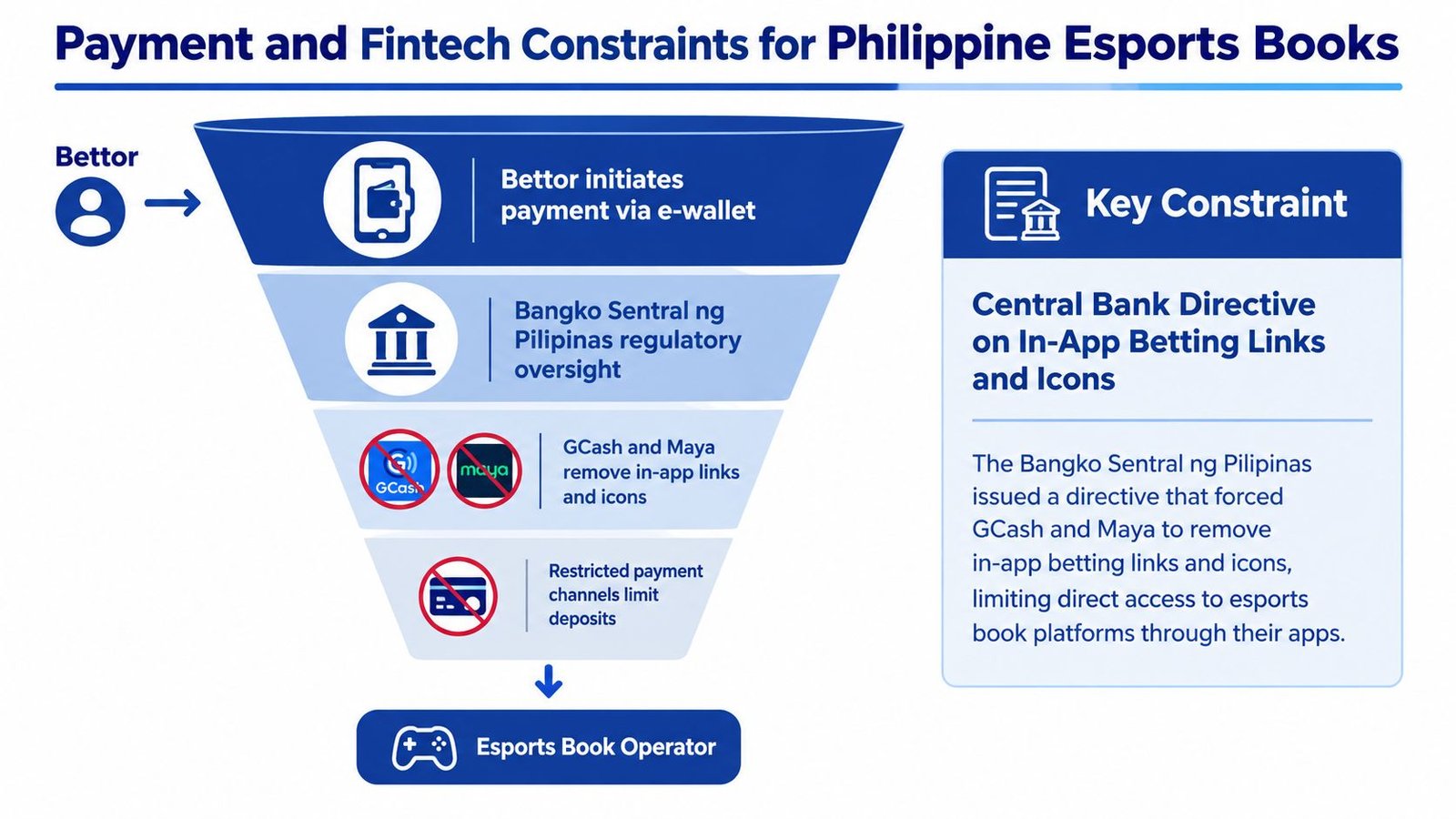
The Bangko Sentral ng Pilipinas directed GCash and Maya to remove in-app links and icons redirecting customers to online-gambling platforms, with the suspension continuing pending a policy framework for online-gambling payment services. The Philippine gambling-payments overview also describes the audience context, including Deloitte's cross-market finding that 82% of esports viewers were Generation Z or Millennials, with viewers disproportionately male and younger.
These facts shouldn't be conflated. Removing gambling shortcuts from an e-wallet changes discoverability, but it doesn't establish the approval status of every possible payment route. Likewise, cross-market audience research isn't a demographic measurement of Philippine esports bettors.
Separate Payment Availability From Payment Permission
PAGCOR's measures also prohibit credit cards and cryptocurrencies for betting. Operators should distinguish whether a payment method is technically integrated, commercially available, and independently approved for gambling use. A successful test transaction answers only the technical question.
Reduced wallet discoverability can plausibly increase abandonment or encourage customers to seek intermediaries. Those are operational risks to measure, not established performance outcomes. Routing customers through an unverified workaround would introduce additional uncertainty rather than resolve the underlying constraint.
A compliant design should separate sportsbook funds from general platform balances, preserve transaction-level provenance, and apply risk assessment to deposits and withdrawals. It should also support disabling a payment channel without altering accepted bets, customer liabilities, or settlement records.
The PAGCOR payment-gateway accreditation guide provides relevant approval context. For supplier evaluation, Paylithix's resource on how to find a gaming payment gateway can help organize technical questions, but it doesn't prove Philippine gambling-payment authorization.
Measure Friction Without Weakening Controls
| Operational measure | Question for the operator |
|---|---|
| Deposit conversion | Are eligible customers abandoning the approved payment journey? |
| Payment failure rates | Are failures concentrated in a channel, provider response, or verification stage? |
| Withdrawal latency | Is delay caused by reconciliation, risk review, or provider processing? |
| Chargebacks | Do disputes correspond to identifiable transaction or account patterns? |
| Suspicious account linkage | Are supposedly separate accounts connected through payment instruments? |
No single metric proves bonus abuse or money laundering. Analysts should combine transaction evidence, account relationships, and verification outcomes before classifying suspicious behavior.
The esports-specific challenge is timing. Customers attempting to fund accounts around fast-moving live markets may experience payment friction as a missed betting opportunity. Operators should explain verification and processing requirements clearly without presenting shortcuts that undermine age checks, funding provenance, or responsible-gambling safeguards.
Consumer Protection and Responsible Gambling for Young Esports Audiences
PAGCOR's Responsible Gaming Code of Practice prohibits persons younger than 21 from gambling, a stricter threshold than the 18-year standard common in many international markets. The Responsible Gaming Code of Practice therefore provides the relevant eligibility standard for Philippine sportsbook access.
Watching esports, following a streamer, or participating in a tournament doesn't establish gambling eligibility. Operators and suppliers should design account opening, payment gating, monitoring, and access controls around the gambling requirement, not the eligibility rules of the underlying game.
Controls Must Match the Betting Experience
PAGCOR's published measures include tighter gambling-advertising rules, self-exclusion and betting-limit tools, and a 24/7 support helpline. Its September 2025 regulatory and responsible-gaming update also describes the betting restrictions on credit cards and cryptocurrencies.
For esports products, these measures should shape the customer journey rather than remain isolated policy disclosures.
| Control | Esports-specific exposure | Recommended implementation focus |
|---|---|---|
| Age verification | A viewer may be familiar with esports but ineligible to gamble | Verify eligibility before enabling betting access |
| Betting limits | Rapid in-play decisions can reduce time for reflection | Make limits accessible within the wagering interface |
| Self-exclusion | Customers may return through promotions or another platform entry point | Enforce exclusion across account access and marketing systems |
| Advertising restrictions | Streamer and influencer audiences can include ineligible viewers | Review audience targeting, creative content, and inducements |
| Support access | A settlement concern can overlap with distress or loss of control | Distinguish dispute resolution from responsible-gambling assistance |
Market Integrity and Customer Protection Aren't Identical
Technical pauses, inconsistent match data, and suspicious wagering require trading and integrity responses. A customer showing signs of harmful play requires a different intervention. Operators shouldn't substitute an integrity investigation for responsible-gambling support, or assume that an ordinary settlement complaint indicates misconduct.
Promotions deserve particular scrutiny because the esports audience includes people whose familiarity with games exceeds their understanding of betting products. Marketing should explain the distinction between competition, entertainment, and wagering without portraying expertise in a game as protection against gambling losses.
Exclusion and limit tools are effective only when the betting interface, payment workflow, and marketing systems respect the same customer status.
The guide to PAGCOR gambling-advertising rules offers related compliance context for operators and affiliates. Acquisition planning should account for those restrictions before campaign commitments are made, rather than leaving compliance review until creative assets are ready to publish.
Market Size, Operators, and Strategic Opportunities
Electronic games generated PHP114.83 billion in gross gaming revenue during the first half of 2025, up 82.67% year on year, while total Philippine gaming GGR reached PHP214.75 billion, according to reporting on PAGCOR's industry figures. These figures establish the scale of the broader regulated gaming environment, not the revenue of esports sportsbooks.
The domestic competitive base is also relevant. 313 Filipino players were reported as actively competing in esports tournaments as of September 2024, within the esports-market data cited earlier. A professional player base provides context for locally relevant competitions, but it doesn't demonstrate that every event is suitable for betting or that commercial data rights are available.
Philippine Esports Betting Market Snapshot
| Metric | Value | Period |
|---|---|---|
| Broader esports economy | Historical estimate, not betting-specific GGR | Historical market baseline |
| Esports economy outlook | Projected expansion, not realized revenue | Forecast period |
| Electronic-games GGR | Commercially substantial, includes products beyond esports wagering | Published first-half reporting |
| Legal esports-betting turnover | Not isolated in the cited figures | Not established |
| Domestic competitive talent | Reported active professional-player base | Historical tournament snapshot |
The snapshot supports market context, not a valuation model. Operators still need product-level evidence on eligible demand, approved payment access, operating costs, and settlement exposure.
Commercial Priorities Within the Authorized Scope
Domestic sportsbook positioning is the most direct opportunity, provided the operator can establish the required product authorization. Local relevance should come from approved competitions, understandable rules, and reliable customer service, rather than claims that the entire esports audience is addressable.
Suppliers can consider data normalization, settlement tooling, compliance reporting, and integrity-monitoring products. Publishers, tournament organizers, and sponsors may offer commercial relationships, but an esports partnership doesn't automatically confer betting rights or regulatory permission.
Affiliates should prioritize verifiable authorization and accurate content. Comparisons of odds or promotions have limited value if the underlying platform's identity, product scope, and customer eligibility remain unresolved. The analysis of user acquisition cost provides a useful commercial lens, but acquisition efficiency should be assessed only after the lawful customer journey has been defined.
The investment implication is that a narrower, well-documented operating model may be more credible than a larger forecast built from total esports revenue. Commercial diligence should test the sportsbook's executable scope, not merely the popularity of the games it proposes to cover.
Practical Checklist for Operators and Affiliates
PAGCOR's warning about false offshore-authorization claims makes operator verification a continuing task, not merely an onboarding check. The earlier regulatory notice provides the basis for reporting suspicious claims through official channels.
A launch review should connect each requirement to an accountable team and retained evidence. Affiliates can apply the same approach when deciding which platforms to promote.
Prelaunch Verification
- Authorization and classification. Confirm the operator's current status, platform identity, and permission for the proposed esports sportsbook content.
- Territorial access. Test geofencing and customer-location controls against the domestic operating scope.
- Identity and age eligibility. Verify that account opening, payment access, and wagering permissions enforce the applicable gambling threshold.
- Payment approval. Establish the status of each channel, including fallback arrangements, rather than relying on technical availability.
- Advertising review. Check campaign audiences, affiliate materials, influencer placements, and promotional inducements before publication.
- Customer protection. Test self-exclusion, limits, and support access across the complete account journey.
- Settlement and integrity. Confirm workflows for roster changes, postponed events, technical interruptions, voided markets, and reversed results.
Keep the Evidence Current
An operator should retain the authorization assessment, supplier documentation, approved market configuration, payment-provider confirmations, and control-test results. Any material change to a platform, product, supplier, or payment route should trigger review rather than inherit approval automatically.
Affiliates should suspend unsupported claims while discrepancies are investigated. A historical license reference, regulator logo, or assertion of offshore approval isn't enough to resolve a mismatch with current official information.
The practical conclusion is straightforward: commercial readiness requires a demonstrable chain from authorization to customer access, funding, wagering, and settlement. A weakness anywhere in that chain can undermine an otherwise attractive esports proposition.
Operators, suppliers, and affiliates preparing a Philippine esports-betting launch should assemble a current authorization file, verify unresolved product and payment questions with PAGCOR, and test customer-protection controls before accepting wagers or publishing acquisition campaigns. Follow Top 1 Rank for ongoing regulatory and market intelligence, and use the checklist above to structure the next compliance review.





Join thousands of gaming professionals receiving the latest iGaming news, regulatory updates, and market insights.
