

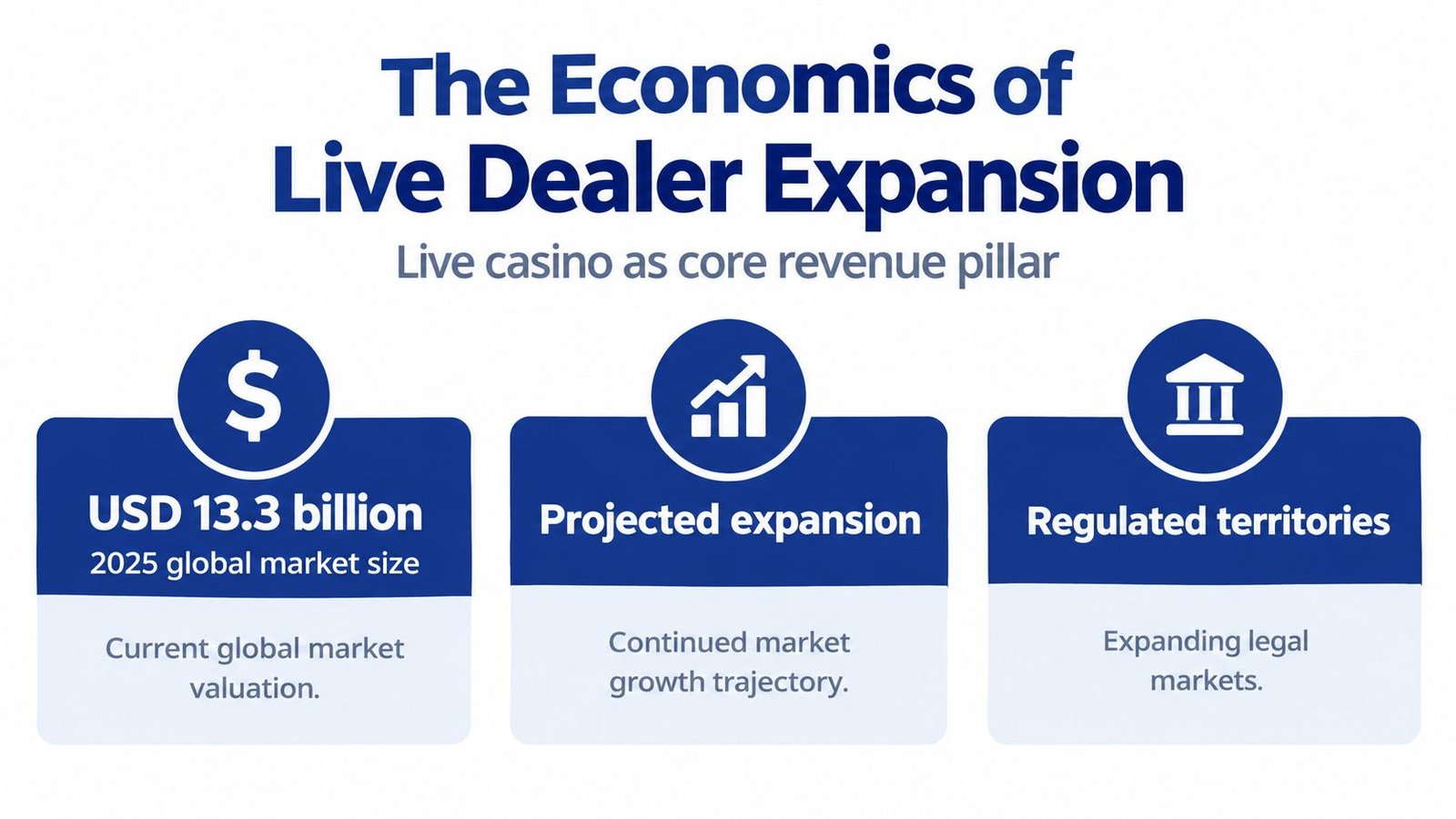
The global live casino market reached USD 13.3 billion in 2025 and is projected to reach USD 38.7 billion by 2034. That scale makes provider selection an operational investment decision, not a preference based on brand familiarity.
For operators, the decisive question is no longer which supplier has the largest game catalogue. It's which provider can deliver stable streams, suitable latency, regulatory access, regional content, and an integration path that matches the launch plan. A useful live casino providers comparison therefore has to examine execution as closely as product breadth.
Table of Contents
- The Economics of Live Dealer Expansion
- Comparing the Major Live Casino Platforms
- Streaming Technology and Latency Requirements
- Market Coverage and Operational Integration
- Strategic Selection and Regional Market Fit
- Vendor Evaluation Framework
The Economics of Live Dealer Expansion
Live casino's estimated USD 13.3 billion valuation in 2025 and projected USD 38.7 billion by 2034 place live-dealer products among the material segments of online gambling. The same outlook reports a 12.6% projected CAGR in the global live casino market outlook. Growth at that scale makes supplier selection an operating and capital-allocation decision, not a catalogue preference.
Expansion affects more than the number of available tables. A supplier can influence launch timing, permitted jurisdictions, stream uptime, player retention, and the cost of adding markets. Operators assessing player acquisition cost and related economics should include supplier performance in the commercial model, alongside integration effort and market-specific operating requirements.
Penetration shows concentration, not universal suitability
Provider penetration indicates where distribution and integrations are already concentrated. One database reported Evolution at 94.3% operator penetration, followed by Pragmatic Play Live at 67.9%, Ezugi at 30.2%, and Playtech Live at 11.3%. These figures show adoption and reach, but they do not establish that one supplier fits every jurisdiction, audience, or platform architecture.
High penetration may reflect operator confidence, established distribution, and mature integration capability. It does not remove the need to verify licensing coverage, latency performance, studio capacity, or deployment timelines. An operator entering a market with distinctive regulatory conditions or demand for localized tables may gain more from regional fit than from the largest global footprint.
European adoption also demonstrates how quickly channel access can change product economics. Industry reporting described live casino content rising from roughly 0.08% to leading-provider status in the UK within about a year. Another tracked-market observation recorded growth from around 0.1% to more than 7% market share in less than a year. The exact trajectory varies by market, yet the commercial implication is consistent: demand can develop rapidly once regulated access, reliable streaming, and effective distribution are in place.
Practical rule: Treat provider penetration as evidence of distribution strength, not as a substitute for technical, regulatory, and operational due diligence.
A defensible shortlist therefore combines catalogue relevance with execution evidence. Compare streaming reliability, jurisdiction coverage, studio availability, integration support, reporting quality, and the time required to launch. These criteria address the gaps that game-count rankings and brand familiarity leave unresolved, while showing whether projected market growth can become dependable product performance.
Comparing the Major Live Casino Platforms
Evolution remains the scale benchmark in most comparative reviews. It's commonly positioned with more than 200 live tables, 4K streaming, and multi-angle or high-definition presentation, while comparison coverage ranks it ahead of Pragmatic Play and Playtech for catalogue depth and streaming quality. Those characteristics are documented in comparative coverage of live casino game providers.
| Provider | Established strength | Operational question for operators |
|---|---|---|
| Evolution | Broad catalogue, large-scale live production, high-definition and multi-angle streams | Does the operator need maximum breadth, and can the integration and commercial model support it? |
| Pragmatic Play Live | Strong market momentum, varied formats, broad supplier positioning | Can its content and deployment model match the target jurisdictions and platform architecture? |
| Playtech Live | Longstanding platform relationships and recognised live casino presence | Does its established enterprise footprint align with the operator's multi-product and compliance needs? |
| Ezugi | Meaningful operator penetration and potential fit for focused selections | Can its regional and table-level strengths complement a larger primary supplier? |
Evolution sets the reference point
Evolution's advantage is less about a single flagship title than about production scale. A wide table network can help an operator serve different player preferences, limits, languages, and peak-period demand from one established supplier relationship. High-definition and multi-angle delivery also create a visible quality benchmark, particularly where operators position live casino as a premium product.
That scale comes with a selection question. A large catalogue can increase choice, but it can also create integration, merchandising, and analytics complexity. The commercial evaluation should identify which tables will be launched, how they'll be prioritised, and whether the operator has enough traffic and operational capacity to use the breadth effectively.
Pragmatic Play Live competes through flexibility
Pragmatic Play Live has become a significant challenger, with the cited database placing it at 67.9% operator penetration. Its relevance in a supplier comparison rests on more than recognition. Operators should examine game variants, market permissions, integration documentation, release support, and the extent to which live content can be managed alongside other verticals.
A provider with a coherent API and useful operational tooling may reduce internal complexity, but that assumption needs verification during technical due diligence. The key test is whether the supplier's integration model fits the operator's existing wallet, account, compliance, and reporting environment.
Playtech and Ezugi occupy different positions
Playtech Live remains important for operators that value established platform relationships and broad brand familiarity. Its reported 11.3% operator penetration in the cited database is lower than the figures for Evolution and Pragmatic Play Live, but penetration alone doesn't capture the value of an existing enterprise relationship or a multi-product technology environment.
Ezugi's reported 30.2% penetration makes it a relevant challenger rather than a marginal supplier. It may be considered as a complementary source where an operator needs additional regional tables, alternative presentation styles, or portfolio diversification. Detailed live-dealer game selection should be assessed against actual target markets, not treated as a generic catalogue exercise.
Streaming Technology and Latency Requirements
Live casino performance depends on timing. A player can tolerate differences in studio design or presenter style, but a delayed betting interface creates uncertainty at the exact moment a wager must be placed. Benchmark guidance notes that a few hundred milliseconds of lag can make fast-paced games feel sluggish.
Transport-layer delivery is typically expected to remain under one second, while end-to-end live delay commonly falls within the 2 to 5 second range, depending on encoding and synchronisation constraints. These benchmarks are set out in technical guidance on live casino software providers.
Where delay enters the pipeline
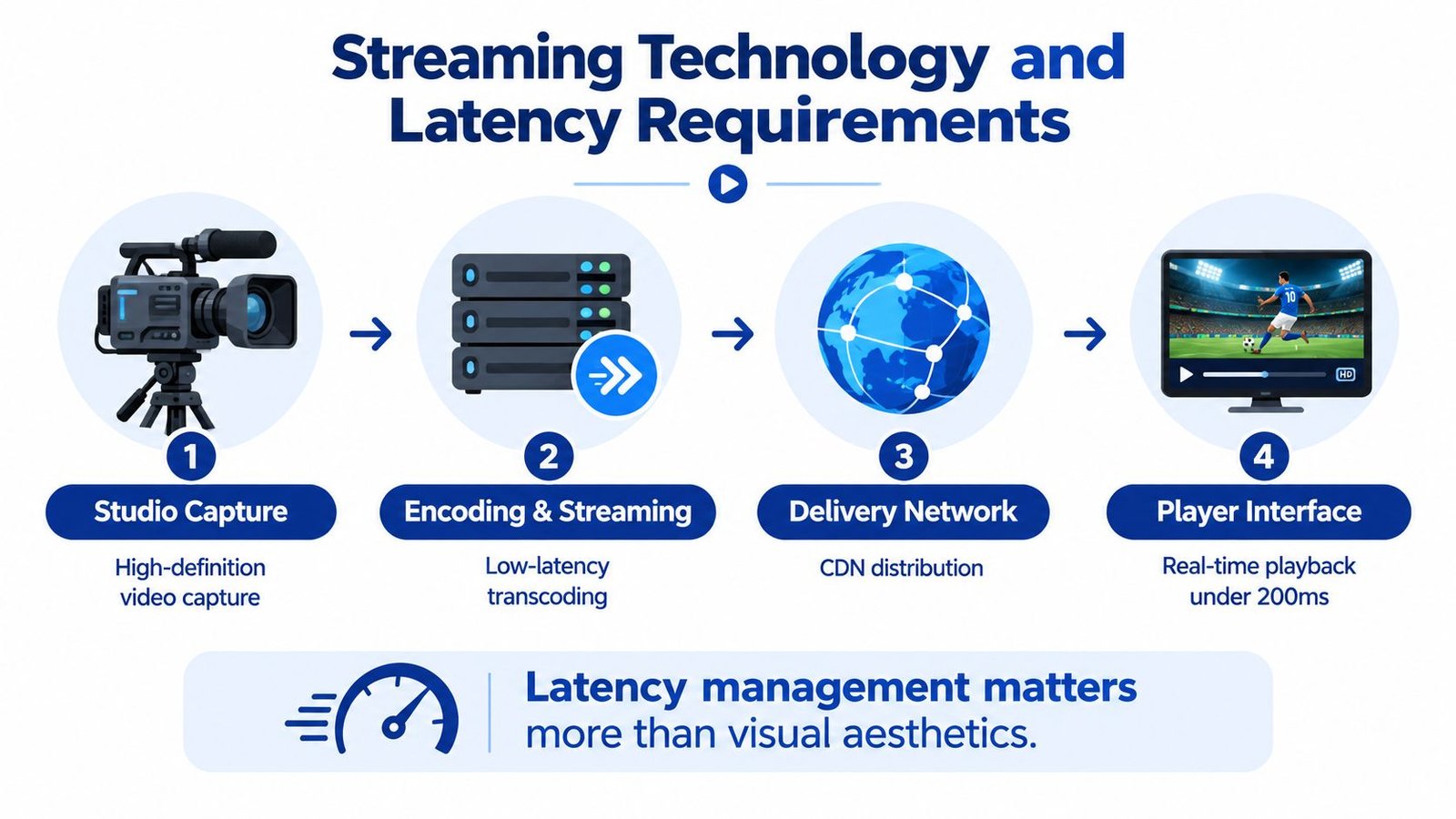
Latency accumulates across several stages:
- Studio capture: Cameras and production equipment capture the dealer, table, cards, wheel, and game state.
- Encoding and packaging: The system compresses the video and prepares it for distribution while preserving synchronisation with game events.
- Network delivery: A content delivery network distributes the stream to players across different locations and devices.
- Interface rendering: The player's browser or app displays the video, betting controls, timers, and outcome information.
Each stage can introduce buffering or timing drift. A provider that reports only a video-stream figure may leave out the end-to-end delay experienced by the player. Operators should request measurements that connect the studio event, betting state, and interface response.
Visual quality cannot compensate for poor timing
4K presentation and multiple camera angles can improve perceived quality, but they don't resolve a delayed betting cycle. High-definition content may also require careful encoding and delivery decisions because additional visual detail can increase bandwidth pressure. The operator's priority should be a stable experience that keeps video, betting controls, and game outcomes aligned.
Technical test: A supplier demonstration should measure the full player journey, not just the stream leaving the studio.
Operators should also examine performance under variable network conditions, mobile usage, peak traffic, and table changes. Documentation for PAGCOR gaming system administrator requirements can help teams frame the wider system and governance questions that sit around a live gaming deployment.
The meaningful comparison is therefore not “which stream looks best?” It's “which supplier can maintain predictable interaction timing across the intended markets, devices, and operating conditions?”
Market Coverage and Operational Integration
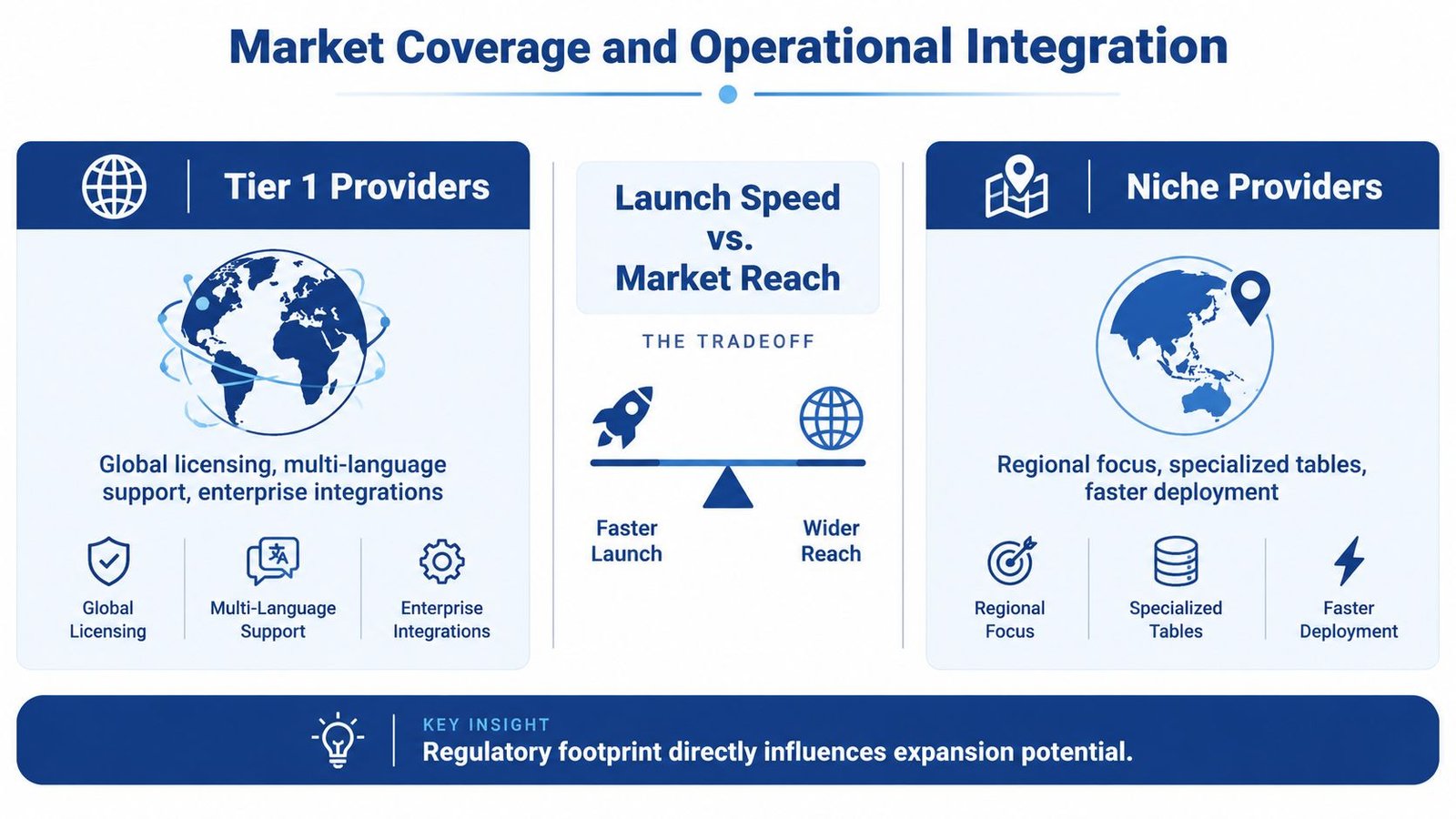
Geographic reach creates commercial value only when it produces usable access in the target jurisdictions. A supplier with an international profile may still require separate verification of licensing, studio availability, language support, payment compatibility, and deployment conditions. The relevant comparison is therefore operational: how quickly a provider can enter each market and whether it can support that launch at scale.
Recent vendor guidance reports integration timelines of 8 to 16 weeks and latency profiles from under 300 milliseconds to about 400 milliseconds. It also compares jurisdiction coverage across Europe, the US, and Brazil, linking market selection with implementation capacity rather than catalogue size alone. These details appear in the 2026 live-dealer vendor guide.
Integration time changes the launch equation
An integration schedule affects marketing readiness, regulatory sequencing, staffing, certification work, and the period in which capital is committed before live revenue begins. A rapid-deployment claim has limited value unless the supplier can document its dependencies, including technical documentation, test environments, certification support, and escalation procedures.
Buyers should request a market-specific implementation plan. A general estimate may change substantially if the selected jurisdiction requires additional controls, reporting, responsible-gambling functions, or studio configurations. Operators assessing the Philippines should also review the PAGCOR B2B provider application process to align licensing and certification sequencing with technical delivery.
Coverage has several layers
A useful review should separate five forms of coverage:
- Regulatory access: Which licences or approvals support the intended launch markets?
- Studio availability: Can the supplier provide suitable tables in the required language and schedule?
- Technical reach: Does the platform support the operator's infrastructure, devices, and delivery regions?
- Operational support: Are service, incident-response, and account-management resources available locally or remotely?
- Commercial scalability: Can expansion proceed without a complete technical redesign?
Brazil and several US states place particular pressure on studio capacity and deployment resources as regulated expansion increases demand. The 2026 vendor comparison identifies these markets alongside Europe and contrasts suppliers by integration, latency, and jurisdictional reach.
The strongest provider is the one whose regulatory footprint, studio capacity, and implementation process match the operator's market-entry sequence. A wider geographic map does not compensate for delayed certification, unavailable tables, or support constraints at launch.
Strategic Selection and Regional Market Fit
Provider selection should follow the operator's launch sequence, not supplier fame. Large platforms offer scale, while niche studios may address regional formats or specialised mechanics more effectively. A 2026 market analysis reports that leading suppliers remained consistent as their share of total live content declined slightly amid broader competition. It also highlights niche providers gaining visibility through regional experiences, as outlined in this analysis of live casino software trends.
One widely cited comparison places Evolution at roughly 60% to 65% market share, Pragmatic Play at around 20%, and Playtech at 10% to 12%. Those figures, also reported in the 2026 provider trends analysis, indicate concentration among the largest suppliers while leaving room for providers with a sharper regional proposition.
The case for a primary provider plus specialists
A primary Tier 1 supplier can supply catalogue depth, established infrastructure, and broad market support. A specialist can add local formats, distinctive table presentation, or regional mechanics that a large catalogue may not prioritise. The combination can improve product relevance, although each additional integration increases support, reporting, and governance work.
Regional fit should be assessed against execution requirements:
- Europe: Review local licensing, language, responsible-gambling controls, and market-specific table preferences.
- Latin America: Check studio availability, localisation, payment context, and deployment capacity before treating a supplier as commercially usable.
- Asia: Regional game styles, language support, and operating conditions may outweigh global catalogue breadth.
A focused supplier can support a controlled market test without assigning the full roadmap to one platform. The operator should define success measures before launch, then compare player demand, technical performance, and operating workload against the primary provider. This creates an evidence base for expansion rather than relying on catalogue size.
Operators considering Philippines-facing activity should connect product selection with the relevant PAGCOR online casino context. The commercial question is whether local relevance improves the proposition enough to justify another integration and its governance burden.
Strategic conclusion: Scale provides the operating base. Specialisation earns its place when it improves regional relevance without creating disproportionate integration or support costs.
Vendor Evaluation Framework
A supplier shortlist should become a due-diligence file before it becomes a contract. Feature checklists describe what a provider sells. Operational testing shows what the operator can deploy, measure, and scale.
Five dimensions for supplier review
Integration complexity. Request API documentation, sandbox access, authentication details, wallet flows, game-state handling, error codes, and certification responsibilities. The operator should identify every dependency that could extend launch work.
Latency and stream stability. Test the complete player path across intended devices and locations. The relevant evidence includes transport delay, end-to-end timing, buffering behaviour, synchronisation between video and betting controls, and incident history.
Jurisdictional coverage. Map each target market to the provider's licences, approvals, studio availability, reporting capabilities, and responsible-gambling controls. A global sales statement isn't sufficient evidence of launch readiness.
Localised game appeal. Review language, presenter format, table limits, game variants, visual style, and regional merchandising options. Catalogue size should be weighted against the number of relevant titles the operator can legally and commercially offer.
Back-office analytics. Confirm whether the platform exposes table performance, session activity, game errors, uptime, player behaviour, and revenue data at the level required by finance, product, compliance, and trading teams.
Questions that should precede signature
The buying team should ask for market-specific implementation references, service-level definitions, escalation ownership, change-management procedures, and the treatment of regulatory updates. It should also clarify dealer scheduling, since operational guidance describes roughly 20 to 40 minutes as a common rotation convention, while stressing that practices vary by provider and aren't universal regulatory requirements. The distinction is discussed in guidance on dealer rotation.
A strong comparison ends with a weighted decision model. Technical performance and market access may carry more weight for a regulated launch, while content differentiation may matter more for an established operator seeking regional growth. The final choice should reflect the operator's actual expansion path, not a generic ranking.
Top 1 Rank provides independent iGaming intelligence for operators, suppliers, regulators, investors, affiliates, and gaming professionals. Follow its coverage of live casino providers, market intelligence, regulation, technology, and commercial strategy at Top 1 Rank.





Join thousands of gaming professionals receiving the latest iGaming news, regulatory updates, and market insights.
