

The UK Remote Gaming Duty rose from 21% to 40% on 1 April 2026, while Malaysia, Malta, Ireland, India, and Australia also moved on tax, licensing, advertising, or compliance within the same regulatory cycle. The result is a synchronized tightening of iGaming economics, not a collection of isolated legal updates.
For operators, the key question isn't whether a market remains open. It's whether the market still supports the same product mix, bonus strategy, affiliate commission model, payment flow, and compliance architecture. A jurisdiction can remain commercially attractive while making a high-bonus casino model, low-margin sportsbook, or lightly governed affiliate funnel materially harder to sustain.
Top 1 Rank examines the iGaming regulatory changes 2026 through that commercial lens. The analysis covers the United Kingdom, Malta, Ireland, India, Australia, and Malaysia, with attention to five connected fronts: tax and duty, licensing and fees, advertising, payments and AML, and responsible gambling.
Table of Contents
- Why 2026 Marks a Turning Point for iGaming Regulation
- The Four Regulatory Fronts Operators Must Track
- United Kingdom Tax Overhaul and Fee Reset
- Malta, Ireland, India, Australia, and Malaysia Compared
- Margin and Market Impact Across Major Jurisdictions
- Compliance Burden Beyond Licensing
- The New Enforcement Bottleneck
- Operator and Affiliate Action Checklist
Why 2026 Marks a Turning Point for iGaming Regulation
The UK offers the clearest margin signal. Remote Gaming Duty increased from 21% to 40% on 1 April 2026, while a new 25% remote betting duty is currently scheduled to begin on 1 April 2027, according to the 2026 regulatory overview from SOFTSWISS. During the same period, the UK recorded £8.3 billion in Remote Casino, Betting and Bingo gross gambling yield, a 6.9% year-on-year increase. Demand was still expanding as the tax burden rose.
The commercial question is therefore margin retention, not market access. Operators must recalculate contribution margins while tax, licensing costs, advertising controls, payment checks, and player-protection requirements draw against the same revenue pool.
Analytical point: Higher GGR can coexist with lower economic value when duty, bonuses, acquisition costs, and verification overhead grow faster than revenue.
The six jurisdictions covered here apply pressure through different mechanisms. The UK is chiefly a margin-compression case. Malta is moving toward a more structured fee and tax model. Ireland is implementing a staged licensing regime. India has introduced a centrally defined online-gaming framework. Australia is preparing advertising reform, while Malaysia has raised its gambling tax burden.
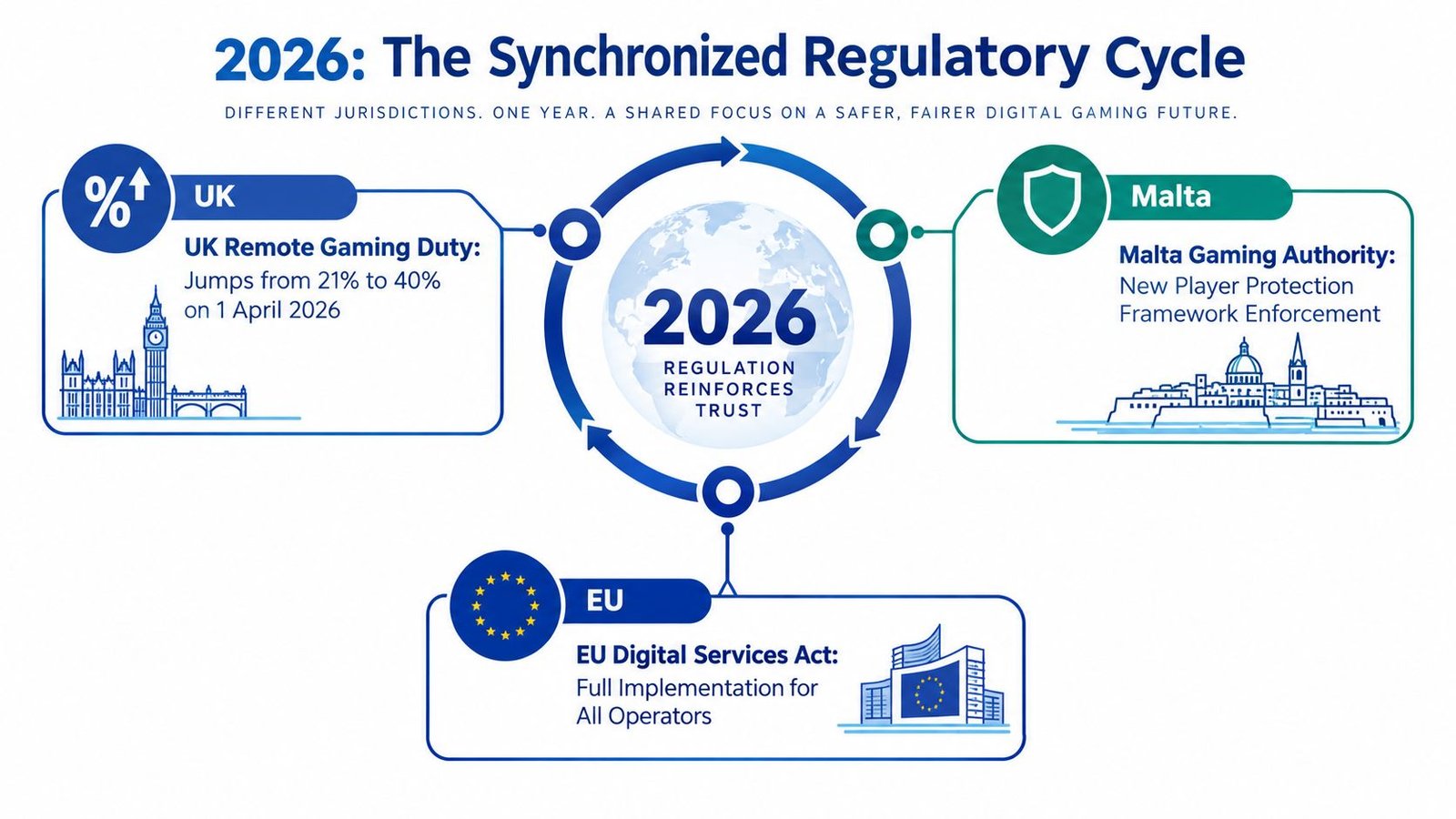
The operating impact is simultaneous re-baselining. Finance teams need market-level GGR models, affiliates need revised CPA and revenue-share assumptions, and product teams need jurisdiction-specific controls instead of one global player journey. High-bonus casino offers, low-margin sportsbook traffic, and lightly governed affiliate funnels face the greatest risk of becoming uneconomic rather than merely less profitable.
The Four Regulatory Fronts Operators Must Track
Regulatory exposure in 2026 can be assessed through four operating fronts, with responsible gambling connecting each one to the others.
| Regulatory Front | Primary Operator Function Stressed | 2026 Pressure Example |
|---|---|---|
| Tax and duty | GGR forecasting, product allocation, bonus funding | UK Remote Gaming Duty moving from 21% to 40% |
| Licensing and fees | Legal entity management, filings, fixed-cost recovery | UK fee and filing changes scheduled to take effect on 1 October 2026, subject to commencement |
| Advertising and marketing | Creative approval, audience controls, affiliate governance | Australia's planned wagering advertising restrictions |
| Payments, source of funds, and AML | Onboarding, transaction monitoring, escalation | Greater scrutiny of payment provenance and player affordability |
Tax and duty determine how much gaming revenue remains after statutory charges. GGR-based, profit-based, and stake-based designs affect casino, betting, bingo, poker, and promotional activity in different ways. A duty applied to remote gaming profit can weaken bonus-heavy products even when headline GGR remains strong, making some acquisition-led models uneconomic rather than merely less profitable.
Licensing and fees cover application charges, recurring fees, reporting obligations, and the internal work required to maintain authorization. Operators must budget for both the visible charge and the staff time needed for filings, entity administration, and regulatory responses. That fixed-cost layer matters most to smaller brands, thin-margin sportsbooks, and affiliates dependent on a single licensed partner.
Advertising controls extend beyond media buying. They affect bonus wording, influencer relationships, affiliate redirects, sponsorships, audience exclusions, and the records needed to show that campaigns were properly targeted. A restriction can therefore reduce traffic yield while also increasing approval and monitoring costs.
Payments and AML require coordination between finance, risk, compliance, and product. Teams reviewing PAGCOR B2B accreditation fees should apply the same cost logic across markets: the visible license or fee is only one part of operating expenditure. Payment checks, source-of-funds reviews, escalations, and failed onboarding also reduce conversion and add support work.
Responsible gambling cuts across all four fronts. Deposit journeys, affordability interventions, marketing exclusions, payment controls, and player monitoring must operate as a connected system.
The binding constraint is increasingly compliance infrastructure, not the initial license fee.
United Kingdom Tax Overhaul and Fee Reset
The UK combines a major product tax increase with a separate fee reset in the same reform cycle. Remote Gaming Duty rose from 21% to 40% on 1 April 2026, applying to remote gaming profit rather than turnover, according to the SOFTSWISS regulatory recap.
The margin effect depends on product mix. Online casino operators carrying heavy promotional costs have less contribution available for bonuses, affiliate commissions, payment processing, support, and acquisition. Brands built around lower-bonus or more organic play face a smaller relative squeeze. Sportsbook economics also require forward planning because a 25% remote betting duty is currently scheduled for 1 April 2027, separate from the 2026 gaming-duty increase.
Bingo provides a counterweight. Bingo duty was abolished during the same 2026 reform period, according to the same regulatory recap. The change improves the relative economics of bingo rather than reducing costs across every vertical. Operators may therefore reassess content budgets, acquisition activity, and promotional allocation by duty treatment.
Why the new duty changes marketing math
A higher duty rate reduces the contribution available to support bonus-led acquisition and aggressive revenue-share arrangements. UK casino is not automatically unviable, but some campaign structures become difficult to defend. High-bonus acquisition combined with generous affiliate terms is most exposed because both costs are deducted from a narrower contribution pool.
The UK Gambling Fees Regulations 2026 create a second planning requirement. The official regulations are scheduled to come into force on 1 October 2026, with changes to fees and filing processes. For mid-tier operators, updated or tiered fee mechanics can weaken fixed-cost recovery. A license burden that rises with business scale changes the economics of smaller brands, single-market affiliates, and operators without enough UK volume to spread compliance overhead.
UK 2026 tax and fee changes at a glance
| Measure | Pre-2026 Position | 2026 Position | Effective Date |
|---|---|---|---|
| Remote Gaming Duty | 21% | 40% | 1 April 2026 |
| Bingo duty | Existing duty applied | Abolished | 2026 reform period |
| Remote betting duty | No new 2026 rate cited here | 25% remote betting duty currently scheduled | 1 April 2027 |
| Gambling fees and filing process | Existing framework | Updated regulations scheduled | 1 October 2026 |
The commercial response is a contribution-margin forecast by vertical and acquisition source, rather than one blended GGR target. A brand can remain profitable overall while bonus-led campaigns, high-cost affiliate deals, or low-value casino cohorts become unviable. For smaller operators, the combined duty and fee burden may make exit or product reduction more rational than further acquisition spending.
Malta, Ireland, India, Australia, and Malaysia Compared
The five markets impose different costs on the operating model. Malta changes entity economics, Ireland introduces staged licensing work, India raises product and control requirements, Australia targets acquisition channels, and Malaysia applies direct tax pressure. The relevant question for each jurisdiction is whether the model remains viable after compliance, payments, localization, and affiliate remuneration.
Malta
Malta remains important to cross-border suppliers and operators, but its 2026 changes make a simple low-friction base assumption less reliable. A tiered fee and tax structure is scheduled to begin on 1 August 2026, as noted in SOFTSWISS' first-half regulatory recap.
The margin effect depends on entity revenue, product scope, and local governance costs. Smaller operators may lose the scale advantage that made a Malta structure efficient, while larger licensees can spread fixed compliance costs across more products or markets. Operators should model each entity and service line separately. For affiliates, the relevant test is whether the resulting operator margin still supports commission rates and media spend.
Ireland
Ireland is moving through staged implementation. The Irish commencement order appointed 5 February 2026 as the date when specified provisions of the Gambling Regulation Act 2024 came into operation. Separate 2026 licensing and application-fee regulations mean that licensing, fees, advertising controls, and AML work may not align behind one launch event.
This sequencing creates operating friction. Operators may need separate project plans for authorization, application materials, marketing review, and transaction monitoring. Affiliates face a similar issue: Irish traffic definitions, operator authorization status, content, tracking, and commercial terms must remain aligned before campaigns scale. Models dependent on rapid market entry become less attractive when compliance work precedes revenue.
India
India's Promotion and Regulation of Online Gaming Rules, 2026 were notified on 22 April 2026 and took effect on 1 May 2026. The framework creates a centrally defined operational architecture affecting KYC, platform accreditation, and the viability of real-money formats.
The cost is not limited to licensing. Cross-border suppliers must assess product classification, player verification, payment routing, registration, and control evidence against the new structure. A format with unclear classification can become commercially unattractive even where player demand remains strong, because assessment and controls consume product and compliance capacity. Affiliates also need confidence that promoted products fit the operator's authorized category.
Australia
Australia's official gambling-reform FAQ sets out restrictions on wagering advertising, including a ban during live sports and in sports venues. The government has indicated that implementation legislation is planned to start from 1 January 2027, so the 2026 priority is planning rather than presenting future rules as already operative.
The immediate margin effect comes from replacing or reviewing acquisition channels, not from a cited 2026 tax increase. Operators should inventory sports sponsorships, broadcast placements, affiliate creative, and audience-targeting logic. Models that rely heavily on sports visibility may become less profitable as replacement media and governance costs rise. Payment and player-protection controls may also require adjustment as the broader reform package develops.
Malaysia
Malaysia's gambling tax rose to 37.8% on 1 January 2026. This is a direct reduction in the contribution pool available for payments, localization, compliance, retention, and affiliate commission.
A campaign can generate attractive gross revenue while failing to produce an acceptable contribution margin after tax and operating costs. Malaysia therefore requires market-level unit economics, not a traffic-led growth assumption. High-commission affiliate models and low-value cohorts are the first candidates for reduction when the remaining margin cannot support acquisition.
| Jurisdiction | Key 2026 Rule | Effective Date | Operator Implication |
|---|---|---|---|
| Malta | Tiered fee and tax structure scheduled | 1 August 2026 | Recalculate entity and product economics |
| Ireland | Gambling Regulation Act provisions commence | 5 February 2026 | Sequence licensing and compliance work |
| India | Promotion and Regulation of Online Gaming Rules notified and applied | 22 April and 1 May 2026 | Align KYC, accreditation, and product classification |
| Australia | Wagering advertising reform implementation planned | From 1 January 2027 | Rework sports marketing before implementation |
| Malaysia | Gambling tax rises to 37.8% | 1 January 2026 | Test whether acquisition and commission remain viable |
Margin and Market Impact Across Major Jurisdictions
Regulatory impact is best measured through the decisions it changes: acquisition spend, bonus design, affiliate remuneration, product scope, and market access.
The UK creates the clearest direct margin shock because remote gaming duty rises from 21% to 40%. Malaysia presents a similar unit-economics problem through its 37.8% gambling tax. Ireland's effect depends more on the licensing and regulatory sequence, while Malta's scheduled tiered structure makes entity, product, and revenue assumptions more important than a single market-wide estimate.
Australia presents a different timing issue. The government has announced that advertising reform is planned to begin from 1 January 2027. During 2026, the measurable burden is therefore planning, creative replacement, governance, and possible channel restrictions rather than a cited tax increase.
India can raise operating costs through accreditation, KYC, payment controls, and product-format assessment. The margin outcome depends on classification and the platform's ability to retain evidence. A large player base does not compensate automatically for a costly control framework.
Decision rule: A market becomes commercially fragile when tax and compliance costs consume the funds previously available for acquisition, retention, and affiliate remuneration.
A worked scenario shows why the UK change matters. Assume a casino generates £10 million in GGR and incurs bonus costs equal to 35% of GGR. Before other operating expenses, the pool after bonuses and a 21% duty is £4.4 million. At 40%, that pool falls to £2.5 million. The duty change therefore removes £1.9 million from the same revenue base before payment processing, staffing, compliance, or acquisition costs are paid.
That is a modeled scenario, not a forecast. Its implication is specific: a bonus-heavy casino that previously supported high CPA can become unviable if acquisition spend was built around the former contribution pool. A lower-bonus operator may remain active, but with reduced promotional intensity and tighter cohort selection.
The same test should be applied to affiliate contracts. A revenue-share arrangement can remain profitable where traffic has strong retention and low servicing cost, yet become loss-making for low-value cohorts or fixed-CPA campaigns. Operators assessing user acquisition cost in iGaming should run at least three cases: continued operation with lower promotion, selective withdrawal by product or territory, and transfer of spend to markets where compliance overhead is manageable.
| Jurisdiction | Margin translation | Business model most exposed |
|---|---|---|
| United Kingdom | Higher duty removes contribution before acquisition and retention costs | Bonus-heavy casino and high-CPA affiliate funnels |
| Malaysia | Tax leaves less contribution for payments, localization, compliance, and commission | Marginal campaigns and high-commission traffic |
| Malta | Tiered fees make cost sensitive to entity and revenue profile | Operators with weak entity-level forecasting |
| Ireland | Licensing and fee sequencing adds planning and implementation cost | Small entrants without dedicated compliance capacity |
| India | KYC, accreditation, payments, and classification determine operating cost | Products unable to produce evidence efficiently |
| Australia | Advertising preparation can require channel, creative, and governance changes | Sponsorship-led and lightly controlled affiliate acquisition |
The strongest consolidation pressure falls on brands dependent on one expensive channel, one high-bonus vertical, or one weakly controlled affiliate network. Diversified operators can reallocate product and media. Marginal brands may need to exit rather than accept permanently negative contribution.
Compliance Burden Beyond Licensing
Licensing grants permission to operate. The operating model must also show that payments, player checks, advertising, and interventions followed the applicable rules. That evidence requirement converts compliance from a legal file into a recurring operating cost.
A practical handover document assigns every control to an owner and specifies the record that proves it operated.
| Workstream | Named Owner | Required Control | Evidence Artifact |
|---|---|---|---|
| Financial controls | Finance and AML | Review payment provenance and high-risk activity | Transaction-review log and escalation record |
| Source of funds | Compliance | Define verification triggers and rejected evidence | Case file with decision rationale |
| Advertising | Marketing compliance | Approve creative, targeting, and affiliate redirects | Versioned approval record |
| Affordability | Responsible-gambling team | Monitor spend and vulnerability indicators | Intervention record and outcome |
| Player monitoring | Risk and product | Connect identity, payment, and behavior signals | Alert history and model governance record |
The UK shift toward broader affordability analysis illustrates the direction of travel. Shared-account analysis can require more data matching and manual review than a simple deposit threshold, raising cost per active player even where the account remains open. Industry regulatory roundups also highlight stronger scrutiny of payments, AML, advertising, and player protection across regions.
Payment teams should test whether blocked or delayed transactions produce a consistent customer journey. Compliance teams should keep source-of-funds requests inside the player record, with the request, evidence, decision, and escalation visible together. Product teams should prevent further staking when a required control remains unresolved.
Operational controls that need evidence
- Payments: Reconcile processor decisions, card restrictions, refunds, chargebacks, and account ownership.
- Source of funds: Record why evidence was requested, what was accepted, and who approved the outcome.
- Advertising: Preserve the exact creative, landing page, targeting rule, affiliate redirect, and approval timestamp.
- Affordability: Document player signals, intervention thresholds, contact attempts, and final decisions.
- AML: Link transaction alerts to investigation outcomes and suspicious-activity reporting decisions.
- Responsible gambling: Connect intervention records to deposits, stakes, marketing suppression, and self-exclusion status.
The commercial consequence is a redesign of deposit and staking flows. An operator should measure whether each control works before the relevant transaction or bet, not merely whether a policy exists. Missing links between identity, payment, behavior, and marketing records can create remediation work, delayed transactions, and avoidable player loss.
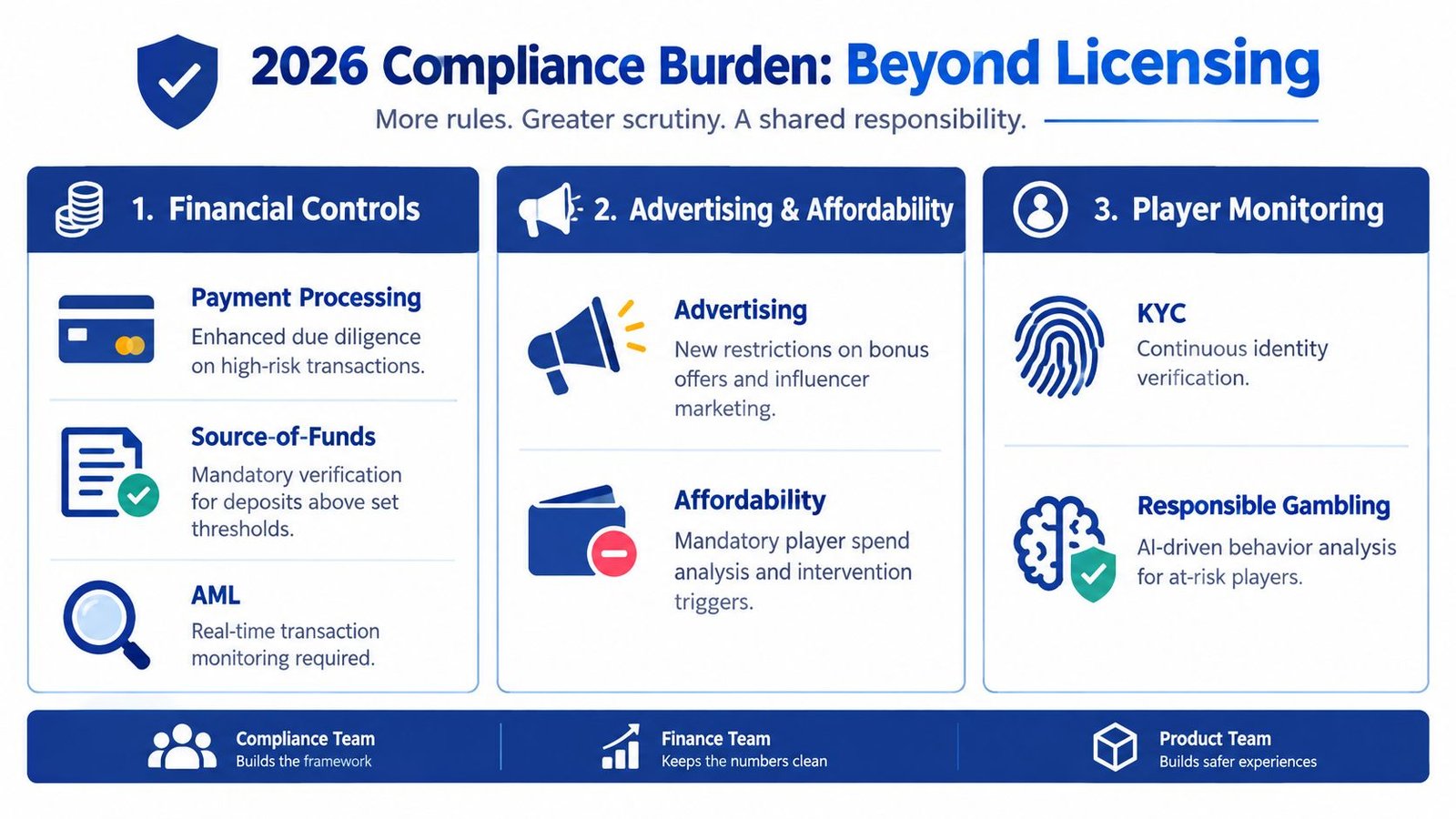
Teams reviewing PAGCOR regulatory updates for 2026 should apply the same evidence-first discipline, while adapting controls to the market's thresholds and reporting formats. For operators and affiliates, the margin test is direct: if proving compliant acquisition costs more than the contribution generated by the traffic, that channel is not merely less profitable. It is commercially unviable.
The New Enforcement Bottleneck
Licensing no longer marks the end of regulatory risk. In 2026, enforcement depends on whether an operator can produce a reliable record of events when a regulator reviews a disputed payment, intervention, or marketing decision. A license authorizes activity, but it does not resolve missing evidence.
UK scrutiny now reaches beyond a deposit threshold toward broader affordability assessment and shared-account analysis, as noted earlier. Attention to source-of-funds reporting and player monitoring is also tightening across several markets.
The enforcement question is therefore outcome-based: can the operator show what happened, when it happened, and which rule or internal trigger produced the response? A disconnected record can turn a defensible decision into a remediation case, even when the underlying control existed.
Enforcement test: If an operator cannot reconstruct the evidence behind a player decision, the regulator may assess the outcome as an unproven control rather than a completed control.
That distinction changes the economics. Missing or delayed evidence can extend investigations, require manual remediation, restrict campaigns, or produce license conditions. For affiliates, an incomplete redirect or attribution trail can make traffic difficult to defend and weaken payment claims. The affected model may become unviable where compliance review costs exceed contribution, rather than suffering a lower margin.
The new bottleneck is data-pipeline compliance. Operators preparing for PAGCOR payment gateway accreditation should assess whether processors can support reconciliation, exception handling, and documented escalation. Those capabilities determine how quickly a business can answer supervisory questions, not just whether it can launch.
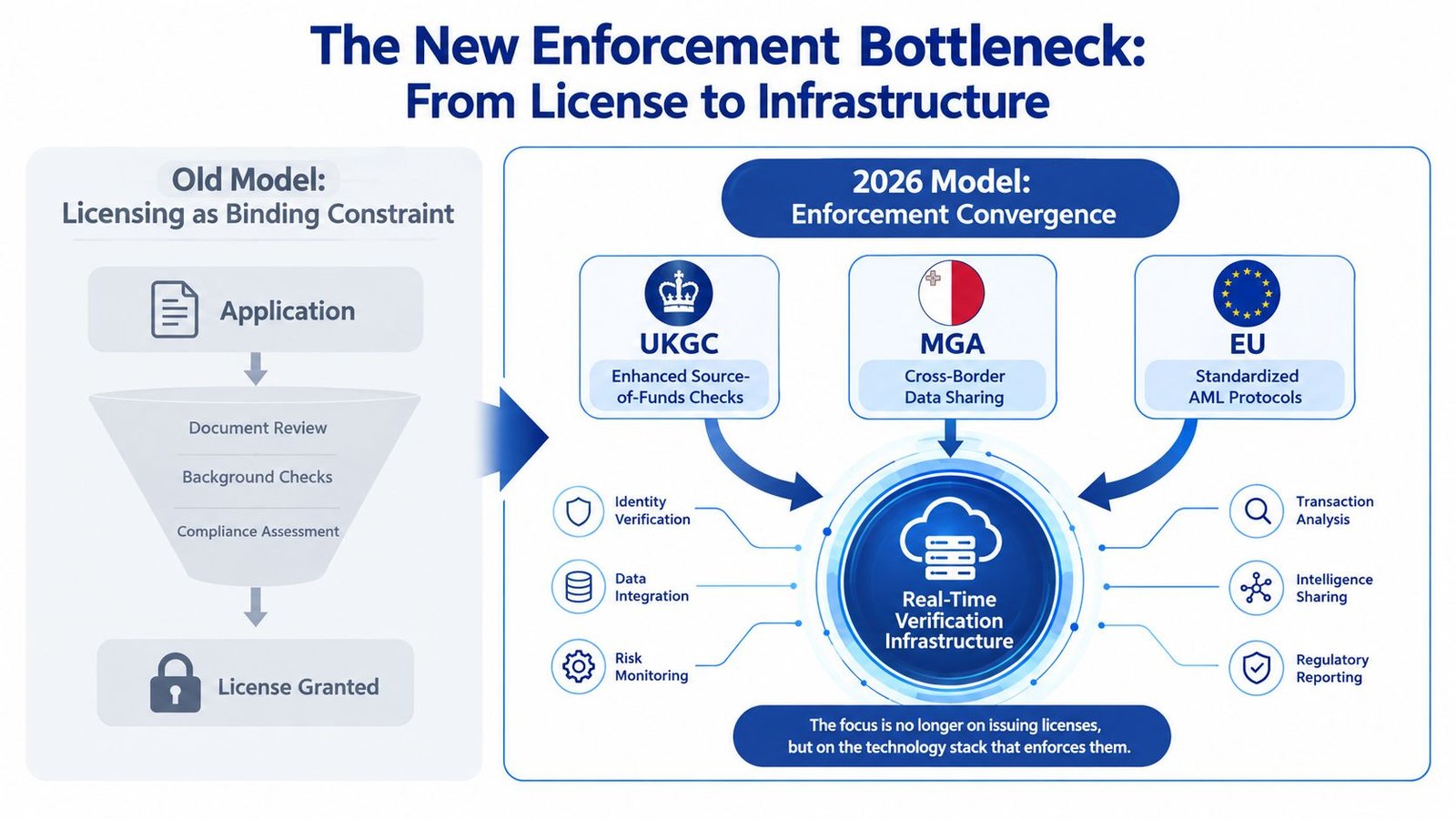
The analyst view is that integrated evidence has become a competitive asset. Groups serving several markets can spread its fixed cost, while smaller operators and affiliates may find fragmented systems commercially untenable.
Operator and Affiliate Action Checklist
A 90-day program should start with market-level economics, then test controls, and finally renegotiate commercial terms. The sequence matters because affiliates cannot assess fair remuneration until finance has separated profitable traffic from traffic sustained by bonuses, media cost, or weak retention.
First phase
Operators should rebuild UK remote-gaming forecasts under the 2026 duty position, separating casino and bingo assumptions. Flag campaigns that no longer fit the contribution envelope, then assign responsibility for the scheduled 1 October 2026 fee and filing changes.
Compliance and product teams should run dry tests for payment review, source-of-funds escalation, affordability intervention, and player monitoring. Each test needs a retained result, owner, and remediation record. A control without evidence remains a cost centre with uncertain regulatory value.
Second phase
Affiliates should review every UK-facing CPA and revenue-share agreement by product and territory. Commission cuts may protect short-term margin but can also remove traffic that remains profitable after retention and compliance costs. Agreements should therefore distinguish sustainable traffic from traffic dependent on high bonuses or weak retention.
Marketing teams should inventory Australia-facing creative, sponsorships, and distribution channels before the planned implementation from 1 January 2027, using the Australian government reform FAQ as a reference.
Third phase
Owners should report exceptions monthly. Escalate a market when tax, licensing, payment, or affiliate costs make the approved product model difficult to sustain. The decision should identify whether delay makes the model unviable or merely less profitable.
| Action | Timing | Owner | Margin impact if delayed | Primary reference |
|---|---|---|---|---|
| Recalculate UK remote-gaming contribution | First 30 days | Finance | Mispriced duty can turn positive campaigns loss-making | SOFTSWISS UK regulatory analysis |
| Map UK fee and filing changes | Before the scheduled 1 October 2026 commencement | Legal and compliance | Late preparation raises fee, filing, and remediation costs | UK Gambling Fees Regulations 2026 |
| Validate India product classification and KYC controls | Immediate operating review | Product and compliance | Misclassification can make the product model unviable | India online gaming rules overview |
| Rework Malta fee and tax scenarios | Before the scheduled implementation | Finance and legal | Wrong tier assumptions create avoidable fee overruns | SOFTSWISS 2026 first-half recap |
| Review Irish authorization sequencing | Current implementation cycle | Legal | Delayed authorization can defer revenue while fixed costs continue | Irish commencement order |
| Audit Australia advertising inventory | Before the planned implementation from 1 January 2027 | Marketing compliance | Restricted creative can reduce acquisition volume and sponsorship value | Australian gambling-reform FAQ |
| Test payment, AML, and player-monitoring evidence | Within 90 days | AML and risk | Manual remediation can erase contribution from smaller markets | Track360 regulatory roundup |
| Renegotiate UK affiliate economics | Within 60 days | Commercial and affiliate teams | Blanket cuts may damage profitable supply; targeted terms preserve it | Internal margin model |
| Update territory exclusions and redirect records | Within 60 days | Affiliate operations | Attribution and payment disputes can make marginal traffic uneconomic | Internal compliance policy |
| Review Malaysian campaign viability | Within 90 days | Finance and growth | Compliance cost can make low-volume campaigns unviable | SOFTSWISS regulatory trends recap |
Affiliates should document excluded territories, approved creatives, redirect behaviour, bonus attribution, and source-of-funds escalation paths. The PAGCOR gambling advertising rules resource provides a useful reference for assigning marketing controls to named owners and retaining an audit trail.
The operating requirement is clear: build a jurisdiction-by-jurisdiction 2026 margin model, connect each payment and advertising control to evidence, and review assumptions monthly. This separates markets that need tighter pricing from models that no longer justify continued operation.





Join thousands of gaming professionals receiving the latest iGaming news, regulatory updates, and market insights.
