

Evolution's estimated 65% to 70% share of the global live-casino market makes it the benchmark against which live-dealer providers are compared in 2026, according to industry market coverage. That concentration changes the procurement question. Operators aren't just choosing the studio with the largest catalogue. They're deciding which combination of content, distribution, certification, localization and commercial control can support revenue across specific jurisdictions.
Online casino has become too economically significant for provider selection to remain a catalogue exercise. A 2026 market report estimates global online casino GGR at $59.8 billion, representing 52% of total global iGaming GGR, while Europe contributes $21.8 billion of that total, as reported in Track360's iGaming market statistics. In Europe's mature ecosystem, EGBA member operators reported €18 billion in combined online revenue, €275.3 billion in stakes and 43.8 million active accounts in 2025. Casino games generated 48% of revenue, compared with 46% for sports betting, according to EGBA data covered by Track360.
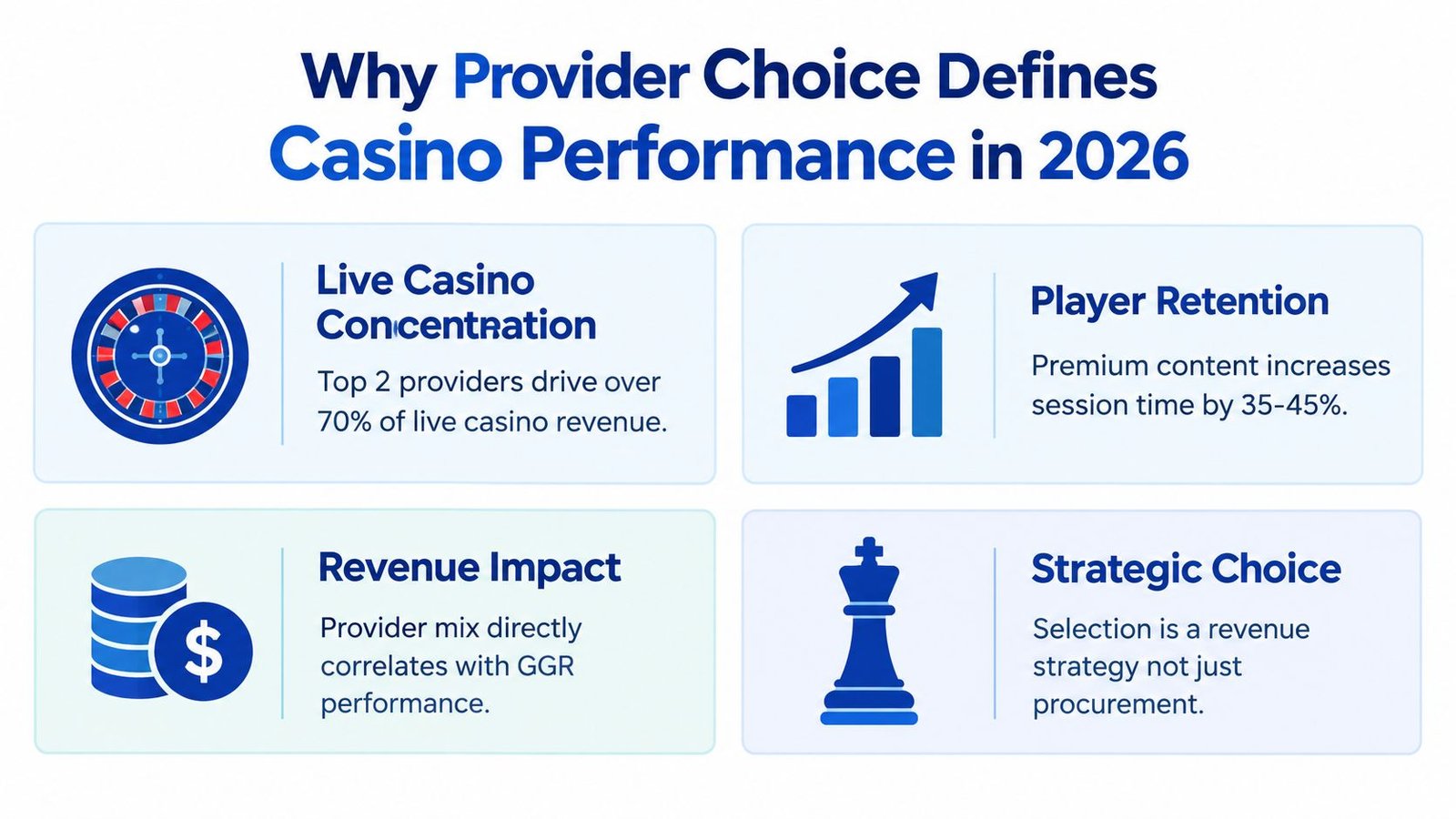
Table of Contents
- Introduction: Why Provider Choice Defines Casino Performance in 2026
- Market Overview and How the Provider Ecosystem Is Structured
- Head to Head Comparison of Leading Providers by Product and Performance
- Technology Stack Integration and Distribution Models Explained
- Regulatory Compliance and Certification Requirements Across Key Jurisdictions
- Use Cases Which Provider Fits Which Operator Strategy
- Strategic Recommendations and Outlook for Operators and Affiliates
Introduction: Why Provider Choice Defines Casino Performance in 2026
Five questions determine whether a provider adds commercial value: does its content fit the audience, can it reach the required jurisdictions, and can the operator run it efficiently at scale? Provider choice affects game discovery, technical reliability, market access, release speed and the operational work between the operator and content owner. A broad catalogue can still underperform if it lacks suitable crash, instant-win or mobile-first content, or if certification limits distribution in priority markets.
Europe's mature online casino market makes brand recognition an incomplete comparison method. Operators need evidence on game mix, certified RTP ranges, volatility, live-table availability, multilingual coverage, geographic reach and the distribution model behind each title. A direct studio relationship may offer closer control over content and commercial terms. An aggregator may broaden access through one integration, while adding another layer between the operator and the supplier. The European online casino statistics analysis supports treating supplier selection as a commercial decision, not only a technical procurement task.
The comparison framework
A useful casino game provider comparison 2026 should answer five questions:
- Product fit: Does the supplier cover the operator's priority verticals, including slots, live casino, table games, jackpots, crash and instant formats?
- Math profile: Do RTP, volatility and maximum-win characteristics suit the intended player segments?
- Distribution control: Is content supplied through a direct contract, aggregator or hybrid arrangement?
- Market access: Can the exact game build be certified and distributed in each target jurisdiction?
- Operating efficiency: Do APIs, reporting, back-office tools and commercial terms support sustainable scaling?
This framework applies to operators adding suppliers, established brands reviewing their mix, affiliates tracking provider momentum, investors assessing concentration and regulators examining how distribution affects access. It also exposes a common weakness in headline provider rankings: catalogue size may conceal limited strength in crash, instant and mobile-first verticals, or a mismatch between a game's certification and the operator's target markets.
The strongest provider is therefore not universal. It is the supplier whose content, approvals and distribution model fit the operator's markets, audience and operating requirements.
Market Overview and How the Provider Ecosystem Is Structured
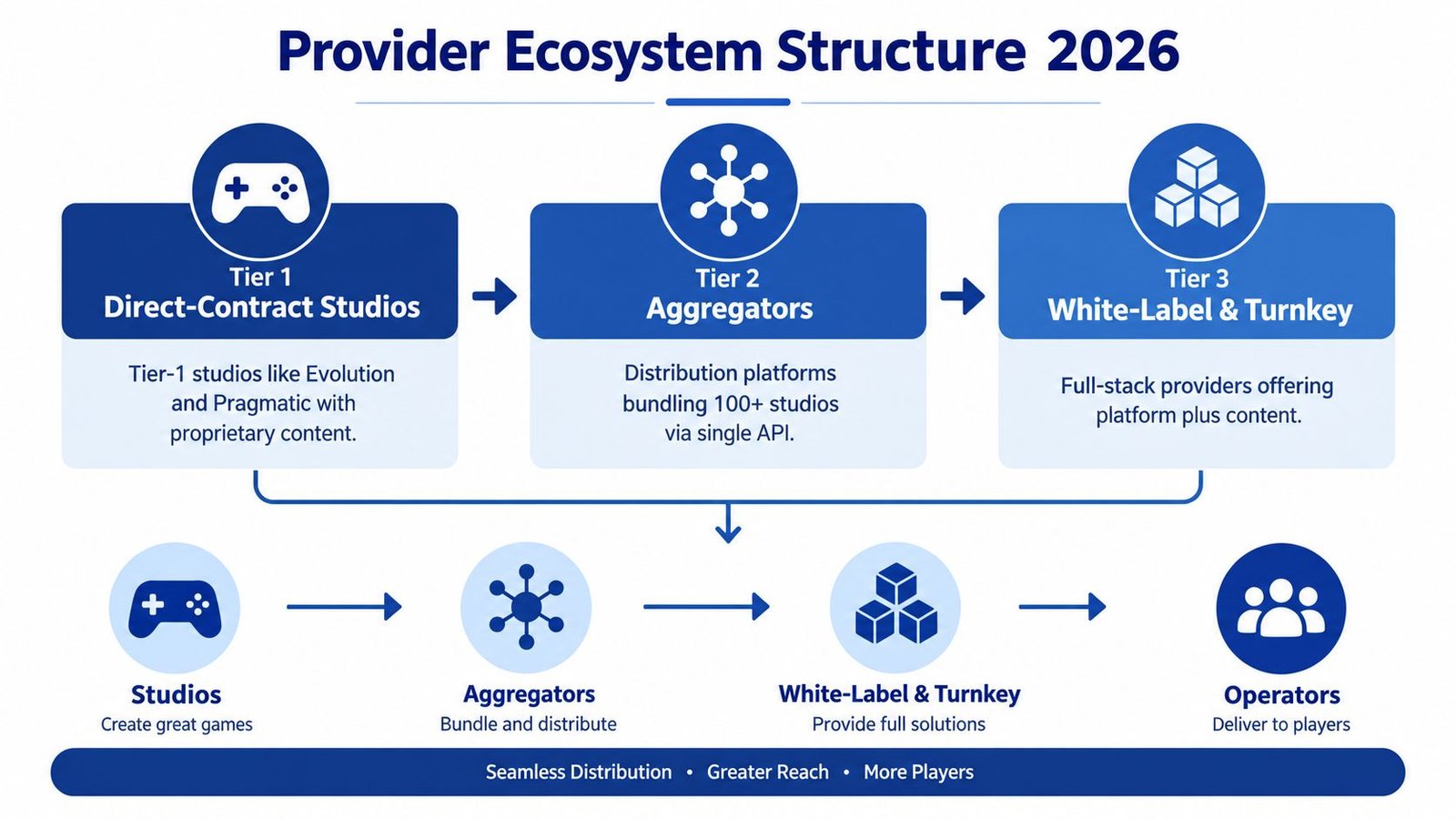
The 2026 provider ecosystem contains several layers that are easy to confuse. A direct-contract studio owns or controls proprietary games and contracts with operators or platforms. An aggregator combines content from multiple studios behind a single integration. A turnkey or white-label supplier can add platform infrastructure, payments, risk functions and content distribution to the same commercial relationship.
A directory mapping the market identifies 69 studios, including 14 live-casino suppliers, 12 aggregators or content platforms and 8 crash, originals or instant-win studios, according to the 2026 casino game provider market map. Those categories don't represent interchangeable vendors. They reflect different positions in the value chain.
Direct studios, aggregators and hybrids
Direct integration generally gives a product team closer access to the studio's roadmap, release process, analytics and commercial negotiation. It can also increase integration effort, certification coordination and ongoing maintenance, particularly when an operator works with several specialist suppliers.
Aggregation reverses that trade-off. A single API can expose a wider catalogue and simplify launch planning, but the operator may have less influence over individual studio roadmaps and less direct visibility into the supplier relationship. The directory's separation of direct suppliers from aggregators is therefore commercially important, not merely descriptive.
An operator assessing PAGCOR game aggregator accreditation requirements should treat the distribution layer as part of the risk assessment. Accreditation, reporting responsibilities and the contractual chain can affect how quickly content is approved and how clearly accountability is assigned.
Why game count can mislead
A large catalogue may be dominated by familiar slot formats while offering limited depth in live game shows, crash mechanics, instant-win titles or mobile-first experiences. The 2026 supplier overview from SoftGamings highlights the need to separate slots, live casino, table games, jackpots and crash or instant games rather than treating total count as a complete measure of strength.
The practical lesson is that portfolio breadth must be measured by relevant vertical coverage. A supplier with fewer titles may be more valuable to a fast-game operator than a larger studio with no meaningful crash or instant proposition. Conversely, a mature European brand may prioritize certified mainstream depth, localized live tables and stable retention mechanics over novelty.
Head to Head Comparison of Leading Providers by Product and Performance
A provider comparison becomes useful only when it applies the same criteria to each supplier. RTP, volatility and maximum-win potential describe different parts of the player-value proposition. They shouldn't be read as promises of individual outcomes, and they don't replace jurisdiction-specific game documentation.
The following matrix uses the math-profile information published in independent provider comparison data. It is most useful for segmentation, lobby design and portfolio balance, not for ranking providers in isolation.
Provider Math Profile and Vertical Strength Matrix
| Provider | Avg RTP Range | Volatility Profile | Core Vertical Strength |
|---|---|---|---|
| Pragmatic Play | 96.0% to 96.7% | Predominantly high volatility | High-volatility slots and large max-win mechanics |
| Big Time Gaming | 96.2% to 96.6% | High volatility | High-upside slots and innovation-led mechanics |
| NetEnt | 96.0% to 96.8% | Low to high | Broad mainstream retention and varied slot profiles |
Pragmatic Play's listed 5,000x to 50,000x maximum-win range and Big Time Gaming's 10,000x to 55,000x range point toward portfolios suited to operators targeting high-volatility play and substantial upside mechanics. That positioning can support promotional and VIP strategies, but it also requires careful segmentation because high volatility isn't automatically appropriate for every audience.
NetEnt's 500x to 50,000x range and low-to-high volatility spread indicate a broader mathematical profile. The strategic interpretation is that NetEnt can support a more varied lobby, from lower-risk mainstream mechanics to higher-upside content, rather than concentrating the portfolio around one sharp play pattern.
Portfolio rule: RTP range describes the game setting, while volatility describes the distribution of outcomes. Operators should assess both before assigning a provider to acquisition, retention or VIP use cases.
Live specialists require a different comparison lens. Evolution's estimated market position makes studio scale, table depth, multilingual coverage and geographic reach central evaluation criteria, rather than slot-style maximum-win comparisons. A diversified provider can be strong across several categories while still lacking the operational depth of a specialist live studio.
Technology also separates providers that appear similar on paper. Cross-platform HTML5 delivery, lightweight mobile performance, localization tooling and release consistency can matter more than a marginal difference in catalogue size. The comparison should therefore pair mathematical data with actual market and product requirements.
Technology Stack Integration and Distribution Models Explained
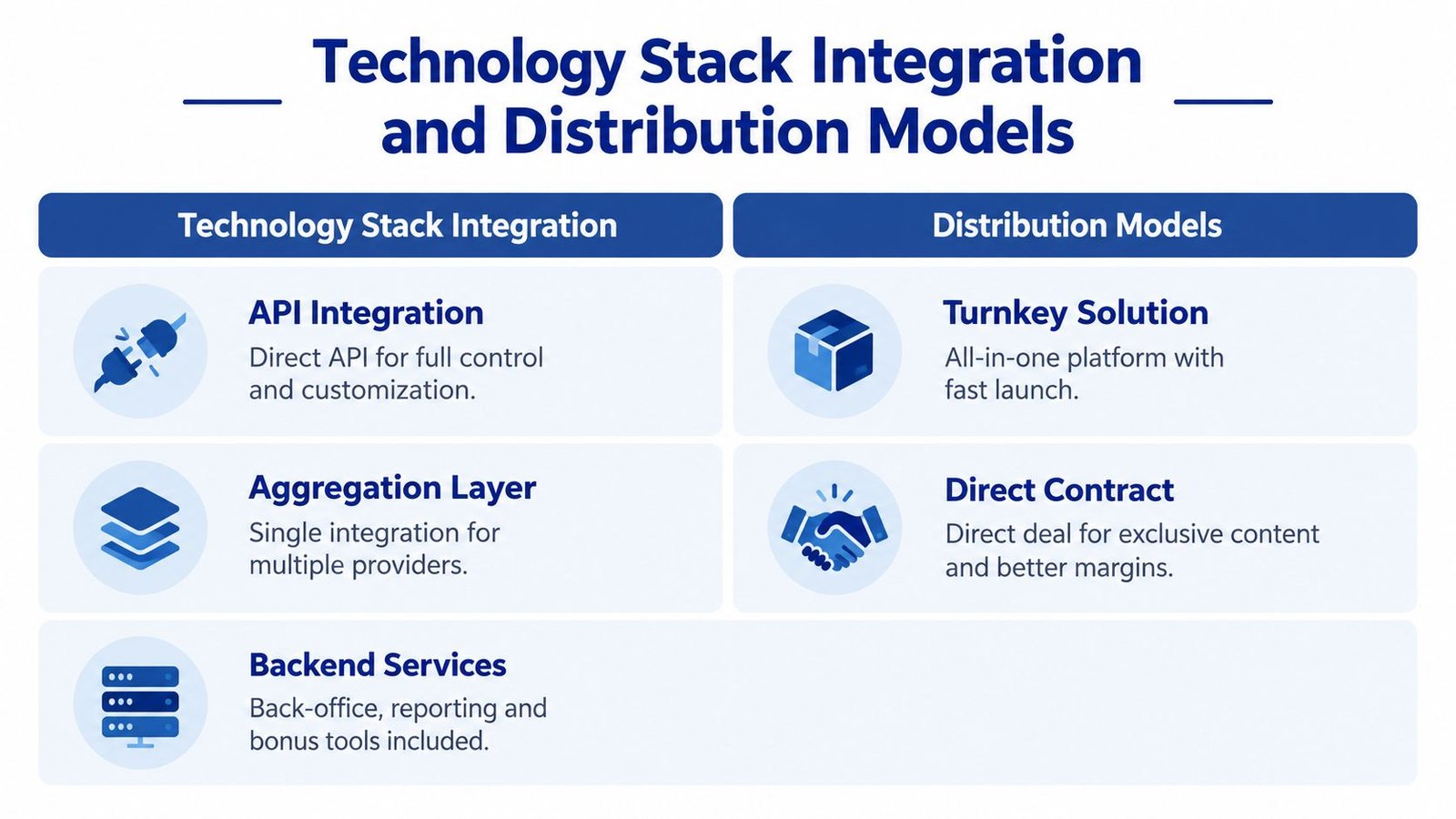
Content becomes commercially useful only when the operator can integrate, certify, merchandise and measure it. The technical choice usually sits between direct API integration, aggregation and a turnkey platform. Each model changes control, implementation workload and negotiating power.
A direct API gives the operator closer control over the player journey, lobby logic, promotional rules and data flows. It can also require more work from product, engineering, compliance and account-management teams. An aggregation layer reduces the number of technical connections and can broaden the available catalogue, but it introduces another dependency between the operator and the underlying studios.
Integration decisions that affect scale
Technical teams should examine documentation, sandbox quality, error handling, game-launch behavior, reporting consistency and release-notification processes. These details determine whether a provider can be maintained efficiently after the initial launch. A catalogue that integrates quickly but produces weak reporting can create a permanent measurement problem for marketing and finance.
Turnkey platforms can accelerate market entry by combining infrastructure and content, but they may reduce the operator's control over architecture and supplier choice. Direct contracts can provide stronger roadmap access or exclusivity opportunities, although those benefits need to be balanced against certification and maintenance responsibilities.
The distinction is especially important for operators that need local accreditation. PAGCOR gaming system administrator requirements should be considered alongside API architecture, reporting ownership and the responsibilities assigned to each party in the technology chain.
Commercial leverage follows the distribution model
Aggregation can create catalogue breadth and reduce integration duplication. Direct contracting can create a closer commercial relationship and clearer access to proprietary content. Neither model guarantees better margins, because revenue share, minimum commitments, exclusivity, launch support, certification costs and promotional obligations depend on negotiation.
The strongest architecture is often hybrid. An operator may use aggregation for breadth and speed, then maintain direct relationships with strategic studios whose content differentiates the lobby. That structure reduces dependence on a single supplier while preserving access to specialist roadmaps.
Implementation test: A provider should be evaluated not only on whether its games launch, but on whether the operator can monitor, merchandise and update those games without creating hidden operational work.
Regulatory Compliance and Certification Requirements Across Key Jurisdictions
A game listed in a provider catalogue is not automatically deployable in every market. Certification, supplier approval and version control determine whether content can legally reach customers. Regulatory status should therefore be assessed before providers are ranked on catalogue size or commercial terms.
RNG-driven remote games may require testing by approved test houses before release. Reviews can cover RNG implementation, statistical behaviour and changes affecting fairness, as outlined in 2026 casino software compliance guidance. Certification is consequently a market-access requirement, not a documentation detail.
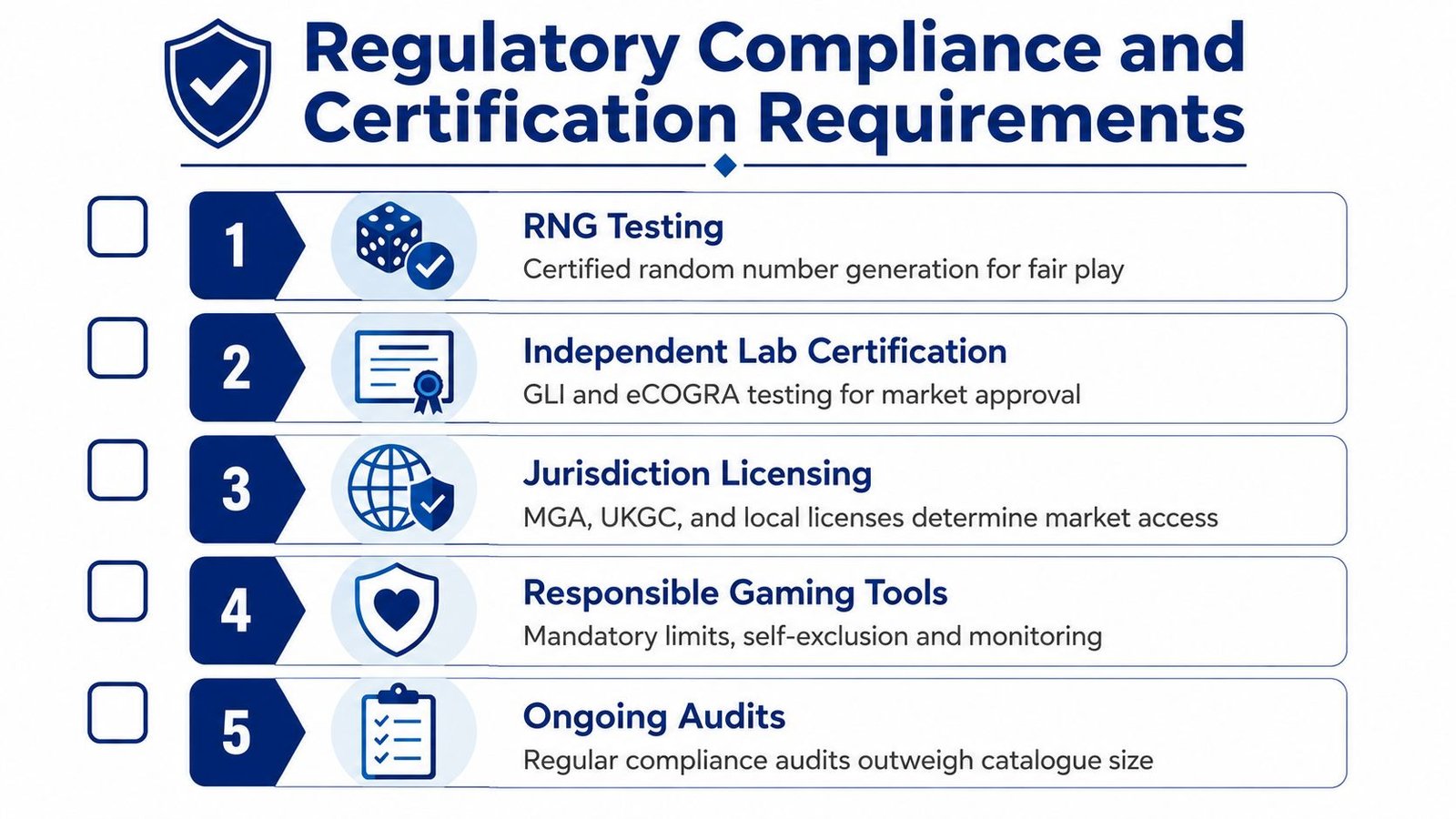
Certification is jurisdiction and build specific
Germany requires an independent body to test compliance with technical standards and the security concept annually under the Interstate Treaty on Gambling. Italy's ADM framework requires certification from an ADM-approved testing house requested by the licensee, according to the EU jurisdiction compliance comparison from CSB Group. Operators tracking Philippine-facing obligations should also monitor PAGCOR regulatory updates for 2026 alongside these EU requirements.
Approval must match both the jurisdiction and the deployed game build. An upgrade or RNG change can trigger re-testing or renewed verification, as explained in SoftSwiss RNG certification guidance. A provider's general statement that a game is certified is insufficient unless the operator confirms that the approval covers the exact version in production.
Sweden requires licensed game suppliers to work with regulated operators. Denmark introduced mandatory supplier licensing from 2025, making B2B approval a condition of market access, according to Vixio's 2026 supplier rules summary. These requirements can weaken headline provider rankings where crash, instant or mobile-first products lack equivalent local certification.
The pre-contract compliance file
Before signing, procurement should request:
- Jurisdiction matrix: Markets where the provider and each relevant build may be supplied.
- Testing documentation: Laboratory records covering the game, RNG implementation and applicable standards.
- Change protocol: Notice periods, re-certification triggers and controls for updates.
- Responsible-gaming capability: Limits, self-exclusion support, monitoring and reporting interfaces.
- Accountability map: Duties assigned across studio, aggregator, platform and operator.
Operators should verify advertising, player-protection and reporting duties before launch. A large catalogue cannot compensate for an unavailable approval route or unclear compliance ownership.
Use Cases Which Provider Fits Which Operator Strategy
The right supplier depends on the operator's constraint. A new entrant may value speed and breadth, while an established brand may value exclusive access, stable localization and control over the roadmap. A mobile-first or crypto-focused casino may need formats that traditional provider rankings underrepresent.
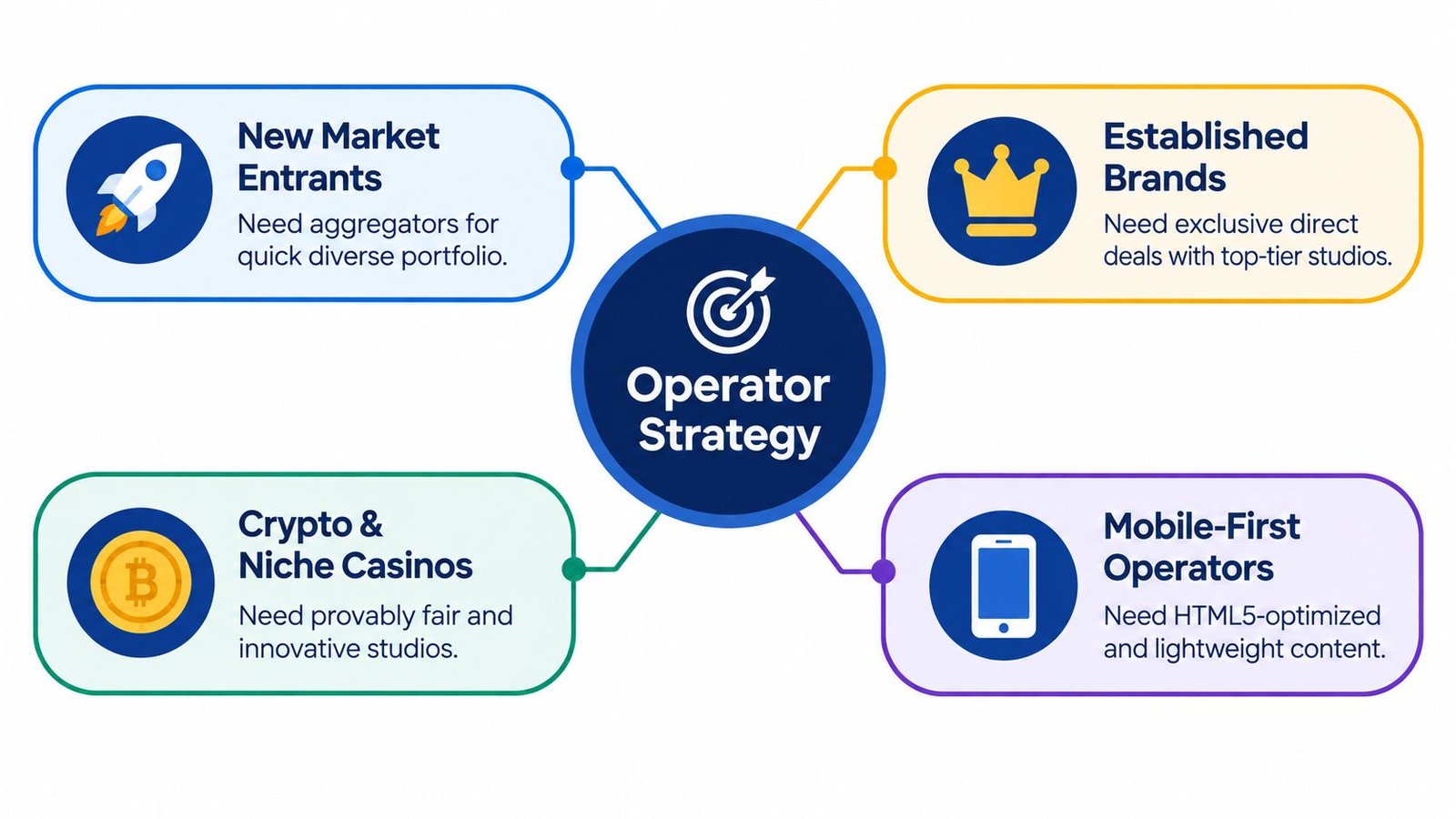
New market entrants
A new operator usually benefits from an aggregator-led launch because one integration can provide varied content while the team builds its own product and compliance processes. The trade-off is reduced direct control and the need to verify that the aggregator's certifications, reporting and commercial terms cover the intended markets.
The selection trigger is not the largest catalogue. It is the combination of launch readiness, approved content, stable APIs, localization and transparent revenue accounting. An entrant should add direct studio contracts later only when a supplier's content clearly differentiates acquisition or retention.
Established European brands
Mature brands can justify direct relationships with specialist studios, particularly where live casino is central. Evolution's estimated live-market position makes it a reference point for evaluating studio depth, table availability and geographic reach, while diversified slot suppliers can fill mathematical and thematic gaps.
European operator scale increases the value of precise portfolio segmentation. EGBA member data shows casino's central role in online revenue, so an established brand should track performance by vertical and jurisdiction rather than accept a single blended provider score. Commercial terms should reflect the operator's distribution power, launch support needs and certification workload.
Crypto, niche and mobile-first casinos
Crash, instant-win and game-show formats deserve separate scrutiny because a provider can appear strong in total games while remaining weak in these categories. Operators serving niche audiences should test whether suppliers support the relevant payment, data, fairness and localization expectations instead of assuming that a mainstream slot portfolio transfers effectively.
Mobile-first teams should prioritize lightweight HTML5 delivery, fast loading, responsive interfaces and clear session analytics. Affiliates assessing user acquisition cost should also distinguish between provider popularity and the content attributes that support conversion and repeat play.
VIP-focused casinos
VIP operators may favor high-volatility and jackpot-style mechanics, but the mathematical profile must match the risk appetite and promotional design. Pragmatic Play and Big Time Gaming show the high-volatility characteristics documented in the comparison matrix, while NetEnt offers a broader spread of volatility profiles.
Revenue share, integration fees, promotional funding and exclusivity should be modeled together. A seemingly attractive commercial rate can lose value if the provider requires additional certification work, limited reporting or expensive technical customization.
Strategic Recommendations and Outlook for Operators and Affiliates
The evidence supports a portfolio strategy rather than a single-provider ranking. Live casino concentration creates a clear benchmark, but concentration also creates dependency risk. Operators should preserve room for specialist crash, instant, game-show and mobile-first suppliers where those formats match the audience.
A practical procurement model has three layers:
- Core coverage: Use proven suppliers or aggregators for the games and markets that generate dependable lobby depth.
- Differentiation: Contract directly with studios whose mechanics, live formats or localization create a meaningful reason to choose the operator.
- Option value: Test emerging suppliers in undercovered categories without allowing unverified compliance or weak reporting into production.
Commercial and operating priorities
Contracts should define certification responsibility, build-change notification, data access, service levels, launch support and exit procedures. The operator should know whether a game update requires renewed testing, who pays for it and whether the title can remain live while approval is pending.
An aggregator can reduce implementation friction, but direct contracts may provide stronger influence over exclusivity and roadmap priorities. The correct balance depends on the operator's engineering capacity, target jurisdictions and need for differentiation. PAGCOR gambling advertising rules should also be reviewed where the commercial plan includes market-specific acquisition and promotional activity.
What affiliates and investors should track
Affiliates should stop using game count as a proxy for provider strength. Better signals include the share of a supplier's portfolio in live, crash, instant and game-show formats, the breadth of approved markets, the stability of integrations and the consistency of release activity.
Investors should examine distribution concentration, certification exposure, dependence on aggregators and the ability to expand beyond a dominant category. A provider with strong headline visibility but weak jurisdictional portability or limited fast-game depth may carry a different growth profile from a smaller supplier with sharper market fit.
Decision rule: Shortlist providers by jurisdiction and player segment first, then compare catalogue, math profile, technology and price. Reversing that order produces attractive spreadsheets but avoidable launch risk.
For immediate action, operators should build a jurisdiction-by-provider matrix, verify certification against every intended game build, segment portfolios by vertical and negotiate both direct and aggregation options. Affiliates and investors should use the same framework to distinguish genuine supplier momentum from catalogue inflation. A disciplined casino game provider comparison 2026 turns procurement into a measurable commercial decision, which is the standard Top 1 Rank applies to the global iGaming market.
Operators preparing a 2026 supplier review should shortlist providers against market approval, distribution model, vertical fit and documented math profiles before negotiating commercial terms. Teams can then validate the resulting portfolio with compliance, product and finance stakeholders, and publish only claims supported by current certification and market data.





Join thousands of gaming professionals receiving the latest iGaming news, regulatory updates, and market insights.
