

A counterintuitive feature of the PAGCOR responsible gaming requirements is that their most important effect isn't the wording of a policy. It's the operational burden created when that policy becomes a condition of operating. PAGCOR's framework applies to PAGCOR-operated and licensed entities in authorized gaming establishments, and it is designed to minimize harm, prevent gambling addiction, and prohibit underage gambling through controls that must function in venues, accounts, workflows, and support channels. PAGCOR's Responsible Gaming Code of Practice makes that regulatory position explicit.
Table of Contents
- Why PAGCOR Responsible Gaming Requirements Matter for Operators
- Core Player Protection Rules and Operator Obligations
- Self-Exclusion Mechanics and Enforcement Timelines
- Technical Controls for Online and Electronic Gaming Platforms
- Governance Structure and Annual Reporting Requirements
- Practical Compliance Checklist for Operators and Affiliates
- Enforcement Actions and Regulatory Risk Assessment
Why PAGCOR Responsible Gaming Requirements Matter for Operators
Responsible gaming sits inside the licensing framework, not beside it as an optional corporate social responsibility initiative. PAGCOR's rules require licensed entities to adopt standardized controls, provide player-facing guidance, and maintain mechanisms that protect players from identified risks. That distinction changes the compliance question from “Does the operator have a policy?” to “Can the operator demonstrate that the policy works across its gaming environment?”
The operational implications reach beyond the casino interface. Age controls affect registration and identity verification. Self-exclusion affects account management, data governance, customer support, and access enforcement. Player messaging affects product design, marketing review, and the placement of notices. Reporting requirements affect internal ownership and evidence retention.
PAGCOR's regulatory overview describes responsible gaming as a framework applicable to PAGCOR-operated and licensed entities in authorized establishments. Because the requirements operate as licensing conditions, gaps can create regulatory exposure even when an operator's commercial performance remains strong.
From policy language to operating controls
PAGCOR's current approach has become more operational. The framework requires licensees to build responsible gaming awareness, display required notices, and maintain player protection systems. Industry and legal summaries of the current framework also identify the need for a Responsible Gaming Compliance Officer, annual Responsible Gaming Implementation Reports, self-exclusion mechanisms, transparent RTP disclosure, employee training, dedicated support channels, and platform controls.
That combination creates a control architecture with several layers:
- Player access: The operator must prevent prohibited players from entering or continuing to use regulated gaming services.
- Player information: The operator must make responsible gaming rules visible and understandable.
- Player intervention: The platform must support limits, warnings, exclusion, and support referrals.
- Organizational accountability: A named compliance owner and documented reporting process must connect product controls to regulatory oversight.
For suppliers, the consequence is equally important. A platform, account system, payment integration, or customer support tool can become part of the licensee's responsible gaming evidence trail. Operators evaluating technology should therefore test not only whether a feature exists, but whether it produces reliable records, clear escalation paths, and consistent enforcement across products.
A Philippine-facing affiliate also operates within this environment. Promotional content shouldn't undermine age restrictions, encourage excessive play, or contradict the responsible gaming messages displayed by the licensed operator. A useful market overview for readers assessing the broader operating context is this Philippines online casino and PAGCOR guide, although the licensed operator remains responsible for its own regulatory controls.
Operational conclusion: A responsible gaming policy becomes meaningful only when product, compliance, support, marketing, and technology teams can each show what they do when a control is triggered.
Core Player Protection Rules and Operator Obligations
The player-facing rules are straightforward in principle, but each one requires a specific implementation decision. PAGCOR's code tells players to gamble for entertainment, set time and money limits, avoid borrowing to gamble, and avoid chasing losses. Operators must turn those messages into visible notices, account features, customer service procedures, and escalation rules. PAGCOR's responsible gaming requirements provide the governing reference for these obligations.
The minimum access standard
Persons younger than 21 aren't allowed to play in PAGCOR-regulated settings. That makes age gating a core access control rather than a marketing disclaimer. Registration flows should prevent an underage applicant from opening an account, while identity and account systems should preserve the evidence supporting the decision.
The prohibition on borrowing to gamble and the warning against chasing losses also carry operational significance. These rules should appear where players make decisions, not only in a static policy page. Responsible gaming messaging should be accessible during registration, account use, and support interactions, with wording that doesn't encourage players to increase activity after losses.
Player-facing controls that need a workflow
Operators should map each rule to an owner and an observable action:
- Entertainment-only messaging: Display clear responsible gaming notices in player journeys and promotional environments.
- Time limits: Give players a practical way to monitor or control play duration where the applicable platform framework requires it.
- Money limits: Provide spending or deposit control functionality and make the settings understandable before play begins.
- No borrowing: Avoid payment or promotional language that suggests credit-funded gambling is appropriate.
- No chasing losses: Use warnings and support pathways when account activity indicates a need for intervention.
PAGCOR's rules also direct operators to provide responsible gaming contact channels, including PAGCOR's RG email address and hotline references. The contact information must be easy to find and connected to a support process, because a visible channel without trained staff or documented escalation offers little practical protection.
What compliance teams should verify
A control review should ask whether age verification blocks access, whether limits are recorded and enforced, whether notices appear at the right points, and whether customer support can identify an exclusion or restriction request. It should also test whether the same player protection rules apply consistently across the operator's relevant gaming environments.
The key issue is traceability. A compliance team should be able to connect the rule, the technical control, the responsible employee, the player communication, and the retained evidence without relying on informal knowledge.
Self-Exclusion Mechanics and Enforcement Timelines
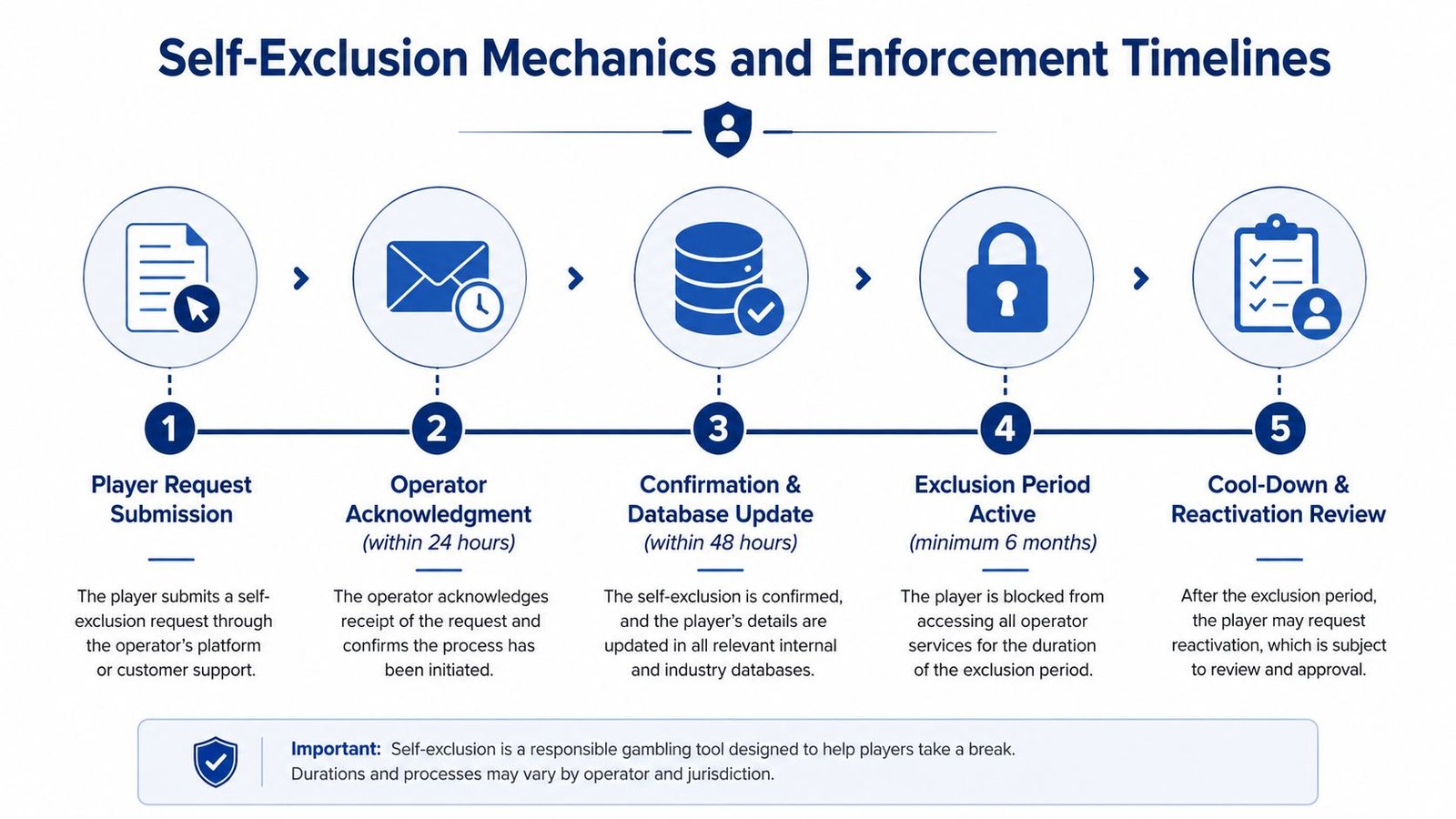
Self-exclusion is a clear example of PAGCOR's shift from broad principles to measurable operating mechanics. Players may request an exclusion period of 6 months, 1 year, 5 years, or lifetime, as set out in PAGCOR's self-exclusion framework. The first 6 months are irrevocable, and the order is lifted automatically after the selected period ends, except where the player chooses lifetime exclusion.
That structure removes two common sources of ambiguity. The operator knows which periods can be selected, and it knows that a short-term exclusion cannot be reversed during its first six months. The control therefore needs more than a customer service note. It requires a formal record, a status that downstream systems can read, and enforcement that continues for the full exclusion term.
The control chain behind an exclusion request
A workflow should connect five functions:
- Request intake: The operator captures the completed application and required identification materials. PAGCOR's framework requires a government-issued photo ID and two 2×2 color photos taken within the last six months.
- Identity matching: The operator links the request to the correct player record and checks affected accounts or gaming environments.
- Restriction deployment: Account access, play, and relevant promotional activity are restricted according to the exclusion status.
- Monitoring: Compliance and support teams retain evidence that the exclusion remains active.
- End-of-term handling: The system records automatic lifting for fixed periods, while lifetime exclusions remain subject to separate treatment.
The operator's responsibility doesn't end when the application is received. It must recognize, record, and enforce the exclusion across affected gaming environments for the full term. That requirement has technical consequences for account hierarchies, duplicate account detection, identity data, and partner platforms.
Why the rule affects commercial operations
Self-exclusion can reduce the revenue associated with an individual account, but that isn't the correct compliance benchmark. The relevant test is whether the operator can demonstrate that the restriction worked, remained active, and was not undermined by another account, product, channel, or support decision.
The framework can also change customer lifetime value models, account management workflows, and support demand. Those effects should be planned rather than treated as unexpected losses. A platform supplier that offers secure exclusion-list management, status propagation, audit records, and controlled reactivation processes can help the operator evidence compliance, but the licensee still needs governance over how those tools are configured and used.
Control principle: Automatic lifting applies to a completed fixed exclusion period. It doesn't justify manual reactivation during the irrevocable period, and it doesn't convert lifetime exclusion into a routine account status.
For operators and technology vendors reviewing this architecture, the PAGCOR gaming system administrator requirements provide relevant operational context. The central question remains whether the exclusion status travels reliably through every system that can permit gambling activity.
Technical Controls for Online and Electronic Gaming Platforms
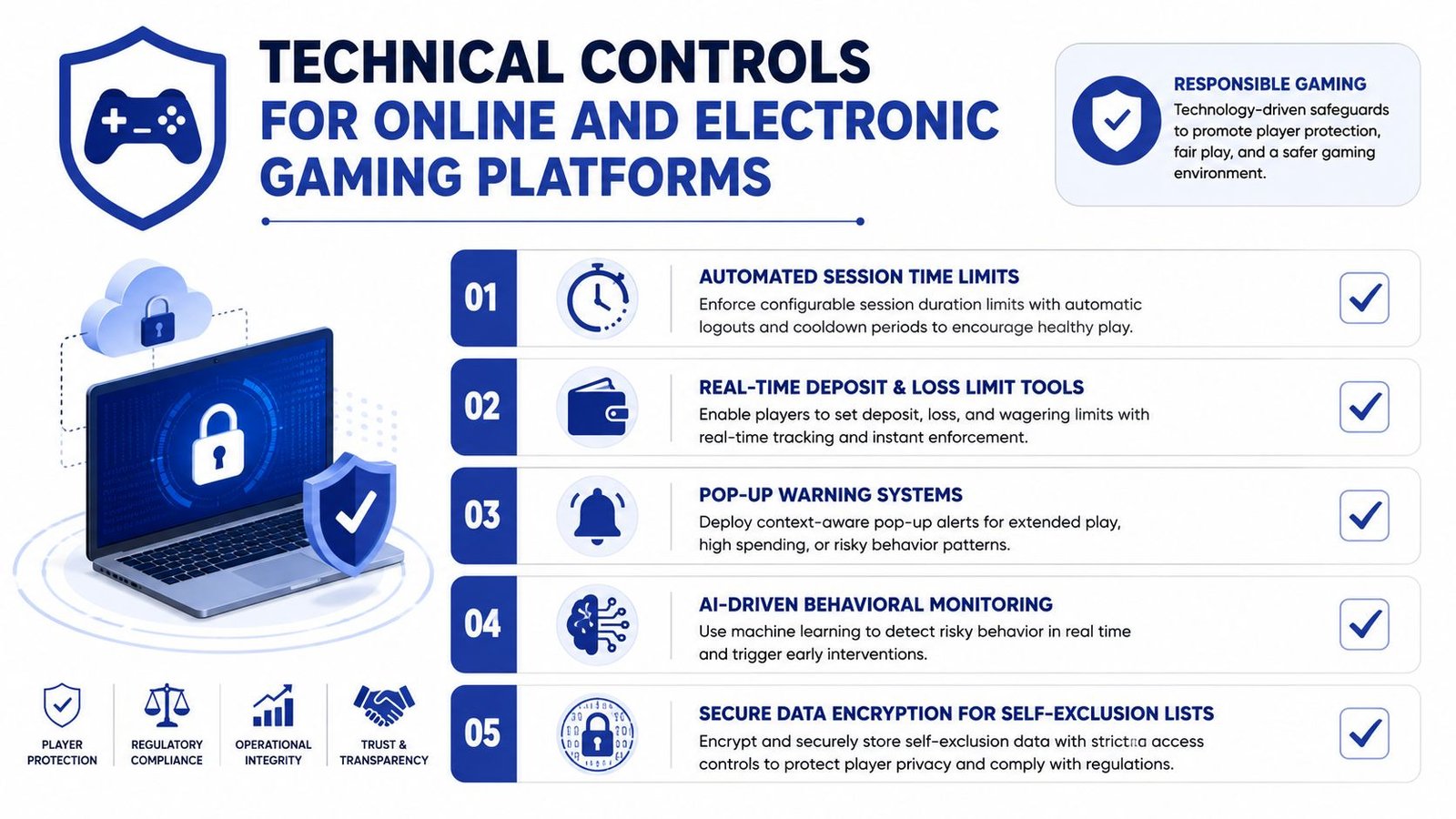
Electronic gaming requires responsible gaming controls to be built into the site and account stack. PAGCOR's Gaming Site Regulatory Manual for Electronic Games requires operators to institute a Responsible Gaming Program. That requirement distinguishes digital gaming from a purely generic policy approach, because the platform itself becomes part of the protection mechanism.
Start at login
Online platforms must show responsible gaming reminders at login. The login stage is important because it reaches the player before a session begins, when information about limits, prohibited participation, and available support can influence the decision to proceed.
The same framework requires warnings against prohibited players, including minors and people on restricted lists. Those warnings should align with the operator's account status logic. A notice that says a player is restricted, while the account remains capable of depositing or playing, creates a conflict between communication and enforcement.
Put controls inside the account journey
Time and spending controls should be visible, understandable, and connected to the systems that authorize play or transactions. Compliance teams should test the complete sequence rather than examining the interface alone:
- Configuration: Can the player select or review the applicable time and spending settings?
- Transmission: Does the selected setting reach the account and wallet systems?
- Enforcement: Does the platform stop or restrict activity when the setting is reached?
- Notification: Does the player receive a clear message about the intervention?
- Evidence: Can the operator retrieve records showing what happened?
Suppliers and operators need a shared technical specification. Responsible gaming widgets, limit tools, account restrictions, reporting functions, and support integrations should use consistent player identifiers and status fields. A limit that works in one product but not another leaves a control gap even if the individual feature performs correctly.
Separate the control from the marketing layer
Promotional technology shouldn't be able to bypass responsible gaming status. Restricted or excluded accounts should be removed from campaigns, direct offers, and reactivation activity where those actions could conflict with the player's restriction.
Payment systems also need defined interfaces with player protection controls. An operator reviewing a payment arrangement, including the considerations covered in this PAGCOR payment gateway accreditation resource, should ask how deposits, spending controls, account restrictions, and audit records connect. Responsible gaming isn't a single front-end feature. It's a cross-system rule that must survive handoffs between the gaming site, wallet, customer relationship tools, and support desk.
Governance Structure and Annual Reporting Requirements
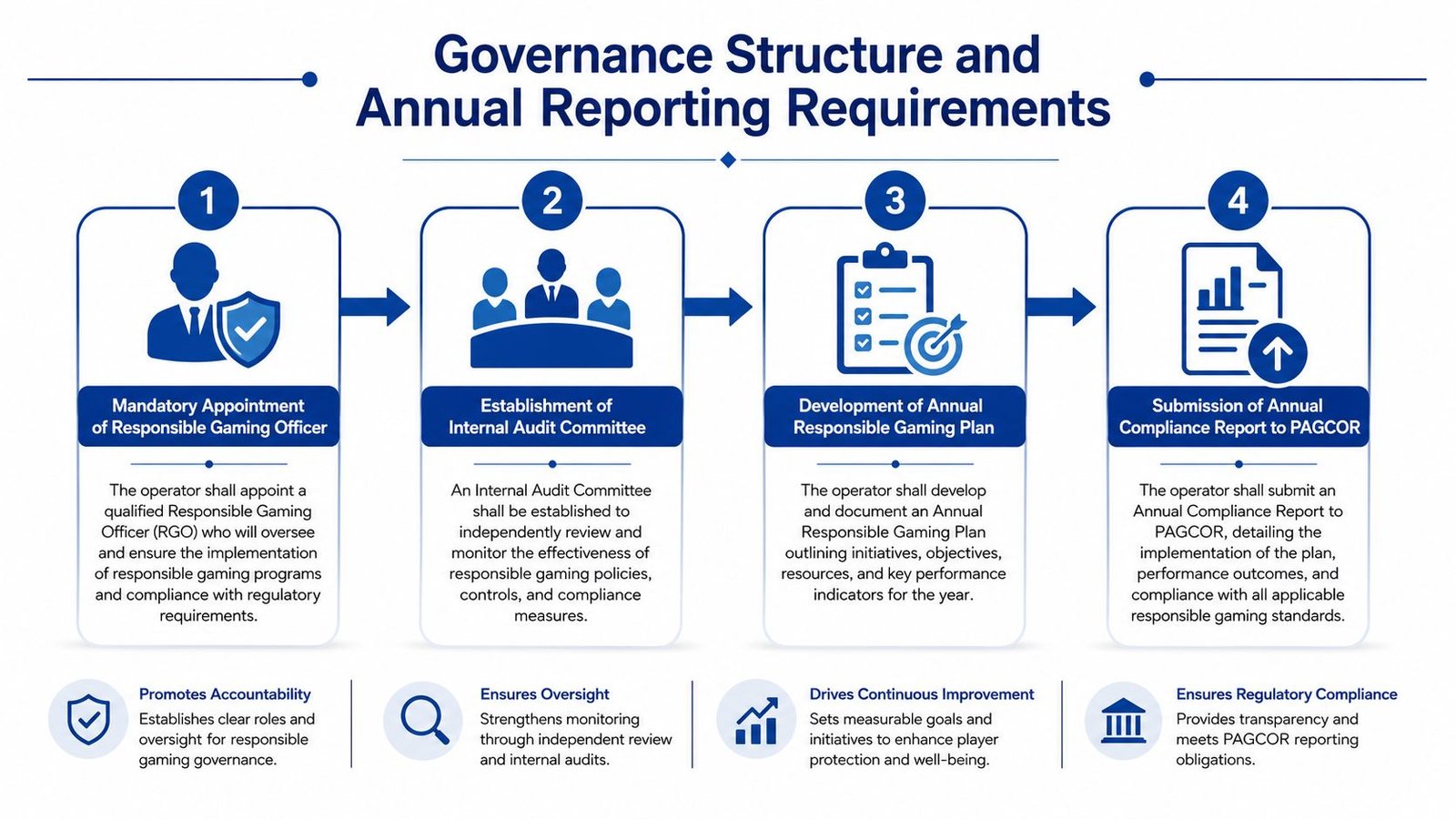
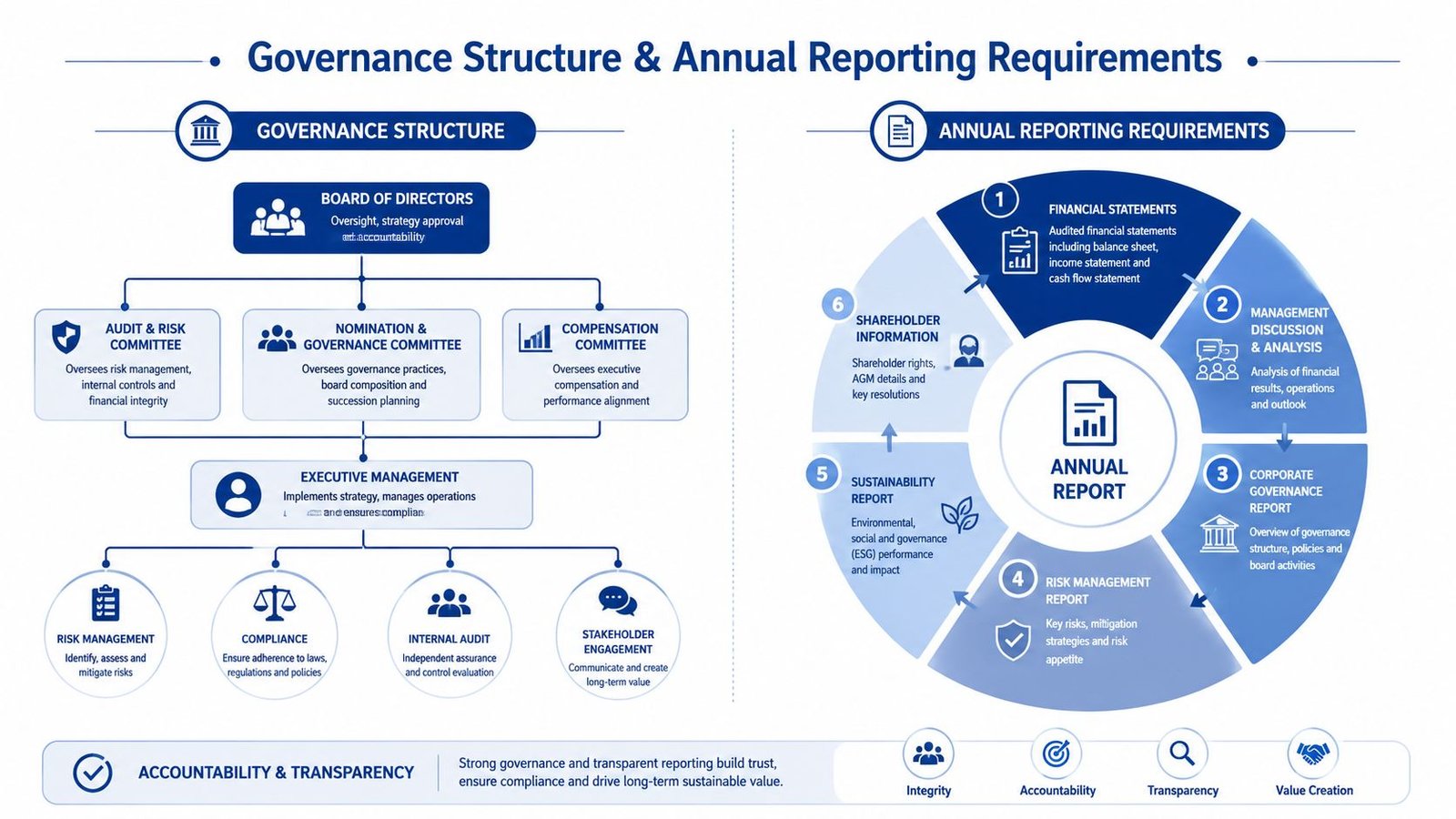
Technology can't carry the compliance program alone. PAGCOR's operational model also requires organizational ownership, documentation, training, and reporting. Operators must have a Responsible Gaming Compliance Officer and file annual Responsible Gaming Implementation Reports, giving the regulator a defined point of accountability and a recurring view of how the program operates.
The compliance officer should not function as a nominal title. The role needs authority to coordinate product, customer support, marketing, security, legal, and operations teams. It also needs access to evidence showing whether controls operated as designed and whether exceptions were resolved.
Four connected governance responsibilities
A mature governance model links the following responsibilities:
- Named ownership: The Responsible Gaming Compliance Officer maintains the control inventory, coordinates remediation, and serves as the internal escalation point.
- Operational execution: Product and operations teams implement age gating, notices, limits, exclusion, support channels, and player-protection systems.
- Staff capability: Employees receive training that enables them to recognize responsible gaming requests, apply procedures, and escalate cases correctly.
- Regulatory reporting: The operator compiles the annual implementation report from contemporaneous records rather than reconstructing activity at reporting time.
The value of this structure is evidentiary. A regulator can assess not only what the operator claims to do, but also who owns the process, how staff were prepared, what the system recorded, and how management reviewed exceptions.
Disclosure and support are part of the control environment
Independent legal analysis of the Philippine framework identifies transparent RTP disclosure, mandatory player-protection systems, employee training, and dedicated support channels, including a 24/7 hotline, among the safeguards expected across PAGCOR-regulated venues and platforms. Online platforms must also display responsible gaming reminders at login and enforce time and spending controls.
These requirements connect customer communications to governance. RTP disclosure supports transparency, while support channels provide a route for players who need assistance or clarification. Training makes those channels usable, because a hotline or email address cannot protect players if staff lack a defined response procedure.
Governance test: If a compliance officer can't produce the control owner, operating record, escalation decision, and reporting evidence for a player protection process, the organization has a documentation gap even if the feature exists.
Annual reporting should therefore be treated as a management discipline. The report is strongest when it reflects regular control testing, training records, incident reviews, and documented changes to the platform.
Practical Compliance Checklist for Operators and Affiliates
A useful audit doesn't begin with a policy document. It begins with the player journey and follows each control into the systems, people, and records that support it. The checklist below converts the PAGCOR responsible gaming requirements into verification questions for operators, suppliers, and affiliates.
| Compliance Area | Requirement | Verification Method |
|---|---|---|
| Age verification | Prevent persons younger than 21 from playing | Test registration and identity verification controls, then review blocked-account records |
| Player messaging | Tell players to gamble for entertainment and avoid borrowing or chasing losses | Review registration, login, account, and promotional content for required messages |
| Time controls | Support applicable play-time limits | Test configuration, enforcement, notifications, and audit records |
| Money controls | Provide time and money limit functionality | Review account settings, wallet integration, trigger logic, and player communications |
| Self-exclusion | Accept applications and enforce selected exclusion periods | Inspect application records, identity evidence, restriction status, and end-date handling |
| Contact channels | Provide responsible gaming contact details, including PAGCOR references | Test visibility on the site and review support escalation procedures |
| Governance | Appoint a Responsible Gaming Compliance Officer | Confirm the appointment, authority, responsibilities, and reporting line |
| Reporting | Prepare annual Responsible Gaming Implementation Reports | Review the reporting calendar, source records, approvals, and submission evidence |
| Staff training | Train employees on responsible gaming procedures | Inspect training materials, attendance records, assessments, and refresh processes |
| RTP disclosure | Present RTP information transparently where required | Review game information screens and approval records |
| Affiliate marketing | Keep promotional content aligned with player protection rules | Sample campaigns, landing pages, social content, and takedown workflows |
Using the checklist across the partner network
Operators should apply the same review logic to suppliers and affiliates. A supplier may own a technical component, while the operator remains responsible for the regulated service. Contracts and service descriptions should therefore specify control ownership, data access, incident escalation, and evidence delivery.
Affiliates should verify that campaigns don't target prohibited players, imply that gambling is a way to recover losses, or omit responsible gaming information where it belongs. Content approval should be documented, particularly when multiple affiliates publish localized pages or paid media.
The 2026 PAGCOR B2B accreditation checklist can support a broader accreditation review, but responsible gaming testing should remain tied to actual player journeys. A completed checklist is not proof of compliance unless each answer is backed by a system test, document, or accountable owner.
Enforcement Actions and Regulatory Risk Assessment
PAGCOR's framework creates enforcement exposure when responsible gaming controls exist on paper but fail during operation. The requirement to institute a Responsible Gaming Program for electronic gaming makes player protection a licensing and platform dependency for digital operators. Teams tracking PAGCOR regulatory updates for 2026 should distinguish developing policy from rules already applicable to current compliance decisions.
Regulatory risk usually arises from control failure, weak evidence, or unclear accountability. An exclusion request may be recorded but not propagated across linked accounts. A restriction may be applied without a reliable audit trail. A responsible gaming officer may be named without authority to suspend campaigns, require remediation, or escalate incidents. Each weakness gives an inspection a specific point of failure.
How regulators and investors may assess readiness
Enforcement reviews are likely to focus on operational proof rather than policy wording. Inspectors, investors, and suppliers should examine:
- Control execution: Can the operator show that restrictions, exclusions, and player protections were applied through the relevant systems, rather than handled only through manual support?
- Propagation and timing: Does a player status change reach linked accounts, gaming products, customer support, and marketing workflows without creating conflicting records?
- Evidence quality: Do event logs, case records, approvals, and escalation notes identify the action, responsible person, effective time, and final disposition?
- Remediation discipline: When testing identifies a failure, are owners assigned, corrective actions tracked, and repeat tests retained for review?
This assessment adds a different question to technical testing: whether controls remain dependable under operational pressure. A fragmented account structure can let a restricted player enter another product. A marketing platform without access to current player status can send prohibited promotions. Manual handling can also produce inconsistent decisions that are difficult to defend during an inquiry.
For investors and suppliers, the important signal is evidence quality. A policy has limited value if the operator cannot connect it to system behavior, staff actions, management review, and reporting records. The strongest readiness position is therefore an evidence chain that links each requirement to an owner, a test, an exception process, and retained documentation.
Compliance leaders should schedule cross-functional reviews before an inspection, record failures as formal findings, and preserve remediation evidence. Responsible gaming teams can use Top 1 Rank's compliance coverage to monitor regulatory developments, while internal teams convert findings into approved procedures, system tests, training records, and annual reporting evidence.





Join thousands of gaming professionals receiving the latest iGaming news, regulatory updates, and market insights.
