

An operator's 2026 risk meeting in Manila can't be reduced to checking whether a brand holds a PAGCOR licence. The more difficult question is whether the operator, platform, game studio, aggregator, affiliate, distributor, and advertising partners are all authorised under the same domestic framework.
That shift defines the Philippines online gambling regulations 2026 environment. PAGCOR is moving from a broad offshore-gaming crackdown toward a more formal domestic licensing and compliance model, with identity verification, responsible-gambling controls, advertising oversight, B2B accreditation, distributor obligations, and commercial thresholds operating together. PAGCOR's updated advertising and responsible-gaming direction shows why a licence alone no longer answers the market-access question.
Table of Contents
- Why 2026 Is a Turning Point for Philippine iGaming
- The Philippine Licensing Architecture in 2026
- PAGCOR's March 2026 B2B Accreditation and Aggregator Rules
- Minimum GGR and Fee Thresholds Reshape the Market
- KYC, Responsible Gambling and Advertising Controls
- Pending Proposals and the Market Viability Question
- A 2026 Compliance Action Plan for Operators and Affiliates
- What Operators Should Watch Next
Why 2026 Is a Turning Point for Philippine iGaming
The practical problem is timing. A domestic operator, B2B game supplier, or local affiliate must determine which requirements already apply, which filings are due during 2026, and which policy proposals remain unsettled. That requires a remediation map, not a generic legality summary.
The Philippines has already separated domestic gaming from offshore gaming. PAGCOR's regulatory materials describe its role as licensing gaming operations within Philippine territory, while current compliance coverage treats offshore operators as banned and resident-facing online betting as lawful only through PAGCOR-licensed entities. The result is a resident-only model in which access, identity, distribution, and marketing all need to be traceable.
Several changes now converge:
- B2B accreditation: Game providers, platform vendors, aggregators, and other service providers are moving into a more formal approval structure.
- Aggregator scope: PAGCOR's updated definition reaches entities supplying Electronic Gaming Systems, Online Gaming Platforms, and gaming system software to licensed or accredited businesses.
- Commercial thresholds: Gaming System Administrators face minimum GGR and Minimum Guaranteed Fee requirements, changing the economics of participation.
- Customer verification: Licensed online operators must strengthen checks before deposits, including government-issued identification and real-time selfie verification.
- Responsible gambling: Self-exclusion tools, a confidential helpline, and local-language harm messaging form part of the tightening player-protection framework.
- Advertising oversight: PAGCOR is working with the Advertising Standards Council on rules extending beyond primetime broadcast restrictions into digital platforms.
The policy debate adds another layer. Proposals involving a 10% online-gambling tax, a 21+ age floor, mandatory loss limits, deposit controls, and wider advertising restrictions have been discussed, but they shouldn't be presented as settled law. Current industry coverage of the 2026 responsible-gambling debate distinguishes those proposals from requirements already introduced or signaled by PAGCOR.
A useful starting point for market teams is the domestic PAGCOR online casino framework, followed by a separate review of every supplier and acquisition channel. That order matters because the central compliance question has changed from “Is the brand licensed?” to “Can every participant in the supply chain demonstrate authorisation and control?”
The Philippine Licensing Architecture in 2026
The Philippine framework is layered rather than monolithic. PAGCOR remains the central gaming regulator, but different business activities can trigger different authorisations, registrations, and reporting duties. Treating all market participants as if they occupy the same licence category creates avoidable gaps.
Domestic operators serving Filipino residents sit within the Online Gaming Licensing structure. Offshore gaming is a separate regulatory concept and no longer provides a safe route into the resident market. Alongside operator licensing, PAGCOR's 2026 updates formalise B2B oversight for game suppliers, platform companies, system providers, and aggregators.
The following comparison is a practical map, not a substitute for a transaction-specific legal review.
Philippine iGaming licences and permits at a glance
| Authorisation | Issuing body | Covers | Typical holder |
|---|---|---|---|
| Domestic Online Gaming Licence | PAGCOR | Resident-facing online gaming conducted through the Philippine framework | Online casino or betting operator |
| Offshore Gaming authorisation | PAGCOR, subject to applicable policy | Offshore-facing activity under the relevant historic framework | Offshore operator, where applicable |
| B2B provider accreditation | PAGCOR | Games, systems, platforms, software, and related services supplied to authorised entities | Game studio, software vendor, platform provider |
| Game Aggregator accreditation | PAGCOR | Aggregation and distribution of games or electronic gaming systems | Aggregator or distribution platform |
| Gaming Affiliate authorisation | PAGCOR | Local distribution or affiliate activity connected with regulated gaming services | Philippine affiliate or distributor |
| Tax registration and reporting | BIR | Tax, withholding, and related business obligations | Operator, supplier, affiliate, or local entity |
| Suspicious transaction reporting | AMLC framework | AML controls and reporting responsibilities | Regulated operator and relevant reporting entity |
| Local promotional permissions | Relevant LGU, where applicable | Certain promotional or event activities | Operator, affiliate, or event organiser |
A Manila-based slot studio illustrates the problem. To place one game with a domestic operator, it may need its own PAGCOR B2B accreditation, a relationship with an authorised domestic operator, and BIR registration for the applicable commercial and tax obligations. The domestic operator must then confirm that the studio, platform, game, and distribution route remain acceptable under its own licence controls.
BIR requirements concern tax administration and withholding rather than gaming permission. AMLC obligations concern suspicious transaction controls and reporting. Local government units can also intersect with promotional events. These functions don't replace PAGCOR approval, and PAGCOR approval doesn't eliminate them.
Practical rule: A Philippine market-entry file should identify the legal entity, activity, customer group, technology layer, distributor, tax registration, and reporting responsibility separately.
That structure helps operators distinguish a right to offer gaming from a supplier's right to provide software or a distributor's right to introduce that supply. The distinction becomes decisive under the March accreditation rules.
PAGCOR's March 2026 B2B Accreditation and Aggregator Rules
A foreign game studio can have a compliant product and still create a market-entry problem if its Philippine distribution route is undocumented. PAGCOR's March 2026 updates push oversight beyond the operator and into the connected supply chain, including suppliers, platforms, aggregators, and local distributors.
The revised definition of Game Aggregator covers entities providing Electronic Gaming Systems, Online Gaming Platforms, or gaming system software to licensed or accredited entities. It therefore reaches arrangements that businesses may previously have classified as indirect technology support, rather than as regulated supply or distribution.
Foreign-based aggregators and content providers that do not seek PAGCOR accreditation must appoint a local Gaming Affiliate as their exclusive distributor. Overseas studios must choose a documented route: obtain accreditation or distribute through an authorised Philippine entity. Continuing without either arrangement leaves the operator and its vendors exposed to an unresolved compliance issue.
The update set specific deadlines. B2B provider accreditation applications had to be submitted by May 31, 2026, and existing distributorship agreements had to be declared by June 1, 2026. Undeclared agreements are treated as void. The March 2026 regulatory update on B2B providers and aggregators sets out the relevant framework and deadline detail.
Accreditation is not the same as distribution
A pure game-provider accreditation and a Game Aggregator authorisation address different operating models. A studio supplying its own certified games has a different control profile from a platform that hosts, integrates, and distributes content from multiple providers.
The application should describe the actual operating model, rather than rely on a broad corporate label. The documentary pack should cover:
- Corporate records: Ownership, incorporation, directors, officers, beneficial owners, and local representation.
- Technical materials: Platform architecture, integration controls, access management, incident procedures, and system documentation.
- Game integrity evidence: RNG and RTP attestations relevant to the supplied products.
- AML documentation: Customer, counterparty, monitoring, escalation, and suspicious-activity procedures.
- Responsible-gaming attestations: Player-protection controls, messaging, exclusion processes, and operator oversight.
Applications must be filed through PAGCOR's accreditation portal. Suppliers should retain submission receipts, document versions, correspondence, and remediation responses in a controlled register. An incomplete file can delay production onboarding when an operator requires proof that a vendor is approved before adding it to a whitelist.
The deadline structure also affects local distributors. A foreign studio without a compliant Philippine partner may need to pause distribution while its status is resolved. The same issue can extend to platform services, advertising technology, payment-related integrations, and support functions positioned close to regulated activity.
The PAGCOR B2B provider application process should be reviewed against the entity's actual distribution map. A generic application that omits affiliates or resellers may leave the operator unable to verify whether every agreement was properly disclosed.
The key operational test is simple: Can the operator prove who supplied the content, who distributed it, under which authorisation, and whether the agreement was declared on time?
Minimum GGR and Fee Thresholds Reshape the Market
PAGCOR's minimum revenue and fee structures turn licensing into a viability test. For operators with electronic casino games, one phase sets a minimum monthly GGR of PHP 30 million and a Minimum Guaranteed Fee of PHP 9 million. The next phase increases those requirements to PHP 35 million GGR and PHP 10.5 million MGF. The thresholds and structure are detailed in the March 2026 PAGCOR regulatory summary.
Gross Gaming Revenue measures gaming revenue after the applicable treatment of player winnings and related gaming adjustments. The Minimum Guaranteed Fee is a minimum commercial obligation tied to the licence structure, rather than a simple reflection of the operator's actual profitability. An operator can therefore hold a valid authorisation while still facing difficult economics if revenue performance doesn't support the required floor.
| License Category | Minimum Monthly GGR (PHP) | Minimum Monthly Gross Floor (PHP) | Practical Impact |
|---|---|---|---|
| Electronic casino games, initial phase | PHP 30 million | PHP 9 million | Requires sufficient scale and cash-flow planning |
| Electronic casino games, next phase | PHP 35 million | PHP 10.5 million | Increases pressure on marginal operators |
The commercial effects spread beyond the licence holder. B2B suppliers may face fewer viable counterparties because smaller operators can't sustain the required economics. Affiliates may see reduced commission pools as brands consolidate acquisition spending. Platforms may need to choose between a broader product offering and a narrower model focused on eGames or other categories with a more manageable cost base.
The thresholds also create counterparty risk. A game studio can invest in integration, certification, and support, then discover that its operator client is commercially unable to maintain the account. The supplier's due diligence must therefore include financial capacity, not only technical certification.
A new entrant should model three outcomes qualitatively: continued operation above the floor, consolidation into a stronger licensed group, or withdrawal from the domestic market. The PAGCOR B2B accreditation fee structure is only one part of that calculation. Compliance staffing, testing, local distribution, tax administration, customer support, and acquisition restrictions all affect viability.
The deeper conclusion is that minimums act as a de facto market filter. They favour formalised and well-capitalised operators, while a licence by itself no longer guarantees a sustainable business.
KYC, Responsible Gambling and Advertising Controls
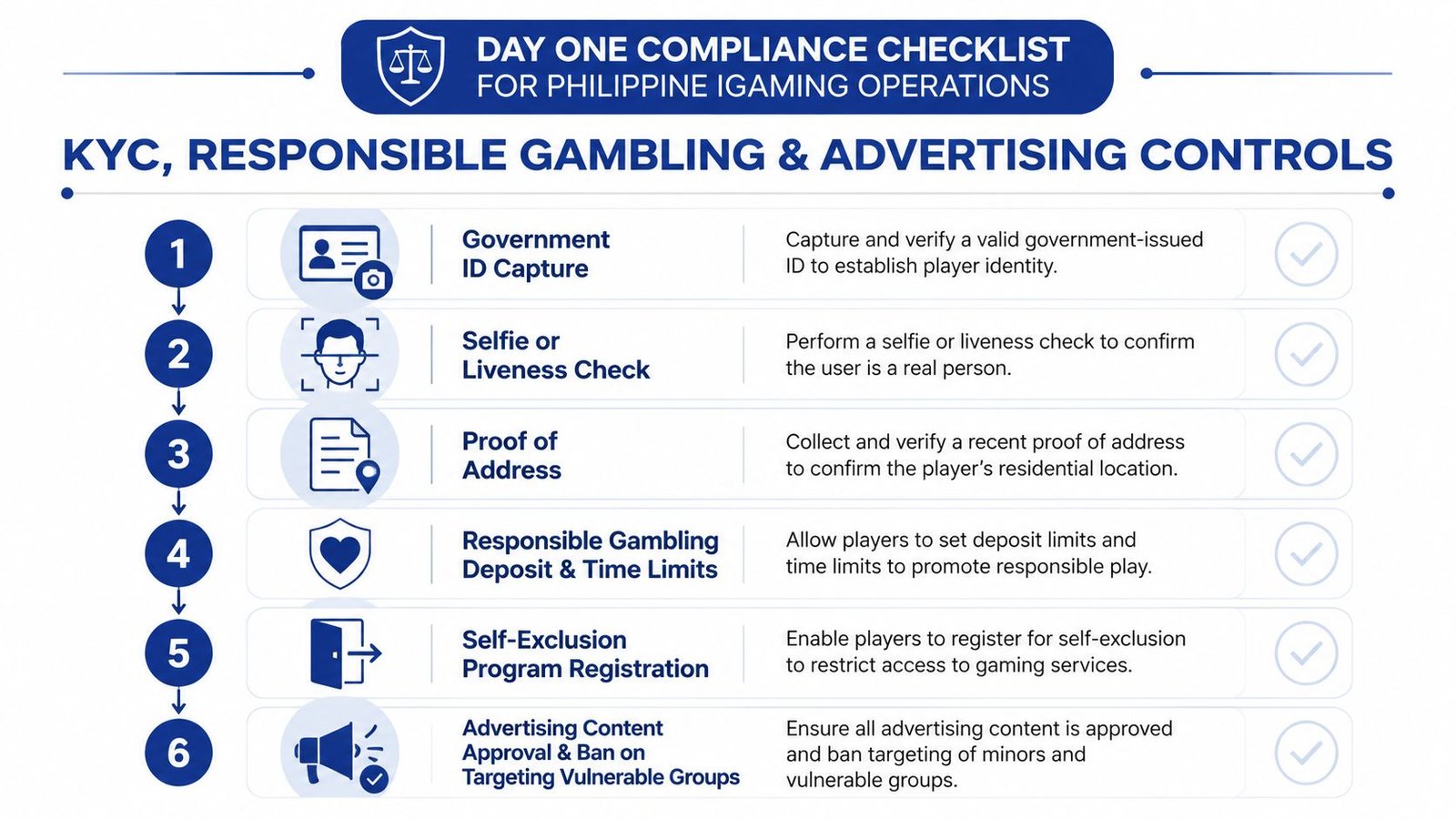
A compliance officer can treat the 2026 operating baseline as a gated customer journey. The customer shouldn't reach deposit access until identity, risk, and responsible-gambling controls have been addressed.
The day-one control sequence
- Capture government identification. PAGCOR's 2026 framework requires stronger customer verification before deposits, including government-issued ID checks.
- Complete real-time selfie verification. The operator should record the outcome of the selfie or liveness process and retain evidence of failed, referred, and approved checks.
- Confirm resident access. The operator should test whether the customer is eligible for the domestic service rather than relying only on a registration declaration.
- Apply risk-based review. Higher-risk activity should trigger enhanced checks, source-of-funds enquiries where required by the operator's risk policy, and sanctions or politically exposed person screening aligned with applicable AML controls.
- Present responsible-gambling tools. Self-exclusion, deposit controls, session information, and harm messaging should be visible at the points where customers make decisions.
- Control advertising before publication. Marketing teams should document approval, audience settings, responsible-gambling language, and the basis for any bonus or promotional presentation.
PAGCOR's direction includes self-exclusion tools, a confidential 24-hour helpline, and local-language harm messaging. Those measures are not decorative website content. They require ownership, escalation routes, support logs, and evidence that a customer request was handled consistently.
The PAGCOR gambling advertising rules should be applied to influencer content, affiliate pages, social campaigns, and platform placements. Digital advertising controls are being developed alongside the Advertising Standards Council, and the direction is broader than primetime broadcast restrictions.
Inspection evidence matters
Operators should retain identity-verification results, exclusion records, customer-support escalations, approved creative, campaign changes, complaints, and vendor attestations. A policy document without operational evidence won't demonstrate that the control worked.
Some implementation details still require careful interpretation. Marketing teams should avoid targeting minors or vulnerable audiences, avoid presenting bonuses in a misleading way, and include responsible-gambling messaging where required. Compliance teams should obtain written internal approval for borderline campaigns rather than assume that a previously accepted format remains acceptable.
Pending Proposals and the Market Viability Question
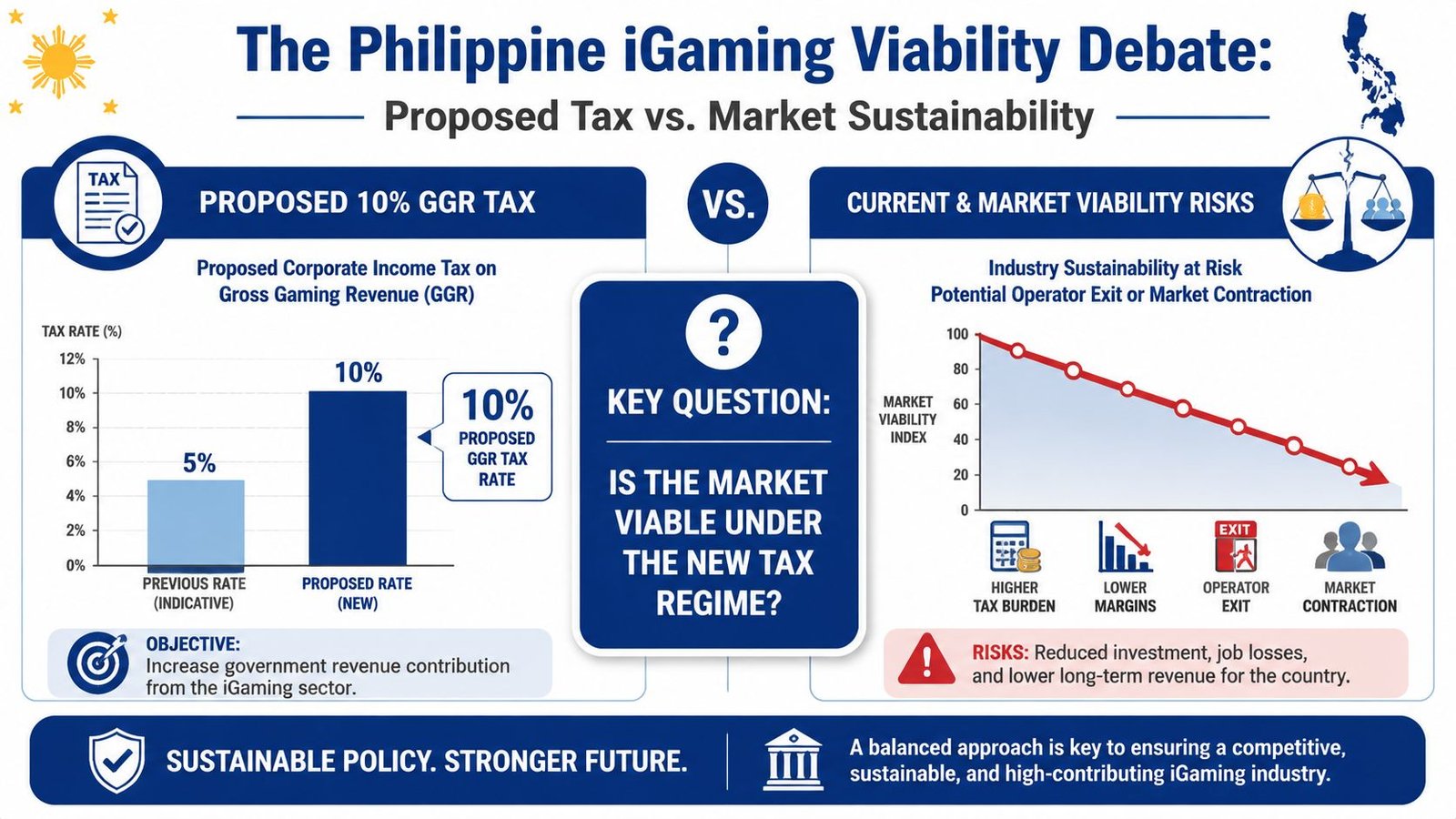
The 2026 question is whether a legal operator can remain commercially viable while carrying a heavier compliance and distribution burden. That burden extends beyond the licence holder. B2B suppliers, aggregators, affiliates, and local distributors may each affect the economics and evidence required to keep a product in market.
Proposals for a 10% GGR tax, a uniform 21+ age floor, mandatory loss limits, deposit caps, and a broad advertising ban would each alter that calculation. They should not be described as enacted requirements unless the relevant measure has formally taken effect. Current reporting presents them as policy proposals or signals within an evolving debate. Coverage of the proposed tax, age, loss-limit, and advertising measures sets out that distinction.
What each proposal would change
A 10% GGR tax would reduce the amount available for platform fees, marketing, supplier payments, staffing, and profit after the existing regulatory burden. The impact would vary by operating model. A scaled operator with diversified products might absorb it more easily than a smaller brand already close to its guaranteed-fee floor.
A flat 21+ rule would simplify age policy, while requiring changes to onboarding, advertising exclusions, affiliate filters, and existing customer controls. Mandatory loss limits and deposit caps would add monitoring requirements. Operators would need a defined basis for applying each limit, such as account, household, payment method, product, or another approved category.
An advertising ban would create the most immediate acquisition challenge. Affiliates, influencers, media buyers, and operators would need to reassess how they present legal products to eligible adults. Even a partial restriction could raise compliant acquisition costs by reducing available channels.
The debate has competing stakeholders. Regulators and public-health advocates may support stronger controls, while operators, suppliers, affiliates, and investors have commercial reasons to resist measures that compress revenue or restrict marketing. Legislative timing and any transition period remain uncertain. Planning around an assumed effective date would therefore be premature.
Three scenarios for management teams
- Rules pass as proposed: Recalculate unit economics, reduce exposure to restricted acquisition channels, and prioritise products with stronger retention and compliance margins.
- Rules pass in diluted form: Maintain the existing control programme while preparing for narrower changes to age, loss, tax, or advertising requirements.
- Status quo continues: Use the available time to complete B2B mapping, improve evidence retention, and avoid treating uncertainty as permission to delay.
Market-entry strategy should assess jurisdiction mix, product scope, and cost base together, because each lever changes viability differently. It should also test the resilience of the supply chain: whether the chosen aggregator is accredited, whether a local distributor is required, whether suppliers can produce audit evidence, and whether commercial agreements allocate responsibility for customer and regulatory controls. A business dependent on one distributor or one acquisition route has fewer compliant alternatives when a proposal becomes binding.
Scenario planning should measure survival, not just compliance. A technically lawful model can still become commercially unworkable when fees, minimums, tax, and acquisition restrictions accumulate.
A 2026 Compliance Action Plan for Operators and Affiliates
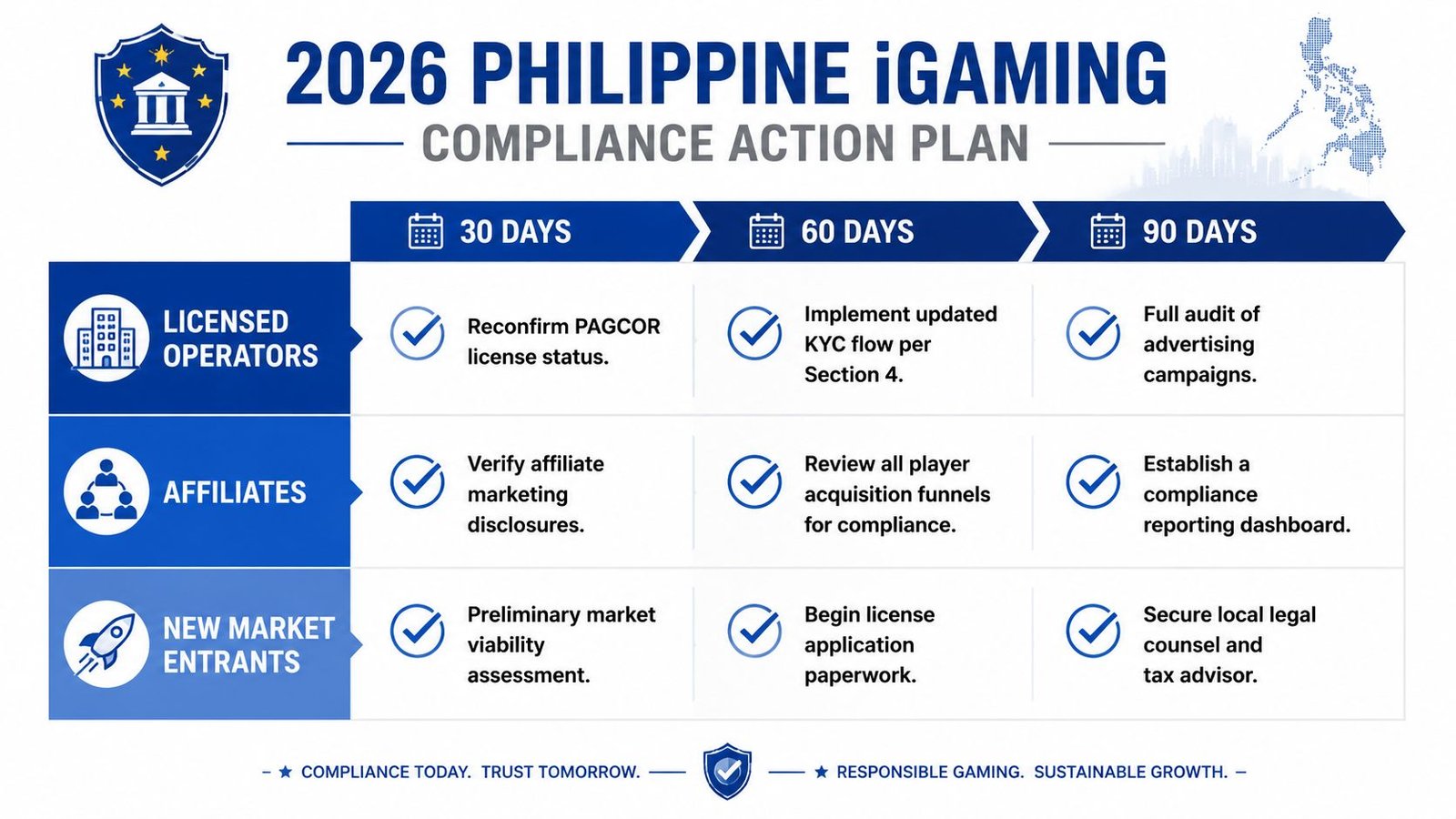
A workable action plan assigns tasks by role and evidence owner. The first priority is not a new campaign or product launch. It's a controlled inventory of licences, suppliers, agreements, customer controls, and marketing assets.
Licensed operators
First 30 days
- Confirm licence scope: Reconcile the PAGCOR licence category, permitted products, resident access, and named entities.
- Build the supplier register: Record every studio, platform vendor, aggregator, affiliate, distributor, and support provider.
- Test customer gates: Verify government ID capture and real-time selfie verification before deposits.
- Collect evidence: Store policies, approvals, technical records, responsible-gaming procedures, and vendor attestations in one controlled repository.
By 60 days
- Review revenue exposure: Audit performance against the applicable GGR and MGF requirements, including the next-phase PHP 35 million GGR and PHP 10.5 million MGF thresholds where relevant.
- Refresh player protection: Test self-exclusion, helpline escalation, local-language messaging, and customer-support procedures.
- Reapprove advertising: Submit current creative for internal and regulatory clearance where required, with special attention to influencer and affiliate placements.
By 90 days
- Complete a chain audit: Match each live game and platform service to an accredited provider and declared distributorship.
- Escalate delays: If a filing or approval remains unresolved, suspend the affected integration or campaign and seek documented guidance through the relevant PAGCOR channel and qualified local counsel.
B2B suppliers and aggregators
The B2B lane begins with the accreditation file. Corporate documents, ownership information, technical architecture, RNG and RTP attestations, AML procedures, responsible-gaming controls, and distribution agreements should be reconciled before submission.
Applications should be submitted through PAGCOR's accreditation portal ahead of the May 31, 2026 deadline, while existing distributorship agreements require declaration by June 1, 2026. An aggregator should separately identify its own platform role and the underlying studios it distributes. If a foreign provider isn't pursuing accreditation, its Philippine Gaming Affiliate and exclusive distribution arrangement must be documented.
During the following review cycle, suppliers should certify live integrations, update technical logs, and check that operator clients remain authorised. If approval slips past the relevant operational window, the safest escalation path is a written status request, a pause on new domestic distribution, and notification to affected operator counterparties.
Affiliates, distributors, and entrants
Affiliates and local distributors should document entity details, ownership, promotional permissions, commission structures, traffic sources, creative approvals, and links to licensed operators. Traffic to unlicensed offshore sites should stop, since resident-facing access is tied to the PAGCOR-licensed domestic framework.
New entrants should begin with a market-viability review rather than an application form. The review should test product scope, minimum-fee exposure, local distribution, tax registration, KYC technology, responsible-gaming staffing, advertising access, and contingency options.
Top 1 Rank can serve as one market-intelligence input for teams tracking regulatory and operator developments, while legal advisers, PAGCOR communications, BIR guidance, and AMLC materials should support formal decisions. The 2026 PAGCOR regulatory update coverage can be added to an internal monitoring workflow, but it shouldn't replace primary regulatory confirmation.
What Operators Should Watch Next
The Philippines online gambling regulations 2026 framework is becoming more traceable, but it isn't fully static. The most important monitoring points are B2B accreditation outcomes, the treatment of foreign suppliers and local Gaming Affiliates, digital advertising rules, minimum-fee implementation, and the status of proposed tax, age, loss-limit, and advertising measures.
A disciplined operator should maintain a live obligations register with three labels: effective requirement, filed or pending requirement, and policy proposal. That distinction prevents two common errors, under-compliance caused by ignoring a new rule and overreaction caused by treating a proposal as enacted law.
The supply chain deserves equal attention. A brand can't rely on its own PAGCOR status if a content provider, aggregator, affiliate, or distributor lacks the required authorisation or documentation. In 2026, compliance teams should ask for evidence before launch, not after an inspection or partner dispute.
Operators, suppliers, affiliates, and investors should commission a Philippines-specific compliance gap assessment now. The review should map every entity and contract, verify PAGCOR accreditation status, test KYC and responsible-gaming controls, assess exposure to GGR and MGF thresholds, and model the three policy scenarios described above. Teams that complete that work before the next filing or policy change will have a clearer basis for deciding whether to expand, consolidate, pause, or exit the domestic market.




Join thousands of gaming professionals receiving the latest iGaming news, regulatory updates, and market insights.
