


Philippines online gaming revenue in 2026 began with a 15.87% year-on-year decline in total gaming GGR. Q1 revenue reached PHP87.6 billion, compared with PHP104.12 billion in Q1 2025, according to PAGCOR-reported Q1 revenue coverage. Electronic gaming generated PHP39.9 billion, while licensed casinos produced PHP44.52 billion.
The figures establish the central analytical issue for the year: revenue quality. Online and electronic gaming became the industry's main growth engine in 2025, yet that concentration also increases national GGR's exposure to payment controls, advertising restrictions, player access, and discretionary spending.
The market therefore requires more than a single topline estimate. Scenario forecasts should separate online streams by their resilience and regulatory exposure, since a disruption affecting one segment may not affect licensed casinos or other channels equally.
PAGCOR chairman Alejandro Tengco said total industry GGR could reach PHP320 billion to PHP350 billion in 2026, a range that may represent a decline from the previous year, as reported by Yogonet's coverage of the 2026 outlook. For operators, affiliates, suppliers, and investors, the range is a planning boundary. It should guide spending, segment allocation, and the regulatory downside built into forecasts.
Table of Contents
- Revenue Forecast Overview
- Historical Industry Context
- Key Drivers of Online Gaming Revenue
- Forecast Methodology and Data Sources
- Revenue Scenarios and Market Segmentation
- Risks and Opportunities in 2026
- Strategic Recommendations for Stakeholders
- Conclusion and Next Steps
Revenue Forecast Overview
The 2026 outlook places Philippines online gaming revenue 2026 within a wider industry range of PHP320 billion to PHP350 billion in total GGR. PAGCOR chairman Alejandro Tengco presented that range for the Philippine gaming industry, covering electronic gaming, licensed casinos, and PAGCOR-operated casinos. It is not a standalone online forecast, yet electronic gaming remains the main variable shaping the national result because of its scale.
Q1 demonstrated that sensitivity. Total gaming GGR reached PHP87.6 billion, down from PHP104.12 billion in Q1 2025, while electronic gaming contributed PHP39.9 billion, according to the earlier PAGCOR-reported disclosure. Licensed casinos generated PHP44.52 billion, and PAGCOR-operated casinos added PHP3.17 billion. Online gaming therefore functions as one of the industry's two principal revenue pillars, rather than a secondary casino supplement.
The range reflects three forces that should be modelled separately:
- Structural scale: Electronic gaming had become the largest industry segment in 2025.
- Current pressure: Q1 2026 started below the comparable prior-year quarter.
- Regulatory exposure: Tighter controls can affect payments, customer acquisition, advertising, and player access simultaneously.
That combination makes a single topline forecast less useful than segment-based scenarios. Digital streams may retain demand while facing greater compliance and distribution risk, whereas land-based channels can provide a different revenue profile. Operators should therefore test whether their forecasts depend on regulated, repeatable traffic or on acquisition routes vulnerable to restriction.
Affiliates need the same distinction when assessing commission growth. Investors should separate businesses with durable domestic compliance from those whose economics rely on rapid online expansion.
Planning implication: Treat the PHP320 billion to PHP350 billion industry range as a scenario envelope, not a guaranteed endpoint. Online gaming businesses need plans that remain viable if digital growth slows and land-based revenue does not fully offset the decline.
Historical Industry Context
The Philippine market changed shape before it softened. PAGCOR reported PHP396 billion in total gaming GGR for 2025, while electronic and online gaming contributed PHP201.12 billion, or about 50.8% of industry revenue, according to Philstar's report on the 2025 gaming results. Electronic gaming therefore overtook land-based casinos as the industry's largest revenue source.
The shift becomes clearer against the prior year. Electronic gaming increased from PHP154.66 billion in 2024 to PHP201.12 billion in 2025, a 30% rise. The key change was not growth alone. Online and electronic play moved from a major contributor to the market's dominant revenue driver, increasing the sector's influence over forecasts, supplier demand, and operator valuations.
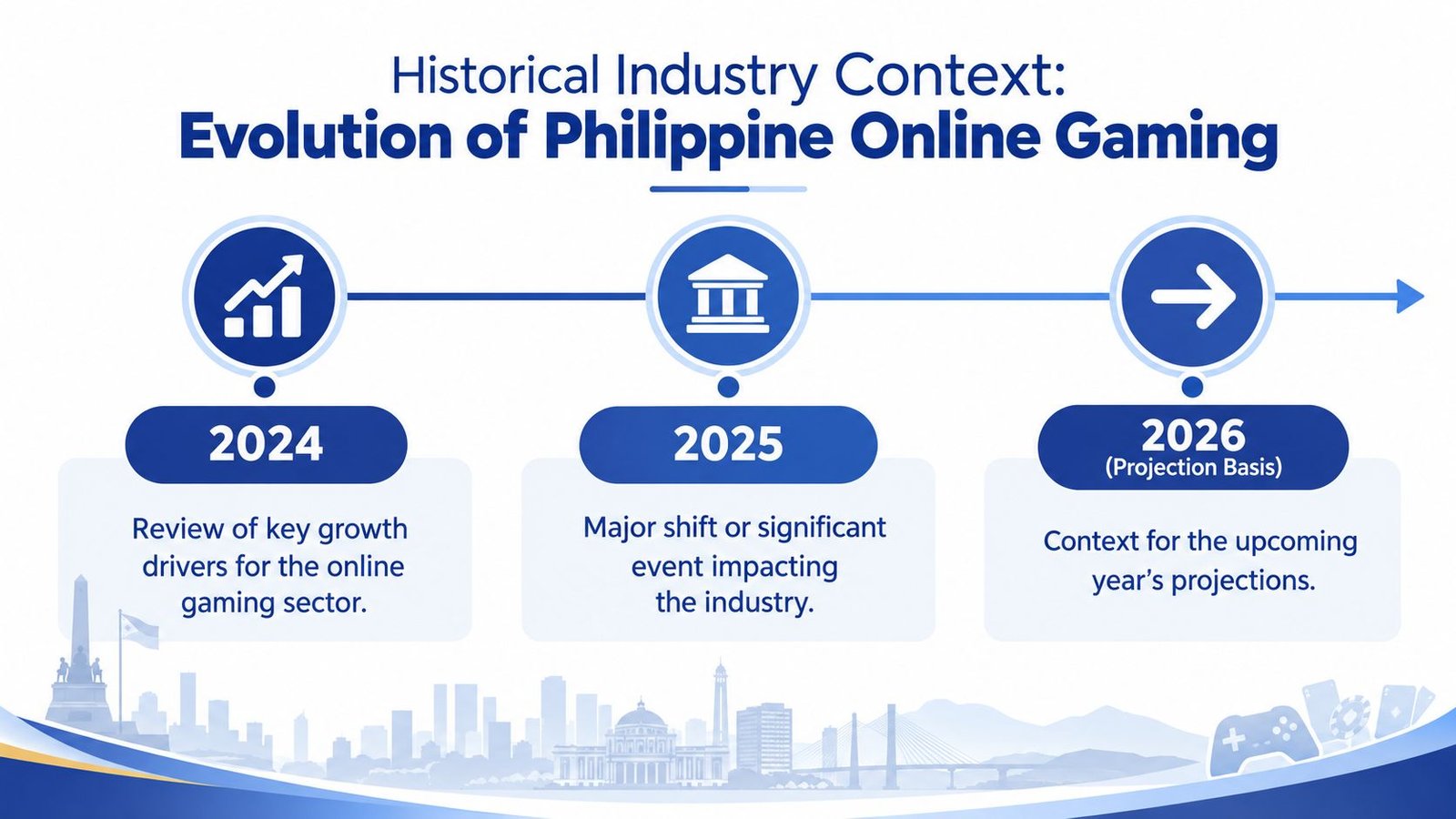
The three-stage market shift
2024 established the growth base. Electronic gaming revenue reached PHP154.66 billion, creating the benchmark for the following year's expansion. This starting point matters because it shows that digital scale was already substantial before the segment became the industry leader.
2025 created the new industry hierarchy. Electronic and online gaming produced PHP201.12 billion within a PHP396 billion market. At about 50.8% of total GGR, the segment surpassed land-based casino revenue and made online performance more significant for investor expectations and supplier planning.
Q1 2026 tested that momentum. Total GGR declined to PHP87.6 billion from PHP104.12 billion a year earlier, a 15.87% year-on-year decline, as reported in PAGCOR data covered by GGB Magazine. Electronic gaming still generated PHP39.9 billion, but the quarter showed that 2025's growth rate could not be treated as an automatic baseline.
The historical pattern has two sides. Digital channels delivered reach and scale, while their growing contribution increased exposure to regulatory decisions affecting licensed access, payments, and distribution. For readers assessing PAGCOR-regulated online casino options in the Philippines, the more useful distinction is between headline GGR expansion and the durability of compliant revenue streams. That distinction should shape 2026 scenarios for operators, affiliates, and investors.
Key Drivers of Online Gaming Revenue
Online gaming revenue in 2026 will depend on how several operating variables interact, rather than on player demand alone. PAGCOR's Q1 disclosure put electronic gaming at PHP39.90 billion out of PHP87.60 billion in total GGR, or 45.55%, according to PAGCOR's official information. That scale gives regulation, payment access, product design, and technology a direct influence on the national revenue trajectory.
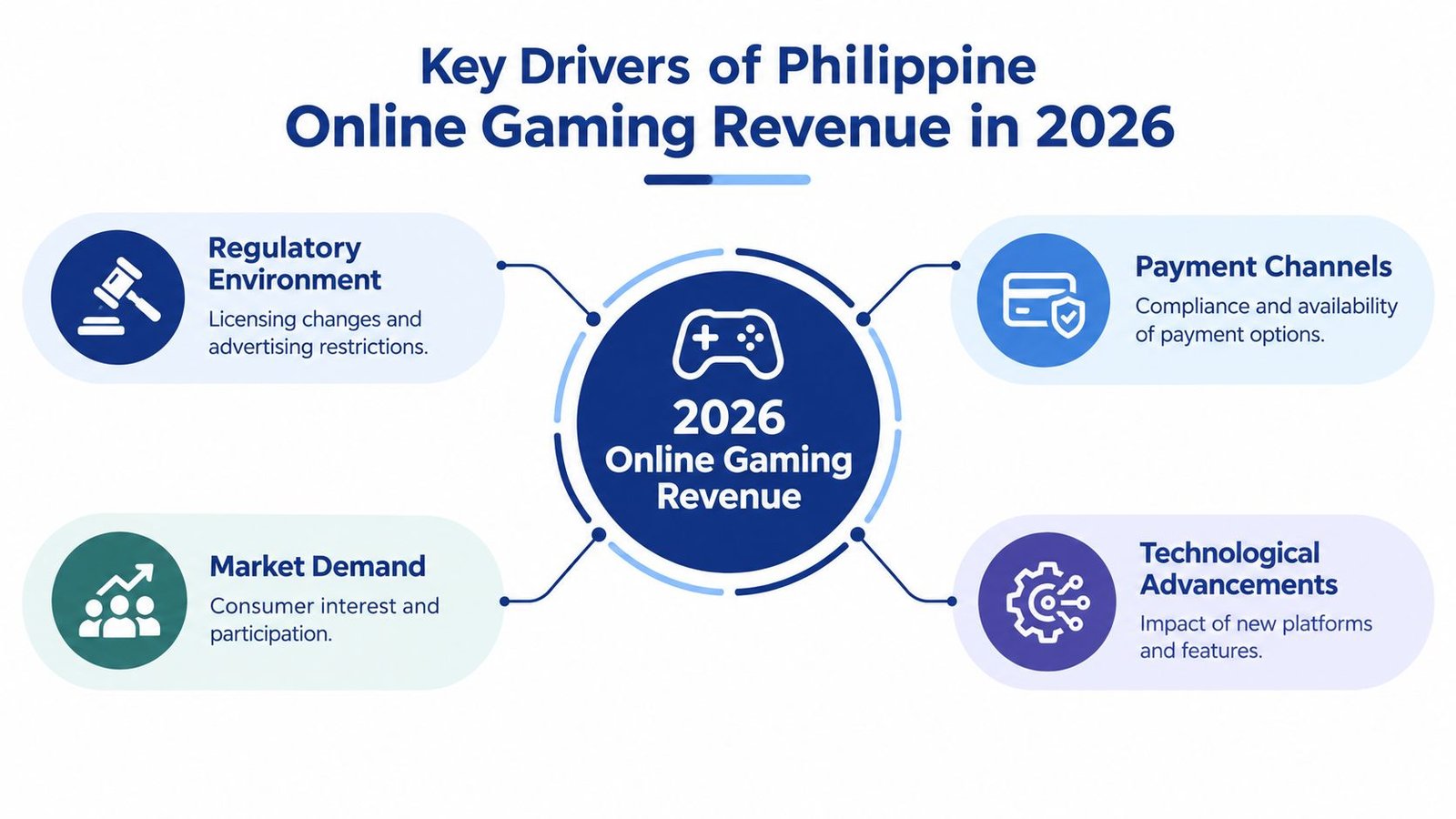
Regulation determines the addressable market
Licensing rules and advertising controls affect more than legal risk. They determine which operators can acquire customers, which affiliates can promote products, and which suppliers can distribute games through compliant channels. A restriction on advertising can reduce new-player discovery. A licensing change can remove an operator from the addressable market. A player-access rule can weaken conversion even when consumer interest remains intact.
The 2026 environment therefore favors businesses that treat compliance as a revenue capability. Operators need documented controls for customer onboarding, payments, responsible gambling, and marketing approval. Affiliates need to know whether their traffic sources, landing pages, and commercial partners align with current requirements.
Payment channels connect compliance with conversion
Payment availability can either preserve demand or interrupt it. Digital gaming depends on a user's ability to deposit, play, and withdraw through channels that satisfy both operational requirements and customer expectations. Tighter controls on payment providers may reduce fraud exposure, but they can also create friction for legitimate players and make acquisition more expensive.
The practical question isn't whether one payment method is popular. It's whether operators maintain a resilient payment architecture that can handle compliance reviews, failed transactions, settlement delays, and changes in provider policy. Businesses assessing user acquisition cost in online gaming should include payment friction in the calculation, because a campaign can attract traffic without producing durable depositing customers.
Product mix changes revenue resilience
Electronic gaming is not a single product. E-games, e-bingo, casino-style content, live casino, sports betting, and other formats can face different levels of demand and regulatory exposure. A portfolio concentrated in one format may produce strong results during a favorable cycle but expose the operator to sharper downside when rules or player preferences change.
Live casino can add a more interactive experience, while e-bingo and other electronic formats may appeal to different user groups. The strategic advantage comes from matching content to compliant distribution, not from adding every available product. Suppliers should also measure whether their games fit the licensed ecosystem rather than relying only on raw player acquisition.
Mobile technology supports reach, but doesn't remove risk
Mobile-first experiences, faster interfaces, localized content, and improved account management can support engagement. Technology can reduce loading friction, improve discovery, and help operators present relevant products across devices. It can't, however, compensate for blocked payments, weak compliance, or a decline in discretionary spending.
The same applies to eSports and emerging skill-based formats. These categories can broaden the addressable audience and create new content opportunities, but their contribution depends on licensing treatment, responsible marketing, integrity controls, and reliable data. The central insight is that technology amplifies a compliant business model. It doesn't substitute for one.
Forecast Methodology and Data Sources
A credible 2026 forecast should separate observed revenue, management guidance, and analyst scenarios. PAGCOR disclosures provide the official baseline for total GGR and segment performance. Operator filings, licensing information, payment data, and market surveys can then be used as contextual inputs, but they shouldn't override regulator-reported results without a clear reconciliation.
The process can be organized into four steps:
- Set the baseline. Use the reported 2025 industry result and Q1 2026 performance as the historical anchor. Electronic gaming's 2025 contribution and Q1 share establish the scale of online exposure.
- Define the drivers. Track consumer spending, player activity, average revenue per user, payment success, licensing conditions, and product mix qualitatively where verified numerical inputs aren't available.
- Build scenarios. Model an upside case where licensed online channels retain momentum, a central case aligned with the PHP320 billion to PHP350 billion industry guidance, and a downside case where regulatory and demand pressures intensify.
- Stress-test decisions. Apply each scenario to marketing budgets, supplier contracts, affiliate commissions, staffing, and compliance investment.
For operators, payment research should distinguish deposits from completed gaming activity and withdrawals. Guidance on GCash withdrawals for Philippine online casinos can support operational review, but no payment channel should be treated as risk-free or permanently available.
The forecast is therefore best understood as a decision framework. It doesn't claim to predict every quarterly movement. It shows which assumptions would need to hold for a business plan to remain credible.
Revenue Scenarios and Market Segmentation
The official 2026 industry outlook provides a range of PHP320 billion to PHP350 billion, rather than a single target. The table below translates that guidance into a scenario framework. The growth-rate column is expressed qualitatively because the verified data establishes the forecast range but doesn't provide a separate, confirmed growth percentage for each scenario.
| Scenario | GGR Forecast (PHP billion) | Growth Rate |
|---|---|---|
| Best case | Above the central range, with performance toward or beyond the upper boundary | Recovery or stabilization |
| Base case | 320 to 350 | Decline versus 2025 remains possible |
| Worst case | Below the central range | Deeper contraction |
The best case requires licensed online channels to retain enough momentum to offset weaker discretionary spending and pressure on land-based operations. It also assumes that payment and advertising controls remain manageable for compliant operators. The base case reflects PAGCOR's PHP320 billion to PHP350 billion industry guidance, while the worst case represents a scenario in which digital restrictions reduce player access and acquisition faster than product innovation can replace the lost activity.
Segmentation matters more than the headline range
Electronic gaming is the market's principal swing factor, but the segment itself contains different risk profiles. E-games and e-bingo should be assessed by licensing status, payment reliability, customer retention, and exposure to advertising restrictions. Live casino may offer a different engagement proposition, yet it remains dependent on compliant distribution and consumer spending.
A channel view adds another layer. Mobile should be treated as the primary design priority for customer journeys, while desktop remains relevant for certain use cases and higher-attention sessions. The available verified data doesn't support a precise mobile-versus-desktop revenue split, so operators should use internal analytics rather than assume that device reach equals GGR contribution.
Payment flows also require separate analysis. E-wallets can support convenience and speed, while bank transfers may serve customers who prefer traditional financial rails. Neither channel is automatically resilient. The essential measures are approval, completion, withdrawal reliability, fraud controls, and regulatory continuity.
Decision rule: A segment deserves incremental budget when it combines demand, compliant access, payment reliability, and retention. High volume alone doesn't prove revenue durability.
Operators considering PAGCOR B2B accreditation fees and related requirements should incorporate those obligations into segment economics before expanding supplier relationships. Affiliates should evaluate commissions by the quality and persistence of player activity, not just by registration totals. Investors should look for businesses whose revenue remains diversified across products, payment routes, and acquisition sources.
The most useful scenario question is not “Which number will the market reach?” It's “Which segment remains investable under each number?” That framing directs attention toward resilience rather than optimistic top-line assumptions.
Risks and Opportunities in 2026
E-games accounted for 53.47% of first-half GGR, or PHP114.83 billion, while licensed online gaming generated PHP69 billion in license fees from January to July 2025. The figures show online channels have become central to Philippine gaming revenue, but concentration also increases exposure to regulatory disruption and weaker revenue quality.
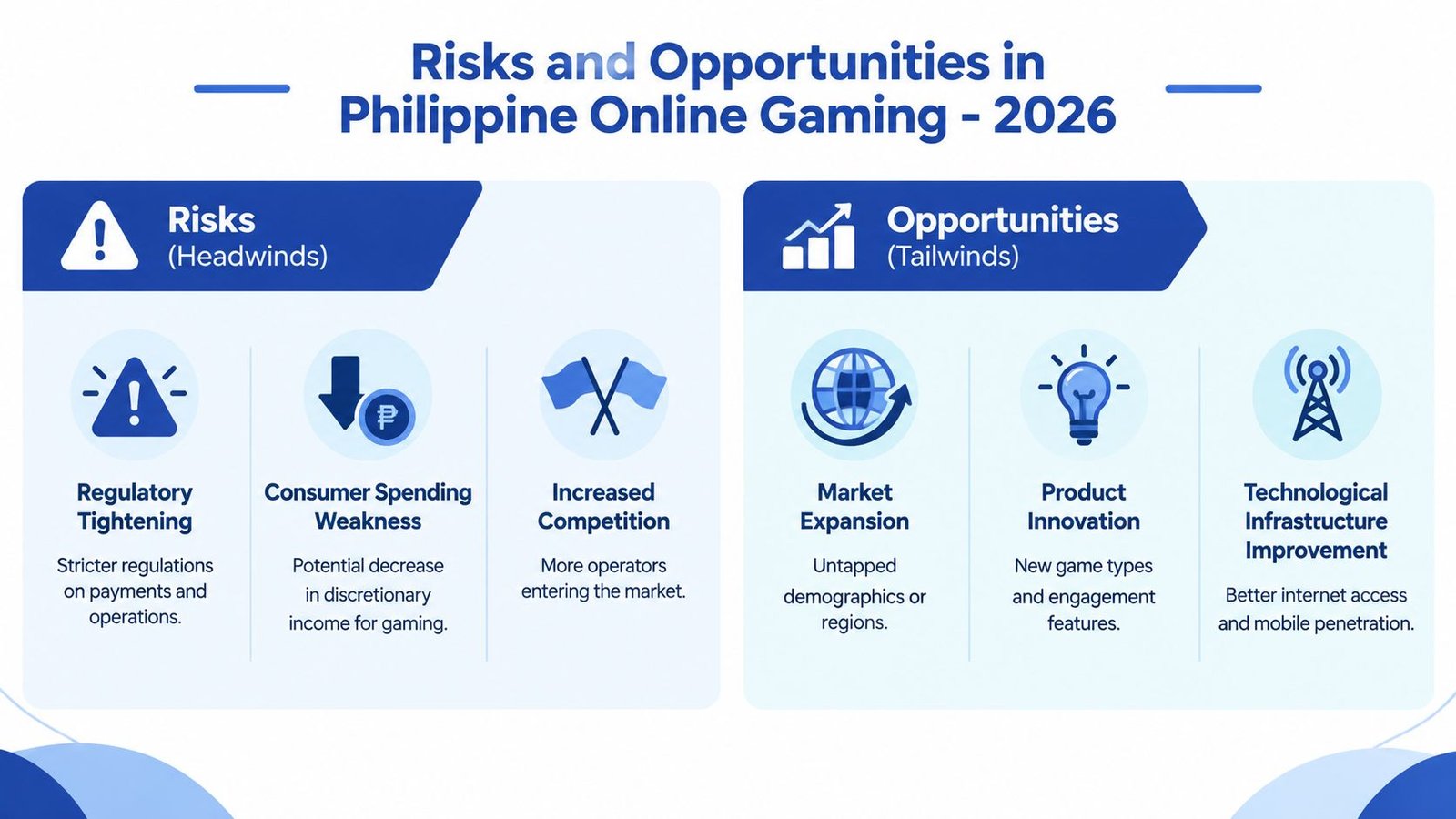
Revenue quality is the overlooked risk
Online growth does not automatically indicate durable demand. A segment can produce high GGR while remaining vulnerable to payment interruptions, advertising restrictions, customer-acquisition costs, or changes to licensing requirements. Operators and investors should therefore assess revenue by product, player retention, payment performance, and regulatory status.
Q3 2025 showed this uneven performance. Overall GGR was PHP94.51 billion, described as flat, while E-Games increased 17.4%, according to Philstar's analysis of the 2026 Philippine revenue outlook. Online momentum was therefore offsetting weakness elsewhere, rather than confirming broad-based expansion across the industry.
PAGCOR's 2025 revenue also fell 5.09% to PHP106.03 billion, with offshore gaming excluded. The result places greater responsibility on domestically regulated channels. Growth that depends on compliant onboarding, transparent payments, and permitted marketing is more defensible than growth driven by volume alone.
Tailwinds remain available
Product innovation can widen demand when operators pair localized experiences with consumer safeguards. E-sports betting and skill-based formats may attract new activity, but their commercial value depends on regulatory clarity, fair-play controls, and reliable dispute processes.
Payment reliability and mobile usability offer another route to growth. Better deposit completion, dependable withdrawals, and targeted affiliate campaigns can improve conversion without assuming that every traffic source produces lasting value. Cross-border affiliate activity may identify demand pockets, yet operators and publishers must verify that traffic, promotion, and player access comply with applicable rules.
Regulatory exposure should remain part of every 2026 scenario. Teams can monitor PAGCOR regulatory updates for 2026 alongside direct legal review, especially when changes could affect payments, advertising, or customer onboarding. The strongest opportunity is not merely higher online revenue. It is revenue that remains accessible and defensible under tighter oversight.
Strategic Recommendations for Stakeholders
The 2026 market rewards selective investment rather than indiscriminate expansion. Operators, affiliates, and investors face the same forecast range, but each group controls different parts of the revenue chain.
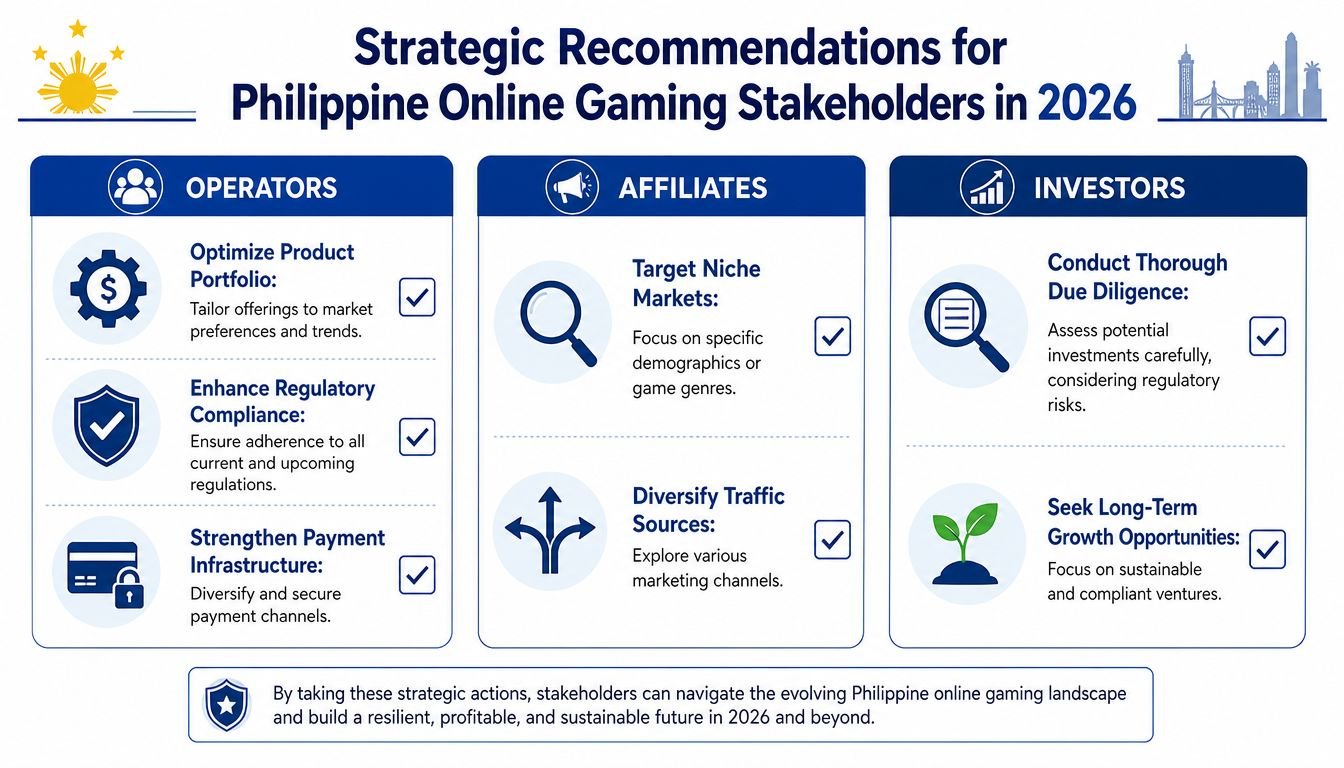
Operators
Operators should prioritize portfolio quality over product count. E-games, e-bingo, live casino, sports betting, and skill-based products should each be evaluated for licensing status, payment performance, retention, and marketing permissions.
Compliance investment should sit inside the commercial plan, not in a separate risk silo. A business that can document customer verification, payment monitoring, responsible gambling, and advertising approval is better positioned to preserve access when rules tighten.
Payment infrastructure also needs redundancy. Operators should monitor failed deposits, withdrawal delays, provider concentration, and dispute patterns. A platform partner or supplier such as Top 1 Rank can be evaluated for market intelligence and industry coverage, while product distribution decisions should remain tied to verified licensing and commercial performance.
Affiliates
Affiliates should move toward niche positioning. Content focused on specific game formats, compliant payment education, or regulated operator comparisons can be more defensible than broad acquisition pages that depend on aggressive promotional claims.
Traffic diversification matters because a single channel can be affected by advertising policy or platform enforcement. Publishers should also audit every commercial partner, confirm permitted claims, and track the difference between clicks, registrations, deposits, and sustained player value.
Investors
Investors should underwrite compliance durability before growth multiples. Due diligence should examine licensing, payment dependencies, customer acquisition sources, product concentration, and exposure to policy changes.
Long-term opportunities are more likely to sit with businesses that serve the regulated domestic ecosystem, provide essential technology, or support responsible and transparent operations. The market still offers expansion potential, but capital should follow durable infrastructure rather than temporary volume.
Conclusion and Next Steps
The PHP320 billion to PHP350 billion 2026 industry outlook describes a market under pressure, not a market without opportunity. Q1's PHP87.6 billion in total GGR and PHP39.9 billion from electronic gaming show why online performance will remain central to the year's result, while the prior year's PHP201.12 billion electronic gaming contribution demonstrates the scale now at stake.
The next step for every stakeholder is scenario testing. Operators should model budgets against the central range and a downside case, then identify which products and payment routes remain viable. Affiliates should separate compliant, repeatable traffic from campaigns dependent on uncertain advertising access. Investors should test whether revenue depends on one channel, one product, or one regulatory assumption.
The strongest 2026 strategy is disciplined diversification. Businesses should protect licensed online revenue, strengthen payment resilience, monitor PAGCOR developments, and invest in products that can retain users without relying on excessive promotional pressure. Teams that complete those reviews before committing expansion capital will be better placed to respond to the next quarterly disclosure.
Operators, affiliates, suppliers, and investors should use this forecast as a working benchmark, review their exposure to electronic gaming and payment controls, and build a documented 2026 plan around both the PHP320 billion to PHP350 billion central range and a downside scenario. Stakeholders seeking ongoing Philippines iGaming intelligence can follow Top 1 Rank's regulatory, market, compliance, and operator coverage while validating each commercial decision against current PAGCOR requirements.





Join thousands of gaming professionals receiving the latest iGaming news, regulatory updates, and market insights.
