


In 2025, online and electronic gaming generated PHP201.12 billion in Philippine gross gaming revenue, while licensed land-based casinos generated PHP182.50 billion. The result marked the first full-year reversal in which digital channels overtook licensed physical casinos, according to official 2025 industry figures cited from PAGCOR.
That headline answers who led the market. It doesn't answer whether the lead is durable. Quarterly figures already show the relationship can reverse, while PAGCOR's own revenue performance indicates that stronger online gross gaming revenue doesn't automatically produce stronger regulator income. For operators, suppliers, investors, affiliates, and policymakers, the central issue in online gaming vs land-based casino revenue Philippines is therefore channel quality, not channel size.
Table of Contents
- The 2025 Crossover That Reset Philippine Gaming
- Defining the Two Segments and What PAGCOR Actually Reports
- Head-to-Head Revenue Performance From 2023 to 2025
- Growth Drivers Behind the Digital Surge
- Is the Crossover Durable or Just a Cyclical Spike
- Strategic Implications for Operators and Investors
- Outlook and Decision Checklist for 2026 and Beyond
The 2025 Crossover That Reset Philippine Gaming
The Philippine gaming market changed direction between 2024 and 2025. In 2024, land-based casinos produced PHP201.83 billion, or 54.2% of industry GGR, while the digital sector generated PHP154.51 billion, or 41.51%. In 2025, electronic and online gaming reached PHP201.12 billion, up 30.04% from PHP154.66 billion in 2024, while licensed land-based casinos fell to PHP182.50 billion, down 9.58% from PHP201.84 billion. Digital channels consequently represented about 50.8% of total industry GGR, compared with roughly 46% for licensed casinos, based on PAGCOR-linked 2025 market data.
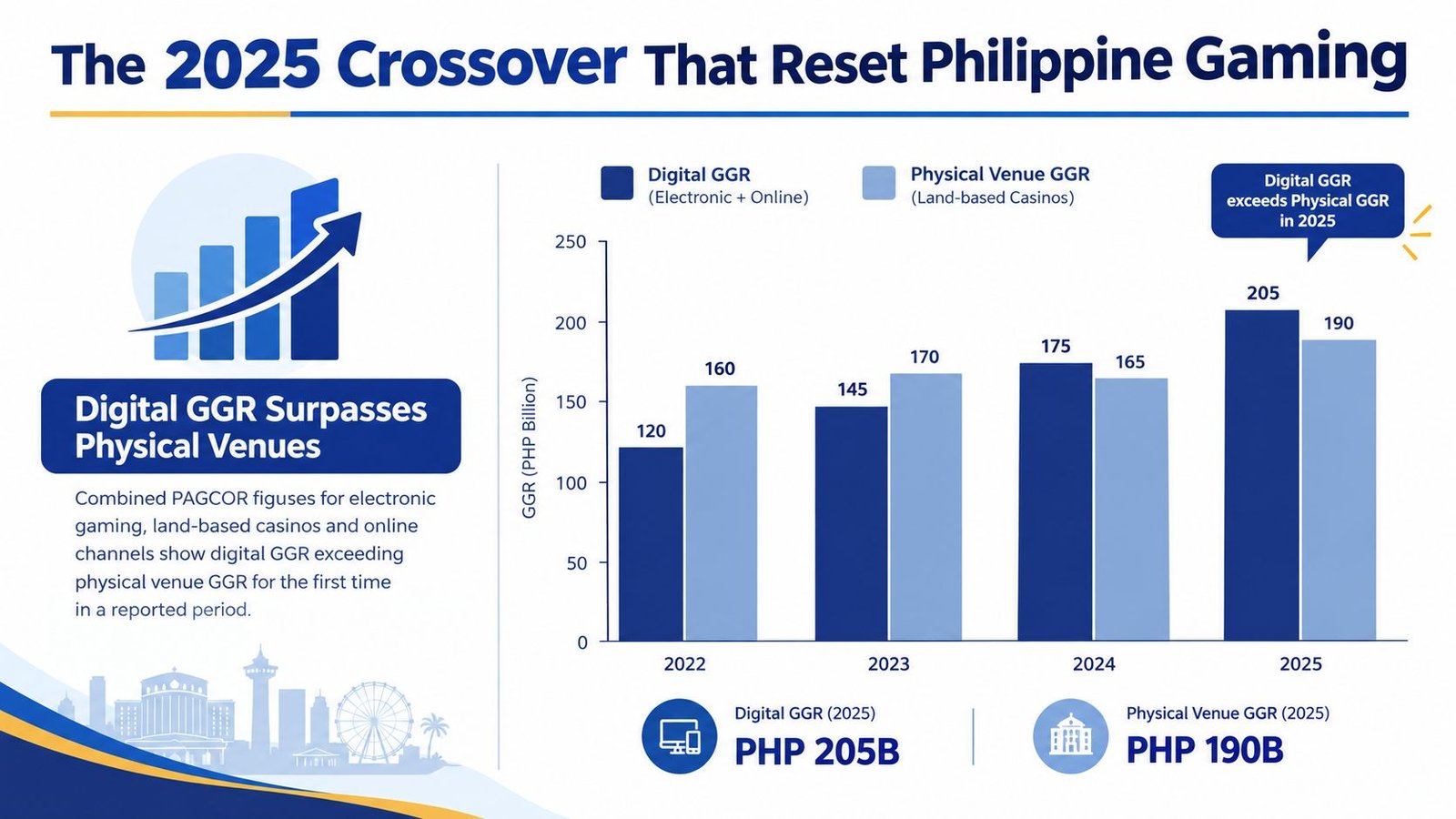
The crossover matters because it changes the commercial centre of gravity. Online operators can reach customers without relying on hotel occupancy, casino floor capacity, or visitor traffic. Land-based groups, by contrast, continue to carry property, staffing, hospitality, and entertainment obligations that digital businesses don't carry in the same form. The revenue comparison therefore affects acquisition budgets, platform investment, compliance systems, supplier demand, and capital expenditure decisions.
The fiscal interpretation is less straightforward. PAGCOR reported PHP106.03 billion in total revenues for 2025, down 5.09% year on year, while gaming operations contributed PHP95.15 billion. Separate reporting said online gaming represented 62% of PAGCOR income, compared with 38% from land-based casinos, as described in PAGCOR-linked reporting on online gaming and regulator revenue. That combination suggests that digital GGR leadership and public-revenue strength aren't interchangeable measures.
Analyst view: The 2025 crossover is a market reordering, but it isn't yet proof that physical casinos have become structurally secondary.
The regulatory consequence is equally important. A larger digital base expands the importance of licensing controls, payment monitoring, responsible-gambling safeguards, and action against unauthorized sites. Operators assessing the Philippine regulatory outlook for 2026 should treat the crossover as a reason to improve evidence, reporting, and compliance capacity, not as permission to assume uninterrupted online growth.
Defining the Two Segments and What PAGCOR Actually Reports
A clean comparison starts with the accounting perimeter. Land-based casino GGR refers to gaming revenue generated in physical casino venues, including licensed casinos and integrated resort operations. The 2024 market figure places those venues at PHP201.83 billion, while the 2025 licensed-casino figure is PHP182.50 billion, but the two years aren't perfectly identical in every published presentation because PAGCOR-linked reports may separate licensed casinos, PAGCOR-operated casinos, and other gaming categories.
Online and electronic gaming is broader than a conventional online casino label. The category includes electronic games, e-bingo, sports betting, and licensed online operators. PAGCOR's electronic gaming classification can therefore include products with different customer behaviour, margin structures, payment patterns, and regulatory requirements. Treating all digital revenue as online casino revenue would overstate the comparability of the segments.
The reporting lines that shape the comparison
PAGCOR's public reporting distinguishes market GGR from PAGCOR income. GGR is the value generated by gaming activity across the market, while PAGCOR income reflects the regulator's own revenue lines, including amounts connected with gaming operations and other reported sources. The two measures can move in different directions, which is why a market-share headline shouldn't be used as a direct proxy for fiscal performance.
The following table provides a practical reading of the main categories:
| Segment | Sub-category | PAGCOR Reporting Line |
|---|---|---|
| Land-based gaming | Licensed casinos and integrated resorts | Licensed land-based casinos |
| Land-based gaming | PAGCOR-operated venues | PAGCOR-operated casinos |
| Electronic gaming | eGames and other electronic games | Electronic and online gaming |
| Electronic gaming | e-bingo | Electronic and online gaming |
| Digital betting | Sports betting and licensed online activity | Electronic and online gaming |
| Offshore or formerly offshore activity | Offshore gaming operations | Reported separately where applicable |
| Regulator income | Gaming operations and other PAGCOR receipts | PAGCOR total revenue and gaming operations |
The classification issue affects every conclusion that follows. In 2024, digital-sector GGR was PHP154.51 billion, while a separate report identified e-games and e-bingo revenue of PHP46.79 billion, up 116.0% year on year. Those figures describe different reporting scopes, so they shouldn't be added together. The distinction is consistent with PAGCOR-oriented coverage of the Philippines online casino framework.
Why gross revenue isn't enough
GGR shows where gaming activity is occurring. It doesn't, by itself, show the profitability of each operator, the cost of acquisition, the tax burden, the cost of compliance, or the amount ultimately reaching the regulator and national budget. Digital channels may scale faster, but their economics remain sensitive to licensing terms, payment controls, promotional spending, fraud exposure, and enforcement.
Land-based casinos have a different revenue quality profile. Their performance depends on gaming demand as well as tourism, hospitality, entertainment, and physical access. A comparison that ignores those operating models will confuse growth velocity with economic resilience.
Head-to-Head Revenue Performance From 2023 to 2025
The market's transition is visible in three stages. Digital gaming was still materially smaller than land-based gaming in 2023. It narrowed the gap sharply in 2024. It moved ahead on a full-year basis in 2025, although the quarterly data shows that leadership can change quickly.
In 2023, total Philippine GGR stood at PHP285.27 billion. In 2024, it rose to PHP372.33 billion, an increase of 30.52%. Land-based casinos generated PHP201.83 billion in 2024, while the digital sector produced PHP154.51 billion, up 165.66% from PHP58.16 billion in 2023, according to PAGCOR-linked reporting on the 2024 market.
The 2024 composition is significant. Digital gaming wasn't merely growing from a small base. It became a major industry revenue stream while physical casinos remained the largest single segment. A separate report on PAGCOR's 2024 revenue performance recorded e-games and e-bingo revenue at PHP46.79 billion, up 116.0% year on year, while Casino Filipino revenue declined 16.2% to PHP12.67 billion and offshore gaming revenue fell 5.1% to PHP2.99 billion.
| Period | Land-Based GGR (PHP bn) | Online GGR (PHP bn) | YoY Change | Digital Share |
|---|---|---|---|---|
| 2023 | Not reported as a directly comparable annual line in the verified data | 58.16 | Digital baseline | Not reported |
| 2024 | 201.83 | 154.51 | Digital up 165.66% | 41.51% |
| 2025 | 182.50 | 201.12 | Digital up 30.04%, land-based down 9.58% | About 50.8% |
The table uses only directly verified figures. It doesn't estimate a 2023 land-based total or assign a 2023 digital share because those values aren't provided within the approved data.
The quarterly signal
The early quarterly evidence reinforced the digital acceleration. PAGCOR's first-quarter 2024 update showed electronic games contributing PHP22.5 billion, compared with PHP3.5 billion in the first quarter of 2023, while licensed casinos still led with PHP49.7 billion. By the first half of 2025, online gambling reached PHP114.83 billion, compared with PHP93.36 billion from licensed land-based casinos. Online therefore held about 53.5% of the relevant total, versus about 43.5% for land-based casinos, a revenue multiple of roughly 1.23 times, according to PAGCOR-reported first-half data.
PAGCOR's own revenue mix also tilted digital early in the year. In the first quarter of 2025, online gambling generated PHP14.32 billion, equal to 56% of quarterly PAGCOR revenue, while licensed land-based casinos produced PHP8.32 billion, or 32.6%, as reported by iGaming Business.
The critical qualification arrived in 2026. Electronic gaming generated PHP39.9 billion in Q1 2026 against PHP44.52 billion from licensed casinos. In Q2, casinos again led at PHP45.4 billion, compared with PHP39.9 billion for electronic gaming, according to GGB Magazine's coverage of quarterly PAGCOR-linked results. The reversal doesn't erase the 2025 crossover, but it does weaken the assumption that digital leadership is automatically permanent.
Growth Drivers Behind the Digital Surge
The digital surge has several identifiable contributors, but the verified data doesn't support assigning a precise share of growth to each driver. Any decomposition should therefore distinguish confirmed market movement from analyst interpretation.
The strongest confirmed signal came from electronic games and e-bingo. Their revenue increased to PHP46.79 billion in 2024, up 116.0% year on year, while the broader digital sector reached PHP154.51 billion, up from PHP58.16 billion in 2023. The scale and speed of that increase indicate that electronic gaming was central to digital expansion, although the available figures don't isolate the contribution of every product, operator, payment rail, or policy change.
What the evidence confirms
| Driver | Type | Confirmed Action | Estimated Impact on Online GGR |
|---|---|---|---|
| Electronic games expansion | Product and channel | Electronic gaming revenue rose sharply in the verified 2024 data | Material, but not separately quantified |
| e-bingo growth | Product | e-games and e-bingo were included in the rapidly expanding electronic segment | Material within the reported category, not separately quantified |
| Licensed online activity | Regulatory and commercial | Digital operators formed part of PAGCOR's electronic and online gaming reporting | Positive, not separately quantified |
| Offshore gaming exits and declines | Regulatory | Offshore gaming revenue declined to PHP2.99 billion in 2024, down 5.1% | Changes the market base, but contribution to digital growth isn't isolated |
| Mobile access and payment development | Technology | Plausible operating enablers, but no approved Philippine contribution figure is available | Unquantified |
| Live-dealer and product improvements | Product | Relevant strategic factor, but no approved Philippine contribution figure is available | Unquantified |
The table's final two rows are deliberately cautious. The commercial logic is clear: mobile access, digital payments, and more varied content can reduce friction between registration and play. But without a verified Philippine dataset isolating GCash, Maya, USDT rails, live dealer, slots, or sportsbook contributions, no responsible analysis can claim that any one of them generated a specific portion of GGR.
Regulation changes the quality of growth
Policy matters because licensing determines which activity enters the regulated market and which activity remains outside it. PAGCOR-linked reporting identifies illegal sites as a risk, while the decline in offshore gaming revenue shows that the digital market's composition has changed. The 5% franchise tax on offshore operators, e-Games and E-Sabong policy developments, licensing expansion, and enforcement against unauthorized platforms should therefore be treated as separate regulatory variables, not blended into a single growth narrative.
Operators also face a cost question. Faster GGR growth can require heavier investment in acquisition, payments, fraud controls, customer support, responsible gambling, and compliance. Teams evaluating user acquisition cost in iGaming should model net economics rather than treating top-line digital growth as a direct measure of return.
Decision principle: A driver belongs in an investment case only when the operator can connect it to verified revenue, sustainable customer value, or a clear regulatory advantage.
The evidence supports a broad conclusion. Digital growth reflects a combination of electronic product expansion, licensed-channel development, and regulatory reclassification or displacement of offshore activity. It doesn't support a precise driver-by-driver attribution.
Is the Crossover Durable or Just a Cyclical Spike
The 2025 crossover was substantial, but the quarterly reversals argue against calling it irreversible. Digital gaming led in the first half of 2025, yet licensed casinos regained the lead in Q1 and Q2 2026. That pattern is consistent with a market in transition, not a market with a settled winner.
The durability question has three layers. First, digital channels have structural advantages in accessibility, distribution, and product iteration. Second, land-based casinos remain exposed to physical demand but can benefit from integrated resort economics and broader entertainment activity. Third, both channels face regulatory and macroeconomic shocks that may affect revenue at different speeds.
Why the 2025 base needs caution
The 2024 comparison includes a very strong digital expansion from a lower base. The same period also included a decline in offshore gaming revenue to PHP2.99 billion, which complicates year-on-year interpretation. When offshore activity exits or contracts, the legal market may grow through substitution as well as through entirely new demand.
PAGCOR's 2025 financial result adds a second warning. Total regulator revenue fell 5.09% to PHP106.03 billion, even while digital gaming became the largest GGR segment. The divergence suggests that online growth can coexist with softer regulator income and weaker land-based performance, particularly when the revenue mix, licensing arrangements, and operating categories change. That isn't proof that digital revenue is lower quality, but it does show why GGR leadership alone can't settle the durability debate.
The indicators that deserve attention
Investors should focus on repeated quarterly performance rather than one annual crossover. The most useful signals are:
- Digital quarterly GGR: Repeated leadership would strengthen the structural-shift thesis.
- Licensed-casino recovery: Sustained improvement would indicate that physical venues remain competitive rather than merely defensive.
- PAGCOR income: A widening gap between market GGR and regulator income would raise questions about fiscal conversion.
- Offshore and illegal-market enforcement: Further exits could alter the comparison base again.
- Product and licensing mix: Growth concentrated in a narrow electronic category may be more exposed to policy change than diversified digital activity.
The calibrated conclusion is that the crossover is structurally plausible but cyclically vulnerable. Mobile distribution and electronic gaming can support persistent digital expansion, yet the 2026 quarterly reversal shows that online has not established an unqualified, quarter-by-quarter supremacy.
Strategic Implications for Operators and Investors
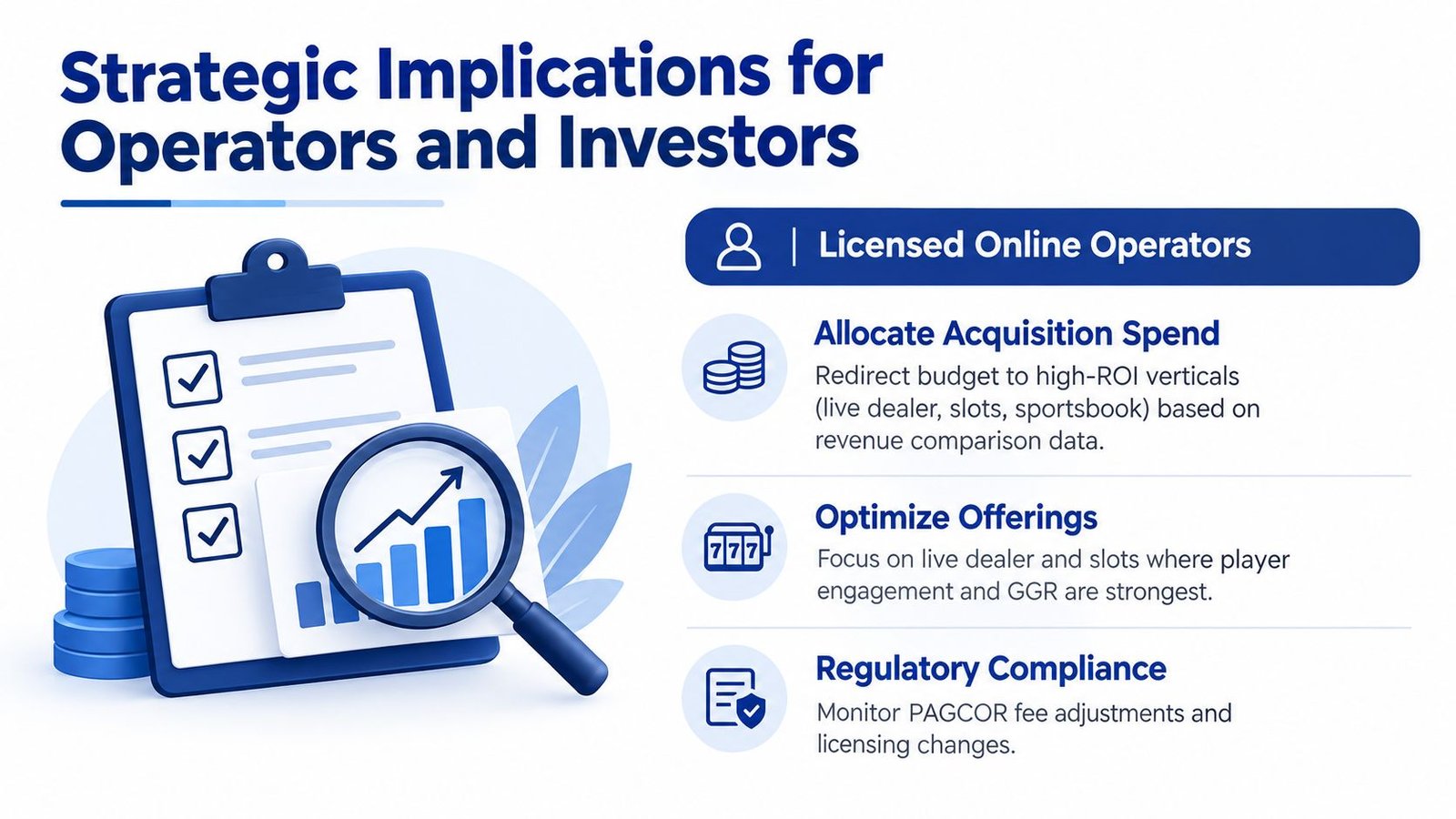
The revenue data supports a dual-channel strategy, but not a uniform allocation model. Licensed online operators have the stronger growth signal, while land-based operators still control valuable physical assets and customer environments. Investors should therefore distinguish between digital momentum, cash conversion, and resilience under regulatory pressure.
For licensed online operators
Online-first allocation makes sense when the operator has defensible licensing, reliable payments, strong player verification, and the ability to control acquisition costs. The category's 2024 and 2025 growth supports investment in scalable infrastructure, but it doesn't justify indiscriminate marketing.
- Prioritize measurable acquisition: Budget should move toward channels with auditable player value, not higher registration volume.
- Build product depth: Live casino, slots, e-bingo, and sportsbook can broaden the revenue base, although the verified data doesn't establish which individual vertical has the highest margin.
- Treat compliance as infrastructure: KYC, anti-money-laundering controls, payment monitoring, safer-gambling tools, and accurate reporting protect the operator's ability to remain in the regulated market.
- Use supplier flexibility: Platforms and game studios should support rapid content changes without weakening control over player data or transaction monitoring.
Top 1 Rank is one example of an industry intelligence publication covering regulatory developments, operator performance, suppliers, and technology. Operators and investors can use such coverage alongside PAGCOR releases, audited filings, and direct compliance documentation rather than treating editorial analysis as a substitute for primary records.
For land-based operators
Physical casinos shouldn't respond to digital competition by copying online mechanics without considering their own advantages. Integrated resorts can combine gaming with hospitality, dining, entertainment, and events, while loyalty programs can connect venue customers to permitted digital touchpoints where regulation allows.
The most defensible physical strategy is selective investment. Operators should examine cashless gaming, customer analytics, property-level experience, and omnichannel loyalty, but each project needs a clear return case. A venue that improves customer retention and non-gaming spend may have a stronger strategic rationale than a large expansion designed only to add gaming capacity.
For investors and suppliers
Investors should use three postures:
- Digital-first: Appropriate when online GGR continues to lead across repeated reporting periods and the target has strong licensing and payment controls.
- Land-based-first: Appropriate when a property has durable tourism, hospitality, or mass-market strengths and digital exposure carries disproportionate regulatory risk.
- Dual-channel: The most balanced posture while quarterly leadership remains volatile. It combines digital distribution with physical customer assets and reduces dependence on one regulatory or demand environment.
For B2B suppliers, the opportunity is less about choosing a winning channel than providing tools that work across both. Payments, identity, fraud prevention, player analytics, content aggregation, and loyalty technology can serve online operators and land-based groups without assuming that one format will eliminate the other. Suppliers reviewing the PAGCOR B2B provider application process should place licensing readiness and documentation at the centre of market entry planning.
Outlook and Decision Checklist for 2026 and Beyond
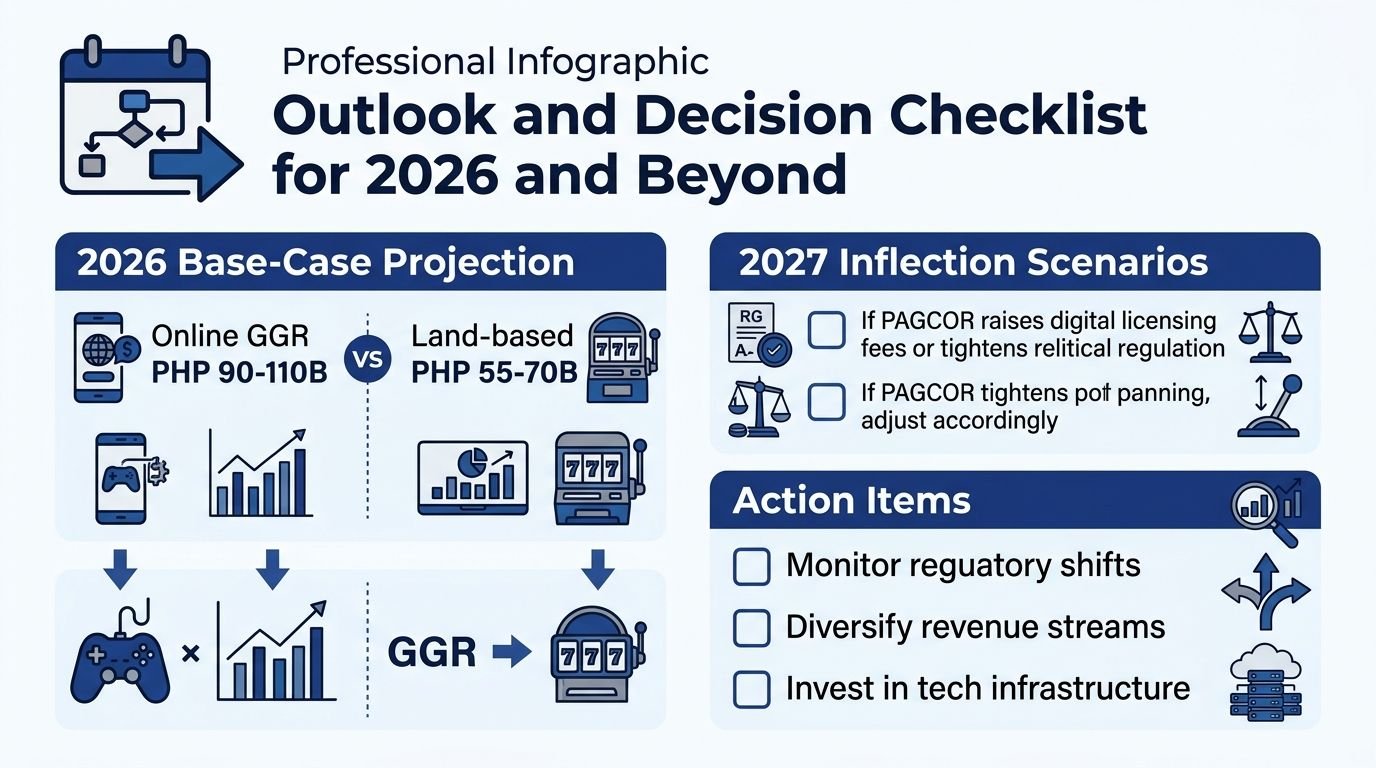
The verified record supports a cautious outlook, not a guaranteed forecast. Digital channels overtook licensed casinos on a full-year basis in 2025, but quarterly data from 2026 already showed casinos ahead in both reported quarters. That makes the base case a contest between digital scale and physical recovery, rather than a simple continuation of the 2025 ranking.
The supplied planning scenario places 2026 online GGR at PHP90 billion to PHP110 billion and land-based GGR at PHP55 billion to PHP70 billion. Those figures should be treated as a scenario, not as a reported PAGCOR outcome, because the verified data doesn't identify them as actual results. Any 2027 view is likewise conditional on licensing costs, enforcement, tax policy, offshore-market developments, and the ability of physical venues to restore demand.
Decision triggers for the next cycle
- Digital leadership: Allocate more capital to digital when online share holds above 55% for two consecutive quarters. This is a proposed decision rule, not a reported market statistic.
- Physical capital expenditure: Review land-based expansion if integrated resort mass GGR grows below 5% year on year. This is also a planning threshold, not verified historical data.
- Fiscal pressure: Prepare for possible higher gaming tax if the national revenue shortfall widens, but don't model a tax change as fact until PAGCOR or another competent authority confirms it.
- Offshore displacement: Track proxy gaming and illegal-site enforcement because offshore exits can distort year-on-year comparisons and redirect demand.
- Tourism exposure: Stress-test Entertainment City properties against changes in foreign visitor demand, especially where premium and tourism-led revenue is material.
- Regulatory concentration: Monitor licensing fees, reporting requirements, product restrictions, and enforcement intensity before increasing digital exposure.
- Cross-platform economics: Test whether loyalty, payments, and customer data can create value across physical and digital channels without breaching regulatory boundaries.
The main risks are regulatory reversal, illegal offshore-market rebound, currency volatility, and a sharper decline in physical demand. The clearest opportunities are mobile-first local products, e-bingo expansion, stronger payment and compliance technology, and cross-platform loyalty that connects permitted customer journeys.
Companies making 2026 and 2027 decisions should audit their revenue definitions, separate GGR from PAGCOR income, track quarterly reversals, and document the assumptions behind every capital allocation choice. Teams preparing for regulated B2B participation can also use a practical 2026 PAGCOR B2B accreditation checklist before committing resources to the Philippine market.
Operators, investors, suppliers, and regulators should use the 2025 crossover as a decision signal, not a conclusion. Review the latest PAGCOR-linked revenue releases, map exposure across electronic and physical channels, and build a scenario model that tests both continued digital leadership and renewed land-based momentum before approving the next major investment.





Join thousands of gaming professionals receiving the latest iGaming news, regulatory updates, and market insights.
