

An operator can have a strong product, experienced suppliers and demand in a new market, yet still be unable to launch legally. The difficulty is that iGaming regulation isn't one licence or one rulebook. It's a set of market-specific permissions and operating duties that reaches from customer location and game settings to payments, advertising, player protection and audit records.
For compliance teams, the practical question is not only whether a licence has been granted. It's whether the operator can prove, day by day, that the licence conditions are built into the product and the people and systems supporting it. The distinction matters to investors and suppliers too: a market's commercial potential has to be weighed against the cost of entering it and maintaining controls.
Table of Contents
- What iGaming Regulation Covers and Who Enforces It
- Licensing Models Compared Across Major Jurisdictions
- Player Protection Rules That Shape Product Design
- Supplier Certification and Testing Obligations
- AML and Crime Prevention Duties Regulators Test
- Advertising Rules and the Offshore Market Problem
- Regulatory Trends Reshaping Compliance Through 2026
- Choose Your Licensing Path Before You Commit Capital
What iGaming Regulation Covers and Who Enforces It
iGaming regulation is the set of laws, licences, technical standards and supervisory rules that govern online casino, sports betting, poker and bingo, and the businesses that supply them. It typically addresses market access, player protection, crime prevention, including anti-money laundering, and marketing controls. Those areas overlap: a rule intended to protect customers can require changes to a game, an account system and the records an operator keeps.

Different bodies perform different jobs. Legislatures pass statutes; regulators issue licences, set or enforce licence conditions, and supervise operators. Courts can review disputes, while payment providers and app stores apply their own access rules and may restrict services even when a business has regulatory permission.
The scale of the market helps explain the attention. The UK Gambling Commission reported that Great Britain's customer-facing gambling industry generated £16.8 billion in gross gambling yield (GGY) in the year to March 2025, up 7.3%. Online gambling reached £7.8 billion, the Remote Casino, Betting and Bingo sector accounted for 46% of the overall market, and the non-remote sector generated £4.8 billion, or 29% of market share, according to the Commission's industry statistics for 2025.
GGY measures the operator's yield after winnings are paid, making it a more useful measure of regulated market economics than total customer stakes. For a market-specific example, operators assessing customer-facing rules can review this guide to online casino legality in the Philippines. The core sequence for any market is to establish who licenses the service, identify the operating duties attached to that permission, then test whether the business can meet those duties in practice.
Licensing Models Compared Across Major Jurisdictions
A licensing model determines who can enter a market and under what conditions. Open licensing lets operators apply if they meet the criteria. Limited licensing caps the number of licences or allocates them competitively. A state monopoly reserves some or all products for a designated provider, while prohibition can be backed by measures such as blocking unlicensed sites.
| Jurisdiction | Regulator | Licensing model | Online market status |
|---|---|---|---|
| Great Britain | Gambling Commission | Operator and personal licences; all online offers to GB customers covered | Open, regulated market |
| Malta | Malta Gaming Authority (MGA) | Remote gaming licence for B2C and B2B operators | Open licensing hub for EU-facing operators |
| Denmark | Danish Gambling Authority (Spillemyndigheden) | Licence under the Gambling Act | Open, licensed market |
| Sweden | Swedish Gambling Authority (Spelinspektionen) | Licence regime introduced in 2019 | Open, licensed market |
| Netherlands | Dutch Gaming Authority (Kansspelautoriteit) | Licence under the Betting and Gaming Act | Open market since 2021 |
| Germany | Joint Gambling Authority of the States (GGL) | State licence under the 2021 Interstate Treaty on Gambling | Licensed market with stricter conditions |
| Ontario, Canada | Alcohol and Gaming Commission of Ontario (AGCO) | Operator registration; market access through iGaming Ontario | Open regulated market since 2022 |
| Philippines | PAGCOR | Online casino licence; offshore gaming licences phased out from 2024 | Licensed online casino market |
| United States | State regulators, for example, New Jersey Division of Gaming Enforcement | State-by-state licences; no federal licensing framework | Legal in a subset of states |
| Australia | Australian Communications and Media Authority (ACMA) | Online gambling restrictions under federal law | Restricted market with blocking of unlicensed sites |
Great Britain is a useful example of how a licence can combine entry permission with ongoing supervision. The Gambling Act 2005 came fully into force in September 2007 and established the Gambling Commission as the principal regulator for commercial gambling, including remote services. A 2014 amendment extended the framework to online gambling offered to customers in Great Britain, regardless of where the operator was based. The government's account of digital gambling reform describes the resulting shift: consumer location became central to regulatory exposure, rather than the operator's physical location alone.
That distinction changes market-entry analysis. A licence in an operator's home jurisdiction doesn't automatically authorize offers to customers elsewhere. Great Britain's model also shows why licensing isn't a one-time approval: licensees must follow Licence Conditions and Codes of Practice, and the Commission can use existing powers to address emerging product risks.
The table's broader pattern is that Malta, Denmark, Sweden and the Netherlands use licence-based access, while Germany adds state-level conditions. Ontario provides access through a regulated channel, and the United States has state-by-state licensing rather than a single federal gambling licence. Australia restricts online casino offers to residents, while the Philippines operates an online casino licensing regime and has phased out offshore gaming licences from 2024.
Before entering any market, an operator should answer three questions: who issues the licence, which products and services it covers, and whether it applies to customers in the target location. The answers define the perimeter of the business, not just the name on its licence.
Player Protection Rules That Shape Product Design
A player-protection rule can become a line of code. Great Britain's age-tiered online slots stake limits illustrate the chain from regulation to product configuration: licensed platforms need accurate age information, a customer-specific limit and a control that blocks a prohibited stake before it reaches the game.
The Gambling Commission set a maximum online slots stake of £5 per spin for adults aged 25 and over from 9 April 2025, and £2 per spin for customers aged 18 to 24 from 21 May 2025. Its market overview to September 2025 records the scale of the segment: online slots generated £747 million in GGY during July to September 2025, up 9% year on year, with 24.4 billion spins.
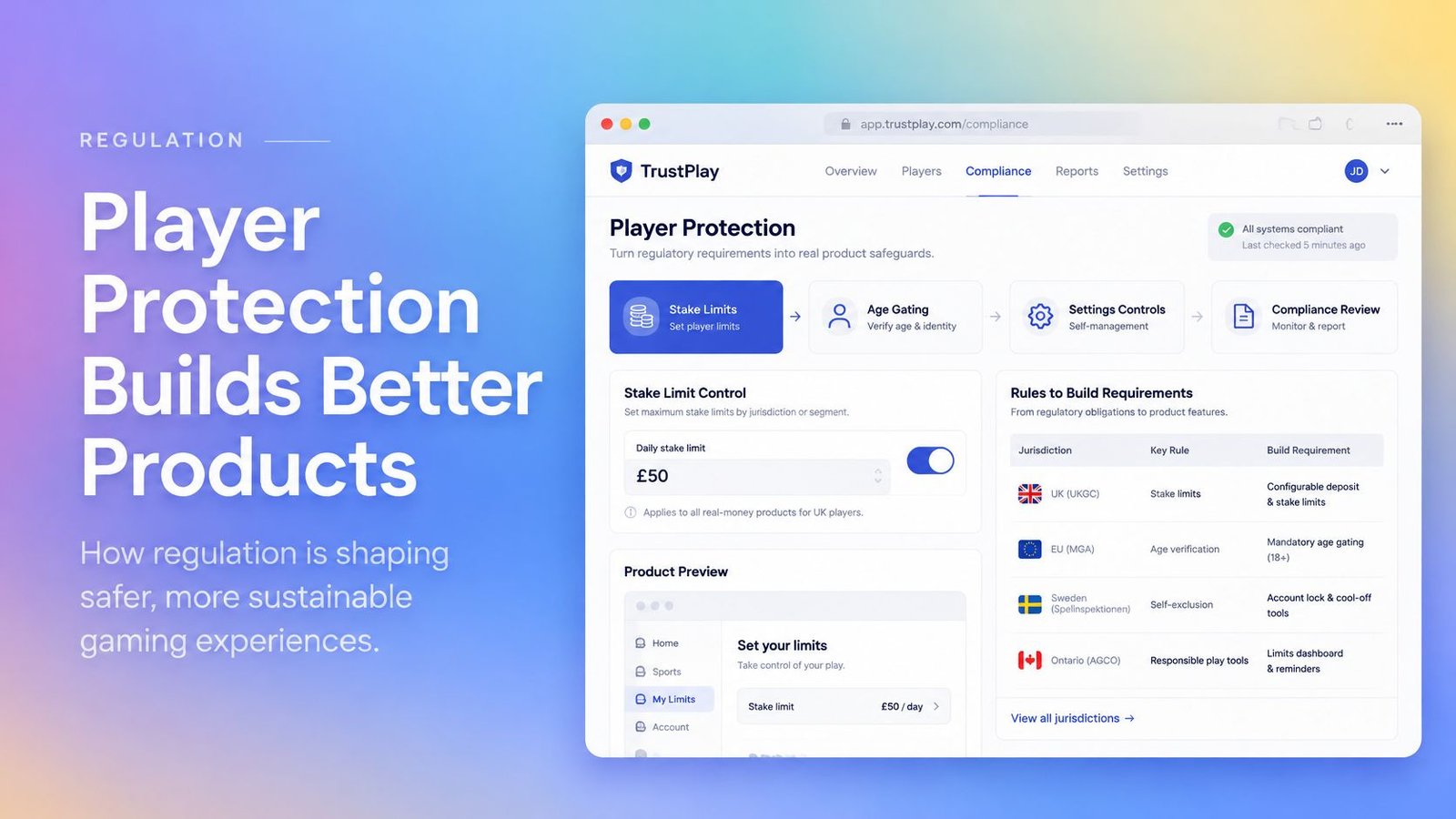
The build requirement is specific. An account's verified age category has to feed the game configuration, and the stake-validation layer must reject amounts above the applicable limit. Testing should confirm the block works across relevant game versions and channels, not only in a demonstration environment.
Protection tools and product evidence
Stake limits sit alongside other tools that shape the customer journey: deposit limits, time-outs, cooling-off options and self-exclusion. Financial-risk assessments also require careful handling. They are not automatically the same thing as mandatory affordability checks, and the information requested should be proportionate to the risk being assessed.
The Commission recorded 8.6 million online slots sessions lasting longer than one hour in the same quarter, down 15% year on year. That measure can help regulators and operators examine patterns of play, but it doesn't by itself establish why behaviour changed or prove that a particular control caused the change.
Great Britain also permanently banned reverse withdrawals and certain intensifying online-slots design features in October 2021, with subsequent safer-design requirements for online slots. Together, these requirements show why a single global game configuration can create compliance risk. Game studios and platform providers need jurisdiction-specific settings, backed by tests that connect customer data, game rules, stake validation and reporting.
Supplier Certification and Testing Obligations
A licensed operator remains accountable for its service, but suppliers control parts of the system the operator may not be able to alter directly. Supplier compliance therefore needs a clear chain of licences, tests, configurations and release records.
A working supplier checklist
- Licence: Confirm whether the target market requires a business-to-business licence, supplier registration or approval of key personnel before games or systems can be supplied. Malta, for example, issues B2B licences as well as operator licences. For a Philippines-specific reference, the PAGCOR B2B provider application process helps frame the provider-side licensing question.
- Certification: Submit game builds, random number generation and payout logic for independent testing against each target market's requirements. The certificate should identify the exact build version tested, so it can't be mistaken for approval of a later release.
- Configuration: Maintain a jurisdiction matrix for stake ranges, age settings, reality checks and bonus rules. The same game may need different approved settings in different markets.
- Change control: Log every release with its version, covered markets and approving test report. Block deployment until the market-specific configuration is certified.
- Evidence: Retain game-event logs and audit trails in a format operators can export for regulatory requests.
Contract terms should assign ownership for each control, including who tests changes, who reports defects and who keeps the records. Clear allocation helps the operator monitor suppliers, but it doesn't transfer the operator's licence responsibility to a third party.
AML and Crime Prevention Duties Regulators Test
A licence file can look complete and still fail the crime-prevention test. Anti-money laundering controls are the procedures an operator uses to establish who a customer is, monitor transactions and account activity, assess source of funds where required, and escalate suspicious activity to the appropriate authority. The policy document is the map; regulators test whether staff and systems follow it on live accounts.
The Gambling Commission's most recent initial assessments found significant failings in crime-prevention requirements at a substantial share of licensees, with consumer-protection controls also showing weaknesses. For the prior reporting year, the Commission's annual report on keeping crime out of gambling records that eight operators paid more than £13.4 million in fines and regulatory settlements in 2023–2024, while assessments included 182 security audits. The lesson is concrete: passing an assessment depends on evidence that controls operated, not evidence that controls were described.
Build the file from the customer journey outward. Identity verification comes first, because later monitoring is weak if the account holder was never established accurately. Monitoring then needs owners, review deadlines and a route to filing; an alert queue without named accountability works like an alarm bell connected to no response team. The FATF framework brings casinos within customer-due-diligence standards, so the operating model should translate that principle into documented checks, alert ownership and a defensible escalation path.
For structure, the anti money laundering audit checklist can help teams test records and control operation before a regulator does. Payment flows belong in the same evidence chain, including market-specific approval requirements such as PAGCOR payment gateway accreditation.
| Control | What the regulator tests | Evidence to retain |
|---|---|---|
| Customer identity verification | Accurate checks completed before play or at withdrawal thresholds | Timestamped verification records by account |
| Transaction monitoring | Alerts raised and reviewed within defined time frames | Alert logs, review times and false-positive rates |
| Source-of-funds checks | Coverage of high-value and high-risk accounts | Source-of-funds records linked to each account |
| Suspicious activity reporting | Reports filed once suspicion is established | Internal escalation files and filing confirmations |
| Self-exclusion matching | Excluded players blocked across all brands and products | Matching logs and block records |
| Repeat-risk detection | Risk patterns identified and acted on | Model version history and intervention completion records |
A useful dashboard measures alert-to-review time, false-positive rates, intervention completion, source-of-funds coverage, self-exclusion matching and repeat-risk detection. Those measures do not replace case review. They show whether the system is operating consistently, where reviews are stalling, and which control needs correction before the next assessment.
Advertising Rules and the Offshore Market Problem
Advertising controls govern who can be targeted, what an operator can claim and how offers are explained. In the UK, the CAP and BCAP codes are enforced by the Advertising Standards Authority alongside Gambling Commission licence conditions. A practical review should check age-gating for paid media, substantiation for promotional claims, clear bonus terms and affiliate oversight. Operators can face exposure for partner promotions, so agreements need approval rules and monitoring, not merely a clause requiring compliance.
Teams assessing creator campaigns may find it useful to navigate financial influencer compliance, particularly when promotions pass through intermediaries. For a local-policy reference, the Philippines gambling advertising rules provide a starting point for market-specific review.
Unlicensed sites create a separate challenge. Regulators may use domain blocking, payment restrictions and rules for intermediaries, while operators and platforms may have to limit search or affiliate promotion of unlawful offers. The trade-off is real: blocking can restrict access to unlicensed services, but displaced customers may move to channels that are harder for regulators to monitor. Licensing access and enforcement therefore address different parts of the problem.
Ontario offers a useful test of whether a regulated market eliminates leakage. By the end of the 2024–25 year, its regulator reported 50 registered operators and 83 active websites, with an estimated legal-market channelization rate of about 85%, according to the Alcohol and Gaming Commission of Ontario. Analysis: that estimate implies roughly 15% of activity remains outside the regulated channel. The precise composition of that remaining activity isn't established by the headline rate, but it matters to both market estimates and harm-prevention planning. Legal-market share alone can't show how much demand still sits beyond regulatory reach.
Regulatory Trends Reshaping Compliance Through 2026
Two decades of milestones trace a clear direction: from statutory licensing toward product-specific and operational supervision. Great Britain's Gambling Act 2005 came into force in September 2007, with a 2014 extension covering online gambling offered to British customers. Germany's Interstate Treaty and the Netherlands' licensed market both date to 2021, Ontario's regulated market followed in 2022, and Great Britain's online slots stake limits took effect in 2025. Each step moved scrutiny closer to the product itself and the controls around it.

What's established and what remains open
Established: supervision in Great Britain is becoming more continuous and data-driven. In its annual report and accounts for 2024–2025, the Gambling Commission reported more than 9,700 compliance activities in 2024–2025, compared with more than 4,200 in 2023–2024, and it requires licensees to submit regulatory returns quarterly. Read those figures as a workload signal. Customer-risk decisions, AML alerts, marketing controls and audit logs all need to be retrievable on request, because quarterly returns make evidence a standing duty rather than a launch task.
A second development is the spread of financial-risk assessments and product controls, with scope that differs by jurisdiction. In a 2025 pilot described in the Commission's speech on the pilot, approximately 95% of stage-one and 97% of stage-two financial-risk assessments could be completed frictionlessly, while under thresholds proposed in an earlier consultation, about 0.3% of active accounts, roughly one in 1,000, would have been unable to satisfy requirements through a frictionless process. The pilot measured how the assessments ran. Whether they should become mandatory is a separate policy question.
Regulators elsewhere are updating their own rulebooks on different schedules, so an operator's obligations can shift even in markets that look settled. Teams tracking the Philippine market can follow the PAGCOR regulatory updates for 2026 to monitor how local requirements evolve alongside the European and North American changes above.
Open: the evidence does not settle whether financial-risk checks should become mandatory across markets or how far scrutiny of payment channels and intermediaries should extend. The practical response is to separate existing legal obligations from proposals and policy debate, then build systems flexible enough to absorb change without treating a possible future rule as current law.
Choose Your Licensing Path Before You Commit Capital
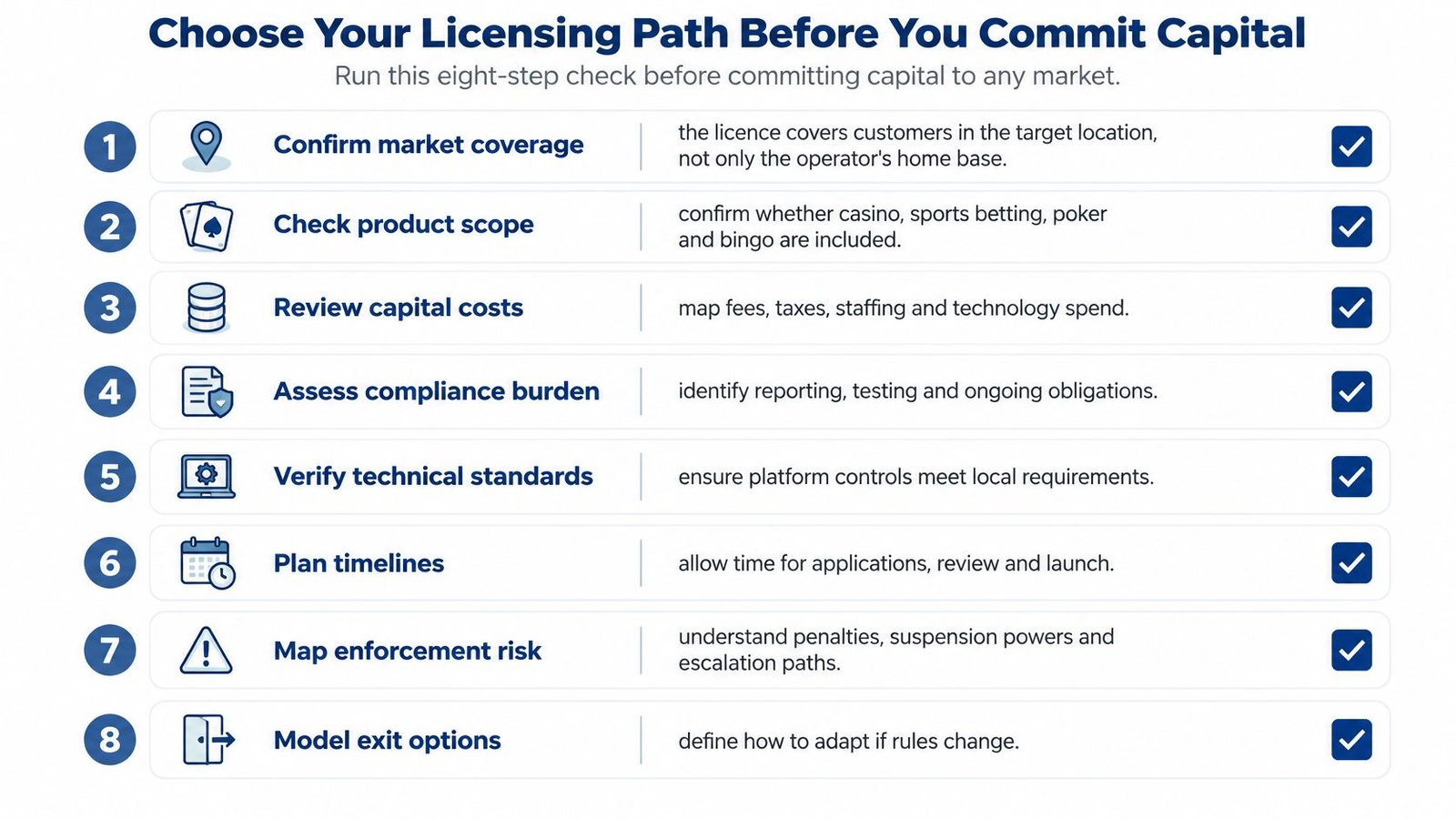
A market can look attractive on revenue and still be unsuitable if an operator can't meet its evidence, technical or supervisory requirements. Before committing capital, the compliance team should complete this eight-step check.
- Confirm market coverage. Verify that the licence applies to customers in the target location, not only the operator's home base. Customer location can determine whether an offer falls within the local regulatory perimeter.
- Map product rules. Match stake limits, slot-design requirements and bonus restrictions to each market's game configuration. A product that's compliant in one jurisdiction may need different settings in another.
- Budget for evidence. Include immutable event logs, audit trails and regulatory reporting in the operating plan. In Great Britain, quarterly returns make reporting cadence a recurring duty, not a launch task.
- Set control targets. Define how the business will measure alert-to-review time, false-positive rates and self-exclusion matching. Test these controls before launch so defects are found before live customers are affected.
- Review advertising and affiliates. Check marketing, affiliate and sponsorship limits, then establish approval and monitoring procedures for partners. The operator needs visibility into promotions made on its behalf.
- Check payment and intermediary rules. Confirm requirements before signing contracts with payment providers or other access intermediaries. Their own policies can affect whether the licensed service is operationally viable.
- Model channelization risk. Estimate what share of demand may remain with unlicensed services, using Ontario's reported channelization rate as a reference point rather than assuming all customers will move to licensed sites.
- Reserve change capacity. Set aside budget and staff time for revisions to licence conditions and codes. Regulators can use existing licensing powers to respond to emerging risks without waiting for a new statute.
The final decision should rank markets on evidence capacity as well as revenue. A team that can't produce reliable account, payment, game and safer-gambling records quickly may face a higher compliance burden than the licence fee alone suggests.
The next step is concrete: request the current licence conditions and codes from each relevant regulator, assign an owner to every obligation, and build a 90-day compliance map covering licences, technical controls, reporting, marketing, suppliers and customer protection before launch approval.





Join thousands of gaming professionals receiving the latest iGaming news, regulatory updates, and market insights.
